Sundog snippets: The learning mutt is learning :)

I haven’t made much progress on Khara House’s May submit-o-rama and that’s kind of pathetic given that I only signed up to submit once a week.

I do have two stories due for the 31st, but can’t see getting another story done this month.  My other two submissions will have to be poetry, if anything at all.  I may just have to concede to failing the challenge.

What’s more exciting (for me, anyway) is that I signed up for some excellent courses in the last few weeks.

First was Marcy Kennedy’s logline, tagline, and pitch webinar, through WANA International.

Initially, the webinar was to have been May 11, but had to be rescheduled due to technical difficulties.  We got to complete the webinar yesterday, May 18, and it was very worthwhile.  Marcy knows of what she speaks 🙂

Then Last Tuesday, I signed up for another WANA International webinar with Angela Ackerman and Becca Puglisi, authors of The Emotion Thesaurus and the minds behind The Bookshelf Muse blog.

That webinar was also very good, and focused on creative ways to show emotion in your writing.  What works and what doesn’t for modern authors.

I’d highly recommend WANA International courses.  They’re reasonably priced, and the presenters are all experts in their respective fields.  Marcy’s and Angela’s/Becca’s webinars weren’t the first WANA courses I attended.  About a month or so ago, I signed up for Jay Donovan’s internet security course.  He’s one of the techsurgeons behind the WANA site.  It too, was a good one, though I had to miss part of it.

The good thing about WANA webinars is that you get the recording on the other side 🙂

My month-long learning effort, though, is my first Margie Lawson course.  Margie Lawson is my kind of writing teacher.  Her method is deep editing and you really have to experience it to understand it.  It’s eye-opening.  She gets into rhetorical techniques and studying the writing of acknowledged masters.

The course will continue until the end of the month  and I’ll blog about it in more detail at that time, but for now, I’ll just say that you have to check out the Lawson Academy.  Once again, the courses are very reasonably priced.

I got hold of Margie through the Writers in the Storm blog.

That’s all I have for you this week, my friends.  I’ll encourage you to check out WANA International and Margie Lawson for yourselves.  They. Are. Awesome.

Until next weekend, the learning mutt is learning.


Writer-tech: Dropbox on Wordsmith Studio

Please go see my post on Wordsmith Studio: Writer-tech: Dropbox.

Image representing Dropbox as depicted in Crun...

Image via CrunchBase

Wordsmith Studio is a wonderful collective of writers that began through Robert Lee Brewer‘s April Platform Challenge last year.

Thanks to Lara Britt for inviting me into the designers group and encouraging my more active participation it the collective.

Hope you enjoy!

Writerly Goodness, signing off from Timmins, Ontario 🙂

The best of Writerly Goodness 2012

Well, since I only started blogging (in this incarnation) in March, it’s not been a year yet online, but I’ll give you an idea about what I think has been the best of 2012.

Best movie:  Definitely Cloud Atlas.  I don’t know why, but this movie really had me thinking and feeling.  I know that not everyone shares my inclinations, but Cloud Atlas blew me away.

Kim and I will be going to see The Hobbit tomorrow, but I honestly don’t anticipate that it will impress me as much.  I’ll enjoy the heck out of it, but Cloud Atlas affected me …

Best writing book: (A.K.A writing book porn): The Right to Write.  I’ve had the book on my shelf for years and it wasn’t until the Wordsmith Studio Goodreads group chose it that I actually cracked the cover.  I love Julia Cameron’s philosophy even if I am still struggling with morning pages.  Yum.  Yum.  Yum.

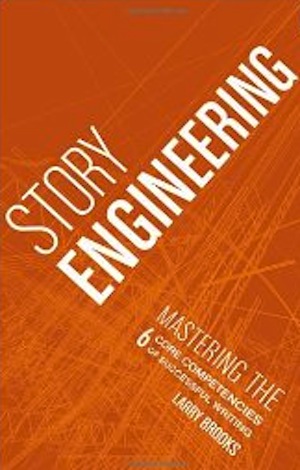
Runners up include Larry Brooks’s Story Engineering and Syd Field’s The Screenwriter’s Problem Solver.

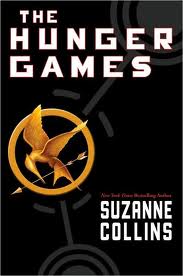
Best fiction: The Hunger Games.  When my Mom read it before I did, I figured I better get around to the dear little thing.  I was pleasantly surprised.  Mind you, Larry Brooks’s 11 part analysis of the book was fantastic too, and made me think that I’d have some substantial writerly lessons to learn from it.

Riding Suzanne Collins’s heals are Hugh Howey’s Wool Omnibus and Juliet Marillier’s Daughter of the Forest, both of which I’m still reading, so I’m not sure, strictly speaking, that they count (!)

Best non-writing, non-fiction book: The Happiness Project, by Gretchin Rubin.  Again, still reading it, but it does speak to the control freak in me 🙂

Best writerly experience: The New York comes to Niagara pitch conference.  Fraught, yes.  Learning experience, double-yes.

Best local arts event: Hands down has to be the Launch of Kim Fahner’s The Narcoleptic Madonna, though Jon Bulter’s The LaCloche spirit: The equivalent light exhibit and Scott Overton’s launch of his novel Dead Air are close seconds.  Nor can I forget the 100 thousand poets for change event in North Bay.  Poetic road trips are the bestest.

Best posts
These have been selected due to the number of all-time views.

  1. Do you dress for success?
  2. The cadre … or should that be cabal?
  3. Feminist lunacy from Battle Chant
  4. Why did I call this category Alchemy Ink?
  5. Eight metaphors for persistence and why you’ll want to read this anyway – my very first post!  Awww … you guys 🙂
  6. Character sketches, part 2: Eoghan
  7. Character sketches, part 3: Dairragh
  8. Rethinking my online strategy
  9. Why spoilers are good for writers
  10. An Interview with Kim Fahner
hAPPY NEW YEAR

hAPPY NEW YEAR (Photo credit: Helgi Halldórsson/Freddi)

I’ll wait until New Years Day to post on resolutions.  So have a happy New Year all, and thanks a bunch for all of your support!

Virtual hugs!

Writerly Goodness.

The Next Big Thing – Initiate of Stone

My friend, Kim Fahner tagged me in this project in which the writer answers questions about their work and then tags other authors to blog their “next big thing” in turn.

So I’m going to victimize tag Scott Overton, who though he’s just published Dead Air, I know has more irons in the fire, Brian Braden, who has a fabulous WIP to share, Tim Reynolds, who’s always working on something fabulous, and Sandra Stewart, who likewise keeps her irons hot (in more ways than one!) 🙂

Onto the Questions:

  • What is the working title of your book?

Initiate of Stone  Bonus: Series title:Ascension, book 1

  • Where did the idea come from for the book?

This is one of the few ideas I’ve had that did not come from a dream.  I just started with an idea of a young woman, forged by elemental forces, who survives war to become the hero the world needs. Everything grew out of that seed of a character and story.

  • What genre does your book fall under?

Epic fantasy.

  • Which actors would you choose to play your characters in a movie rendition?

Actually, I’ve blogged this before, so I’ll take the lazy-a$$ route and simply link the previous character sketches, all of which include my casting suggestions:

Ferathainn

Eoghan

Dairragh

Supporting characters

Villains (muwahahahahaha)

  • What is the one-sentence synopsis of your book?

An uninitiated mage must uncover the secrets her family have kept from her in order to defeat the man who ripped her family, her hope for initiation, and her innocence from her.

  • How long did it take you to write the first draft of your manuscript?

About a year, writing in the evenings and weekends, working full time in the day.

  • Who or what inspired you to write this book?

I’ve always wanted to write novels.  I have lots of ideas.  This just happens to be the first one I chose to work on.

  • What else about your book might pique the reader’s interest?

IoS features a strong female character that doesn’t necessarily find fulfilment with a guy.  There are romantic elements, but Fer’s issues can’t be resolved in the course of this novel.  Thematically, I address the painful legacy of secrets, even those kept in care or kindness; the sometimes twisted relationship between parents and children; the difference between institutionalized religion and spiritual practice (how the one can damage and the other promise healing); and the struggle to realize one’s true potential, whatever it is.

So I hope your interest has been piqued 🙂

Thanks for the opportunity Kim, and if anyone is interested, I’ve blogged about my WIP Writerly Goodnesspretty extensively.  If you’d like, just pick my “Work in progress” category and read away.  I haven’t blogged the novel itself, just the character sketches and world-building behind it.

It’s back to the day job for me tomorrow, so I probably won’t post again until the weekend.  Have a good end-of-the week all!

Writerly Goodness, signing off.

On virtual homework and the reading of books

Dan Blank of We Grow Media

So here we are in week two of We Grow Media’s Build Your Author Platform course.

Week one was about developing focus, and I think I did pretty well.  As I mentioned a few weeks ago in my post about Michael Hyatt’s Life Plan document, I’ve done a lot of thinking about my life and what I want out of it.  It wasn’t difficult for me to put into words my plans for my creative life.

This week, it’s going to be a little more challenging.  I have to figure out my writerly identity and brand.  I know what I’ve said about myself on this blog and elsewhere, but this week’s assignment will have me digging deeper.

I have this morbid image floating about in my head …  See, a garden spade is pretty sharp, and I can imagine that digging into my tender heart and mind being a bit painful.

One benefit is that my name is pretty unique, and since I’ve bought my domain and all my SoMe is in my name, my blog, Twitter, Facebook account, LinkedIn account, etc. appear at the top of the results in most search engines.  And if my blog isn’t up there, then one of my poetry books, NEOVerse is.  So that’s a win.

I’ll have to let you know how the branding exercises go.  I’m not a tooter of my own horn.  It makes me squirm, actually.  Hence the painfully-sharp-spade-phobia.

On introversion

I’m an introvert, though I work in an industry that has me putting myself “out there” as a trainer.  My friend, Brainy (pseudonym) had this to say about introversion on her blog this week:

Other people in my work environment likely see me as fairly extroverted because I am very outspoken and I address individuals and groups quite confidently when sharing the expertise that I have accumulated in recent years.  I do a lot of online coaching and desktop sharing with collaborative technology but it’s usually one-on-one now.  I can only sustain the energy required for the group stuff once in awhile and with considerable advance preparation.

I can relate.

She also recommends Susan Cain’s Quiet: The Power of Introverts in a World that Can’t Stop Talking.  It’s on my reading list.

What else I’ve been reading lately

Last month, I finished Suzanne Collins’s The Hunger Games.  I’d had the trilogy since last year when I saw the movie with a couple of friends who had both read the whole series and loved it.  More recently, I was urged to take the plunge for two more reasons: 1) my mom had just read the series and also loved it, and 2) Larry Brooks’s eleven-part analysis of the first book on his Storyfix blog (more on that in a moment).

I too, loved the book.  Having seen the movie, read Brooks’s analysis, and a few other reviews/articles on the novel, I was well aware of the plot and events of the novel.  But spoilers never spoil a book for me.  When I know the major plot points, I only enjoy the book more.  I read to improve my craft.

Collins’s prose is clean, her POV engaging, and her craft extraordinary.  Damned.  Good.  Book.

Mind you, I think I might be the last person on the face of the earth to read The Hunger Games 🙂

Brooks’s analysis of the book also lead me to read his: Story Engineering.  I did get a lot out of his book, but it was despite the author’s ethos.  Brooks comes on a little strong for my liking, and I truly resent having anyone shake a virtual finger at me.

For more of my thoughts on this writing craft book, please check out my review on Goodreads.

Ethos, for those who may not know, is the author’s personality as it comes through in print.

My undergrad was in rhetoric, so I’m pretty adept at reading past ethos.  It’s a good thing too, because Brooks does have some great information to share and I have already implemented some of his lessons.  I do get it.  I’m just not fond of how Brooks got his message out.

Currently, I’m reading Diana Gabaldon’s The Scottish Prisoner, which I’m enjoying quite a bit (though not as much as the main novels in the Outlander series), and A Medieval Miscellany.

Will let you know how all of that goes.

Right now, Writerly Goodness needs a wee bit of rest.  A new work-day awaits!  Egad …

Three great books on self-editing

(A.K.A. more writing-book porn!)

Since I started serious writing practice and got down to the business of trying to turn my idea into a publishable work, self-editing has been an obsession of mine.  I started out with a good grounding (2 degrees in English), but soon learned that there is always room for improvement.  Always and forever.

When the publishing boom of the 80s and early 90s changed directions, agents and editors state one principle requirement: write a damn good book, and write it well.

Here are, in no particular order, three books that have helped me immensely.  Just ask my Author Salon critique group, I am the queen of nitery-pickery (I’m not sure why I choose to write it like that, but I suspect it might have to do with the character of Rockery Hud-Peck from The Fintstonesthat’s just how my brain rolls).

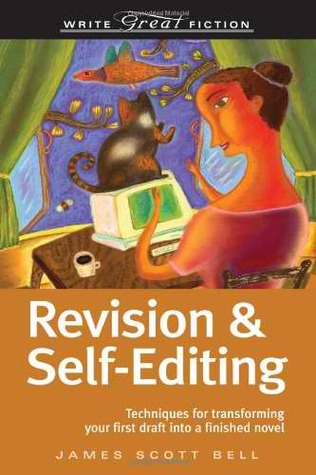
1. Revision & Self-Editing: Techniques for transforming your first draft into a finished novel by James Scott Bell (The Write Great Fictions Series, Writer’s Digest Books, Cincinnati, OH, 2008).

Bell divides his book between self-editing and revision, which he states are two separate processes.  They are 🙂

In his introduction, he references Browne and King’s Self-editing for Fiction Writers: How to edit yourself into print, another of my selections (see below), as well as a slew of writing gurus ranging from Brenda Ueland to Natalie Goldberg and Ray Bradbury.

Bell begins each section by presenting his philosophy of the task, then proceeds through self-editing with various chapters on each aspect of the work (character, plot, POV, etc.), asking probing questions along the way to get the writer deeper into their novel, and offering exercises to assist with the understanding of the element at hand as well as its relevance in self-editing.

When he gets to revision, it’s more about process than elements and analysis, but Bell is equally insightful in his discussion.

Bell is a skilled author and editor.  He writes from his experience in self-editing.  This perspective is what sets my first pick apart from the others.

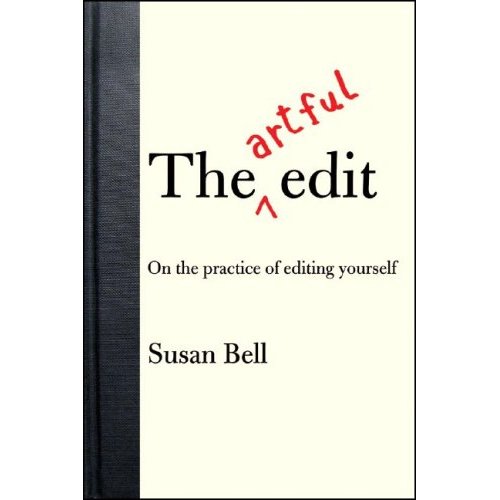
2. The artful edit: On the practice of editing yourself by Susan Bell (Norton, New York, 2007).

Susan Bell is a veteran editor and author, but her authority and perspective derive from the former role.

She breaks the self-editing task into Macro and Micro phases, again, providing examples, checklists, and exercises to deepen understanding. Then Bell offers what she calls her Master Class, provided in the form of experts in different creative fields (photographer, film, etc.) and what each can teach writers about how to make their story come alive.

Finally, she provides an overview of the evolution of editing, fascinating in itself.

Bell applies investigative zeal to her book, and it offers unique insight into the world or authors and editors, their relationships, where one begins and the other ends, and what the writer can do to become both.

3. Self-editing for Fiction Writers: How to edit yourself into print by Renni Browne and Dave King (Second Edition, William Morrow, New York, 2004).

First published in 1994 by HarperCollins, Self-editing for Fiction Writers is seen by many as one of the definitive works on the subject.

As with the James Scott Bell’s book, Browne and King’s breaks the task of self editing into its elements (characterization, dialogue, voice, etc.) devoting a chapter to each with examples and exercises.

One thing that I appreciate is the first chapter: Show and Tell (emphasis mine).  The point is made, and I fully agree, that while the writer should endeavour to show, that there are some places in your novel where telling is not only appropriate, but necessary.  It is the skilled writer who knows the difference and knows what technique should go where.

I also enjoyed the collaborative tone of the book.  When the authority is identified by “we” and not “I,” something rhetorical and clever happens: readers begin to feel that they are a part of the illustrious editorial team that wrote this book.

It’s an inclusive way of writing that empowers reading-writers to believe in their ability to self-edit.  The doors of the country club have opened, my friends, and we have all been invited in for drinks 🙂

The Wordsmith Studio Goodreads group is currently reading this book and it’s been a wonderful opportunity for me to get reacquainted with some old friends.

I recommend all three books highly (not to show favouritism or anything).

Do you have any books on self-editing that you would recommend?  Share their titles and maybe a few choice words of review in the comments so everyone can benefit from your experience 🙂

Writerly Goodness is calling it a night.

Some of my favourite books on the craft

Several months ago, I read a post called “Confessions of a Craft Book Junkie.”  I had no choice but to comment, because reading books on the craft of writing is an addiction for me.  I’m always buying more!

I have no idea what brought this issue up for me again, but having thought of it, I’ve decided to share some of my favourite craft books with you, and may you reap their myriad benefits! I don’t care if you get them as ebooks, or from a used book shop.  Just get ‘em 🙂

In the beginning …

There was Natalie GoldbergWriting Down the Bones and Wild Mind were the first two books I read about writing, and they’ve stuck with me through the years.  Goldberg espouses a philosophy of “first thoughts.”  Writing in your journal first thing when you wake up.  Sound like morning pages to you?

Goldberg introduced me to free-writing, and weaves in wonderful exercises for journal writing with Buddhist philosophy.  Monkey mind and wild mind is a concept I come back to again and again.  Monkey mind is the nattering, distracted place in our heads we occupy most of the time. 

Wild mind … well, draw as big a circle as you can on a piece of paper.  Put a wee speck of a dot in the middle of it.  The dot is monkey mind.  The rest of the circle—you guessed it—that’s wild mind, the cosmic consciousness that will endow your writing with greatness.

The key is to let go.  Don’t worry.  Don’t pin all your hopes on the greatness you might achieve.  Just be in the moment and do it.

Word after word

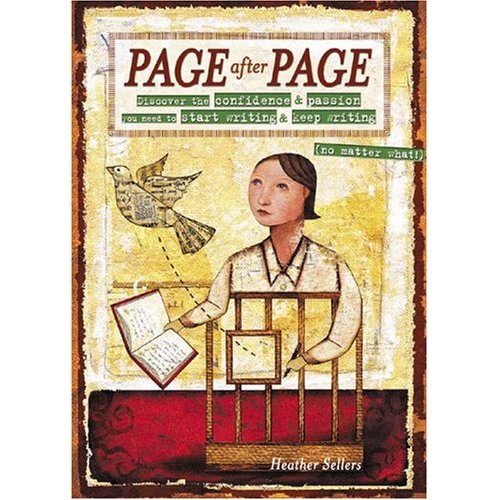
Heather Sellers two books: Page After Page and Chapter After Chapter really changed my writing game.  It was time for some tough love, and Sellers delivered.  She was the first author I read who asked the question: do you want to be a writer, or are you a writer?  She made the distinction very clear.

Wanting to be a writer means that you’re letting things get in the way, making excuses, because the phrase is always followed by the word “but.”

If you are a writer, you write.  You write every day.  You’re dedicated to your craft and you don’t let excuses get in the way.

Sellers also writes about her struggles, how the disapproval of peers and professors affected her, how relationships, good and bad, can influence your work, and how serious life incidents like car crashes and disease can change things forever.

In the end, you can only keep writing, word after word, page after page, and chapter after chapter 🙂

The Maass Oeuvre

Donald Maass is an industry expert and he turned his expertise into several wonderful books.

His first, The Career Novelist, delved into the changing face of the publishing industry.  No longer the land of monster advances, runaway auctions, and multi-book contracts, Maass discussed the kinds of writers, the kinds of agents, the kinds of editors, and publishers that were emerging, how they might survive the new era, and he offered a lot of practical advice about the mathematics of publishing (what do the numbers mean and why should I care?).

In the current market, this book has lost some of its relevance, but I would argue that it is still an important read.  Understanding the changes that led to the current state of publishing offers the reading writer insight.  Learning from history, we hope not to repeat it.

Writing the Breakout Novel gets more into the mechanics of how to write a damn good novel.  Using his personal experience and that of some of his well-known clients, Maass explains what agents and publishers are looking for, and gives the reader tools to achieve their goals.

The Fire in Fiction is more of the same, but deeper.  Maass really asks the writer to dig deep in this one and offers exercises to deepen your understanding of exactly what it is you’re doing.  Analysis.  Critical thinking.  If you’re willing to work for it, Maass tells you how to write a novel that will WOW.

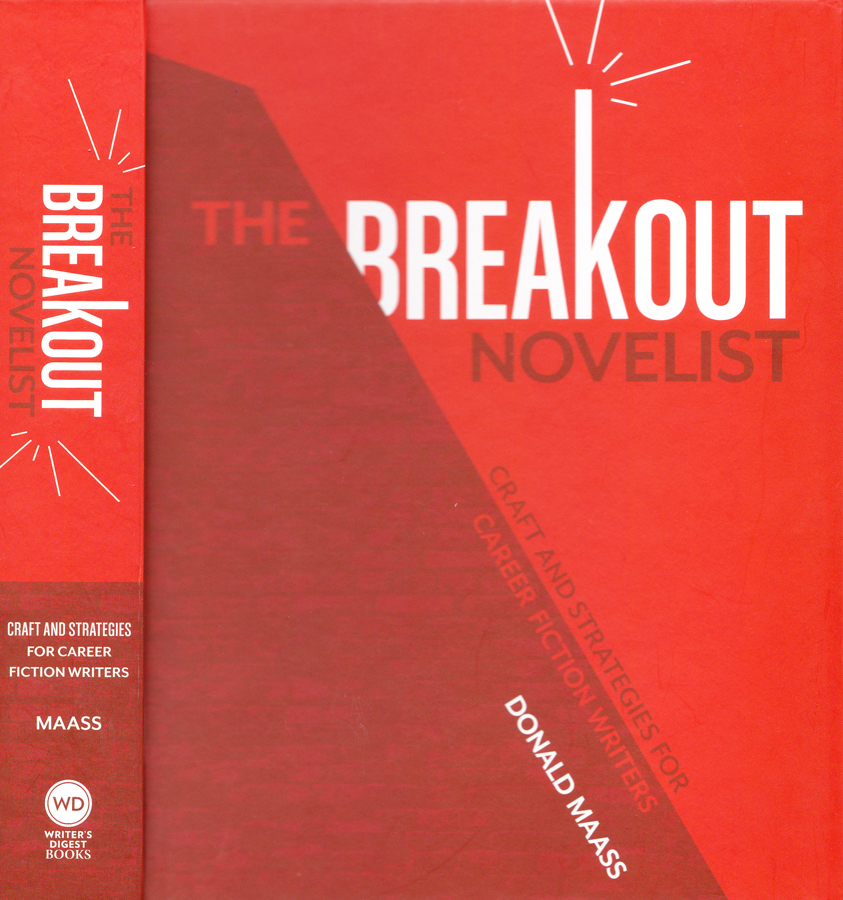
Finally, The Breakout Novelist, Maass’s most recent publication, is more of a workbook and reference than some of his other books.  It combines the best of Writing the Breakout Novel and The Fire in Fiction with extra exercises.  If you’re having trouble with a particular aspect of your novel, flip to that section and start working through the exercises.

Obviously, I’m a fan.

I’ll have more of these coming in future months.  I just thought I’d start with what I think are the best of the best 🙂

What are some of the craft books that you value and why?  How did they speak to you?  And as always, like, comment, share, subscribe!

Dream a little dream … and go from there

I was going to write something about where I get my ideas from because a lot of people out there have done that recently, but it really depends on where I am, what I’m doing, and what the idea ends up becoming. So I think I’ll focus on one of the best places I get my ideas: my dreams.

When I was a kid, I had very vivid dreams. The earliest I can remember, occurred after I had my tonsils out. Actually, it occurred after my stitches ripped open and I was rushed back to the hospital for emergency surgery.

In the wake of that experience, I had a dream in which I actually died in the process of that surgery, but I still woke up the next morning.  Only, in the world I woke up in, I dreamed of this one.  It’s hard to explain.  Essentially, I dreamed that this world was nothing but the dream of my sleeping self in another world.

Pretty multidimensional/existential for a four-year-old, eh?

I had insomnia, the kind where you wake up in the middle of the night and can’t get back to sleep.  I’d lay there and rehearse my dreams, or tell myself stories until I eventually got back to slumber town.

When I dreamed of falling, I woke up several inches off the bed.  What I know of dreams now tells me that the sensation of falling in the dream was so intense I felt that I was still falling when I woke.  I wasn’t actually levitating 🙂

A visit to a Christian book store led to me reading a comic book about an African missionary.  The barbarism with which the artist depicted the rituals of the native tribesmen made such an impact on me that I dreamed of the scar-faced man, had nightmares about him really.  You know the ones, where there’s a man standing at the foot of your bed, staring at you?

I often had out of body experiences (OBEs) when falling asleep, or waking.  I remember these distinctly.  I was like a balloon, tethered, but being flung around (or was I trying to escape?).  That’s how my young mind interpreted it, but when I later delved into meditation and eastern spirituality, I realized that this is classic OBE.

I didn’t keep a dream journal then, but many of my childhood dreams and nightmares have stayed with me nonetheless.  I often dreamed of being abandoned: driving in a van with my family and then one by one, everybody but me disappeared, and I was too small to drive the van (couldn’t reach the pedals).  Stuff like that.

I actually dreamed in story sometimes.  Full, 3-act drama.  If my dreams stayed with me long enough, I wrote them down, but often the delay meant I lost critical pieces.  I’d tell my dreams to my friend Margaret at recess as a way to keep some of them alive.

I started to record my dreams (among other things) when I went away to university for the first time.  I have a number of story ideas that have emerged from those journals.

In university, my room mate, Sandra, enlightened me regarding another aspect of my nocturnal life.  I talked in my sleep, and often sat up and did things as well.  Once, she reported that I sat up in bed, said, “It’s really not that bad … ,” reached around to open the closet door (right beside my bed), looked frowning into the mirror on the door, looked at her, then closed the door, and went back to sleep.

I had night terrors too.  Once I dreamed that something (what I can’t remember) was escaping from me.  I reached up to snatch it back, and when I woke up, I’d torn down a mobile that was hanging in the window.  I dreamed of insects (or other things) crawling on me, or of not being able to find something important.

The first time I went to camp (Southerners read cottage) with my boyfriend (now husband), I sat up and started searching the bed frantically for something.  I kept saying, “I can’t find it.  Help me find it.”  That kind of freaked Phil out, but it wasn’t the most bizarre thing I did while I was sleeping.

When we were living in Married Students’ Residence at Laurentian University, we had a 1-bedroom apartment.  In the middle of January, I got up in the middle of the night and opened all the windows. Phil woke up at 4 am shivering, realized what I’d done, and rushed to close the windows before the radiators burst.  It was a very cold night.  I had no memory of doing that.

One of my favourite courses was one regarding the Surrealists (writers primarily, but artists to a lesser extent).  I really fell in love with the way the surrealists let loose with their subconscious and tried to capture the world of dream on the page.
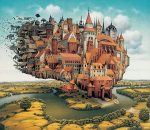
Since I started working full time and sorted out my depression (that’s another story), my dream life has been less vivid.  I dream more of stress and work-related issues (repetitive loops of action) or of terrible things happening to me or someone that I love.  I still have insomnia, but it’s more troublesome because I can’t afford to sleep in to catch up, and I don’t like what sleeping pills do to me …

I’ve started reading before I go to bed and have noticed I’m having more creative dreams.

I don’t necessarily want to start sleepwalking, having night terrors, or fall into depression again, but it would be nice to have the old story-dreams back again.  I’ll let you know how it goes.

An interesting book about writers and their dreams:

A selection of dream/depression/creativity links:

A dreamy soundtrack:

  • California Dreamin’ – The Mamas and the Papas, 1966
  • Dream a Little Dream – Mama Cass, 1968
  • Dreamboat Annie – Heart, 1976
  • Dream On – Aerosmith, 1976
  • Dreams – Fleetwood Mac, 1977
  • Dreaming – Blondie, 1979
  • Sweet Dreams – Eurythmics, 1983
  • These Dreams – Heart, 1986
  • Don’t Dream it’s Over – Crowded House, 1987

There are hundreds more, but these are my favourites 🙂

How have your dreams influenced you as a creative person?  Have your dreams/sleeping habits  changed over the years?  How has that affected your writing?

Why did I call this category Alchemy Ink?

I thought it was about time I answered this question.

I was reminded that I hadn’t addressed the issue yet when I read Martina Boone’s guest post on DIYMFA yesterday.  Martina writes:

Writing fiction is alchemy. We can have all the ingredients for a great story and still miss that wow factor that makes it all come together, makes our work transform from words on a page to a living, breathing entity with the possibility to burrow into someone else’s consciousness.

I’ve always thought of writing as a kind of alchemy, a kind of magic.  This might be

My only souvenir of Siobhan’s art is this book cover.

because I write epic fantasy.  Or it might be because when I started reading for pleasure, I started with C.S. Lewis, Lloyd Alexander, and Madeline L’Engle.  It could even be my inspiration for writing: the wonderful artwork of Siobhan Riddell.  When I was in grade three, she and her grade five classmates wrote and illustrated their own storybooks.  Siobhan’s was of a knight fighting a dragon.  Classic fairy tale.

And I was hooked.

I wanted to write something, even then, that made people feel the way Siobhan’s storybook made me feel.  That was the kind of magic I wanted.

Much later, I tried out a few of writers’ groups.  One was composed of friends from university: Kim Fahner, Steven Lendt, and Dan McCormick.  I actually proposed the name “Alchemy Ink” to them.  No one seemed particularly keen.

The next was a group of women brought together around the fabulous Si Tranksen.  That group published Battle Chant in 1999 and included Paulette Dahl, Violet Brenner, Louise Lane, Carole Trepanier, and, though she departed before the book project came together, Sonny B.

After that, another group of women writers, including the fae folkstress Dolores Dagenais, Gypsy, and fellow Sudbury Writers’ Guild members, Irene Golas, Margaret Lavoie, and Sue Scherzinger met irregularly to engage in creative stuff.  We didn’t only share our writing, but did cool things like playing with clay.

When the chemistry is right, a writers’ group can be magical.  I’m going to use some of my dreadful learning lingo here, but synergies can develop between the writers, and the creative energy so generated tends to fuel the creative self in wild ways.  Some of my best writing/most productive periods were inspired while I was in writing groups.

This is why I’ve called this category Alchemy Ink.  It’s a kind of substitute for the old writing groups.  Magical things can happen when you share …

But getting back to the writing of fiction, transforming what is in my head and heart onto writing on the page is pure alchemy.  I struggle to create gold, but what I might have is a means to immortality, the other goal of alchemy.  My words, if they’re good enough, will have a life outside of mine.  With luck and diligence, they may outlast me 🙂

Martina goes on to write that she is not a pantser (like me).  For her, the magic happens between the characters, in the backstory, in the execution.  She uses plotting and structure to “make room” for the more magical aspects of her art.

The last word belongs to Martina:

Chances are, that’s the part of storytelling we fell in love with in the first place.

Why did you fall in love with the alchemy of storytelling?  Where does the magic happen for you?

Do you dress for success?

If you’ve been reading Writerly Goodness for any length of time, then you’ll know that I’m fascinated by process, my own and others’.  I love to find out how other creative people do what they do, their sets of rules and their arcane rituals.  On Facebook, I often share the tips and tricks I find on my blogly ramblings, and secretly, I take a certain perverse pleasure in how many of those rules I break, and how many guidelines I defy.

Writerly Goodness aspires to the transgressive, but only rarely does she manage the faithful leap such actions require.

In May of 2011, I attended the Canadian Authors Association’s CanWrite! Conference.  Workshop host Barbara Kyle offered many writing tips, but the one that stays in my mind is this: dress for success.

Why?  I suppose it’s because I don’t, but more on that in a bit.

Barbara stated that when she got up in the morning, she was always careful to dress appropriately, as if for work: business casual.  She said that this practice honoured her work and her as its creator.  Dressing for work meant that she was serious about her writing, that she wasn’t taking anything for granted, and that she wasn’t going to waste anyone’s time, not hers, not her readers’, and certainly not her agent’s, editor’s, or publisher’s.

I agree that one should dress appropriately for one’s work, but to me, that depends entirely on what your work and life is like.  Let me ‘splain …

Writing is Barbara’s second career, after a successful first career as an actress.  She stopped acting to become an author and made the decision to write full time.  The temptation for someone in that position would be to become part of the pyjama patrol, roll out of bed, and stumble to the computer.  Barbara worked hard at her first career and knew the value of discipline, however; she knew that the slovenly writer’s life was not for her.

I don’t have that luxury.  I have to work and I have to dress appropriately for work.  When I get home of an evening, it’s actually part of my ritual to dress down for my writing.  Phil and I call this transforming into ‘comfort woman’ 🙂

I need to shed one professional self to become another, and my professional writer wants to be comfortable.

Right now, I’m in my shortie penguin pj’s, and damn, do I feel good!  You might have the urge to equate me to Michael Douglas’s character in Wonder Boys who wore the same bedraggled housecoat to write in every day … and discovered he was hideously blocked!  That would be a mistake.

I have a reason to dress as I do when I write.  That in no way means that I am any less diligent or devoted to my craft.  It simply means that my definition of appropriate dress is different.  So I’m comfortable saying that I still dress for success.

Process is different for every writer.  That’s why I find it so fascinating.

What about you?  How do you dress for success?  What does that mean for you?