The Writing Excuses Retreat, part 2

Copenhagen and day at sea

In this instalment, I’m covering days two and three of the Writing Excuses Retreat (WXR) Baltic cruise.

On day two, I was up fairly early, mostly because I hadn’t yet fully adjusted to the time change. Then again, daylight savings messes me up twice a year and the two times I travelled west, I never adjusted to the time change at all. I just got by on a sleep deficit for the week I was in Vancouver and Calgary, respectively.

It was a good thing, though. Day two was our day in Copenhagen and I had a tour to catch.

We went straight to the Little Mermaid. The Little Mermaid has always been one of my favourite Hans Christian Andersen fairy tales. This is probably due to the 1975 animated version narrated by Richard Chamberlain. It was faithful to the tale Andersen popularized, including the attempted murder of the Prince and suicide of the heroine.

LittleMermaid

Of course, I know it’s a terribly misogynist tale that entrenches some vile stereotypes of feminine agency, or the lack thereof. But it’s still one of my favourites.

Fountain

We then stopped at the Fountain of Gefion, the goddess who created Denmark. The Swedish king Gylfi promised her all the land she could plough in a night. She turned her four sons into oxen and the land she ploughed was thrown into the sea to become Denmark. Next to the fountain was the oldest Anglican Church in Denmark.
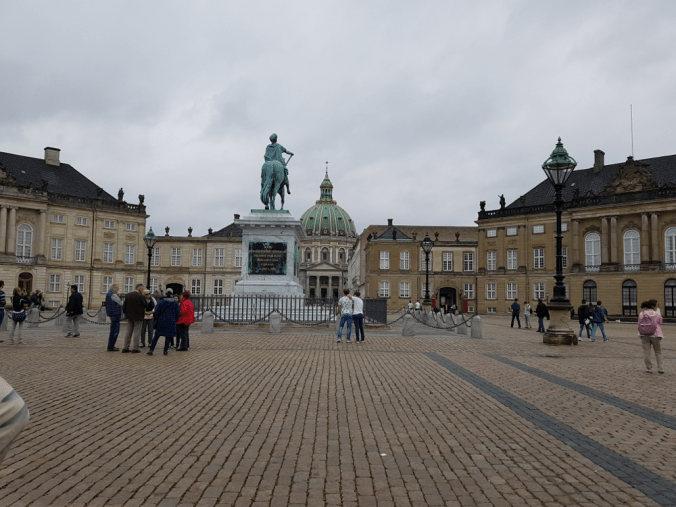
Christianborg

From there, we visited the Christianborg Palace courtyard (our tour did not go inside) and saw the opera house, the canal, and the new incinerator. Our tour guide proudly pointed out that Copenhagen imported garbage to incinerate from all over the EU and that 100% of private residences ran on renewable energy.

canal

Interestingly, the new incinerating facility was built like a mountain and the plan is to have a ski hill on its slope. Denmark is a flat land and citizens have to travel elsewhere to ski.

Next, we toured the royal reception hall. Though once the place of all royal business, the hall is now only used to entertain visiting dignitaries.

Some intriguing facts about Queen Margrethe: she’s an artist. Under a pseudonym, she illustrated an edition of Tolkien’s Lord of the Rings. She designed one of the carpets in the reception hall. For her 50th birthday in 1990, the queen was presented with 17 surrealist tapestries depicting the history of Denmark.
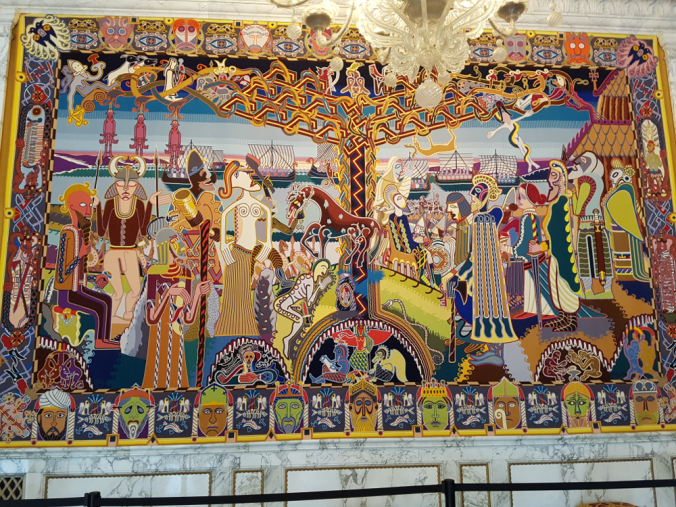
Tapestry

My picture does not do the tapestries justice. They were breathtaking. My favourite room in the reception hall.

Well, I was rather fond of the library, too.

library

The history of the Danish kings (either Christian or Frederick) reads like Game of Thrones. Our tour guide intimated that George R.R. Martin drew inspiration for some aspects of Westeros from Danish history.

The tour returned to the Fantasia just after noon and I had time to grab lunch before John Berlyne’s presentation on the purpose of an agent.

JohnBerlyne

Then, Aliette de Bodard presented Worldbuilding in the Smallest Parts and it was time for dinner.

That night, I was seated with other attendees, but our table was short one. At the table next to us, one lone participant sat. We asked him over, but he was waiting for his spouse, so two of our table went to join him, instead. And it wasn’t too long before another table of two was asked to join us. Yes, it was musical chairs night, but it was one of the best evening meals I had with the two Sarahs and the two Laurens 🙂

Unfortunately, that was also the night my throat got sore, heralding the cold that was to become known as Cruise Crud. I’m still clearing out the trachea, three weeks later … at the time, I thought it was just the wine and the continual gales of laughter.

That night, we once more passed under the Øresund bridge, but I didn’t get another picture.

On day three, we crossed the Baltic heading toward Stockholm, Sweden.

I just want to digress for a moment. I’d never been on a ship the size of the Fantasia before. Sure, I spent many summers on my uncle’s houseboat. Yes, I’ve been on ferries like the Toronto Island ferry and the Chi-cheemaun. I was fairly confident that I wouldn’t be sea sick, but I had no clue.

The truth is, I barely felt the ship’s movement. When we departed or approached a pier, yes. The ship had to employ engines on the sides of the ship. There’s not enough pier to glide in like a smaller ship might. So the ship moves parallel and sidles up. That’s when you feel the chop.

So I’m happy to say my constitution did not let me down. In that respect, anyway.

I got to sleep in a bit on day three. Not that I actually did, but I didn’t really have anything to get up early for. Every morning, the instructors gathered for office hours, but I didn’t have any specific questions to ply them with … yet.

After the breakfast buffet, I headed down to the breakout session. I was group cake, but I’d signed up for the lightning readings in the afternoon and attended Mary Robinette Kowal’s foreshortened How to Present workshop which was squeezed in at the beginning of the breakout session.

MaryRobinetteKowal

Then, I hung out until my one-on-one with Tempest, which was scheduled in the middle of the breakout session. Day three was my first real opportunity to do any writing and the first day I felt like my body had adjusted to being seven hours in the past 😉 I lugged my laptop around with me so I could use what opportunities I could.

WesleyChu

Back to the buffet for lunch, and then it was time for Wesley Chu’s Deep Dive into Action presentation, which was followed by the lightning readings, at which I believe I acquitted myself well.

Afterward, Margaret commented that she wanted to read the novel when it came out. I think I blushed. The reading was from a short story, but I guess that’s just more confirmation that my story ideas tend toward novel-length projects.

There were a lot of interesting pieces and I’m looking forward to reading some of the resulting projects, whether story or novel, as well 🙂

Day three was the evening of the costume contest. I didn’t have room to pack one, but there were some very clever costumes. Ann Tagonist and Professor Tagonist had the pages of a book incorporated into their costumes. One young man was the Excuses Monster, onto which people were invited to write their writing excuses on Post-its and stick them to his cape.

There were a number of flappers and a number of Regency costumes. Waldo and Carmen Santiago made an appearance, as did Nanny Og.
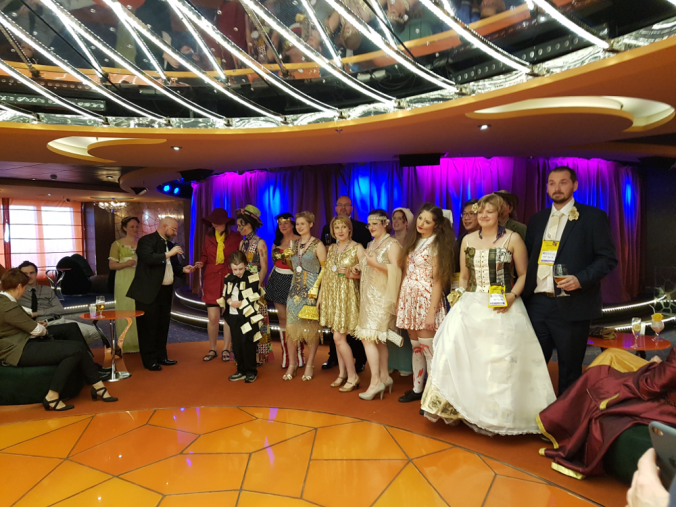
masquerade

That night, I sat at Mary’s table at supper. It was another night of fascinating conversation at which I got to regale the group about my malignant hyperthermia (Google it).

The Cruise Crud was blossoming, so I once again called it a night after supper.

And that’s where I’m going to pause in my tale.

Next weekend, we enter a new month and it will be time for my Next chapter update.

I’ll pick up with our arrival in Stockholm on the weekend of the 9th.

Until my next blog, be well, be kind, and stay strong, my friends 🙂
Tipsday: Writerly Goodness found on the interwebz, June 11-17, 2017

A smaller trove from the Tipsday vault this week.

Jane Friedman coaches you on how to immediately improve your query letter’s effectiveness.

K.M. Weiland shares five ways to write a (nearly) perfect first draft (and why you should try). Helping Writers Become Authors

Later in the week, Kate shows you how to use the Myers-Briggs Type Indicator to improve your characters.

Piper Bayard discusses the art of physical surveillance. Writers in the Storm

Emily Wenstrom answers the question, can Facebook ads really boost your author platform? DIY MFA

Oh yeah. It’s me. Talking about time travel. DIY MFA

And so I had to cram this in here: Natalie Zutter wonders, is time travel is science fiction or fantasy? 🙂 Tor.com

Gabriela Pereira interviews DIY MFA columnist and romance author Robin Lovett for her podcast. Now I have an earworm … Let’s talk about sexy, baby / let’s talk about you and me … 😀

Becca Puglisi demystifies worldbuilding. Writers Helping Writers

Remember that post I shared a couple of weeks ago that Foz Meadows took exception to? Yeah, well Janice Hardy takes on the topic, too: why you shouldn’t write every day. Janice makes some points that I seriously considering. I do work a day job and I regularly face burnout because I write like a maniac when I’m not working. Food for thought. Fiction University

Oren Ashkenazi lists five tropes that make a villain look incompetent (and how to avoid them). Mythcreants

Jenna Moreci: how to choose an editor.


Joanna Penn interviews Dan Blank on changes in the publishing industry and launching non-fiction books. The Creative Penn

Claire Light reviews WisCon, the world’s preeminent feminist speculative fiction convention. Literary Hub

Foxy Folklorist, Jeana Jorgensen, explains why the translation of the fairy tale collection you read matters. Patheos

And that, my friends, was you informal writerly learnings for the week 🙂

Come back for some thoughty on Thursday, and in the meantime, be well.

tipsday2016

Tipsday: Writerly Goodness found on the interwebz, May 21-27, 2017

Another week of informal writerly learnings? Get set to open your goodie bag 🙂

K.M. Weiland debunks five misconceptions about writing. Helping Writers Become Authors

Later in the week, Kate posits that great comedy is meaningful, and shares four tips to help you make it so.

Kathryn Craft reviews the decade in publishing. Writers in the Storm

Kimberly Brock says, you’re writers, not waiters. Writers in the Storm

Jane Friedman advises on how much you should personalize a query letter.

Elizabeth Huergo pays tribute to C.D. Wright: songs and their landscapes. Writer Unboxed

Heather Webb teaches a survey course in time management: writing through our busy lives. Writer Unboxed

Dan Blank says, if you want to be successful, surround yourself with success. Writer Unboxed

Jamie Raintree: let your writing process be your own (and how to discover it).

Bonnie Randall gets into character minutiae and seemingly irrelevant details. Fiction University

Stacy B. Woodson shares her fantastic experience at Malice Domestic 2017. DIY MFA

Jami Gold challenges us to deal with character stereotypes.

Kristen Lamb reveals how shame is at the heart of good fiction.

Will Hindmarch explains how to give great notes a writer can use. Magic Circles

Nina Munteanu gives you the tools you need to make a believable world.

Writer and geologist Alex Acks examines Arakkis, Tatooine, and the science of desert planets. Worldbuilding advice from Tor.com.

Jo Walton looks at genre fiction’s obsession with Belisarius, with a lovely recommendation for Guy Gavriel Kay’s Sarantium novels. Tor.com

Darlene Naponse is a Reveal – Indigenous art award Laureate.

Emily Temple curates some pearls of wisdom—on writing and life—from Jamaica Kincaid in honour of her 68th birthday. Literary Hub

These are old human themes: Margaret Atwood on the enduring power of The Handmaid’s Tale. CBC

James Whitbrook watches the new Game of Thrones trailer. i09

I hope you’re having a lovely week.

Be well until next I blog 🙂

tipsday2016

Tipsday: Writerly Goodness found on the interwebz, March 12-18, 2017

This week is filled with informal writerly learnings 🙂

K.M. Weiland shares five rules that will help you write a sequel. Helping Writers Become Authors

Becca Puglisi adds another entry to the character motivation thesaurus: pursuing justice for oneself or others. Writers Helping Writers

Jami Gold returns to the Writers Helping Writers coaches corner: what does it mean to raise the stakes?

Jami follows up on her own blog with three steps that raise your story’s stakes. And later in the week, she posts about balancing rules and voice.

Lisa Cron offers some ways pantsers can use the Story Genius method. Writers in the Storm

David Corbett: emotion vs. feeling. Writer Unboxed

Annie Neugebauer suggests changing up your reading patterns to gain more. Writer Unboxed

Dan Blank shares some great social media tips for writers on The Creative Penn.

Sara Letourneau continues her developing themes in your stories with part 9: the midpoint. DIY MFA

Stacy Woodson looks at mysteries, thrillers, and suspense: does the label matter? DIY MFA

Gabriela Pereira interviews Ben Blatt for DIY MFA radio.

Rachael Stephens shares her new favourite plotting method: Dan Harmon’s Plot Embryo.


Dimitra Fimi: inventing a whole language. The Times Literary Supplement

Chris Winkle lists five worldbuilding mistakes to avoid. Mythcreants

Jenna Ireland: racism in a fantasy landscape.

Kobo interviews Margaret Atwood on woman-crushes, feminism, and advice for her younger self. Medium

In the wake of his passing, Richard Wagamese: what it means to be Ojibway. Anishnabek News

Michael Moorcock: what is the new weird and why is weird fiction so relevant to our times? The New Statesman

What “White Rabbit” really meant (with an awesome, vocal-only track). Dangerous Minds

Wil Jones thinks this literary map of the world is simply brilliant. The Indy 100

Cracked lists 21 movie lines nobody actually says. Several commenters have refuted this, but they say these things because they’re said in movies …

Elodie shares one-sentence summations of every literary genre. Sparklife

Angela Watercutter presents the “Jane Test,” a new way to tell if your scripts are sexist. Wired

Patricia Cornwell unmasks “Jack the Ripper.” Tom Bryant for The Mirror.

Beth Elderkin shares the new Wonder Woman trailer: how the girl became the legend. i09

Katharine Trendacosta shows us the latest American Gods trailer. i09

And, phew. We’re done.

Come back on Thursday for some thoughty.

And, in the meantime, be well.

tipsday2016

WorldCon 2016: The art of worldbuilding

Disclaimer: I am not perfect and neither are my notes. If you notice anything that requires clarification or correction, please email me at melanie (dot) marttila (at) gmail (dot) com and I will fix things post-hasty.

Panellists: Peter Tieryas, Carrie Patel, Luke Peterson (moderator), Amanda Downum, Greg Bear

Worldbuilding

Joined in progress …

GB: Edgar Rice Burroughs was the first worldbuilder. He delved into culture and economics. Read Olaf Stapledon’s Star Maker.

LP: Where do you start?

AD: Use the character as the starting point. Develop the city, country, and world around them. Move outward to weather and so forth.

CP: Ask, what does the society value most and what does it fear the most?

PT: If you see a movie with a good story but bad effects, it’s ok. A movie with good effects but a bad story is just bad.

GB: I work from the top down. Sometimes a complete vision of the world will take years to form.

LP: How much do you need to know?

GB: I’m an English major.

CP: You don’t need to tell your readers everything. What’s important to the story you’re telling?

AD: Have a friend ask random questions and build your world or research based on that.

PT: sometimes the best research is done by people who have no expertise.

AD: Find someone who doesn’t read your genre. That’s the acid test.

LP: How do you set your limits? When do you stop?

AD: It’s hard to tell. When you’re drafting, it’s okay to leave some things undefined for later. Get the bones of the story down first.

CP: You might have to dive back in, mid-draft, if you write yourself into a situation only worldbuilding can get you out of.

PT: Hitler exempted artists, and later scientists, from war. It was dark material I had to research for my book. I didn’t want to continue, but I needed to get a grip on the story.

CP: Does the research or detail of the world tell the reader something about the character or the plot? If not, it shouldn’t be in there.

And that was time.

Next week, we move from worldbuilding to alienbuilding 🙂

Be well until then, my writerly friends, and work to make your dreams come true.

WorldCon 2016: Beyond—fantasy creation for the bold

Disclaimer: I am not perfect and neither are my notes. If you notice anything that requires clarification or correction, please email me at melanie (dot) marttila (at) gmail (dot) com and I will fix things post-hasty.

Panellists: Kate Elliot and Ken Liu

kateelliottkenliu

My apologies for the picture, Kate. this was actually the better of the two I took 😦

Joined in progress …

KE: People who live in the tropics tend to have darker skin. Those in northern countries are pale. It’s a specific adaptation to their environment.

KL: My book is not an Asian epic fantasy. It’s a reinterpretation of the Han Dynasty. I defined what it means to be Chinese in my world and purposefully varied the appearance of my characters. What does it mean to be a Han Chinese? Ultimately culture is how they define themselves, not by appearance. That’s [definition by appearance] a western-centric notion.

KE: The Mali from my spiritwalker series has eight or nine ethnic groups. They identify by where they live. Ethnicity is fluid. As writers, we have to think about our choices.

KL: The shape of the eye is not a defining feature.

KE: In any culture, you’re going to have sub-cultures develop. A static culture is a dead culture. Every empire is made up of many ethnicities interacting with the dynamics of assimilation, resistance, centre/periphery. These are character and plot dynamics.

KL: Cultural change is good for building a plot. All cultures are not equal. People adapt differently to their circumstances. Build a richer world. Show the dominant culture being challenged by another.

KE: Writers bring their ideas of what cultural changes matter. The Silk Road wasn’t an actual road. It was a chain of stops on a trade route.

KL: Transformative ideas are themselves transformed in the process of their transmission from culture to culture. Christianity in South America is different than the European tradition. Buddhism is different in India, Tibet, China, Japan, and Korea. Religion interacts with political power.

KE: The way they infiltrate through social strata is also different. Ptolemaic Egypt was actually more influenced by Macedonia and Greece. The native Egyptians were marginalized and had their own traditions. One of the best ways to research a historical time period is through art history.

KL: “We have not changed” is a common cultural narrative. Why do they need to insist on that cultural story?

KE: The centre of an empire will have one narrative and peripheral societies will have other narratives unique to them. Look at the Aztecs. The conquerors write history. Find stories on the peripheries.

KL: When writing an epic fantasy based on an historical culture, respect the intellect of the people of the past. The Ancient Romans were as cynical as we are.

KE: People don’t believe the same things in the same ways.

KL: The western bias is that cultures that lacked science must have been stupid.

KE: The history of technology is fascinating. Look at the geographical impact. Where do they live? Whether the society was coastal or land-locked makes a difference in what might otherwise be common myths and legends, like flood stories.

KL: Consider you narrative space and language as a part of worldbuilding. There are two layers of understanding, the linguistic, and the folk/colloquial. Power and self-image are parts of contextual identity.

KE: Language sticks around like an artefact. European place names that were derived from the Celtic tribes remained even though the culture was marginalized.

And that was time.

Next week: We’ll delve into class and equality in fantasy and science fiction for my final WorldCon report of the year. I’ll continue them in January, after my next chapter update for December and my year-end wrap up. And of course, Tipsday and Thoughty Thursday will continue 🙂

Hope you’re enjoying time with your family and friends, whatever holiday you celebrate.

Be well!

Tipsday: Writerly Goodness found on the interwebz, September 6-12, 2015

May I present your Writerly Goodness for the week:

K.M. Weiland continues her most common writing mistakes series with part 44: too many participle phrases.

Katie encourages writers to let Toy Story show you the key to subtle character development.

Vaughan Roycroft has series aspirations and looks at Robin Hobbs’ Assassin series in this post: Drawn to the long arc.

Porter Anderson refers to Roz Morris and Joanna Penn’s posts in this piece for Writer Unboxed: Looking for truth in the time of hype.

Writing begins with forgiveness: Why one of the most common pieces of writing advice is wrong. Daniel José Older for Seven Scribes.

The creative life interviews: Laura Belgray and talking shrimp. Anna Lovind.

New Zealand bans award-winning teen novel after outcry from Christian group. Really, Kiwis? I thought we were past this kind of stuff. The Guardian.

Then again . . . Henrietta Lacks biographer, Rebecca Skloot, responds to concerned parent about ‘porn’ allegation. The Guardian.

A new Author’s Guild survey reveals that the majority of authors are earning below the poverty line. Publishers Weekly.

Mike Hernandez writes about constructing cultural taboos in this helpful worldbuilding post for Mythcreants.

Helen Maslin presents her top ten literary castles and country houses. The Guardian.

Hope the week started off well.

I’ll see you with a load of thoughty videos on Thursday 🙂

Tipsday

Crafting the contemporary genre novel with Jane Ann McLachlan

It’s been a busy weekend for Jane Ann.

After a reading and book signing in southern Ontario Friday night, Jane Ann drove up to Sudbury for a book signing at Chapters.

I went out to visit her, say hi, and meet her daughter, Amanda.

Attracting a new reader

Of course, I have to buy some books as well <chagrin face>.

Jane Ann did well signing and selling 11 copies of The Occasional Diamond Thief, and practicing her schmooze 🙂

Today, she delivered a workshop on crafting the contemporary genre novel.

She started off with some resources.

Her top five blogs for writers:

Her top five writing craft books:

Her top five pieces of advice for beginning writers:

  1. Try writing poetry as well as prose,
  2. Read across genres and analyse what you read (the same goes for movies),
  3. Learn grammar and spelling; these are the tools of your trade,
  4. Join a critique group, and
  5. Think beyond the cliché.

Then, she asked us to provide the top five elements of a good story:

  • Conflict
  • Character
  • Goals
  • Stakes
  • Difficult obstacles

Then, Jane Ann discussed the story idea, which must contain,

  1. a universal theme
  2. an inherent conflict
  3. a perennial premise, which you have twisted to make it unique to your story
  4. gut-level emotional appeal

It should be stated in the following form: What if (protagonist) in (setting/situation) had (problem)?

The discussion progressed to world building and the inevitable research that must take place to make the story world believable, even if the setting is contemporary.

The caveat is that, having done all this research, the writer must then resist the temptation to display all this knowledge in the text of the novel. It’s called info-dumping.

Every story has to have compelling characters who have strong, clear wants and desires. We did another writing exercise, in which we defined our protagonists. Jane Ann advised that this process should be repeated with each of the main characters in the novel, including the antagonist.

We then looked at point of view (POV) and tense, and the considerations writers need to take into account when deciding whether their stories should be told in first person, present tense, as many young adult novels are written, or in deep third person, past, as many adult novels are written.

There was another exercise in identifying lapses in POV that was quite interesting.

Finally, Jane Ann shared with us her outline for novel writing, as well as a couple of other templates that could be used. She confessed to being on the pantsing side of writing, but that she’s never started writing a novel unless she had a clear idea of what the main plot points were.

At the workshop

Then, there was a drawing for two bottles of The Occasional Diamond Thief wine, books were bought, and a brief Q&A ensued where other issues were discussed as time allowed.

Unfortunately, I was so wrapped up in the activities and making notes . . . I forgot to take more pictures 😦

Overall, it was a great afternoon, but I think Jane Ann will be happy to get home and put her feet up 🙂 She’s one busy writer, promoting the heck out of her novel.

Mel’s movie madness

Beware! Here be spoilers!

Cloud Atlas

Cover of "Cloud Atlas"

Cover of Cloud Atlas

Last Sunday, I attended the film with my mother, mother-in-law, and sister-in-law.  I was blown away.  Loved it.  Like any good meal, fine beverage, or other work of art, it wants savouring.  It takes time to digest.  And so, here I am, a week later, blogging about it.

First, a word about music.

In a previous life (only about 25 years ago), I was a music major.  Total miscast, that one 🙂  But I learned a few things that have stood me in good stead as a writer.

In my first year, I was introduced to the structure of symphonies.  Like most other art forms, symphonies tell stories.  They’re told in several movements and bound together thematically by the leitmotif.

Think of Bethoven’s Fifth.  The opening bars provide the listener with the motif.  The motif appears throughout the work in its rhythm and interval, but it transforms through key and tonality.

Another example is Berlioz’s Symphonie fantastique.  The leitmotif appears first as a lilting flute line, reflecting the main character’s beloved.  Through the movements, the motif transforms into a parodic witch’s dance on the main character’s grave and ultimately to the main character’s redemption.

Classical music is a wonderful exercise in structure.  Get into a music appreciation/analysis class sometime and you’ll see.

All kinds of good to be taken away to the writer’s desk.

So back now to Cloud Atlas.

Based on David Mitchell’s novel of the same name, the movie is a masterful symphonic composition.

Six stories play out simultaneously, weaving back and forth between one another and bookended by a seventh.

The movie begins with an old man telling a story around a camp fire under a starry sky.  His face bears markings reminiscent of Maori, or other aboriginal cultures, and he speaks in a form of pidgin English.

Though the movie moves back and forth between the stories constantly, I’ll lay them out in a more or less chronological fashion.

In 1849, lawyer Adam Ewing travels to the Chatham Islands to conclude a business contract for his father in law, Haskell Moore, a man famous for his tracts on the moral rectitude of slavery.  While on the islands, Ewing is horrified by the manner in which the slaves are treated.  He meets Dr. Henry Goose as he digs for evidence of cannibals and subsequently contracts some form of parasite, which Goose promises to treat for him.  One of the slaves stows away on Ewing’s ship and convinces Ewing first to hide him, then advocate for him.  Goose is actually poisoning Ewing in an attempt to steal his gold, and the slave saves Ewing’s life.

In 1936, gay composer Robert Frobisher leaves his lover in Cambridge and becomes amanuensis to famed composer Vyvyan Ayres in Edinburgh.  His goal is to complete his own work and while under the thumb of Ayres, he becomes embroiled in the drama of Ayres’s “Jewess” wife (remember this is pre-WWII), and seeks solace in the travel journal of one Adam Ewing.  He writes letters to his lover, Rufus Sixsmith.  Ayres hears Frobisher’s composition, The Cloud Atlas Sextet, and attempts to take credit for it.  Frobisher shoots Ayres and flees, completes his masterpiece living under the assumed identity of Adam Ewing, and ultimately commits suicide, leaving his work to Sixsmith.

We leap to San Francisco (coincidentally the home of Adam Ewing) 1973, where journalist Luisa Rey bumps into a much older Sixsmith, who is now a nuclear physicist.  Sixsmith wants to disclose something to Rey, but before he can, he is murdered.  As she follows the clues, Luisa discovers Frobisher’s letters to Sixsmith and falls in love with their story.  This leads her to a second hand record store where the proprietor plays The Cloud Atlas Sextet for her.  She determines to solve the mystery of Sixsmith’s murder.  At the reactor where Sixsmith worked, Rey meets Isaac Sachs, who gives her incriminating evidence against the plant’s owner who is purposefully looking to engineer a failure to feed Big Oil interests.  Though Rey becomes a target of the assassin, a war buddy of her father’s helps her out and she survives to write her expose.

In 2012, publisher Timothy Cavanaugh watches one of his authors throw a critic off a balcony in front of a room full of witnesses.  The spendthrift wastes the ensuing windfall and when the author’s criminal family come to claim their share of the profits, Cavanaugh flees to his long suffering brother, who institutionalizes him in a nursing home reminiscent of One Flew Over the Cuckoo’s Nest.  Eventually, in a series of comedic misadventures, Cavanaugh escapes and pens a screenplay of his story which becomes a major motion picture.  He also writes of Alexander Solzhenitsyn in his screenplay.  I believe Rey is one of his other authors.

In dystopian Neo Seoul of 2144, Sonmi-451, a fabricant waitress, comes to the awareness that she is a member of a slave race.  Freed by Hae-Joo Chang, a member of the resistance, she studies Solzhenitsyn and Cavanaugh’s movie as she is inducted into the underground.  Fabricants, told that they are going to ascend, are in fact slaughtered and recycled into the food that feeds them.  As the final battle between Neo Seoul military forces and the rebellion plays out before her and she watches Chang die, Sonmi-451 broadcasts her message of hope and freedom.  When she later tells her tale prior to being executed, she influences the man who interviews her.  He now believes as she does.

Finally, the post-apocalyptic Hawaiian Islands (approximately 2321) form the setting of the final story.  Zachry, a devotee of the goddess Sonmi, is plagued by visions of “Old Georgie,” his tribe’s version of the devil, after failing to save his brother-in-law Adam from the cannibalistic Kona.  A Prescient (the remnants of technological society after “the fall”) named Meronym visits from the mainland.  She is on a mission to save humanity by activating a distress beacon located on the island.  The beacon will send a call to humans who have settled off-world.  Radiation will kill everyone on Earth if they can’t evacuate.  In the process Zachry and Meronym find the recording of Sonmi-451’s broadcast.

We return to the even later, where the old storyteller, Zachry, finishes his epic tale.  His audience is composed of his many grandchildren.  At the end of the tale, Zachry shows one of the children where Earth winks in the sky, then ushers them inside where Meronym waits to embrace him.

While it may seem that I’ve spelled everything out here, I haven’t.  The story, or stories, are much more complex than that.

On Theme

When I first emerged from the movie, in a bit of a daze I must admit, my first thought on its theme was: The truth shall set you free.

While I still think this holds true, there are many themes in Cloud Altlas, just as there are many stories that intertwine throughout the movie.  Slavery appears overtly in Ewing’s story as well as in Sonmi-451’s, but prejudice and the abuse of power go hand in hand with it.

Homophobia and anti-Semitism appear in Frobisher’s story and the abuse of the elderly in Cavanaugh’s story.  Zachry’s tribe lives in ignorance and is victimized by the Kona.  Cannibalism features in Ewing’s tale as well as Sonmi-451’s and Zachry’s.

The abuse of power shows up in all the stories one way or another, from Haskell’s assertion that slavery benefits the enslaved, through Ayres’s attempted appropriation of Frobisher’s work, corporate espionage in Rey’s story, Cavanaugh’s commitment, and the “right” of the Neo Seoul hierarchy to create a slave race to serve society, to the Kona’s slaughter of Zachry’s people and the abuse of secrets withheld from them by the Prescients.

Knowledge is power could also be a theme as well as the enduring power of the creative work.

With regard to the leitmotif, the endurance and influence of the creative work is one.  Each story connects in some way to the next through the creative medium.  Ewing’s travel journal, Frobisher’s letters to Sixsmith and The Cloud Atlas Sextet, Rey’s expose and resulting career as a mystery novelist, Cavanaugh’s screenplay, and Sonmi’s broadcast.

The actors form another set of leitmotif, as most appear in every story.  The make-up and effects are stunning.

If I was still in school, I’d be writing a thesis on this movie 🙂  It is that good.

Best movie I’ve seen this year. It’s the true-true.

Writerly goodness, signing off.

Nine (plus) world building resources

Open any book on writing fantasy or science fiction and you’ll find a section on world building.

Cover of "The Craft of Writing Science Fi...

Cover via Amazon

Four cases in point:

Bova writes a section on “Background in Science Fiction” in which he discusses the uses of background (back story and world building elements), offers a complete short story as an example, and then practical suggestions on how to apply the techniques he’s discussed in the context of the story.  Bova makes reference to the greats of SF (Bradbury, Niven) as well as to literary works to round out his advice.

Card also has a chapter on “World Creation” which he summarizes thusly:

How to build, populate, and dramatize a credible, inviting world that readers will want to share with you.

Kinda speaks for itself, doesn’t it?

Killian writes a chapter on “Creating Your Fictional World,” including the following topics: A symbolic reason; A sense of what is natural; Parallel worlds; and Fantasy worlds.

Gerrold’s book contains several chapters on world building: Setting the stage; To build a world; Detailing the world; Building aliens; Believability; and Fantasy worlds.

Once again, every book on writing SF or Fantasy will include a section on world building in one form or another.  The more you read about it, the more you learn and the better you get at this whole world-building thing.

Books specifically about world building

I’m going to start with a book by fellow Canadian Authors Association member, Sandra Stewart.  She offers workshops in world building based on this publication.  Go check out her site for more information, or to get a copy of her World-building Workshop Workbook.

Sandra’s philosophy is to build from the micro to the macro and she gets into all the details from arts and entertainment, through calendar, to war and wizards.  She covers common pitfalls too.

Three more from Writer’s Digest:

If you’re interested in creating planets and star systems, this is the book for you.  In fact, I’d recommend the whole of the Science Fiction Writing Series, which delves in-depth into Space Travel and Time Travel among other subjects.

Ochoa and Osier cover some topics, like space stations, spaceships, civilizations, and other technological jumping-off points that some of the other writers don’t treat in quite the same way.

Contributors include Terry Brooks and Sherrilyn Kenyon.  As detailed as the above references are regarding the creating of a science fiction world/universe, this book is just as thorough with respect to the creation of a fantasy world.  It covers law and commerce, costume, myths and legends, and castles among other topics.  It’s a great starting point for research.

And finally:

Though this book might more appropriately belong in the books on writing SF and Fantasy (above), Scott fills more than half of it, pp 27-120, with various aspects of world building.  Like Stewart’s World-Building Workshop Workbook, I’d recommend Scott’s book because it offers a woman’s perspective on the techniques of world-building.  Further, Scott was Harvard-educated, which makes her perspective even more unique.  Her apology, “A brief defense of Science fiction, or why does someone who went to Harvard write this stuff anyway?” is both a humorous and insightful look at how SF is really a way to deal with our essential discomfort about change.

If I’d wanted to go tub-diving in my basement storage, I could have come up with half a dozen more books to recommend, but it takes something really special to make me dare the Rubbermaid jungle 🙂  Yes, I’m a book-addict.  Ask my husband, and if you do, have a beer ready for him to cry into!

Do you have any books on or containing sections of world-building that you’d recommend?  Share in the comments so everyone can benefit!

As a friend of mine says … heading for Bedfordshire.