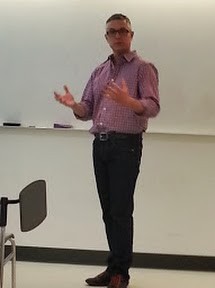
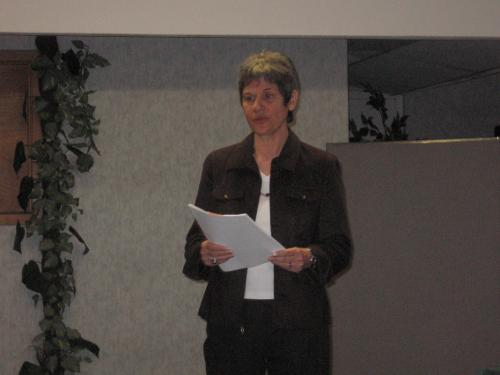
Lauren Carter: Deep Character Workshop, Oct. 6, 2013

I spent the afternoon with Lauren Carter, her mother, Laura (a visual artist with a good feel for story), and five other wonderful writers talking, and writing, about character.

SwarmcoverLauren is on a tour to promote her literary dystopian novel, Swarm, which was released in September by Brindle & Glass publishing.  She’s been to Orillia and Blind River (both places she used to live), and has made a stop in Sudbury for a couple of days before she heads south to continue her journey.

As part of her Sudbury leg, Lauren agreed to offer a writing workshop for the Canadian Authors Association Roving Writers program.  Tomorrow night, she will be giving a reading at the south end branch of the Greater Sudbury Public Library as part of the Luminaries reading series.

Lauren indicated that nothing she had to teach was proprietary and so I’m going to offer a bit of a run down of her workshop.

  • Lauren is a firm believer that there are no rules in writing.
  • People come to writing as artists – organically.
  • Character is important in prose, even in plot-based fiction, someone has to be at the heart of the action.
  • The reader (and therefore the writer) must know those characters intimately.
  • Each writer will have her or his approach.
  • All great art begins at a point of absolute confusion.
  • Writers make decisions about their characters.

Eric Maisel – characters are not people, they are in the novel to serve the writer.

We then reviewed two writing samples: Matadora, by Elizabeth Ruth and Anne of Green Gables by Lucy Maud Montgomery.  We looked at the clues the writers offered about their characters, their backgrounds, the techniques used to engage the reader in the character, how descriptions were used, and so forth.

Lauren passed out a character development questionnaire put together by Kathy Page.  We didn’t use it, however.  Not yet.

Then followed the first of several writing assignments.  This first focused on character description.

Next, we wrote specifically about a possession or place specific to the character, like a purse, car, or room.

Then we focused in on a specific object within the last writing assignment and worked with that.

Finally, after having gotten to know our characters a bit better, Lauren guided us back to the questionnaire and focused the next writing assignment on that.  Having written through a few iterations of describing our characters through physicality, place, and possessions, it was not easier to enter into the details of the list and discover even more.

The last writing assignment took all that we’d learned about our characters and focused on plot. This was set up by another reading from Eric Maisel about “The writer as Experimental Psychologist” taken from his book, What Would your Character Do?

Essentially, plot is a matter of answering three questions:

  1. What does the character want?
  2. Why does the character want it?
  3. How will the character achieve his or her goal (or not)?

After that, it’s a matter of the author rigorously testing the hypothesis she or he has developed until all three questions are answered satisfactorily.

So first, we explored our characters’ psychological make-up; then, we answered the first of the three questions.

Each writing assignment was a free-write and delivered with the instruction to follow the writing wherever it led.  In several cases the characters did, as they are notoriously known to do, their own things 😉

It was a good workshop, and I was happy to have been part of it.

Workshop alert: Lauren Carter Oct 6, 2013

You may remember that I’ve become a member of the Program Committee for the Canadian Authors Association.

The committee is responsible for the annual conference, the Literary Awards, professional development of the membership, and something called the Roving Writers program.

I volunteered to be on the sub-committee for the Roving Writers and our first event will be in a scant week!

Author Lauren Carter will be coming to Sudbury as part of her book tour.  So on Sunday, Oct 6, from 1-4 pm at the Parkside Older Adult Centre in the YMCA building, she will be delivering a workshop on Deep Character.

Here’s the poster with the deets (including how to sign up):

RWTP_Carter Poster

The CAA office will be sending me a copy of the participant list and I will be taking payment (cash or cheque only, please) at the door. The discounted fee of $25 applies to members of the CAA only.

Light refreshments (fruit, muffins, water, and juice) will be provided.

I can’t thank the Sudbury Writers’ Guild enough for their assistance in getting this event off the ground.

Following that, on Monday, Oct 7, Lauren will be at the south end branch of the Greater Sudbury Public Library as part of the first LUminaries reading series.  This has nothing to do with the CAA or the Roving Writers, but I thought I’d spread the word.

She will, of course, have copies of her dystopian literary novel, Swarm, available for sale and signing.

Have a lovely evening!

Caturday Quickies: Brian Henry workshop Sept 22, 2013

Last Sunday, Sept. 22, 2013, I attended a Brian Henry workshop here in Sudbury.  The Brian HenrySudbury Writers’ Guild brought him up for a visit.  This will have been my fifth of Brian’s workshops, I’m thinking?

I used to attend the workshops he delivered in North Bay, take the drive over in the morning with my mom, drop her off at the mall for a day of shopping, and pick her up at the end of the workshop.

Brian Henry is an experienced editor who now teaches at Ryerson University.  He also conducts workshops on a regular basis across southern Ontario.

If you don’t know about it, you should really visit Quick Brown Fox, Brian’s blog.  He blogs about agents and editors and publishing opportunities for Canadian writers (here and in the States).  Sign up for his newsletter.  It’s full of great information.

Brian has also been instrumental in developing the talent of some well-known authors – anyone heard of this woman named Kelly Armstrong?

This workshop was about plotting short fiction and novels, the differences, and markets.  If you have access to one of Brian’s workshops in your area, I would recommend attending.

As a fellow member of the Sudbury Writers’ Guild says, you have to be open to learning about your craft, even if you’ve already been published.  It’s a lifetime commitment.

Oh yeah, he set us an assignment to write a short story (preferably one of the ones we worked on in the workshop and submit it to CommuterLit.com.  We were supposed to do it before the week was out.  I don’t have much time to get cracking on my submission 🙂

Have you attended any workshops recently where you learned something new about your art or craft?  Maybe it reminded you of something you already knew, but temporarily forgot?  Please share 🙂

CanWrite! 2013: Open mic, Andrew Pyper, and Cordelia Strube

I already mentioned the welcome reception and the morning creative writing circles, but have since launched into panels and sessions without mentioning what happened the evenings of June 13 and 14.

Back-pedalling now …

Open mic and shortlist readings

On June 13, interested parties were encouraged to sign up for the open mic.  I did and intended to read the revised opening of my novel as I had at Wordstock, then at supper I heard that the readings would be restricted to five minutes.  This was reduced to three by the time I arrived due to the number of last minute sign-ups.

Not having brought my poetry with me that night, I read as much of my opening as I could.  It was well-received.

Other readers offered their poetry and stories (one humorous one was about discovering one was having a heart attack while on the toilet – shades of Elvis) the organizers sticking strictly to the three-minute limit.

June 14 was to have been readings from the authors short listed for the CAA Literary Awards, but again, a last-minute change opened the floor to additional readers.  I signed up and brought my poetry, a much more appropriate genre for the three-minute limit.

I got to hear the end of the Elvis story and some more great poetry, fiction, and non-fiction.

I enjoyed the readings from the short listed works.  With one exception, none of them could show up in person.  The man who did was Michael S. Cross, author of A Biography of Robert Baldwin: The Morning-Star of Memory (Oxford University Press).

Michael’s reading was wonderful.  I didn’t know Robert Baldwin was such a fascinating character.

Another fascinating author was Jane Doe. She read from her book The Story of Jane Doe.  She is an advocate and activist and her story is a compelling one.  I encourage everyone who has an interest in women’s issues, advocacy, or the attitudes of the legal system to victims of rape and violent crime to pick up this book.

Andrew Pyper

Andrew Pyper

Andrew Pyper

Andrew Pyper is the author of six novels, most recently, The Demonologist.

Andrew’s session was on the afternoon of June 14, and it was as much workshop as presentation.

The session, Getting organized, getting started, focused on the essential elements required before an author begins to write a novel.

  1. An Idea;
  2. A Premise;
  3. A Protagonist;
  4. A Hook;
  5. A Structure; and
  6. An Outline.

He also offered six tips for overcoming roadblocks.

One of the most interesting pieces of his presentation was about ideas.  Yes, one must have at least one good idea to propel one’s plot, but the author shouldn’t stop there.

Traditional thought and misconception would imply that one idea must be made big enough to become the basis for a novel.  Andrew suggested that rather than one idea expanding to fit a novel, that a multitude of ideas should funnel down and feed into a single novel.

This made a lot of sense to me, and when I think about it, that’s how I write fiction.  I never write about one thing.

The premise is distinguished from the main idea of the novel because of its scope.  Andrew’s explanation reminded me of Larry Brooks’s.

He offered the following example:

Idea: A modern-day Frankenstein.

Premise: Archaeologists extract DNA from mosquitoes trapped in pre-historic amber and use it to clone dinosaurs. A philanthropist establishes a theme park around the beasts and invites a select group of scientists and family to witness his triumph; then the beasts escape (Jurassic Park).

The key to a premise is “high concept,” a concept that can be evasive.  This is why Larry Brooks is forever explaining the difference between idea, concept, and premise on his site 😉

Andrew had us write our premises for the Rob Ford story.  As expected, we all had different takes on the well-publicized scandal.

I won’t give away the whole of Andrew’s session, but I will say that it was informative and fun.

Cordelia Strube

Cordelia Strube’s session, on the afternoon of June 15, was mostly workshop.  She’d actually had workshops on both afternoons (14th and 15th) and anticipated that conference-goers would attend both, but a miscommunication occurred and the message was never conveyed to attendees.

Cordelia has published eight funny, powerful, sparse, cathartic and critically acclaimed novels, among them Alex & Zee, Teaching Pigs to Sing, The Barking Dog, Blind Night, and Lemon. Her ninth, Milosz was published last year.

Her plan was to have participants from the first session return and revise the work they had started the day before.  Those of us who only came on the second day would have to start from scratch.

Cordelia gave us a framework and some strategies for getting into our focused writing.  She then distributed horoscopes and a number of other prompts: postcards, small items, all of which were to inform our writing project for the afternoon.

After we were sent off to write however and wherever we wished, the class was asked to share the results of their writing.

It was an excellent session.

________________________________________________________________________

I should take a moment to mention that there were a number of sessions happening concurrently on Friday and Saturday afternoons.  I can only report on the ones that I attended.

Specialty sessions, at a nominal additional cost, also took place during the mornings.

There were also agent pitch sessions occurring Thursday, Friday, and Saturday mornings.  Though I did not opt into these, they were very popular and booked solid.

I like the way in which they were conducted.  Each author was to submit their query letter and first five pages of their novel in advance of the pitch session.  I think that this is a much better way to conduct pitches than to do them blindly.  It’s better for the agents because they have a sense of the author’s work.  It’s better for the writer because they don’t only have their two to five minutes to convey the meat of their novel.

A professional photographer was also on site to take author shots for the attendees.  I happily paid the (again, nominal) fee for this.  I should have the results next week and I hope they will be better than my efforts to date.

Tomorrow: The final panel, Traditional vs. Self-publishing.

G’night y’all 🙂

Caturday Quickies: Susan McMaster Workshop

Susan McMaster

Susan McMaster (Photo credit: pesbo)

When I originally indicated that I was going to change my blogging schedule to weekends only, one of my online writing friends commented on how wonderful the idea was of a ‘flurry of posts’ on the weekend.

I’ve been posting fairly consistently on the weekends since, but I realized that I have a few things to catch up on.  So this weekend, though the weather is sunny and cold here in the Sudz, I’m creating my own mini storm of blog posts.

Who is Susan McMaster?

Susan McMaster is a past-president of the League of Canadian Poets, poet, and spoken word artist.  She’s given a workshop in the north before, and this time, I decided to partake.

The Sudbury Writers’ Guild had enough funds in its coffers to pay Susan’s fee for the afternoon workshop and to secure space at the newly rebuilt south end branch of the Sudbury Public Library.

The theme of the workshop was Writing through the Emotions.

Susan gave a brief introduction and offered up a couple of samples of her work and the work of other poets to illustrate.  Breath and space seemed to be the key elements to evoking emotion in poetry, and so, when Susan gave us our writing assignment, I was expecting something a little different.

For the first part, we weren’t to write a single word.  Instead, we were to map out what we were going to write in terms of beats.  Long, flowing sentences would be represented by lines and short, curt sentences and breaths by carets.

Though I think several of us (fiction writers, in particular) struggled with the concept, we all dove in with enthusiasm and gave it our best.

Afterward, we had the opportunity to read from either our work of the afternoon, or something that we had brought with us.

Though only two and a half hours, the workshop was interesting and gave me a different way to look at my writing that I hadn’t considered before.

Adventures in professional development October 2012

In-person team meeting, Oct 16-17

My team works virtually.  We’re scattered all over Ontario and so when we can meet in person, we take the opportunity.

This year, our in person team meeting was held in Toronto and we assembled from our respective offices: Timmins, Sudbury, Scarborough, and Chatham, to meet with the three of our colleagues that lived and worked in Toronto.

The focus of the meeting was professional development, but there were a couple of specific things that we had to accomplish: review our accomplishments to date, and plan our activities for the remainder of the year.

My team is diverse with respect to skills and relative areas of expertise.  I contribute to subject matter expertise in my business line, technical, facilitation, instructional design, and other communications skills.  Others bring subject matter expertise in other business lines, project management, instructional design, presentation, and specific business communication skills.  Some have great budget management skills and a holistic knowledge of our business that I lack.

We all come together to support one another and get things done.  As the result of our accomplishments/planning session, I once more find myself entering uncharted territory and helping to put together professional learning agreement (PLA) templates for various positions my business line.  This will be interesting work.

In the professional development category, we were reintroduced to a tool called the Passport to Service Excellence (PSE), which is supposed to help us chart our career path.  Talent management is something still fairly new and very much in development at my employer.

We have several tools and platforms to help us do this.  One is, of course, the PLA, where outside our departmental mandate and goals, we list activities that we would like to engage in and what positions we’d like to move into, job shadowing or acting roles we might like to adopt.

There is a Renewal Gateway site onto which we can post our resumes and where managers from various departments are supposed to look for individuals to suit their needs.  There are also formal and informal assessment processes for various jobs occurring all the time.  There is the PSE, and I’ll be helping out with another project geared to assist employees in planning their professional development activities in the coming weeks.

It seems to me that there’s a little too much duplication in these tools.  So if I were to take a course, I would have to update my own resume, the one posted on the Gateway, then open up my PLA and list it there, go to the PSE and make the appropriate alterations there, and soon possibly also update the new tool that’s being proposed.

That’s a lot of work.  It’s almost enough to make one reconsider taking part in any professional development activity.

What would be better is to work into one of the tools the ability to export information into other forms.  So that if I complete a course, I then go into one tool, for sake of argument, the PSE, update it, and then have the tool communicate with and update the other tools (PLA, resumes, etc.)  It makes sense to me, but when I made the suggestion, it seemed something beyond what could be provided.

This kind of thing happens a lot at my employer.

The Business Expertise Forum, Oct 29-31

Along with the SMART Board training that I delivered with my colleague Monica in September, I was to deliver a workshop at the BE Forum.  It soon turned out to be three workshops offered to a portion of the attendees in rotation with two other presentations.

Monica ended up having to deliver other training and couldn’t help me, so I said for convenience’s sake that I’d deliver the workshops solo.

I thought I’d have time in October to develop the presentation, handout, and complete the work necessary to have a translated version of the handout ready in time.  Unfortunately, other priorities emerged.  My job as training coordinator is not a boring one, to be sure.

Then two days before I was off on leave to attend a writing conference, one of my team mates volunteered to co-facilitate.  At that point, I didn’t really have the presentation hammered out, but I gratefully accepted the offer and shared what I could put together in a day.

Another issue was that the training room that I was assigned and that I wanted to get in early to set up was in use the day previous.

So making the best of the chaos, I travelled down with my colleague and attended the first part of the Forum.  There were a pile of work friends from various departments and locations that I got to see again.

Our regional head delivered a welcome address and expressed interest in attending the SMART Board workshop.  <gulp!>  Fortunately, her schedule was too full to allow it, but I had a momentary wiggins 🙂

One of my training team colleagues did a presentation on creating a quality monitoring program.  She’d been called in at the last minute when the original presenter was unable to attend.

Finally, at the end of the day, I got into the training room, hooked up my computer, and tested the SMART Board out.  Joy.  Everything was working.  Linda and I started to go through the workshop and had to finish off our mini-run through the next morning, as the training rooms were being locked down for the night.

Ultimately, all went well, and I ended up having a great time.  I went out with all of my work friends and caught a couple of great presentations, on training in a multi-generational environment and on managing transitions (another course that I will be delivering at some point in the future).

Now I’m in recovery 🙂

On taking breaks and lunches

One of the other things that came out of my team’s in-person meeting was that we all need to take care of ourselves.  A former member of the team, who’d left it prior to my coming on-board in May, had passed away in the summer at the young age of 51.

So we were all encouraged to take our lunches and breaks, and to take care of ourselves.

I have to confess that I haven’t taken more than a handful of legitimate lunches or breaks since starting with the team.  I tend to take on too much.  I know this about myself, but when I have something that I’m interested in, I can’t help myself.

Unfortunately, the things I’m interested in are not the kinds of things anyone else shares a passion for.  So I end up being a niche specialist because no one else has the time or aptitude to take up the torch.

I’ll have to let you know how my quest for personal time and balance at work goes.

The Learning Mutt has a couple of weeks at home before she’s on the road again, and hopefully for the last time this year …  I can dream, and whuffle in my sleep 😉

CanWrite! The Canadian Authors Association 2011 Conference

May 2-6, 2011.

Yes, I finally did it.  I managed to do something entirely nourishing to my writer’s soul.

I’d determined that I wanted to go to at least one conference week-long workshop last year and when the announcement went out in November 2010, I signed up right away.  Barbara Kyle, one of the workshop presenters, was also offering 20-page critiques for a nominal fee.  Again, I was in.

My next challenge was how to pay for the venture.  I applied for a Northern Arts Grant for professional development from the Ontario Arts Council, but was not accepted.  So, credit it was.  As far as conferences go, the CAA conference wasn’t expensive.  Even with my day job, I don’t make enough money to drop a thou and not feel it.  Still, it was time and long past that I made a substantial investment in my creative self.

Throughout February, March, and April the CAA conference organizers held little writing contests to get participants in the creative frame of mind.  I submitted to two of the three and though I didn’t even manage an honourable mention, they were interesting exercises and did serve to build a lovely feeling of anticipation.

I made my leave request at work as soon as I could, but operational requirements made it seems unlikely that it would be approved.  As the date of the conference approached, I began to worry that I’d have to withdraw.

Then my father passed away, April 9, 2011 and thoughts of the conference vanished.  For the week previous, Mom, a family friend, and I took turns watching vigil.  Dad had originally gone into the hospital March 18, 2010, and though he never recovered sufficiently to come home, his final illness and his ensuing struggle were completely unexpected.  Needless to say, Mom and I were devastated.

To paraphrase Forrest Gump: that’s all I have to say about that.

In the dizzying days following, my leave was miraculously approved.  Now the conference had a second purpose: I needed to get away and do something that did not involve Dad, his funeral arrangements, or my mom’s uncertain financial situation, all of which were consuming my life in large, ragged mouthfuls.

The drive to Grand Bend from Sudbury, though long, was relaxing.  There’s some beautiful country in Bruce and Gray counties, and now, there are lovely windmills and solar panels dotting the landscape.  I don’t understand the public resistance to wind and solar.  They’re some of the cleanest, greenest sources of energy around, and I didn’t find them ugly at all.  I rather thought them graceful, alien guardians, standing sentinel over the people and the land.  In any case, I arrived at the Pinedale Motor Inn in time for the evening meet and greet, and welcome barbeque.

I discovered that that year’s conference was a departure from previous years.  It was set up as a writers’ retreat with workshops and events, but with the afternoons off to enjoy the town and to write.  No maddened dash to attend competing workshops, this.  Never having attended any conference before, I didn’t have anything to compare it to, but it seemed like exactly what I needed.

I won a bottle of wine in a raffle.  We were off to a good start

The first workshop presenter was Sandy Plewis.  Her session was highly interactive with lots of writing exercises, but she depended heavily on secondary sources in her lectures.  She seemed pleasantly surprised at the willingness of the conference attendees to dig deep and write.  There was not a still pen in the house when it came time to complete an exercise.

Then came time for my critique with Barbara Kyle.

Globally, she was complementary.  My characters were interesting, their conflicts dynamic and immediate, but then, as the critique commenced, the shortcomings emerged: the pacing was too fast, my scenes lacked a sense of place, and I didn’t go deep enough into my characters’ hearts and minds.  And I was too subtle.  While I got a lot of good advice from Barbara, by the end of it, I was dizzy, hardly able to breathe.  I think it was a panic attack.  I wasn’t able to think about things clearly until much later in the day.

Barbara’s workshops, one based on The Writer’s Journey by Christopher Vogler, and the other on her own experiences as a first draft survivor, were illuminating.  Though not heavy on the writing, they were professional, and informative.  I had a revelation.

I’d read Vogler’s book, and its inspiration, Joseph Campbell’s The Hero’s Journey.  The guardian at the gates has been a repeated part of my development as a writer, and my past experiences with those guardians informed my inner critic, the biggest, baddest guardian of them all.  That’s what happened in the critique session.  Though intellectually, I knew that Barbara was giving me exactly what I needed to head into the next revision of my novel, to make it stronger, and better, emotionally, every negative that emerged seemed a confirmation of my worthlessness.

So … I confessed.  Spastically and awkwardly–which is the only way I can confess the deeply embarrassing–I told everyone about my struggle.

That afternoon, Lightning Strikes, a series of mini-workshops, took place, and in the evening, at the Mock Awards Ceremony, I received the “Best Attempt to Make Us Cry” award.

Even the annual general meeting was interesting.  As a professional member, I had a vote.

Overall, the CAA conference was a very rewarding experience, and one I hope to repeat.

Conferences can be fertile experiences.  Have you made a breakthrough at one?  New friends?  Networked connections?

Words in the Wilderness

July 23-29, 2010.

This conference was the darling of the Sudbury Hypergraphic Society.  While I did not attend all the events, the workshop with Marie Bilodeau and Jennifer Rouse Barbeau was great.  Hosted at Music and Film in Motion, the session was an intimate affair with wonderful insights into process and what it takes to get published.  Jennifer was about to have her first novel, Swampy Jo, published through Your Scrivener Press.

Marie in particular intrigued me with how she broke into publishing and how hard she had to work to get there.  Starting off with success in e-books, Marie’s first novel, Princess of Light, was so successful that the publisher decided to move it to their print line.  The only condition was that she had to have the remaining two novels in her trilogy written and ready for editing ASAP.

Princess was published February 29, 2009 and the second novel, Warrior of Darkness, was released in July of the same year.  Sorceress of Shadows came out in April of 2010, which will give you an idea of how quickly the work had to be done.  Marie front-loaded the work and still managed to write a phenomenally successful series.  One of her secrets: when necessary, she retreated to a local convent to focus on the task of writing.

I’ve since “friended” Marie on Facebook and follow her blog and adventures.  She’s published two more novels, Destiny’s Blood and Destiny’s Fall.  The latter is just out in March (see Amazon for details) from Dragon Moon Press.

Recently, she wrote that she had another date with “giant Jesus.”  This was a reference to another personal writing retreat she had planned at the convent.

When she got there though, she discovered the convent secularized, and dubbed it the no-longer-convent convent.

Have you discovered anyone through a conference or workshop who inspired you?

Brian Henry, “Writing and Revising” Workshop

I first heard of Brian Henry a number of years ago.  I honestly can’t remember where, but I might have been the Sudbury Writers’ Guild.  At the time, I had to travel to North Bay to attend one of his workshops, and I attended two.

The first focused on the publishing industry, how it worked, from query, through slush pile, agents, Canadian vs. American pub houses, all the eventual way to publication.  There were a lot of eye-opening stats that day and it was my first introduction to the world of publishing.  At the time, I hadn’t even finished my first draft though, so I knew I wasn’t ready to start sending off letters yet.

The next workshop was on characterization.  Different topic, different insights.  That trip, I took my mom along for the ride.  She went shopping, and I went to the workshop.

Then finally, we got the Quick Brown Fox to come to Sudz 🙂

“Writing and Revising,” offered May 30, 2010 in Sudbury was the third Brian Henry workshop I attended.  It was very informative and well worth the nominal fee.

Brian talked about the difference between revision and editing, and the relative time and place for each given your writing process.  We shared our stories for a quick and dirty critique, and some of the participants were able to get one on one guidance after the workshop itself was formally over.

Brian has been a book editor, writer, and creative writing instructor for more than 25 years. He teaches creative writing at Ryerson University and George Brown College. He also leads weekly creative writing courses in Mississauga, Oakville and Burlington and conducts weekend workshops throughout Ontario. He has helped many of his students become published. 

Check out his Blog: Quick Brown Fox, for more information on his workshops, contests, calls for submissions, student writing, publishing and agent news.  QBF is one of the most popular blogs for writers in Canada.

Have you participated in a Brian Henry workshop or writing course?  Or maybe you have someone like Brian in your area of the world?

A visit from Valerie Senyk

March 25, 2010.

Throughout the year, the Sudbury Writers’ Guild brings in guest speakers.  That year, there had been some interest from the membership in learning how to read one’s work more effectively.  One of our members, and past president, Janice Leuschen, had just started up her business and had delivered a session for the Guild already, but there were still rumblings and mumblings.

At the September meeting, where the year’s creative agenda was hashed out, I suggested Valerie Senyk as a possible speaker.  She is associate professor of theatre arts at the Georgian College University Partnership Centre as well as a poet, a playwright, a director, and a fantastic performer.

The members in attendance showed interest, so I got in touch with Valerie, who was also interested and coming to Sudbury to see her son in March.  We firmed things up and made the date.

I’d known Valerie since Spring Fever: the (W)rites of Spring in which our poetry was published.  Subsequent readings, events like the Northern Lights Festival Boreal, which featured not only our motley crew of spoken word performers, but her creative performance poetry collaborations LipSkinDance and Poemotion, and our association through Your Scrivener Press publisher Laurence Steven, often put us together.

At the time of our first association, Valerie was a professor in the Drama Department at Thornloe University, one of three federated universities within Laurentian University.  I’d seen her perform and attended several of her students’ productions at Thornloe.

Valerie did an evening workshop for the Guild and everyone in attendance read a work of short fiction or poetry and received excellent feedback and tips from Valerie.  Though I considered myself an experienced reader, she had some insightful advice for me as well.  It was a lovely evening, and it was great to see an old friend again.

It is always a pleasure to work with Valerie.

If you enjoyed this post, Like, Share, or Comment.  I invite you to subscribe, or easier still, add me to your Google Reader subscriptions.  Google Reader has saved my social networking sanity so I’m not shy about the plug 🙂