Learning elearning, the hard way :)

Last time, on Breaking open the mind: I participated in my first real working group.

In March of 2011, my team received a gift: our first non-acting manager in years!  We’d gone through four in the past year alone and it was hell.  The manager that we started the year out with had been our acting manager for a while.  He knew the team and what we needed, but then he moved onto another position.  Then, we had a manager for all of three weeks before she also took on another position.

Finally, there were two other acting managers who, while well-meaning and perfectly competent, really didn’t feel comfortable in the role for the training team.  The manager that we’d had for such a short time the summer previous was successful in a competition and returned as our manager, but this time permanently.

So, a new manager, and a new fiscal year threw things into high gear.  Our budget was restricted.  No overtime, and certainly no money for travel.  We had to start looking at alternatives to in-class, instructor-led training if we wanted to be able to continue and continue to be relevant.

Thus working groups evolved for the SMART Board and WebEx, our two main tools that could be used to deliver virtual training, either synchronously (together), or asynchronously (independently).  To follow up those two courses was to be a third, regarding elearning design and the conversion of in-class course materials to online or virtual vehicles.

Though I was considered the go to person with regard to the SMART Board, I couldn’t legitimately volunteer for any of the working groups.  My father had recently passed away, and I had asked for several weeks of leave.  I wouldn’t even be around when the training would be delivered to our colleagues.

However, I did get a “consulting” role on both the SMART Board and the elearning groups.  I ended up designing a good portion of the pre-course modules for the SMART Board course, though I must say that Monica did a smashing job of finishing them off, and of the Notebook presentation and recording.  Sadly, I got little to nothing done with regard to the elearning design course.  Monica and Laura were left with the bulk of the work.

When I returned from my leave, however, there was tweaking to be done.  The SMART Board course was a success as it was, but the elearning, having been piloted, needed some rework.  For one thing, it was too long.  Laura was seconded to another working group, and so Monica and I set to.
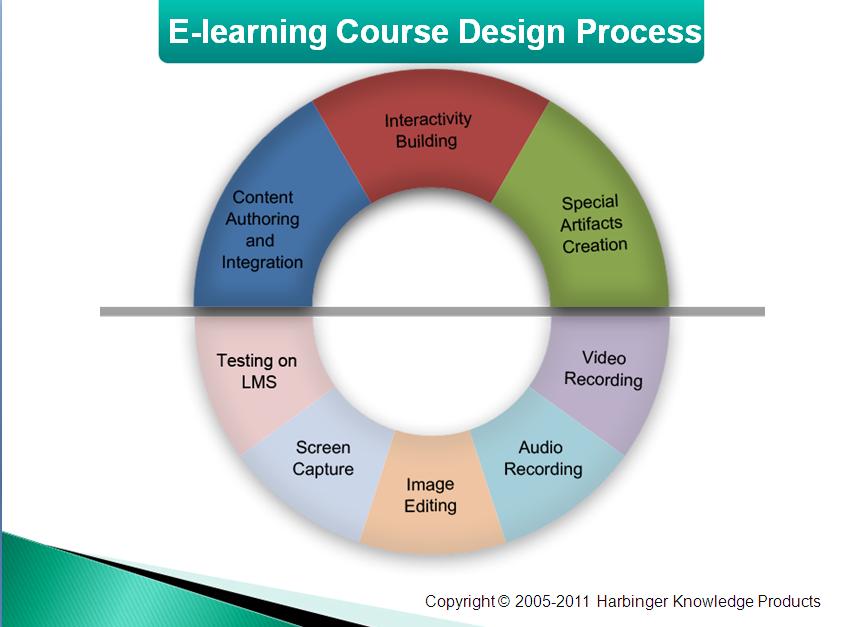
Shortly thereafter, Monica was pulled onto the WebEx team, or rather became the WebEx team, leaving me to finish off the elearning.  Really, I didn’t have a clue what I was doing.

I can write though 🙂  So I wrote my way through, like I usually do, and ran the rest on instinct.

I turned the lectur-y, research-y bits into a search and learn pre-course module.  I crammed in metaphors a-plenty, drawing heavily on the resources that my manager threw my way.  I created a post-course assessment, and tidied up the elearning toolkit that Laura had created.

One critical piece I learned was the importance of storyboarding the presentation.  I scripted that sucker out to the last detail.  I also became fairly adept at PowerPoint, and incorporated Notebook activities into each module as review and assessment tools.

I learned a lot writing the course, but in the months since, I’ve learned much more, and I’d love the opportunity to go back and refine things a bit.

When time came to pilot the course a second time, there was only one of our colleagues left to attend, or offer input for review (Thanks, Sandy).  It seemed to go well, but there hasn’t been much call for the course since.  No sooner was I finished with elearning, though, and I was on to the next project.

More on that in a couple of weeks.  Next week I’m going to share a recent, bittersweet experience with you.

Interesting update: Our work of the SMART Board project has been recognized with a service award for our wee working group. (w00t!)

How has the era of reduced budgets and travel affected your training efforts?  Are you adapting courses for online delivery?  How is that working out for you?

My first “real” working group

It was an education, that’s for sure.

Ostensibly, I was brought in to advise the group regarding training and supports for a new unit that the working group was to establish.  They’d already been meeting for some time and I had a fair bit of catching up to do.  A further complication was that while there were several members of the group in my office, it was a virtual group.  We met by teleconference.

I got the notification while I was out of town, training.  At first, I thought it must have been a mistake, but I was soon set straight.

I’d never done anything of this nature before, and I was flattered that my manager and director had recommended me for the group, but I was completely out of my depth.

With the responsibility came the looming possibility of a needs analysis.  I didn’t think I knew how to do that.  I started searching the Intranet, found a few ideas, canvassed my colleagues, and got a few more.  Then I started Googling and that’s when things got really interesting.

Here are a few samples of the kinds of things I found:

Of all the resources I’d gathered, many were vague, some differing, and a few in outright opposition.  Most weren’t recent.

I even discussed the topic with my husband Phil, who was going through something similar at work.  What he recommended was a process analysis.  Essentially, the work to be done is broken down into its component steps, and then each step analyzed and potentially broken down further.  With a process analysis, task competencies could be easily identified, and from that, training specific to those competencies determined.  It could also be the basis for procedure and/or policy, or even a screening tool for candidates.  I liked the efficiency of the concept, and found it a reasonable proposal.

The unit had yet to be approved though, and so the people working in it couldn’t be officially identified, nor could the new unit or its potential requirements be discussed withanyone outside the working group.

How was I supposed to determine what training and supports might be necessary for a group of people who had yet to be named?  The process analysis still stood out for me as a solution.  The suggestion was not received with enthusiasm, however.

I had no experience.  I didn’t know how these things worked.  The project lead took my under her wing.  Another member of the group who’d had more experience in working groups than I, was also generous with her time and helped me to understand how things were supposed to go.

We were to cast our net wide, and think of all the possible courses that might be required by the unknown members of the proposed unit.  I researched, obtained estimates for training costs, and started to work on a self-study course for one of the applications that the staff would be using.  I also suggested a SharePoint site, which the group did set up and begin using.

Then we discovered that there was no budget, and most of my work had to be abandoned, the arragnements I’d tentatively made cancelled, and apologies and gratitude distributed tactfully.

About that time, things started getting hectic in my personal life.  My father “took a turn,” as they say, and passed away a week later.  After the family time I’d taken to stay with him during his illness, and my bereavement leave, I was approved for a number of additional weeks of annual and self-funded leave.

When I finally returned, the project and the nature of the unit had changed completely.  The necessary training was accomplished in my absence, my training course was not used, and the working group ceased to meet shortly thereafter.

It felt … anticlimactic.

It was an interesting experience and I certainly learned a lot (mostly about myself).

  • I will dive into a new project, even if I have no idea what it is about.
  • I’m a good researcher, so long as I have a defined goal.
  • I’m not confident in proposing my own ideas.
  • I will defer to the current authority.
  • I’ll adopt current procedures, even if I don’t see the value in them.
  • I’ll pursue my own goals and projects on the side (subversive me).
  • I’ll totally forgive myself when life happens.
  • I know my real priorities.

I still think the process analysis would have worked 🙂

Have you ever been thrown into the deep end?  Did you sink or swim?  Did something else happen?  I like to think I dog-paddled my way to the shallows where other priorities arose and by the time I was ready to dive back in, everyone else left the pool.  Special projects and working groups can be great learning experiences, but they can also be trials.