WWC Day 1: Anthology Jam

Panelists: Ron S. Friedman, Randy McCharles, Charles V. Prepolec

RonFriedmanrandymccharlescharlesprepolec


Q: As a writer, how do you approach an anthology? How to you get in?

RM: There are two kinds of anthologies, open and closed. Open anthologies are exactly that. There will be an open submission period. Closed anthologies tend to be by invitation only and some are dedicated to a particular franchise or theme.

CP: Open anthologies are the only chance for newer writers to get published. They tend to be niche and specific. Pitching an anthology to a publisher is difficult these days. People aren’t reading them as much. You can check out the possibilities on ralan.com. Ralan’s good because it will list the rates as well as the contact information. Professional rates are like six cents a word or something like that. I think Innsmouth Free Press has an open call out for She Walks in Shadows, for Lovecraftian stories featuring a female protagonist or deity. Also check out Kickstarter (Mel’s note: I just did a quick search for anthologies and sorted by newest). It’s a way of guaging the market as well as raising funds. Some of them have open reading periods, for example, ChiZine Publications’ Fearful Symetries, which Ellen Datlow edited. Duotrope is another good place to go. It’s reasonable at $50 a year.

RM: Really, you have three options: magazine, open anthology, and collection. There’s no other way to get your short stories published.

Q: Do you write to a particular Anthology’s theme?

RM: Yes. I wrote to theme for Tesseracts: Parnassus Unbound.

CP: You can write to the market.

RF: If you write for a particular anthology and your story doesn’t make it, you can always submit it elsewhere.

RM: You write stories. Keep a “story drawer” and repurpose as required. I had five short stories that I cobbled together for Tesseracts 16. It was published in the anthology, the year’s best, and nominated for an Aurora. Sometimes it’s an issue of money vs. passion.

RF: You can also publish short fiction on Amazon. Kindle Singles.

Q: What rights go to the anthology?

CP: Usually for an anthology it’s first time print rights for about a year.

RM: Short fiction is a one time sale. There aren’t any royalties like for a novel.

RF: Rights are usually considered from date of publication, not date of sale.

RM: Anthologies love reprints because they feed back to sales for the originating anthology.

CP: Gaslight Grimoire had two stories picked up for other publications. You don’t want to be competing with yourself though. If you want to find out more about the market, you can check out The Market List, Writeaholics.net, Towse’s links to online submission guidelines.

RF: Check out the SFWA site as well.

Q: I’d recommend submission grinder.

CP: If you’re heading into this world for the first time, I’d also check things out on preditors and editors.

RM: Your goal isn’t just to sell, but you want to sell to a market that people read. Ask yourself, is this a market that people are reading? Send to the highest paying markets first. They usually have a larger readership.

RF: Bundoran Press will have an open submission period for Second Contact, September 15, 2014 to January 15, 2015.

CP: Small presses are more open to anthologies and collections. Prime Books – Sean Wallace. Edge Science Fiction and Fantasy Publishing – Brian Hades.

Q: How much material do editors request? Do you ever oversubscribe?

RM: Content or contributors may be assigned. Choose between five or six of these authors. The editor may choose. There is going to be a total word limit you have to stay within.

CP: We oversubscribe by about 30%. There will always be people who drop out or don’t follow through.

Q: Can a writer pitch an anthology?

CP: No. Editors, maybe. You could pitch a collection of your own stories, but not an anthology.


Tomorrow: The Next Chapter: August 2014 update.

WWC Day 1: On dialogue, building accents, and dialect

Disclaimer: These are my notes. I am human. As such, I fully acknowledge that my notes are imperfect. Feel free to correct me if you see any glaring errors or misrepresentations.

Panelists: Axel Howerton, Sandra Fitzpatrick, Nola Sarina, Minister Faust

axel_photoSandraFitzpatrickNolaSarinaMinisterFaust


NS: You have to be consistent. Don’t shock your readers by changing things up part way through your novel. Don’t write phonetic dialect or idiom. It’s too much.

MF: There is no right and no wrong. Everything is a matter of taste. Chaucer would have probably hated Shakespeare. Does that make either of them wrong, or one better than the other?

SF: Make sure your dialogue is pronounceable. There are problems with other languages, like Gaelic, in which nothing can be sounded out, or Japanese, in which everything is contextual.

NS: Write out the dialogue from movies whose characters reflect your protagonist. Reflect the evolution of your character.

Q: What if all your characters are from the same small town? How do you make them distinct?

MF: Look at your friends. You can identify each of them by specific catch phrases or tics. Go someplace in your town or city where you don’t normally go. Listen. Learn to love how people talk.

NS: Bond two characters through dialogue similarities. Have a third party interpret for your reader.

Q: Any tips of how to keep consistency in your characters? In one novel, I had to tone down the protagonist’s swearing, but it was a part of his character. In the end, I only had him swear when he was upset, but that could come off as jarring.

NS: Edit for voice by character. Make a pass for each.

Q: What about using other languages?

NS: Intersperse them in the text. Try not to have long passages in other languages. Use another character as interpreter.

Q: How do you avoid caricatures or stereotypes? For example, I have a character much like Mr. Miyagi from the Karate Kid.

MF: Avoid stereotypes if you can. If you can’t, make sure there’s a reason for it. With regard to Miyagi, if someone watches the Karate Kid and comes away thinking that Miyagi is uneducated or backward, they’ve missed the point of the character. He was betrayed by his country, lost his wife in tragic circumstances, and has a disorder as a result. He’s chosen isolation as protection. He’s rejected the society that betrayed him.

Q: Is there a way to ease off dialect over the course of the novel?

NS: We’re back to consistency again. If it’s too much at the beginning, it’s too much, period.

MF: If you want to write a character with thick dialect, then do it. Don’t tease. Write the book you want to write.

Q: What about multiple different languages?

SF: It depends. In a science fiction setting, you could have something like a universal translator, but you have to make it plausible. Otherwise, think about syntax, word order. What are the differences between the languages we speak on this planet?

Q: I’m writing a YA historical. It’s historically accurate for the protagonist to call his parents mother and father, but writing it that way felt awkward.

MF: If it feels awkward to you, chances are it will feel awkward to your audience, too. If you want to address it, do so head on. Show it. Hang a lantern on it. Reveal it’s relevance by contrast. Do people of other classes refer to their parents in the same way?


I hope you enjoyed this opening salvo of When Words Collide (WWC). I’ll be continuing the transcription of my notes, one session each weekend, until I run out of notes.

WWC set a military pace. Most sessions were one hour and though intended to end at about 50 minutes, initially, most session ran overtime. There were no breaks for meals with sessions running from 10 am through to 9 or 10 pm. Special events often ran later.

In many cases, I had to arrive late or leave early to catch the next session with enough time to hit the bathroom, or grab a quick snack at the commissary.

Next week: The Anthology Jam. All about how to get published in an anthology.

Caturday Quickie: Calgary, I am in you

I’ve been waiting to say that for a long time. I’m such a nerd.

To be brief:

Thursday afternoon, Phil and I went to see Guardians of the Galaxy. I may have to post a Mel’s Movie Madness about it. For the future. I enjoyed it thoroughly, however.

Yesterday (Friday), I got up at the ungodly hour of 4 am so I could get out to the airport by 5-ish and catch my 5:55 am flight.

All went well, caught my connection, watched the second Hunger Games en route, and arrived at 10:18 am, on the dot, in Calgary.

My friend, Sharon, offered to pick me up and we went out to lunch before I checked in at the Carriage House Inn and started my marathon of sessions.

I attended 5 of those yesterday, plus the keynote speakers in the evening. I also met, in person, several people I’d only known to this point virtually: Angela Ackerman, Diane Walton, Tim Reynolds, and I reconnected with some fellow writers and publishers: Mark Leslie, Ron Hore, Swati Chavda, and Avery Olive.

I had dinner and lovely conversation with Nina Munteanu, and met a few other writers and editors hanging around outside the hotel. I also saw the wonderful Jack Whyte again, and met Brandon Sanderson in the flesh. Brandon was my fangirl moment of When Words Collide so far.

I’ll be in sessions from 10 am to 6 pm today, and then there is the mass autograph session this evening.

It has been a jam-packed conference so far, but I’m having a blast. Prepare for much bloggage coming out of this 🙂

Also got to see the 2014 In Places Between anthology chapbook. The readings and judging take place tomorrow morning. Will let you know (of course) how “On the Ferry” fares.

I think this may be my only post this weekend, just because WWC is proving to be a very fast-paced event.

In the meantime, I shall wish much you all much Writerly Goodness.

Caturday Quickies

The next chapter: July 2014 update

July was much the same as June for me.

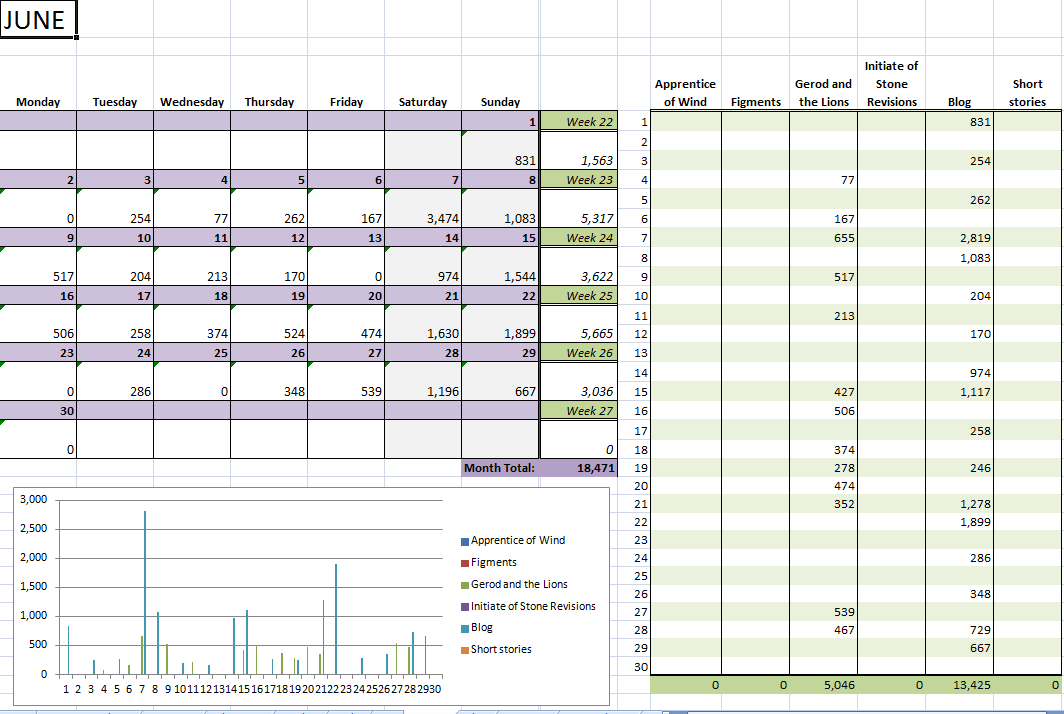
I worked primarily on Gerod and the Lions, am still slowly mapping out Figments, and though I did some work on a short story (it’s almost 10K, so not really short, per se) it was revising, and the word count was negative.

July's progress

Total for the month: 17,516 (not quite as high as last month, but still a w00t! in my book)

Total on GatL: 4,821 (again, a little less than last month, but I’m still on track to finish the first draft by year’s end)

Total on blog: 12,695

Thought it might be time for a review of the year to date:

Month Total Blog Initiate of Stone Apprentice of Wind Figments Gerod and the Lions Short Stories
January 11,532 7,114 0 2,781 207 821 609
February 9,789 6,303 0 47 308 1,296 1,835
March 10,781 8,193 0 333 1,488 312 455
April 11,612 10,930 0 0 381 0 301
May 7,503 7,503 0 0 0 0 0
June 18,471 13,425 0 0 0 5,046 0
July 17,516 12,695 0 0 0 4,821 0
YTD Total 87,204 66,163 0 3,161 2,384 12,296 3,200

I must say, I’ve impressed myself. This ain’t bad for a writer with a day job.

It’s a comfort to know that I could convert some or all of those words spent on the blog into other writing projects, even while continuing in my day job. That could be two books a year, and that’s awesome.

Why don’t you do that now, you ask (and well you might). Right now, I’m happy to blog away for the benefit of my readers and writerly friends. Though a platform isn’t required for a publishing deal, it doesn’t hurt. Plus, sharing my struggles, progress, and process, curating and conference/convention reportage is gratifying to me. It seems that I’m sharing material that benefits my network.

It warms my wee heart when people like, comment, reblog, or otherwise share my posts.

The fact that I’m making progress also makes me happy. I don’t want to rush into querying or publication and regret it later.

I have to work the day job at least until Phil and I have our remaining debts paid off. There’s a lot of uncertainty in our lives right now (of which I’ll write tomorrow). Call me a chicken, but I can’t take the risk of quitting at the moment.

If I’m fortunate enough to get a deal of some description before we’re debtless, I’ll also have a choice. I could potentially devote all my time to writing, and produce three or four novels in a year. That could translate into a replacement income . . . eventually.

Due to the uncertainty in our lives and in the rapidly-shifting publishing industry at the moment, I’m not prepared to take that chance now, but I know I can do it if I have to.

I write because I enjoy it and I want to keep it that way.

What’s on for this month?

I’m going to continue to plug away at GatL and Figments, and that 10k story I mentioned, I’m going to submit it after revision. I don’t want to talk too much about it, because a story of this length is a huge risk. I’ve also submitted it to other anthologies and magazines in the past to a resounding “no.” Let’s see if I can’t do better this time.

This coming Friday, I’m off to When Words Collide in Calgary, and I’ll learn on Sunday morning whether my top ten story “On the Ferry” was considered a winner in the In Places Between contest. Though I’m really excited about the possibility, I’m just pleased as punch to be in the chapbook anthology.

So, of course, there will be more conference reportage coming your way 🙂

And that’s about it.

Tomorrow, I’ll be posting my CanWrite! Conference wrap and writing about the unsettled nature of things, not necessarily in that order.

Have a happy Civic Holiday long weekend, my Canadian friends 🙂

The Next Chapter

The next chapter: June 2014 update

Hey all!

I must say that June was a blockbuster month for me.

It started with the publication of my science fiction short story “The Broken Places” being published in Bastion Science Fiction Magazine. Still so excited about that.

I attended June’s @M2the5th Twitter chat with Roz Morris, focusing on her Nail Your Novel series. I’m learning quite a bit from these, and though we cancelled July’s because, Independence Day, we’ll be getting back to our monthly schedule in August.

A comment on last month’s update had me a little concerned about what my readers might be taking away from these posts. It seems May’s update was taken as a warning about social media. If the warning was timely and helpful, great, but it’s not the message I hoped to convey.

I have now finished reading my ARC of K.M. Weiland’s forthcoming Jane Eyre: Writer’s Digest Annotated Classics. I’ll be posting a review later in the month, so stay tuned for that.

The adjustable desk is working out very well, and I’m now standing for longer between rests. At work, I read a post from a learning and development blogger in which he discussed his experience with his standing desk, which he described as continual fidgeting.

He uses a kitchen stool to take a periodic break from standing and has discovered that he can’t write while standing (!) Thankfully, that hasn’t been my experience.

CanWrite! 2014 was a great time, as usual. I’ve been blogging the panels, sessions, and workshops I’ve attended on a weekly basis.

Another piece of exciting writerly news arrived when I returned home from the conference: another speculative short story, “On the Ferry,” made it into the top ten in the When Words Collide writing contest.

This means I’ll appear in their chapbook anthology, In Places Between, though I’ll have to wait until the conference to find out if I’ve placed. Still. Squee-worthy.

Last month, I had a blogging disruption around the arrival of my desk and spent most of my non-blogging writing time working through Initiate of Stone, all of that work in long hand. Though I completed a lot of work on IoS, I wasn’t able to capture a word count from it.

In last month’s update, I mentioned I would be getting back to countable writing.

June's writing progress

June’s total word count: 18,471!!!!!

13,425 of those words were on my blog, but 5,046 were written in Gerod and the Lions. I set myself a goal of 5k for the month on that project, and I made it. The draft is now just over 10k words and I’ll have a workable draft by the end of the year 😀

I only just started working on Figments (my NaNo project from last year) as I had worked on IoS last month. In all fairness, I have a little more to do with Figments than I had to do on IoS.

First, I’m mapping it. This is something I picked up from reading Donald Maass’s The Breakout Novelist. For each chapter, I list the title, page count, word count, the first and last lines (both hooks, one to draw the reader into the chapter and the other to propel the reader onward), the purpose of the chapter, in story terms, the internal and external conflicts, and finally, what changes for the story, and for the POV character as a result of the chapter.

These are actually from several separate exercises in Maass’s workbook, but I’ve cobbled them together to create my map. These are like index cards and I can rearrange them as needed when I work on the structure of the story. I can see where I might have to divide longer chapters, and fairly easily pick out plot points, pinch points, reversals, etc.

Once I get the mapping done, I’ll fiddle with Figments’s structure and tighten things up, work through a beat sheet ala Roz Morris, and finally reverse engineer the plot with Victoria Mixon’s holographic structure.

June has taught me that I can’t draft one project and then work by hand on another project simultaneously. I’m going to try alternating and see how that goes.

And that is all the Writerly Goodness I have for you tonight.

How are your works-in-progress coming, my friends?

Coming up this month: An interview with author and editor Mat Del Papa on his new anthology Creepy Capreol, I take another shot at the writing process blog hop, the review of Katie’s book, more CanWrite! reportage, and a couple of poems with creation stories.

The Next Chapter

Sundog snippets: Something I learned about myself as a creative person this week

This week has not been a very productive one for writerly goodness. I have been so tired. I’ve attempted to write despite that, but I haven’t managed to get into what they call “flow.”

I think I’ve landed on the reason. At work, I’m developing a new course on the subject of constructive written feedback. It may be instructional design, but it’s still writing, and it still requires creativity. That’s why I think I’m tapped out when I get home. I’ve been writing all day. The muse needs a break. The well is dry.

So I’m doing something a little different this afternoon. I’m heading off to a friend’s to workshop a play she’s working on. It’s still creative, but it’s different. While I may be reading and getting into character, it’s not drawing upon my writerly energies in the same way.

I’m thinking that this will be the perfect perk-up for the weary muse.

On that topic, while I’ve mentioned in recent posts what my goals are for the year and the various projects I’m working on, I haven’t written a word about conferences or workshops.

Conferences, or conventions, are two ways to fill up that well, energize that muse and revitalize your love of your art and craft.

So.

First up, I’m trying something a little different this year. I’m attending a Virtual conference: WANAcon next weekend. I kind of like the idea of sitting in my PJ’s and interacting on line. It’ll definitely be different.

In March, Brian Henry, the Quick Brown Fox himself, will be returning to Sudbury for another workshop.

In April, I’ll be heading down to Toronto for Ad Astra. It’s more of a convention rather than a conference, and I wanted to see what, if any, difference there may be. And no, before you ask, I will not be participating in cosplay while there. I’ll certainly enjoy observing it, though 😉

In June, I’ll be heading to CanWrite! In Orillia again.

CanWrite! 2014

Finally, in August, I’m definitely hitting When Words Collide.

It’s a pretty full line-up, but my experiences of last year have proven that the expense is worth it. Plus, it gives me lots of blog fodder!

What conferences are you heading off to this year? Any workshops of interest? Do these events feed your muse and fill your well?

Until next week, my friends, TTFN!