The cosmology and divine history of Tellurin, part 2

Last time on Work in progress: Yllel got his narsty on and killed his father!

With the death of Auremon, Yllel fled.  Almost at once, Auremon’s school, and indeed the entire island of Aurensart crumbled. Many of the initiates, apprentices, and magi died in the collapse.  What was left of Auremon’s school was a single spire of rock that rose from the water to the full height of the island.

Kaaria, an air elemental from Elphindar, and her sister Naia, rescued what was left of Auremon’s spirit and bound him into the spire that was all that remained of Auremsart. Without his god-share of power, though, Auremon was effectively trapped within the stone. He could communicate with no one but Kaaria and Naia.

Yllel returned to his preying on sourcerors and now magi as well.  He held the magi in particular contempt for his father’s sake.

Auraya, saddened enough at her mate’s sacrifice of his power, was now left bitter and bereft by his death.  She withdrew in earnest from the world, allowing Tryella to serve Tellurin in her stead.

The Kas’Khoudum, or book of light, that was started when Auraya, Auremon, and Tryella mingled freely with the people of Tellurin, was revised and added to.  Many of the feats described in its pages were Tryella’s but the goddess was more than happy to let her grieving mother take the credit for her good deeds.

In response, and out of a twisted need to outdo his mother, Yllel began to inspire the creation of his own holy book, the Rada’Khoudum, or book of darkness.  In its pages he put hideous secrets in the guise of rituals and ceremonies that seemed as if they honoured Auraya.  In truth, the spells he wove into those rituals would drain his mother of her power and bind her will to do terrible things.

When finished, Yllel was careful to see the precious book into the hands of the greatest spiritual leaders of the time.  The Kas’Khoudum, which Yllel encouraged to be seen as a pleasant book of fables, was supplanted by his liturgical masterpiece.  Unfortunately, neither Auraya nor Tryella were very interested in reading and neither of them discovered what deviousness Yllel had been up to.

Tryella investigated Auremon’s murder intensively, but none of the magi who survived the collapse of Auremon’s school could remember anything useful.  The only thing either Tryella or her mother knew for certain was that Auremon’s murderer had been one of his students.

Yllel had visited each of them briefly to offer his condolences, but did not join Tryella in her search.  Auraya retreated to the moon, but Tryella, something piqued by her brother’s behaviour, began to suspect Yllel of his treachery.

She had no proof, but it would only be a matter of time before she found it.

While Tryella didn’t find exactly what she sought, she soon learned how her brother spent his leisure time: hunting and killing the very magi their father helped to train.  She confronted him and Yllel told her that he was merely exacting revenge.  One of these was surely the creature who had killed a god.  Why should he not hunt and kill, even torture them?

Tryella went straight to Azuresahki, the blue realm of her mother.  Auraya listened with uncertainty to what Tryella told her and together they continued to observe Yllel from near and afar.

There was nothing in his choice of victim to indicate that he suspected any of these poor users of magick of Auremon’s murder.  Rather it seemed that he chose them for how much power they had.  Some managed to escape him through clever tricks they called binding, but though their power and soul might have been safe within an amulet or object, that often wasn’t enough to prevent Yllel from killing them for spite and trapping them within the object they had bound themselves to.

He didn’t attempt to break or destroy the artefact, but ensured that the object would remain lost to Tellurin forever, thus relegating the magi within to isolation, and eventual insanity.

This wanton killing and cruelty was enough to inspire Auraya to action.  Tryella still hadn’t shared her suspicions about Auremon’s murder yet, fearing her mother’s response, but held the secret as a trump card until a critical moment, or until she had proof.

Auraya first tried something like an intervention in the hope that Yllel was not lost to her entirely.  Her efforts were rebuffed. She tried again with the same results but was reluctant to give up hope.  Auraya couldn’t bear, after losing Auremon and the akhis before him, to lose another member of her family.

Eventually though, even she realized that tough love was more likely to get results.  Unfortunately, administering a godly spanking was more difficult than she could have imagined.  Tryella at her side, Auraya tried yet again to deliver her son a smack down that would put him in his place.

For his part, Yllel soon grew tired of his mother’s attempts to discipline him.  At first they might have been amusing, but now they were simply tedious.  Soon he no longer cared to hide his true feelings and motivations from them.  Soon he would have enough source that it wouldn’t matter.

Auraya had eventually to concede that Yllel was evil.  He killed for the joy of it as much as any other purpose.  He tortured her with her inability to discover Auremon’s murderer.  His attacks on Tryella were growing positively barbaric.

She had to face the fact that Yllel wanted to kill his sister, and that was something she could not allow.  Reluctant as she was to lose a child, even an evil one, Auraya began to up the stakes, pulling out all the tricks she had learned in her exceedingly long life.  Still every confrontation ended in defeat.  Yllel gloated, but though he seemed eager for the kill, he held back from it, as though he were testing them.  Or perhaps himself.

Something else would have to be done.

She got the idea from Auremon’s ill-advised release of power into the world.  In the process she knew he had torn open a Way Between the Worlds.  Auraya sought that place out and investigated it as a possible means to be rid of Yllel without having to kill her own child.

That Way would not be suitable, however.  There were still a great many people living in the world on the other side.  As Tryella continued her investigations and Yllel continued to test his newfound strength against her, Auraya sought out all the Ways Between the Worlds that existed in Tellurin.  One after another, they proved unsuitable. Until she found the one on the plains.

In the middle of the lush, grassy plains of eastern Tellurin. Auraya found a Way that seemed to lead nowhere at all.  There was literally nothing on the other side, no light, no sound, no air, and certainly no innocent people or creatures for Yllel to torture.  Now that Auraya had found her cage, she would have to figure out how to get the Way open wide enough to admit her son without sucking half of Tellurin in with it, and she would have to figure out how to close the Way afterward and make it impassable to Yllel.

She hadn’t thought so deeply about anything in a very long time.  Rarely had she had to think about how to accomplish something she desired at all.  Usually her desires simply manifested themselves.  This was something different.  Auraya was trying to change the very nature of something, a place, a void, into the ideal prison for her son.

Think of the void as a black hole … sort of.

Despite its apparent suitability, the void was its own place with its own purpose.  It did not want to be changed.  It had its own power and its own desire to use it.  In the end though, Auraya had more power and more desire, and a son she desperately did not want to kill.

When the void was subjugated and prepared, Auraya and Tryella found Yllel, engaged him in battle and lured him to the Way that led to the void.  The battle lasted sunspans in Tellurin time.

Great earthquakes shook the land.  The entire western coast of the world sheered off.  The mountains grew.  Volcanoes long dormant erupted into life.  The plains upon which the three gods fought became a desert.  The jungle became infested with random power, investing its creatures with strange abilities.  Vedranya changed from a season where few wished to travel to one in which shelter was an inescapable necessity.

This was the Tellurin Cataclysm.

In a few short suns, much of Tellurin civilization fell.  Many creatures died before they learned how to survive the newly changed Vedranya.

Finally, on the verge of exhaustion, Tryella and Auraya brought Yllel to the opening of the Way, but now Auraya had to focus her attention in opening the Way without tearing it so that it could be sealed again once Yllel was within.  That meant that the task of forcing Yllel into the void fell to Tryella alone.

She was unequal to it.  Yllel taunted her, as much as confessed to the murder of Auremon while his mother was otherwise occupied.  He was too confident by half and Tryella managed to make him stumble until he was caught in the well of the Way.

He realized his fight against the pull of the void was not going to be successful and relented, but not before reaching inside his sister and tearing her source and immortality from her, in one swift motion, killing her instantly.

Auraya wailed in despair.  First she lost the ahkis, then Auremon, now both children at once.  As she sealed the way to the void, Auraya heard Yllel say one final thing. “Don’t you want to know what I did to—”

And then he was shut away … Auraya thought forever.

Auraya was so depleted from her long battle and so wounded from her losses that she retreated again at once to the moon for solace.  Taking stock, she realized that she was now slowly dying, fading away.  She had poured out so much of her power during the battle with Yllel that the world had gotten hold of it and was slowly siphoning it away.  She could not stem the flow or find a way to reverse the process.  It would take centuries yet, perhaps even millennia for her to die completely, but it was a certainty now.

Kaaria and Naia, as they had with Auremon before, now resurected Tryella in the same manner.  The only vessel that could hold the former goddess was that of a giant sea eagle, or yrne.

From within his prison, Yllel discovered that while he could not escape, his thoughts could, and a god’s thoughts are powerful. He found someone willing to help him escape, a sourceror named Kane.  Over the next two centuries, Yllel plotted, used his favrard soul-slaves to trick some of the other people of Tellurin, the okante, krean, blinsies, grunden, and bakath into binding their collective souls to him as the favrard had done.

Tryella and Auremon, meanwhile found themselves in a predicament. Due to the nature of their respective deaths and resurrections by Kaaria and Naia, they were invisible to all but each other and their saviours. They couldn’t even tell Auraya they were still alive.

The only talent that Tryella retained was that of prescience. That talent alerted her to Yllel’s scheming and she tried to find some way of stopping him. Even with Kaaria’s help, however, her efforts proved futile, until her visions revealed to her the face of a young girl. She could be the means of defeating Yllel. Together, Tryella and Kaaria set out in search of her.

Auraya, meanwhile, while still hidden on Azuresakhi, nonetheless felt the effects of Yllel’s machinations in the world.  She determined to raise a champion of her own, a man who would become the Kas’Hadden, or hammer of light, and her avatar on Tellurin. He would protect the world and end Yllel’s predations once and for all.

Like his sister, Yllel began to be haunted by dreams of a girl. She had power, a mere splinter of a god’s but more than most Tellurin could ever hope for. He knew that she could prove a complication to his plans.  She could kill Kane before the sourceror could free Yllel from the void.

She was such a tasty prize, though, that Yllel determined to enslave her to his will instead.  Only if that plan failed would he concede and kill her.

He also became aware of what his mother was trying to do to end his hopes of escape.  Even as he commanded Kane to set sail for Tellurin and begin the war that would eventually result in his freedom, Yllel began to manipulate his mother’s followers, the Faithful.  He’d make sure that the Kas’Hadden would never be made.

And this is the point at which the novel opens.

Next week: We’ll start on the earthly history of Tellurin.

The cosmology and divine history of Tellurin, part 1

Last time on Work in progress: The supporting cast was introduced.

Once I had all my characters, I needed to think about the world they inhabited.  I went back to the beginning.  The very beginning of everything …

In the beginning, there was the One.  It was everything and everything was in it. The One simply was, and was in perfect harmony, until something within it recognized its independence, and in that moment, the One ceased to be and everything else came into existence (including time, hence the moment, the first).

Modern science would call this the big bang.

The-thing-that-recognized-its-independence wandered the universe, searching for something like itself.  Really, it was searching for the harmony of the One again, but it had destroyed the One, a crime of which it was ignorant, thus authoring its own loneliness and misery.

Having explored about three quarters of everything that existed, it was about to give up, when it finally found something else that felt like “home.”  It had discovered the disc of debris of a planet accreting itself into existence.

The two kindred spirits found names for each other: The-thing-that-recognized-its-independence became Auraya, and the planet, Tellurin.

Tellurin is the name of the world and its spirit, but it is also the name for the main continent of the world.  Originally, it was nothing but a large landmass, one of five on the planet.  Life was limited to plants, protozoa, bacteria, and insects.  The world was one rich in power, but it was latent and undirected.  When Auraya first chose the planet for her home, she explored it thoroughly.

Eventually, the mere exposure of the world to a sentient and powerful being like the goddess encouraged the development of innate intelligences.  The world responded to Auraya’s loneliness and became her first family.

One of the continents took on sentience and personality as brothers: Zaidesahki, Tahesahki, and Nuresahki.  The four remaining continents did not fully emerge into sentience, although the achieved consciousness.  They are called the watchers, because they did not speak or interact with anyone.  They simply bore witness to all that happened.  Similarly, the planet’s single blue, moon became conscious, though never sentient.  She was nonetheless given a name: Azuresahki and became a haven for Auraya.

The air and the water were their sisters: Freyesahki and Augesahki.  The deep fiery core of the earth was another brother, but more distant and less social than the others.  He was also more volatile and less kind that the others.  His name was Dwergesahki.

When Auraya left them to explore the rest of the universe, they felt abandoned.  The first life forms above the level of insect were the elementals.  Each of the sentient elements made its own creature, rich in source and of high intelligence: sylphs (air), undine (water), nomi (earth), and efts (fire).  Then came the animals, birds, and fish.

These arose due to the combined efforts of Zaidesahki with Freyesahki and Augesahki.

Tahesahki and Nuresahki became jealous and wanted to create something better.  Beastly races like blinsies, okante, krean, grunden, bakath, and the like arose from those efforts.

Without jealousy, but merely wishing to make companions for the creations of his brothers, Zaidesahki brought forth humans (Tellurin), and favrard.  Dwergesahki, less interested in all this wasteful creating than the others, asked for Zaidesahki’s assistance in creating the dwergen and dwergini.  Along the same lines as the subterranean folk, and for purely selfish reasons (much like Auraya), Zaidesahki and Augesahki joined forces again and created the anogeni, the hidden people, as special and secret companions for themselves.

Eventually, Tahesahki and Nuresahki became increasingly jealous of their brother, who seemed so contented with what he’d done.  Tahesahki lured the favrard away from Zaidesahki to his deserts.  Surprisingly, Zaidesahki let them go and made Tahesahki welcome as the favrard were much more suited to Tahesahki’s deserts than Zaidesahki’s lush forests and mountains.

The bitter brothers ignored and mistreated their own creations, creating miserable children.  In the end, they rose up against Zaidesahki, shattering him into seven pieces and killing him.  In the process, they sundered the great landmass that had once been their collective “body,” giving themselves wounds as mortal as their brother’s.

Augesahki, devastated by the death of her brother and lover, collected the seven shattered

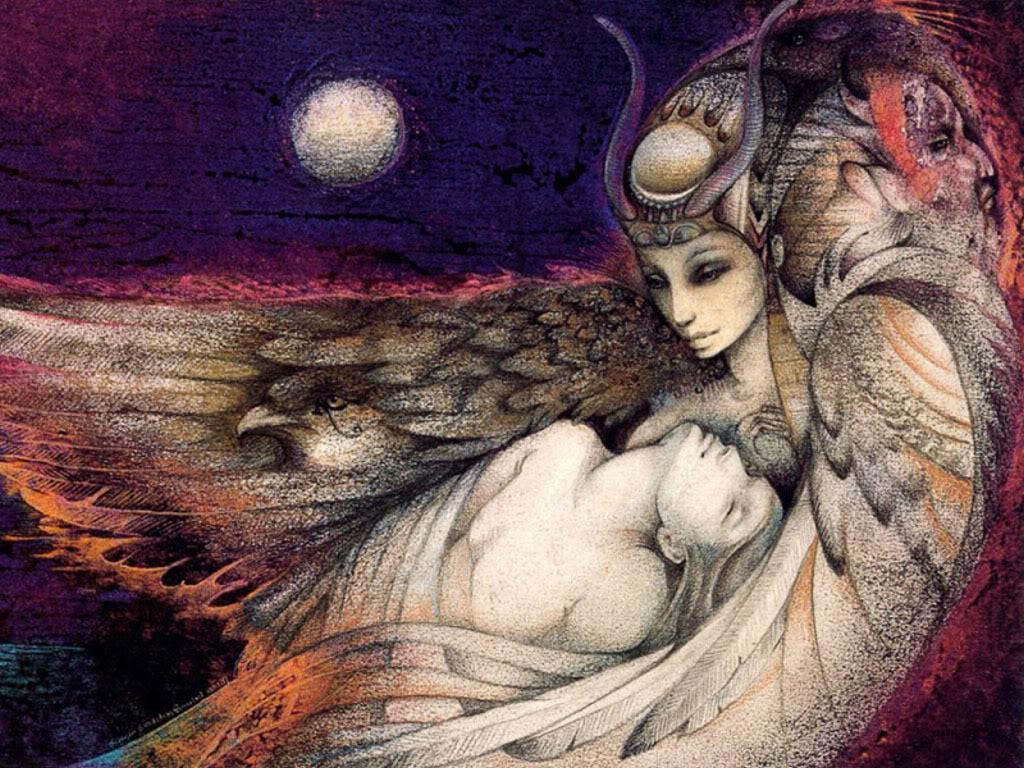
Susan Boulet’s Isis and Osiris

pieces of Zaidesahki’s soul and encased them in the body of a Tellurin who willingly sacrificed himself for the purpose.  She sealed Zaidesahki in a stone sarcophagus at the bottom of a lake in the middle of the continent.  She withdrew to the sea and became silent. (Based in part on the myth of Isis and Osiris, and in part on Arthurian Legend.)

Freyesahki and Dwergesahki remained what they always were, flighty and stoic respectively, and nothing more was heard of any of the akhis.

Auraya returned to Tellurin to show off Auremon.  Having failed to find anyone else like herself in the entire universe, she clove herself in two, creating Auremon her other half and spouse/consort. (Derived from a tale of how the Celtic goddess Aine fell in love with her reflection in a magic mirror that showed her the masculine part of her, or animus, and subsequently brought him to life.)

She was greeted with the desolation of her first “children” and the chaos of a million different life forms all clamouring for help and guidance.  The watchers, as ever, were silent.

Auraya vowed never to leave her beloved Tellurin again.

Auraya and Auremon began immediately to help the denizens of Tellurin, Auraya from her new home in the blue moon and Auremon by walking among the people in their guise.  Soon it became a titanic task for even the two celestial beings.

They determined to create two of their own children, helpers in their task.  Tryella was much like her father, adventurous, playful, and interested in getting her hands dirty.  She too, like Auremon, walked among the people of Tellurin and helped them in the disguise of one of their own.

Yllel was more introverted.  He resented the time and attention that the denizens of Tellurin exacted from his family.  Attention he thought more befittingly belonged to him.  He only helped the people of Tellurin when forced to and while neither Auraya nor Auremon chastised him for his lack, the praise they lavished on Tryella for her efforts made Yllel feel all the more jealous.

He began to sabotage their efforts in subtle ways, but bored of that quickly.  His attention was then captured by the sourcerors.  These people had recognised in themselves the ability to access and manipulate the innate power in all things.  They called it the source and themselves sourcerors.  Yllel realized that these sourcerors had much to teach him.  After all, what was he but source?  How did the gods manipulate the world around them but through the use of source?

When they began to kill one another and steal each others’ source, Yllel learned the art.  When they developed binding as a way to protect themselves from one another, Yllel paid careful attention.  Soon the god willingly masqueraded as a Tellurin to kill sourcerors and take their source.  Then a truly devious idea occurred to him.  Soul and source could be bound to other objects and even people.  What would happen if he tricked someone, or several someones into binding their source to him while they still lived …  And so Yllel created the first and greatest of his soul contracts, that with the favrard.

The favrard still lived on Tahesahki in isolation from the main continent.  They were in the midst of a battle against the other denizens of Tahesahki: the krean.  The lower race, as even the krean fancied themselves, were numerous in the extreme.  Though short-lived, the krean possessed the ability to regenerate, or heal themselves (essentially trolls, but sea-faring as well as desert-dwelling). Sheer numbers were taking their toll on the valiant favrard and they faced extermination.  In their darkest hour, Yllel came to them, putting on his most beatific form and manner.  He easily tricked the favrard into signing over their source and souls to him while they still lived, to be his slaves in perpetuity.

Binding the living to him taught Yllel much.  He did not get to claim the favrard souls and source wholesale until they died, at his hands or at each other’s, but he could use their source to feed himself even while they lived, and their connection allowed him to possess them from time to time at his whim.  It was as though a piece of him resided in each of them.  He could eavesdrop on any of them, or all of them, at will.

He experimented freely, and sometimes fatally with the first.  He learned just how far he could push them, exactly what he could make them do.  He wasn’t satisfied though.  They were still frail and mortal.  To make them immortal, Yllel would have to sacrifice too much of himself in the process.  His intent was to gather source, not expend it.  So he used his connection with the favrard to alter them.  He made them tougher, stronger, and imbued each of them with the incredible healing ability of their enemies, the krean, so that they could heal from all but the most drastic of injuries.  They would never grow old or ill, but they could be killed.

Yllel continued to make his study of the sourcerors.  One in particular was different.  His name was Halthyon, and he wasn’t a Tellurin, dwergen, dwergini, or any other people that walked on or under the earth.  Halthyon refused to give up his secrets, however.

It wasn’t long before Auremon, also seeing the sourcerors and what they did, but not understanding it in the same way that Yllel did, sought to bring even more source into the world for the people to benefit from.  He believed that if there was more power, more people could learn to use it.  Or more people would be born with the innate ability to access and manipulate the power, and he hoped that it would give them the ability to protect themselves from the worst of the sourcerors who only lived to kill each other and subjugate those of lesser talent.  So he determined to forfeit his godhood and release his power into the world.

Noble sentiments, but things don’t always go as planned.

When he released his power into the world, Auremon inadvertently tore open a doorway he hadn’t even known existed.  Speckled throughout Tellurin, and every world for that matter, are Ways Between the Worlds.  Yllel’s mystery sourceror, Halthyon came through one of these from the world of Elphindar.

Now Auremon tore that Way wide open, pulling a good half of the population of eleph, and many of the other animals, elementals, and other denizens of the world in a cataclysmic maelstrom.  Many of those so pulled died in transit, but those who survived found themselves stranded in a strange place and inexplicably unable to cross back through the Way to Elphindar.

They established their own settlements and learned of Auremon’s terrible mistake when in the aftermath of the Rending, he came to them and tried to make amends.  Their collective fear and anger and shame caused the eleph to reject Auramon’s overtures as well as those of the Tellurin, dwergen, or anyone else who came to trade or make alliances.  They became solitary, wounded people, and for a long time, there was no hope in them.

The cataclysm was a blessing in disguise, however, though one they would not understand for many sunspans to come.  Elphindar was already a dying world.  Auremon’s mistake ushered it on its way more swiftly, but the ultimate decline of Elephinar was inevitable.

Auremon’s mistake did not yield the results he had hoped for either.  No more people than before were able to sense and manipulate power.  He wanted to discover the reason why, but without his own, he was little more than a Tellurin himself.

He researched for a while, found like-minded sourcerors who thought the cannibalistic ways of their fellows and their experiments a form of heresy.  Together these sourcerors, guided by Auremon, devised a new way of viewing the manipulation of power.

By changing the names of all things sourcerous, they hoped to divorce ensuing generations of magi (as they now called themselves) from much of what was evil in their practice.  Source became magick and those who manipulated it were called magi.  A structured apprenticeship bound in ceremony and ritual and true research grounded the craft and made it “safe.”

A young mage was initiated by one of his elders when his talent was detected.  After thirteen sunspans of continuous study, the mage would be made apprentice and his abilities “unlocked.”  In truth the ability was never locked to begin with, but the young mage would be so occupied with his training that he wouldn’t have time to realize that small lie.

Auremon set up a school on a small but mountainous island off the coast of the main continent and magi from all over Tellurin would report for training.  Yllel, in the meantime, had been working hard to fortify his store of source and became contemptuous of his father’s attempts to “dumb down” the art of sourcery.

There were still sourcerors in the world and more recognized their abilities all the time, but Auremon turned a blind eye to them, hoping, quite naively that if he just ignored them, they would go away.

Yllel disguised himself as a Tellurin again and approached his father’s school as an initiate.  He soon became a favoured student, completing all of his tasks competently and without complaint, but Yllel soon began to ask questions about sourcery and the sourcerous arts.

He was trying to expose the dullards his father was producing to the true art of which Agrothe magery was a pale imitation.  Eventually, Auremon invited Yllel to a private meeting.  As he was trying to enlighten what he thought was a simple student, Yllel took advantage of their seclusion and murdered his father.  There was no source left to take, and this left Yllel frustrated and empty.

To be continued …