Mini disclaimer: These are my notes and may contain errors. Got corrections? Email: melanie (dot) marttila (at) gmail (dot) com
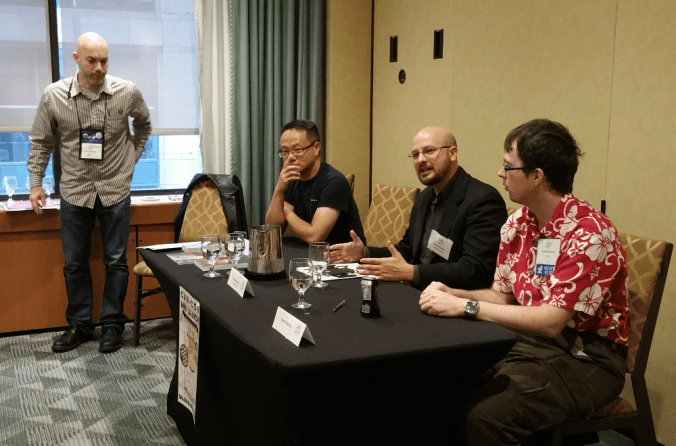
Panellists: Trevor Quachri, Wolfram Lunscher, Eric Choi

TQ: What do you think would be the most promising method of space travel for the exploration of the solar system?
WL: Nuclear-powered space travel. Once you’re in space, chemical rockets make less sense. NASA has developed a reactor the size of a fridge for interplanetary travel. Financing of the Mars program has been a contentious issue, however, and, for now, the Russians are ahead of the West.
EC: There is a lot of optimism about space travel again. It’s the positive influence of science fiction. Are there negatives to the way fiction portrays space travel?
TQ: Not really. Except, “where’s my rocket pack?” People want access to this technology now. It’s hard to see the destination when the process is so drawn out. We need to encourage science literacy.
WL: 2001: A Space Odyssey shows the way it was supposed to work, the way we thought it would work. There was a lot of optimism. After the moon landing, we were going to establish a presence on the moon in the 70’s and then use that as a step toward Mars, and eventually Jupiter.
EC: Fred Ordway was the advisor for 2001. They showed the use of flat screen monitors and newspads. While we don’t have human exploration of the Jovian system, in terms of the other technology featured in the film, we’ve been there and beyond.
TQ: The human interest aspect is crucial. We lose some of the romance when we compare what’s actually happening with what’s portrayed in science fiction.
WL: Space exploration was a human endeavour in the 50’s ad 60’s. That robots would go first wasn’t part of the picture. Arthur C. Clarke followed up on this with the message the monolith transmitted. There was a documentary on Discovery about a manned mission to another planet. The craft was totally automated.
TQ: In some fiction, automated probes are designed to build habitat and biological bodies for scientists, then the scientists’ consciousnesses are transferred into the remote bodies.
WL: They’re looking at similar possibilities for the moon.
EC: In Stephen Baxter’s alternate history Voyage, Kennedy survives and the mission to Mars is accomplished in the 70’s. They swung around Venus. We know more from robotic probes than the characters were able to gather. What are the hurdles we need to overcome to make this kind of vision happen?
TQ: Public interest needs to be sustained over long periods of time. This is the primary challenge. Science fiction is optimistic that we can overcome the obstacles.
WL: The biggest hurdle is money. We have to invest heavily to make the vision a reality. The money spent on The Avengers: Age of Ultron exceeded the cost of the last probe sent to Mars. The money being generated from the space program isn’t being realized in the same amounts as the money being invested into it. The money comes from the government or military, so it becomes politicized. It’s all quid pro quo. We need to build an industrial space infrastructure that will lead to colonization. There are parallels to be drawn to the discovery of the New World.
EC: William Proxmire, a former US senator, created the Golden Fleece Award, and gave it to scientific experiments that he considered to be the biggest wastes of taxpayer money. A number of them resulted in advances, but it just reflects his misunderstanding of science and scientific enquiry. Niven and Clarke both wrote stories about him. Sagan knew that Proxmire was opposed to SETI, but the senator was also concerned with the nuclear arms race. Sagan framed SETI in terms that were attractive to Proxmire and was able to get support for the project.
Q: How do private enterprises figure in?
TQ: Heinlein pre-figured that private industry would be responsible for our exploration of space. The Military-industrial complex worked toward it. Outside of public good, how do they identify the cost effectiveness of their efforts?
WL: What goes out has to come from somewhere. Rocket Ship Galileo was owned by the older brother of one of the characters. Serenity was bought in a junkyard. Elon Musk doesn’t fund Space X entirely out of his own pocket. NASA is his partner. They’ve faced hardship because of rocket explosions. That’s how research and development goes, though. Sometimes experiments fail.
TQ: In the golden age of science fiction, the archetype was the two-fisted astronaut-explorer. Now characters fit into the Elon Musk or Tony Stark archetype.
WL: In Clarke’s Prelude to Space, the mission tot he moon was funded by the last millionaire in England who bequeathed his fortune to the space program. The general belief is that mad scientists working in basements come up with all of the scientific innovations. In reality international teams of scientists do that work.
TQ: It’s a childhood fantasy, though. People have been building rockets in their back yards.
WL: Larry Niven isn’t just an author. He was involved in the Strategic Defence Initiative, the Citizen’s Advisory Council on National Space Policy, and an advocate for the Single-Stage-to-Orbit concept. He’s advised the Department of Homeland Security.
EC: Elon Musk was asked, how does one make a small fortune in space? His answer? You start with a large fortune. He went to Russia and tried to buy a rocket. It was beyond his means and so he started his own company.
WL: The question of security has been raised. What are they afraid of? That we’ll drag everyone to the trailing edge of technology? It’s so expensive because, to this point, most projects have been one-offs. One shuttle. One space station. Or the numbers have been limited. It’s the opposite of manufacturing. We need to think of efficiency and reusability for space exploration to move into the future.
And that was all we had time for.
Fascinating. Thoughty, even 😉
Next week, I’ll be coming to my last report from CanCon 2015. Sunday was not only a short day because of travel, but it was also the day when I had most of my pitches and blue-pencils scheduled.
It’s been fun. I won’t have more convention reportage to share with you until after Ad Astra at the end of April. In the meantime, I’ll fill up Saturdays with movie madness, series discoveries, and next chapter updates. I might even muster a book review. You never know.
Have a great weekend, everyone!
 Always Looking Up