Storyteller is just another name for liar.
In grade one, I think all my classmates (and teachers) thought of me as a silly giggler, a liar, and cat-lady-in-training.
I didn’t even know how to write properly yet, so I exercised my creativity by telling my classmates in “show and tell” about the latest stray cat that I picked up on the way home. They’d always run away after a few days and so I could show the class a different picture from the cat book I’d checked out of the library and tell them that my latest find looked just like that.
Daydreaming was also a preoccupation. Because my dad had epilepsy, it was thought that I might too and that my habit of totally “zoning out” was actually petit mal seizures. Later in life, I was formally tested for epilepsy and there was absolutely no sign of it. I’d just delve so deeply into my fantasy world that there was nothing could tear me away.
If I was born 20 years later, I’d probably have been diagnosed as ADHD and drugged into submission. As it was, I was “spoken to” and ignored. I was deemed enthusiastic but disruptive by different teachers for different reasons.
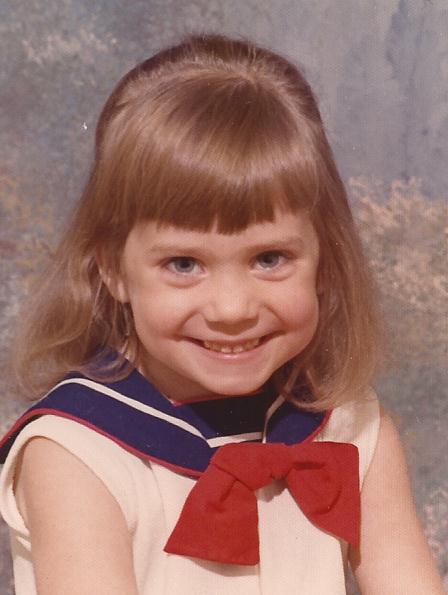
Can you see the mischievious? Just call me “wee devil” 🙂
Really, I was painfully shy, and the giggling was a way of deflecting uncomfortable situations, which meant pretty much everything. To this day, I still laugh when I offer a thought or suggestion to my colleagues or manager at work. If it’s too radical, my suggestion can always be dismissed as a joke, right?
The daydreaming-at-inappropriate-times thing stayed with me until my mid-twenties, and then I started to get clever about it. I’d restrict my mental ramblings to my “alone time” so no one would be put off by my apparent disinterest in whatever it was they were saying. Now I cultivate solitariness. As I writer, I have reason to, but as a creative soul, I simply can’t do without.
As for the telling of stories, I’ve always wondered what might have happened if someone had recognized what it was I was trying to express and encouraged me to turn those imaginary powers to something else. If I’d started writing my dreams and stories down earlier, where might I be today?
Ultimately what-ifs and might-have-beens are only intellectual exercises. None of us have do-overs.
A few months ago, one of the writers I consider to be a mentor, Barbara Kyle, presented this TED talk (via Volconvo) to her creative network: http://www.volconvo.com/forums/content/226-do-schools-kill-creativity.html
It is 20 minutes well-spent, trust me. Sir Ken is incredibly funny, but his message is dead serious. Currently, it is not the business of schools to nurture creativity, but to create useful/functional members of society. I rather agree with Sir Ken, that only by nurturing the creativity of our children will schools produce truly valuable members of the human community.
I’ve also been disturbed by the resurfacing of the ADHD debate. Are children being over diagnosed/incorrectly diagnosed? This debate has been around for decades and it still hasn’t been resolved.
Some food for thought:
- http://www.kelownacapnews.com/opinion/142856815.html
- http://www.medpagetoday.com/Pediatrics/ADHD-ADD/29063
- http://www.psychiatrictimes.com/adhd/content/article/10168/1926348
Were you a creative child smothered by a school system that didn’t recognize what your “acting out” meant? How did you come to understand your creativity and who helped you through that sometimes agonized and agonizing process? Did you ever feel less valued or less intelligent because you were more creative than academic?

 Always Looking Up