September 2008.
I don’t even remember specifically where I heard about the workshop. It might have been through the Sudbury Writers’ Guild, or through the Sudbury Arts Council. In any event, I learned of a relatively small event called the W.O.W. workshop. I believe that it stood for writers on the water. It took place in Bruce Mines, Ontario. It was a one day workshop and the featured speaker was Sue Harrison.
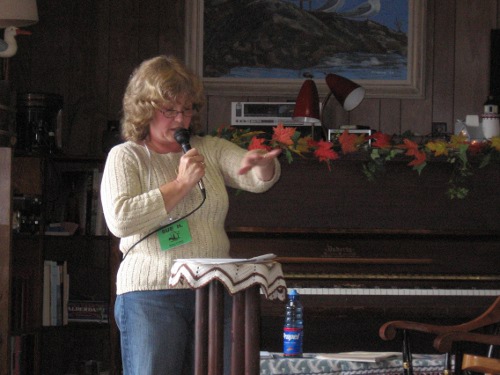 The first part of the workshop focused on character development and was excellent. Sue had several exercises worked out and all of the participants, regardless of their respective levels of professionalism, gained valuable insight into what makes a character come to life on the page. Sue read not only from Mother Earth, Father Sky, but from a new novel that she was working on.
The next part of the workshop was presented by Sue’s husband and focused on the publishing business and the important lessons they learned from their experiences.
Sue’s story is a fascinating one. She had been working on a novel based on the lives of the prehistoric Aleut tribes who populated the islands of the Alaska Panhandle. When she had it to the point where she felt she was ready to shop around, Sue started looking for an agent. She took the directory and started at “A,” sending out queries five at a time. Eventually she found an agent: her name began with a “W,” Rhoda Weyr I believe (yup, just checked the acknowledgements).
Sue was told that what she was presenting as her novel was in fact three novels crammed together. Sue was assigned the daunting task of dissecting her work and reconstructing it into three separate but coherent novels.
A confluence of events began to swirl around Sue’s work. The first was the runaway success of Jean Auel‘s prehistoric novels which created a ready audience. Another was a publishing industry in boom, able to invest in its authors. The third was an agent willing to find and fight for the best possible deal for her author. After finding several publishers interested in the novel that would become Mother Earth, Father Sky, Sue’s agent initiated an auction for the novel. The result was a phenomenal advance and promotional budget. Knowing that there were two other novels in the series made Sue’s first work an attractive commodity in the publishing world.
The road was not all paved with gold, however. Agents and editors changed. At one point, her work was “orphaned” by an editorial shift, jeopardizing publication. Sue and her husband were forced to become experts in publishing and contract law to protect their interests.
I can’t begin to tell you how informative the workshop was or how much I gained from the experience.
Sue was fantastic.
Have you met an expert in your creative field whose story you admired and were inspired by? Who was it, where did you meet, and what was the impact on your creative life?


 Always Looking Up