Draft two and what it taught me

I printed out and read through my first draft.  It was painful.  I made notes all over it and as I went, made additional notes on scrap paper.  Afterward, I physically mapped out my next revision.  At that point, it was just a bunch of pieces of paper floating around like a free-form puzzle on the table.  I looked for the pattern, made sense of it, and put the papers in ordered groups.

My scrap paper novel map

My scrap paper novel map

I revisited all of my previous work: the character sketches, plot sketches, and timeline.  The title changed again, finally to Initiate of Stone.  This emerged from the text itself, organically, the way I like it.

There were a number of metaphors and events that related to the earth element: taking shelter in caves and underground, the hidden people, who have a special skill with shaping the stone, whose father was the elemental spirit of the continent, now entombed in the mountains awaiting rebirth and acting as a kind of gatekeeper to the otherworld at the Well of Souls, the seal that must be broken to free the dark god is buried beneath the desert sands.

I decided to reinforce the theme and add to the images.  I made even more notes for all the changes I wanted to make and dove back into writing.

I wrote more, started playing with the prologue, nearly 50 pages on its own.  Each chapter now had a framing piece about the world, its history, and other things that I thought I couldn’t bring out in the story but wanted to share.  Characters developed further, names changed, existing plot lines developed, and new plot lines evolved.

I started sharing this revision out to select readers.  In retrospect, it was too early, but I got some excellent feedback from Scott Overton, then president of the SWG.

Part-way through, I abandoned the preface pieces, and decided that the prologue, though important for me to have written, was largely cut-worthy.  I redacted whole sections and added new ones.  I rearranged their order to make more sense with the timeline.

This time, the draft was close to 1200 pages.  I’d done a lot of cutting, so this was a surprise.

What I learned:

  • Step away from the novel between drafts.  You need figurative “space” to approach it fresh.
  • It’s okay to murder your darlings, especially if you keep previous drafts stored on your computer and backed up onto CD.  That way, you haven’t done away with them altogether.
  • Physical mapping is liberating.  Being able to see the structure of your novel, and to play with it, is extremely helpful.  It’s like putting a puzzle together.  Some pieces may seem similar, but they only fit together in one way.  Looking at the story in its concrete representation can help you to find the best fit.
  • Sometimes, you write things that don’t make sense, and you don’t see it until revision.  That doesn’t necessarily mean that to have to throw them out.  If there was a reason that you wrote it, try to figure out what the core intention was.  Don’t put too much intellectual pressure on it or you risk forcing it the wrong way, but if you realize why it was important to write it in the first place, that will give you the key to revising the section in a way that improves your story.

What has your revision process taught you?
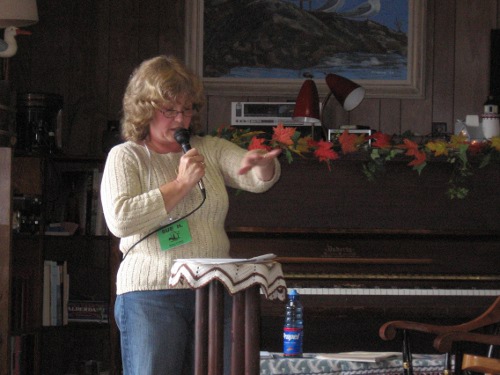
Sue Harrison

September 2008.

I don’t even remember specifically where I heard about the workshop.  It might have been through the Sudbury Writers’ Guild, or through the Sudbury Arts Council.  In any event, I learned of a relatively small event called the W.O.W. workshop.  I believe that it stood for writers on the water.  It took place in Bruce Mines, Ontario.  It was a one day workshop and the featured speaker was Sue Harrison.

The first part of the workshop focused on character development and was excellent.  Sue had several exercises worked out and all of the participants, regardless of their respective levels of professionalism, gained valuable insight into what makes a character come to life on the page.  Sue read not only from Mother Earth, Father Sky, but from a new novel that she was working on.

The next part of the workshop was presented by Sue’s husband and focused on the publishing business and the important lessons they learned from their experiences.

Sue’s story is a fascinating one.  She had been working on a novel based on the lives of the prehistoric Aleut tribes who populated the islands of the Alaska Panhandle.  When she had it to the point where she felt she was ready to shop around, Sue started looking for an agent.  She took the directory and started at “A,” sending out queries five at a time.  Eventually she found an agent: her name began with a “W,” Rhoda Weyr I believe (yup, just checked the acknowledgements).

Sue was told that what she was presenting as her novel was in fact three novels crammed together.  Sue was assigned the daunting task of dissecting her work and reconstructing it into three separate but coherent novels.

A confluence of events began to swirl around Sue’s work.  The first was the runaway success of Jean Auel‘s prehistoric novels which created a ready audience.  Another was a publishing industry in boom, able to invest in its authors.  The third was an agent willing to find and fight for the best possible deal for her author.  After finding several publishers interested in the novel that would become Mother Earth, Father Sky, Sue’s agent initiated an auction for the novel.  The result was a phenomenal advance and promotional budget.  Knowing that there were two other novels in the series made Sue’s first work an attractive commodity in the publishing world.

The road was not all paved with gold, however.  Agents and editors changed.  At one point, her work was “orphaned” by an editorial shift, jeopardizing publication.  Sue and her husband were forced to become experts in publishing and contract law to protect their interests.

I can’t begin to tell you how informative the workshop was or how much I gained from the experience.

Sue was fantastic.

Have you met an expert in your creative field whose story you admired and were inspired by?  Who was it, where did you meet, and what was the impact on your creative life?

Nino Ricci

October 21-22, 2006.

Through long-standing member Rosanna Batigelli, the Sudbury Writers’ Guild was able to arrange a workshop with Nino Ricci.

The first day of the workshop was devoted to the author sharing the insights into the writing life that he learned through his experiences.

One of the most helpful stories shared (for me) concerned Nino’s struggles through graduate school.  I was still grappling with a pretty powerful “guardian at the gate” of my own and his tale gave me hope and inspiration.  Not to be overly dramatic, but it spoke to my writer’s soul.

While working on his graduate degree at York University, Nino’s advisor was none other than W.O. Mitchell.  He’d given Nino some negative feedback, but Nino, though discouraged, determined to find his own way through the novel.

We all have our gatekeepers to circumvent, and if a Governor-General’s Award winner could be successful despite his, then it gave me hope that I might be able to as well.

On the second day, we workshopped our poetry, short stories, and novel excerpts.  I received some excellent feedback and to this day, I credit the workshop with inspiring my own rededication to the writing life.  You may remember last week, I mentioned that I’d been writing agnostic for years …

After this workshop, I dedicated myself to daily writing practice in a way I frankly never had before.  Despite work and other life challenges, I had my first draft finished just under two years later.  It may not seem like a monumental accomplishment, but it was the first full draft of a novel I’d ever written.  It taught me a lot, and I have Nino Ricci to thank for it, at least in part.