Wordstock Sudbury

Today, I was pleased and privileged to be a part of Wordstock Sudbury, the first of what is hoped to be a biannual literary event.  At the Sudbury Theatre Centre (STC), Wordstock took over the main stage, lounge, and lobby areas for readings, workshops, and the essential selling of books.

If you would like to have a look at the full schedule, it is available on the site linked above.

I attended primarily to support my friend, poet Kim Fahner, and my fellow members of the Sudbury Writers’ Guild (SWG).  I also read the recently revamped opening of my novel.

Kim read with former Sudbury Poet Laureate Roger Nash, and Charlie Smith from Massey, all of them published by Your Scrivener Press (YSP).  The theme of their reading was Home and Away.  Though all three have very distinctive voices, the reading went well and had a seamless feel.  It’s always a pleasure to see such consummate professionals perform their works.
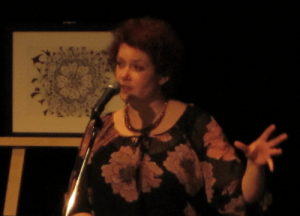
KimFahnerOf course, Kim was fabulous 🙂  She has a way of addressing the audience, slightly self-deprecating yet hilarious, that establishes a relationship.  We feel instantly at home with her, and completely comfortable as she shares pieces of her life in verse.

After a brief break, Sudbury Arts Council (SAC) president, Vicky Gilhula took the stage and presented the youth writing contest winners with their prizes.  One young man (forgive me, but I forget his name) came prepared to read and his story, based on his grandfather’s life in Sudbury and his career in the mining industry, was spectacular.  Amazing: a thirteen year old young man had the confidence and presence to bring us to tears.

He was that good.

Next, the SWG took over the auditorium, beginning with Rosanna Batigelli, who read a RosannaBatigellicouple of chapters from her historical novel, La Brigantessa.  The novel’s protagonist takes to a life of a brigand when she is assaulted and forced to leave her home by a tyrannical general.  Rosanna is in the process of revising her novel for publication.
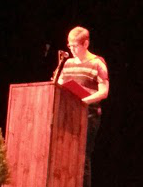
EmilyDeangelisEmily Deangelis read from her middle grade/young adult novel about a young girl who loses her father in a car accident and subsequently experiences supernatural visitations when she is left with her great-aunt in Manitoulin Island’s Meldrum Bay.

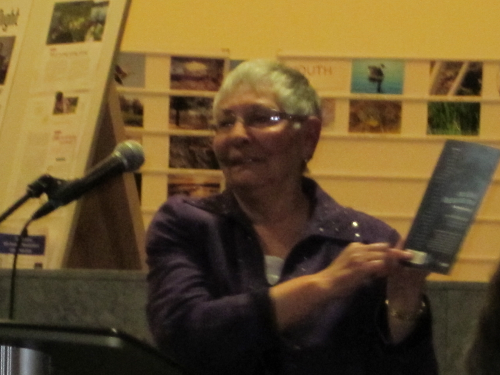
Irene Golas read a selection of her poetry and flash fiction.IreneGolas

Tom Leduc read a number of his poems centering on his experience of Sudbury and its mining industry.

MargoLittleMargo Little from Manitoulin Island read some of her works published through projects of the Manitoulin Writers’ Circle including one on the War of 1812 and how the soldiers of the time became enamoured of their muskets, called Brown Betties.

Janice Leuschen, a member of both the SWG and of the JaniceLeuschenProfessional Writers Association of Canada (PWAC) read one of her stories, and Heather Campbell, also a member of PWAC, finished off the session with a discussion of creative non-fiction.

I read just after Margo and just before Janice.  I don’t have any pictures and I’ll reach out to my fellow guildies to share any pictures they may have of me at the event.  It would be a lovely remembrance of the day.  Sincere thanks in advance 🙂

As I mentioned, I read the revised opening of Initiate of Stone; it was my first public presentation and I received some excellent feedback from Kim and Emily.  The technical director of the STC also found me in the lobby and complimented me on my reading.

I have often been told that I have a great voice.  It’s one of the things that helps me both as a corporate trainer and as a writer, a learned skill from my days as a poet, honed by years of practise.  I tend to a literary style, even though I write genre, and the voice creates an appropriately dreamy backdrop for my words.

After the SWG session was over, playwright Matthew Heiti took the stage to host a series of readings from plays in which one friend, Paulette Dahl, was reading from a play by another, mutual friend, Louise Visneskie.

The English Arts Society of Laurentian University also hosted a reading, Heather Campbell hosted a workshop on the creative process, and Roger Nash and Daniel Aubin, Sudbury’s current Poet Laureate read their poetry.

And all of that wasn’t counting the Friday night cabaret, the children’s and young adult programming on the patio, or any of the other workshops and events that I couldn’t attend.

Though attendance was modest, I think that it was a good start.  The hope of the organizers is to grow Wordstock into a full literary festival at a larger venue, or at several venues throughout the city.  I wish them the best and applaud them for this year’s event.

I had a blast 🙂

The Next Chapter: Progress by inches (and bounds)

It’s been a while since I’ve posted about my progress, or lack thereof, on my writing.

Initiate of Stone

I’ve been struggling to rewrite my first chapter.  I’ve now made progress, after writing, and rewriting it several times.  I really had to go back and decide what it was necessary to accomplish in my opening chapter.

A short list:

  • Introduce my protagonist – Ferathainn, or Fer, is fifteen, and her coming of age is in two moons, at the next goddess festival, Sestaya.  She wants to become an Agrothe mage, and will be the first girl to do so in a very long time, but she chafes under the tutelage of her master, Aeldred.  Fer has been studying from the moment she wakes to the moment she sleeps (except festival days) with Master Aeldred for 12 turnings of the sun through the seasons, but it’s all been mundane. He’s forbidden her from using her innate talent, to speak with the spirits, or souls, of animals, plants, elements, and perhaps even people, like he controls who the spirits speak to …  Fer desperately wants to be initiated so she can start using her talent and learning “real” magick.  She knows she’s capable of more than what Master Aeldred permits her to do.  The process is long and demanding, though, and she will have to make sacrifices.  She loves Leaf, the eleph finiris, or song master, and will marry him on Sestaya as well.  She sees her astara, or soul-lights, in his eyes, something that only the eleph are supposed to see.  She’s not so sure about children, though they seem to be the natural consequence of marriage.  She’s just been so long separated from other girls her age by her studies that she wants something that everyone else takes for granted.  Fer worries that love, marriage, and family will be the sacrifices that she will have to make to become a mage.  She’s determined to have at least love in addition to the solitary life of a mage.
  • The “normal” world – Hartsgrove, Fer’s village, is a “free town” and the eleph and people of Tellurin live side-by-side in relative peace.  It’s an agrarian village that sends tributes to the surrounding, larger, towns and cities to show fealty and secure support in times of need.  The predominant religion is worship of the Goddess Auraya, creatrix of Tellurin.  Every year the season of Vedranya brings deadly storms to besiege the land.  This has been the way of things since the Cataclysm, two centuries before, changed the face of Tellurin and reduced much of Tellurin civilization to rubble.  Fer lives in a small, but sturdy cottage, with her mother and father, Selene and Devlin, a seer and a bard respectively, and her younger half-sister, Aislinn.  She has never left Hartsgrove.
  • Hook the reader – What’s the root cause of Fer’s resentment of her master, the man who could grant her wish to become a mage?  Why does he want to keep her from using her talent?
  • Ask a question (that needs to be answered by the end of the novel) – What is the secret Master Aeldred feared so much he magickally bound Fer’s friends and family to silence?
  • Foreshadow the inciting event – An earth elemental, or nomi, tells Fer the secret is a potentially deadly one though it cannot more than hint at the nature of the secret; she must be strong to face the trials to come.

So I’m slowly working my way through the list without dumping too much backstory or world building on the reader.  Beginnings, why are you so hard?

Some links about beginnings:

On a whim, I’ve signed up for Margie Lawson’s course, A Deep Editing Guide to Making Your Openings Pop, starting May 6, 2013.  She focuses on psycho-linguistic and rhetorical techniques to improve your writing.  My undergrad was focused on rhetoric and I love psychology, linguistics, and brain science, so this looks like it’s right up my alley.  Will let you know how it goes.

I might do the crazy and send my beginning (when I’m more or less happy with it) to Ray Rhamey’s Flogging the Quill to see if it passes his test.  Stay tuned.

Short Stories and poetry

Well, so far, I’ve kept up with Kasie Whitener’s Just Write short story challenge.  I’ve written a completely new short story for each of January, February, and March.  I’m a little behind in April, and may opt for flash fiction to make up the short fall.

The short story that I revised and sent to On Spec in January has been accepted (!)  I am very (like !!!!!!!!!!!!!!!!!!!!!!!!!!!!!!!!!!!!!!!!!!!!) excited about this, even though I know that it won’t be in print until sometime next year.  I’m looking forward to working with their editorial team to whip “Downtime” into shape.

“Beneath the Foundations (original story #2),” my attempt at medieval Cthulian for Sword and Mythos was rejected.

“A Terrible Thing” was rejected by the editors of Tesseracts 17.

It’s too early to have heard back from either Writers of the Future, to whom I sent “The Gabriel,” or In Places Between, to which I submitted “Molly Finder (original short story #3).”

There wasn’t room for my poem “peregrine” on the League of Canadian Poets National Poetry Month blog, but I have subsequently submitted that poem plus two more, “contain you” and “infant crawls,” to Sulphur.

From last year’s submissions, I learned that my submission to Mark Leslie’s Spooky Sudbury will be included in the publication, and my poem, “north of thule” was included in the fabulous Sopphey Vance’s Enhance no. 11.  It’s been a good month (and a bit) for happy dancing!

I’m going to work on something flashy this week to round out April’s short story quota, and set to work on another original for May in hopes of garnering some attention in the Rannu Fund competition.May Submit-o-rama Choice

I’ve joined Khara House’s May submit-o-rama and have committed to 1 submission per week in the Choose Your Own Challenge category.  Rannu will make up only one of those, so I’ll have to get my arse moving on identifying other submission opportunities (!)

Critiquing

Actually finished the BIG critique for my online group and am working on a review of the first 100 pages of another online critique buddy.

Have only three people left to critique for the Sudbury Writers’ Guild before I’m caught up with them.  We’re trying to get our stories and poetry together for an anthology.  I put forward “A Terrible Thing” and “Old Crow,” another short story of mine that was rejected by Tyche Books last year (Masked Mosaic anthology).  It looks like “Old Crow” might be salvageable as a short story, but that “A Terrible Thing,” as editors have said—and I’ve thought—in the past, is really a novel in the making.

Conferences

A local effort, Wordstock, will be happening June 7 and 8 at the Sudbury Theatre Centre.  This is the first year for the event, and the organizers are hoping to build on what they hope to be this year’s success.  The SWG has a block of time for readings.

I’ve registered for the Canadian Authors Association CanWrite! conference in Orillia, June 12-16, and booked my room in the Orillia campus of Lakehead University.

I’m still waffling about When Worlds Collide August 9-11.  The registration fee is reasonable in the extreme, but I still have to bear the cost of the flight and accommodation.

One reason I’m waffling is because I want to go to the Surrey International Writers’ Conference this year (Oct 25-27).  Domestic flights are sooooo expensive.  Right now, a return to either Calgary or Vancouver for the conference dates is showing as over $1000.  It may be an either/or kind of thing for me.  Or I might just cash in my Avion or Aeroplan points for one or the other flight.  That’s an idea!  Thanks for letting me suss that one out online 😛

I think that’s all the conferencing I can take for this year.  Next year, I hope to add some fancons like Ad Astra.  We’ll see how the financial situation sits.  And my various air rewards plan balances 🙂

Other stuff

Taxes done and refund received 🙂

Am still putting off the decision to move to WordPress.org.  I think I just need some dedicated time to devote to research and reflection.

Hope all is well with you and your writing lives.

I’d love to hear from you about your latest literary adventures!

Tonight’s viewing line-up: Doctor Who and Orphan Black!

Tomorrow, I’ll share my thoughts on happiness and how my experiences have influenced my writing in the final instalment of a life sentence with mortal punctuation.

A life sentence with mortal punctuation: part 8

How did what was supposed to be a mere two-part guest post get to be this huge?  I think it’s what project managers call “scope creep.” 🙂  Essentially, the story demanded something more, and as with many of the things I write, it told me the shape it wanted to be in.

Thanks to everyone who’s stuck with me through this very personal tale.  If it touches you in any way, I encourage you to like, share, comment, or subscribe as your conscience dictates.

I’ll take the opportunity here to remind everyone that while this story is based on my life, that it is filtered through my frame, and is, no more and no less than anything else I write, a story.

Last week: I discussed some of the things that I do to keep the wolf of my depression from the door, or perhaps invite it in, let it curl up by the hearth, and make itself at home.

This week I’m going to pick up the original thread of the tale where I left it.

Those sixteen years

The years during which I was “growing up,” getting a job, and learning how to deal with my depression were largely fallow ones for me creatively.  I got off to a good start in my undergrad years, both at Guelph and at Laurentian, but faltered during my struggle to achieve my master’s degree.

Though my primary poetic publications, NeoVerse and Battle Chant, emerged around the time that I finally received my graduate degree, I found it difficult to continue writing.  A handful of scattered publications in poetry and a short-lived foray into publishing weren’t enough to validate my still-fragile writer’s ego.

I’ve never had a thick skin.

As I slowly worked through my issues, however, I started to realize that writing wasn’t something I did or didn’t do.  It’s something I am.  My inability to commit to the writing life on a regular basis made me question my calling.  If I couldn’t write, how could I call myself a writer?  Maybe it was time to throw in the towel and commit to a life without magic.

The sheer impossibility of that thought told me that writing was what I was meant to do.  I just had to find my way to it without a map or any orienteering skill whatsoever.

Upon my triumphant return from Windsor and contract jobs interspersed with unemployment, Phil and I decided to get a puppy.  We already had two cats, one a three-legged refugee from my days at the Veterinary Emergency Clinic in Mississauga, the other a sweet-natured black cat that Phil got me for my birthday one year.

Our dependent quadrupeds helped me immensely.  I believe that pets have a lot to teach us about unconditional love and being good people.  My pets are some of the best people I’ve known 😉

I got my full time job with my current employer.  Phil and I got a house and a car.  I made use of my new benefits to get some serious work done on both my body and my mind.  I figured out that medication was not the way to address my feral disease.

My mother was still working, part-time at the local hospital, at home, taking care of my father, who had graduated to a disability pension and therapy, and at the seniors’ residence where my grandfather now lived.

I went out with her to see my grandfather about once a week, and helped her to transport him to his various appointments.  My father began to have issues with his heart, eventually diagnosed as arrhythmia and congestive heart failure.  He got a pace-maker, and a new suite of medications.

Shortly after retiring from the hospital, my mom developed diabetes.  Dad started to fall.  If it happened at home, either Phil or I, or both of us would have to help Mom, because Dad couldn’t get up under his own power and she couldn’t lift him.  If it happened outside home, it generally involved a hospital stay.  Dad was on Cumadin by this time and as a result, even the smallest injury could become serious due to the complications of the medication.

Then my dog died

ZoeIt wasn’t something sudden.  Zoe developed hemangiosarcoma and though we caught it early, the vet wasn’t able to catch it all with surgery and internal lavage.

The issue with this particular type of canine cancer is that it likes vascular areas, that is, places in the body where blood vessels tend to gather, like the spleen and the liver.  Once it takes hold, it disseminates quickly and almost always results in death.

The biopsy taken in the surgery came back malignant.  It would only be a matter of time.  As it turned out, we only bought Zoe a couple of weeks.

At first, it seemed like she was recovering.  Phil and I had taken to sleeping on the futon in the living room so we could be close to her if problems arose.

The morning she woke me at 5 am looking for comfort was her last.

I won’t describe that morning other than to say that I called in sick.  I was devastated.  For the first time, I cried legitimately over the loss of a loved one.

Papa

My maternal grandfather was the only one of my grandparents left alive.  He’d been a hard-core smoker, and alcoholic for most of his life.  When my grandmother passed away, he reacted poorly and within a few months, a fall resulting from TIA, landed him in the hospital.

From there, arrangements were made to move him into a seniors’ residence and for many more years, he lived happily, adjusting to the fact that he couldn’t drive anymore, that he had to go outside the residence to smoke, and that he had to depend on my mother to ration him a few beer on special occasions.

Some irregularities regarding his heart landed him in the hospital and when I got the call at work that I should come to the hospital, I had a bad feeling.  In the time it would take me to get the car, drive to the hospital, find parking, and get to his room, I could walk, so I sped along as quickly as I could, hoping that he would hold on long enough for me to get there.

Turns out he’d already passed away when I got the call.

Papa’s passing wasn’t all that traumatic for me.  He’d lived 94 years despite his addictions and was, so far as I know, happy.  I also felt confident that I had been there for him as much as I could.

I helped Mom settle his estate.  Being able to help her out in that way made another big difference for me.

I received a small inheritance, just enough to invest in my first laptop computer.  That year, I started to get back to my writing and the novel I’d conceived of all those years ago in university.

In another year, Phil and I felt that we could bear the love of another pup.  That was when we got the Nuala-beast.

The butt-in-chair breakthrough

Though I was writing more, I wasn’t writing daily yet.  It wasn’t until Nino Ricci came to town to do a workshop with the Sudbury Writers’ Guild that my head got turned around the right way on that.

It was his sharing of his own guardian tale that helped so much.  Every writer has at least one, that big name, well-established Author who tells you that your work is crap.

The breakthrough was that I could choose not to let the well-meant, but unfortunate words of my guardian keep me from entering the inner sanctum and gaining my prize.

Productive or not, I’ve been writing every day since, and that, as the poet said, has made all the difference.

The diabetic cat

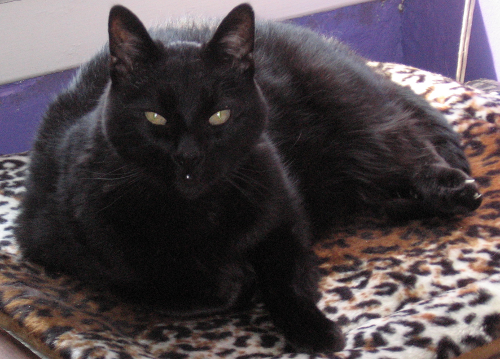
Our little black cat, Thufir (named after the Mentat Thufir Hawat due to his fondness for Thufir Hawat the Mentat Catflashing lights) developed feline diabetes.  Phil and I were surprised because he wasn’t obese or showing any of the other signs, but his blood glucose level didn’t lie.

He was on Metformin for a year and graduated to insulin after that.  I became very adept at taking his blood sugar levels and injecting him daily.  He came to tolerate, if not anticipate his injections, like he knew that they made him feel better.

Once again, however, it was a matter of time.  Eventually, organ failure took out little guy.

I wasn’t sad this loss either.  I’d been the best kitteh-mama I could have been and I knew that I’d done well by him.  I’d kind of made my peace with death by this time.

I’m going to leave things here for now.  The next big event for me was the death of my father, and that’s going to need a post unto itself.

After that, I’m going to delve into my insights into happiness as a result of all I’ve learned and that will be the culmination of the series.

Tomorrow I’m going to be writing the Wordsmith Studio Anniversary post 🙂  What’s that, you ask?  Read and find out, my friends.

Coming soon: I have a few wonderful authors who have agreed to do interviews for little ole me.  Look out in the next few weeks for six questions with fantasy author J. L. Madore, poet Barbara Morrison, and D. J. McIntosh, author of The Witch of Babylon, and the soon-to-be-released The Book of Stolen Tales.

I’m finding all sorts of writerly goodness to share 🙂

Caturday Quickies: Susan McMaster Workshop

Susan McMaster

Susan McMaster (Photo credit: pesbo)

When I originally indicated that I was going to change my blogging schedule to weekends only, one of my online writing friends commented on how wonderful the idea was of a ‘flurry of posts’ on the weekend.

I’ve been posting fairly consistently on the weekends since, but I realized that I have a few things to catch up on.  So this weekend, though the weather is sunny and cold here in the Sudz, I’m creating my own mini storm of blog posts.

Who is Susan McMaster?

Susan McMaster is a past-president of the League of Canadian Poets, poet, and spoken word artist.  She’s given a workshop in the north before, and this time, I decided to partake.

The Sudbury Writers’ Guild had enough funds in its coffers to pay Susan’s fee for the afternoon workshop and to secure space at the newly rebuilt south end branch of the Sudbury Public Library.

The theme of the workshop was Writing through the Emotions.

Susan gave a brief introduction and offered up a couple of samples of her work and the work of other poets to illustrate.  Breath and space seemed to be the key elements to evoking emotion in poetry, and so, when Susan gave us our writing assignment, I was expecting something a little different.

For the first part, we weren’t to write a single word.  Instead, we were to map out what we were going to write in terms of beats.  Long, flowing sentences would be represented by lines and short, curt sentences and breaths by carets.

Though I think several of us (fiction writers, in particular) struggled with the concept, we all dove in with enthusiasm and gave it our best.

Afterward, we had the opportunity to read from either our work of the afternoon, or something that we had brought with us.

Though only two and a half hours, the workshop was interesting and gave me a different way to look at my writing that I hadn’t considered before.

The Narcoleptic Madonna Launch, Dec. 7, 2012

Lovely night!  Music, poetry, and beautiful art.  Inspiring in all kinds of ways 🙂  Thanks, Kim, for putting together a wonderful evening.

My apologies though, for being late (!)  I knew I needed $6 for parking, but I was hoping that I’d be able to pay on exit and get some change at the launch, or, failing that, there would be some place on campus to get change, whether it be a change machine or store.  There was a store, but the vague directions of “down the hill” didn’t really help.  So I ended up stopping at a couple of different places and essentially going most of the way back home before I got the change I needed, returned, paid, parked, and finally got in.

It’s all on me, but I missed some of Kim’s opening remarks, including some very kind ones about myself.  If it’s possible to kick yourself in the ass, toe first (‘cause, come on, that’s the only way to do it so it counts), then I’d be doing it.

The day itself was a bit of a crap shoot for me.  I was ill (still am), but damned if I’d miss Kim’s launch and I am SO glad I made it.  Enough about me.

Kim Reading1Ever the gracious hostess, Kim started off with her acknowledgements to the people in her life who’ve been teachers, mentors, and friends on the way, to the artists who have influenced her and the experiences she’s had that have shaped her craft.

As mentioned in the interview I posted last week, The Narcoleptic Madonna has been twelve years in the making, and most of that time, Kim has been primary care-giver for her parents, both of whom have passed away.  Kim also struggled with depression.  This journey of love and loss, recovery and the process of reclaiming the self is the journey that Kim describes in the pages of TNM.

I’m not going to share any of her poetry here.  For that, you can friend Kim on Facebook, follow her blog, The Republic of Poetry, or, best of all, buy TNM, Braille on Water, and You Must Imagine the Cold Here, or any of the other anthologies that her work may be found in.  The experience of reading Kim’s poetry is well-worth the price of admission.

Kim reads with wit and élan, the genesis and process of her work as much a part of her presentation as the poetry.  At several points, she had the audience in stitches, and reached out to specific communities within her fandom (Catholic, fellow teachers, students, family, Irish heritage, etc.) with particular poems.

After Kim’s first set, she invited The Wild Geese of the Sudbury Branch of the ComTheWildGeesehaltas Ceoltoiri Eireann up to perform.  She sang “The Fields of Athenry” with them, her soulful vibrato pulling the tenderness and sorrow out of each verse and chorus.

In the second set, Kim delved into some of the darker moments of the past twelve years.  Then she moved into the process of how she began to reclaim her life and happiness.  She also read one poem that emerged from her recent visit to the Anam Cara Artist’s and Writer’s Retreat.

A second set of music from The Wild Geese followed in which Kim sang “Red is the Rose.”

After a brief but heartfelt thank you, we were released to refreshments, book-purchasing, and the long line-up for the signing.  Kim also made available a family “puffed wheat” recipe for those who’d been clamouring for it 🙂

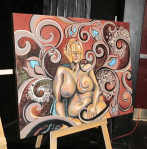
TrishStenbaughArt2I took a few moments to appreciate the backdrop for the event, the evocative art of Trish Stenabaugh, who contributed the cover art for TNM.

In the line-up, I had a chance to chat with a number of friends, Doctors Shannon Hengen and Marilyn Orr from Laurentian University, Karen Baglole, a mutual friend and owner of The Ultimate You, one of the best aesthetician/day spa joints in town, Irene Golas and Vera Constantineau from the Sudbury Writers’ Guild, and some other mutual friends.

By the time I reached Kim with my five copies, I could tell that the wrist cramps were KimSigningsetting in, but she bore up well and continued to smile and share a laugh with her friends throughout.

Several of the attendees have been posting to Facebook since last night that Kim’s event was the Best. Launch. EVAR.  I tend to agree.  Kim puts on a launch like she would a dinner party, inviting us into her world, asking us to make ourselves comfortable, and sharing her life and love generously.  Kim gives us gifts and we are happy to reciprocate.

Bask in the glow, my poetic soul-sista!  Ya done good 🙂

La Cloche Spirit: The Equivalent Light

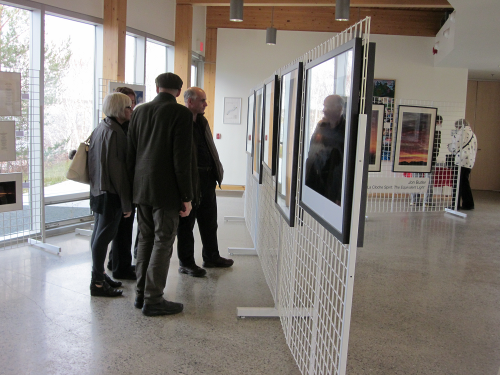
This afternoon, for a creative date, I treated myself to Jon Butler’s exhibit at the Living with Lakes Centre, La Cloche Spirit: The Equivalent Light.  I did some visiting with the photographer and some of my friends from the Sudbury Writers’ Guild, did some Christmas shopping, and generally had a lovely time.

Jon’s exhibit remains at the Living with Lakes Centre through to Friday, November 30, 2012.  Go consume the visuals.  They are eminently tasty 🙂

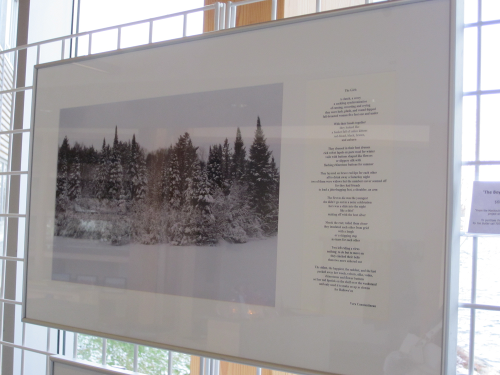
The photograph that lent its name to the exhibit is, I think, my favourite.  A thick fog rolls over the mountains, pools between them, as the sun rises through clouds, casting a purple strier effect across the sky.  Against the shadows of further mountains, two wisps of fog chase one another, the lead one almost looking as if it has a head.

If I had enough disposable income to blow, I’d be installing the mounting hardware about now and ‘La Cloche Spirit’ would be hanging in my office in short order.

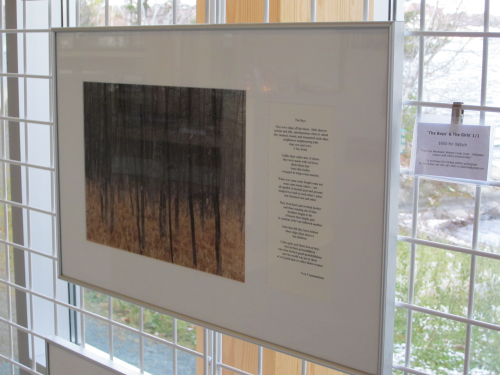
I first heard of Jon a number of years ago, through my SWG friend Vera Constantineau.  She and Jon worked together on an ekphrastic collaboration for the Manitoulin Writers’ Circle’s Cross-Pollination project.   She’s since teamed up with Jon again, and here are the wonderful results.

The two photographs reminded Vera of her family with the right number to reflect her aunts and uncles.  Her poems, entitled “The Boys” and “The Girls” were inspired by Jon’s photography.  “The Girls” has subsequently been published in The Antigonish Review.

Jon does a little of his own ekphrasis too.  In these two photographs, he’s written haiku on birch bark and inserted them into the frame.

In addition to the framed photographs, art cards are available for purchase, and Ian Tamblyn’s Willisville Mountain CD, also inspired by Jon’s work.

Apparently only a few copies of his coffee table book of photography remain at the Art Gallery of Sudbury, so if you’re in the market for a lovely Christmas gift, hit the AGS before they’re all gone.

It’s well worth your while to visit the exhibit, even if it’s only to gaze longingly at and be inspired by Jon’s beautiful photography.  Of course, you can also visit his web site or find him on Facebook if you want to know more about Jon and his work.

There’s still time if you want an evocative and uniquely northern Christmas gift 🙂

Our Lakes Shall Set Us Free – November 6, 2012

A chilly night for a poetry anthology launch, but as several of my Sudbury Writers’ Guild friends were featured in its pages, I couldn’t resist the opportunity to blog the event 🙂

A very well-attended event, as it turned out.  Parking was at a premium at the Living with Lakes Centre of Laurentian University.  With the poetry of 26 of the Northeast’s best and brightest featured, 15 of them reading that night, and with family and friends in tow, the lobby was filled to capacity.

Editor of the anthology, Roger Nash, started off the evening in lieu of publisher Laurence Steven, who was unfortunately ill.  Roger spoke of the anthology’s inception, the contest that generated its content, and how he was able to encourage Margaret Atwood (not having read her Web site and not knowing that she didn’t do such things) to write an introduction for the collection.

The Dean of Humanities and Social Sciences spoke to the interdisciplinary evolution of Laurentian’s programs: students in the sciences may minor in social sciences or humanities, and vice versa.  The Director of the Living with Lakes Centre then offered a few words about his support for the anthology and how the centre is invested in the local arts community.

Then the poets in attendance were invited to come up and read.

Tom Leduc, the contest winner, read his poem “My Northern Lake.”

Mandy Steele, the youngest poet in the anthology, asked her father to read her poem, “White Water.”

Kim Fahner read “Tai Chi on Ramsey,” a poem inspired by fellow writer Rick DeMeulles.

Irene Golas, fellow SWG member, read not only her haiku sequence, “Weekend at a Northern Lake,” but also returned later in the evening to read the tanka sequence of her Breccia collaborator, Ignatius Fay.

Dillon Daveikis recited her poem, “A Lake’s Journey,” from memory.

Rebecca Salazar read “First Alchemy”; Danielle Pitman, “The Dive”; and Dr. Dieter Buse read his poem, “To Children Under Ninety in a City of Lakes.”

Connie Suite read her poem, “Born to Fish” and 90-year old Greg O’Connor asked his daughter to read his poem, “Gone Fishing.”

Christine Poropat read “Pure Dreams” and Rosemarie Mirfield read “World Under.”

The evening came to a close on two more SWG members, Betty Guenette, reading “Poor Minnow,” and Margot Little reading “Shell-Shocked.”

It was a wonderful night of great poetry in a variety of forms.  The anthology is divided into themed grouping of poems: Our Lakes Shall Set Us Free, Voyaging, Taking the Plunge, Gone Fishin’, The Seasons, and Urban Jungle Lakes.

The first printing of the anthology, priced at a reasonable $12, is already almost sold out.

Get yours while they last 🙂

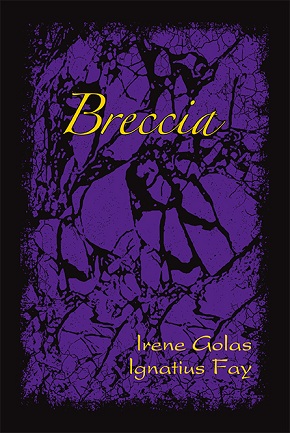
Breccia: An interview with Ignatius Fay and Irene Golas

Irene Golas discovered the world of haiku when she purchased a slender volume of Japanese nature poetry in a gift shop in Elmvale, Ontario. She was immediately drawn to the brevity and concision of the haiku form. Her first haiku were published in 2005, followed by her first tanka in 2006.

Ignatius Fay is a retired invertebrate paleontologist who began writing haiku and related forms of poetry primarily for his own pleasure and as a means of personal expression. His first published poem appeared in 2008, the same year he published a small book of haiku/senryu, Haiga Moments: pens and lens, with photographs by Ray Belcourt, of Leduc, Alberta. In 2011, he published Points In Between, an anecdotal history of his early years.

Irene and Ignatius have been published in many print and online journals, including Acorn, Eucalypt, Frogpond, and The Heron’s Nest. Irene’s poems have also been chosen for a number of anthologies. Both authors reside in Sudbury, Ontario.

___________________________________________________________________________

WG: How long have the two of you been working together?

Irene: I’d known about Ignatius since 2008, but it took me a while to find any contact information. I emailed him in the summer of 2010, asking if he’d be interested in corresponding about the art and craft of haiku. There aren’t many haiku poets in town! At first we talked in general terms about books, haiku and other poetry. Soon we were exchanging haiku books and journals and some of our unpublished work. By the fall of 2011, we had developed a mutual trust and a respect for the other’s judgment. This is when the idea of a collaborative publication first came up.

Ignatius: Irene and I are alike in that we are straightforward when asked an opinion. Our intent is always positive, to help each other become better poets. I don’t think a collaboration would have worked had we not first gone through this process.

WG: Whose idea was Breccia? When did you actually begin work on it?

Ignatius: I suggested we consider doing something jointly. After toying with the idea for a time, we got down to it in January 2012.

Irene: We were ready to prepare the manuscript for publication by the end of July. Since then we’ve spent good chunks of time writing promotional material and otherwise spreading the word about Breccia.

WG: By the way, who came up with the name, Breccia? What is its significance?

Ignatius: Irene suggested the title. She was unfamiliar with the term when she read it in one of my poems. I was referring to the Sudbury Breccia, a rock formation that is part of the Sudbury Basin. Both the basin and the breccia were formed by an asteroid impact about 1.85 billion years ago. The nickel-iron-copper ore bodies of the Sudbury area are all associated with this rock.

A breccia is made up of fragments of preexisting rock that have been re-cemented. By analogy, our collection may be considered a haiku ‘breccia,’ poems from two sources cemented together to form a unique whole.

Irene: When Ignatius sent me his manuscript, there were a few poems about his childhood in Levack. They shone a light on a way of life that was unique. It occurred to me that the Sudbury area should have a larger presence in our book. Sudbury is our home, after all, and has shaped our lives in so many ways. I encouraged Ignatius to write more. He did, expanding his focus to include details of miners’ lives and the changing face of Sudbury. I added several of my own and soon we had a ‘Sudbury Breccia’ section.

WG: This type of collection is rather rare in that it is a collaboration and in the way your poems are intermingled. What made you decide on this format?

Ignatius: Our original intention was to put together a small collection of selected and new haiku and senryu. A poem had to satisfy us both to make the cut. A fair number of poems were edited or rewritten.  We ended up with more good poems than expected. Then we complicated matters by deciding to include tanka and haibun.

Irene: At the same time, we began to discuss layout. We wanted Breccia to be a true collaboration rather than a joint publication with two sections, one for his poems, one for mine. We also wanted something different from the traditional grouping by season, something with a more organic feel. Eventually we decided to integrate our poems, creating several extended sequences in which each poem suggests some relationship to the immediately preceding poem.

WG: Breccia is 208 pages long. That’s a lot of poetry. Did you find the sequencing difficult? How long did it take?

Irene: Sequencing turned out to be the longest part of the process. And the most satisfying. We spent hours trying to get short bits of sequence to feel right, then emailed it to the other. Often the response brought suggested changes. Occasionally, emails passed each other in cyberspace and we found we had very different ideas for the next part of the sequence. This process alone took more than two months.

WG: How did you like the experience of collaboration?

Ignatius: Delightful. We’re a good match. Sure, there was lots of hard work, but we work well together. We share an interest in the English language and a commitment to our art.

Irene is an extremely efficient editor…far better than I. She has such patience and attention to detail. Many of my poems have benefited from her insights. She is straightforward in her criticism, encouraging growth. And she doesn’t hesitate to praise something I’ve written that she likes.

Irene: We both look for honest assessment of our work. We strive for improvement, which includes acknowledging a weakness in our poetry when it is pointed out and being open to editorial suggestions.

WG: Why did you choose to self-publish Breccia?

Irene: We both got the same story when we looked into traditional publishing. Finding a publisher for your first book can be a long, drawn-out process. Then it may take a couple of years for the book to appear. Our biggest concern was getting our work out there. And Ignatius had some experience with the process, which is becoming increasingly popular.

Ignatius: Another problem with using a traditional publisher is the need to travel and do personal appearances to promote the book. My inability to do that lowers our prospects significantly.

WG: This was a strictly do-it-yourself project. Did the two of you also design the cover and do the layout?

Irene: Yes, we did everything. From the beginning, we agreed we wanted this to be 100% our project. But I have to give credit to Ignatius for carrying the weight when it came to the actual layout and other aspects of desktop publishing. He’s been in graphic layout and design for 22 years.

WG: What was the most difficult part of publishing Breccia?

Irene:  Definitely the promotional writing. First we had to distill the essence of what Breccia is about – a slow process. Then we had to present that essence – sell it, really – in a catchy way, often in a hundred words or less. Too often we found ourselves reverting to a dense academic style of writing, or reaching for clichés.

Another challenge was reworking this material into different packages – a flyer, a press release, and at least half a dozen blurbs. To avoid sending out carbon copies, we had to rephrase, augment, emphasize or completely delete things from one piece to the next. A case of “how many ways can you serve hamburger?”

Ignatius: For me, the most difficult part was not being able to work regularly with Irene in person. Face-to-face, so much more can be accomplished in a short time. But my health and Irene’s other obligations were limiting factors.

Thank goodness for email! Much of the work was done through the back and forth of emails. It could be frustrating, waiting for a response or trying to iron out a miscommunication, but it allowed us to proceed. We may never have completed the project without it.

_______________________________________________________________________

You can purchase Breccia on Lulu.

Related articles:

What happened afterward

Last time on My history as a so-called writer: NEOVerse opened new possibilities 🙂

About the same time that I started working for ACCUTE, my sister-in-law told me to apply for a job with her employer.  I did and before the year was out, I was once again working two jobs at the same time, up to sixty hours a week.

Exhausted, I left ACCUTE and stuck with the better career opportunity.  It was in a call centre, not something I’d generally choose for myself, but in Sudbury at the time, it was a very good job (considering pay, benefits, and pension) and I needed that.

It felt like selling out, though.  Plus, I wasn’t suited to it.  Every negative call stayed with me.  Every anguished personal tale made me feel guilty that I couldn’t do anything to help.  I tried working full-time, but couldn’t hack it long-term and returned to a part-time schedule after six months.

It was at this time that my depression, which I’d been trying to deny since I was seventeen, reared its ugly head in earnest and I had to deal. Medication and therapy provided a short-term solution, but eventually, I weaned myself off the meds and tried to manage my illness through diet, exercise, meditation, and persistent awareness of what my body, heart, and mind were telling me.

They were screaming at me to get out, but I didn’t have any other options.

Term employment led to permanent, a mortgage (negotiated to consolidate our debt including our sizable school loans), and a car loan.

I was an adult now, with an adult job, adult debts, and adult responsibilities.  I was a home-owner.  All creativity seemed to vanish.  Though I was still certain that I wanted to write, I was unable to muster the necessary dedication.  Writing was now something reserved for vacation.

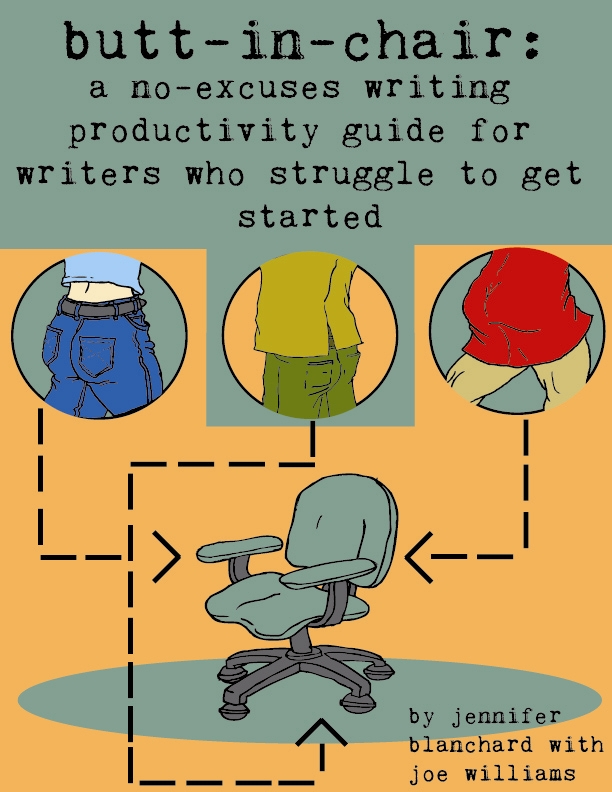
This went on for years.  I tried to wedge my butt in my desk chair, but it never stayed for long.  I did pull out my old project from time to time, but couldn’t focus. I joined the Sudbury Writers’ Guild and attended a fall workshop with Rosemary Aubert.  To be honest, I’d never heard of her before, but the workshop was great and I was inspired.

When my grandfather passed away, part of my small inheritance went toward a lap top computer.  That helped a little too.  I wasn’t chained indoors in the middle of summer anymore.  I wrote more that year.

I was successful in an internal competition at work.  Better pay and a better job.  It was a good thing.  Just before I started, the Sudbury Writers’ Guild scored another coup: Nino Ricci.  That was when my writing life changed.

In the wake of that workshop, I started writing every day.

That was the real beginning of my life as a writer.

Took me long enough, didn’t it?

Gratuitous links regarding the butt in chair phenomenon:

____________________________________________________________________________

This is my last post in My history as a so-called writer for the foreseeable.  Other tales of Writerly Goodness can be found under my categories: Work in progress and Authorial name dropping.  Next week, my blogging schedule will change, so stay tuned.

I will continue to post in Select poetry, Alchemy Ink, Work in progress, and Breaking open the mind, my learning category.

A visit from Valerie Senyk

March 25, 2010.

Throughout the year, the Sudbury Writers’ Guild brings in guest speakers.  That year, there had been some interest from the membership in learning how to read one’s work more effectively.  One of our members, and past president, Janice Leuschen, had just started up her business and had delivered a session for the Guild already, but there were still rumblings and mumblings.

At the September meeting, where the year’s creative agenda was hashed out, I suggested Valerie Senyk as a possible speaker.  She is associate professor of theatre arts at the Georgian College University Partnership Centre as well as a poet, a playwright, a director, and a fantastic performer.

The members in attendance showed interest, so I got in touch with Valerie, who was also interested and coming to Sudbury to see her son in March.  We firmed things up and made the date.

I’d known Valerie since Spring Fever: the (W)rites of Spring in which our poetry was published.  Subsequent readings, events like the Northern Lights Festival Boreal, which featured not only our motley crew of spoken word performers, but her creative performance poetry collaborations LipSkinDance and Poemotion, and our association through Your Scrivener Press publisher Laurence Steven, often put us together.

At the time of our first association, Valerie was a professor in the Drama Department at Thornloe University, one of three federated universities within Laurentian University.  I’d seen her perform and attended several of her students’ productions at Thornloe.

Valerie did an evening workshop for the Guild and everyone in attendance read a work of short fiction or poetry and received excellent feedback and tips from Valerie.  Though I considered myself an experienced reader, she had some insightful advice for me as well.  It was a lovely evening, and it was great to see an old friend again.

It is always a pleasure to work with Valerie.

If you enjoyed this post, Like, Share, or Comment.  I invite you to subscribe, or easier still, add me to your Google Reader subscriptions.  Google Reader has saved my social networking sanity so I’m not shy about the plug 🙂