Reprioritizing

This week, I had an epiphany. The tension has been building for some time and, really, it should have happened years ago, but I had to come to this place in my life to be able to wrap my head around it fully.

Now that I’ve come to a decision, though, I feel stupid for not having realized this sooner.

I’m a writer (duh).

What, you say? I thought you figured that one out already. Yes. I had. But it’s one thing to know something and another to become it, to take action to make your dreams reality.

Let me ‘splain.

C’mon, people, by now you should realize that everything’s a story with me 😉

Back when I was still a wounded creative (oh, poor me), even though I’d been published as a poet, and completed my MA in English Literature and Creative Writing, I couldn’t establish a regular writing practice. I knew that I wanted to be a writer, but I couldn’t find my way there.

I’d been working contract jobs interspersed with employment insurance claims and then I started working for my current employer. At last, I had a job that could pay the bills. The hand-to-mouth existence ceased.

I finally started to sort out my damage, got into therapy, went on antidepressants. I did a few other things to help myself health-wise, and then, thanks to a writing workshop arranged by the Sudbury Writers’ Guild, I found my way to the page.

I drafted my first novel, went to more workshops and conferences, read my way though one writing craft book after another, and joined professional associations.

At work, I was successful in an assessment process, and, after a relatively short period of time, another.

I started this blog and began to work on creating a “platform.”

By this time, I was in my late 30’s and I was under the impression that I could do everything. I could be awesome in my day job, my personal life, and in my creative life.

The truth? You can only run on all cylinders all the time for so long before you need a tune up.

I thought that taking the occasional self-funded leave would be enough, but each time I returned to work, exhaustion crept up on me more and more quickly.

I hit forty and travelling for training started to become less enjoyable. I applied for process after process, getting screened out of most of them, and eventually landed an acting consultant position that drove me a little crazy. I got my training certification.

Then the certification program ceased and I wondered what I had spent all that time and effort on.

Our internal college is undergoing a transformation of its own, by the way, and may be losing more than just the training certification program.

Creatively, I started working on other novels and started to get my short fiction published again.

And now, I’m in another acting consultant position.

I’ve just spent a week in Toronto, training. Introvert me was so drained, I had nothing left for the page.

That was when it hit me.

I’m spending my energy on the wrong thing.

Last year, I wrote about how my creative life was feeding me in a far more meaningful way than my work life. Dan Blank, from whom I learned a lot about platform, made particular note of that statement. He saw it was the light that would eventually become a revelation. As usual, I was a little slow on the uptake.

I’d just returned to my substantive position as an advisor with the training unit and my employer was in the midst of a business transformation process. On the heels of that, they engaged in a massive hiring process that required a lot of training for the newly hired employees.

Retirements at the executive level caused another kind of upheaval and only eight months after getting our manager back from an extended leave, we lost her to a management shuffle. Nearly everyone was moving around; nearly everyone was acting in one capacity or another. There was no stability.

We’re still in chaos. I think that’s supposed to be the new normal, but I don’t deal well with that much upheaval.

I had just decided that I would be happy not getting another acting consultant position, because there were geographical restrictions and I was not willing to move. My friends in the pool were being offered indeterminate positions and I was happy for them.

Then this position came up.

I think the same thing has happened at work that happened back when I was finishing my BA.

At that time, I was moving into a good place creatively. I was starting to get published. I thought I needed the validation of an MA, though.

So, I put myself through hell and though I got the damned degree, it’s still one of my biggest regrets.

Now, I think I need the continuing validation of promotions. I don’t. I so don’t.

What I need is to settle in as advisor for the rest of my career, however long that may be. No more special projects that either get abandoned or taken over by other departments. No more assessment processes that have nothing to do with the jobs they result in. No more acting positions in which I fail to the degree that the lessons learned are no longer within my grasp.

More than that, I don’t want to travel anymore. It simply drains me too much. I’m even considering a parallel move into quality monitoring, which would not involve training or travel, though I would be willing to help out with training in my office, if my new manager would be agreeable.

I’m planning on another self-funded leave this year, but after I’ve paid that off, I’m considering part-time work as well. My work/life/creative balance has been off for so long I can’t see how screwed up things have gotten.

This is not to say that I’m going to coast, or dog it, for the rest of my career. I don’t think that would be possible. It’s just not in me to purposefully do a poor, or inadequate, job. I’m a perfectionist, after all.

I just don’t want a day job that depletes me to the point that I can’t do what it is that I’ve been put on this spinning orb to do.

I still have to work for a few years yet to make sure our remaining debts are paid off, but once we’re in a good place, financially, I intend to make an early retirement of it and get on with the business of the rest of my life.

I’m a writer and the day job is a means to that end. I have to keep my priorities straight. I can’t afford to be putting good energy after bad.

I just have to make it through the remainder of my current acting assignment with my sanity intact first.

Wish me luck?
Muse-inks

Sundog snippet: Writerly events and an update on the construction

Kim FahnerOn Thursday, I went to see my friend Kim Fahner read her poetry at the Open Studio Showcase. Along with Kim were all three of Sudbury’s Poet Laureates, past and present (Roger Nash, Daniel Aubin, and Tom Leduc). Richard Van Camp was MC and storyteller for the evening.

A couple of people signed up for the open mic and added some much needed estrogen to the line up 🙂

The theme of the evening was Identity.

Today, I took a trip out to our Chapter’s to visit with Mat Del Papa and Lisa Coleman-Brown, who were selling and signing copies of Creepy Capreol. While there, I met with fellow Sudbury Writers’ Guild members Renny De Groot, Scott Overton, and Irene Golas.

Mat and Lisa

I an odd turn of events, a gentleman asked the table to watch his collie, fittingly named Lassie, while he dodged over to Kelsey’s for lunch.

. . .

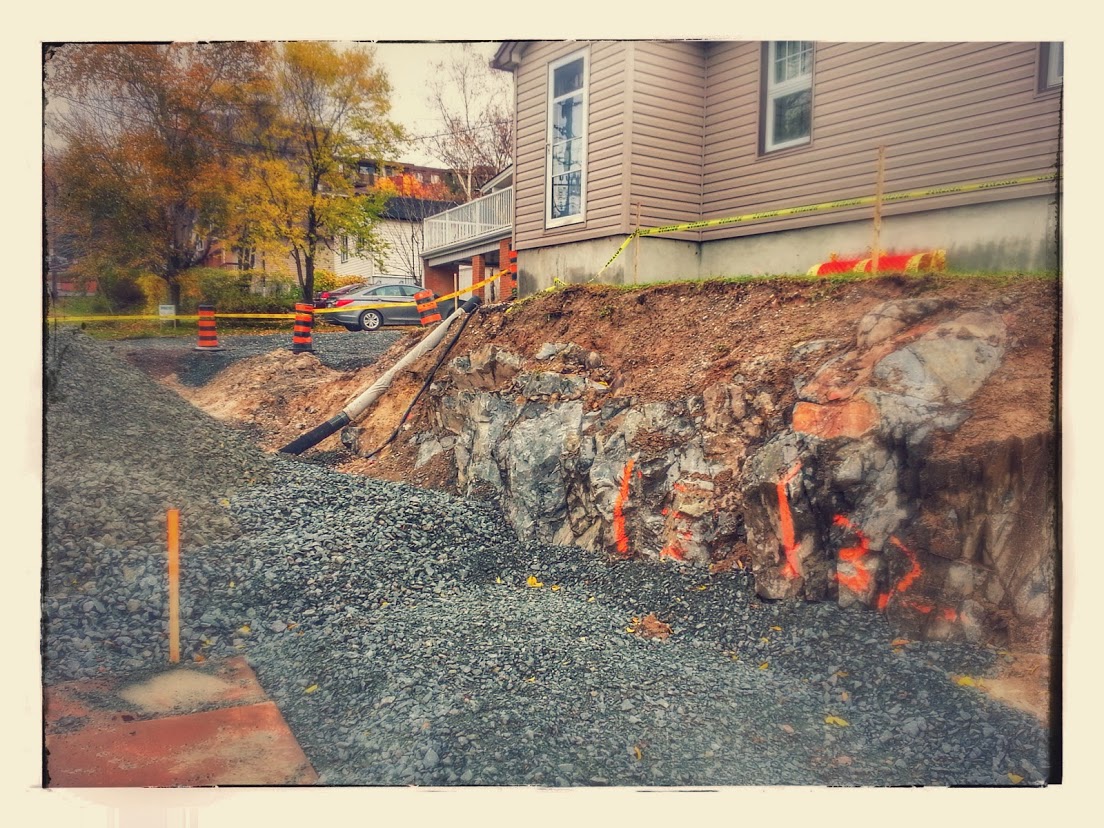
In destruction construction news, the blasting is over, the rubble is cleared, and they’ve torn up all the old paving on our driveway.

SatOct18b

I think they need to move the storm drain and reconstruct the curb before they get the retaining wall started. The hold up with the driveway appears to be the mass of clay around the water shut off valves, which must, of course, be excavated and replaced with proper fill (otherwise, they’ll just have to redo things next year when the frost heaves all that clay again).

Nu is doing well. Phil and I are getting used to the VetPen, but I won’t have further news until Nu has her next glucose curve on the 30th.

And that’s all the news that’s fit to print, people.

See you all on Tipsday!

Sundog snippet

Six questions with Mat Del Papa

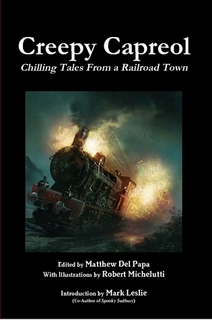
Mat is a writerly friend and a past-president of the Sudbury Writers’ Guild. He’s published two collections of stories loosely based on the history of the railway in Capreol, and now, he has become an editor, assembling fact and fiction to create Creepy Capreol, a collection of supernatural tales about his hometown.


Welcome to Writerly Goodness, Mat!

WG: What inspired the Creepy Capreol project, and how did it evolve?

MDP: The inspiration came from Spooky Sudbury. Mark Leslie and Jenny Jelen put together a great book and I was fortunate enough to be involved in a small way. That got me thinking about doing something more scary than my usual. Seeing the phenomenal success they had combined with the unexpected discovery of two other stories about Capreol in Spooky Sudbury to give me another push. Mark provided the final impetus. We’d been joking, via email, about the various weirdness in Capreol (the river’s burned twice and the fire hall three times — for a example) and he said something like “You should write a book.” I forget who came up with the title, him or me, but it clicked.

WG: How did you go about recruiting your writers and artist? How smoothly did that process go for you?

MDP: I recruited the writers I thought would the best fit first — current and former Capreol residents who already write genre-type stories. Steve Vernon was on top of that list. Born and raised in Capreol he’s had a great deal of success writing horror. Next came Jason Shayer, another Capreol boy who’s gone on to bigger things. Both were happy to contribute and their inclusion gave me the confidence to move forward (until they signed onboard I was more or less toying with the idea — getting two published authors was the final push).

It would have been a thin book though if I hadn’t approached a few members of the Sudbury Writers’ Guild. Betty Guenette wrote about her uncle from Milnet (a ghost town just north of Capreol) and gave me a second story set in Sellwood (another nearby ghost town). Lisa Coleman-Brown had impressed me with her ability to write gross fiction and she delivered another stomach-churner for Creepy Capreol.

The artist proved easiest of all. Robert Michelutti lives in Capreol and volunteers at the local train museum (the Northern Ontario Railroad Museum and Heritage Centre). I’ve had dealings with the museum before (they sell my previous books in their gift shop) and so had an “in” with Bob. I sent him some samples stories and he sent me some sample art — they proved a great fit.

WG: Once you had the writers lined up and their stories in hand, it would have been time for editing. What did you learn from wearing the editorial hat that you may not have known as a writer?

MDP: Editing is hard. Everyone knows that. What I didn’t realize was how many little details there were. Things you have to keep track of at all times. It’s like juggling — only you’re dealing with people and their creations! Getting the best work sometimes meant stepping on toes. I found a hundred ways to say, politely, “Try again. You can do better.” The amazing thing is . . . the various contributors did do better, every time, revising until we both were happy. No doubt they came to curse my very name, but the final product proved the efforts (and swearwords!) weren’t in vain.

WG: Did you do the layout work yourself as well? How was it organizing text and images for publication?

MDP: I did just about everything — that’s the only way to keep costs reasonable. Luckily there are plenty of quality programs and templates available. It probably took me ten times as long as a professional, but in the end everything came together.

The hardest part was balancing the content. I agonized over the order, trying to compliment each story with the one before and after.

WG: What is it like to create a project like this and have a hand in it from start to finish?

MDP: Satisfying . . . and frustrating. I enjoyed 99% of the process. But that last 1% had me almost tearing my hair out. I can live with the odd technical glitch. It’s my own stupid mistakes that gall. Luckily I’ve done the whole self-publishing thing three times before and have learned from most of my mistakes.

Having contributors was a new experience. One I found both difficult and exhilarating. Their enthusiasm pushed me through some rough patches, but waiting on others to revise (in some cases four or five times before getting it right) was a challenge. The fact that I’m not the best time manager meant that the last few weeks were a tight crunch. Still, for all the struggles, the final product turned out better than I could have hoped.

WG: What’s coming up for Creepy Capreol?

MDP: First comes the official launch. I always hold a book-signing/launch as part of the Capreol Days festivities (held on the August long weekend). This summer is no different. I’ll be in downtown Capreol on Saturday, August 2nd with a table of books — Creepy Capreol will be selling at a special holiday price of $14.00 — and encourage anyone interested to come out. There’s music, barbeques, a sidewalk sale — last year had horse rides, kids games, an animal exhibit — and more.

After that I hope to hit Valley East Days in early September. It’s another fun weekend, full of music, food, and entertainment.

The book should be available on Amazon in the fall. Kobo, Kindle, and iBookstore versions are coming soon. And I hope to have it in Chapters Sudbury location for October.

Thank you for taking the time to tell us a little about Creepy Capreol and your journey to publication.


About the book:Creepy Capreol
Creepy Capreol
Chilling Tales from a Railroad Town

Introduction by Mark Leslie.
Illustrations by Robert Michelutti.

The book consists of two parts:

Non-Fiction

That Darn Sock Monkey — How a stuffed sock monkey traumatized my youth.
Bigfoot Lives! — A look at the Capreol connection to the famed creature; with references to fact, legend, and some personal observations.
Help! My Wheelchair Is Trying To Kill Me — Humorous take on the many times I’ve almost been killed by my wheelchair. Mostly true, some exaggeration for effect.
Vigilante Justice: Capreol Style — An account of Frederick Chase Capreol’s many failings and lone stellar success. It is mostly factual, but with some humour.
The Mystery Of Capreol’s Mass Grave — Fact-based article that refutes the commonly held belief that between 30 and 80 people are buried in a mass grave.
The Wreck At Drocourt — A poem by Ida Quackenbush and her son George. Originally written approximately 1930.
Ghost Town Trilogy — Loose histories of three local ghost towns.

Fiction

Rolling Stock — Steve Vernon
Set in Capreol’s railyard the story revolves around one man’s late-night encounter with the supernatural.
Not The Basement! — Lisa Coleman-Brown
An overworked PSW is filling in for a co-worker when she discovers a disturbing secret.
The Likely Story — Paul Mandziuk
A literary mystery; it features a vicious murder in a bookstore — with a novel twist.
This Old Man — Betty Guenette
The bond between nephew and uncle are tested as more than age and isolation separate the two.
The One That Got Away — Matthew Del Papa
A northern Ontario fish story as told by the bait dealer who saw it all happening.
Dual Ghost Towns — Betty Guenette
Ghost towns aren’t always empty. Two sisters find this out in traumatizing fashion on a visit to Sellwood.
Stagnant Waters — Jason Shayer
Exploring abandoned buildings reveals something unexpected … and evil.

The next chapter: April 2014 update

The Next ChapterIf March was a little weird, April was a whole lot weird.

Lemme ‘splain.

I abandoned the thought of keeping to any kind of “schedule” with regard to my writing. At the end of last month, I had drafts for Apprentice of Wind and Figments completed, or so I thought.

So you’ll understand my surprise when I went to print off Figments, that I hadn’t, in fact, finished it. A few hundred words fixed that up, but boy was I embarrassed.

Then, once I had AoW and Figments printed, I heard Initiate of Stone calling my name. Even though I haven’t heard back from all my betas yet, I needed to do a little work on IoS.

I just finished reading Roz Morris’s first Nail Your Novel, and before that, I read Victoria Mixon’s Art and Craft of Story. I wanted to do a combination approach with each draft, using Roz’s form of beat sheet and Victoria’s holographic structure.

With IoS, I had previously eliminated a POV character. Now I’ve decided to remove her entirely and give the specifics of her plotline to other POV characters. It was something others had recommended and I resisted. I guess I just needed time and space away from the ms to realize the truth.

And it wasn’t half so difficult (read fraught) as I thought it would be.

So I knew that I would not be doing a lot with regard to “new words” in April because I’d mostly be focusing on working with my printed drafts and most of the new work would be on my blog.

Then I edited a couple of stories for submission, but the net new words for that was just over three hundred.

Once again, I find myself surprised.

April's word count

I am still eternally grateful to Jamie Raintree for this fabulous tool

Total word count for the month: 11, 612 (!), 10,930 of that from blogging alone.

Amaze-face.

Mind you, I have been blogging all those juicy sessions from Ad Astra. It’s transcription, but it counts.

Here’s the round up for the year so far:

Month Total Blog Initiate of Stone Apprentice of Wind Figments Gerod and the Lions Short Stories
January 11,532 7,114 0 2,781 207 821 609
February 9,789 6,303 0 47 308 1,296 1,835
March 10,781 8,193 0 333 1,488 312 455
April 11,612 10,930 0 0 381 0 301

So this has been an interesting month, and the next few promise to be as well.

I won’t be actively querying until I have revisions done on IoS, so that’s on hold, again, too.

I did receive my contributors’ copy of Sulphur IV, the literary journal of Laurentian University. I have three poems in there. The CV has been updated.

The Sudbury Writers’ Guild, with its slick new web site, is moving forward with its anthology, so I’ve set aside some work for that.

I made a decision at the end of March. I’d been an associate member of the League of Canadian Poets since 1999, but I’d never gone to its annual conference or AGM. So I decided this year not to renew my membership and instead invest in SF Canada and the Canadian Science Fiction and Fantasy Association (home of the Auroras).

It’s been interesting so far.

As far as what’s coming up, Baen Books has a short fiction contest, and I’ve just become aware that Lightspeed has an open reading period for Women Destroy Fantasy.

So there you are.

Progress continues to be made.

How is your writing life going?

Brian Henry workshop, Sudbury, March 22, 2014

Brian HenryThis afternoon, I attended my fifth Brian Henry workshop.

This one, the third held in Sudbury and hosted by the Sudbury Writers’ Guild, was on “How to make your stories dramatic.”

These workshops are Brian’s bread and butter, so without giving too much of the content away, here are my notes:

  • The scene is the basic building block of your story.
  • There are two kinds: the dialogue-based scene, and the action-based scene.
  • Every scene must have a plot-related point. It must answer the question, “so what?”
  • Push and pull. The push is the point of view (POV) character’s need. The pull is what the pursuit of the need leads to (promise, twist, decision, new threat, etc.).
  • Your characters must be interesting. They should be unique, have their own interests, passions, a quirk, backstory (dole it out gradually). If two characters are similar, shoot one.
  • Readers, sadly, do not remember names.
  • Your protagonist should be a good “tour guide.”
  • Every character has her or his own agenda (the scene’s push). It’s better if they are at odds with one another.
  • Pick your scenes carefully. Show the important stuff. Tell the rest.
  • Don’t get to the point too quickly.
  • Scene = hook, hook, and hook.
  • Ford Madox Ford, “No speech of a character should reply directly to another character.”
  • Dialogue shouldn’t be smooth.
  • An action scene consists of set up, action, and wind down.
  • Set up = setting, background, tone, suspense.
  • Action = plot, character, relationships.
  • Wind down = the result, new information, what is gained or lost.
  • Dialogue is important, even in action scenes.
  • Make sure it feels exotic (most people don’t spend a lot of time fighting, in chase scenes, etc.)
  • Use internal monologue to your scene’s best advantage. No long-winded explanations.
  • You need to have some kind of surprise.
  • Have more than one thing going on at any one time.

We went through a few examples of dramatic scenes, one from Lawrence Block, one from George R. R. Martin, and one from Bernard Cornwell to look at the variations and interplay of action and dialogue. We also completed a writing exercise, for which I chose a scene (to that point unwritten) from Gerod and the Lions.

Since I’m always trying to learn and improve upon my craft, the workshop brought up a number of bits and pieces that I’ve learned over the years.

Emily Dickenson wrote, “Tell all the truth, but tell it slant.”

Last fall at the Surrey International Writers’ Conference, I attended a Diana Gabaldon session where she shared her technique of driving a scene forward by raising questions in the reader, but delaying the answers for as long as possible.

I just finished reading Victoria A. Mixon’s The Art and Craft of Story, in which she describes “holographic structure.” This takes the basic three act structure of hook, development, and climax and breaks it down.

The hook consists of the hook and the first conflict, the development includes (at least) two more conflicts, and the climax consists of the faux resolution and climax.

In fact, breaking it down even further, each of these six elements contains its own six elements.

Thus, the hook part of the hook section contains its own hook, (at least) three conflicts, faux resolution, and climax, as does each of the remaining parts.

If this seems confusing, please read Victoria’s book. She explains it at much more length and much more clearly than I do.

Suffice it to say that the ultimate breakdown is at the scene level, and each scene, in keeping with its overall purpose within the story, has its own hook, three conflicts, faux resolution, and climax.

That’s all the insightful I have for you today, my writerly peeps.

Until next time.

Six questions with Renny deGroot

I recently made Renny’s acquaintance (formally) at a meeting of the Sudbury Writers’ Guild.

She let us know that she had recently published her first historical novel, Family Business.  Another Sudbury Writer? W00t! Of course, I had to ask for an interview 🙂

______________________________________________________________________

Renny deGroot

Renny deGroot

Renny deGroot is a first generation Canadian of Dutch parents. She is a published poet and song lyricist, with Family Business being her debut novel. She studied English Literature at Trent University. Her strong Dutch roots continue to influence her while the love of her Canadian homeland with its beauty and freedom, flavours all that she does.

Renny lives in rural Ontario with her Great Pyrenees, Chocolate Lab and very old tabby cat.”

My parents were somewhat ‘citizens of the world’. My mother lived in England for a period after the war, before moving to Indonesia where she met my father (who was there with the Dutch military). They immigrated to Nova Scotia (where I was born) before settling in Ontario. This spirit of adventure influenced their three children (of whom I am the youngest). I’ve lived in Ireland, hung out in the south of France for a bit and  go ‘back’ to the Netherlands regularly to spend time with family and soak up my heritage, before always coming back with a sigh of relief, to the best and most beautiful place in the world – Canada.

_______________________________________________________________________

WG: Welcome to Writerly Goodness, Renny!

RdG: Thank you! I’m really pleased and honoured that you’ve invited me to participate.

WG: How did you come to the writing life? Give us the origin story of Renny deGroot, author 🙂

RdG: I’ve always felt artistic pulls. While my sister was sent to Brownies and my brother to Navy cadets, I was sent to art classes. Unfortunately my drawing skill set didn’t live up to my desire, so I turned to writing as an outlet. As a teenager I wrote the usual angst-ridden poetry, some of which found their way into community newsletters and school yearbooks (my mother was a faithful ‘sender-outer’ of my pieces J ). Lots of encouragement at home and from great English teachers drove me to take creative writing classes and work on my degree in English Literature.

WG: What inspired Family Business?

RdG: Well, simply put – family stories. One evening a couple of years ago I was visiting my family in the Netherlands. My uncle Jan (the youngest of my father’s six siblings) and his wife, Marja, were telling me of a certain situation with my great grandmother, and when he finished I said: ‘wow – there’s a book in that.’ My uncle looked sceptical, but they are such a great support and when I really started writing the story they did everything they could to help me with background, details and encouragement. Of course, it isn’t at all intended to accurately represent the family thing – it just was the starting point – as you say – the inspiration.

The end result is a story about a young man who struggles to learn the meaning of freedom amidst family conflict during the depression years and World War II German occupation in the Netherlands. The notion of freedom on a macro level (for a nation, race, community) and a micro level (our own individual right to choose and determine our path) is timeless and a topic that I’m passionate about. When I’m not writing, I manage an Irish tenor (http://jimmycartonband.com). Being so immersed in the Irish culture and music has been a huge contributing influence on my interest in the topic of freedom.

I’ve read that every writer could come up with ten stories based on family stuff, and I believe it. I don’t know if I just happen to have a quirky family, but I know that there’s inspiration for a few more still sitting there waiting to be harvested.

WG: And what about your new work in progress?

RdG: The working title is After Paris and it opens in spring of 1916 in Paris. World War I changed the world forever and, like Family Business, it isn’t a war story, but I’m interested in how people manage the massive changes that come into their lives both during and after these huge events. The role of women changed with WWI, for some more than others. I’m also very interested in personal development – emotional vs. intellectual. These are some of the things I want to look at, but of course rolled up into a great story.

WG: I love when writers talk about their process 🙂 Would you care to share a part of yours?

RdG: I can get pretty distracted so I need to set targets for myself – generally a page count per session and I tell myself I won’t finish for the day until I’ve done three pages or five pages, or whatever is realistic based on where I am. The beginning is the hardest so if I can get two pages done, I’m satisfied. I generally go through several pots of tea before the day is done.

After that, I love writing outside. I have a large screened-in deck and a pond with a waterfall. I’m surrounded by trees – so I am most productive when I sit out there with the sound of the wind in the trees and the music of the waterfall in the background. I’m afraid I’m less productive in winter, but do enjoy being by the fire, either reading for background, or doing a bit of writing.

When I’m in the groove, I don’t worry about grammar or phrasing too much. I want to get the story down and then I go back to start the revisions and editing. With Family Business I edited the finished story several times before hiring a professional editor and then we worked together for three full rounds. It was a great learning experience and of course I’ll incorporate those lessons into the writing of After Paris.

WG: You have a lovely Web page. Are you active on social media? What role has “platform” played in getting your work published?

RdG: I’m afraid I’m not great with the technology side of things and am learning as I go along. I guess I have to admit that I’ve only just set up a Facebook page – on the tenth anniversary of Facebook, I accept it’s here to stay, so I’ve climbed aboard, albeit somewhat reluctantly. I am more comfortable with the website for sure. That gives me the opportunity to give reign to my creativity and I see it as a spot , not just to provide information for fans, but to really interact in a virtual ‘book club’ environment. My book is for sale via my website, so it’s handy for that as well of course. Publishing and book buying/selling is a whole different world than it was, even five years ago. Amazon.com and other on-line retailers have opened up the world to make it accessible to writers like myself, who probably wouldn’t get the attention of large traditional publishing houses, and have done a great service to the reading world – as people can choose for themselves what grabs them versus having their tastes steered by the large publishers.

WG: What’s coming up for Renny deGroot and Family Business?

RdG: I am really excited about the next few months. It’s such a long process to get a book published that I feel like I’ve stepped away from Family Business for a while as I’ve become more involved with the outlining, research (including a trip to Paris last summer!) and writing of After Paris. It means putting Paris on hold for a bit, but I’m happy to be ‘back with the Meijer family.’ I have the official Book Launch in Toronto on March 1st at a wonderful downtown spot called The Hothouse Café. It’ll be an afternoon of wine, food, music and of course a reading and book signing. After that I’ll be doing a launch tour which I’m still firming up, but will certainly include Sudbury in early April, and various other spots in Ontario (looking at Port Perry, Bowmanville, and Mississauga, with more spots in Toronto, Brampton and Brantford to start with.) Then, in the summer I’ll be looking at the Maritimes – definitely Nova Scotia and New Brunswick and probably Newfoundland.

I’ll be updating my website regularly on the ‘Events’ tab, as well as Facebook – so I hope that your readers will join me, and even suggest other places that might like to host a book signing. I’m open to ideas. One idea that I really like is participating in small ‘house-readings’. I’ve been to a couple of house concerts (I first saw/heard the Good Lovelies at a house concert) and I think it’s a perfect setting for a book reading/signing/discussion. I’m really excited about these events as I get to travel, meet people and share some opportunities for storytelling.

WG: Thanks for a wonderful interview, Renny. Break a pencil in your future writing endeavours!

______________________________________________________________________

Family Business

Family Business

About Family Business:

Set in the Netherlands against the backdrop of the Great Depression and through World War II, Family Business follows the story of Agatha Meijer and her sons, André and Johan, as they build their textile business, a business Agatha is determined her sons will carry on, regardless of their own desires. Family tension comes to a head when the boys each take a stand, sending all their lives spinning in directions none of them would have ever anticipated, and making each of them question the true meaning of loyalty, love, and freedom.

For sale at:

http://rennydegroot.com (Canadian customers who would like a print copy)

http://www.amazon.com/Family-Business-Renny-deGroot/dp/1494233231/ (U.S. customers who would like a print copy)

https://www.smashwords.com/books/view/401486 (eBook)

Various other Amazon affiliates also have the print copy available for international customers (.co, .UK, .fr, etc.).

Also – Amazon.com will sell to customers in Canada, but as it comes from the U.S., shipping is much more expensive – so better to buy through the rennydegroot.com website.

My first NaNoWriMo

Winner, winner, chicken dinner

Off the top, I have to say this: I won!  My first time out and I won 🙂

Backtracking to my trip to Surrey

Before I even left, I was considering NaNo. The municipal liaison came out to the Sudbury Writers’ Guild meeting in September to promote. My leave would be until November 18, 2013, so I thought I’d probably have a chance.

While at SiWC, I heard several people talking about NaNo and how it had really helped them get their ideas down, break through writers’ block, built their confidence, and so forth.

By the time I got back, I was determined to give it a try.

I chose a project that I had outlined years ago. I’d had a little bit written, but I hadn’t touched it in years.

I was going to start over in any case.

The power of planning

I knew I was going away for a few days to visit some friends, and that I’d be going back to work before the month was out. I started out by front loading the work, trying to move ahead quickly at the beginning so I could coast a bit at the end if I needed to.

Still, when I went back to work, there were a few low count nights. I was worried.

To make time for my writing in the evenings when I went back to work, I tried using my smart(er than me) phone to keep track of my email and social media.

I got up a half-hour earlier than usual to check Facebook, WordPress follows, and my Feedly follows and share the interesting stuff on Twitter and Google+.

The pilgrim’s progress

Here’s a convenient table for you:

Day Count Total + or –
1 2161 2161 +494
2 2284 4445 +1111
3 2325 6770 +1769
4 travel 0 6770 +102
5 2122 8892 +557
6 travel 0 8892 -1110
7 1877 10769 -900
8 2168 12937 -399
9 2190 15127 +124
10 1675 16802 +132
11 1721 18528 +191
12 2284 20812 +808
13 2008 22820 +1149
14 1699 24519 +1181
15 1684 26203 +1198
16 1894 28097 +1425
17 1668 29801 +1462
18 1727 31528 +1522
19 return to work 1181 32709 +1036
20 549 33258 +82
21 507 33765 -1242
22 1822 35587 -1087
23 1814 37301 -1040
24 1707 39008 -1000
25 1731 40739 -936
26 1677 42416 -926
27 1692 44108 -901
28 757 44865 -1811
29 2232 47097 -1246
30 3802 50899 +899

What I learned

I don’t think I could do this working full time.

Having said that, it was fantastic to know that I could pull a 50000+ word draft together in 30 days. It was interesting to me because my first novel took me a year to write, working in the evenings and on weekends.

It gives me hope that if I do end up getting a deal for my work at some point and am asked to pump out sequels in swift succession, I should be able to do so. Also, if I end up going the self-publishing route, it’s always good to have moar material out there. If people like what I write, I can potentially supply the demand.

While my Samsung Galaxy Note II is quite lovely, I don’t think that I could manage my social media long term using it alone. Some of the information so easily accessible on my desktop is not so convenient to find in an Android app version of the program. Also, some things don’t translate well. Though the Feedly app appears to allow FB mentions in a post, it does not actually include them when posting to FB.

I have a few strange-looking posts over the last couple of weeks, and was not able to keep track of anyone’s birthdays on my phone, so apologies to anyone I may have offended or missed as a result.

Again, it’s good to know that I can do a minimally good job of maintaining my social media from my phone if need be.

Today, except for these blog posts, I have not written. I’ll get back on that horse shortly. I’ve also had to let a few submission deadlines slide because I just couldn’t manage to do it all. Everyone has their limits.

Coming up

I’ll be blogging in the future about my writing plans moving forward as well as a little about work. Interesting times I live in 😉

Writerly Goodness, signing off.

Mark Leslie workshop with the Sudbury Writers’ Guild

This past Thursday, November 28, Mark Lefebvre of Kobo, who writes under the pen name Mark Leslie, conducted a workshop on self-publishing for the Sudbury Writers’ guild.

Mark spoke a bit about his experience with self-publishing first.

Mark Leslie

Mark Leslie with members of the SWG and Barnaby

His horror short story collection, One Hand Screaming, was published using Lightning Source (now Spark) from Ingram.

For his anthology Campus Chills, Mark and his friend Steve formed Stark Publishing (Steve + Mark). They used the Espresso Book Machine, which got its name because in the time it takes to make an espresso, the machine could produce a book.

At the time, Mark was working for a university book store and convinced the store to invest in the machine. He made the venture a paying one, producing all kinds of books for various groups in the university and surrounding community.

Mark is also an editor, editing North of Sixty, and Tesseracts Sixteen.

More recently, he compiled stories with background research for Haunted Hamilton and Spooky Sudbury, which he co-authored with Sudbury journalist Jenny Jelen. Both books were published with Dundurn Press in Hamilton.

One of the things to keep in mind is that traditional publishing can get you into places that you could never get into alone, for example, Costco.

Now Mark works for Kobo (which is just an anagram of book, by the way).

Why authors choose to self-publish

  • For the new author, it’s a way to break in to traditional publishing, make a mark, get noticed.
  • For mid-list writers, it’s most often used to resurrect their backlist. As copyright returns to authors, they format for self-publication and keep their work in circulation longer than their traditional publisher were willing to.
  • For the NYTBS author, self-publishing offers control.

In general, self publishing offers higher royalties and faster payouts than traditional publishing.

Epub format is the industry standard.

Mobi is the Amazon standard.

Self-publishing is good for long-form journalism. (Mel’s note: we had a fair discussion of this. For those who don’t know what long-form journalism is, it is the full version of the article with bonus research materials. The print article may be a thousand or so words. The long-form version may be five or ten thousand. Think academic essay, but more accessible.)

It’s also good for publishing collections of short stories. If the stories have already been published elsewhere, then it can be seen as a kind of validation or pre-screening, and the collection may have a ready audience.

Services:

  • Kobo
  • Kindle
  • Nook
  • iBooks
  • Smashwords

Kobo started out with Reading Life for their ereaders, and then developed Writing Life for their authors. The Kobo dashboard allows the author to see stats, earnings, and sales figures globally at a glance. (Mel’s note: Hugh Howey used, liked, and promoted Kobo Writing Life.)

You can format your work in Word or OfficeLibre (formerly Open Office). Use Sigil, or Calibre to tweak formatting, and Kobo even has a native WYSIWYG editor which will be familiar to WordPress users.

Follow the formatting instructions of your chosen platform carefully.

A word on DRM: it only hurts paying customers.

Branding

It’s not just about your name.

Mark takes his skeleton, Barnaby, on the road with him wherever he goes. He puts a t-shirt on Barnaby and sets him up outside the bookstore. People wandering by sit down and have their pictures taken, post them on social media. It’s free publicity.

Vistaprint is a great source for promotional materials. Pens, mugs, and t-shirts are just some of the swag you can buy to give away and promote your work.

KDP and KDP select

KDP select is Kindle’s exclusivity line. You can only publish with KDP select, no one else. You can only price books for free on KDP select, but only for five days out of every ninety.

You can work around it. Just publish using KDP and also on other services. Price the book for free on Smashwords or elsewhere, and Amazon will price match if one of your fans reports the competitor pricing.

Diversifying is better. Get your work out there and into the hands, or ereaders, of your fans. Let them choose the service.

Price is a verb

$2.99 seems to be the sweet spot (right now). The lower you set your price point, the more your royalties will be reduced.

You have to know who your audience is.

$1.99 seems to be the price point of doom. Currently, no one knows why.

$.99 is good, as are $3.99 and $4.99.

Authors can experiment. One author change the price of her ebooks from $4.99 to $5.99 and saw sales across all platforms except Kindle increase slightly. Kindle sale went down initially, but within two weeks, they levelled out again and all was well.

The two biggest complaints from marketing about ebooks are:

The cover sucks; and

It’s priced too low.

Free can work as a gateway to a backlist.

Workshop alert: Lauren Carter Oct 6, 2013

You may remember that I’ve become a member of the Program Committee for the Canadian Authors Association.

The committee is responsible for the annual conference, the Literary Awards, professional development of the membership, and something called the Roving Writers program.

I volunteered to be on the sub-committee for the Roving Writers and our first event will be in a scant week!

Author Lauren Carter will be coming to Sudbury as part of her book tour.  So on Sunday, Oct 6, from 1-4 pm at the Parkside Older Adult Centre in the YMCA building, she will be delivering a workshop on Deep Character.

Here’s the poster with the deets (including how to sign up):

RWTP_Carter Poster

The CAA office will be sending me a copy of the participant list and I will be taking payment (cash or cheque only, please) at the door. The discounted fee of $25 applies to members of the CAA only.

Light refreshments (fruit, muffins, water, and juice) will be provided.

I can’t thank the Sudbury Writers’ Guild enough for their assistance in getting this event off the ground.

Following that, on Monday, Oct 7, Lauren will be at the south end branch of the Greater Sudbury Public Library as part of the first LUminaries reading series.  This has nothing to do with the CAA or the Roving Writers, but I thought I’d spread the word.

She will, of course, have copies of her dystopian literary novel, Swarm, available for sale and signing.

Have a lovely evening!

Caturday Quickies: Brian Henry workshop Sept 22, 2013

Last Sunday, Sept. 22, 2013, I attended a Brian Henry workshop here in Sudbury.  The Brian HenrySudbury Writers’ Guild brought him up for a visit.  This will have been my fifth of Brian’s workshops, I’m thinking?

I used to attend the workshops he delivered in North Bay, take the drive over in the morning with my mom, drop her off at the mall for a day of shopping, and pick her up at the end of the workshop.

Brian Henry is an experienced editor who now teaches at Ryerson University.  He also conducts workshops on a regular basis across southern Ontario.

If you don’t know about it, you should really visit Quick Brown Fox, Brian’s blog.  He blogs about agents and editors and publishing opportunities for Canadian writers (here and in the States).  Sign up for his newsletter.  It’s full of great information.

Brian has also been instrumental in developing the talent of some well-known authors – anyone heard of this woman named Kelly Armstrong?

This workshop was about plotting short fiction and novels, the differences, and markets.  If you have access to one of Brian’s workshops in your area, I would recommend attending.

As a fellow member of the Sudbury Writers’ Guild says, you have to be open to learning about your craft, even if you’ve already been published.  It’s a lifetime commitment.

Oh yeah, he set us an assignment to write a short story (preferably one of the ones we worked on in the workshop and submit it to CommuterLit.com.  We were supposed to do it before the week was out.  I don’t have much time to get cracking on my submission 🙂

Have you attended any workshops recently where you learned something new about your art or craft?  Maybe it reminded you of something you already knew, but temporarily forgot?  Please share 🙂