Disclaimer: I am not perfect and neither are my notes. If you notice anything that needs correction or clarification, please email me at melanie (dot) marttila (at) gmail (dot) com
Panellists: Suzanne Alyssa Andrew, Carrie Snyder, Maria Meindl, Heidi Reimer, Sarah Henstra (Moderator)
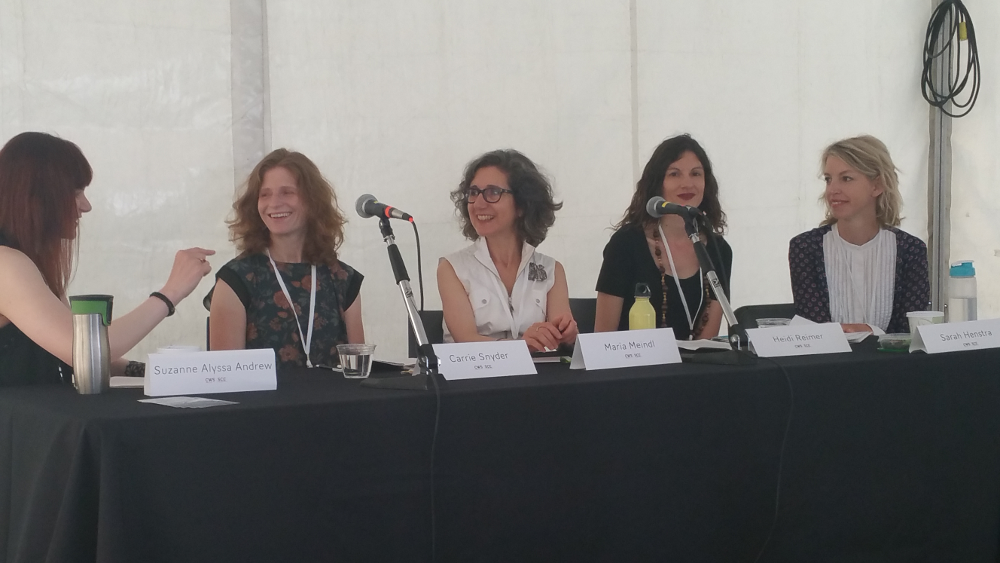
SH: Everyone talks about the struggle that precedes publication, but what about what happens afterward?
[Panellists introduced.]
What’s been your experience with the shadow side?
HR: I’ve been thinking about this because I achieved my creative goals and felt things nobody I knew had ever mentioned. I finished my novel and I felt depressed rather than elated. My spouse is an actor and he’s experienced in the art of letting go. In his world, it’s a recognized thing that all actors experience. It’s not in mine. When I won the Chatelaine contest, I was elated, and then terrified. I looked up their distribution and readership on line. That amount of exposure made me feel vulnerable. I physically recoiled. Something intensely private was about to become public. I talked to friends about my distress.
MM: I feel like I’ve confronted the connection between success and darkness in my life. My grandmother was Mona Gould. By the time I was a child in the 60’s, her poem, “This was My Brother at Dieppe” was everywhere. When her success faded, she turned to alcohol and became bitter. What I learned from that experience is that success is harmful. It can destroy you. When she died, I received boxes of her materials. It took me five years to sort through it. She started promoting her work at the age of eleven. Her poem was sponsored by an arms manufacturer, but she was a pacifist. She didn’t feel she could object. Now I understand that it’s not success that’s destructive, but the lack of a forum and the means to use it.
CS: I always wanted to be a writer. As I was driving in from Waterloo, I tried to figure out what that seven-year-old girl’s impulse was. I focused everything on becoming an author. I published by first book at the age of twenty-nine. It was written when I was twenty-six. It was another eight years before I published my second novel. In 2012, The Juliet Stories came out and was nominated for a Governor General’s Award. It was a huge moment for me. I embraced the high and I rode it. I wasn’t prepared for not winning, though. I mean, I knew I wasn’t going to but knowing it and experiencing it are two different things. They informed us ahead of the public announcement and I sat with the secret for a week. I felt ashamed. I was afraid of disappointing my kids and everyone else who’d been so supportive of me and my book. I didn’t know how to cope with it. I am so grateful for my blog because I was able to get my experience out there. I almost changed careers. I had my acceptance to McMaster’s midwifery program in one hand and the offer for The Girl Runner in the other. I thought I’d made a mistake in pursuing my dream. Now I’m making a living as a writer. It’s wonderful and it’s amazingly difficult at the same time. It’s hard to be here and to be vulnerable in front of you.
SAA: Everything you’ve all said resonates. I’ve just published my first novel and I, too, have always wanted to be a writer. I went on a book tour and it was the first time my family had heard me read my work. I play bass in a band. It’s a group, a community. We share. In literary circles, I find there’s a lack of transparency, especially about publishing in Canada. I think the reality’s worse than any of us realize. There’s a lot of pressure to market your own book. I invested in promotion. I’m a freelance writer. I don’t regret making that investment. At the time I figured, I’ll worry about it later. Well, it’s later and I’m feeling the financial impact. I have second book paralysis, knowing how hard it was promoting my first. Musicians are open and honest about the challenges. They offer each other advice and strategies. Authors in Canada don’t talk about these issues. We’re worried about seeming ungrateful. It’s very isolating. We need to be more vocal as a community.
SH: Can any of you comment further on shame and vulnerability?
CS: You’re novel is something you’ve worked on for years. It will be judged. There will be reviews. I’m a private person. I work through things in writing. It doesn’t feel right to be so exposed. To create anything of value, you have to go there, though. I was terrified of being changed by success. I can deal with rejection, but I have no experience in dealing with success.
SAA: It’s about being a creative person in the public sphere. You can get so involved in the persona you adopt for the media that you can start to feel schizophrenic. We don’t express our real feelings on social media. Everyone else seems more successful, happier. You compare yourself to others and find yourself wanting. There’s another reality to the one presented on Facebook.
HR: When I was published for the first time (I wrote an essay about the experience) I suffered anxiety and panic attacks. If it’s not discussed openely, everyone thinks it’s only them. I have a novel on submission. I received a rejection and felt relief. I know what to do with rejection. A ‘yes’ involves a whole other world. I was happy to stay in my identity as a rejected writer. You have to redefine yourself in light of success.
SH: Is this a question of gender? We’re all women on this panel.
MM: There’s a line between the inner and outer worlds of the author. There’s a free-floating shame still attached to being a woman and a woman writer in particular. Hélène Cixous once asked, “write? With what right?” We’ve internalized this social message. It’s about taking charge of the narrative. Take hold of the narrative. Be heard. It’s a gendered issue.
CS: Are there any men authors in the audience?
Aud: Yes. When the questions was asked, all the women were nodding and the men were shaking their heads. We don’t talk about the shadow side.
MM: The word authorship, etymologically, it means leadership, mastery. As a woman, I didn’t feel welcomed into that world.
SH: Many authors speak of their novels as their ‘book babies.’ There’s a stigma to post-partum depression. You’re not allowed to feel down after having a human baby. Have you found anything that helps?
SAA: Being someone who had this dream, I had high expectations. Being in a band dialled those expectations back. Check your expectations. Talk about it with other authors. What does success mean to you?
CS: Create a safe, private space in which to create. Don’t get down on yourself if you can’t create while you’re doing publicity. It’s not what I thought the job was. I have to remember why I write. I have to turn off all of my expectations. I’m still a writer, even if I never get published again. I wanted to make a living as a writer. I have. But there are worse things than not making a living as a writer.
HR: I did a releasing ritual. I needed to get all of that stuff out. Society says you should be happy. I felt loss. I had to write it out. I had to acknowledge the feelings and affirm what I wanted.
SH: How do you not miss the moment because you’re rushing on to the next fifty things you have to do? You have to celebrate your successes. Ania Szado says you also have to honour your losses.
MM: When my book came out, my Rabbi did a blessing over the book. It was a wonderful thing, on the Sabbath, so, no selling, no pressure. We were just honouring a life event.
SH: Do you want to say something about your definition of success?
MM: The more I thought about it, the more I realized how much others define success for us. We also internalize those definitions and move the bar.
CS: My ‘word of the year’ was success. It terrified me. To everyone else, it looks like success. To me, it doesn’t feel like success. It has a lot to do with what we expect.
SAA: Amy Winehouse’s definition of success was to sing. That’s it. When she got big, she imploded.
Q: What issues turn you on to writing?
CS: I write because I have something to say. Later, the issues grow out of what I’ve written.
SAA: Despite all the challenges of writing, we all have something to say. The joy of writing is in expressing something, of speaking to your readers.
Q: How do you relate to your readers and how is that relationship affected by the shadow side?
MM: I used to be more involved in small press publication. A man bought my book for a dollar and then returned later to tell me that he was moved. It was a wonderful feeling.
SAA: I started out on fire about online marketing. Eventually, I felt like I was speaking into the void. It wasn’t until I went on tour that I felt it was real. I could talk to people. Writers are rarefied outside Toronto.
CS: I was at a writers’ festival in BC and a woman gave me an envelope. In her letter she asked me how I had known her so intimately? She felt like I had written for her, to her. It was humbling.
SH: When I launched Mad Miss Mimic last year, a girl bought the book, sat down, and didn’t stop reading all night. My favourite thing is when parents send me pictures of their kids reading the books. It’s old school. One reader can change your world.
Q: What kind of support do you look for?
SAA: I get the best support from other writers. I have a wonderful agent, Samantha Haywood, and she held my hand through the process.
Q: What strategy do you use to deal with criticism?
CS: I bounce back really quickly now. I’m as polite as possible in person. Privately, I allow myself 24 hours of bleakness, and then I get over it.
SAA: A lot of critique says more about the critic than the writer.
Q: Do you get requests for information from aspiring writers?
CS: Yes. I have advice on my blog. I’ll respond to individual requests for advice from friends.
HR: Take me out for lunch and I’ll tell you whatever you want to know.
Q: How do you deal with family stuff?
HR: I write what I write and when it goes out into the world, I panic. The Chatelaine article reveals some personal information about my relationship with my dad. I had to tell him when I heard that it would be published. I was worried, but it was good. It’s best to deal with it directly.
And that was time.
Next week, I’m going to post another book review. It’s a five-star so you can look forward to that 🙂
Be well until next I post, my friends.



 Always Looking Up