Settling into recovery mode … (cue olde-timey modem squealing)
Life in general
The illen settled in, but I hadn’t yet gotten headaches, facial pain, or any of that ilk, so I continued on with the neti-pot, Emergen-C, and Advil Cold & Sinus. If things got worse, I figured I’d go to the clinic as I’d done in the past and see what came of it.
If I made it through to my January doctor’s appointment (not my preference—I really didn’t want to be sick over the holidays) I’d see what he’d say about it.
In the meantime, I’m trying to take care as best I know how. Staying hydrated, eating well, getting as much sleep as I can, though I rarely get the sleep I need during the work week. And that’s the blessing and curse of working from home. I can still work while I’m sick without exposing anyone else to what I’ve caught, but sinus infections aren’t contagious, per se.
There was work to be done, though, and so work I did.
I sought the advice of a pharmacist who recommended Cold FX. So, I tried that out. I thought the illen was too far advanced for it to help but combined with meds to reduce symptoms and the irrigation of the neti-pot, it seemed to help with sleeping through the night. I also added hot toddies in the evening (tea with honey and rum). I’m pulling out all the old home remedies and supports I can.
And…toward the end of the month, after some narsty nights plagued with coughing—more the result of stubborn snot clinging to my airways and turning my throat into some bizarre mucus air harp (wheeze, whistle, gurgle) than anything else—I finally managed to sleep through the night.
Things seemed to be turning the corner in a positive direction.
I’ve discovered that if I have anything other than work scheduled on a weekday evening, be it a critique group meeting, support group meeting, haircut, taking Torvi to get her nails ground—anything, I’m out of spoons for the day.
I’m trying to respect my energy levels, day to day, and I’m learning that my executive function and support needs also vary daily. What I was once able to do easily, I may now struggle with. It’s a difficult lesson to learn.
Thank…whatever, I have some time off over the holidays.
The month in writing
Getting back into writing mode is an iffy proposition. I worked on some edits for a short story early in the month and that seemed to go well.
I wrote a poem. Not sure of its quality, but it felt good in the writing.
But when it came to Reality Bomb, the going was tough. I got back to it on the 9th but managed maybe half a page. Still, I touched it!
The next day, I had an appointment after work and my Dispatches meeting, so I wasn’t able to get to RB.
I did a little more work on it the next evening, but the following two days were challenging at work, and I had no energy to speak of in the evenings. I also had a sneezing fit (one every 10 to 15 seconds for about a half hour) the first night and that took all the fight out of me. The second night it was coughing fits over the course of an hour, which aggravated my GERD. I’m sure both helped to usher out infection (it’s what they do, after all) but both were exhausting and not conducive to trying to write (or do anything else).
But I finally finished rewriting the troublesome chapter I started working on last month and moved on with my re-read. I finished that in a couple of evenings, with minor touch-ups.
When I got back to the drafting of the final two chapters, though, I stalled again, but just for a couple of days while I was focusing on recovery, finishing up the Christmassing, and doing some associated running around.
The going was slow, but I got back to it.
Along with preparing my application to the Banff Centre for Arts & Creativity SFF Program, and some grant applications.
Something I neglected to mention last month was that an old friend of Siobhan Riddell reached out to me and offered to send me one of the sketches she’d done for him. I couldn’t justify accepting one of his remembrances, but I did accept a couple of pictures. They’re lovely.
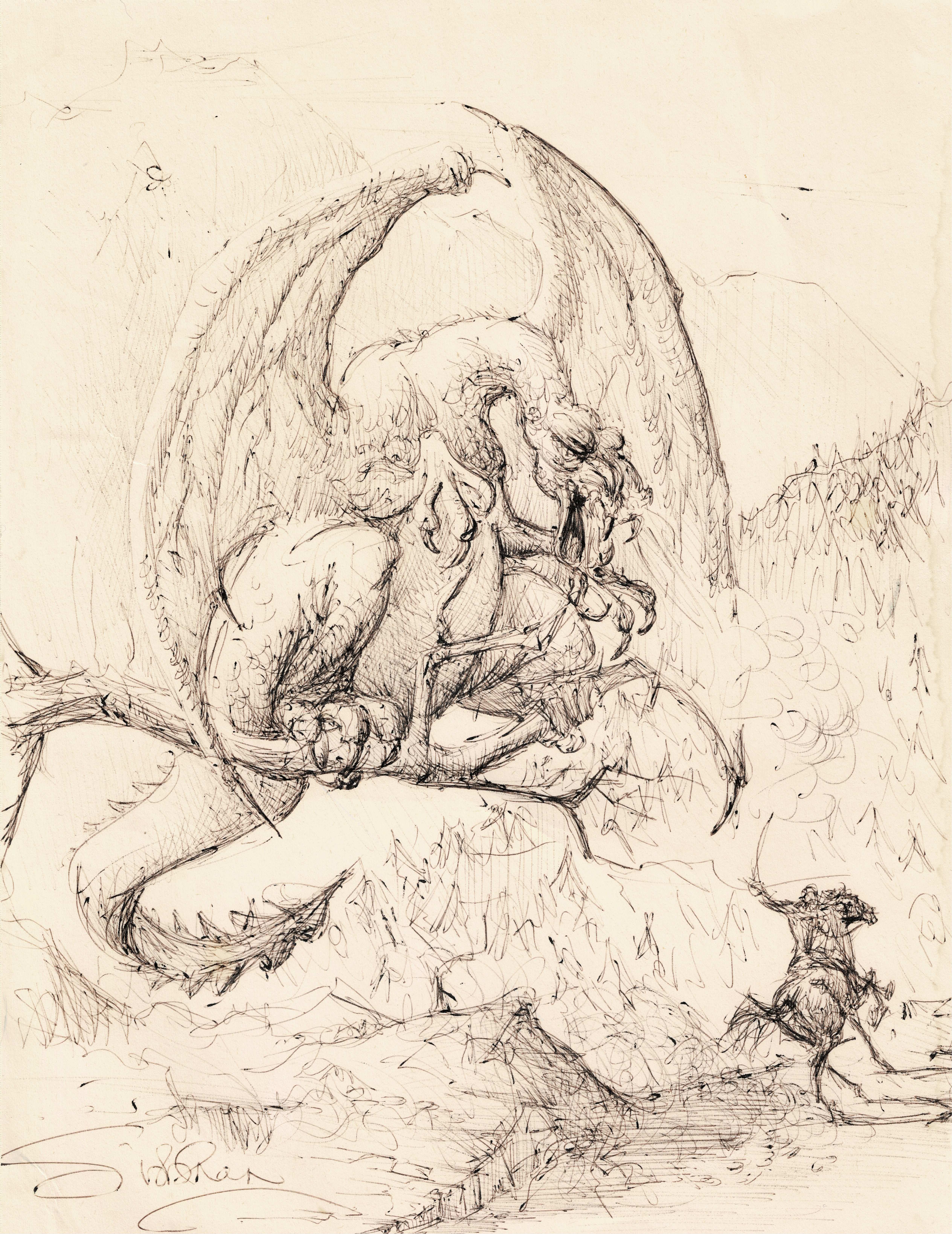
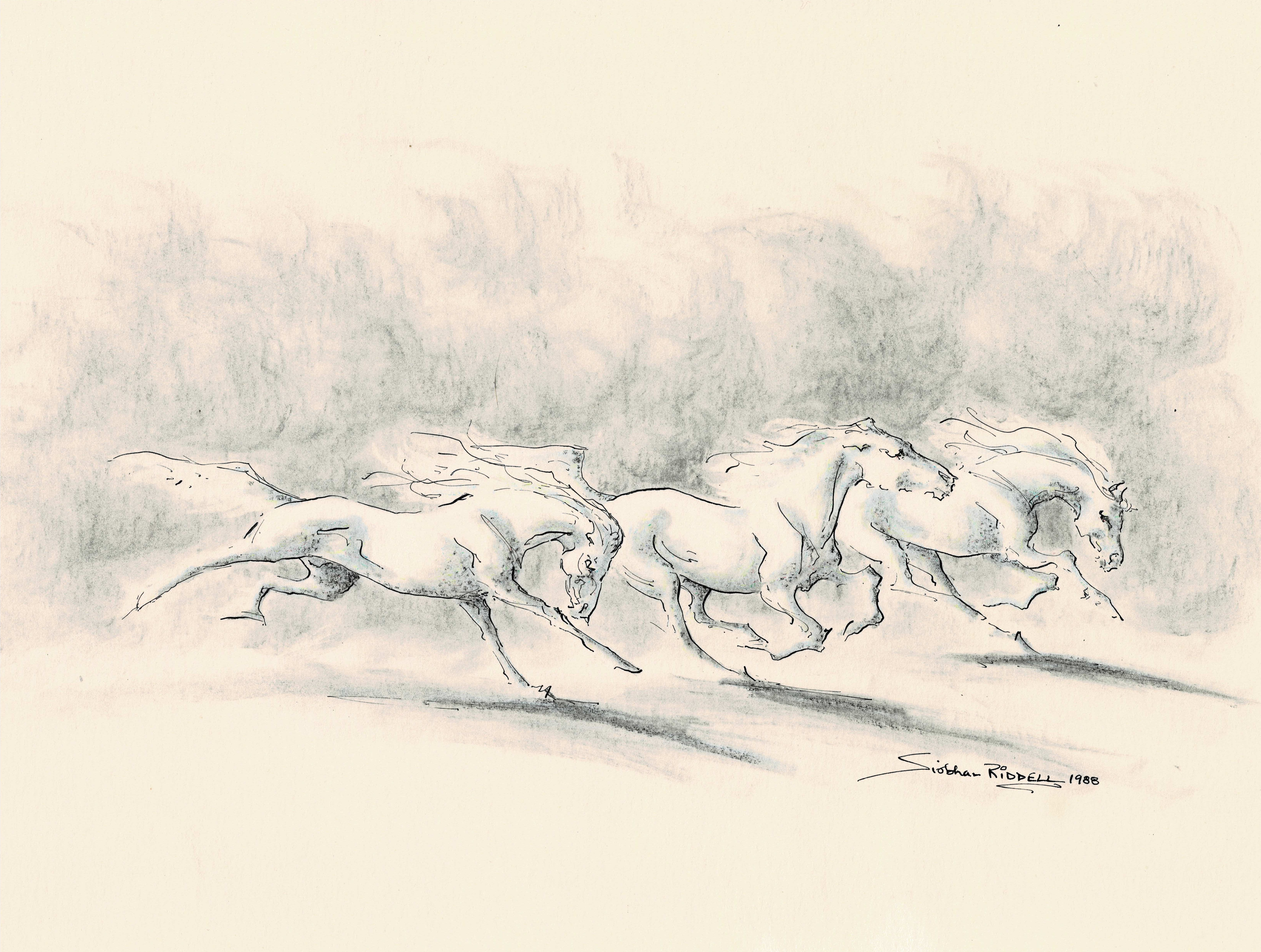
This has happened periodically over the years, and it gives me all the feels to know that Siobhan’s wondrous work has touched other people as deeply (or deeper, frankly) as it’s touched me.
Then, I received some news about Through the Portal. Apparently, their website was down, but it’s back up and running again.
And they are planning two in-person events for the anthology, both in Toronto. One was on December 28th and the other in February 2025. I can’t participate in either, so I’ve been kept out of the loop on the publicity.
I received an opportunity mid-month to submit my work to the poetry in Canada poetry bookshelf. I’ll let you know when The Art of Floating makes its appearance.
There was an SF Canada board meeting on the 3rd to prepare for the upcoming AGM. It was an efficient meeting, and all the necessary decisions and arrangements were made.
The AGM itself was scheduled for the 28th. There were a few technical issues and delays, but everything worked out in the end.
The year in review
This has been a momentous year for me in terms of writing. My debut poetry collection! All the promo and signings and reviews and events around that! More poetry publications! A cli-fi short story publication! Another acceptance of a poem and a short story for future publication!
Given that I’ve been in burnout since September, that’s not bad!
In terms of words written or revised in the year, I:
- wrote only 1,553 words of short fiction and revised 187 (that I tracked),
- wrote 3,232 words of creative non-fiction,
- wrote 28 new poems, and
- wrote 39,059 words in this blog/newsletter.
I stopped tracking my revision efforts on Reality Bomb partway through the year. It was getting complicated. But if things progress as they have been, I should finish with a 120k-word draft. I’d wanted to bring it down more than that, but I still have a listening pass to go, and hope to find a few more places to trim then.
In writing-related events, my ongoing, though stalled, work with Suzy Vadori, and the Stillwater Writing Retreat are highlights.
In retrospect, though I took my six-week, self-funded leave as a means to recover from the flurry of activity around the launch of The Art of Floating, I now recognize that I was probably anticipating burnout even then. I could not have anticipated the accidents and illnesses of either my mom or my mom-in-law, but I could probably feel the impending exhaustion.
I’m grateful I took the leave and that my employer offers the work arrangement, but it means that I won’t be able to take another until the latter part of 2025.
At work, I was able to accept an acting position as an instructional designer on a new team, and though the transition has been a bit fraught, things are finally coming together on the one major project.
In terms of reading, I set myself the goal of reading 50 books this year. In fact, I’ve read or listened to 93 books, 186% of my goal. Admittedly, reading several poetry collections, a fair amount of short non-fiction, and listening to audiobooks helped to increase the number of books I read this year, I still outpaced my goal by quite a bit. And I’ve read a bunch of books that I wouldn’t normally.
Filling the well
The new Reed moon in Sagittarius was on December 1st.
The full moon in Gemini was on the 15th.
Winter solstice fell on the 21st. Did my altar thing.
And the new Elder moon in Capricorn was on the 30th. I know the second full moon in a month is referred to as a “blue” moon, but I had no idea that the second new moon in a month is called a “black” moon. It’s not official astronomy terminology, but that’s what’s out there on the interwebz.

I had no writerly events this month, to my great relief. I needed the relax and to focus on getting my words back.
I did meet for a final time this year with my Dispatches critique group on the 10th. It was a relaxed evening.
I had a massage on the 4th. Bliss.
My support group met on the 18th. This month’s topic was shame. And hoo-boy is this a big issue for me.
And I finished the month with some well-earned and desperately needed annual leave. I was off from the 21st through to January 1st, 12 days off for the price of 5.
My bestie and her partner came up for a visit on the 28th. Phil made cookies and apple cake. They went home with the remainders.
What I’m watching and reading
I watched the fourth and final season of Superman & Lois (CTV SciFi). Yeah, they did the death of Superman. Last season, Lex Luthor turned Bizarro into Doomsday by injecting him with a serum that resurrects him and then killing him repeatedly (I know, I know). Doomsday kills Superman in front of his family, ripping out his heart. Jordan gets him to the Fortress and into suspended animation, but he can’t heal without a heart. So, General Lane sacrifices himself after injecting himself with the serum that resurrected Bizarro so that Lois and the boys can use it to heal Clark. But having a human heart is enough to make Clark age and slowly de-power.
Yadda, yadda, yadda. Final showdown with Doomsday (again) and Lex in John Henry’s suped-up suit. Superman saves the day. In the aftermath, Lex goes to jail for good, several couples are united, Jon (who developed powers) and Jordan get married and have a passel of kids. Lois’s cancer returns, she dies, and then Clark’s human heart gives out. Clark and Lois are reunited in the afterlife.
Having said that (and rather snarkily), S&L was one of the best series to emerge from the “Arrowverse” (even though it was supposed to be in a separate timeline). All the other series got old after a few seasons of retreading the same ground, although most were entertaining, initially.
Charlie Jane Anders has an interesting take on why the Arrowverse, as a whole, was the best set of superhero series on TV. I don’t know if I agree with her, but she says that superhero stories, having come from the comics, are inherently episodic and focused not on superheroic antics, but on the emotional entanglements and journeys of the characters. They’re soap operas. I see her point, but I was never fond of soap operas. Maybe that’s why the various Arrowverse series got old for me, real fast, and why S&L, at only four seasons, comes out ahead of the pack.
Then, I watched the first season of Time Bandits (Apple TV +). I watched the original Terry Gilliam movie so long ago that I don’t really remember it, but I enjoyed this new adaptation. History nerd Kevin is bullied, and his family doesn’t understand him. When the self-proclaimed Time Bandits enter his room through a portal in his closet, pursued by the Supreme Being (who wants his map back, thankyouverymuch), Kevin is swept away into time travelling adventure, while the bandits try to steal treasures from everywhen they visit. Fun.
Next, I finished Black Cake (Disney +) based on Charmaine Wilkerson’s novel of the same name. Byron and Benedetta (B&B) are estranged but come together when their mother dies of cancer. In a series of pre-recorded statements, the siblings learn that their mother, who they knew as Eleanor, was actually Coventina. As they slowly learn the truth, they begin to work through their own secrets and trauma. I enjoyed it (especially Nine Night and duppies), and I have the ebook, which I’ll now have to read 🙂
The series ended on a cliffhanger as B&B’s recently revealed half-sister begins to listen to her separately-recorded message from Eleanor/Coventina, but Hulu cancelled it, so the book may be the only place I can find out what happens next (!)
I also finished watching the latest season of Only Murders in the Building (Disney +). The gang is excited because an OMitB movie is being made, but it’s not long before they figure out that Sazz, whose murder was revealed in the last moments of last season, is missing. When they find one of her prosthetics in the apartment’s incinerator, they have their next season of the podcast. Charles’ serial killer ex escapes prison, Oliver and Loretta navigate their long-distance relationship, and poor Mabel ends up squatting in a dead guy’s apartment. And, of course, another murder was revealed in the last minutes of the season. Fun, as always.
Then, I watched The Lost City when it was shown on the CTV Scifi channel. It’s been on my list of fun movies to watch for a while, but I haven’t been able to find it on any of the streaming services. I guess it will be on Crave now, but I was happy to have a relaxing evening of enjoyable and undemanding viewing. Sandra Bullock stars as Loretta Sage, a former archeological researcher and reclusive romance author on a book tour with her cover model Alan played by Channing Tatum. When she’s abducted, Alan ropes in former Navy SEAL and CIA operative Jack Trainer (Brad Pitt) to help him rescue Loretta.
Phil and I watched the Doctor Who Christmas special, Joy to the World (Disney +). It was a lovely, sentimental story, and I loved the idea of the time hotel, but the story could have used more Joy in it 🙂 The character was a bit sidelined in the story, but I guess you only have so much runtime to fill, and you have to make cuts somewhere. Watch it and see what you think.
Finally, Phil and I finished watching the third season of Bleach: The 1,000-Year Blood War (Disney +). Yhwach tricks Ichigo into killing the Soul King, though one of the soul reapers sacrifices himself to become the Soul King’s right hand. Various factions of the soul reapers fight various members of the Stern Ritter. At the end, Uryu’s plan to infiltrate the Stern Ritters and stop Yhwach is revealed. He stays to fight Haschwalth, who is endowed with Yhwach’s Almighty while Yhwach sleeps, and sends Ichigo to kill the sleeping Yhwach. One more season to complete the story arc!
My first listen of the month was the Audible Original Goblin Hero, the second in Jim C. Hines’ Goblin Trilogy. The reputation of “Jig the Dragonslayer” draws a desperate ogre to the goblin caves. Pixies have taken over the ogres, literally, and they need Jig’s help. The goblin leader is all for it, wanting to rid herself of Jig and all the goblins who want him to be leader instead of her. And Jig’s not too sad to go, either. Vika, obsessed with the hero’s journey, has been bothering Jig to teach her magic, but he doesn’t know how.
Things get interesting when Vika decides to embark on her own hero’s journey and follows Jig into the heart of rainbow-coloured, mind-controlling, pixie madness. Fun!
Then, I read Legacy, the second in Lois McMaster Bujold’s The Sharing Knife series. Dag and Fawn return to his home, uneasy with their anticipated reception. Dag warned her that it would be more difficult than sorting things out with her family, but Fawn doesn’t realize how hostile the Lakewalkers are until Dag’s brother Dar refuses to recognize their marriage and insists that Dag turn around and deliver Fawn back into the uncaring arms of her family. Things get complicated when Dag has to lead a rescue mission to a northern town overrun by a Malice and it’s mudmen and mind slaves, leaving Fawn to face the hostility of the Lakewalkers alone. Very good.
Next, I read The Heart Forger, the second book in Rin Chupeco’s The Bone Witch series. It’s the continuing story of Tea, The Bone Witch. Each chapter continues Tea’s past adventures as she relates them to the bard she initially compelled to tell her tale and jumps into the present as the bard witnesses what she does as a result of all she learned. A complex plot and intertwined characters. I loved it.
Then, I finished my reread of C.S. Lewis’ The Magician’s Nephew. There was a time when I used to read the entire Chronicles of Narnia about once a year, sitting at my desk in the evenings, but it’s been decades since I thought to pick up some of my childhood favourites. As good as I remembered it.
I also read The Shadow Glass by Rin Chupeco, the third book in The Bone Witch series. There seemed to be some issues with bringing the story full circle with the dual timelines and some critical events/information were glossed over toward the end, relying on revelations from the beginning of book one and narrative summaries from earlier in the book to fill in the gaps. It was a bit disorienting, but the author ultimately stuck the landing with a bittersweet ending that was worth it.
I read Kelley Armstrong’s Tales of the Otherworld. This collection so shorter tales focuses more on the Cabal than on the werewolves, but vampires make a couple of appearances, and we get the backstory of how Elena and Clay met and fell in love.
Next, I finished That Hideous Strength, the third in C.S. Lewis’ Space Trilogy. Having read the full trilogy now, I’d say they’re more in the way of science fantasy than science fiction.
Unlike the first two books, which focus of the adventures of Ransom as he travels first to Mars and then to Venus to fight the evil spirits of the universe, this novel begins with the tale of Mark and Jane Studdock, as Mark, a sociologist and academic, is seduced into the ranks of the NICE. Jane, lonely and rudderless as she tries to orient herself to married life when her husband is so often absent, begins to have visions, which draw her into the community of St. Anne’s.
NICE aims, through eugenics and fascism, to control humanity. Weston, Ransom’s antagonist in the last two novels, is mentioned as a martyr to their cause and other of Weston’s co-conspirators from the first novel have been given new names as they seek to corrupt the social and intellectual foundations of Britain. At St. Anne’s, Jane meets the director, who is, in fact, Ransom, and who has an odd affinity for animals. In a final battle for free will and humanity, Ransom’s people find Merlinus Ambrosius, whom NICE operatives are also seeking. Merlin is sent into the NICE stronghold to disrupt their plans, free their prisoners and animals, on whom they experiment, and lead the internal revolt.
Perelandra, or Venus, comes to take Ransom to his heavenly reward, Mark is freed from the machinations of NICE, and Jane welcomes her wayward husband home. The characters are mostly passive, with the exception of Merlin, but even he is counselled not to murder anyone, but to let them be hoist by their own petards. Not for everyone, but enjoyable.
And that was the month in this writer’s life.
Until next month, be well and stay safe; be kind and stay strong. The world needs your stories!


 Always Looking Up