Ad Astra 2016, day 1: The influence of Shakespeare on science fiction and fantasy

Disclaimer: I am not perfect and neither are my notes. If you notice anything that needs correction or clarification, please let me know: melanie (dot) marttila (at) gmail (dot) com and I fix things post-hasty.

Panellists: Kate Heartfield, Arlene F. Marks, Kate Story
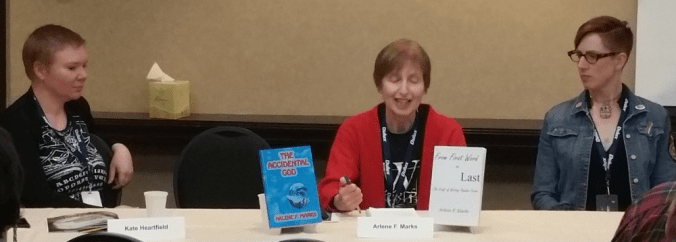
ShakespearePanel

AFM: Shakespeare’s plays were, in his time, entertainment and education. They’re lessons in history, then and now. They also were some of the earliest examples of genre. Hamlet is, in part, a ghost story. MacBeth can be seen as urban legend. A Midsummer’s Night’s Dream is fantasy.

KS: Shakespeare needed to make a living. That’s why he wrote. He was a great enabler of public discourse.

KH: You don’t have to go far to find gender queer characters in Shakespeare.

AFM: The Hogarth Shakespeare series from Penguin Random House is asking well-known authors, like Margaret Atwood, to re-imagine his plays. That’s the brilliance of Shakespeare. You can put any one of his plays into any era or milleu.

KH: A lot of adaptations of his work are coming out because it’s the 400th anniversary of his death.

KS: My father was a scholar in Newfoundland. We had a cultural renaissance in the 60’s and 70’s and we started to make some connections. Maybe we have something to offer to the tradition. I think the spirit of Shakespeare’s time was close to Newfoundland’s now. Shakespeare has always been there and has always been an influence. Shakespeare’s women were far more realistic than the women characters of many modern playwrights.

[Kate then performed the monologue from her story in Carbide Tipped Pens, edited by Ben Bova and Eric Choi. It was a variation of Romeo and Juliet, set in space. She’s currently working on the stage play. I just sat back and enjoyed 🙂 ]

Ian McKellan said in an interview, “Where in the modern world would it be so wrong for two people to fall in love?” It resulted in a 70’s production of Romeo and Juliet set in Belfast.

AFM: In Shakespearean times, it was forbidden for women to go in stage. All women’s roles were played by men, or, more often, boys. The audience was very demanding. If they didn’t like a play, or the actors, they brought rotten vegetables to throw.

KS: He was asking the audience to be clever, to know it’s a man playing a women, pretending to be a man. It engaged the audience, drew them in.

AFM: It’s the fiction of the people. The only publisher that approaches this today is Harlequin, who would hold regular “reader appreciation” luncheons to meet their most popular authors. In Shakespeare’s day, there would be nobles and prostitutes in the same audience. It was whoever had the money to pay.

KS: It was nuts for the theatre. A sixth of the population of London would attend the performances.

KH: The culture of fandom/fanfic has a lot in common with the culture of Shakespeare. There’s nothing more Shakespearean than fanfic. Most of Shakespeare’s plays were drawn from earlier works. He borrowed liberally from Ovid.

Q: Shakespeare’s plays address universal themes. The more popular ones get done. Some might say overdone, but the historical plays are ignored.

KS: My theatre did a gender-swapped Taming of the Shrew.

KH: The film industry has done a better job. My Own Private Idaho, The Hollow Ground series, Looking for Richard.

AFM: A Thousand Acres was the story of King Lear. Shakespeare was brilliant of using every member of the company. There were often comic actors. Characters like Falstaff were written for them. If there were acrobats, he’d give them something to do. They had to be very practical in terms of costuming for these reasons.

KH: Titus Andronicus and Troilus and Cressida were essentially horror. Shakespeare was a great worldbuilder. He was consistent in terms of how fairies, spirits, and witches behaved. His idea of Titania was dark, but comic. Fairies had an alien sense of good and evil.

AFM: He built on the motivations of all his characters.

And that was time.

Next week: The do’s and don’ts of writing erotica (oh, my!).

Tipsday: Writerly Goodness found on the interwebz, May 8-14, 2016

All kinds of writerly goodness for you this week!

K.M. Weiland has made no secret of her disappointment in the Star Wars prequel trilogy. In classic Kate fashion, she gleans writerly goodness from the experience. Planning your story: what George Lucas can teach you (not) to do. Helping writers become authors.

Later in the week, she offered eight tips for writing child characters.

Jessi Rita Hoffman explains how to write a thrilling action scene for Writer Unboxed.

Sophie Masson shares the building blocks of great young adult fiction. Writer Unboxed.

Lisa Cron advises: don’t accidentally give your characters a time out. Writer Unboxed.

Margaret Dilloway explores overcoming impostor syndrome for Writer Unboxed.

Christine Frazier shows you why your hero should eavesdrop and make a bad assumption (in four steps). The Better Novel Project.

Janice Hardy looks at writing a character with a gender not your own. Fiction University.

Dan Koboldt offers some tips for creating fundamentalist religions in fantasy.

Chris Winkle offers strategies for defeating the contrivance boogeyman. Mythcreants.

Jami Gold wonders if your plot obstacles are too easy, too difficult, or just right?

Jennie Nash studies great opening lines. The Book Designer.

Chuck Wendig advises us to defy reality and become artists. Terribleminds.

Jami Gold explores how to reach your potential through writing feedback.

Angela Ackerman offers six rules that will keep your critique partnerships golden. Writers helping writers.

Gabriela Pereira interviews Charlaine Harris for the DIYMFA podcast.

Annie Neugebauer says, don’t hate the query—master it! Writer Unboxed.

Janet Reid shares a checklist of things you need to be thinking about between offer and acceptance.

Susan Spann offered some advice on royalty clauses in publishing deals and how authors get paid. Writers in the Storm.

Karina Sumner-Smith guest posts on Janice Hardy’s Fiction University: is a quick release schedule right for you and your books?

My friend, Kim, is back on the road. This time, she spends an afternoon with Margaret Atwood.

Micah Solomon offers three books that will help you to radically improve your writing. BookBaby

Cory Doctorow shares his vision of how publishers, libraries, and writers could work together. BoingBoing.

Delilah S. Dawson wrote this beautiful post on writing and grieving: someday this pain will be useful to you.

Natalie Zutter shares Nnedi Okorafor and N.K. Jemesin in conversation: masquerade, initiation, and science fiction and fantasy. Tor.com

Bustle wants you to diversify your reading list with these 23 LGBTQ books with a person of colour as a protagonist.

What Bustle says your to-be-read list says about your personality.

Ferris Jabr revisits the lost gardens of Emily Dickinson. The New York Times.

Kathryn Hughes looks at the dystopian world of Beatrix Potter. The Guardian.

Shakespeare and death:


Women swept the Nebulas! i09.

Jo Walton reviews Ada Palmer’s Too Like the Lightning for Tor.com.

A Ken Liu short story will be made into a movie. i09.

John Marcotte reports that Marvel is committing to a Black Widow movie (at some unknown point in the future). Heroic Girls.

And, speaking of Marvel, the next X-Men movie is due out May 27th: X-Men Apocalypse.

Here’s the teaser:


And the official trailer:


Buzzfeed shared what was a sneak peek of Outlander’s next episode (I saw it Sunday) but I thought I’d post it anyway. “Ovaries explode!” – funnee.

See you Thursday for some thoughty stuff 🙂

Tipsday

Tipsday: Writerly Goodness found on the interwebz, April 24-30, 2016

Another lovely batch of writerly goodness for you!

First some Sudbury poet laureate news 🙂

Adriana Nicolucci interviews Kim Fahner for Our Crater.

More poet laureate goodness: it’s been a busy week at Sudbury’s libraries. Jessica Watts for The Sudbury Star.


K.M. Weiland asks, do you have a writing superpower (and why you shouldn’t)? Helping writers become authors. Later in the week, she helps us understand how to write scenes your readers will rave about.

Roz Morris shares tips on how to blend a parallel, allegorical fantasy plot into your novel. Nail Your Novel.

Bonnie Randall guest posts on Janice Hardy’s Fiction University: battling the block.

Marcy Kennedy returns with part two of her reading like a writer mini-series.

Chuck Wendig: What I’d like to say to young writers, part two.

Leanna Renee Hieber guest posts on Terribleminds: what to do when the bottom drops out.

James Scott Bell guest posts on Writer Unboxed: how to weave a message without pummelling your readers.

Steven Pressfield: I can’t squeeze my theme in! My favourite bit: “This is why writing (or the pursuit of any art) is, to me, a spiritual enterprise. It’s an endeavor of the soul. The stories we write, if we’re working truly, are messages in a bottle from our Self to our self, from our Unconscious/Divine Ground/Muse to our struggling, fallible, everyday selves.”

Later in the week, Shawn Coyne posts this: the designated driver. I’ve been listening to The Story Grid podcast and Tim Grahl has just finished his first draft.

Nina Munteanu explores the writer-editor relationship: editors preparing writers.

Stephen Stratford writes an essay on the dark arts of editing for The Spinoff.

Query Shark Janet Reid sounds off on why you should avoid querying services.

Author brands: Which kind of influencer are you? Carly Watters.

Martha Alderson guest posts on Jane Friedman’s blog and shows us how to use a plot planner.

Jami Gold looks at brain science from the perspective of how we, as writers, imagine.

I may have shared this before, but it’s a good article: how stories change the brain. Paul J. Zak for Greater Good.

This is long as heck, but Tor.com covers (almost) all the science fiction and fantasy adaptations in production and already on the air.

Charlie Jane Anders explores the moment when science fiction diverged from competence porn. i09.

Cassandra Clare created a fantasy realm and aims to maintain her rule. Penelope Green for The New York Times.

The secrets of medieval fonts. Medieval Books.

David Tennant as Puck. Just ‘cause it’s Shakespeare’s 400th 🙂

Shakespeare is dead: six hot takes. Literary Hub.

Rob Brydon shares Shakespearean phrases in everyday use.


The Doctor’s Long Story, a fan video with heart. Radio Times.

John Boyega and James MacAvoy to voice Netflix’s Watership Down. Comic Book Resources.

Nathan Fillion joins the cast of Guardians of the Galaxy 2, with more than just a prosthetic-covered cameo. Peoples Choice.

Electric Lit shares an infographic that explains the real history behind Game of Thrones.

Sarah Mesle reviews the first episode of season six for the LA Review of Books.

Until Thursday, be well.

Tipsday

Tipsday: Writerly Goodness found on the interwebz, April 17-23, 2016

Dialling back on the writerly goodness this week, but there’s still a shit-tonne to share 🙂

Sudbury IS Reading Town Canada. April 30 to May 8, 2016.

K.M. Weiland shares everything you need to know about writing third person point of view (POV). Helping writers become authors.

Dave King writes about writing class accurately in an historical context for Writer Unboxed.

Elsa S. Henry guest posts on Terribleminds about writing blind characters realistically.

K.M. Weiland points out the one major pitfall of writing strong characters. Helping writers become authors.

Becca Puglisi discusses friends as enemies for Writers Helping Writers.

Diverse fantasy is better fantasy. Fantasy Faction.

Oren Ashkenazi lists five signs that your story is racist. Mythcreants.

Ricardo Fayet lists twelve common writing mistakes even bestselling authors make. BookBub.

What’s your potential? Dan Blank on Writer Unboxed.

Jamie Raintree shares her thoughts on the real reason we want to be published. Writers in the Storm.

Awesome process alert! Kameron Hurley discusses why she writes non-chronologically. I can’t. One thing needs to lead to the next for me. But try it out. If it works for you, why not do it? Process is an evolutionary thing.

Janice Hardy explores how to balance writing and working without losing your mind. Fiction University.

Kameron Hurley writes about the slog on the mountain and the calm before the storm.

Related: Lauren Carter writes about climbing gear.

Jim C. Hines considers shield theory as a way of explaining spoon theory to his son.

Publishing news: proposed settlement reached in Harlequin class action suit.

SFWA contracts committee alert.

Nina Munteanu examines the moving target of indie publishing. What every writer and editor needs to know.

I read Janet Reid’s blog religiously. Here’s an excellent post on author/agency agreements.

Carly Watters interviews Kurestan Armada concerning her first year as an agent for the Things I wish I knew series.

Agent Chip MacGregor defines success. MacGregor Literary.

Chris Winkle analyses the fantastic writing of Andy Weir’s The Martian. Mythcreants.

Charlie Jane Anders lists eighteen short stories that pack more of a punch than most novels. Gizmodo.

Michael Peck explores the literature of cyborgs, robots, and other automata. Literary Hub.

Leah Schnelbach wonders why we’re still white-washing Asian characters. Tor.com

These are all kinds of beautiful: Studio Ghibli’s greatest works drawn in Art Nouveau. Go Boiano.

Colm Tóibín on writing. Sentences as rhythm. Sentences as brush strokes. Yummy. Louisiana Channel.

Jeanette Winterson examines Shakespeare’s take on love: bed tricks and broken women. A friend took exception to the dim view of Anne the piece presents, but y’all know not to believe everything you read, right? The Guardian.

The manuscripts of the first two English women writers are now on display. Alison Flood for The Guardian.

Thoughty Thursday is full of videos. See you then.

Tipsday

Tipsday: Writerly Goodness found on the interwebz, April 3-9, 2016

Wahoo! Is it possible there’s even more writerly goodness in here then there was last week? Hella yeah!

More exciting local news: Sudbury is part of Reading Town 2016 (think Hockey Town with books) 🙂


Most common writing mistakes, part 50: Info dumps (and how to fix them). K.M. Weiland. Helping writers become authors.

Liz Bureman looks at parataxis and hypotaxis (and how Greek makes you a better writer). The Write Practice.

Sara Letourneau explores how to develop theme in your stories through symbolism. DIYMFA.

Donald Maass discusses relevance for Writer Unboxed.

Juliet Marillier writes about the different responses you can (and should) have to an editorial report. Writer Unboxed.

Roz Morris asks, must plot twists always be misfortunes or disasters? And, where does your story end? Nail you novel.

Daniel José Older offers twelve fundamentals of writing the other (and the self). Buzzfeed.

Marcy Kennedy explores how to read as a writer (part 1).

Real writers don’t self-publish, part two. Kristen Lamb shares her further thoughts on the issue.

Mike Shatzkin wonders what will happen to high-cost non-fiction in the evolving indie world.

C.S. Lakin points out the need for persistence in your writing journey. Live, write, thrive.

Janice Hardy shares her thoughts on challenging yourself, versus setting yourself up to fail. Fiction University.

Kameron Hurley writes about career milestones and prioritizing projects.

Catherine Ryan Howard recounts how the idea for her novel Distress Signals evolved.

How to create a better writing space (and other thoughts on writing). Avoiding Atrophy.

Jennie Nash shares her one page book planner on Kobo Writing Life.

Sarah Selecky shares more writing retreats for your wish list.

Speaking of writing retreats, my friend, Kim Fahner, has just spent the week in Banff with Lawrence Hill. Here are her posts on the experience: Making time to write, and Writing retreats and the friends you meet.

“Mad Men” creator, Matthew Weiner’s reassuring life advice for struggling artists. Fast Company.

Sword and Laser: Interview with Ken Liu.


The Writes of Women: a celebration of female writers and their work.

Stephen Greenblatt explores how Shakespeare lives now for The New York Review of Books.

A Shakespeare first folio was discovered on the Isle of Bute, just in time for the Bard’s 400th anniversary. The New York Times.

The history of typography. Ben Barrett-Forrest.


Christopher Zumski Finke discovers what Battlestar Galactica teaches us about the militarization of police. Yes! Magazine.

Rogue One teaser trailer.


Kate Spencer says, hey dudes, you should be watching Outlander. Esquire.

And that should keep you busy for a while (!)

See you on Thursday for a video heavy dose of thoughty edutainment 🙂

Tipsday

Tipsday: Writerly Goodness found on the interwebz, March 20-26, 2016

Holy shemoley! Lookit all the Writerly Goodness!

Ok. This is big news around here. Sudbury has a new poet laureate, and its first woman in the role, my awesome soul sister, Kim Fahner! The Northern Life. And here’s the interview she did with Markus Schwabe of the CBC’s Morning North. She had a cold, but it’s still a fabulous interview 🙂 She’s on her way to Banff right now to work with the wonderful Mr. Lawrence Hill!

Jane Friedman points out the pros and cons of maintaining a personal profile versus a professional page on Facebook.

Susan Spann advises us when a book is considered out of print. Writer Unboxed.

Jed Herne guest posts on The Better Novel Project with The Half-Blood Prince guide to question arcs.

Michelle Hoover writes an excellent guest post for Writer Unboxed on the duplicity of a character’s desire.

John J. Kelley explores the art of the plausible for Writer Unboxed.

Barbara O’Neal discusses the matter of talent. Writer Unboxed.

C.S. Lakin offers three ways to keep readers reading past page one. Live, write, thrive.

Tiffany Lawson Inman explains how to build dramatic momentum in fiction. Writers in the Storm.

Janice Hardy explores the ebb and flow of plotting a novel. Fiction University.

K.M. Weiland’s back with five more ways to trim your novel’s word count. Helping writers become authors. Later in the week, she helps us choose the right protagonist.

Kate Elliott gives us the tools to write women characters into epic fantasy without quotas. Tor.com

Awesome: How do we write about diversity when the word has lost its meaning? With Daniel José Older, Ashley Cassandra Ford, and Tanwi Nandini Islam. Elle. (Really? Yuh-huh.)

Steve Kettmann: On knowing what to leave out. Medium.

Victoria Mixon shares her super-easy formula for creating a blurb.

Ruthanne Reid points out the two most important words for writers: don’t quit. The Write Practice.

Kerry Lonsdale writes an open letter to writers at every stage of publishing. Books by Women.

Kameron Hurley ponders her sales.

J.K. Rowling shares rejection letters on Twitter to help beginning authors. The Guardian.

Jamie Raintree explores how to decompartmentalize your art.

Anna Lovind bares herself in this post on the process of creative transformation.

Dan Blank shares what he’s learned from 30 days of vlogging.


Thinking about a writers’ retreat? Sarah Selecky gives you a place to start looking.

Madeleine Dore offers 50 ways to take care of yourself in the arts. Performing Arts Hub.

Robert J. Sawyer shares his creative process with Inverse’s Lauren Sarner.

Where five Canadian authors read. The Globe and Mail.

Buzzfeed lists 21 German words we should be using in English.

Victorian doctors thought reading novels made women incurably insane. History Buff.

On the other hand, art is proven to have mental health benefits. The Butler Collegian.

National Geographic lists its top ten book stores in the world.

Daniel José Older: Notes on love and revolution. Guernica Magazine.

Brainpickings shares Charlotte Brontë’s love letters.

The Telegraph lists ten novels with titles from Shakespeare.

Shakespeare’s skull stolen from grave. BBC.

15 Welsh myths and legends. Wales Online.

Michael Boyle and Daniel A. Kaufman wish Babylon 5 a happy birthday. This is one of my all time favourite series. The Electric Agora.

I don’t know about you, but I’m exhausted!

See you Thursday 🙂

Tipsday

Tipsday: Writerly Goodness found on the interwebz, Jan 3-9, 2016

Victoria Mixon returns to Writer Unboxed with this post: four Post-its over our desks.

K.M. Weiland continues her Most Common Writing Mistakes series with part 47: Ineffective setting descriptions.

Communication as a literary theme: a case study, by Gabriela Pereira for DIYMFA.

Chuck Wendig advises: be the writer you are, not the writer other people expect you to be.

Donald Maass writes about tension versus energy for Writer Unboxed.

Kameron Hurley explains why she doesn’t want to be called talented.

Delilah S. Dawson writes about prepping for winter and the seasonal depression that comes with.

Jerry Jenkins shares his guide to how to become and author.

Deena Nataf offers a great trick to sort who from whom. The Write Practice.

Beware of this scam on YA authors by people posing as Penguin Random House employees. Bookish Antics.

David Gaughran identifies several Penguin Random House imprints that are still doing business with Author Solutions.

Joseph Boyden appointed to the Order of Canada. CBC.

The Complete Deaths is a new play that compiles all of the deaths in Shakespeare’s plays in one gory spectacle. The Telegraph.

A brief history of books that don’t exist. Literary Hub.

Harlan Ellison, the author who wrote in bookstore windows. Mental Floss.

The Ottawa Citizen posts its list of the 16 (Canadian) books to watch for in 2016.

Mental Floss lists six book festival towns for you to visit.

The Guardian lists its top ten modern medieval tales.

Tom Waits reads Charles Bukowski’s “The Laughing Heart.”


Here’s a new Outlander trailer to see you through #droughtlander.

W00t!

Come back on Thursday for your weekly dose of thoughty 🙂

Tipsday

Tipsday: Writerly Goodness found on the interwebz, September 20-26, 2015

One day left in September? Where did the time go?

It’s another tasty week of Writerly Goodness 🙂

K.M. Weiland invites you into her process as she corrects her story on her blog. Listen to the podcast and follow along with the screen shots on the blog.

Then, Katie shares what this past year preparing for publication has been like.

And for the hat trick: Foreshadowing and misdirection. Two sides of the same writerly skill best used in concert. Find out how in Katie’s Friday vlog.

Bonnie Randall returns to Janice Hardy’s Fiction University to explore the lessons writers can learn from The Killing. Phil and I are watching this on Netflix now. Just started season two. It’s definitely well-written.

Barbara Kyle shares five tips for writing a series on Chryssa Bazos’s blog.

Jane Friedman discusses the evolution of the literary agent. Writer’s Digest.

Porter Anderson digs deeper into the Authors Guild survey and what it means on Thought Catalog.

You may be surprised at what counts as a success in terms of book sales. Lynn Neary for NPR.

Ebook sales slip and the rumours of print book death are greatly exaggerated. The New York Times.

Summary judgement motions filed in ebook price fixing suit. Publishers Weekly.

How Oyster’s shut down (and movement of its employees to Google) is affecting attempts to create a “Netflix” for ebooks. Forbes.

Forbes’s Edmund Ingham interviews Reedsy founder, Emmanuel Nataf, about how his service is disrupting publishing.

Last week, I shared a post about a banned book in New Zealand. This week, the author speaks out. The Observer.

Messages to the future. Vsauce. I’ve chosen to put this in Tipsday because it’s about the stories we tell.

J.K. Rowling gets into the Potter family history on Pottermore.

Watch this fairy tale love story with a twist. i09.

Kate Beaton shares her top ten warrior princesses from Elizabeth I to Boudicca. The Guardian.

This. Is. Brilliant. #15secondShakespeare Radio Times.

Come back for Thoughty Thursday, y’all!

Tipsday

Tipsday: Writerly Goodness found on the interwebz, August 9-15, 2015

Four methods to invigorate your prose with surprising sentences. K.M. Weiland.

Moar Katie: How not to waste your story setting’s full potential.

The love that dare not appear in print. David Corbett for Writer Unboxed.

The socially awkward writer. Sarah Callender for Writer Unboxed.

Roz Morris guest posts for Romance University on what you need to do for your NaNoWriMo preparation.

Harry Connolly shares what keeps him writing full time. Jim C. Hines.

The five things productive writers do differently. Joe Bunting guests posts on Tim Grahl’s blog.

Kristen Lamb explains what went wrong with True Detective, season 2.

To the lab! Veronica Sicoe writes about creating alien species in three steps.

Joanna Penn and Guy Windsor discuss the difficulties of writing good sword fights.

Just call her our lady of dark grace. Silvia Moreno-Garcia responds to commenters who call her a “little bitch” for daring to publish an anthology of Lovecraftian tales written by women.

Why do people say that the novel is dead? The New York Times.

Deborah Malcom was inspired by Neil Gaiman to create Meh, her wordless picture book that helps kids understand mental health issues. The Big Issue.

J.R.R. Tolkien’s first fantasy story to be published. Aaaannd, it’s from the Kalevala, the Finnish national epic poem. The Guardian.

Hear Shakespeare’s plays in Renaissance English. Open Culture.

Cannabis found in Shakespeare’s pipes (!). As a friend said, this explains The Tempest! The Telegraph.

Russell Smith offers six tips to help you write and publish your first novel. The Globe and Mail.

Five Room writers talk about their favourite writing tools.

Being a medieval librarian was hard work. Medieval books.

New images from the set of Star Wars: The Force Awakens. Entertainment Weekly.

More Tipsday coming up next week, but in the meantime, swing back for some thoughty on Thursday 😉

Tipsday

Tipsday: Writerly Goodness found on the interwebz, May 17-23, 2015

Seems like I’m all about the Writerly Goodness lately 🙂

Not all hybrid publishers are created equal. Jane Friedman in Publishers Weekly.

Here’s K.M. Weiland’s post and podcast on the perfect midpoint.

Avoid false suspense unless you want to ruin your climax. Katie’s Wednesday post.

How to silence your inner critic and defeat your writing demons. The Write Life.

Jules Feiffer in conversation with Neil Gaiman. Publishers Weekly.

The Publishers Weekly podcast: Rose Fox and Mark Rotella interview Naomi Novik.

Two Kurt Vonnegut articles from Open Culture: Eight tips on how to write a good short story, and how to write with style.

For Lois. Shane Koyczan’s poem from Superman to Lois. LOVE.

Female literati pick summer’s best books. Harper’s Bazaar.

Nine great science fiction books for people who don’t like science fiction. i09.

20 obscure English words that should make a comeback. Matador Network.

For balance: Fifteen words you should eliminate from your vocabulary if you want to sound smarter. The Business Insider.

Ballagàrraidh: The knowledge that you have been domesticated. The dictionary of obscure sorrows.

Is this what Shakespeare really looked like? BBC News.

This artist combined different cats and birds to create a whole new class of gryphons 🙂 Tumblr.

Check out these gender flipped Disney characters from Yue “Sakimi Chan” and then check out the links to Yue’s work on Deviant Art and Tumblr. UpRoxx.

How about these historically accurate Disney princesses? Buzzfeed.

The Huffington Post shares this list of ten things you may not know about Sailor Moon.

Who’s the best new superhero, The Flash, or Marvel’s latest incarnation of Daredevil? Salon.

Ok. So there was this big thing on the interwebz last week about the latest rape scene in Game of Thrones. I don’t want to get into the controversy, but I will present a number of posts on both GoT and Outlander and how the sexual violence portrayed in them differs.

As ever, you’ll have to decide for yourselves.

George R. R. Martin responds to criticism of Sansa’s rape scene in Game of Thrones. The Huffington Post.

Tobias Menzies shares his experience playing Black Jack Randall on Outlander. He’s terrifying in the role, by the way. Such an amazing actor. The Vulture.

Scotland Now recaps Outlander, episode 15.

How Outlander got it right and how Game of Thrones got it wrong. Playboy.

IndieWire weighs in on Outlander vs. Game of Thrones.

And a bonus: Never go anywhere without a Murtaugh! Q&A with Duncan Lacroix on playing Murtaugh. Access Hollywood.

See you on Thursday 🙂

Tipsday