Tipsday: Writerly Goodness found on the interwebz, July 20-26, 2014

Angela Ackerman details her encounter with copyright infringement on Writers Helping Writers. This is serious stuff.

I’ve had other writerly friends who’ve noticed their books have been pirated and if you’ve been following Angela on FB, you probably know that she’s encountered that too.

There’s a mode of thought on the interwebz that says pirating is not your enemy. If people like your book so much they steal it, then it will likely convert to more readers.

I think that argument is fundamentally flawed. Chuck Wendig spoke to this quite eloquently a few months ago, here, here, and here.

What if people are stealing your work and trying to make money off it illegally by selling it and pocketing the profits? For a self-published author, the book is her livelihood. Even for the traditionally published, what money he might have seen from a legitimate sale, disappears. It’s wrong.

And the readers who buy these pirated copies may not even know that their money is not going to the author. That’s doubly wrong. Theft, deceit, and fraud? That’s jail time people.

But as Chuck said, it’s not just about the money. An author (or authors) slaved over that book for months, if not years. It’s their intellectual property (IP). It’s their blood, sweat, and tears.

Don’t pirate books. Don’t do it.

<end rant>

Onward, to more light-hearted material.

M.M. Finck posts on Women Writers, Women’s Books about the querying process and why it’s not just about the query. Thanks to Jamie Raintree (see below) for bringing this to my attention.

Anthony Metivier guest-blogged about how to mine your dreams for story gold on Writers Helping Writers.

Bringing a strong vision to your fiction, by Laura K. Cowan, for Writer Unboxed.

Jamie Raintree asks, how far do we follow our dreams? Since we’ve become acquainted, Jamie’s acquired an agent and is now working on a second novel. I love watching her journey unfold.

Here’s Janice Hardy’s guest post for Anne R. Allen’s blog about how not to start a novel.

Veronica Sicoe follows up last week’s post on how she structures her novels with this one on how she brainstorms an idea into a working concept.

K.M. Weiland continues her negative character arc series with part 2: The negative character arc in the second act.

Whether you’re considering hiring a ghost writer, or becoming one, this post by Roz Morris will answer your questions.

Four reasons to use dramatic irony from Writers Write.

Chuck Wendig gets a mention again for sharing this i09 post about Snowpiercer and its fascinating influence. Yes, it’s a South Korean movie based on a French graphic novel, but it’s still great storytelling.

Xia Jia shares her thoughts on what makes Chinese science fiction, Chinese on Tor.com. Translated by Ken Liu. It’s interesting socio-political stuff.

And if your to-be-read (TBR) pile isn’t big enough yet, here is some recommended reading from TED.

Flavorwire presents the 35 writers who run the literary internet.

As a follow-up to my last week’s posting of the CanLit song, here’s every Canadian novel ever. It’s kind of true. And funny. The Toast.

And that’s it for this week, folks.

Thanks for following, sharing, and all the good stuff you do.

Tipsday

Tipsday: Writerly Goodness found on the interwebz July 13-19, 2014

A cavalcade of creative coolness. Just for you.

The July 2014 author earnings report. For those who haven’t already read it.

Anne R. Allen defines traditional publishing and offers some perspective on what’s happening with the Big Five in this changing publishing world.

Carly Watters points out the biggest query letter mistake.

Jamie Raintree writes about what we can and can’t control in the business of writing.

In which Veronica Sicoe shares her method for planning a novel.

The negative character arc series begins. K.M. Weiland.

And moar Katie: What if your antagonist is right?

MJ Bush guest posts on Writers Helping Writers. Three steps to deepening your character with anger.

Reverse engineering your character arc with Jami Gold.

Roz Morris diagnoses and prescribes treatment for a writer’s ailment: The plot hole.

Kristen Lamb discusses the seven deadly sins (and a few virtues) of prologues.

The BookBaby blog asks, are you more creative writing by hand or typing?

Brainpickings features Leonard Cohen on creativity, hard work, and perseverance. Excerpted from Paul Zollo’s Songwriters on Song-writing.

How SF writers predicted the conflict in the Ukraine and how they’re trying to stop it. Slate.

David Brin shared this SF story by E.M. Forster (written in 1909): The Machine Stops.

Grammar Girl, Mignon Fogarty shares ten words whose pronunciation has changed over the years.

Everybody and their dog’s pet hamster has been sharing this around the interwebz ‘cause Weird Al is just so brilliant 🙂


And Kari Maaren sings a lovely little song about CanLit 🙂


Enjoy, my writerly peeps 🙂

Tipsday

Tipsday: Writerly Goodness found on the interwebz July 6-12, 2014

Not a huge whack this week folks, but what there is, is all quality 🙂

Most common writing mistakes with K.M. Weiland. This week, one dimensional conflict.

Janice Hardy discusses character development.

Roz Morris demonstrates her beat sheet technique with Ray Bradbury’s Fahrenheit 451.

Anne R. Allen lists twelve dumb things writers do to sidetrack our success.

The ever-awesome Robin LaFevers writes about the crushing weight of expectations on Writer Unboxed.

Lisa Cron writes about how writers have the powah on Writer Unboxed.

Carly Watters reveals three signs that you’re past the form letter rejection stage.

Writer’s Relief presents the joy of gerunds.

Did you need even moar books to read? I didn’t think so. Still, here’s The Millions’ book preview for the second half of 2014.

Eight things you should know about Diana Gabaldon’s Outlander series from the Barnes & Noble book blog.

A review of the two volume Robert Heinlein biography from Barnes & Noble Reviews.

Enjoy!

Tipsday

Tipsday: Writerly Goodness found on the interwebz, June 29-July 5, 2014

Heading off to yoga shortly, so getting this week’s offerings up all hasty like.

Despite the title, K.M. Weiland offers writers some comfort: Why every story you write is a guaranteed failure.

C.H. Griffin posts about what Firefly can teach us about writing. Love Joss Whedon and Firefly, so this geek was caught at the title 😉

Infuse your fiction with Donald Maass on Writer Unboxed.

Ruth Harris blew me away with all of these writerly resources, many of them free!

Neuromarketing advises us to forget the fold. Interesting news for those of us who have usually posted loooong.

Roz Morris counsels a young aspirant about what path she should take to become a writer. This is good advice for anyone considering taking a course, workshop, or degree to bolster their “qualifications.”

The CBC’s list of the 100 novels that make us proud to be Canadian.

Brainpickings presents the greatest books of all time, as voted by 125 famous authors.

Why people in the 19th century thought reading fiction was bad for you. The Huffington Post.

A TED Ed video on the art of metaphor by Jane Hirshfield.

Four lessons in creativity from Julie Burstein. A TED Talk.

And that she be it.

Tipsday

The next chapter: June 2014 update

Hey all!

I must say that June was a blockbuster month for me.

It started with the publication of my science fiction short story “The Broken Places” being published in Bastion Science Fiction Magazine. Still so excited about that.

I attended June’s @M2the5th Twitter chat with Roz Morris, focusing on her Nail Your Novel series. I’m learning quite a bit from these, and though we cancelled July’s because, Independence Day, we’ll be getting back to our monthly schedule in August.

A comment on last month’s update had me a little concerned about what my readers might be taking away from these posts. It seems May’s update was taken as a warning about social media. If the warning was timely and helpful, great, but it’s not the message I hoped to convey.

I have now finished reading my ARC of K.M. Weiland’s forthcoming Jane Eyre: Writer’s Digest Annotated Classics. I’ll be posting a review later in the month, so stay tuned for that.

The adjustable desk is working out very well, and I’m now standing for longer between rests. At work, I read a post from a learning and development blogger in which he discussed his experience with his standing desk, which he described as continual fidgeting.

He uses a kitchen stool to take a periodic break from standing and has discovered that he can’t write while standing (!) Thankfully, that hasn’t been my experience.

CanWrite! 2014 was a great time, as usual. I’ve been blogging the panels, sessions, and workshops I’ve attended on a weekly basis.

Another piece of exciting writerly news arrived when I returned home from the conference: another speculative short story, “On the Ferry,” made it into the top ten in the When Words Collide writing contest.

This means I’ll appear in their chapbook anthology, In Places Between, though I’ll have to wait until the conference to find out if I’ve placed. Still. Squee-worthy.

Last month, I had a blogging disruption around the arrival of my desk and spent most of my non-blogging writing time working through Initiate of Stone, all of that work in long hand. Though I completed a lot of work on IoS, I wasn’t able to capture a word count from it.

In last month’s update, I mentioned I would be getting back to countable writing.

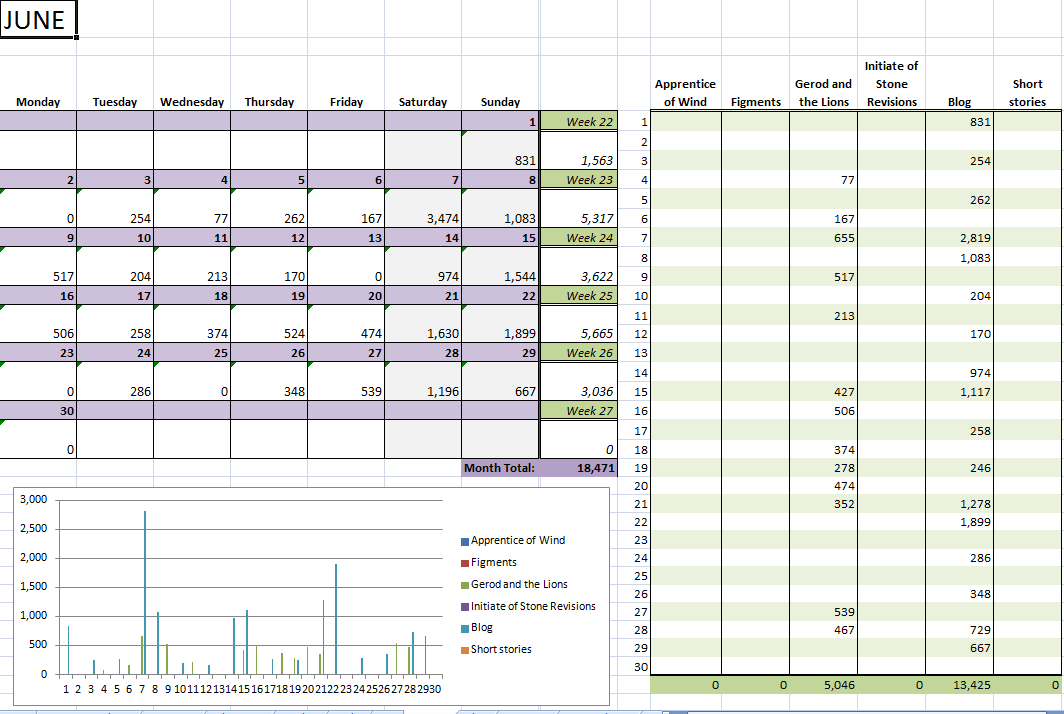
June's writing progress

June’s total word count: 18,471!!!!!

13,425 of those words were on my blog, but 5,046 were written in Gerod and the Lions. I set myself a goal of 5k for the month on that project, and I made it. The draft is now just over 10k words and I’ll have a workable draft by the end of the year 😀

I only just started working on Figments (my NaNo project from last year) as I had worked on IoS last month. In all fairness, I have a little more to do with Figments than I had to do on IoS.

First, I’m mapping it. This is something I picked up from reading Donald Maass’s The Breakout Novelist. For each chapter, I list the title, page count, word count, the first and last lines (both hooks, one to draw the reader into the chapter and the other to propel the reader onward), the purpose of the chapter, in story terms, the internal and external conflicts, and finally, what changes for the story, and for the POV character as a result of the chapter.

These are actually from several separate exercises in Maass’s workbook, but I’ve cobbled them together to create my map. These are like index cards and I can rearrange them as needed when I work on the structure of the story. I can see where I might have to divide longer chapters, and fairly easily pick out plot points, pinch points, reversals, etc.

Once I get the mapping done, I’ll fiddle with Figments’s structure and tighten things up, work through a beat sheet ala Roz Morris, and finally reverse engineer the plot with Victoria Mixon’s holographic structure.

June has taught me that I can’t draft one project and then work by hand on another project simultaneously. I’m going to try alternating and see how that goes.

And that is all the Writerly Goodness I have for you tonight.

How are your works-in-progress coming, my friends?

Coming up this month: An interview with author and editor Mat Del Papa on his new anthology Creepy Capreol, I take another shot at the writing process blog hop, the review of Katie’s book, more CanWrite! reportage, and a couple of poems with creation stories.

The Next Chapter

Tipsday: Writerly Goodness found on the interwebz June 22-28, 2014

Happy Canada Day, writerly peeps!

Red-Maple-Leaf-for-Canada-Day

Publishing news of the week: Writer’s Digest dumps Author Solutions. What David Gaughran thinks of the move.

Roz Morris explains how to write from an outline and still be creative. My subtitle: How to bend it like Morris 😉

The third and final instalment of K.M. Weiland’s flat character arc series: The flat character arc in the third act.

MJ Bush wrote a guest post for Writers Helping Writers on how regret can deepen your character’s arc.

Training your internal editor with Mary Robinette Kowal.

Writers, what do you fear? Dan Blank offers some compelling thoughts on how to deal on Writer Unboxed.

66 facts you may not have known about the English language from The Huffington Post.

John Vorhaus lets his wordy whimsy out to play on Writer Unboxed.

14 pieces of brilliant short fiction from Art.Mic.

Five hundred fairy tales discovered in Germany, brought to you by The Guardian. I can’t wait to get into these!

See you on Thoughty Thursday!

Tipsday

Tipsday: Writerly Goodness found on the interwebz June 15-21, 2014

There’s a little bit of everything this week. A little craft advice, some blogging tips, love for the word nerds and the book worms, writerly brain science, and a couple of thoughtful pieces about women in fiction and making it in the world of fandom.

Part two of K.M. Weiland’s how to write a flat character arc series.

Later in the week, Cathy Yardley wrote a guest post for Katie: Six tips to outline your novel faster.

Jan O’Hara discusses McKee’s four tips on writing a BIG story on Writer Unboxed.

Anne R. Allen’s blogging essentials for authors.

In related news, Roz Morris answers the question, how much time should an author spend blogging and building websites?

10 words that started out as errors from Grammar Girl, Mignon Fogarty.

Moar wordnerdery from ideas.ted.com: 20 words that used to mean something completely different.

24 quotes that will inspire you to write more from Buzzfeed.

Also from Buzzfeed, 37 books every creative person should read.

Back with ideas.ted.com, six science fiction and fantasy books for the app generation.

Benedict Cumberbatch reads Kurt Vonnegut’s letter to McCarthy after the burning of (among other books) Slaughterhouse Five.


I just saw Lisa Cron tweet about this NY Times article: This is your brain on writing, by Carl Zimmer.

Tasha Robinson’s post on The Dissolve, We’re losing all our strong female characters to Trinity Syndrome, caused a bit of a furor on the SFCanada listserv, and elsewhere on the interwebz.

Jim C. Hines shares his Continuum guest of honour speech. It’s kick-ass. Then again, Jim’s good at that kind of thing 😉

Enjoy, my writerly peeps.

Tipsday

Tipsday: Writerly Goodness found on the interwebz June 8-14, 2014

Another fine crop of lovely stuff to share. I’m even curating the curators this week 😉

Ten ways to tell a story – all about point of view from Writers Write out of South Africa. Solid article with good examples.

Are shifts in point of view and head-hopping always bad? Roz Morris answers.

How to ‘stay lit’ from The New York Times. An article Roz brought to my attention.

Finishing the novel: the daily task of “getting it done.” Elissa Field shares her process.

Elissa’s also a fellow curator. Here’s her Friday links for writers.

Writing the flat character arc, part 1: the first act. K.M. Weiland’s next character arc series begins!

What kindergarten got (and still gets) really, really wrong. The continuation of Lisa Cron’s standardized testing adventure on Writer Unboxed.

Robin Lafevers discusses what writing as therapy means to her. Also from Writer Unboxed.

Agent Noah Lukeman shares fifteen tips to help sell your ebook series.

The Atlantic: No, The Fault in Our Stars is not young adult fiction’s saviour. A few weeks back, I posted an article that posited Greenlit (for John Green, author of the above named YA novel) was a thing. Is this article the other side of that coin? Read and find out.

Guy Bergstom’s Red Pen of Doom: The six horsemen of the writepocalypse.

Enjoy, my writerly peeps.

I’m heading down to CanWrite! tomorrow. While I’ll keep the blog fires burning, I might be a little scarce around the interwebz otherwise. Good news, though: I’ll have more panels and sessions to blog!

Whee!

Tipsday

Tipsday: Writerly Goodness found on the interwebz June 1-7, 2014

Here’s the loot from the last week.

Ellen’s 12 rules for novelists from the Girlfriends Book Club.

How to make the most of your writing time from Aliventures.

The right way to layer desire in your story from MJ Bush of Writingeekery.

Vaughn Roycroft wrote a wonderful post on death and the writer for Writer Unboxed.

Roz Morris answers the question, “How do you keep motivated when your books aren’t selling well?

K.M. Weiland takes a break from character arcs and returns to her most common mistakes series with this post and podcast about describing character movements.

TED talk on how Sting got his groove back. It’s all about storytelling.


Further insight from Carly Watters on why your query and/or sample pages aren’t generating interest.

A Rewording Life. A worthy, and wordy, project from Sheryl Gordon, in honour of her mother, and all those who have lost their words to Alzheimer’s Disease.

Famous authors and their favourite writing tools, a fun infographic from Bookbaby.

Clarkesworld Magazine interviews Chuck Wendig.

And for more Wendig-ishness, here’s the SFsignal podcast with Chuck and Gail Carriger.

Interesting news: Oryx and Crake series in development.

It’s all Writerly Goodness 🙂

Tipsday

Muse-inks

Muse-inks

One of the comments I received on my monthly writing update, The Next Chapter, has prompted me to write this post.

The comment was:

I’m learning a lesson from this, have seen it happen to many others, how the blogging/social media/screen time eats up the creative writing time. Writing must come first, thanks for this warning.

I’m glad when anyone takes anything useful away from my blog and so in one sense, this is great.

But…

That’s not what I intended in writing the post. At all.

I had to go back and check. Was I inadvertently whiny? I strive for a factual reporting. Things are always open to interpretation, but I don’t think I was complaining about anything.

It’s true, every one of my 7503 “new” words I counted last month was written on this blog, but that wasn’t all the writing I did.

I edited a short story for publication, which ended up reducing the number of words in the story, so I couldn’t properly count those. I went through Initiate of Stone and made notes for my next revision, fairly extensive notes, as they involved the elimination of a character from the story. I have flags, and notes in different colours of ink in the ms, and pages of handwritten notes, which I inserted into the binder after.

I did a reverse structural analysis of IoS as well, also by hand, and I had to go through about three attempts before I actually had something that both satisfied me and made sense.

Though I wasn’t successful, I attempted to write a piece of creative non-fiction. This was done by hand, and I’ve decided not to count those words, because, frankly, it’s a pain to keep track of anything I don’t write on a computer.

So it was a productive month, it just wasn’t productive in the usual way.

Plus, I wrote about A Rewording Life, a wonderful project I have been privileged to become involved in, and my opportunity to review an ARC for K.M. Weiland. I forgot to mention my continuing involvement in @M2the5th’s monthly Twitter chats with Roz Morris focusing on her Nail Your Novel books.

When I’m not at my day job, I’m writing, or thinking about writing, or learning about writing. It’s the way I roll.

Since I began these monthly updates, the preponderance of words has always been on the blog.

And I don’t begrudge a single one.

Back in February, I attended WANAcon, and one of the sessions that has stayed with me was Kristen Lamb’s Blogging for Authors. In that session, she said that blogging teaches discipline. It teaches the writer to produce quality content on a schedule. It teaches you to ship.

I don’t begrudge the time I spend on social media either.

I read articles by fabulous writers every day and share and curate what I think are the best of the best. I’m not telling people about the last meal I ate, or playing endless games. I use SoMe with purpose, and I’m happy to say I have developed some legitimate relationships with some truly talented authors.

My SoMe activity is as much about my development as a writer as attending conferences and workshops, reading writing craft books, and, yes, writing.

I’m addicted to learning and SoMe is just one manifestation of that.

I don’t want this post to sound defensive, but sometimes, I assume things when I blog (and you know what happens then). I just want to be clear, and completely factual about why I do what I do.

Nor am I saying that everyone has to do what I’ve chosen to do. SoMe is not for everyone. Blogging is not for everyone. We all find our own ways to get the words on the page. It’s just been something I’ve taken to. And it works. For me.

My commenter took my post as a warning, and maybe that’s what she needed. While I’m happy my post spoke to her, I’m also a little sad that the rest of my message was not received.

The rest of my message?

I’m doing well, and, yes, I’m writing. Writing is a lifestyle for me. It’s a spiritual practice. It’s a kind of therapy. Everything I do, even my day job, funnels into my writing. The word count is only the tip of the iceberg. That’s why I write a post to go with it, to share all the writerly goodness of the past month.

Thank you to all of my readers and commenters. YOU. ARE. ALL. FABULOUS!

Be well.