Tipsday: Writerly Goodness found on the interwebz July 6-12, 2014

Not a huge whack this week folks, but what there is, is all quality 🙂

Most common writing mistakes with K.M. Weiland. This week, one dimensional conflict.

Janice Hardy discusses character development.

Roz Morris demonstrates her beat sheet technique with Ray Bradbury’s Fahrenheit 451.

Anne R. Allen lists twelve dumb things writers do to sidetrack our success.

The ever-awesome Robin LaFevers writes about the crushing weight of expectations on Writer Unboxed.

Lisa Cron writes about how writers have the powah on Writer Unboxed.

Carly Watters reveals three signs that you’re past the form letter rejection stage.

Writer’s Relief presents the joy of gerunds.

Did you need even moar books to read? I didn’t think so. Still, here’s The Millions’ book preview for the second half of 2014.

Eight things you should know about Diana Gabaldon’s Outlander series from the Barnes & Noble book blog.

A review of the two volume Robert Heinlein biography from Barnes & Noble Reviews.

Enjoy!

Tipsday

Ad Astra 2014 day 3: Biotech, identity, and personal freedom

Panellists: Alison Sinclair; Shirley Meier

SM: Everyone is terrified of the loss of control. We use plague zombies to explain our fear. Dracula was about the fear of women’s power and blood magic. One of our biggest fears in biotechnology. There are a couple of good TED talks on the subject (Mel’s note: I found this one and this other one). Chemotherapy can be delivered directly to the tumour.

AS: Spider Robinson wrote about electrodes implanted in the pleasure centre of the brain. In the Star Trek: The Next Generation episode, “Crossroads,” the Federation becomes a dystopia. The Borg are biological machines. In Star Trek: Voyager, 7 of 9 and Hugh explore these ideas.

SM: The essential questions are: Who am I? Who owns my thoughts?

Q: In Brave New World, what was horrifying then is common place now. People fear science. What’s the positive side of biotechnology?

SM: In my books, MOM (the medical override module) is corrupted. Technology is what saves people, frees them from the villain, Prime. Pets are modified into true companions. Of course, then you have the issue of old age, disease, and how you can justify putting the dog down. They rejuvenate animals, mammals specifically.

Q: What about clones? Currently they age rapidly to the age of the animal they were cloned from.

AS: Medical technology is always advancing. Right now, they’re working on cloning the heart. The brain is still too much of a mystery. Is it ethical to “treat” mental illness? How does the process impinge on personal freedom?

SM: Heart surgeons have noticed personality changes after bypass surgery. There is a distinctive decrease in, or complete loss of, empathy.

Q: Who should be afraid of biotechnology? Who will suffer?

SM: We add to our knowledge; we don’t replace it. The old doesn’t disappear. Norms shift.

Q: Do you have statistics regarding the percentage of personality change in heart transplant patients?

SM: It was in a Smithsonian Magazine article. The percentage isn’t certain. They’re not even sure why it happens. It might be a drug interaction.

Q: If we look at biotechnology rationally, our fear is relatively low. Irrational fear is automatically high, however. People forget our own criminal predisposition.

SM: Look at the military. They have drills for the nuclear fighter jets frequently. They have to make sure that all is in readiness in case the worst happens. They don’t run in these drills. They walk slowly. If the jets take off, the world will probably end. The ground crew is assessed. If they don’t react appropriately, they will be removed. When we write SF, we are troubleshooting. What if? Utopias are boring. Consider the controversy over stem cells.

AS: But what about the cost? We need to invest in quality control. In our society, who can afford it? In Speed of Dark by Elizabeth Moon, the main character is autistic and offered a cure. Who chooses?

Q: What do you consider “you”?

AS: My mother has Alzheimer’s. Her personality hasn’t changed yet, but layers of memory get stripped off.

SM: Treatment is not the same as a cure. It makes illness tolerable. There’s a loss of dignity in Alzheimer’s that’s difficult to deal with. In the early stages, patients can be mistakenly addressed as if they are in the advanced stages. They don’t need that.

Q: There’s a tension between internal and external identity. Who we are vs. who others think we are. Is it the same person? I’m thinking of Heinlein’s Puppet Masters.

AS: Do we have a problem with free will?

SM: Yes. Our monsters steal our free will. Truth, justice, and the American way vs. the New World Order.

Q: What about mind control?

SM: Noam Chomsky’s Manufacturing Consent is a fascinating look at mind control and possession in our society.

AS: There’s also a struggle between personal and medical personhood.

SM: Why do things not work? We’re essentially monkeys. Would you give a monkey “the button”?

AS: Technology both reinforces and subverts existing power structures.

And that is the last session I attended at Ad Astra this year.

I’ll save the wrap post for next weekend.

In the meantime, have a fabulous weekend, my writerly peeps. I’ll be back on Tuesday with my regular Tipsday curation.

How the magick works

Last time on Work in progress: I told you how I came up with my idea for Tellurin’s magic system, and the dark history of the craft.

But how does it work, you ask?  We all have Robert Heinlein to thank for that.

Ever read Stranger in a Strange Land?  Excellent, then you’ll know what I mean when I say “grok.”  You might even grok it 🙂

Grokking was what Martians did.  They raised Valentine Michael Smith and taught him how to do it.  When Val eventually came to earth, he started to teach humans how to do it too.

Grokking, is not just understanding a thing, it is understanding it in every way possible, through all the senses, emotionally, intellectually, physically, and sub-atomically.  Val could grok something so completely, it would cease to exist, having achieved its greatest purpose in having been so completely understood.  Yes, extreme grokking means understanding something into non-existence.

It’s not exactly the same thing, but sourcery and magick work in a similar way.  Sourcerors manipulate a thing by understanding its nature.  They understand a thing in its molecular structure, by its DNA, though they don’t call it that, and perhaps even to its atomic structure, but no further, and this understanding works on an instinctual basis.  No sourceror ever thinks in terms of modern science.  It’s just not a part of their vocabulary.

As I wrote in last week’s post, the source is a special kind of energy, but it’s still energy, and everything in Tellurin possesses its share.

Those born with a talent are also born with the innate understanding of how to use that talent.  The Agrothe magi have attempted to subvert those talents to their own ends.  They delay the expression of latent talents through their arduous initiation process and indoctrinate their students into thinking that their powers must somehow be “unlocked.”  If left to their own devices, anyone with talent could figure out how to use it on their own.  The Agrothe just want to ensure that the talent develops in an ethical framework.  Theirs.

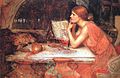
Georges Merle’s The Sorceress.

As a child, the first creatures Ferathainn understood were the spirits of things: grass, flowers, rocks and trees all “talked” to her.  Because of this talent, Ferathainn understands the spirits of things well enough to evoke their qualities.  She can summon them too, though Aeldred hasn’t explained that what she’s doing is summoning.  He doesn’t want her to run amok.

With people, this understanding takes the form of being able to use thought speech.  Though she does not know it, Ferathainn can also read minds and project her thoughts into the minds of others.  Aeldred, not being a skilled mind-mage, has discouraged this avenue of Ferathainn’s development to the best of his ability.

Ferathainn’s understanding of spirits is also what makes it possible for her to excel at spirit travel.

Ultimately, her understanding of spirits will enable Ferathainn to master all of the elemental powers and talents, beginning with the earth, geomancy.  Hence, Initiate of Stone.

A note on source theft, farming, or poaching

As I mentioned last week, a person’s share of source is attached to their spirit or soul.  It’s part of what makes each person what he or she is.  Because of this, the soul and source may be called at the moment of death and taken by another sourceror.  This is usually accomplished by calling the source by its name, which for most people, is their everyday name.

Clever sourcerors have adopted source names, but these can easily be discovered by an adept mind-mage and so are no guarantee of protection.

In taking another person’s source, the sourceror risks taking not only the victim’s power, but also their personality and memories.  This can lead to insanity unless the sourceror can figure out a way to filter out the undesirable bits of the victim.

Waterhouse’s The Sorceress.

So … everything Ferathainn does is magic 🙂

Next week: a worldbuilding vacation.  I’m going to write about my most recent draft of IoS and what it’s taught me.  Stay tuned.