Thoughty Thursday: Things that made me go hmmmm on the interwebz March 23-29, 2014

Thoughty ThursdayIt’s an eclectic collection this week. A bit imagistic, an iota of cute, a tad astronomical, a titch creative, a little kindness to yourself and others, and a couple of really awesome musical covers.

Enjoy!

The hidden meanings of logos.
http://www.buzzfeed.com/video/dimitri/change-the-way-you-look-at-logos

The top photos of 2013:
http://dailynewsdig.com/top-photographers-photos/

There was another cool post about surreal places that really exist, but the link seems to be corrupted 😦

If you want to take better pictures, start with these five design elements:
http://photofocus.com/2014/03/26/5-design-elements-for-better-pictures/

They had me at sleep.
http://blog.bufferapp.com/creativity-methods-more-ideas

What a neuroscientist says about the benefits of meditation.
http://www.trulybuddha.com/how-meditation-changes-your-brain-a-neuroscientist-explains/

Defining bullying.
http://www.huffingtonpost.com/signe-whitson/bullying_b_2188819.html

Things to stop doing to yourself. Just stop.
http://www.lifebuzz.com/just-stop/

How to keep quiet and carry a big telescope. #scienceiscool
http://www.wired.com/2014/03/secret-bicep-inflation/

Pet shaming. Because hilarious.
http://blazepress.com/2014/03/35-hilarious-pet-confessions/

What a dachshund did the first time it was allowed on the bed.
http://blog.petflow.com/a-tiny-puppy-was-allowed-on-the-bed-for-the-first-time-look-what-he-did/

Musical discovery of the week, thanks to new Twitter friend, Mark Hanson.

Two cellists rock cover of ACDC’s “Thunderstruck.”
http://www.sharedots.com/2-men-with-their-cellos-produce-most-incredible-song-cover-ever-this-will-blow-your-mind-122.html

And that, my friends, is all I shared.

Thoughty Thursday: Things that made me go hmmmm on the interwebz March 9-15, 2014

Thoughty ThursdayJust so you’ll have this straight, Tipsday is for writing-related finds and Thoughty Thursday will be for other interesting stuff. It’ll be a mix of science articles, health articles, and other stuff that might be cool for inspiration or research. Info of the public service announcement variety may appear here as well (I have my causes). Occasionally, there might be a music or other fun video in there, ‘cause you know, we all love the YouTube 😉

Oh, and BTW, happy spring, though up here in Sudbury, we’ve just had 10-15 cm of snow 😦 This is what the first day of spring looks like up here:


First day of spring in Sudbury

So here we go in 3, 2, 1—

Otters are bad-ass:

http://news.nationalgeographic.com/news/2014/03/140306-otter-alligator-florida-predator-photos-wildlife/

David Brin shared this next amazing blog post and video.

Mr. Science, A.K.A. the hubbie, informs me that the ribosome moves around far more chaotically, directed by something called Brownian motion and bumps into the transfer molecules until it finds the one it needs for the sequence.

Still, this is supposed to be “real time,” so imagine how quickly everything is moving about in the stew that is you 😉

http://www.npr.org/blogs/13.7/2014/03/04/285414954/watch-and-be-amazed-by-the-machinery-of-life

I love genetics.

One of the places I’d love to spend a month in someday. ‘Twas a lead-up to St. Patrick’s Day.

http://www.irishcentral.com/roots/travel/Stunning-travel-video-of-7-Days-in-Ireland.html

Clara Hughes, multi-Olympic gold medal winner in both summer and winter Olympics embarks on her latest journey to bring awareness to the issue of mental health. I admire this woman so much.

http://fullcomment.nationalpost.com/2014/03/14/claras-big-ride/

The overwhelmed employee is foreseen as one of the new crises of the modern workplace. This is hard, researchy stuff, but it’s actually pretty fascinating. From the day-job file.

http://dupress.com/periodical/trends/global-human-capital-trends-2014

The health hazards of sitting. I’m still researching a reasonably-priced standing desk solution for my office.

http://apps.washingtonpost.com/g/page/national/the-health-hazards-of-sitting/750/

Felicia Day tweeted something. And then she had to write this post.

http://thisfeliciaday.tumblr.com/post/79718617942/tiger-lily-doesnt-equal-human-torch-plus-a-very-long

And this was just fun. Ooh-la-la!

The Benny Hill soundtrack just makes this one shine. Oh, no, he di’n’t!

http://blog.petflow.com/this-dog-is-not-allowed-on-the-bed-this-is-what-he-does-when-his-owners-are-away-hilarious/

Until next week, my wise and witty friends!

Research panel

This panel was a question and answer session.

Panelists: Anthony Dalton, Jack Whyte, Anne Perry, Diana Gabaldon, Susanna Kearsley

Q: Is it okay to use unusual names? e.g. in a historical novel set in Poland, the names are strangely spelled and not pronounced how a North American audience would be familiar with.

JW: If it’s appropriate to the historical setting, keep them.

DG: Find out how the names are treated in the time and culture you’re writing about.  e.g. Black Brian, or Mac Dubh.  Use nicknames or short forms.

AP: Are they named by profession, by an attribute?

SK: Have an outsider character learn how to pronounce the name.  Readers will remember after.

Q: How do you organize your research?

DG: I’ll have sticky tabs in the books I use for research and refer to them when necessary.

AP: I do much the same.

SK: I get documents from the archives (note: Susanna Kearsley used to be a museum curator) and organize them into binders, probably because I’m the daughter of an engineer.

AP: I find that most of the research I use in a first draft is later redacted.

JW: I recommend Scrivener (about $40).  It’s excellent for organizing your research, though it does fall down a bit in the final formatting of a manuscript.  Simply export to MS Word.

Q: How do you get translations?

SK: Try French translators, call your local university, see if they have a translation department, etc.

AD: French immersion teachers are also a good resource.

DG: Is it critical to the story?

AP: Don’t tell people what they don’t need to know.

Q: What gets questioned?

DG: Once you are immersed in the time period, you know what is likely to have happened.

AP: Research is often borne out.  In some cases, my educated guesses have later turned out to be correct.

SK: Historians can leave holes – they are bound by facts, or the lack of them.  Writers have to fill in the holes.

JW: Historians cannot speculate.

Q: Would it be okay to spell Welsh phonetically?

SK: Have an outsider character to help interpret.

DG: Language consists of three things: accent, dialect, and idiom.  For the Outlander series, they are conducting Gaelic classes.

AP: In practice, though signs might have Gaelic and English, few people actually speak Gaelic anymore.

JW: Rhythm is important.  Cadence.

AD: I researched an ocean crossing and read three accounts by three London travellers.  They were all different in spelling, etc.

Q: How do you pick out the pertinent bits?

SK: History is curated.  People save what they think is beautiful, or what has value to them.  Go back to the contemporary record, if possible.

The Daughter of TimeJosephine Tey.

Q: What if you’re dealing with several different languages?

DG: You bring in a translator.

SK: You use a dictionary, or you bring in an outsider.

JW: Tarzan of the Apes is an excellent interpretation of what it might be like to teach oneself a language.

SK: Another great example is The 13th Warrior.  There is a campfire scene where the camera pans around the Vikings and Antonio Banderas’s character catches a few words each round until suddenly, he understands what they’re saying.

Q: Who is the most interesting person you’ve researched that you haven’t written about?

AP: Torquemada.

SK: John Thomson.  He almost bankrupted Britain in the 1700s.  He told everyone a different story about what happened.

DG: Joseph Brant.

JW: William Paterson.  Founded the Bank of England and a Panamanian colony for the Scottish.  The colony was blockaded and eventually disappeared, though there is a native group who still paint themselves in tartan patterns.

Q: Whose diary would you like to fictionalize?

JW: Casca, the first man to stab Caesar.

AP: Faucher (?) He had albino genes. French Revolution.  The Butcher of Nantes.

DG: Thomas Paine.

SK: Geoffrey Plantagenet.

AD: Sir John Franklin.

Q: How do you find your research?

JW: Get to know the librarian in charge of the humanities section of your local public or university library, and ingratiate yourself shamelessly.

SK: Google Books.

Q: What are your favourite books to read?

SK: Diana Gabaldon and Nevil Shute.

JW: Roger Zelazny.  Really, it depends on how I feel when I get up in the morning.

AP: G. K. Chesterton’s poetry or crime writers like Michael Connelly.

DG: Celtic crime writers like Ian Rankin and Phil Rickman.

The things you learn when you look into your family tree

Or … the duty of a bard

This week, I thought I’d write a little bit about genealogy.  I’m not going to post any of my family trees (I have three, though they’re incomplete and slightly out of date) … I’m just going to write about the wonderful things you can learn when you do a bit of digging.

The first is this: genealogy is one of the duties of the bard.

Whether you think of a bard as a bard, or filidh, or ollamh, a bard wasn’t just a collector of tales, a memorizer of songs and poems, but they also held the responsibility to guard the family history and bloodlines.  They were scholars, doctors, law-givers, and just darned cool, and as a writer, I feel that I have some connection to that tradition, and some responsibility for the history of my family.

I’m a Celtophile, and unabashedly so (hence the interest in filidh and ollamhs), but the family I can trace is Finnish.  Yes, Marttila is a Finnish name.  You can generally tell because of the three consonants together.  That, or the double vowels (e.g. Saarinen) are pretty clear give-aways.

The larger family name in my genealogy is Wiirtanen.  There is a large Finnish community in the Sudbury area, many of them coming from the Long Lake area of town and the Pennala subdivision there.  That’s where the Wiirtanens settled.

One of my Wiirtanen relatives still lives out at Beaver Lake, a bit of a drive out of town.  He’s a trapper and owns a farm.  Other Finnish families moved into town around Lake Nepawin (Maki Avenue was named after one of them) and there have been a few books published on the Finnish roots of Sudbury.

A number of years ago, a genealogist visited me out of the blue.  I sat with him for a few hours in an afternoon and he taught me a few things about my family, which happened to be part of his family tree, which is why he looked me up.

In Finland, at the beginning of the last century (give or take a few years) families gave up their names, and took on the names of the farms or cities where they worked.

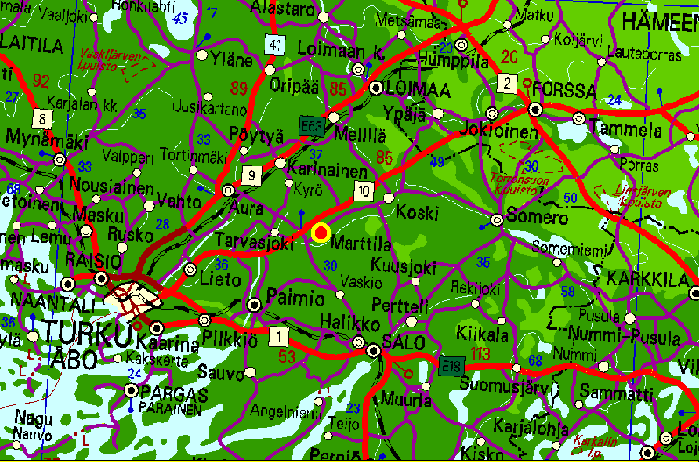
There’s a city in Finland called Marttila.  My uncle Walter and aunt Margaret visited it years ago.  Here’s a wee map and the city’s crest from their Web site:

Notice the image on the crest: It’s St. Martin of Tours cutting his cloak in half to give to a beggar.  So Marttila roughly translates to St. Martin, not a particularly Finnish icon, but at least I know where my family name comes from.

So I started keeping a few files on my family tree.

Something else I did was to look into the kalevala, the national epic poem of Finland.  It’s a creation myth, set of legends, and features magicians and the mystical sampo, which could be, among other things, an analogy for an instrument that could track the precession of the stars.

It’s no wonder I’m into the fantasy 🙂

My mother was adopted and has no interest in looking into her family, so I’m kind of stumped there, though she tells me that she was Irish, something my grandfather liked to tease her with.  So maybe there’s a reason, I’m so enamoured of all things gaelic.

Have you delved into your genealogy?  What did you discover?