Hi-ho, hi-ho …

Life in general
I returned to work on December 1st, after a five-week leave. And discovered things were pretty much as I’d left them. Yes, the training for trainers had taken place and everyone was impressed with my reworking and additions to the Nation Learning Roadmap courses for facilitators. Yes, the pilot had taken place and was a little bit of chaos.
But now we had another slate of recommended changes to be made by the 19th.
I got back to the grind.
Come the 19th, there were still outstanding courses and modules left to be received from the content writers (or rewriters in this case) but I turned on my out of office notification and logged out of my work computer determined not to think about work for the next nine days.
On the 4th, I received an email advising that I was eligible for the Early Retirement Initiative, which was part of the recently-passed budget. Immediately, I went into panic mode. WHAT DID THIS MEAN?! I called my team lead, who’d received the same email. We discussed. Then I did the smart thing and contacted my sister-in-law, who’d been looking into the situation for months.
TL;DR: Hold steady. This is just the first volley of the employer trying to get people to leave without availing themselves of the workforce adjustment provisions in our collective agreement.
I later learned that 60,000 emails had been sent in the hope of getting 40,000 employees to opt in. Another article released in Quebec, perpetuated the rumour that the return to 5 days in the office would start in 2026.
Still later, the news and the union started to report that job cuts would begin in the new year. Management indicated that they had no information to report, but they were committed to transparency.
On the 7th, I slipped and fell while walking Torvi (a combination of unplowed sidewalk and a dancing dog) and sprained the middle finger on my right hand (fuck!). It was purple, swollen, and had limited mobility for the first few days. And boy, did I learn how much I use my right hand to grip, lift, and carry things. A friend suggested that maybe I’d broken it, but I could still move it and didn’t think so.
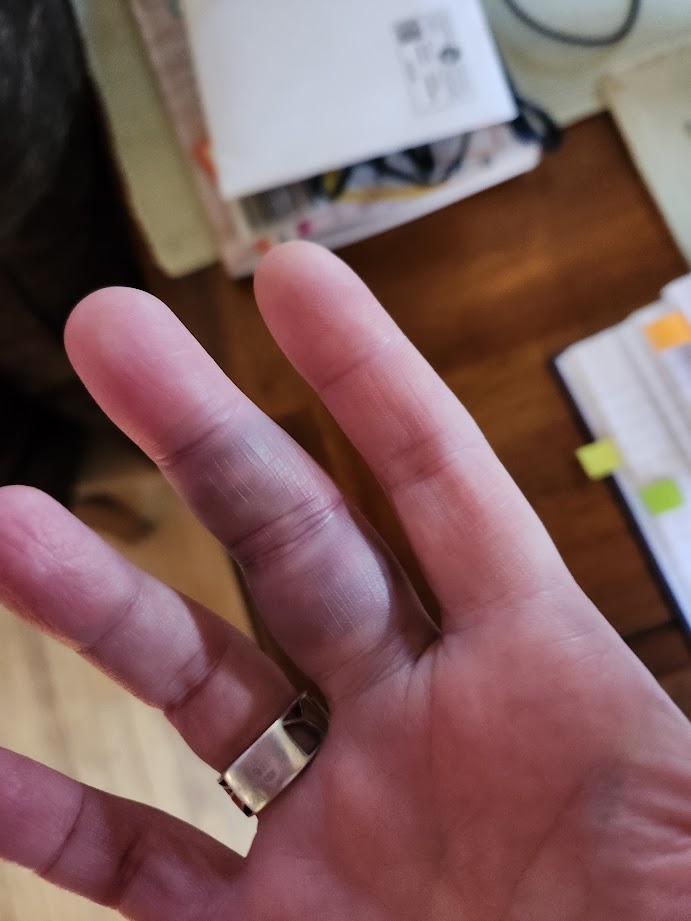
Typing wasn’t an issue (thank goodness), but the accident really made me aware of my body, or at least my hand, in a way I hadn’t been for ages.
By the end of the first week, the bruising had worked its way through black to brown to yellow, though it was still painful and swollen. I finally checked Dr. Google, and it is possible that I’ve broken the finger. If I have, it’s a stable fracture (no deformation) and the only thing that might have been done was to splint the finger or buddy-bind it with another finger. Movement would probably still have been advised as a form of physiotherapy. I honestly didn’t think I needed to go to the clinic, though. I would have been waiting for hours in a room with a bunch of people with seasonal viruses I don’t need to catch.
I was still treating my seasonal sinus thing. Once the snow stayed, the allergic triggers shouldn’t have been an issue. At one point, I was feeling well enough to try going without the Ryaltris, but within a few hours, a headache set in, followed by chunks of bloody mucus in my blowings, so I resumed.
It soon became apparent that the bloody snot would continue, regardless. I chalked it up to the dry winter air, inside and out, and let my immune system deal with it as it would with neti-pot and supplemental (Emergen-C and Cold FX) support.
I also deduced that the continued use of the Ryaltris when I no longer needed it may have made my nasal tissues more sensitive. Whatever the cause, the bloody snots slowed down after a couple of days.
Also still dealing with the dregs of the eczema. Though it’s no longer itchy or swollen, eczema’s not really gone until the discoloured, leathery skin returns to normal.
I got the notification on the 9th that I was not selected for the intake unit. There may be opportunities in the future, as I was advised that they may rotate people through the unit.
Which made the Power BI course I took from the 8th to the 11th less relevant/urgent. It’s still an asset, but I might have been able to use the 3 hours of class a day in a more productive manner. Productivity matters at work. A year and ten months until pre-retirement leave. Three years and ten months until retirement. Unless I’m surplussed, and then workforce adjustment provisions should compensate me appropriately.
Then, my team lead advised that, while we still had to fulfill our commitment to the current (albatross) project, we would be the design team attached to the intake unit and would handle any learning materials that did not already have a design team committed to the subject matter. This meant that we would be doing several different short-term projects in the new year.
I was looking forward but still dwelling in the uncertainty of potential lay offs. As a unilingual English employee within five years of retirement, I’ll probably be one of the first to go … after the term employees.
But I was grateful to have the week of Christmas off. After only 3 weeks of work, I needed another break.
The month in writing
After finishing the last cutting pass last month, I took a break from Reality Bomb and let the project simmer in the back of my mind. I’m already mulling over ideas for how to rewrite the first chapter and further tweak the draft.
In the meantime, I’ve turned my attention to working on a couple of short stories for future submissions as well as some poetry.
While I was at my latest appointment with my therapist, I articulated a decision I hadn’t even known I was contemplating. I’m going to put off the cleaning/reorganizing of my office until I have RB in the query pipeline. I’ll have the headspace/spoons to dedicate some time to it without having to worry about a creative project.
Yes, I’ll then have to get back to working on my next creative project, but I figure I can take a week or two to deal with my environment and dive back in refreshed and feeling like I’ve accomplished something. Until then, I’ll just do a few small things. There’s already more candle glass to clean up, more essential oil bottles to clean, plants to repot, a bulletin board and white board I haven’t been using to take down and store, that kind of thing.
On the 4th, Frances Boyle’s lovely review of The Art of Floating was published in ARC Poetry Magazine online. I’m so grateful that my debut collection is still getting attention more than a year out from publication.
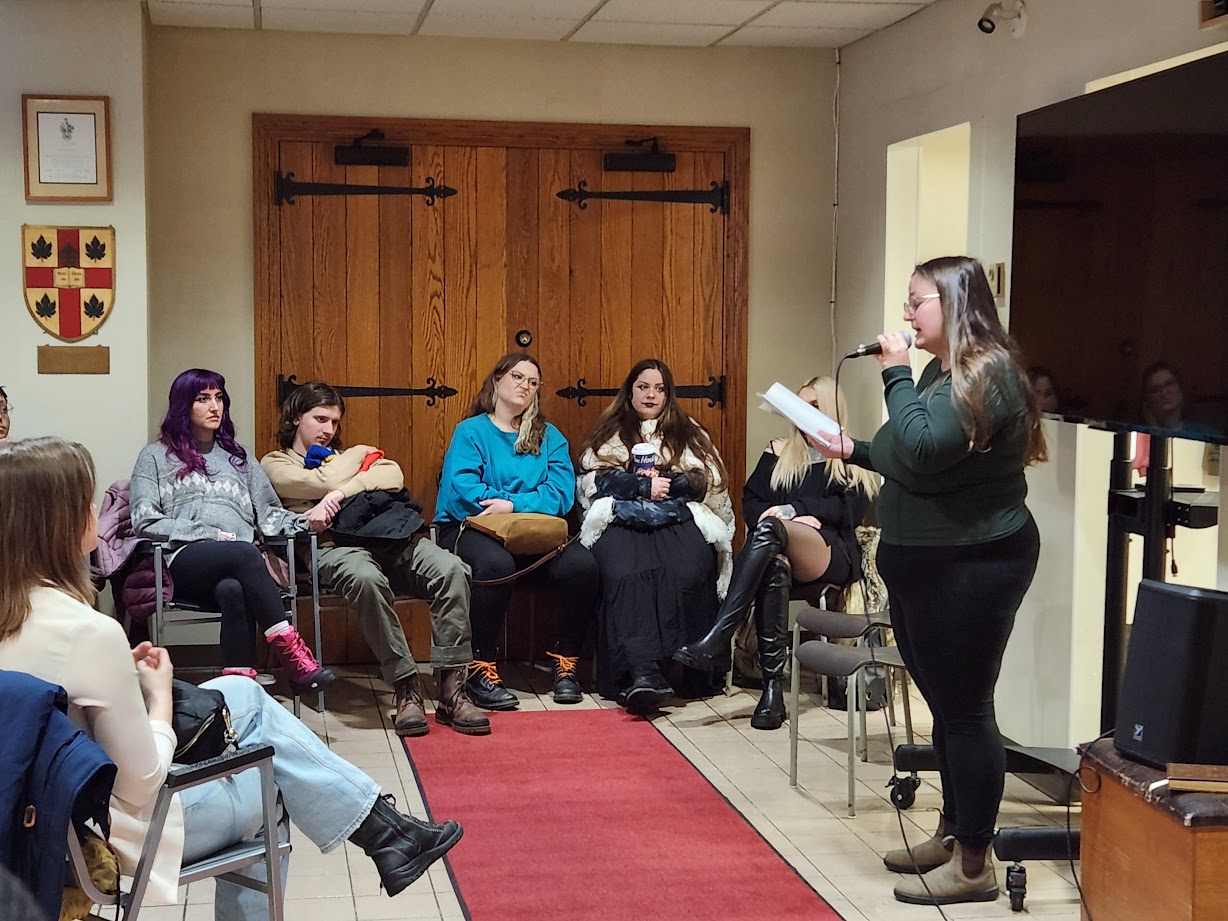
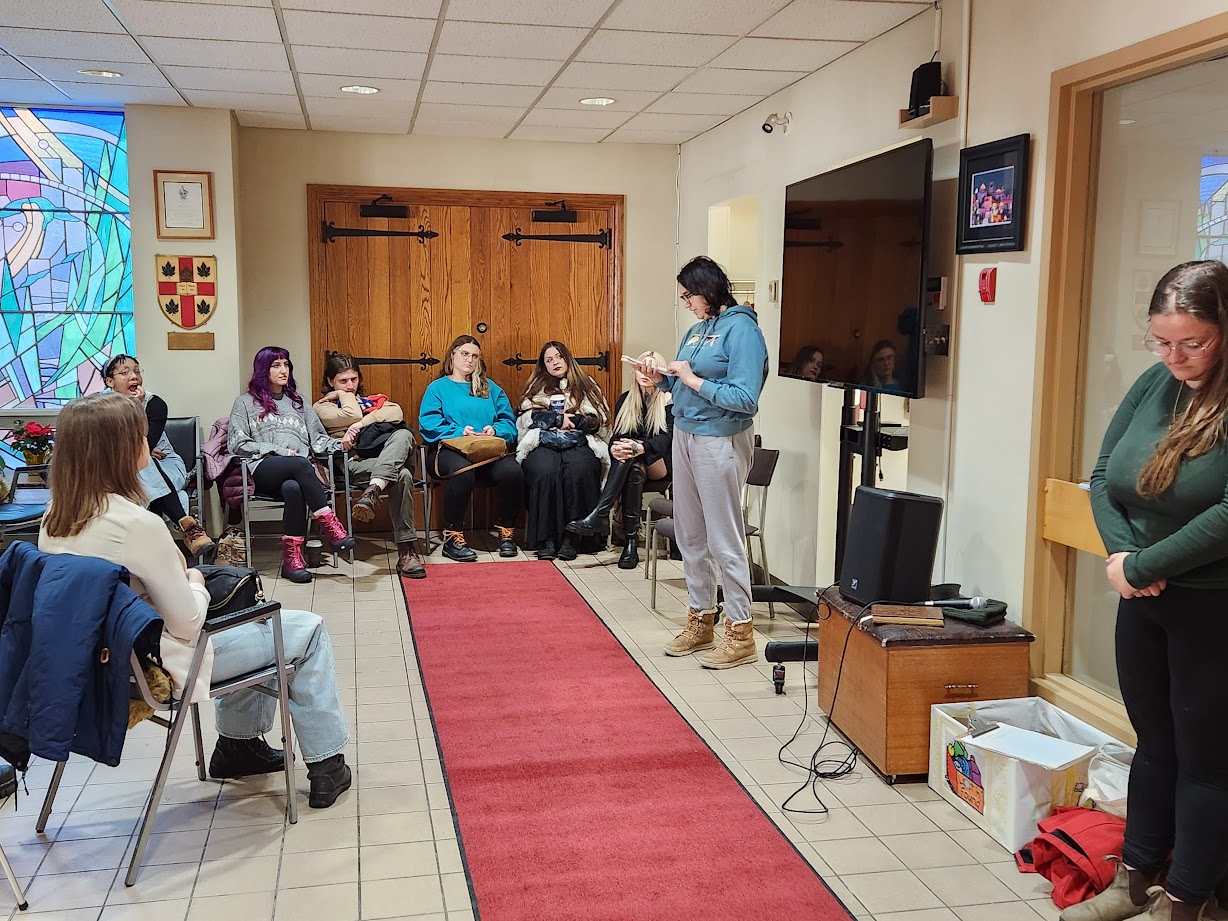
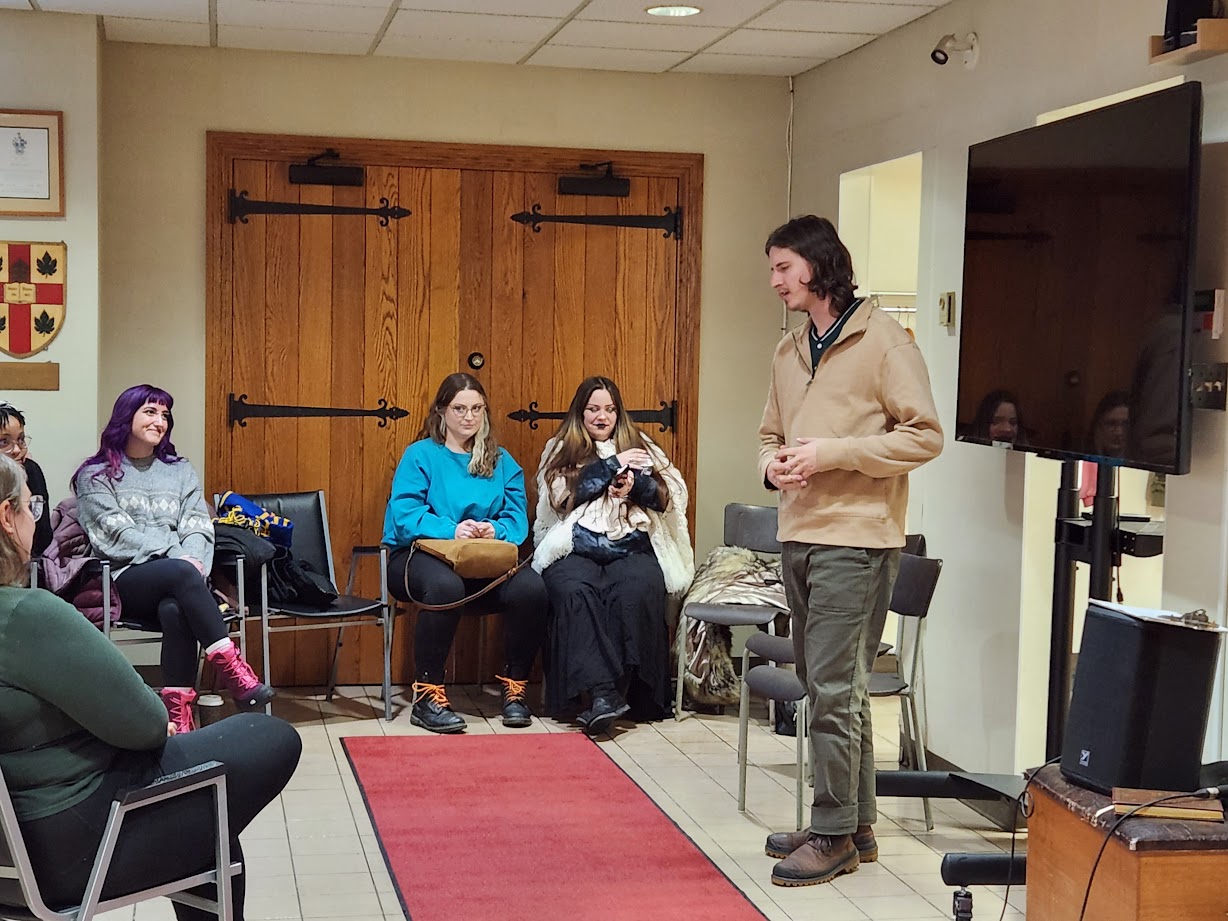
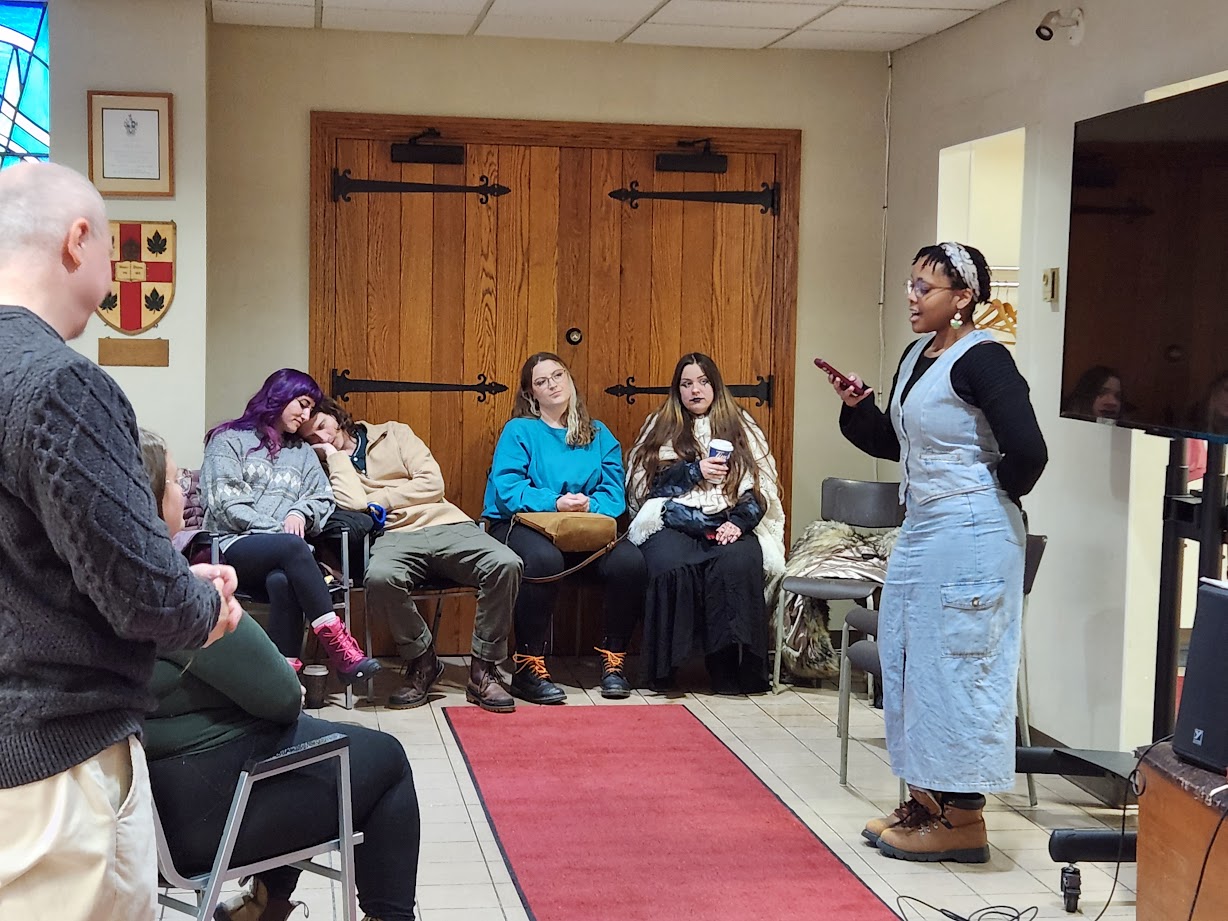
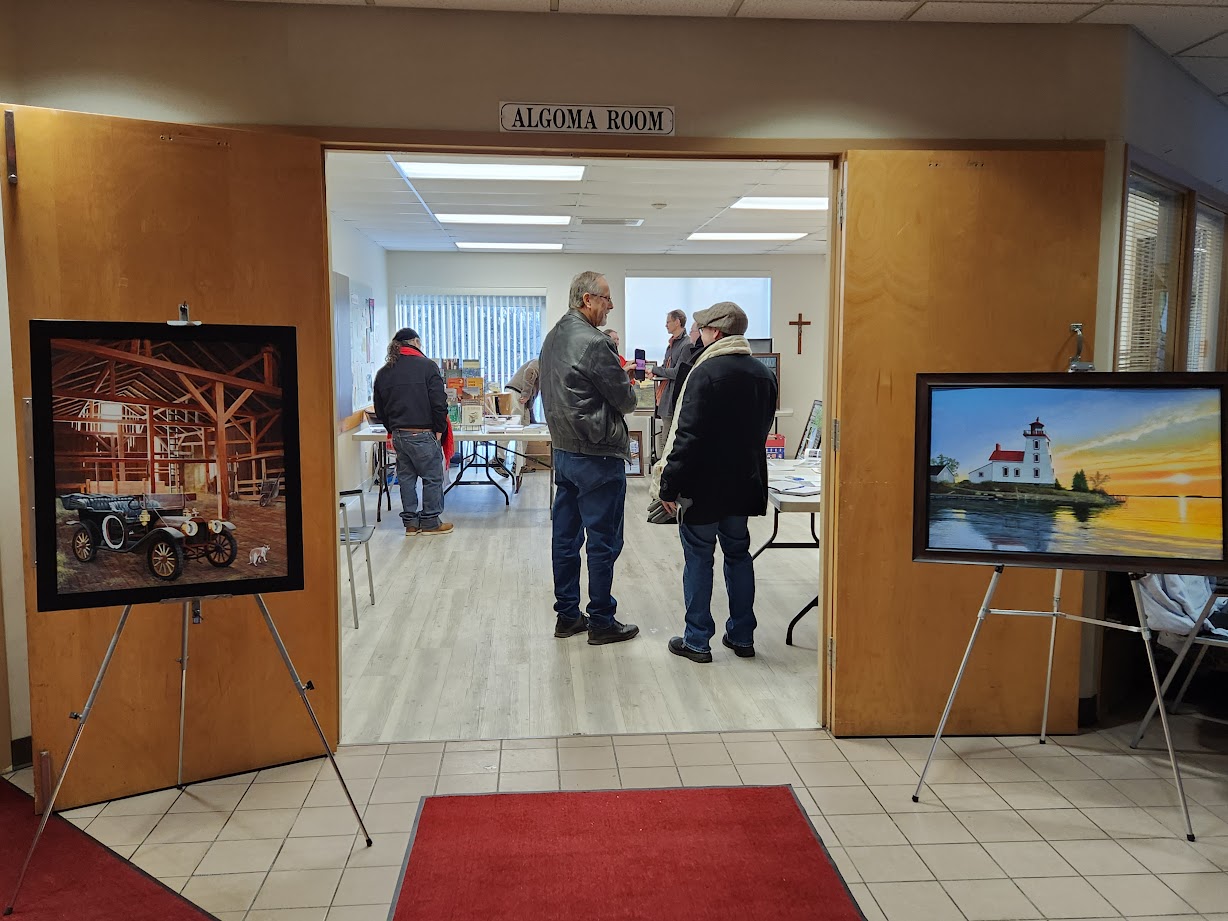
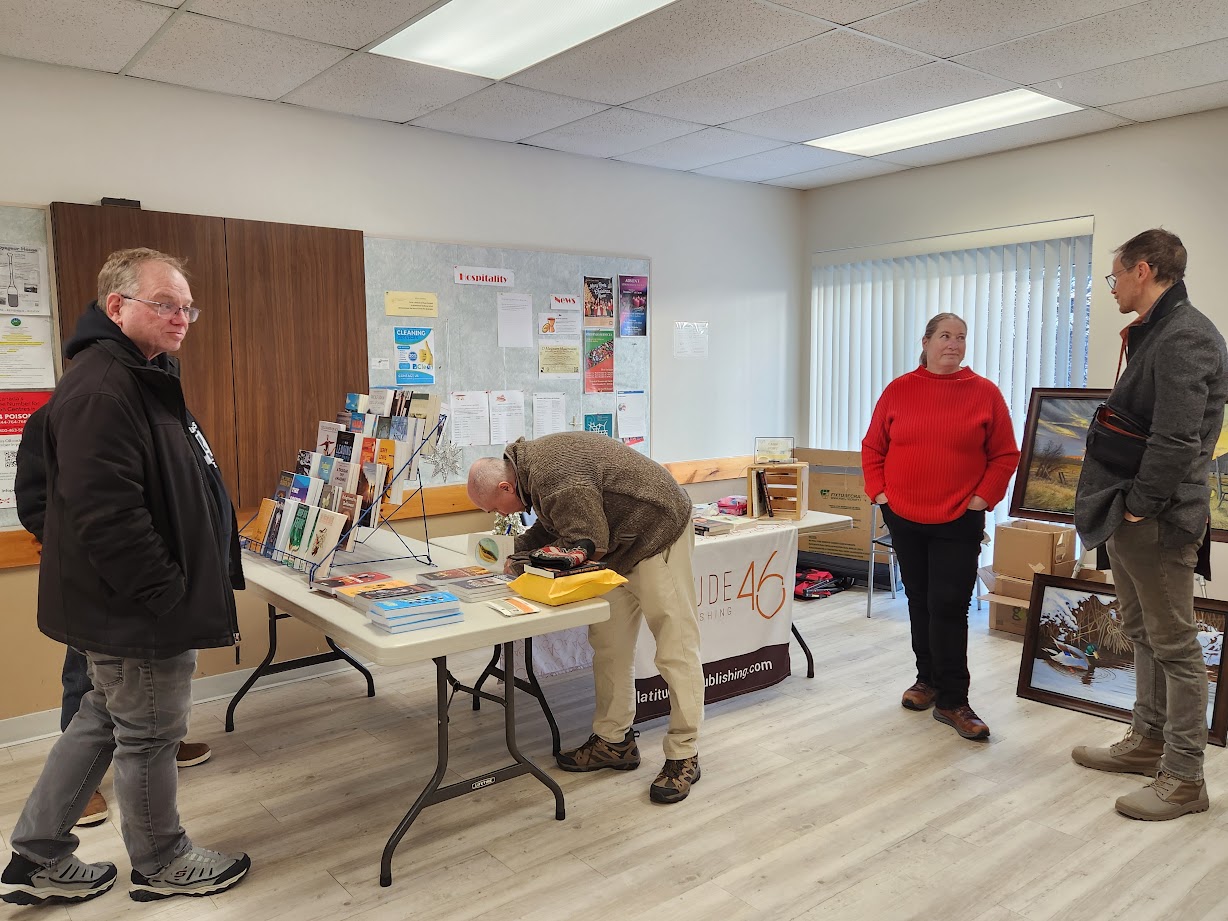
I took part in the open mic reading at the Latitude 46 stop in the Downtown Sudbury Art Crawl on the 6th. Had a lovely afternoon chatting with writerly friends.
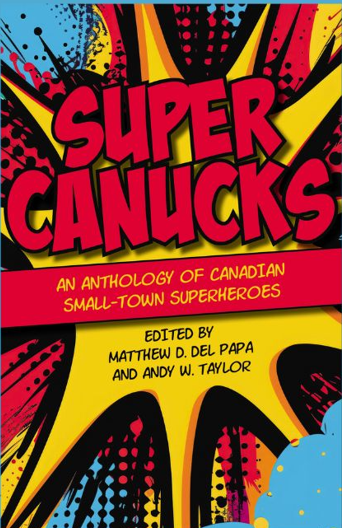
On the 12th, the revised cover of Super Canucks was released. Apparently, there were problems with the original.
The SF Canada annual general meeting was on the 14th. And it went swimmingly! We have a complete board, internal auditors, and a few ideas for the coming year!
The year in review
In 2024, I started out in the usual fashion, establishing which projects I would work on and word count goals to achieve, and entering everything into my Excel tracker, but something happened early in the year that made me change course. I realized that having these goals was stressing me out. Because of my uneven productivity, I wouldn’t always (or even often) meet these arbitrary goals and every time I missed one, I’d get distressed.
So, in 2025, I just put in the projects I hoped to work on, but no word count goals. Accordingly, my Excel has become a true tracker of my progress, and I can use the totals page at the end to show me what I accomplished rather than flog myself with all the goals I missed in the year.
It’s been a great boost for my mental health.
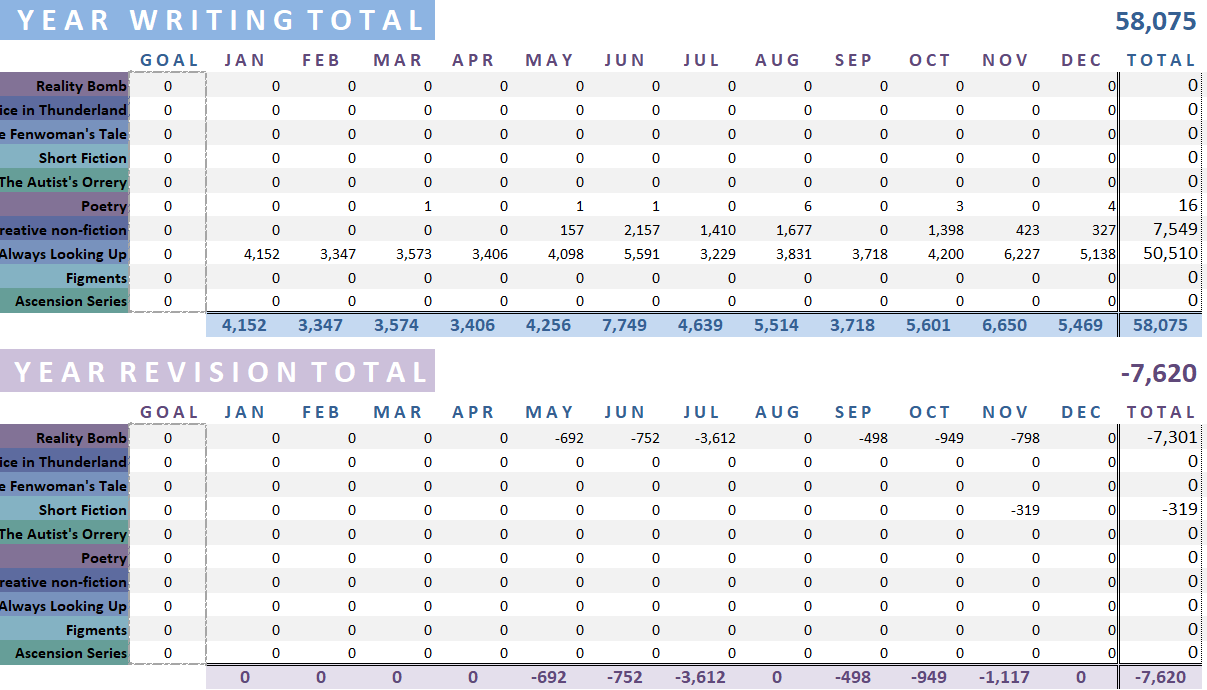
Here’s how the year broke down:
I wrote 58,075 words. 7,549 of them in creative non-fiction. Mostly these were my book reviews, but there was also a CNF flash piece that I wrote and submitted. The remaining 50,510 words were my newsletters/blog posts.
I revised -7,620 words, subtracting 7,301 words from Reality Bomb and the remaining 319 from a couple of short stories I was revising.
I reviewed my annual writing totals since I started using the tracking Excel. In general terms, from 2014 to 2020, I wrote between 150,000 and 300,000 words a year. In 2021, the year I suffered a crisis of creative confidence and obtained my autism diagnosis, my annual writing total was 68,000 words.
That was the first crack in my writerly façade, and the first year of my latest burnout. In 2022, I felt I had recovered, and my total went up to 100,000 words, but it’s clear that was unsustainable. Since then, I’ve written between 45,000 and 60,000 words a year, most of them on my blog/newsletters. But my focus has also shifted from drafting to revision, with regard to my novels and short fiction.
My word for 2026 is balance. I need to find the balance between creative production and rest and work. My autistic brain needs it.
In terms of reading (paper, e-book, and audiobook), I read 97 books this year! I’d actually set my goal low, at 60 books, raised it twice, and still read more than my goal.
A note about my reading habits. Because I work, I’ve structured my reading time around my lunch and breaks, and I usually have 6 books on the go at any given time. A paper book, a kindle e-book, a Kobo e-book, a pdf e-book (usually a review book these days), another book that could be a reread, and therefore paper, or research, and likely a library e-book loan, and an audiobook that I listen to while I walk Torvi and do random tasks.
This is why I appear to be a fast reader, but am, in fact a very slow reader. Sure, I go through audiobooks at a rapid pace, but reading a paper or e-book takes time. Sometimes a lot of time. This is low-key distressing, because in my youth, I used to read very rapidly. A book a day sometimes. I can’t do that anymore in middle age.
Also, I’ve tried to continue reading when I’m not working but find it’s difficult to fit reading in when I don’t have a designated break or lunch within which to read. I’ll have to figure out a system by the time I retire but, for now, it’s easier to read in short bursts while I’m working than when I’m off.
This year has not been a productive one. Because I’ve been struggling with burnout, I haven’t produced a lot. I only have one publication this year (aside from reviews) and that is a very short poem, “Pocket Dimension,” that was published in Polar Starlight 17 in February.
Still, I’m going to submit it for consideration for the Aurora Awards and to Year’s Best Canadian Fantasy and Science Fiction, Volume 4 for consideration. I had hoped that Super Canucks, and therefore my story “Old Crow,” would have been published in 2025, but due to various factors, it could not be added to Latitude 46’s 2025 release schedule.
With my publications over the past few years (at least one story and several poems) it’s felt weird to have a “fallow year.” But I recognize that I must be gentle with myself. If I push and try to produce while my brain is giving “hard no” vibes, it’s not going to do me or my creative work any favours.
Filling the well
The full freezing moon in Gemini was on the 4th. Though it was a sunny day, it was dark by the time the moon rose.

The new reed moon in Sagittarius was on the 19th. It was raining and melty, which was a bit of a downer at this time of year.
And winter arrived on the 21st with the solstice. After this, the light slowly began to return.
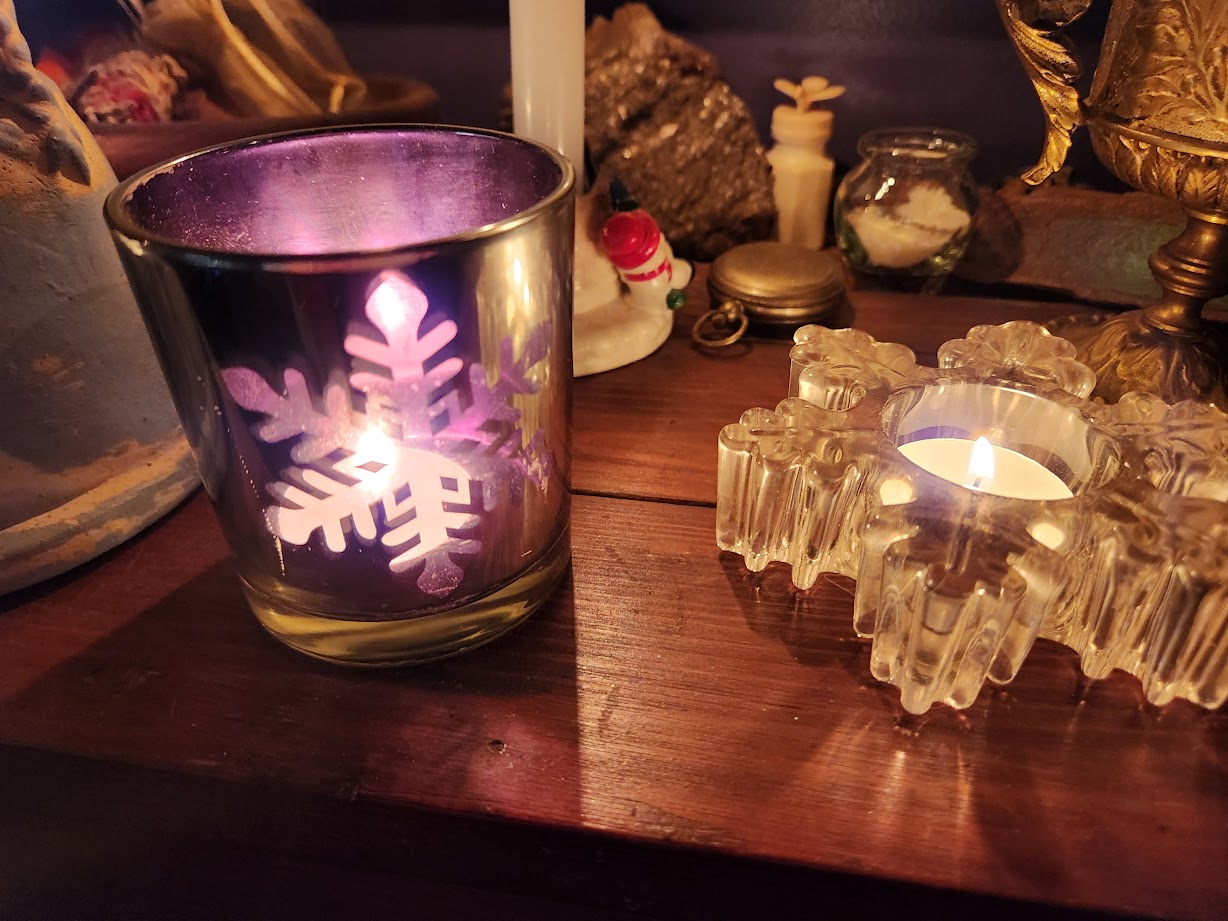
The final class of Unmasking through our writing with Muratroyd Monaghan was on the 4th. It was a great course, and I would highly recommend it to any ND authors. She’ll be offering it again in 2026. Stay on the look out. The organizer is Off Topic Publishing.
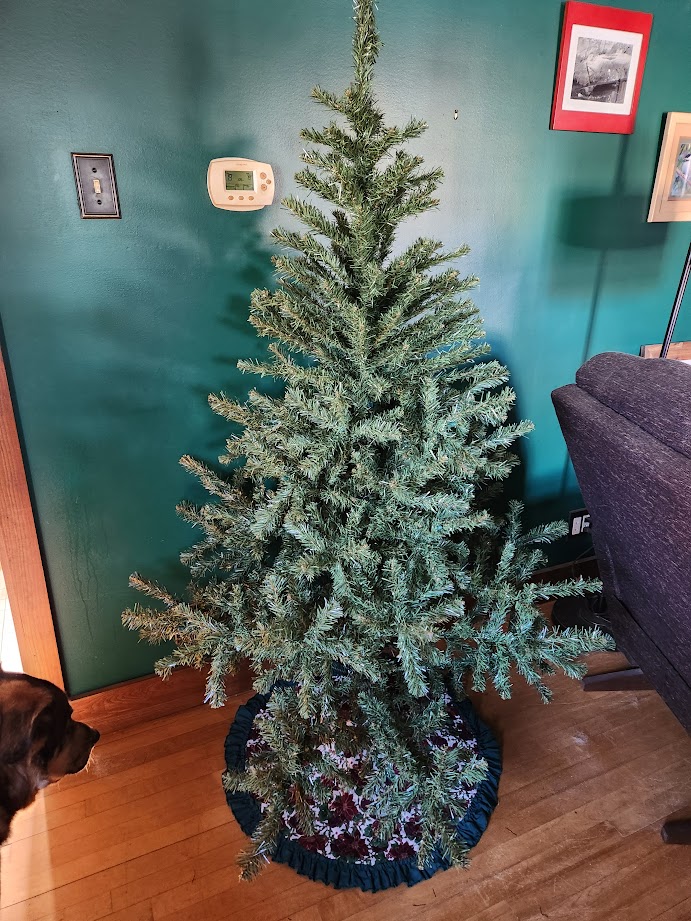
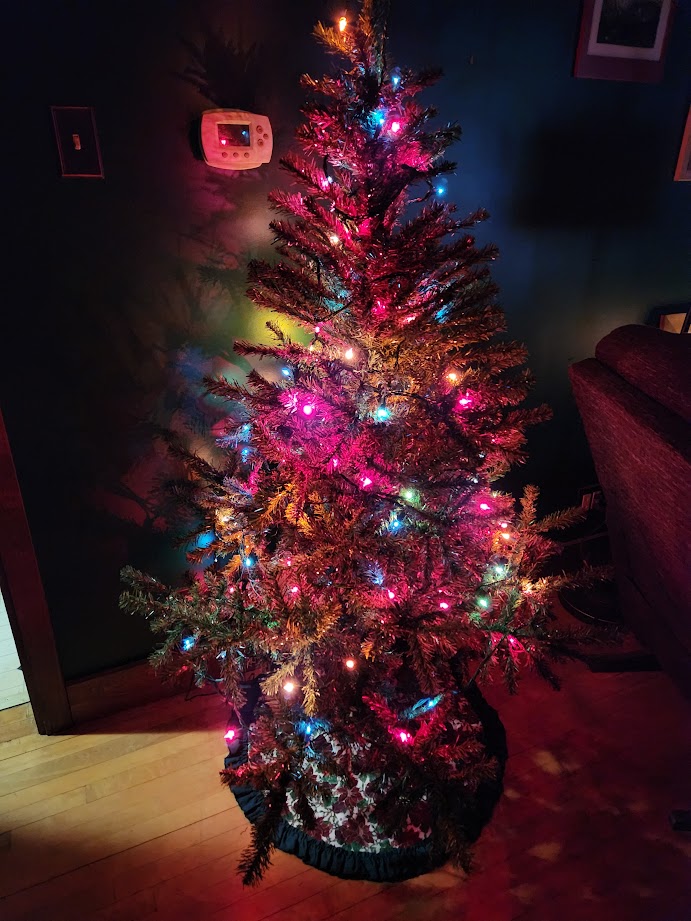
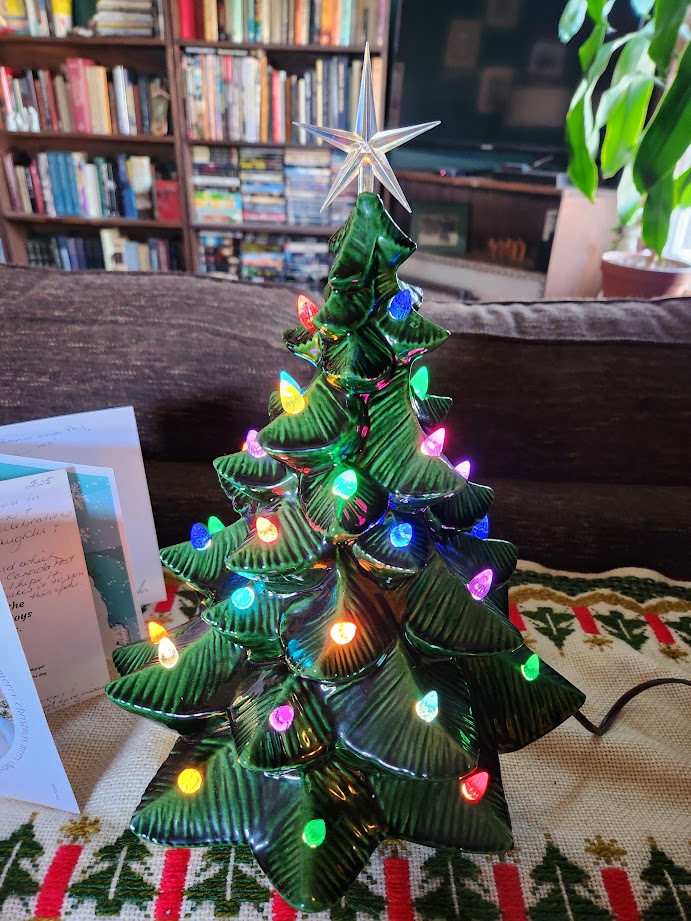
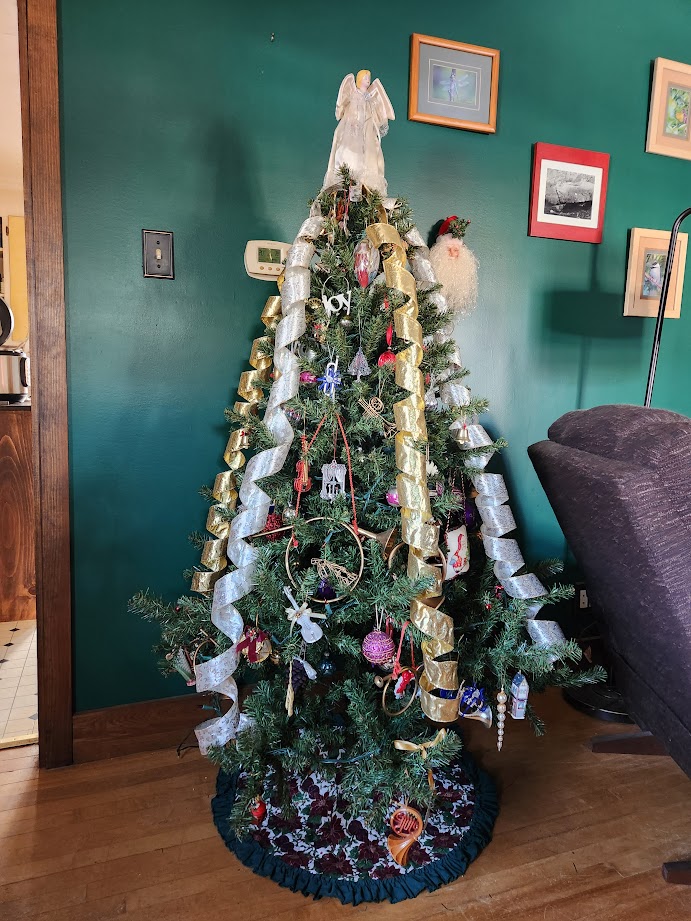
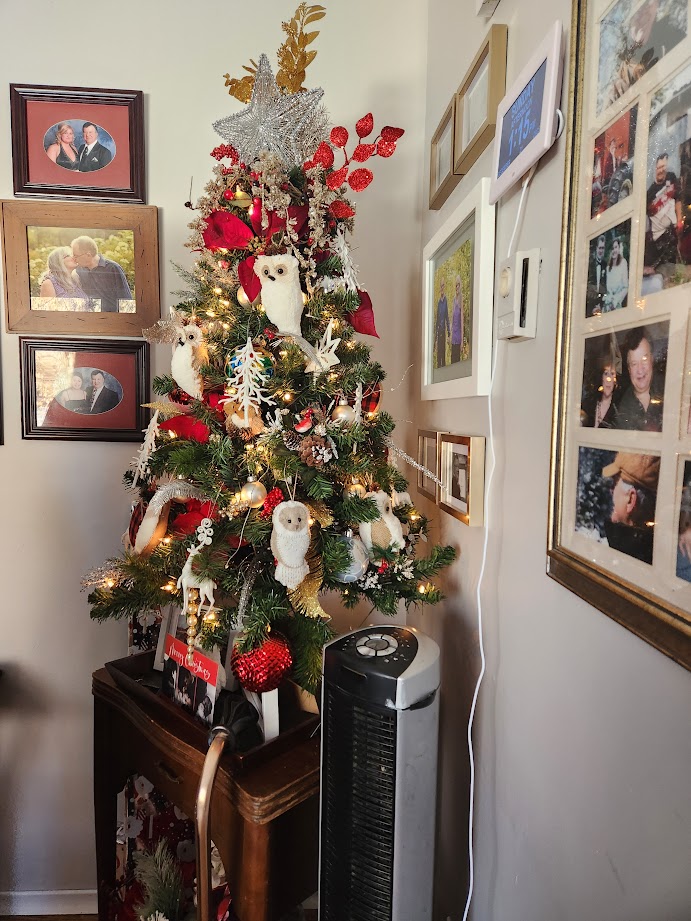
I finished the Christmassing on the 11th! I’ve been a little slower this year than in the last couple getting the tree and decorations up.
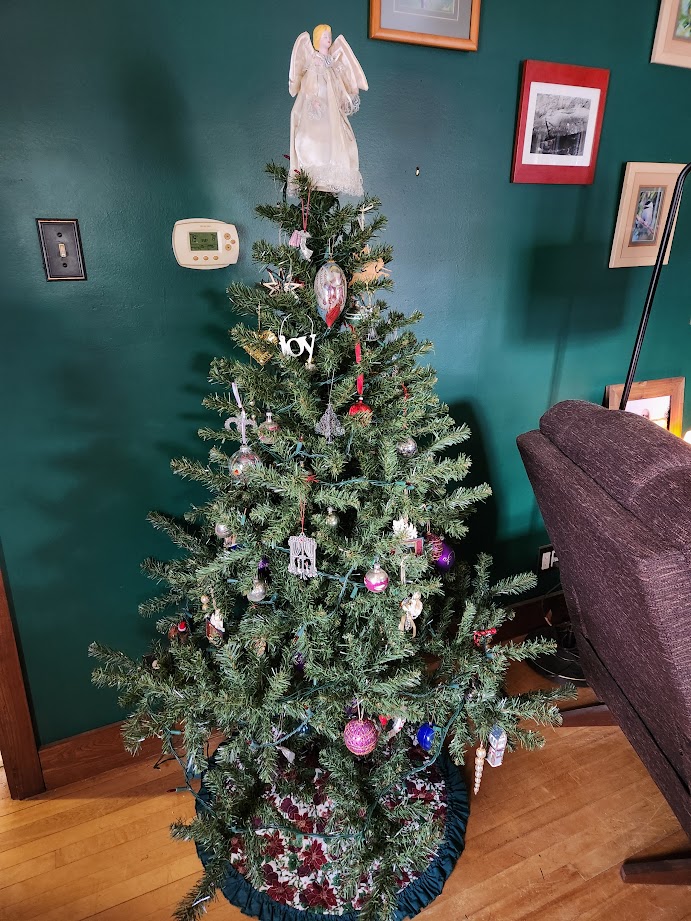

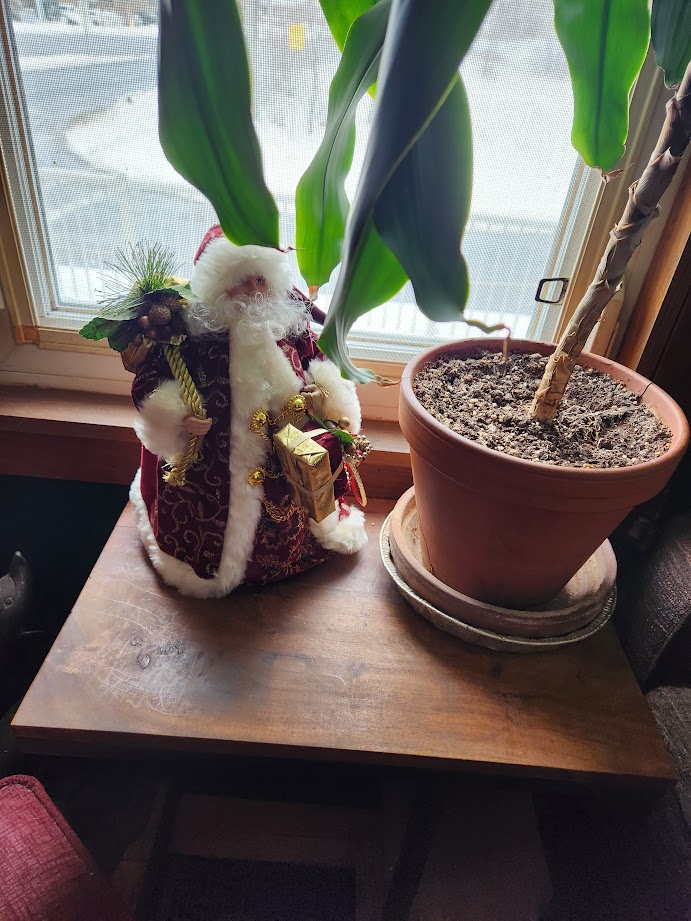
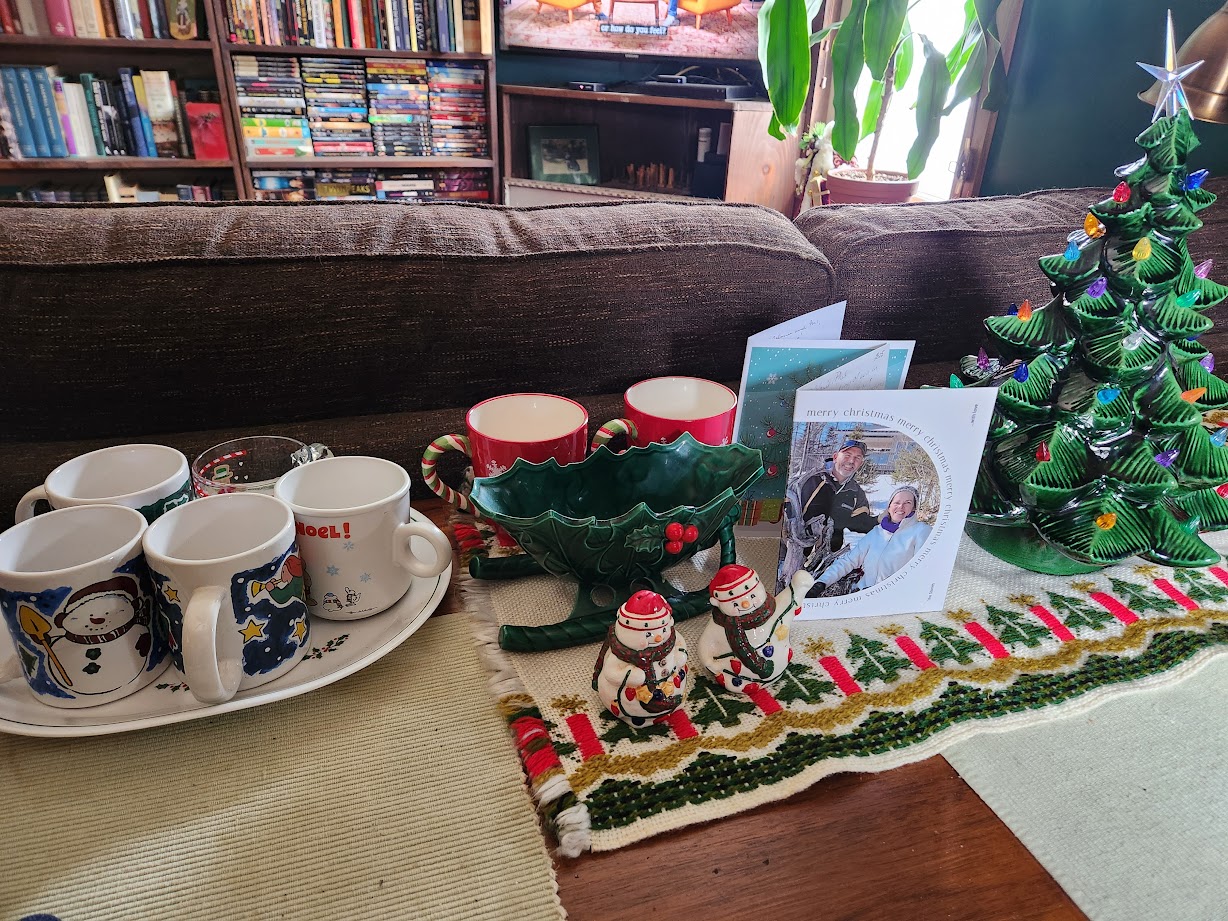
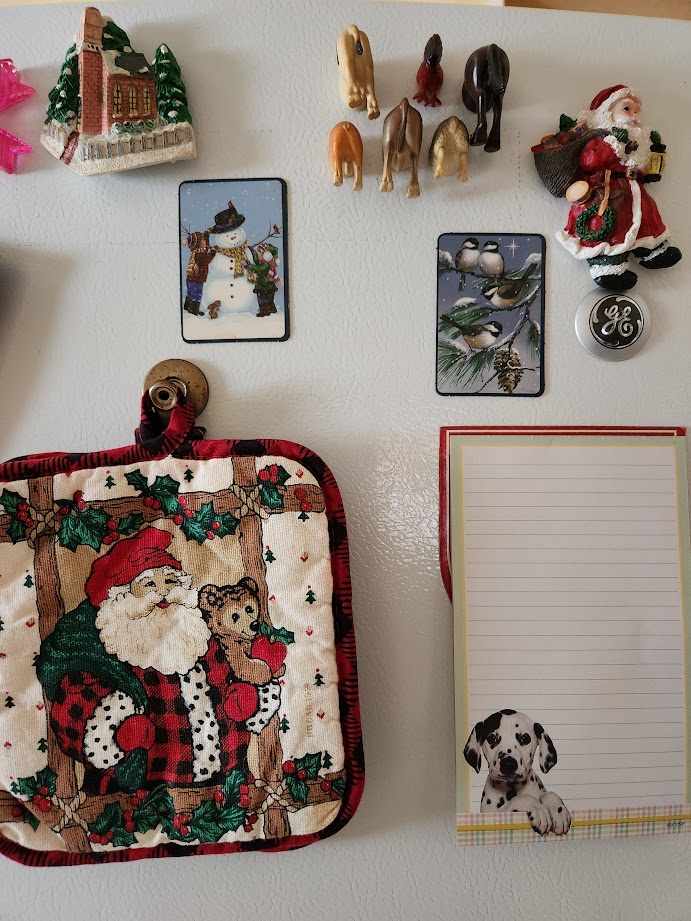

My next therapy appointment was on the 15th. We chatted about my plans for the holidays and when I outlined my week ahead (three appointments during the week while working, hair appointment and Mom’s birthday dinner on the 20th, and a cookie exchange on the 21st), she asked me how I felt about that. In the moment, I’d said that I was trying to spread things out and that the appointments during the week were focused on self-care. Once my very busy week had passed, though, I realized that I hadn’t done myself any favours. I think she was trying to cue me to the fact that I was doing too much. In retrospect, I agree, but hindsight is always clearer, especially when you have trouble living in the moment.
I had another glorious massage on the 17th.
Also on the 17th was my support group meeting. The topic this month was family. Good preparation for the holiday season. This time around, I was the odd one out, having a small family and no real family conflicts at this time of the year.
Torvi got her regular touch-up on the 19th.
On the 20th, I took my mom out for a pre-holiday trim and then Phil and I took her out to her favourite restaurant to celebrate her birthday.
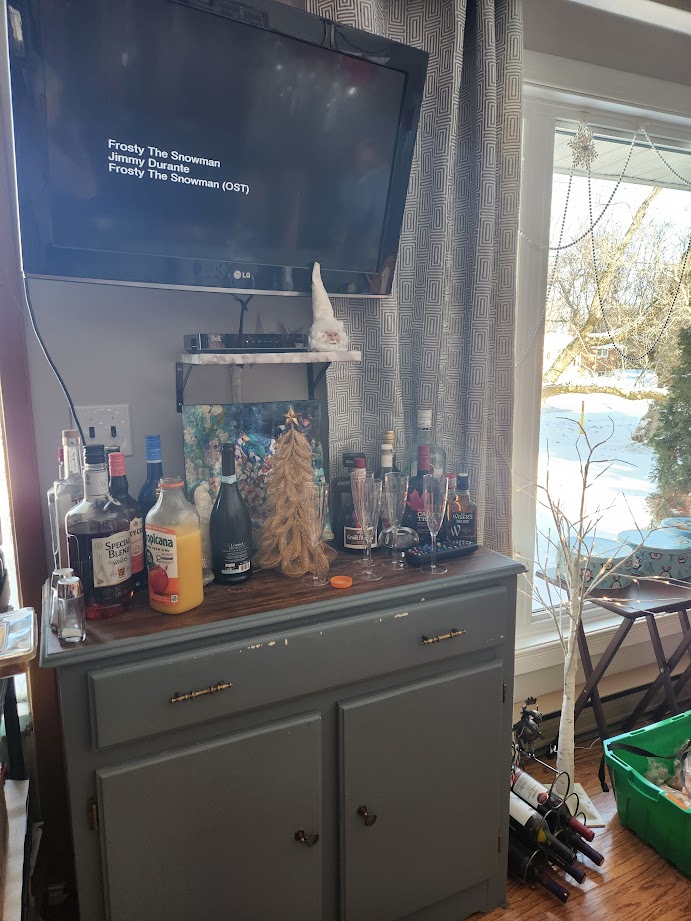
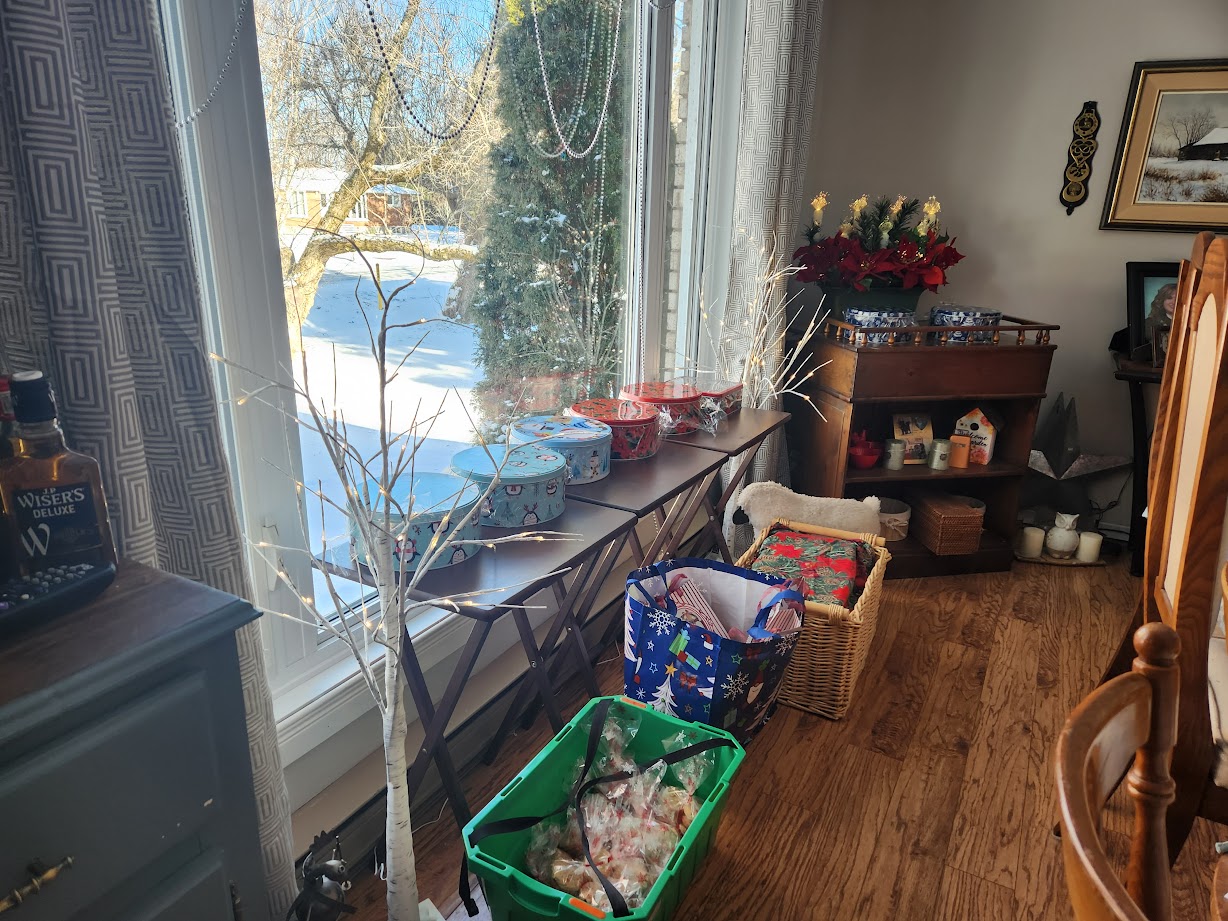
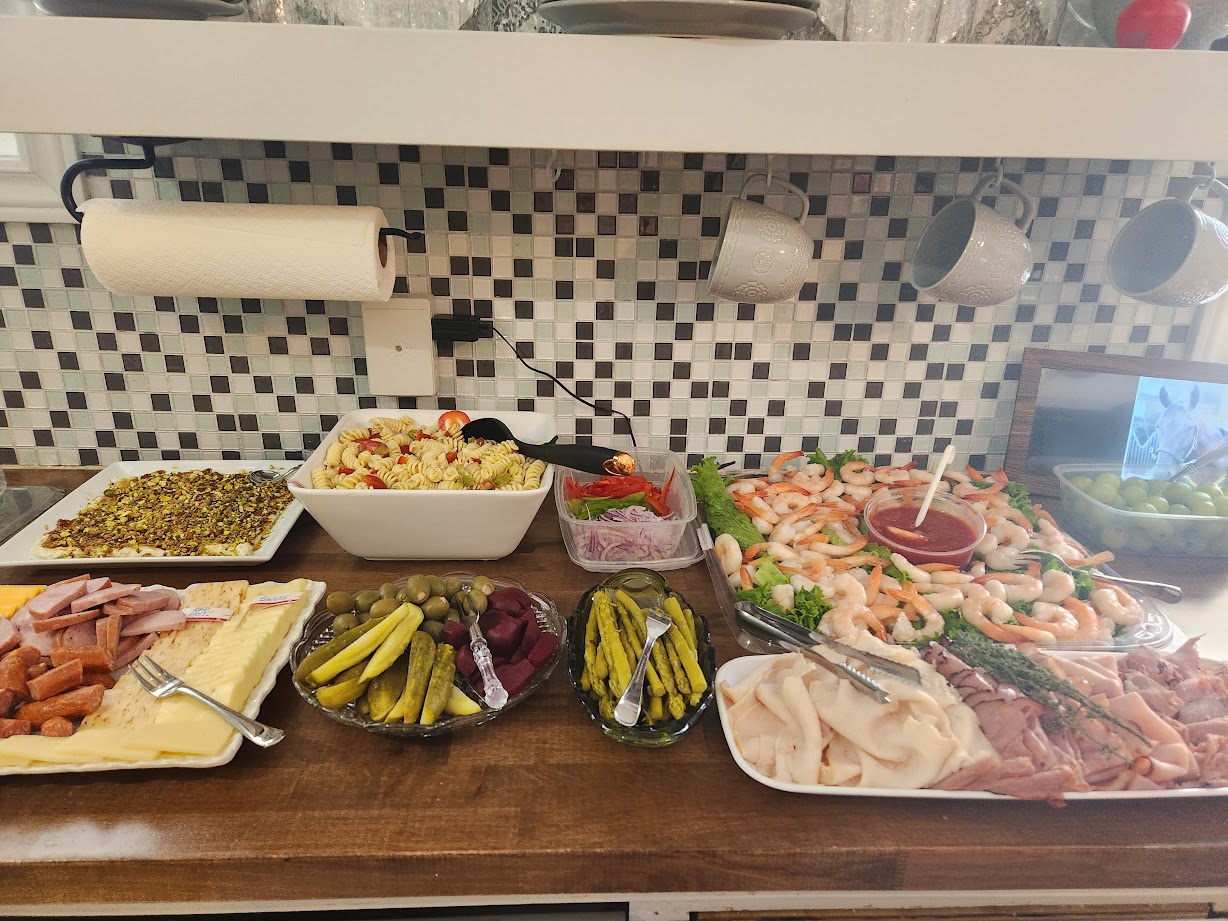
My sister-in-law hosted a cookie exchange on the 21st. It started at 1 and Mom and I left at 3:30. It was a very social afternoon with mimosas to start, a buffet-style assortment of finger foods and appetizers, and, of course, cookies.
One thing I realized after the fact, as I was recovering from my “social hangover,” was that these kinds of events are not my cuppa. Too loud, too many people talking all at once. I’ll probably go again, but I may have more of a strategy around it. Prep for a few days before (and clear the decks of all other obligations, appointments, etc., if possible) and make sure I have time and space after to recover.
We celebrated Christmas on Boxing Day, to allow my sister-in-law and mom-in-law to attend their in-law celebrations on Christmas Day. It was a nice, family-focused evening, but stormy weather added to the stress of travelling (even a relatively short distance), and I found myself in recovery mode again, following.
Finally, friends from out of town visited on the 27th. Unfortunately, because my brain was mush, I wasn’t a particularly good host, but I enjoyed the evening.




What I’m watching and reading
The first series I finished watching in December was the full run of Inu Yasha (Netflix). It’s taken years, y’all! I used to watch episodes on YTV … way back, and when I saw that the whole series was available, I started a rewatch. This is another comfort watch for me. The whole series is too involved to get into any detail. Suffice it to say that Kagome falls through the Well of Bones back in time to feudal-era Japan, where she teams up with a half-dog-demon (Inu Yasha), a fox demon pup (Shippo), a lecherous monk (Miroku), and a demon hunter (Sango) to collect the scattered shards of the Shikon jewel before the half-demon Naraku (with whom everyone has beef) can. There are lots of recurring secondary characters that are as interesting as the main cast. Very fun. All the nostalgic.
Then, I watched Wake Up, Dead Man (Netflix). Rian Johnson’s latest Benoit Blanc mystery is engaging, amusing, and all kinds of awesome. Father Jud, a former boxer from New York, is assigned to the rural parish of Our Lady of Perpetual Fortitude after he punches a deacon. Even the bishop agrees that the deacon was a jerk, but it’s probably a good idea for Jud to get out of the city for a while. Father Jud is immediately at odds with Monsignor Wicks, the parish priest who insists on the title of monsignor. Wicks has driven away almost all his parishioners with his condemning sermons. On Good Friday, Wicks retreats into a closet to “recover” from his homily, and Jud takes over the service only to hear a clatter from the closet. Opening the door, Jud finds Wicks face down and stabbed in the back. Jud is the prime suspect, for reasons (watch the movie, people!).
The ultimate locked room mystery causes the local police to call in the renowned Benoit Blanc, who is as over-the-top and overconfident as ever, to solve the murder. Great performances from a stellar cast, and a twist that will have viewers wondering whether Benoit Blanc has at last met his match. Loved!
After I finished the latest season of Only Murders in the Building last month, Disney + recommended the Only Murders in the Building Official Podcast. It was apparently intended to be viewed as the new episodes were released, but I found the behind-the scenes interviews with the cast, writers, and showrunner interesting and entertaining.
Next, I finished watching The Bad Guys series and seasonal specials (Netflix). I started with Haunted Heist, moved through the Breaking In series, and finished with A Very Bad Holiday. These are all prequels to the first movie and lead up to the Bad Guys becoming the less-Bad Guys – Lol! Mostly, the series focuses on the gang trying to make the list of the baddest of the bad. And failing. But they each have their own journeys preparing them for the first movie switch.
Then, on the recommendation of Friendly Space Ninja, I checked out Kill Boksoon (Netflix). This is a dubbed Korean movie that’s basically John Wick with a single mother as the protagonist and no dead puppies.
Gil Bok-soon is a professional assassin working for the MK company. She has this skill, much like Holmes in Guy Ritchie’s Sherlock Holmes movies, where she runs through the possible outcomes of her actions before she decides what to do. Bok-soon tries to be a good mother and protect her daughter, Jae-yeong, from the dark life she leads. She considers leaving the business, but when Jae-yeong stabs a fellow student in the neck (not fatally) and is under threat of expulsion, MK’s director convinces her to take on another contract, or show. In the middle of Bok-soon’s show, Jae-yeong calls her to confess why she stabbed her fellow student and Bok-soon decides not to complete the contract. Things devolve from there, forcing Bok-soon to kill her way free of MK’s current management. A little slower than John Wick, but the fight scenes are excellent, and the story is more compelling.
I watched the first season of The Mighty Nein (Prime). I tried to get Phil interested, but he wasn’t as keen on this Critical Role offering as he was on The Legend of Vox Machina. Most of the season was about the group coming together while the Trent Ikithon stole the Beacon from the Kryn Dynasty. The two storylines are brought together when the Gentleman hires the Mighty Nein to steal the Beacon from Trent. I enjoyed it quite a bit.
Because I’d enjoyed the first The Bad Guys movie, series, and seasonal specials, I decided to watch The Bad Guys 2 on Prime. Picking up after the events of the first movie, the Bad Guys are having a rough go trying to find work with criminal records. After serving their time, they’ve gone straight, but no one is willing to give them a chance. They try to prove themselves by bringing in the Phantom Bandit. Instead, the Phantom Bandit blackmails them into performing one last heist. She has footage that identifies Diane Foxington, now governor, as the Crimson Paw and will release it, ruining Diane’s career, unless the Bad Guys comply. All sorts of call backs and shout outs to various movies and series. It’s a lot of fun.
Then, I saw Hazbin Hotel Live on Broadway was out on Prime (!) and had to watch it. Like the OMitB podcast, it was intended to be viewed before the second season aired. Regardless, it was a beautiful fan-fest with cosplayers and musical performances of songs from the series. I may have to get the soundtrack.
I finished watching season 4 of The Witcher (Netflix). Liam Hemsworth makes a nearly seamless new Geralt (I feel I should not be surprised, but I was). Ciri has relinquished her powers and taken the name of Falka, joining The Rats, a gang of thieves. Thinking that Ciri is in Niflgard, Geralt, Jaskier, and Milva fight their way there. Yennefer gathers the remaining sorcerers and initiates in an attempt to defeat Vilgefortz. The end of the season sees Ciri in the hands of Bonhart, a witcher-killer, Geralt sworn to Queen Neve’s service, and Yennefer off to confront Vilgefortz alone.
Finally, on December 31st, Phil and I watched the finale of Stranger Things (Netflix). The Duffer brothers managed to bring everything around to a satisfying close. Hawkins is occupied by the military and “rockin’” Robin and Steve take over the local radio station to keep the residents informed and secretly organize Hopper’s “crawls” in the upside down in search of Vecna while El trains to confront him. Then Holly Wheeler is abducted and Vecna’s plot is slowly uncovered. I won’t get into the rest of the season, because it is a worthwhile watch, if you’ve been following the series. Mind you, if you’re a fan, or just a completionist, you’ve probably already seen it.
Yes, there are a fair number of pivotal events that happen off screen. Yes, there are plot holes and unresolved plotlines. But it’s an entertaining and dynamic season of an entertaining and dynamic series with much nostalgia and 80s fan service. The ending is bittersweet, with the older gang members reminiscing and making plans to keep in touch, Hopper proposing to Joyce, and Mike’s post-D&D storytelling making hopeful, if fictional, sense of everything. It was also nice to see the next generation of gamers taking over the table.
My first listen of the month was another Great Courses/Audible original collaboration, Witchcraft in the Western Tradition by Jennifer McNabb. From the witch hunts of early 15th century Europe through the “satanic panic” of the 80s to the current moment of neo-paganism, McNabb examines not only what happened, but the causes and the sometimes-surprising results of witch hunts through the ages.
Then, I listened to Mistletoe Murders 4 by Ken Cupris. Mild spoilers for MM3 if you haven’t listened yet. After finding the body of her former lover and fellow agent under her Christmas tree, Emily Lane is forced into hiding for 11 months with only a voicemail to Sam, the police officer she’s falling in love with. When she returns to Fletcher’s Grove, the entire town is undergoing a facelift, Sam has a new girlfriend, and Sam’s daughter Violet has left for college. Everything’s changed, except murder. This edition features three new mysteries for Emily to solve. Fun, cozy, and just the thing to put you in the mood for the holidays.
My next listen was Grimm’s Fairy Stories, translated by Margaret Hunt. These are all the traditional tales, Little Snow White, Thumbling and Tom Thumb, Brian Rose, Cinderella, Little Red Cap (with alternate ending), The Frog Prince (which is more bizarre than I remember), and more. 25 tales that will give you all the background on the Disney princesses you’ll ever want. Just kidding. A classic.
I also listened to The Secret Garden by Frances Hodgson Burnett. Yes, another classic I hadn’t read! I loved this gentle fable about the power of nature to heal. When Mary is the only survivor of a cholera outbreak that sweeps her home in India, she is sent to live at her uncle’s house in Yorkshire. She arrives a thin, jaundiced girl with a sour disposition, having only ever been waited on hand and foot by Indian servants while her parents lived their lives as if she didn’t exist. Her uncle, Archibald Craven, is often away and his housekeeper meets Mary at the train. In her first days, she’s told the tragic tale of how her uncle’s wife fell out of a tree in her favourite garden and died, prompting her uncle to lock the garden and bury the key. She soon becomes obsessed with finding the secret garden. It’s absolutely lovely and I really enjoyed the authentic Yorkshire spoken by the narrator. It added so much to the tale.
Then, I read Incantations by N. (Nicole) Milanne, the first self-published book in her projected Jeannie’s Bottle series. This sweet middle-grade tale follows 12-year-old Jeannie, whose mother Clara, disappeared and is presumed dead. After her father’s dental practice fails, Jeannie, her dad, and her little brother move to Shallow Cove to live with Aunt Marid (in Islamic tradition, a marid is a demon like an ifrit), whose vegan cuisine Jeannie considers a trial. At her new school, Jeannie makes friends with UFO-obsessed Rita but is also harassed by “Glam Girl” Leah, and her English teacher, Mr. Queue, gives her the creeps. While helping at Aunt Marid’s second-hand shop, Mr. Queue shows up with a box of donations and Jeannie finds a brass bottle inside, which she promptly takes when it begins to glow.
Later, when she deciphers the inscription and recites it, Anpudru (Dru) the jinn emerges from the bottle. Bound to the bottle, Dru must obey many rules, like speaking in awkward forced rhyme. He can also grant Jeannie one wish per day. Jeannie’s first wish? That Leah can’t talk anymore. That goes about as well as you might expect. The story follows Jeannie as she learns to use her wishes more responsibly, while trying to solve the mystery of why Mr. Queue seems to have an interest in her. The crisis culminates on Halloween night under a blood moon lunar eclipse, and Jeannie learns who Mr. Queue really is.
I finally finished my reread of C.S. Lewis’ The Horse and His Boy. As lovely as I remember. One of my foundational series that got me into writing fantasy.
Next, I listened to Mur Lafferty’s Station Eternity, the first in her Midsolar Murders series. Mallory Viridian seems to attract murders wherever she goes, and she only failed to solve the first few — including the murder of her mother — because she was too young to put the pieces together. But as she grows up, her talent only seems to put her on the list of suspects, and the authorities actively block her from becoming a police officer or private detective. She can’t go to school or hold down a job because if she’s around people, they eventually get murdered. Stuck volunteering at an animal shelter and writing novels about the mysteries she solves to earn a living, Mallory eventually witnesses one murder too many and appeals to the alien-only sentient space station Eternity. If she can live someplace where there aren’t humans around, maybe she won’t be responsible for any further death. Unfortunately, Eternity subsequently accepts human tourists and before they even arrive, another murder — that of Eternity’s alien symbiont, or host — throws Eternity into chaos and threatens the life of every sentient species aboard. Can Mallory solve the murder before Eternity self-destructs? Awesome in every way. LOVED!
I loved it so much, in fact, that I immediately started in on the next audiobook in the series, Chaos Terminal. Mild spoilers for Station Eternity follow. Mrs. Brown, Eternity’s new human host, must travel to Eternity’s home world to learn how to be a proper host to a sentient space station. She takes Eternity’s daughter, the shuttle Infinity, depriving Xan, a former soldier claiming sanctuary on Eternity, of both his living quarters and his symbiotic partner. She also leaves Mallory in charge because of her symbiotic bond with the wasp-like sundry, who maintain Eternity’s systems. Eternity herself will be dormant for the duration of her host’s absence.
When another shuttle from Earth arrives with the new human ambassador, Mallory is completely blindsided to find the other passengers include the SBI agent who claimed the credit for all of Mallory’s solved murders on Earth, Mallory’s best friend from high school, now a quantum physicist, and her brother, Mallory’s high school crush — who, until the moment she saw him again, she had completely forgotten existed (!) Of course, murder follows on the heels of the shuttle’s arrival, and Mallory must try to solve the murder on a dormant station. Worse, she discovers bodies of hundreds of sundry and loses her connection to their hive mind, the very connection that allowed her to solve murders in the first place. How will she solve the murder during all this chaos? Another amazing listen.
So, of course, I headed right into book three of the Midsolar Murders, Infinite Archive. For a few months, Mallory is blissfully murder-free, but her time is taken up with raising the sentient ship Moebius and trying to reconnect with the sundry hive mind. She’s so absorbed in these tasks that she misses a visit from Queen Tina and Ferdinand, her nice (a rock-like alien species, not the adjective) friends from Bezoar … and a bunch of messages from her agent telling her that he’s coming to Eternity on a murder mystery convention on a giant, one-of-a-kind sentient ship called Metis and wants to talk about her next novel and, oh, and by the way he’s signed her up to be the keynote speaker and participate in a murder mystery LARP. By the time Xan prompts her to check her messages, Metis is already in transit. Never having delivered a keynote, Mallory panics and then enters research mode. When she meets with her agent, he wants her to write a cozy mystery instead of waiting for the next murder to happen, causing her to spin out further.
Then Tina returns with a “new friend,” an unknown alien, from Bezoar, and Moebius goes missing, and Mallory’s agent turns up dead in the ladies restroom where his newest author has also been assaulted, and Metis, who contains a copy of the entire internet in pocket dimensions, starts to malfunction, and things get more chaotic from there. An interesting commentary on the writing life, the publishing industry, and fan fiction. Wild but fun. I hope she continues the series.
I’ve listened to Mur’s podcast, I Should be Writing, for years, and she did a lot of research to learn how to write a mystery, like studying Agatha Christie’s entire oeuvre.
And that was the month in this writer’s life.
Until next month, be well and stay safe; be kind and stay strong. The world needs your stories!
I acknowledge with respect that I am in Robinson-Huron Treaty territory, that the land from which I write is the traditional territory of the Anishinaabe and home of Atikameksheng Anishnawbek and Wahnapitae First Nation.

 Always Looking Up