How my life sentence with mortal punctuation has informed my writing

A.K.A. The period at the end of this series 🙂

I’ll preface this bit by saying that I don’t think I’m unique among writers in this respect.  In fact, I think every writer works, at core, with and through the same issues.  This past week, I read (and shared) a great interview with Chuck Wendig in which he talks about (among much other awesome) the themes that crop up in his work.  Surprise, surprise, death and family rank prominently.

In this morning’s The Sunday Edition with Michael Enright, one of the Canadian greats (with whom I was privileged to work, even though he didn’t like my genre/subject matter) Alistair MacLeod, mentioned the same influences and themes.

Think of just about any author you’re reading or have enjoyed, and I think you’ll find death and family cropping up: Rowling’s Potter books were all about death and the search for family despite its omnipresence; Martin’s Song of Fire and Ice is about a number of families and he keeps on killing off prominent members 😉 (note here: in this context, what is politics, but family drama writ large on the world stage?); Collins’s Hunger Games = Death/Family; Gabaldon’s novels are a series of time travelling family sagas and death plays a prominent role.

I could go on, but I won’t.  Search your own shelves/ereaders to find your own examples.

What’s unique about me is my story, my life, and I hope that translates to my characters so that even though the theme may be familar, the way that it is expressed through my characters and stories is something just a little different.

Death

Death finds its way into a lot of my stories in different ways:

In my first published short story, “Chlorophyll and Corruption” (which is probably the prologue to a YA sci-fi), my protagonist first saves his brother from being pushed out of their atmospheric containment bubble, then must flee an impending supernova. “For a Change” (which I have subsequently rewritten as “The Gabriel” and may yet become a sci-fi novel) my protagonist’s reaction to a world of sterile Transmat immortals is to attempt suicide, repeatedly.

In “Fox Fur,” my protagonist is trying to deal with the death of her parents by means of various encounters with foxes.  “Dead Issue,” is about a young woman who makes a personal discovery at a family funeral.

“Tonsillitis Blues” from my 1999 MA Thesis, Whispers in the Dark, is an interpretation of my adult exploration of the near-death experience prompted by my tonsillectomy trauma.  The protagonist of “Fool’s Journey” (subsequently rewritten as “A Terrible Thing” and likely a YA paranormal novel), another story from the same collection, attempts suicide because she can’t deal with the visions of danger and death she’s been gifted with.

Even my poetry is liberally sprinkled with death.

Ferathainn, the protagonist of Initiate of Stone, experiences the deaths of her best friend,

English: Colored version of the ancient Mesopo...

English: Colored version of the ancient Mesopotamian eight-pointed star symbol of the goddess Ishtar (Inana/Inanna), representing the planet Venus as morning or evening star. (Version not enclosed within a surrounding circle) Polski: Kolorowa wersja symbolu ze staroĆŒytnej Mezopotamii, oƛmioramiennej gwiazdy Bogini Isztar (Inany/Inanny), reprezentujacej planetę Wenus jako poranną lub zachodnią gwiazdę. (Photo credit: Wikipedia)

fiancĂ©, and father, and subsequently dies herself attempting to exact revenge.  She undergoes an Inanna-inspired journey into the underworld to reclaim herself and her will to live.  Eoghan witnesses the execution of his brother for heresy and when the goddess Auraya calls him to become her champion, or Kas’Hadden (hammer of light), he experiences an assassination of personality at her hands.  Dairragh, deeply affected by the death of his mother years earlier, inadvertently triggers the destruction of his home and the death of his father.  He succumbs to his wounds and is resurrected and set on a shamanic path by the mysterious anogeni.

I won’t get into the protagonists of my other unpublished works, but death and its impact are recurring themes.

Death is the period of every life sentence and so it is a universal.  Few readers will fail to be engaged by various explorations of death and its impact on those left behind.  Thrillers and mysteries are built around it and are two of the most popular genres in publishing today.

Family

Likewise, everyone has a family.  Even the only child who has chosen not to have children of her own (like me) has parents and understands the pull of the complicated legacy handed down to them.

In my, admittedly small, family, women proved to be the peace-makers, sacrificial lambs, care-takers, bread-winners, and all around protagonists of the story.

My maternal grandfather was an alcoholic and a womanizer.  He and my grandmother were unable to have children and adopted my mother and aunt.  My grandmother worked in a textile mill during the depression and worked for most of her life until her first major heart-attack forced her into early retirement.

On my father’s side, my grandfather died at a relatively young age because of heart failure and my grandmother was an entrepreneur.  I still meet people in Sudbury who hear my name and ask if it was my grandmother who owned Marttila Sewing Centre.  Yup.  That was her.  She remained fiercely independent until stroke and cancer eventually took her life.

My father was always an ill man and though he was the bread winner for most of his life, it was my mother who held the family together, getting her high school diploma and driver’s licence in her forty’s and starting a new career as a ward clerk in the hospital when my father had his breakdown.  My mother was the one who cared for her parents and my father until their respective deaths.  Though she doesn’t have to, she still takes care of me.

It’s no wonder then, that my work focuses primarily on strong female characters.

Incidentally, here are a couple of posts I came across this week from Marcy Kennedy on strong and likeable female characters.

I had trouble for many years writing strong and likeable men because that was an archetype largely absent from my experience.  I found my way to that eventually, though, because of Phil, and because I learned to recognize the good qualities in the men in my life and expand those into heroic proportions.

Everyone is a mix.  My paternal grandmother may have been a business woman, but she was a poor fiscal manager, and tried too hard to curry favour with the well-to-do women of Sudbury (read sycophantic).  She first promised my mom inheritance of her business, then rescinded the offer and sold the business to a third party.  I think this was because she was too embarrassed to let my mom see what a shambles she’d made of things.

Though family dynamics run through all of my stories and novels, I’ll just present one example, from IoS, because it’s going to take a while to break down for you 😉

Ferathainn’s family in IoS is complex.  Her parents, Selene and Devlin, can’t have children and adopted Fer when she was abandoned by a bedraggled, but clearly noble, woman who refused to speak and ran away before she could be made to explain anything.

Devlin, feeling the need of a child of his blood, fathered Fer’s half-sister Aislinn, with Willow, a family friend and eleph (read elf).  Willow is misanthropic and makes her living as a brew-master and owner of the local public house.  She readily gave Aislinn into Selene and Devlin’s care.

Aislinn is obviously a half-breed, and largely reviled by the Tellurin (human) villagers of Hartsgrove as a freak. She is destined to become a bridge between the eleph and Tellurin peoples, however, by virtue of her heritage.

When Selene and Devlin adopted Fer, the resident eleph, Willow and her brothers Oak and Leaf, invited the new family and Aeldred, the local mage, to a Shir’Authe.  The Shir’Authe foretells the destiny of the child in eleph culture.  At the ceremony, none of the eleph can see anything about Fer’s future, but Leaf sees his spirit-lights, or astara, in the baby’s eyes (if you’re an Elf Quester, this is recognition, if you’re a Meyers fan, it’s imprinting).  This is bizarre enough, because only eleph are supposed to bond with one another in this way.

Selene, understandably, freaks out, but Leaf promises never to act on this deep spiritual attraction unless Fer somehow miraculously sees her astara in his eyes, or otherwise returns his feelings once she is gown.

Aeldred senses a wild and powerful magickal talent in the infant.  He fears that he will not be able to control the child and that she will become a rogue mage.  She has the potential to wreak havoc on their world and her talents will be much sought after, by moral and immoral authorities, both magickal and political.

In an attempt to minimize Fer’s potentially negative impact, he merely tells the others that she has talent and that he will remain in Hartgrove to become her teacher.  He further tells them that Fer’s parents are powerful, but immoral, people and that they must protect the child in the event that either one, or both blood parents, come seeking her.

He gets everyone to agree to a magickal binding.  None of them will be able to speak of the circumstances of Fer’s birth or of her coming to Hartsgrove until the girl comes of age.  By then, Aeldred hopes that he will have thoroughly indoctrinated Fer in the disciplines of the Agrothe magicks and that he will therefore be able to control her chaotic potential and prevent her from doing harm.

In truth, Fer’s parents are Aline of Gryphonskeep and Halthyon, an eleph mage, or kaidin. Aline is descended from the de Corvus family and magick flows through the bloodline.  The original Kas’Hadden was a de Corvus, so the power of the gods has been passed down to Fer.  Aline is married to Killian of Gryphonskeep and mother to Dairragh (dun, dun, dun!).

Halthyon is one of those rogue magi that Aeldred worries about.  He has extended his lifespan far beyond the already lengthy eleph standard.  His goal is to accumulate magickal power (by draining it from others as he kills them) and to ascend to godhood (in the process of which he intends to kill the existing gods of Tellurin).

Halthyon is unable to extract the child’s location from Aline and subsequently kills her in the attempt.  He wants to find his child because he considers her the only person worthy of ascending with him.  In order to do that, Fer must become a god-killer as well.

Okaaaaaay.  So there, in a convoluted nutshell is the familial basis of the plot of not only

English: St. Etheldreda's Churchyard - Family ...

English: St. Etheldreda’s Churchyard – Family Plot with Snowdrops (Photo credit: Wikipedia)

IoS, but the ensuing novels in the series, which I have called Ascension.  You can see why I identify the book in the epic fantasy genre 😀

Family is an endlessly intriguing Gordian knot to unravel and I think you can see where I have mined my tapestry to create Fer’s.

It’s all variations on two essential themes.

How have your life experiences contributed to your creative work?  Do death and family inform your stories?  Do you have a family-plot?

I’d love to hear from you!

Here ends the series that was A life sentence with mortal punctuation.  I hope you have enjoyed it, and found it to be useful in your creative pursuits.

Coming soon: I’ll have a book review for Laura Howard’s The Forgotten Ones, and hopefully a couple of author interviews to throw your way.  I’ll definitely share my experience in Margie Lawson’s  A deep editing guide to making your openings pop course, and in Marcy Kennedy’s Crafting your logline and pitch workshop next weekend.  There might even be some Pupdates and Next Chapters in there.
The Next Chapter: Progress by inches (and bounds)

It’s been a while since I’ve posted about my progress, or lack thereof, on my writing.

Initiate of Stone

I’ve been struggling to rewrite my first chapter.  I’ve now made progress, after writing, and rewriting it several times.  I really had to go back and decide what it was necessary to accomplish in my opening chapter.

A short list:

  • Introduce my protagonist – Ferathainn, or Fer, is fifteen, and her coming of age is in two moons, at the next goddess festival, Sestaya.  She wants to become an Agrothe mage, and will be the first girl to do so in a very long time, but she chafes under the tutelage of her master, Aeldred.  Fer has been studying from the moment she wakes to the moment she sleeps (except festival days) with Master Aeldred for 12 turnings of the sun through the seasons, but it’s all been mundane. He’s forbidden her from using her innate talent, to speak with the spirits, or souls, of animals, plants, elements, and perhaps even people, like he controls who the spirits speak to …  Fer desperately wants to be initiated so she can start using her talent and learning “real” magick.  She knows she’s capable of more than what Master Aeldred permits her to do.  The process is long and demanding, though, and she will have to make sacrifices.  She loves Leaf, the eleph finiris, or song master, and will marry him on Sestaya as well.  She sees her astara, or soul-lights, in his eyes, something that only the eleph are supposed to see.  She’s not so sure about children, though they seem to be the natural consequence of marriage.  She’s just been so long separated from other girls her age by her studies that she wants something that everyone else takes for granted.  Fer worries that love, marriage, and family will be the sacrifices that she will have to make to become a mage.  She’s determined to have at least love in addition to the solitary life of a mage.
  • The “normal” world – Hartsgrove, Fer’s village, is a “free town” and the eleph and people of Tellurin live side-by-side in relative peace.  It’s an agrarian village that sends tributes to the surrounding, larger, towns and cities to show fealty and secure support in times of need.  The predominant religion is worship of the Goddess Auraya, creatrix of Tellurin.  Every year the season of Vedranya brings deadly storms to besiege the land.  This has been the way of things since the Cataclysm, two centuries before, changed the face of Tellurin and reduced much of Tellurin civilization to rubble.  Fer lives in a small, but sturdy cottage, with her mother and father, Selene and Devlin, a seer and a bard respectively, and her younger half-sister, Aislinn.  She has never left Hartsgrove.
  • Hook the reader – What’s the root cause of Fer’s resentment of her master, the man who could grant her wish to become a mage?  Why does he want to keep her from using her talent?
  • Ask a question (that needs to be answered by the end of the novel) – What is the secret Master Aeldred feared so much he magickally bound Fer’s friends and family to silence?
  • Foreshadow the inciting event – An earth elemental, or nomi, tells Fer the secret is a potentially deadly one though it cannot more than hint at the nature of the secret; she must be strong to face the trials to come.

So I’m slowly working my way through the list without dumping too much backstory or world building on the reader.  Beginnings, why are you so hard?

Some links about beginnings:

On a whim, I’ve signed up for Margie Lawson’s course, A Deep Editing Guide to Making Your Openings Pop, starting May 6, 2013.  She focuses on psycho-linguistic and rhetorical techniques to improve your writing.  My undergrad was focused on rhetoric and I love psychology, linguistics, and brain science, so this looks like it’s right up my alley.  Will let you know how it goes.

I might do the crazy and send my beginning (when I’m more or less happy with it) to Ray Rhamey’s Flogging the Quill to see if it passes his test.  Stay tuned.

Short Stories and poetry

Well, so far, I’ve kept up with Kasie Whitener’s Just Write short story challenge.  I’ve written a completely new short story for each of January, February, and March.  I’m a little behind in April, and may opt for flash fiction to make up the short fall.

The short story that I revised and sent to On Spec in January has been accepted (!)  I am very (like !!!!!!!!!!!!!!!!!!!!!!!!!!!!!!!!!!!!!!!!!!!!) excited about this, even though I know that it won’t be in print until sometime next year.  I’m looking forward to working with their editorial team to whip “Downtime” into shape.

“Beneath the Foundations (original story #2),” my attempt at medieval Cthulian for Sword and Mythos was rejected.

“A Terrible Thing” was rejected by the editors of Tesseracts 17.

It’s too early to have heard back from either Writers of the Future, to whom I sent “The Gabriel,” or In Places Between, to which I submitted “Molly Finder (original short story #3).”

There wasn’t room for my poem “peregrine” on the League of Canadian Poets National Poetry Month blog, but I have subsequently submitted that poem plus two more, “contain you” and “infant crawls,” to Sulphur.

From last year’s submissions, I learned that my submission to Mark Leslie’s Spooky Sudbury will be included in the publication, and my poem, “north of thule” was included in the fabulous Sopphey Vance’s Enhance no. 11.  It’s been a good month (and a bit) for happy dancing!

I’m going to work on something flashy this week to round out April’s short story quota, and set to work on another original for May in hopes of garnering some attention in the Rannu Fund competition.May Submit-o-rama Choice

I’ve joined Khara House’s May submit-o-rama and have committed to 1 submission per week in the Choose Your Own Challenge category.  Rannu will make up only one of those, so I’ll have to get my arse moving on identifying other submission opportunities (!)

Critiquing

Actually finished the BIG critique for my online group and am working on a review of the first 100 pages of another online critique buddy.

Have only three people left to critique for the Sudbury Writers’ Guild before I’m caught up with them.  We’re trying to get our stories and poetry together for an anthology.  I put forward “A Terrible Thing” and “Old Crow,” another short story of mine that was rejected by Tyche Books last year (Masked Mosaic anthology).  It looks like “Old Crow” might be salvageable as a short story, but that “A Terrible Thing,” as editors have said—and I’ve thought—in the past, is really a novel in the making.

Conferences

A local effort, Wordstock, will be happening June 7 and 8 at the Sudbury Theatre Centre.  This is the first year for the event, and the organizers are hoping to build on what they hope to be this year’s success.  The SWG has a block of time for readings.

I’ve registered for the Canadian Authors Association CanWrite! conference in Orillia, June 12-16, and booked my room in the Orillia campus of Lakehead University.

I’m still waffling about When Worlds Collide August 9-11.  The registration fee is reasonable in the extreme, but I still have to bear the cost of the flight and accommodation.

One reason I’m waffling is because I want to go to the Surrey International Writers’ Conference this year (Oct 25-27).  Domestic flights are sooooo expensive.  Right now, a return to either Calgary or Vancouver for the conference dates is showing as over $1000.  It may be an either/or kind of thing for me.  Or I might just cash in my Avion or Aeroplan points for one or the other flight.  That’s an idea!  Thanks for letting me suss that one out online 😛

I think that’s all the conferencing I can take for this year.  Next year, I hope to add some fancons like Ad Astra.  We’ll see how the financial situation sits.  And my various air rewards plan balances 🙂

Other stuff

Taxes done and refund received 🙂

Am still putting off the decision to move to WordPress.org.  I think I just need some dedicated time to devote to research and reflection.

Hope all is well with you and your writing lives.

I’d love to hear from you about your latest literary adventures!

Tonight’s viewing line-up: Doctor Who and Orphan Black!

Tomorrow, I’ll share my thoughts on happiness and how my experiences have influenced my writing in the final instalment of a life sentence with mortal punctuation.

Six questions with Barbara Morrison

Barbara MorrisonBarbara Morrison, who writes under the name B. Morrison, is a poet and writer, a publisher, teacher, and dancer. A few years after graduating with a BA in English, her marriage collapsed and she found herself forced to go on welfare. It is this experience of a world very different from the one in which she grew up that she describes in her memoir, Innocent: Confessions of a Welfare Mother.

She attributes part of her success in escaping poverty to her involvement in the world of traditional dance and music. She performed as a morris dancer for thirty years and continues to be active in the Country Dance and Song Society and several of its affiliates.

Barbara is also the author of a poetry collection, Here at Least, with a second volume, Terrarium, scheduled for 2012. She is currently working on a novel. Barbara has won multiple awards, been invited to speak as a featured author, and been published in magazines such as The Sun, Sin Fronteras, Scribble, and Tiny Lights. She conducts writing workshops and speaks on women’s and poverty-related issues. She is also the owner of a small press and speaks about publishing and marketing. Come by her website for more information.

Barbara’s Monday Morning Books blog is where every week since 2006 she has been sharing insights about writing gleaned from her reading. You can also find her on Twitter where she tweets regularly about poetry and on Facebook. Be sure to visit her GoodReads Author Page and her Amazon Author Page.

____________________________________________________________________________________

I met Barbara through Robert Lee Brewer’s April Platform Challenge last year and am pleased to welcome her to Writerly Goodness.

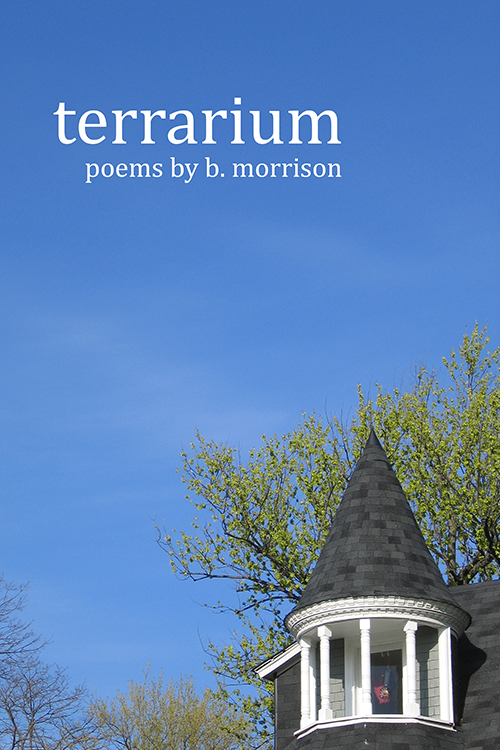
Terrarium will be Barbara’s second collection of poetry and will be published in May 2013.

WG: When did you begin to write poetry and how do your poems come to you?

BM: I began writing poetry in high school and continued through good times and bad, even when I was a single parent working three jobs. Although I’ve also kept a journal, it is in poetry that I seem to have chronicled my life. At first I thought I had to wait for poems to come to me, but after I spent a couple of years making myself write a poem a day, I realized that there would always be something troubling or tickling me, something I wanted to praise or puzzle over.

WG: What is your creative process like?  Do your poems incubate for a while?  Do you edit extensively?  What role does your publisher play in the process?

BM: They often start with a single phrase. Some poems come quickly while others take their time. I then put them away for a while before starting another round of editing. I often repeat this process several times. I self-publish my poetry, but once I put on my publisher’s hat, I might demand further revisions.

WG: Terrarium’s theme revolves around various interpretations of home.  How did this theme evolve for you and how does it reflect the “place” you find yourself in at this point in your life?

BM: I actually started with the theme and deliberately wrote poems around it. I often dream about a particular city. It doesn’t exist in our world, as far as I know, but I could draw you a map of it; the streets and shops and houses are the same whenever I revisit them in dreams. Trying to work out why my unconscious needed to construct and continue to inhabit this place made me wonder how our places, both those we choose and those where we find ourselves, influence who we become. I never meant to stay in the city where I now live, so on some level I continue to feel even after many years that my life here is temporary, which in turn reminds me that our stay on earth is temporary, and I must make the best use of it that I can.

WG: How was assembling Terrarium different from working on your first collection, Here at Least, and what has the experience taught you about yourself as a poet?

BM: With the first collection I agonized over selecting and arranging the poems. I must have changed my mind a thousand times! With Terrarium I was more focused. Also, each of the three sections has a kind of chronology which helped.

WG: Is a launch or reading planned?  Will there be an online component to your promotion?

BM: Yes, I have a book launch party scheduled for 10 May 2013 at The Ivy Bookshop in Terrarium CoverBaltimore, MD. I also have several readings set up; see my website for details. One thing I’ve learned about online promotion is that there is no end to what you can do, so I will pace myself.

WG: What’s coming up next for you?

BM: I’ll be teaching a five-day memoir workshop called Sharing Our Stories at Common Ground on the Hill in July; for more information, see my website http://www.bmorrison.com. I am also working on a novel.

Thank you for sharing your creative journey with us!

A life sentence with mortal punctuation: part 8

How did what was supposed to be a mere two-part guest post get to be this huge?  I think it’s what project managers call “scope creep.” 🙂  Essentially, the story demanded something more, and as with many of the things I write, it told me the shape it wanted to be in.

Thanks to everyone who’s stuck with me through this very personal tale.  If it touches you in any way, I encourage you to like, share, comment, or subscribe as your conscience dictates.

I’ll take the opportunity here to remind everyone that while this story is based on my life, that it is filtered through my frame, and is, no more and no less than anything else I write, a story.

Last week: I discussed some of the things that I do to keep the wolf of my depression from the door, or perhaps invite it in, let it curl up by the hearth, and make itself at home.

This week I’m going to pick up the original thread of the tale where I left it.

Those sixteen years

The years during which I was “growing up,” getting a job, and learning how to deal with my depression were largely fallow ones for me creatively.  I got off to a good start in my undergrad years, both at Guelph and at Laurentian, but faltered during my struggle to achieve my master’s degree.

Though my primary poetic publications, NeoVerse and Battle Chant, emerged around the time that I finally received my graduate degree, I found it difficult to continue writing.  A handful of scattered publications in poetry and a short-lived foray into publishing weren’t enough to validate my still-fragile writer’s ego.

I’ve never had a thick skin.

As I slowly worked through my issues, however, I started to realize that writing wasn’t something I did or didn’t do.  It’s something I am.  My inability to commit to the writing life on a regular basis made me question my calling.  If I couldn’t write, how could I call myself a writer?  Maybe it was time to throw in the towel and commit to a life without magic.

The sheer impossibility of that thought told me that writing was what I was meant to do.  I just had to find my way to it without a map or any orienteering skill whatsoever.

Upon my triumphant return from Windsor and contract jobs interspersed with unemployment, Phil and I decided to get a puppy.  We already had two cats, one a three-legged refugee from my days at the Veterinary Emergency Clinic in Mississauga, the other a sweet-natured black cat that Phil got me for my birthday one year.

Our dependent quadrupeds helped me immensely.  I believe that pets have a lot to teach us about unconditional love and being good people.  My pets are some of the best people I’ve known 😉

I got my full time job with my current employer.  Phil and I got a house and a car.  I made use of my new benefits to get some serious work done on both my body and my mind.  I figured out that medication was not the way to address my feral disease.

My mother was still working, part-time at the local hospital, at home, taking care of my father, who had graduated to a disability pension and therapy, and at the seniors’ residence where my grandfather now lived.

I went out with her to see my grandfather about once a week, and helped her to transport him to his various appointments.  My father began to have issues with his heart, eventually diagnosed as arrhythmia and congestive heart failure.  He got a pace-maker, and a new suite of medications.

Shortly after retiring from the hospital, my mom developed diabetes.  Dad started to fall.  If it happened at home, either Phil or I, or both of us would have to help Mom, because Dad couldn’t get up under his own power and she couldn’t lift him.  If it happened outside home, it generally involved a hospital stay.  Dad was on Cumadin by this time and as a result, even the smallest injury could become serious due to the complications of the medication.

Then my dog died

ZoeIt wasn’t something sudden.  Zoe developed hemangiosarcoma and though we caught it early, the vet wasn’t able to catch it all with surgery and internal lavage.

The issue with this particular type of canine cancer is that it likes vascular areas, that is, places in the body where blood vessels tend to gather, like the spleen and the liver.  Once it takes hold, it disseminates quickly and almost always results in death.

The biopsy taken in the surgery came back malignant.  It would only be a matter of time.  As it turned out, we only bought Zoe a couple of weeks.

At first, it seemed like she was recovering.  Phil and I had taken to sleeping on the futon in the living room so we could be close to her if problems arose.

The morning she woke me at 5 am looking for comfort was her last.

I won’t describe that morning other than to say that I called in sick.  I was devastated.  For the first time, I cried legitimately over the loss of a loved one.

Papa

My maternal grandfather was the only one of my grandparents left alive.  He’d been a hard-core smoker, and alcoholic for most of his life.  When my grandmother passed away, he reacted poorly and within a few months, a fall resulting from TIA, landed him in the hospital.

From there, arrangements were made to move him into a seniors’ residence and for many more years, he lived happily, adjusting to the fact that he couldn’t drive anymore, that he had to go outside the residence to smoke, and that he had to depend on my mother to ration him a few beer on special occasions.

Some irregularities regarding his heart landed him in the hospital and when I got the call at work that I should come to the hospital, I had a bad feeling.  In the time it would take me to get the car, drive to the hospital, find parking, and get to his room, I could walk, so I sped along as quickly as I could, hoping that he would hold on long enough for me to get there.

Turns out he’d already passed away when I got the call.

Papa’s passing wasn’t all that traumatic for me.  He’d lived 94 years despite his addictions and was, so far as I know, happy.  I also felt confident that I had been there for him as much as I could.

I helped Mom settle his estate.  Being able to help her out in that way made another big difference for me.

I received a small inheritance, just enough to invest in my first laptop computer.  That year, I started to get back to my writing and the novel I’d conceived of all those years ago in university.

In another year, Phil and I felt that we could bear the love of another pup.  That was when we got the Nuala-beast.

The butt-in-chair breakthrough

Though I was writing more, I wasn’t writing daily yet.  It wasn’t until Nino Ricci came to town to do a workshop with the Sudbury Writers’ Guild that my head got turned around the right way on that.

It was his sharing of his own guardian tale that helped so much.  Every writer has at least one, that big name, well-established Author who tells you that your work is crap.

The breakthrough was that I could choose not to let the well-meant, but unfortunate words of my guardian keep me from entering the inner sanctum and gaining my prize.

Productive or not, I’ve been writing every day since, and that, as the poet said, has made all the difference.

The diabetic cat

Our little black cat, Thufir (named after the Mentat Thufir Hawat due to his fondness for Thufir Hawat the Mentat Catflashing lights) developed feline diabetes.  Phil and I were surprised because he wasn’t obese or showing any of the other signs, but his blood glucose level didn’t lie.

He was on Metformin for a year and graduated to insulin after that.  I became very adept at taking his blood sugar levels and injecting him daily.  He came to tolerate, if not anticipate his injections, like he knew that they made him feel better.

Once again, however, it was a matter of time.  Eventually, organ failure took out little guy.

I wasn’t sad this loss either.  I’d been the best kitteh-mama I could have been and I knew that I’d done well by him.  I’d kind of made my peace with death by this time.

I’m going to leave things here for now.  The next big event for me was the death of my father, and that’s going to need a post unto itself.

After that, I’m going to delve into my insights into happiness as a result of all I’ve learned and that will be the culmination of the series.

Tomorrow I’m going to be writing the Wordsmith Studio Anniversary post 🙂  What’s that, you ask?  Read and find out, my friends.

Coming soon: I have a few wonderful authors who have agreed to do interviews for little ole me.  Look out in the next few weeks for six questions with fantasy author J. L. Madore, poet Barbara Morrison, and D. J. McIntosh, author of The Witch of Babylon, and the soon-to-be-released The Book of Stolen Tales.

I’m finding all sorts of writerly goodness to share 🙂

The next chapter: Diving back in

The last of my caturday quickies is a bit of an update on the work in progress (WIP) and other writing projects I’m tackling these days.

I revised my short story “A Terrible Thing” for Tesseracts 17 and submitted that on February 27, just one day before the deadline (!)  I submitted a short story back in October for the competition, but was not successful at that time, though the rejection letter was of the very encouraging variety (please send us something else).  I followed the editors’ advice, and ATT is sufficiently different from the story I submitted last fall that I hope it will tickle some fancies 🙂

I also submitted a poem for the League of Canadian Poets’ National Poetry Month blog: “peregrine.”  I’ll link through when it’s posted.

In related news, I forwarded an opportunity to my friend, Kim Fahner, a couple of months ago, and she, in turn, asked her publisher to submit her poetry collection, The Narcoleptic Madonna, to the powers that be.  The result?  Kim will be participating in the Battle of the Bards at Harbourfront Centre April 3rd!

It’s inspired me to think more seriously about submitting some of my poetry to various publications.  We’ll see where that leads.

As of today, I’ll be diving back in to Initiate of Stone and the next set of revisions.  I’ll also be revising “The Michael” for the Writers of the Future competition and working on a new story, “Way Station,”  (which the Retro Suites inspired) for In places between.

Finally, after my bout of training fury and certification regret, I’ll be catching up with my critiquing crew.

I never did work further on Gerod and the Lions.  I am hoping that I got far enough into it that I’ll be able to pick up the threads when the time comes.

A not so pleasant writing-related task that I’ll be picking up shortly, is collecting all my various financial bits and pieces and submitting my taxes.  I claim writing as self-employment on my income tax.  My lack of recent publishing success is a bit of a concern, but it’s certainly not for lack of effort 🙂  Do you think auditors would accept this blog as evidence of my industry? 😉

Writerly Goodness

Writerly Goodness

What’s been happening in your writerly lives lately, my friends?  Are you writing “hard”?

What’s coming: I’ll continue my series, A life sentence with mortal punctuation, tomorrow, and in the future, I hope to have an interview with Amazon Breakthrough Novelist Award 2012 quarter-finalist Alon Shalev regarding his writing life and the second book in the Wycaan Master Series, The First Decree.

The next chapter: update February 17, 2013

Just a brief catch-up here on what’s been happening.  Brief, because what’s been happening = not much 😛

This week, I put my second original short story of the year, “Beneath the Foundations” in the can and submitted to the Sword and Mythos anthology.  I’m not optimistic because the story that bubbled up was not along the lines that the editor said she was looking for.

The editor was looking for aboriginal (not just NA, but Australian, etc.) northern Africa, Arab, Indian, or Asian settings, female protagonists, and in general, a new spin on the old Cthulian genre.

BtF is medieval European, specifically England during the time that King Alfred was ousted

English: Statue of King Alfred in Wantage, England

English: Statue of King Alfred in Wantage, England (Photo credit: Wikipedia)

by the Danes and was gathering his forces to retake Wessex and Mersea.  Adric, the protagonist, is male, though he is a little person, and by that I don’t mean that he was a pixie, but short of stature.

He’s bought by a Danish lord, Ofded, as a sapper along with several other boys from St. Jerome’s. Proper miners supervise the expendable boys in the endeavour.  Alfred’s supposedly harbouring in Castle Sark,  and Ofded wants to get the credit for his capture.

The story is about what Adric finds beneath the foundations and the horror that ensues.

So I’ll have to wait and see.  Typically, I don’t think much about my stories after I send them off.  I list them in my submissions table and mark off the result when it eventually comes in, or not, as the case may be.

Next up, I’ll be revising a couple of stories for submission to Tesseracts 17.  I haven’t quite decided which one I want to send in yet.  The deadline for that is February 28, for those of you who would like to submit.  Check out the guidelines.

I haven’t had a lot of time to work on Gerod and the Lions, and haven’t gotten back to Initiate of Stone yet.  I have a busy time coming up for the day job, and I have to pick and choose.

This week coming, I’m out of town for a training gig, and then again, after one week at home, I’ll be travelling again for more training delivery and my attempt at certification.  I don’t think it will be reasonable for me to return to IoS until after the next few weeks.

In March, when I dive back into my project, revising for beta-reader feedback (and yes, I will be asking a broad cross section of friends RL and online for their assistance) I will also be working on revising another, fairly long, short story for the next Writers of the Future (April 1) and a new short story (idea hasn’t cropped up yet) for In Places Between (April 4).

I’ve submitted to WotF before, and was pleased to receive an honourable mention certificate, but it’s hard to know how one would do in such a popular arena.  Again, I’ll encourage those of you who are working on your own stories to submit.

Also this week, I submitted some work to my critique group and am largely caught up.

Next weekend, when I return from training, I’m going to be attending a poetry workshop and I actually have some poetry to take with me.  My poet friend, Kim Fahner, graciously offered to have a look and I hope to have the few revisions she suggested ready.

I hope to submit some of my poetry to various journals, but I’m not so much into the poetry these days, so if anything this may be something that has to go by the wayside for now.  I definitely want to submit a poem to the League of Canadian Poets National Poetry Month Blog, and have a few options for online submissions that might suit.

Upcoming for the blog, I’m going to try my hand at submitting a post to Wordsmith Studio, another pupdate (Nu had her check up this past week, but I won’t have the time to commit it to the blog this weekend), I’m going to continue my new series, A life sentence, with mortal punctuation, I hope to have an interview with my friend, Brian Braden, about his new book, Black Sea Gods, and will likely blog about the training, the poetry workshop, and anything else my life offers up for sacrifice 🙂  Writerly Goodness

That’s it for now.

Good words at y’all!  Writerly Goodness, signing off.

The best of Writerly Goodness 2012

Well, since I only started blogging (in this incarnation) in March, it’s not been a year yet online, but I’ll give you an idea about what I think has been the best of 2012.

Best movie:  Definitely Cloud Atlas.  I don’t know why, but this movie really had me thinking and feeling.  I know that not everyone shares my inclinations, but Cloud Atlas blew me away.

Kim and I will be going to see The Hobbit tomorrow, but I honestly don’t anticipate that it will impress me as much.  I’ll enjoy the heck out of it, but Cloud Atlas affected me …

Best writing book: (A.K.A writing book porn): The Right to Write.  I’ve had the book on my shelf for years and it wasn’t until the Wordsmith Studio Goodreads group chose it that I actually cracked the cover.  I love Julia Cameron’s philosophy even if I am still struggling with morning pages.  Yum.  Yum.  Yum.

Runners up include Larry Brooks’s Story Engineering and Syd Field’s The Screenwriter’s Problem Solver.

Best fiction: The Hunger Games.  When my Mom read it before I did, I figured I better get around to the dear little thing.  I was pleasantly surprised.  Mind you, Larry Brooks’s 11 part analysis of the book was fantastic too, and made me think that I’d have some substantial writerly lessons to learn from it.

Riding Suzanne Collins’s heals are Hugh Howey’s Wool Omnibus and Juliet Marillier’s Daughter of the Forest, both of which I’m still reading, so I’m not sure, strictly speaking, that they count (!)

Best non-writing, non-fiction book: The Happiness Project, by Gretchin Rubin.  Again, still reading it, but it does speak to the control freak in me 🙂

Best writerly experience: The New York comes to Niagara pitch conference.  Fraught, yes.  Learning experience, double-yes.

Best local arts event: Hands down has to be the Launch of Kim Fahner’s The Narcoleptic Madonna, though Jon Bulter’s The LaCloche spirit: The equivalent light exhibit and Scott Overton’s launch of his novel Dead Air are close seconds.  Nor can I forget the 100 thousand poets for change event in North Bay.  Poetic road trips are the bestest.

Best posts
These have been selected due to the number of all-time views.

  1. Do you dress for success?
  2. The cadre … or should that be cabal?
  3. Feminist lunacy from Battle Chant
  4. Why did I call this category Alchemy Ink?
  5. Eight metaphors for persistence and why you’ll want to read this anyway – my very first post!  Awww … you guys 🙂
  6. Character sketches, part 2: Eoghan
  7. Character sketches, part 3: Dairragh
  8. Rethinking my online strategy
  9. Why spoilers are good for writers
  10. An Interview with Kim Fahner
hAPPY NEW YEAR

hAPPY NEW YEAR (Photo credit: Helgi HalldĂłrsson/Freddi)

I’ll wait until New Years Day to post on resolutions.  So have a happy New Year all, and thanks a bunch for all of your support!

Virtual hugs!

Writerly Goodness.

The Narcoleptic Madonna Launch, Dec. 7, 2012

Lovely night!  Music, poetry, and beautiful art.  Inspiring in all kinds of ways 🙂  Thanks, Kim, for putting together a wonderful evening.

My apologies though, for being late (!)  I knew I needed $6 for parking, but I was hoping that I’d be able to pay on exit and get some change at the launch, or, failing that, there would be some place on campus to get change, whether it be a change machine or store.  There was a store, but the vague directions of “down the hill” didn’t really help.  So I ended up stopping at a couple of different places and essentially going most of the way back home before I got the change I needed, returned, paid, parked, and finally got in.

It’s all on me, but I missed some of Kim’s opening remarks, including some very kind ones about myself.  If it’s possible to kick yourself in the ass, toe first (‘cause, come on, that’s the only way to do it so it counts), then I’d be doing it.

The day itself was a bit of a crap shoot for me.  I was ill (still am), but damned if I’d miss Kim’s launch and I am SO glad I made it.  Enough about me.

Kim Reading1Ever the gracious hostess, Kim started off with her acknowledgements to the people in her life who’ve been teachers, mentors, and friends on the way, to the artists who have influenced her and the experiences she’s had that have shaped her craft.

As mentioned in the interview I posted last week, The Narcoleptic Madonna has been twelve years in the making, and most of that time, Kim has been primary care-giver for her parents, both of whom have passed away.  Kim also struggled with depression.  This journey of love and loss, recovery and the process of reclaiming the self is the journey that Kim describes in the pages of TNM.

I’m not going to share any of her poetry here.  For that, you can friend Kim on Facebook, follow her blog, The Republic of Poetry, or, best of all, buy TNM, Braille on Water, and You Must Imagine the Cold Here, or any of the other anthologies that her work may be found in.  The experience of reading Kim’s poetry is well-worth the price of admission.

Kim reads with wit and élan, the genesis and process of her work as much a part of her presentation as the poetry.  At several points, she had the audience in stitches, and reached out to specific communities within her fandom (Catholic, fellow teachers, students, family, Irish heritage, etc.) with particular poems.

After Kim’s first set, she invited The Wild Geese of the Sudbury Branch of the ComTheWildGeesehaltas Ceoltoiri Eireann up to perform.  She sang “The Fields of Athenry” with them, her soulful vibrato pulling the tenderness and sorrow out of each verse and chorus.

In the second set, Kim delved into some of the darker moments of the past twelve years.  Then she moved into the process of how she began to reclaim her life and happiness.  She also read one poem that emerged from her recent visit to the Anam Cara Artist’s and Writer’s Retreat.

A second set of music from The Wild Geese followed in which Kim sang “Red is the Rose.”

After a brief but heartfelt thank you, we were released to refreshments, book-purchasing, and the long line-up for the signing.  Kim also made available a family “puffed wheat” recipe for those who’d been clamouring for it 🙂

TrishStenbaughArt2I took a few moments to appreciate the backdrop for the event, the evocative art of Trish Stenabaugh, who contributed the cover art for TNM.

In the line-up, I had a chance to chat with a number of friends, Doctors Shannon Hengen and Marilyn Orr from Laurentian University, Karen Baglole, a mutual friend and owner of The Ultimate You, one of the best aesthetician/day spa joints in town, Irene Golas and Vera Constantineau from the Sudbury Writers’ Guild, and some other mutual friends.

By the time I reached Kim with my five copies, I could tell that the wrist cramps were KimSigningsetting in, but she bore up well and continued to smile and share a laugh with her friends throughout.

Several of the attendees have been posting to Facebook since last night that Kim’s event was the Best. Launch. EVAR.  I tend to agree.  Kim puts on a launch like she would a dinner party, inviting us into her world, asking us to make ourselves comfortable, and sharing her life and love generously.  Kim gives us gifts and we are happy to reciprocate.

Bask in the glow, my poetic soul-sista!  Ya done good 🙂

An interview with Kim Fahner

Kim FahnerKim Fahner lives and writes in Sudbury, Ontario, where she teaches English at Marymount Academy.  She had published two books of poems, You Must Imagine the Cold Here (Your Scrivener Press, 1997) and Braille on water (Penumbra Press, 2001).  This new book, The Narcoleptic Madonna, is also being published by Penumbra Press (2012).  Kim is a member of the Writers’ Union of Canada, The League of Canadian Poets, and PEN Canada.  She worked with Timothy Findley through the Humber School for Writers back in the late 1990s.  Most recently, she served on the editorial board of the ezine, terra nord/north.

_______________________________________________________________________

WG: First, hugs and thanks for virtually gracing me with your poetic presence here on Writerly Goodness.  I’m really excited about the launch of The Narcoleptic Madonna on Friday, December 7, 7pm, at Thorneloe University Theatre.

TNM will be your third poetry collection.  Could you comment on how, from the poet’s perspective, your work has evolved from You Must Imagine the Cold Here, through Braille on Water, to TNM?

KF:  If I consider how my work has evolved over the years, since the publication of my first little book of poems in 1997, I find some aspects echo through all three collections, but I also find that I have grown both as a person and as a poet.  This is to be expected.  My early poems were often lengthy, wordy and more narrative in nature.  I still have narrative work, but it might be more of a ‘narrative lyric’ in style and form.  My most recent poems, some unpublished, are purposeful experiments in poetics.  In August of this year, I attended an ekphrastic poetry workshop at the Anam Cara Writers’ and Artists’ Retreat in Eyeries, on the Beara Peninsula, Co. Cork, Ireland.  I had, prior to that, written a few ekphrastic poems, but now I am very enamoured of the genre.  That wonderful retreat was led by Seattle poet, Susan Rich, and attended by poets from around the world.  Since then, I’ve been playing with the idea of persona poems and dabbling more and more in the ekphrastic field.  I’m trying to stretch out in a poetic yoga pose, so to speak.  I want to continue to challenge myself to evolve as a poet.

WG: How or from where do the ideas for your poems come to you?

KF:    I think, as many poets might say, my ideas for poems come from life itself.  I find that I am always observing others.  Poets need to be in the world, but not always of the world, if that makes any sense.  We must hover on the margins, so as to better see how people behave in the world.  I get poetic ideas when I’m walking my dogs.  I find inspiration in nature, something that is prevalent here in Northern Ontario.  I also love to travel and I find that traveling often inspires me to write.

WG: What themes does TNM address?

KF:  This new collection, The Narcoleptic Madonna, seems to have a few key thematic threads running through it.  The most obvious, to me, is that of the idea of journeying to find oneself.  I often find that I must journey outwardly in order to go inside.  By traveling, I journey within myself and uncover new layers of being.  Sounds elitist, but it’s not.  It’s just a heightened awareness of who and what you’re made of, and how you fit into the world around you.  The collection covers poetry that was written over a twelve year period of time.  During the last ten years, I spent a great deal of time taking care of my parents as they became ill and then died.  This was transformative to me, in terms of how I defined myself and how I saw myself.  As a result of that, a number of the poems in NM deal with life, love, death, and the recreation of spirit that comes after death.  It really is a collection that speaks to the phoenix-like quality of life itself.  There are endings, but those endings always seem to spawn new beginnings.  I’m not saying it’s easy to recreate oneself after losing someone you love, but it’s necessary and unavoidable.  That process, of walking someone through the last years of their life, isn’t an easy one, but it did serve as inspiration for poetry and for reflection on lessons learned.  I also spent a great deal of time dealing with depression.  This, too, was a painful, but transformative process for me.  Sometimes you have to hit rock bottom in order to recreate yourself.  That seems to have been part of my process, as a person, and that process is reflected in my work.

WG: I’m a big fan of writing process.  Could you say a few words about your process as a poet?

KF:   I’m not the best at revision.  Usually, when I’m not experimenting with purposeful poetic exercises like ekphrasis or persona, I tend to find that lines discover me!  Usually, when I’m walking, images come to visit.  Sometimes they come to me in dreams, but if I don’t write them down, they disappear.  Other times, when I’m driving through the city on the way to work, I see people and begin to wonder at their lives.  A poem comes to me quickly, in a rush of lines or a first stanza.  Then, I might leave it for a day or so, but whenever I return to it, the poem writes itself in a rush.  I fiddle with it a bit, initially, but then it sits on its own for a few days.  When I return, I slice and dice it a bit, but I’m nowhere near the expert at revision as some of my poet friends are.

WG: Given all of the above, how long did TNM take to come together for you?

KF:  The final part of the collection, its acceptance by publisher John Flood and Penumbra Press, has birthed itself over the last ten months or so.  I had submitted the manuscript to another press, but it was rejected.  Then, I sent the collection to John and he had it for a while.  He emailed me in January or Februrary of 2012 and said he was interested in publishing the work.  I was thrilled.  The last few months, from September onward, has been a time or editing, proofreading and revision.  I love working with John because he has decades of experience in working with poets, so he often sees things in my work that I would rather ignore.  He’ll suggest revisions that, initially, I might resist.  That’s all ego, though, as I always initially feel ‘Oh, I can’t change that….it’s my poem.’  Once I get past the idea of resisting the suggested revision of my work, I always get to a place where I see that his edits are things that make my poems stronger, leaner, and more than what they were before.  I trust him implicitly now and I know he sees my work with more objective eyes.

The actual writing of the manuscript, though, has stretched over a twelve year period.  The topics of the poems vary, but I notice that I am always a keen employer of metaphor in my work.  It’s my favourite poetic device, I am sure!  I think in metaphor on a daily basis, and I know I teach through metaphor as well, so it makes sense that metaphor plays such a key role in my work.

WG: Is there anything else you’d like to share about NM?

KF:   I’m just very excited to have this book come into the world.  My only regret is that my parents aren’t here to share in it.  Without them, without their support, I would never have come this far in my life as a poet.  They were always supportive of my creative sidnarcolepticcovere.  When I decided not to do a PhD in English years ago, in my mid-twenties, because I was worried about what academia would do to my creative work, they were the first to reassure me that I wasn’t making a mistake.  The certainty that they had in my gift, in my talent, was comforting.  I just wish they were still here to see NM arrive in the world.  I think they would have loved it.  It’s dedicated to their memory and I hold them close to my heart.

WG: Thank you for dropping by Writerly Goodness, and for your time and thoughtfulness in sharing these insights.

_______________________________________________________________________

The countdown to Kim’s launch has begun!  In six days she’ll be at Thorneloe University Theatre reading from her brand-spanking new book.  Will you be there?  I certainly will!

Our Lakes Shall Set Us Free – November 6, 2012

A chilly night for a poetry anthology launch, but as several of my Sudbury Writers’ Guild friends were featured in its pages, I couldn’t resist the opportunity to blog the event 🙂

A very well-attended event, as it turned out.  Parking was at a premium at the Living with Lakes Centre of Laurentian University.  With the poetry of 26 of the Northeast’s best and brightest featured, 15 of them reading that night, and with family and friends in tow, the lobby was filled to capacity.

Editor of the anthology, Roger Nash, started off the evening in lieu of publisher Laurence Steven, who was unfortunately ill.  Roger spoke of the anthology’s inception, the contest that generated its content, and how he was able to encourage Margaret Atwood (not having read her Web site and not knowing that she didn’t do such things) to write an introduction for the collection.

The Dean of Humanities and Social Sciences spoke to the interdisciplinary evolution of Laurentian’s programs: students in the sciences may minor in social sciences or humanities, and vice versa.  The Director of the Living with Lakes Centre then offered a few words about his support for the anthology and how the centre is invested in the local arts community.

Then the poets in attendance were invited to come up and read.

Tom Leduc, the contest winner, read his poem “My Northern Lake.”

Mandy Steele, the youngest poet in the anthology, asked her father to read her poem, “White Water.”

Kim Fahner read “Tai Chi on Ramsey,” a poem inspired by fellow writer Rick DeMeulles.

Irene Golas, fellow SWG member, read not only her haiku sequence, “Weekend at a Northern Lake,” but also returned later in the evening to read the tanka sequence of her Breccia collaborator, Ignatius Fay.

Dillon Daveikis recited her poem, “A Lake’s Journey,” from memory.

Rebecca Salazar read “First Alchemy”; Danielle Pitman, “The Dive”; and Dr. Dieter Buse read his poem, “To Children Under Ninety in a City of Lakes.”

Connie Suite read her poem, “Born to Fish” and 90-year old Greg O’Connor asked his daughter to read his poem, “Gone Fishing.”

Christine Poropat read “Pure Dreams” and Rosemarie Mirfield read “World Under.”

The evening came to a close on two more SWG members, Betty Guenette, reading “Poor Minnow,” and Margot Little reading “Shell-Shocked.”

It was a wonderful night of great poetry in a variety of forms.  The anthology is divided into themed grouping of poems: Our Lakes Shall Set Us Free, Voyaging, Taking the Plunge, Gone Fishin’, The Seasons, and Urban Jungle Lakes.

The first printing of the anthology, priced at a reasonable $12, is already almost sold out.

Get yours while they last 🙂