Welcome to tipsday, your opportunity to fill up on informal writerly learnings for the week!
Also, I’m super excited for the launch of Pirating Pups at When Words Collide this coming Friday, August 12, at 3 pm MT, 5 pm EDT. WWC is virtual again this year and registration is FREE. Find out more on their website.
And … here we are in August. Is the summer really half over? *Gives head a shake. Onward!
Trying something new this month. I opened my template early (around the 6th) and filled things in as the month progressed. We’ll see if this experiment bears fruit 🙂
UPDATE (July 13th): Boy howdy, it’s a bumper crop! With more time to write leisurely, this post is over 2000 words and it’s not even mid-month. I may have to edit (!)
UPDATE (July 30th): I’ve decided not to edit. We’ll see how the new mega-update flies.
Imma stick with it. It makes drafting the update much easier writing as it happens/in bits and pieces. The only reason this one is huge-mongous is that I’ve included my comparative review of Station Eleven now that I’ve finished the book and series (see what I’m watching and reading, below). That was over a thousand words on its own … Sorry/Not sorry.
Your monthly PSAs:
All lives cannot matter until Black, Indigenous, and people of colour lives matter.
Continue to observe public health guidelines (washing hands, maintaining physical distance, masking where you can’t, getting your vaccinations as recommended). They’re saying we’re entering a seventh (!) wave in Ontario. For some of you, the waves probably merge/never end. Covid is endemic and new variants continue to crop up. Take care of yourselves and the people you love.
These protective measures are even more important now as the friggin’ monkeypox threatens to become endemic as well.
Russia’s unprovoked war in the Ukraine continues and continues to be deplorable. I stand with the Ukraine!
I’m filled with hope at the response of US legislators at various levels of government to the reckless revocation of Roe. Reproductive rights are everyone’s fight!
The month in writing
I finished version 6 of Reality Bomb on July 5! I only did my curation and filled in bits of this template the next day. For the rest of the week, I shifted to poetry and short fiction on a casual/as I felt like it basis.
After that first week, I started reviewing RB using my map, which is a breakdown of chapters and scenes in the novel. I incorporated notes I’d taken in my journal, and I think I have a path forward for my final (for now) pass. I also started reading through the second novel in my Ascension series, here and there. It’s not bad 🙂
I thought I might get to freewriting some ideas for my next novel (alt-history/steampunk), but here I am at the end of the month, and I haven’t touched it yet.
My intent is to get back to RB in August, while continuing to plug away at poetry and short fiction and whatever else I dip my fingers into, and then seek out a book coach/editor in the fall. Things have been pushed back. They’ll still get done. And I’m feeling fairly optimistic that I should be back in the query trenches by the end of the year. Not sure that’s something I should be optimistic about, given the current state of the publishing industry, but I can win if I don’t play …
And that’s all the excitement.
Except for this: signed two contracts in one day 🙂 One was for my most recent poem to be published in Polar Borealis 22. The other was for my poetry manuscript. It’s becoming a REAL THING!
Actual publication is a long way away on the poetry collection, but I wanted to share, and I wanted to celebrate all the things. Because all the things are good! And I find that I haven’t been recognizing and celebrating the good things as much as I deserve (I originally wrote “should,” but that’s something I deserve less of—shoulding all over myself!).
I also attended a couple of board meetings for the Canadian Authors Association.
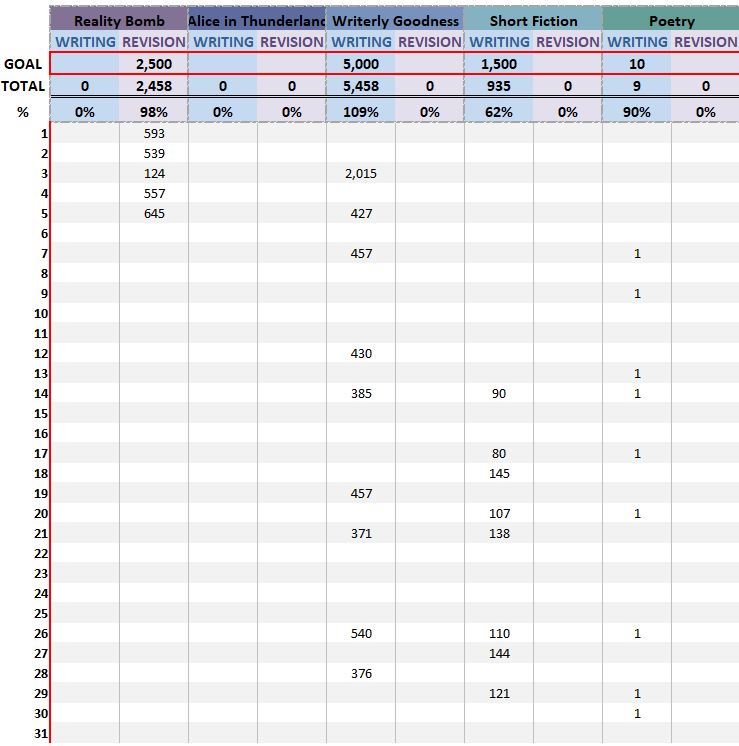
In terms of my writing and revision tracker, here’s how the month broke down:
As I mentioned, I finished this draft of RB on the 5th. That was 2,458 words and I set an arbitrary goal of 2,500 words, so that’s 98%.
I exceeded my blogging goal, writing 5,458 words of my 5,000-word goal, or 109%.
I worked casually on my short fiction. It’s a story that was inspired by an anthology call, but just for me. I wrote 935 words, set my goal for 1,500 words, and managed 62% of goal.
I hoped to write 10 poems this month, actually wrote 9, resulting in 90%.
And that’s it for the month in writing.
Filling the well
I attended Author Accelerator’s “Ready, Set Revise” webinar on the 8th. I signed up for “How to revise like an Editor,” another Jane Friedman webinar presented by Tiffany Yates Martin and watched the replay (theme developing here, but it’s where my head is at). On the 19th, I attended “The Story You Tell Yourself,” presented by Sue Campbell.
I registered for Daniel David Wallace’s “Find Your Reader Summit” over the weekend of July 22nd to 25th.
Finally, I registered for an Authors Publish webinar on revision with Jenn Givhan with the intent of watching the replay.
A couple of months ago, I added several podcasts to my listening … and fell way behind because every time you add a podcast, the app adds the last several episodes. And I can’t not listen to them (!) Darned autistic/completionist urges! Mind you, I have resisted listening to every episode, historically, so that’s a win.
I’m now almost caught up and will get to listen to my music again, which I’ve been dying to do, because Florence + The Machine’s “Dance Fever” is my new jam.
Happy to say that I don’t seem to have caught covid after last month’s exposure. No symptoms presented themselves in the five days I was required to self-isolate, anyway. I could always be asymptomatic, so I continue to mask when I go out in public.
My one physiotherapy appointment in July was my last. I’ve “graduated.” Yay me and all my ritualistic behaviours 🙂
I also saw my massage therapist again. I’m doing well and feeling healthy.
Finally, on the last day of the month, I went to my sister-in-law’s for a barbecue and family get-together. Phil’s helping her renovate her kitchen and though it’s only about half done, the results so far are stunning.
A lovely evening for a barbeque.One of the cabinets in progress.
What I’m watching and reading
In terms of viewing, Phil and I watched season four of Stranger Things (Netflix) and enjoyed it verra much. While Phil did whinge a bit that they were holding over Venca/Henry for another season, I mentioned that it was a similar situation to Babylon 5, one of his favourite series. It was always intended to be a (four- or) five-season arc. All the “big bads” of prior seasons are linked. Mind you, Phil thinks that the mind flayer is the big boss. Henry may have given it form, but it was clearly in his head from the time he was a child (like Will). I think there’s something to that theory 🙂
Then, I finished watching the first season of Star Trek: Strange New Worlds (network TV). I liked it. Maybe even more than Discovery.
When I was a kid, I was more of a Star Wars than Trek fan, though I have watched my share: TNG, DS9, Voyager (but I stopped watching after the first couple of seasons), the movies. I wasn’t turned on by Enterprise and haven’t watched a single episode of Picard, Lower Decks, or Prodigy. But I’m really enjoying Discovery now that they’ve settled in the future, and SNW was good from the start.
Anson Mount is fabulous as Pike (I didn’t recognize he was the same actor who played Black Bolt on the ill-fated Inhumans) and Ethan Peck is capturing young Spock. What I enjoy most? The theme music. It’s the same as ToS, but the composer’s done something, built the chords a bit differently, different instrumentation (def no theremin), something. There’s more tension in the theme, a yearning toward the major, and hope. It choked me up a bit when I first heard it, but music can do that to me.
Next, Phil and I watched The Boys, season 3 (Amazon). Typically bloody, squirm-worthy (for many reasons), and overall, what we’ve come to expect from the series.
Butcher’s used temp V enough that he’s permanently damaged his brain and has 18 months to live (maybe). Hughey’s managed to resist the temptation (ha!) of temp V and is reconciling with Starlight. MM has told his daughter the family history/trauma with Soldier Boy. She tells him that he’s her hero (d’aw). Frenchie’s grown a spine and ain’t takin’ any more shite from Butcher, a newly-repowered Kumiko by his side. Starlight’s gone rogue and exposed Homelander for what he is (uber douche). At the end of the season finale, she officially joins the boys. Maeve sacrificed her powers to put Soldier Boy back in cold storage, but now has a second chance for a more normal life, albeit in the run, with the woman she loves. Homelander killed Black Noir for not telling him Soldier Boy was his dad and has taken poor Ryan under his wing.
I hope they don’t make Ryan Homelander’s mini-me. It was bad enough when Ryan accidentally killed his mom, but to have a kid with powers running around murdering people … I hope the writers don’t go there. I’d rather see the small smile on Ryan’s face as a sign that he’s thought of a way to take Homelander down.
The Deep’s divorced and having sex with sea life (mostly octopi), and A-Train has a second chance to run after receiving the heart of the low-powered superhero he killed (for terrorizing A-Train’s home community and crippling his brother). Victoria Neuman (the head-popper) may be on her way to the White House.
Then, Phil and I watched Ms. Marvel (Disney+). Loved. LOVED! Some mature viewers might steer clear because, ew, teenagers, but we really enjoyed the family dynamic and Kamala’s spirit and the cultural grounding of the show. There were a couple of contrived conflicts resolved by Kamala’s “power of kindness,” but aside from those, it was a solid show. Toronto’s Iman Vellani plays the titular role with a geek’s fervour. And she really is a fan of Marvel comics. The aesthetic was chef’s kiss.* I don’t want to spoil the show. I’ll just encourage you to watch it.
Season 2 of Russian Doll (Netflix) was characteristically confusing. It picks up on the mystery of the missing krugerrands for Nadia, complicated by Ruth’s declining health, and Alan gets his own motherly mystery to solve. Motherhood seems to be the theme for the season. This time around, Nadia and Alan jump around in the past, courtesy of the New York subway, but also into their respective mothers. Nadia breaks time by taking her infant self (whom she, in the body of her mother just gave birth to) into the present. There is a satisfactory resolution to the two main plotlines that doesn’t involve the disintegration of time.
Then, Phil and I watched season 3 of The Umbrella Academy (Netflix). I liked all three seasons for different reasons. Season 3 wasn’t as wacky as the first two, and though the series’ fate hasn’t yet been decided, it felt very much like it could have been the last.
I watched Spiderman: No Way Home (Amazon). Gaaaaah! Aaaaa! More wordless wonder! I loved it so much, I can’t even.
Then, I watched Spiderhead (Netflix). I’d read the short story the movie was based on, George Saunder’s “Escape from Spiderhead,” earlier in the year and was curious to see how it was adapted for the screen.
Very differently, it turns out. The story starts the same way. The protagonist is a convicted murderer who’s volunteered for a drug trial reminiscent of Brave New World. That is, they change your mood, but not just by making you happy/euphoric/languid. The drugs are loaded into an implanted device and administered to the “volunteers” in a series of trials.
In the story, the protagonist’s crime (vehicular manslaughter) isn’t revealed until the end, and he escapes Spiderhead by killing himself, after which he, in ghostly form, visits the survivors of his victims and achieves a post-mortem catharsis.
In the movie, the protagonist’s crime is revealed in bits and pieces throughout. He’s given a love interest in the research facility, with whom he escapes in the end. The antagonist, the head researcher, is actually the inventor of the drugs and owner of the facility. He also takes the drugs himself to alleviate his personal malaise.
In the end, the protagonist conspires with the research assistant to rig the antagonist’s drug supply. He overwhelms the antagonist with conflicting emotions and makes his escape, but in the process, the antagonist’s implant is mashed, and he gets all the drugs all at once. Though he takes off in his float plane, the drugs alter his perceptions to the degree he crashes his plane into Spiderhead island.
I enjoyed the story more than the film, but it was interesting to see Chris Hemsworth play the villain.
Then, I watched Night Raiders (Crave). Sorry, had a few days off and a gap in series to watch with Phil at supper. I substituted movies.
This movie, Indigenous written, Indigenous directed and produced, and with a primarily Indigenous cast, was a refreshing pause to the doom-and-gloom of most post-apocalyptic movies. It begins with a prophecy and by the end of the movie, the prophecy is fulfilled in an unexpected way. There were a couple of uncharacteristic shifts in the protagonist, clearly done for effect, but aside from that, I enjoyed it. The movie ended on a hopeful note, and I appreciated it for that alone.
Moving on to the month’s reading …
I finished reading Station Eleven on July 2nd. While I enjoyed the book, I like the series better. What follows is my comparative review of both, as promised last month.
HERE BE SPOILERS. You have been warned.
Hate to say it, but the book suffered from the disconnection that a lot of “literary” works fall victim to. The novel, however lauded it may be, is a series of “things that happen.” It’s a survival story more than anything else as well as a deeper dive into the characters united (physically or by circumstance) at the time the Georgia Flu decimates the world.
It could be summed up thusly: Arthur Leander died the night the Georgia flu killed most of the people on the planet. Most of the people connected to him survived—except for poor Miranda, who wrote a graphic novel that shaped the world of the survivors—for 20 years. The end.
Maybe not so flip.
Arthur has a fatal heart attack while playing Lear. Jeevan is a former paparazzi (who used to wait outside Arthur’s house for pictures), now paramedic-in-training, who tries to save his life. Kirsten is a young actress who witnesses the event. In the novel, Jeevan sees Kirsten to her “minder,” and then leaves.
The novel then follows Jeevan (for a while) and Kirsten into year 20 of the pandemic while jumping around in Arthur’s past (and therefore Miranda’s) leading up to his death. The other major characters are tied to Arthur in some way. Miranda, who creates the graphic novel that gives the book its name, and Elizabeth, mother of Tyler, the boy who eventually becomes the prophet, are two of Arthur’s former wives. Clark, who creates the Museum of Modern Civilization at the Severn City Airport, is his best friend.
Arthur receives two copies of the graphic novel from Miranda, one of which he gives to Tyler, and a snow globe paperweight from Clark. On the night of his final performance, he gives the other copy of the graphic and snow globe to the minder who then gives them to Kirsten. The graphic becomes a touchstone for Tyler and Kirsten, but in very different ways. The snow globe and graphic become exhibits in the Museum of Modern Civilization.
And that’s it. These thin strands connect the lives of the characters very tentatively. Kirsten eventually kills the prophet on the way to the Museum, where the travelling symphony regroups after being separated, and they perform Shakespeare and concerts for five days before departing to investigate what seems to be a settlement with electric light. Kirsten leaves one of the copies of the graphic in the Museum before she goes as a promise to return.
Like I say, I enjoyed the novel. I don’t mean to imply that I didn’t.
But the series was much better. I appreciated most of the creative decisions they made.
After failing to save Arthur, Jeevan tries to take Kirsten home in the midst of a snowstorm and the first wave of the pandemic (much worse than covid—most people die within a day of contracting it). They end up going to Jeevan’s brother Frank’s apartment, where they stay until a home invasion results in Frank’s death.
This plot point is another difference I appreciated. In the novel, Frank is in a wheelchair and chooses to commit suicide, thus setting Jeevan free to leave. I understand the situation. Without power, utilities, food, mobility, or the proper medications, he doesn’t want to burden Jeevan with his care. It’s a realistic problem that would have to be faced. But it’s a variation on the kill your gays/the Black character dies first/fridging tropes. Disabled Frank dies to motivate/traumatize Jeevan.
To continue with the series, Jeevan and Kirsten travel together until Jeevan is attacked by a wolf and taken in by a group of pregnant women and their doctor who needs help delivering all their babies. Kirsten travels alone until she joins up with the travelling symphony.
Meanwhile, Miranda dies in Malaysia. She can’t find a way out and catches the Georgia flu. Clark, and Elizabeth with Tyler, are both on flights diverted to the Severn City Airport, and after it becomes apparent that there’s no rescue coming, they set up a community there. Tyler “fakes” his death by making his mother and Clark believe he’s in a plane full of Georgia flu victims when he sets it on fire. He runs away in the ensuing panic.
Years later, the prophet visits the symphony and Kirsten tries to kill him to prevent him from taking her young friend Alex, but she doesn’t succeed, and they meet up again as the prophet continues to harass the symphony.
This is one of the decisions made in the series that I wasn’t so fond of. In the novel Tyler/the prophet sets up a bigamist cult in which they abduct young girls for him to marry. In the series he adopts/gathers children and indoctrinates them into becoming suicide bombers for him. I don’t like either scenario, but the child bombers make it really challenging for the reconciliation between Tyler and his mother that happens in the series to feel authentic. Who would forgive a guy who does that?
So, Kirsten takes Tyler captive and brings him to the Museum of Modern Civilization where he reconciles with his mother. And the symphony entertains the community as in the novel.
But their conductor is sick, and they’ve called the local doctor—Jeevan. There’s a little bit of Jeevan and Kirsten narrowly missing each other as they move around the airport, but they finally reunite.
Tyler and Elizabeth depart with the prophet’s remaining children and Alex. Kirsten continues on with the Symphony, with the Airport now on their route, and Jeevan returns to his home, a cottage or resort somewhere in Michigan’s Upper Peninsula or cottage country in Ontario, where all the children he helped bring into the world and their mothers live. I think this is the settlement with electric light that Kirsten departs to investigate in the novel.
I haven’t spilled every last drop of tea, but that’s the gist of it. The series left me feeling more hopeful than not. The novel left me hopeful, but unsatisfied. There seemed less rhyme or reason, and I suppose that’s fair, if you’re going for a realistic post-apocalypse. Even with so few people left in the world, coincidences like those in the series wouldn’t happen.
END SPOILERS.
But there you go.
Then, I finished Down Among the Sticks and Bones, the second of the Wayward Children series by Seanan McGuire. This novel focuses on the backstories of Jack and Jill and what brought them to Eleanor West’s Home for Wayward Children. It’s lovely and heart wrenching and depressing and hopeful all at once.
Next, I read Stories of the Raksura, volume 1: The Falling World and Indigo and Cloud by Martha Wells. I haven’t read The Cloud Roads yet, though it’s in my TBR pile. Starting with these stories (there are two more shorts in the collection as well as the two novellas) was a good beginning, as most of these tales pre-date The Cloud Roads and offer context.
Then, I read Ashley Shuttleworth’s A Cruel and Fated Light. I read A Dark and Hollow Star last year and enjoyed it enough that when the next book in the series was released, I snatched it up. This is a YA urban fantasy series and Shuttleworth’s worldbuilding is quite complex. So complex that the times she has to convey essential information to the reader, whether through narrative or internal monologue, can come off as info-dumps. But the information is essential to understanding either what’s going on in the moment, or the context of what’s happened in the past (backstory). I definitely enjoyed it, though, and will probably pick up the next in series.
A little bit of whimsey—a rainbow in my palm.
And that was a very long rambling report of the month in this writer’s life.
Until next tipsday, be well and stay safe; be kind and stay strong. The world needs your stories!
First of all, yeah, I’m late. Life got the better of me. I even tried to write little bits of this post through the week. Didn’t work. As Inigo says, “Let me ‘splain. No, there is too much. Let me summarize.” I should probably take those words to heart.
Here we are, halfway through the year. And … what have I accomplished? It doesn’t feel like a lot, though this year has been … kind of awesome. I’m just in a weird place. Is it just imposter syndrome, or am I failing to take the time to recognize and celebrate my wins? I’ll dig in, in a bit.
Before we get to the month in writing, here are your monthly PSAs:
All lives cannot matter until Black, Indigenous, and people of colour lives matter.
I’m still washing my hands, maintaining physical distance, and masking in indoor public spaces, and I encourage you to do the same. Covid and its variants are still out there (that’s what endemic means). People are still being hospitalized and dying, though vaccination and the above public health measures are working to keep numbers relatively low. Protect yourself and the people you love.
I can’t believe that the war in the Ukraine has lasted more than 100 days. I deplore Russia’s continued unprovoked aggression.
And now …
The month in writing
May should have been better, productivity-wise, than April. At work, we got one major project put to bed and things haven’t been so stressful.
Having said that, I only revised 5,711 words of Reality Bomb in May. That’s 29% of my 20,000-word goal. Yes, I’ve hit another stretch where it’s more writing than revision, but damn. It’s disappointing. I’m within 30 pages of the end of the novel (and have been there for … a while), over 120,000 words on the draft, and I have no idea if I’ll meet my goal of another pass before July. It feels like it’s not going to happen, right now.
I really wanted to reduce the manuscript to 110,000 words, but that may not happen, either.
I blogged 5,514 words of my 5,000-word goal, or 110%.
I revised a short story and submitted it. Most of it was cutting, but 60 new words got on the board. I put in the “goal” of revising 100 words, but it was going to be what it was going to be, so that 60% isn’t really reflective.
And I wrote three new poems and submitted them. A fabulous poet friend suggested that I try to commit my autistic journey to poetry, but damn is that hard. I’m not really in a place where I understand it yet.
I had a trifecta of good news early in the month. On the 9th, “The Undine’s Voice,” a story that was accepted last year was published in Polar Borealis 21. On the 10th, Tyche Books began promotions for Pirating Pups, in which “Torvi, Viking Queen” will appear. Cover and TOC announcement went out that day, and pictures of pirate pups have been making the rounds on Facebook, Twitter, and Instagram.
Then, on the afternoon of the 10th, I was contacted by a small publisher who’s interested in my poetry collection (!) It was a happy-dancing couple of days 🙂
Filling the well
May 1st to the 7th marked the return of FOLD, the festival of literary diversity. I signed up for the virtual stream and watched most of it after the fact (‘cause work). If you’re interested, replays should be available to watch until June 11th. You can still register and watch if you wish. FOLD has some of the best programming.
I also attended a book club/reading with Xiran Jay Zhao on the 6th, and a reading by Sarah Polley on the 12th.
I attended a staged reading of Kim Fahner’s play, “All the Things I Draw” on Friday the 13th at the Sudbury Theatre Centre. It was great to get out and see something in person again, but it was my first such outing since the pandemic hit and I was a bit overwhelmed.
I attended the retirement party for a co-worker the next day. Shirley and I joke that we’ve been joined at the hip since we started working. We started in the same class, worked in the call centre for six and a half years, were both successful on the same process to move into adjudication, and then became BEAs at the same time. Though I had a few acting positions as a BEC and then moved to the College to become an instructional designer, until the pandemic hit, we’d always worked together and sat in the same area. It was lovely to be able to see Shirley into the next phase of her life.
On the 29th, I went to dine at an actual restaurant (!) with a friend I haven’t seen in forever. It was great catching up.
In the health/self-care arena, I started to see a physiotherapist because of pain in my shoulders. Not wanting it to develop into anything serious or long-term, I asked my doctor for a referral. After a month of weekly visits, I’ve made progress and graduated to bi-weekly appointments. Yay!
May’s therapist appointment will be my last one. For now. We both agreed that I didn’t need her support anymore, though I will continue to attend my support group meetings.
My employer has accepted the discontinuation of my duty to accommodate request, which is a big relief.
It was a good month, all around.
So … this leaves me wondering about my current low mood. I think it’s a combination of lack of progress on RB and having to be more independent again.
Last year, I reached out for help in a number of areas, and I received it. At the time, I needed the support. Now, I need to take responsibility for my wellbeing again, and it’s hard work. Honestly, though, I’ve been doing the work all along. It was just the presence of health care practitioners that made it feel like I wasn’t.
It was nice to be cared for, though. I think I just have to get used to being on my own again. It’ll take a little time. And I have to grieve the end of some productive, supportive relationships.
What I’m watching and reading
Phil and I watched three shows together. The first was Moonknight. I loved it. Phil, not so much. Oscar Isaac did a fabulous job as Mark/Steven/Jake. Tawaret! LOVE! I’m looking forward to what happens next.
Next up was Raising Dion. What a disappointment. I’d hoped that they would have learned some lessons from season one, but all the same problems popped up. Plot holes galore.
Then, we watched Love, Death and Robots, series 3. Bloody violent. It was good but unsettling. And some of it was hard to watch.
On network television, I watched Outlander. I will never not love the show or the books. So, I think expressing an opinion would be disingenuous. I watched some interviews, though, and discovered that the season was cut short due to Catriona Balfe’s pregnancy. But if you read the books and watch the show, it’s a master class in adaptation. You can see the choices made and why they make sense for the medium. I won’t go on. Suffice it to say—loved!
Then, Naomi. In a way, it’s a bit sad that it was cancelled after one season. The show had potential. A young Black female lead, a diverse cast, and an interesting story. Unfortunately, the writers had a habit of playing the same irritating misdirect in several episodes. They’d set things up to make it look like Naomi was doing something irresponsible, go to break, and return with the reveal of a secret plan.
And finally, The Rookie. It’s a consistent show if nothing else. And they do address interesting issues. But I’m still pissed off that they killed Jackson. A “kill your gays” / “the Black character dies first” double suck.
On streaming, I finished watching Arcane. The animation was gorgeous. The story could have been better. Jinx was another female character whose trauma drove her insane and made her incredibly destructive. Kind of tired of the trope.
My non-fiction (kind of) watch of the month was We’re All Gonna Die (Even Jay Baruschel). Amusing. Horrifying. Both!
And … I don’t know how I squeezed them all in, but I watched three movies, too.
The first was The Matrix: Resurrections. Awesome. Very meta.
Then, I watched Ghostbusters: Afterlife. Also awesome. I love a new story in a favourite imaginary world. And Phoebe was autistic-coded!
Finally, I saw The Kingsman. None of the problematic camp that marked the first two films. It was basically a WWI family tragedy/drama. The action scenes couldn’t save it.
I read five books in May.
The first was All Systems Red by Martha Wells. I lurved Murderbot. Who was also autistic-coded. Will read more of this series.
Then, I finished Go Tell the Bees that I am Gone by Diana Gabaldon. Yup, I read the latest book while watching the series 🙂 This is an amazing saga.
Next, I read Wolf’s Bane by Kelley Armstrong. This is the first of her Logan and Kate (the children of her Otherworld werewolves) books. Fun. Ended on a huge cliff hanger. I think the whole story was arbitrarily broken up. Will read more, though.
My non-fiction read was Burnout by Emily and Amelia Nagoski. Even though it wasn’t specifically about autistic burnout, this book is a-MA-zing. It’s written for women and woman-presenting people who suffer from “human giver syndrome.” It’s hilarious and affecting. Highly recommend.
Finally, I read Stormsong by C.L. Polk. Fabulous. I love how this woman’s mind works and it’s no wonder the Kingston Cycle is up for best series at the Hugos.
And that, my friends, was the month in this writer’s life.
Until next time, be well and stay safe; be kind and stay strong. The world needs your stories!
Blink and the month disappears. Boggle. I think 2022 is off to a reasonable start, though. More on that in a bit.
First, here are your monthly PSAs:
All lives cannot matter until BIPOC lives matter.
As restriction are once again lifted, it’s even more important that ever to stick with basic preventative measures. Wash your hands, maintain physical distance, wear a mask when you can’t, get double vaccinated if you haven’t, and get your booster. Make sure your children are vaccinated and boosted as soon as they become eligible.
And to the “freedom convoys”—just fuck right the hell off.
The month in writing
Revisions to Reality Bomb continue. Slowly. January was still a bit of a struggle, mostly because of work (more on that in filling the well).
Originally, I thought I might be able to get as much as 10,000 words revised on RB (though I suspected that it was a bit optimistic). Part-way through the month, I adjusted that down to 5,000 words. I still fell a bit short of that, revising 4,945 words, or 99% or my adjusted goal.
I wrote 5,390 words of my 5,000-word blogging goal, or 108%.
I revised and submitted another short story. I had thought that there would be more rework involved, but it turns out I only added about 70 words. The rest was all cutting. It’s an experimental piece for me. I tried out 2nd person POV and included footnotes. We’ll see what the editors think. I’ll let you know in a future update.
So, 70 words revised of a 250-word goal, or 28%.
In other writerly news, another of my short stories was accepted to an anthology that should be published later this year. I’ll share more as announcements are made.
And, a year to the day after I submitted a small sample of my poetry to a small press, I received a request for the full manuscript. I spent a few hours sprucing it up and adding one of my new poems published last year … and sent it.
Again, I’ll have to let you know if anything comes of it in a future update.
I’ve been slowly updating my blog and social media to include what I’ve come to think of as my new branding. Writerly Goodness has become Always Looking Up. This comes, in part, from my sky photos, but I’ve come to understand that everything I write has an undertone of hope. I’m also including the #actuallyautistic hashtag to my site and social media. I have to take some updated pictures, include the covers of my more recent publications in my header image, and other stuff like that, but I’m not stressing it. It’ll happen when it happens.
The other big thing I did in January was submit an application to Your Personal Odyssey, Odyssey’s new one-on-one program. The deadline isn’t until April 1st, but I wanted to get my application in sooner than later. I’ll find out if I’m accepted after that date. Crossing fingers.
Filling the well
In terms of writing events, I attended “The Anxiety Talk” from Jane Friedman, “Hosting Accessible Events” with Amanda Leduc of the FOLD, and “How Self-Editing—and Editors—Help You Perfect your Stories” by Dani Alcorn.
I also signed up for “Introduction to Illustration” with Millie Nice through The Guardian Masterclasses. It was something I wanted to do for myself. I used to draw and sketch a lot but haven’t been able to get back to it despite wanting to. Millie’s class was a lovely kickstart. I haven’t had the time to sketch since, but I anticipate that I’ll take some time to do it in the future.
I had another appointment with my therapist, another support group meeting, and an online writers’ meet up, which was nice.
I was boosted on the 11th! Side effects the same as the prior two vaccinations despite receiving Moderna this time. So, I’m a Pfi-Pfi-Mo.
My accommodation request has progressed. I now have Wednesdays off pending the official agreement. I have an appointment with my doctor to get the accommodation form filled out and then it’s back to my employer for next steps.
Again, this seems to be moving a lot faster than I thought it might and my manager has been supportive.
Feeling gratitude.
Rosy dawn and a wee pillar.
What I’m watching and reading
In January, Phil and I watched a couple of series.
First, we finished watching the last season of The Expanse. The feels! It was a great send off for all of the characters.
Then we watched the most recent season of Titans. All I have to say about it is … come on. It was not good.
We also watched The Eternals. I enjoyed it. It’s not your typical Marvel movie, but I appreciated what Zhao tried to do with it. It was more about the relationships between the eternals than big fight scenes.
I watched a couple of movies on my own.
The first was Free Guy. So. Much. Fun!
And then, I watch Encanto. Lovely, low-key family story. Loved.
In the reading department, I finished ReDawn, the second Skyward Flight novella by Brandon Sanderson and Janci Patterson. ReDawn picks up where Sunreach left off with the gang on Detritus. [SPOILERS] Minister Kuna has been rescued, but now, the governing council of Detritus is considering an overture from the Superiority.
Alanik, the POV of this novella, returns to her home only to discover that her people are facing the same problem.
In Evershore, the third Skyward Flight novella, the POV character switches to Jorgen. Though he and the rest of Skyward Flight have helped to save Alanik’s people, Detritus has suffered a devastating blow, losing their governing council, including Jorgen’s parents.
As Jorgen works through his grief and tries to secure Detritus against the Superiority, he also has to solve a cytonic mystery. Spensa’s grandmother and their admiral have gone missing. Alanik was able to confirm that they were not killed with the rest of the council, but she can’t find them.
Then, she picks up a Kitsun transmission that they have some of Spensa’s people to return.
Jorgen’s growing cytonic abilities, affected by his grief, prove problematic as he leads Skyward Flight on a rescue mission in the hope of forging another alliance.
I took a break from Skyward Flight, reading Sarah Penner’s The Lost Apothecary. It’s a lovely piece of women’s fiction with a dual timeline. In the present day, Caroline deals with the disintegration of her marriage and the dreams she abandoned for it. Triggered by the discovery of an old vial, she delves into the never-solved apothecary murders.
In the past, Nella, the apothecary who dispenses poisons to help women escape abusive relationships waits to see her next customer.
Then, I read Bad Witch Burning by Jessica Lewis. Katrell can talk to the dead and makes a little money on the side by writing letters that invite ghosts to talk to their living loved ones. She receives a warning that she chooses not to listen to, because she’s in desperate need of money to support her mother and a string of abusive, deadbeat boyfriends. When the current boyfriend kills her dog, Katrell tries to write a letter to him, only to bring him back from the grave.
And that was the month in this writer’s life.
Until next tipsday, be well and stay safe; be kind and stay strong. The world needs your stories!
And, just like that (and, no; never watched SatC; won’t watch AJLT), the second year of the pandemic ends.
2021 was an … interesting year. I’ll get to that in a bit.
Before we get to my December update, my monthly PSAs:
All lives cannot matter until BIPOC lives matter. We need to keep striving to be good allies and keep the critical issues front and centre.
Wash your hands, maintain physical distance, mask in public, get vaccinated (if you haven’t), and get your booster. Delta and omicron won’t be the only variants to emerge. And let’s be clear. The variants are there. They always have been. It’s just that, as we get better at suppressing the ones we know about, the ones we don’t have a chance to surge. Some may be less virulent, or not virulent at all. Some may be less transmissible or not transmissible at all. Some may not even infect humans. But it’s the ones that are more virulent, more transmissible, and infect humans that we have to watch for. This ain’t over yet.
The month in writing
Following the marathon that is NaNoWriMo, I wanted to take a break from revision. I only intended to rest until December 5th, but work got hectic again, and I ended up revising as I could, which meant not much at all.
Originally, I thought I could, based on my performance in November, revise about 20,000 words of Reality Bomb. Unfortunately, I had to amend that goal mid-month and reduced it first to 10,000 words, then 5,000 words, and ultimately 1,000 words. Of that 1,000-word goal, I revised 853 words, or 85%.
Admittedly, I decided to read through the draft to the point where I left off in NaNo, which was about the midpoint of the novel. So that 853 words represents a bunch of cutting and adding that I chose not to get too granular on.
My only writing goal for the month was the blog and of my 3,500-word goal, I wrote 5,422 words, or 155%.
The writing year in review
I started out 2021 by trying something different. I’d finished the last rewrite of RB by the close of 2020 and decided to focus on short fiction and poetry for the first three months of the year.
This worked out well for me. I wrote, revised, and submitted several short stories and poems, earned several rejections, and then had three poems and a short story accepted for future publication in February.
In March, I entered the SciArt Poetry competition and won the community category. I read my poem on Science North’s YouTube channel at the end of March, and the poem would be published later in the year in Sulphur X, Laurentian University’s literary journal.
I also started to revise RB in March based on my returned critiques.
In April, I had another story accepted for future publication, and the last of my poems accepted in 2020 was published.
Revision was not going well, though.
I was somewhat stymied by the critiques I received back in January and February. I couldn’t figure out how to use the feedback to revise my novel. I had thought a couple of months would be long enough for me to figure out a game plan, but, because I had already started on my journey to autism diagnosis, I was thinking about other things.
I had intended to rewrite/revise between 500 and 1,000 words a day on weekdays and a chapter each day on weekends, and thus be finished my next draft sometime in the summer. At that point, I had hoped to move onto Marushka and prepare that draft, on which I’d also received feedback, for next round revisions in November.
I wrote a new opening chapter and revised from there, dividing chapters into smaller chunks. I was still writing in close third (or trying for it). I revised 28,202 words up to about the middle of July, when I hit the point where my protagonist enters another of the many worlds and is trapped inside her other self.
The challenges of having two people in the same physical body and trying to make then both distinct and identifiable in terms of formatting (italics for one, ? for the other?) made it clear that I had to rewrite the draft in first person. Past or present, though? I opted for present despite my failure to nail the POV on an earlier draft. There would still be some difficulties making the story dynamic enough for first person present (my protagonist is disembodied for three quarters of the novel and thus, largely “in her head”), but I decided that it would be the best fit and returned to the beginning.
From the middle of July through to the end of November, I revised 62,996 words, but some of that was reworking my novel map (chapter and scene breakdown), which I counted only in November. I got to the midpoint … and then decided, as I mentioned above, to take a break.
Since, I’ve been rereading the revised draft to date, making a few more additions and deletions, and thinking of a better way to weave in some of the minor characters throughout the novel so they don’t feel like wasted opportunities.
I’ve even been using tarot to help free my intuitive writer. It’s working out surprisingly well.
About the same time I made my fateful POV decision in July, I realized that if I wanted to work on any other big project this year, it would not be Marushka. But, as it turned out, I haven’t had the spoons to finish my work on RB, let alone start on a new novel …
In November, I made the decision to leave DIY MFA as a regular columnist. I’m trying to conserve my energy for what matters most.
I’m going to have to review my other commitments as well.
I haven’t been active in my critique group since summer. I need to reconnect, but I’m struggling.
Onto the statistics!
In terms of word count, I wrote:
10 poems,
4,146 words of short fiction,
58,061 words on Writerly Goodness,
5,623 words on my Speculations column, and
360 words on a side project.
That’s 68,190 words and 10 poems.
I revised:
92,048 words on RB (some several times), and
12,023 words of short fiction.
That’s 104,071 words revised.
Some of these goals I didn’t assign numbers to at the beginning of the year. I didn’t know how much I would write or revise on some projects and so just left them blank in terms of goals. The poetry and short fiction (writing and revision) were in this category and so any work done on those projects was bonus.
If you want to zoom in on the relative percentages of the writing and revision goals I did set out for myself, you’re welcome to do so 🙂
There was also the work on my Ascension series masterdoc (like that term so much better than bible) that I didn’t track in terms of word count. Throughout the year, I wrote out and revised the worldbuiding for my world (cosmology, history, peoples, languages, etc.) and character sketches, and I restructured the first book of the series in outline. I’ve had to work out the calendar of events for the last bit of book one. I had a lot of questions marks on my timeline. I’m working it out.
Eventually, I’ll expand the outlines/maps for each book in the series with scenes and sequels as I rewrite.
Looking forward
I’m going to try to finish my rewrite of RB this year. I’m not setting any hard and fast goals, but I’m hoping to do that by the end of June.
I might decide to work with a book coach or editor at that time. So, I’ll probably spend some time in the spring making initial enquiries.
Then, I’ll probably do with the summer what I did with January to March of last year and focus on short fiction and poetry as a break from novelling. I’ll also use that time to revisit my next novel project (partly written as a very long short story) and prepare to begin drafting in the fall.
I have most of my drafted novels included in my 2022 writing and revision tracker, but I’m not committing to them in any way. They’re just there to remind me that I have a lot of things I can work on, if I so choose.
Filling the well
In December, I didn’t attend any literary events live online. I did sign up for a Tiffany Yates-Martin webinar through Jane Friedman, but I watched the replay, ‘cause work.
My small family (me and Phil, his sister and spouse, our moms) got together to celebrate my mom-in-law’s 80th birthday and then again on Boxing Day for Christmas (it was supposed to be Christmas Day, but freezing rain changed our plans).
And aside from therapy, a support group meeting, massage, and a couple of days of leave, that was it for filling the well in December.
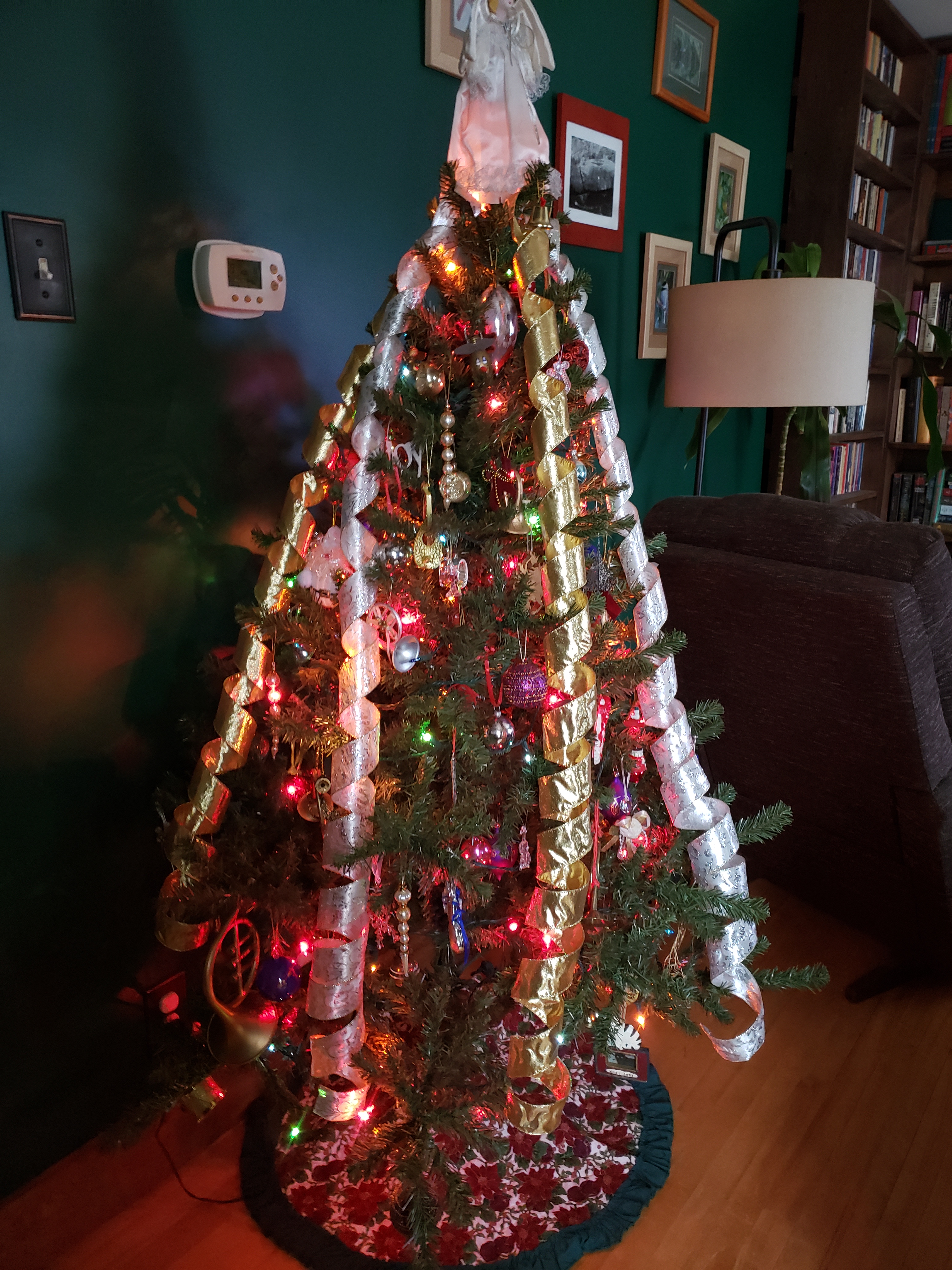
For the first year in … forever, I put up the Christmas tree.
The personal year in review
I started 2021 at a low point, feeling like an imposter at both work and creative pursuits. I was also feeling stuck physically, having slowly yo-yo’ed between 170 and 200 pounds since my early 20s.
It being a pandemic and all, I decided that, instead of going it alone, as was my habit, I’d ask for help.
For mental health support, I reached out to my employer’s EAP. For physical health support, I turned to Noom. By May 10th, I’d been diagnosed as autistic, a timeline that I’ve since come to understand is amazingly quick. By the end of July, I cancelled my Noom account, having surpassed my goal of 170 pounds and achieved 150. I continued to lose weight through August, finally settling at 140 pounds, which I’ve since maintained (even during the holidays!).
It’s the lightest I’ve been in my adult life and I’m feeling physically healthy.
In November, I finally connected with a therapist through the Redpath Centre, which specializes in support for autistics. When I met with her for the first time, my therapist referred me to a support group.
I’m currently working toward getting a workplace accommodation, having experienced autistic burnout as the result of a very stressful acting position and project. I struggled again in December because of a similar situation and I’m trying to find a way to manage my stress levels on an ongoing basis, so I don’t need to take additional time off to recover my head.
It’s been a transformative year with regard to my physical and mental health, and I’m ready to shift my focus back to creative pursuits.
What I’m watching and reading
In December, I watched three movies and finished watching three series. That seems nice and symmetrical, to me 😉
First, I watched Shang Chi and the Legend of the Ten Rings. I loved it. Yes, it wasn’t really Shang Chi’s story, and there were a few things that stretched credibility, but I really appreciated the homage to Jackie Chan’s movies (many of which I’ve watched over the years) and fighting style. They even had choreographers from Jackie Chan’s team working on the movie. Wong and Morris rock.
Then, I caught John Wick 3: Parabellum. It filled in the series for me. What can I say? Over the top violence is something I enjoy? In the right circumstances, I guess. Didn’t appreciate the uncharacteristic twist that was JW’s dark moment, but the movie made up for it in the end.
Phil and I watched The Suicide Squad on New Years Eve. So much better than the first movie. Harley Quinn is the best character in the DCEU.
I finished watching the final season of Dear White People. Not sure if I liked the framing device (telling the season from the perspective of the characters in the future) or the whole season being focused on the musical review in their last year as Winchester. It was okay. They tied up all the critical stories in the end.
Watched the latest Dr. Who series, said to be Jodie Whittaker’s last. It was a bit confusing at first, but after a couple of episodes, everything came together. I also was the New Year’s special, thinking that it might offer up a clue to the next regeneration. It didn’t. I can’t not love Jodie Who. I’ll be sad to see her leave.
Finally, Phil and I watched the first season of The Wheel of Time. Neither of us have read the books. I really liked it. More than Phil did, I think. He was put off by all the comparisons to Game of Thrones. WoT is its own thing. I appreciated it as such.
Reading-wise, I only finished reading three books in December.
I read Julia Quinn’s The Duke and I (yes, the book that was the basis for the first season of the Bridgerton series). I’ve read romance in the past, but my preference runs to Kathleen E. Woodiwiss, whose books would probably be classified as “bodice rippers.” The book does treat Daphne’s technical rape of Simon more tactfully, but the story itself was less compelling.
Brandon Sanderson and Janci Patterson have written several novellas in the Skyward Flight series to bridge the gap between books two and three of the series. I read the first of those, Sunreach, which focuses on the secondary character of FM, the rescue of Minister Kuna, and how the rest of the flight back at Detritus deals with the discovery that Spensa’s pet Doomslug, a Taynix, is a cytonic creature capable of powering a hyperdrive. I really liked it and am now on the second novella, Redawn.
I finished off the year with Sarah Hollowell’s A Dark and Starless Forest. It’s a dark book, and thus was a little challenging to get through. It focuses on a remote house in which abandoned child “alchemists” live under the dubious protection of Frank. It’s clear the young alchemists, including Derry, the protagonist, live in fear of Frank, and it soon becomes clear why. But as Derry’s sisters disappear, one by one, she has to find a way to solve the mystery without arousing Frank’s wrath. Despite its darkness, I really liked the book.
Because of general busy-ness and distraction, I only read 55 books of my 65-book goal in 2021.
I’ve reduced this year’s goal to 60 and hope to attain it, but that will depend, in part, on work.
And that was the month (and year!) in this writer’s life.
Until tipsday, be well and stay safe; be kind and stay strong. The world needs your stories!
This will be the last tipsday until December 7th! Yup, it’s NaNo again. So, stock up for the month and feel free to peruse past weeks’ posts as well. I don’t know if it’s a coincidence, but this tipsday is jam packed full of writerly goodness. Enjoy!





 Always Looking Up