Breccia: An interview with Ignatius Fay and Irene Golas

Irene Golas discovered the world of haiku when she purchased a slender volume of Japanese nature poetry in a gift shop in Elmvale, Ontario. She was immediately drawn to the brevity and concision of the haiku form. Her first haiku were published in 2005, followed by her first tanka in 2006.

Ignatius Fay is a retired invertebrate paleontologist who began writing haiku and related forms of poetry primarily for his own pleasure and as a means of personal expression. His first published poem appeared in 2008, the same year he published a small book of haiku/senryu, Haiga Moments: pens and lens, with photographs by Ray Belcourt, of Leduc, Alberta. In 2011, he published Points In Between, an anecdotal history of his early years.

Irene and Ignatius have been published in many print and online journals, including Acorn, Eucalypt, Frogpond, and The Heron’s Nest. Irene’s poems have also been chosen for a number of anthologies. Both authors reside in Sudbury, Ontario.

___________________________________________________________________________

WG: How long have the two of you been working together?

Irene: I’d known about Ignatius since 2008, but it took me a while to find any contact information. I emailed him in the summer of 2010, asking if he’d be interested in corresponding about the art and craft of haiku. There aren’t many haiku poets in town! At first we talked in general terms about books, haiku and other poetry. Soon we were exchanging haiku books and journals and some of our unpublished work. By the fall of 2011, we had developed a mutual trust and a respect for the other’s judgment. This is when the idea of a collaborative publication first came up.

Ignatius: Irene and I are alike in that we are straightforward when asked an opinion. Our intent is always positive, to help each other become better poets. I don’t think a collaboration would have worked had we not first gone through this process.

WG: Whose idea was Breccia? When did you actually begin work on it?

Ignatius: I suggested we consider doing something jointly. After toying with the idea for a time, we got down to it in January 2012.

Irene: We were ready to prepare the manuscript for publication by the end of July. Since then we’ve spent good chunks of time writing promotional material and otherwise spreading the word about Breccia.

WG: By the way, who came up with the name, Breccia? What is its significance?

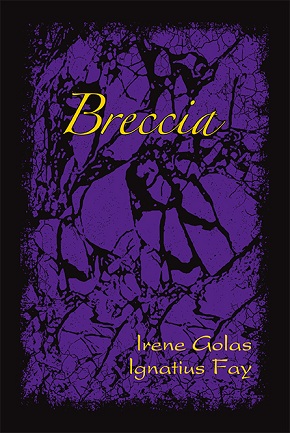
Ignatius: Irene suggested the title. She was unfamiliar with the term when she read it in one of my poems. I was referring to the Sudbury Breccia, a rock formation that is part of the Sudbury Basin. Both the basin and the breccia were formed by an asteroid impact about 1.85 billion years ago. The nickel-iron-copper ore bodies of the Sudbury area are all associated with this rock.

A breccia is made up of fragments of preexisting rock that have been re-cemented. By analogy, our collection may be considered a haiku ‘breccia,’ poems from two sources cemented together to form a unique whole.

Irene: When Ignatius sent me his manuscript, there were a few poems about his childhood in Levack. They shone a light on a way of life that was unique. It occurred to me that the Sudbury area should have a larger presence in our book. Sudbury is our home, after all, and has shaped our lives in so many ways. I encouraged Ignatius to write more. He did, expanding his focus to include details of miners’ lives and the changing face of Sudbury. I added several of my own and soon we had a ‘Sudbury Breccia’ section.

WG: This type of collection is rather rare in that it is a collaboration and in the way your poems are intermingled. What made you decide on this format?

Ignatius: Our original intention was to put together a small collection of selected and new haiku and senryu. A poem had to satisfy us both to make the cut. A fair number of poems were edited or rewritten.  We ended up with more good poems than expected. Then we complicated matters by deciding to include tanka and haibun.

Irene: At the same time, we began to discuss layout. We wanted Breccia to be a true collaboration rather than a joint publication with two sections, one for his poems, one for mine. We also wanted something different from the traditional grouping by season, something with a more organic feel. Eventually we decided to integrate our poems, creating several extended sequences in which each poem suggests some relationship to the immediately preceding poem.

WG: Breccia is 208 pages long. That’s a lot of poetry. Did you find the sequencing difficult? How long did it take?

Irene: Sequencing turned out to be the longest part of the process. And the most satisfying. We spent hours trying to get short bits of sequence to feel right, then emailed it to the other. Often the response brought suggested changes. Occasionally, emails passed each other in cyberspace and we found we had very different ideas for the next part of the sequence. This process alone took more than two months.

WG: How did you like the experience of collaboration?

Ignatius: Delightful. We’re a good match. Sure, there was lots of hard work, but we work well together. We share an interest in the English language and a commitment to our art.

Irene is an extremely efficient editor…far better than I. She has such patience and attention to detail. Many of my poems have benefited from her insights. She is straightforward in her criticism, encouraging growth. And she doesn’t hesitate to praise something I’ve written that she likes.

Irene: We both look for honest assessment of our work. We strive for improvement, which includes acknowledging a weakness in our poetry when it is pointed out and being open to editorial suggestions.

WG: Why did you choose to self-publish Breccia?

Irene: We both got the same story when we looked into traditional publishing. Finding a publisher for your first book can be a long, drawn-out process. Then it may take a couple of years for the book to appear. Our biggest concern was getting our work out there. And Ignatius had some experience with the process, which is becoming increasingly popular.

Ignatius: Another problem with using a traditional publisher is the need to travel and do personal appearances to promote the book. My inability to do that lowers our prospects significantly.

WG: This was a strictly do-it-yourself project. Did the two of you also design the cover and do the layout?

Irene: Yes, we did everything. From the beginning, we agreed we wanted this to be 100% our project. But I have to give credit to Ignatius for carrying the weight when it came to the actual layout and other aspects of desktop publishing. He’s been in graphic layout and design for 22 years.

WG: What was the most difficult part of publishing Breccia?

Irene:  Definitely the promotional writing. First we had to distill the essence of what Breccia is about – a slow process. Then we had to present that essence – sell it, really – in a catchy way, often in a hundred words or less. Too often we found ourselves reverting to a dense academic style of writing, or reaching for clichés.

Another challenge was reworking this material into different packages – a flyer, a press release, and at least half a dozen blurbs. To avoid sending out carbon copies, we had to rephrase, augment, emphasize or completely delete things from one piece to the next. A case of “how many ways can you serve hamburger?”

Ignatius: For me, the most difficult part was not being able to work regularly with Irene in person. Face-to-face, so much more can be accomplished in a short time. But my health and Irene’s other obligations were limiting factors.

Thank goodness for email! Much of the work was done through the back and forth of emails. It could be frustrating, waiting for a response or trying to iron out a miscommunication, but it allowed us to proceed. We may never have completed the project without it.

_______________________________________________________________________

You can purchase Breccia on Lulu.

Related articles:

My Journey to the Misty Lands – Guest blog post by John Rice

John William Rice (1942-) was born in Iroquois Falls Ontario to parents of Scots/Irish/Welsh ancestry, spent his public school years in Charlton Ontario, and quit school after completing grade eight. In the spring of 1968, he returned to school under a government upgrading program, completed high school and studied electronics at Northern College of applied arts and technology where he earned the nick name, “The Whisky Poet.”

After graduating in 1971, he began a 34-year career as an instrument technician at International Nickel Company. Along the way, he married and fathered two sons. His wife Patty died from cancer in 2003. John retired in 2005 and after completing a book of verse, From the Heights to the Enchanted Places, he plunged head first into his fantasy novel, Keeper of the Sword.

John lives and writes in Sudbury, Ontario and can be reached on twitter, @keeperofthsword, on Facebook, and on his blog.

My Journey to the Misty Lands

I lie on my bed, let Return of the King, the last volume of Lord of the Rings drop from my hands, and close my eyes. My mind drifts far away from my small room in the Piccadilly Hotel, far away from Vancouver, and far away from my job as a sheet metal helper at Humble Manufacturing, to Middle earth, where I march with Frodo and Sam toward Mount Doom.

The sounds of feet shuffling outside my door bring me back to harsh reality. I prop myself up on the pillow, rummage around in the rickety dresser drawer for a pen and scribbler, and write, “Keeper of the Sword” across the top of the page. Images of a completed epic poem dance through my mind and I bend all my thoughts to the first word, the first line, but nothing comes. I struggle for a while, still nothing comes, and it seems my muse, such as it is, eludes me once more. “Someday,” I whisper, “Someday I’ll write it.”

I put my writing utensils away, snuggle under thin blankets and let my mind drift over towering mountains, across the endless prairie, through the rugged Cambrian Shield, to the village of Charlton Ontario, to the house where my sister, mom, and dad live. For a moment, I wish I was there, instead of in this city by the sea, thousands of miles away.

I kick the homesickness out of my mind, and go back, back into my past, back to my first attempts at writing verse. I remember finding a love poem my brother wrote for some high school girl, remember thinking if he can write poems than I can write a song.

I remember the name of the piece, “There once was a horse named General Jim,” but little else of my first plunge into writing, and most of all I remember sending it away to an address I found in Popular Mechanics, to a person that promised to turn it into a hit record.

Days, each one seeming like a year, passed while I waited for my first of many checks, and at last one day after school, my mom handed me an envelope. I took a deep breath, and taking care not to damage the contents tore it open. A piece of folded paper fluttered to the floor. I bent over, scooped it up, and unfolded it. “We don’t think this subject matter is suitable to become a commercial song,” burned into my eyes.

“What’s wrong,” mom asked.

I turned away, hiding my tears, hiding my disappointment.

For years I never wrote another thing, but at last my bitter disappointment slipped deep into my mind. One day a cousin of mine wanted to know if I had any songs he could sing to the girl he was courting, and over a couple of hours I managed to write a piece he liked. This adventure sparked a creative flurry and dozens of lyrics tumbled out of my mind onto paper.

My alarm clock’s strident ring drags me out of my dream of home and to the reality of a new workday.

Forty-six years have come and gone since I first read Lord of the Rings in that small dingy room, since I first came up with the title, “Keeper of the Sword.” Over those years, I’ve completed high school, completed two years of electronics at Northern College of Applied arts and Technology, worked thirty-four years as an Instrument Technician, fathered two amazing sons, and lost my wife to cancer.

During that span I had periodic spurts of writing verse, most notably while attending college, where I earned the name, “The Whiskey Poet.” Of course I didn’t deserve the title because at that time of my life I could only afford to drink beer.

While at northern college I believe I let an opportunity slip away, an opportunity that might have changed my life in a dramatic way.

I always sat with my peers from my Man Power retraining days, where I completed high school, for lunch, and often wrote poetry during the hour-and-a-half. One day our English teacher joined us and asked if he could see the poem I was working on. I finished the last line, and handed it to him with a degree of trepidation.

He took several minutes to read the short poem, nodding several times. He handed the poem back and said, “Not bad, as a matter of fact it’s quite good. I know someone in Toronto that might be able to help you, but before I put you in contact with him, I want you to learn ten new words every day for two weeks. You not only have to be able to spell them, but you need to be able to use them correctly in a sentence.”

I folded up my poem, “Waiting,” and placed it in the binder.

As the years have speed by on the one way train of time I’ve often wondered what my life would have been like if I’d taken his advice, but I preferred to spend time in the bar with friends instead of taking the time to improve my vocabulary.

The dream of becoming a writer and completing at least one novel has always lingered in the deep recesses of my mind, and in the winter of 2007, I decided it was time to make my dream come true. I started off by attempting to write a play. About half way through, “Music Box Dancers,” the concept for another play, “I taught a Mocking Bird to Sing,” came to me.

After completing two plays, and feeling confident, I wrote several short stories, a book of poems, and remembering that title from long ago, I plunged into Keeper of the Sword.

I still live and write in Sudbury.

_____________________________________________________________

And here is a free excerpt from John’s novel:

In the beginning


Morgan Connelly, stunned, unable to move for the moment, feeling a warm wetness dripping down her skin, fluttered violet eyes open and stared at the growing red stains on her blouse, the amber feathers attached to a long slender egg yolk colored piece of wood jutting out from under her collarbone, and whimpered, “Josh. Josh. Josh. Help meeee.”


Something crashed to her right, and screams sounding like a cat in pain filled the air around her.

_____________________________________________________________

To read more of Keeper of the Sword visit John’s blog, tweet him @keeperofthsword, or friend him on Facebook.  His novel is available on Smashwords, on Kobo, or on Amazon.

100 thousand poets for change in North Bay, September 29, 2012

Please note: this post originally appeared as a guest post on John Rice’s Keeper of the Sword blog on October 3, 2012.

It was a grey autumn day when I set off for North Bay.  Then I picked up Kim Fahner, and the journey became a poetic road trip of epic proportions 🙂  Talked craft, poetry, fiction, blogging, social media, and Doctor Who!

Kim brought me back a gift from her recent trip to Ireland: Leanne O’Sullivan’s Cailleach: The Hag of Beara.  Lovely book.  Saving it for the weekend 🙂

The drive was blessedly uneventful and we arrived early enough to have lunch before the event started.

On the way back to the park for the reading, we were greeted by Father Forrest.  The White Water Gallery’s Youth Arts Initiative created puppets this summer.

Father Forrest was one of them and he stopped by the reading later on in the afternoon.

We walked on to the park where the poets and audience were already gathered.

Though the organizers, Kevin smith and Natalie Wilson had brought a PA system there wasn’t an outlet to power it.

Still, Kevin introduced the event and got underway promptly, explaining a little of the background of 100 Thousand Poets for Change.

100 Thousand Poets for Change was initially conceived by Michael Rothenberg and Terri Carrion in March, 2011, as a worldwide set of events to take place simultaneously on September 24, 2011. Literary event organizers volunteered to host associated events in their own cities or schools. ~Wikipedia

The first reader of the North Bay event was Laurie Kruk, professor at Nipissing University and author of Theories of the World, Loving the Alien, and the soon to be released, My Mother Never Told Stories.

She read several selections from her new book of poetry.

I was the next poet to read and only chose a couple of poems: “Manitou Sky” and Relatively Speaking.”

I started my set with a post on Jezebel regarding a Sikh woman and her response to what seemed a malicious picture posted as a critique on her appearance.  It was my way of commenting on how social media can be an avenue for positive change.

I finished my reading by offering some advice from Kristen Lamb in this season of political frenzy on how writers really change the world.

Following my set was Tim Robertson, poet and aphorist, that is, writer of aphorisms.

He started the session with a series of witticisms and then read a couple of his longer poems.

After Tim’s reading was a brief intermission where poets mingled and chatted.  I took a few moments to reacquaint myself with Natalie, with whom I’d contributed to NEOVerse, and Laurie, with whom I’d read on several occasions during my more active poet years.

The second half of the afternoon session began with Christine Charette, artist and poet.  Father Forrest visited at this point and remained around for her set.

Christine’s poetry has as its heart the issues of womanhood and motherhood and it did speak to the theme of change.

Denis Stokes read next.  He’s taught English in high school and at Nipissing University, and published poetry in print and online.  Denis’s poetry was definitely the poetry of Northern Ontario, evocative of its sights and sounds in the context of family and change.

Then Doyali Farah Islam took the stage, er, cobblestones 🙂  She published her first book of poetry, Yusuf and the Lotus Flower, in October of 2011.

Doyali is definitely influenced by Rumi, and her poetry brought a bit of the sacred to the assembly.

The last poet of the afternoon session was my friend, Kim Fahner, English teacher, and author of You must imagine the cold here and Braille on water.  Her new book of poetry, The Narcoleptic Madonna is due out this fall.

Kim is a great reader who interacts with her audience with humour and self-conscious grace.  Kim read from her new work.

Afterward, the poets mingled again.  Business cards and books were exchanged.  Though there was an evening session where Ken Stange, Kevin, and Natalie would be reading, Kim and I had to toddle off.  Nonetheless, I understand the evening reading at the Cornerstone Cafe was a great one, and the North Bay edition of the 100 thousand poets for change event a success.

And then, after a fortifying pumpkin spice chai latte at Twiggs, we were on the road again, chatting more about the day, poetry, creativity, and again, the fabulous Dr. who 🙂  David Tennant is one of Kim’s secret husbands, don’t you know.

The day ended with a lovely supper at Verdiccio’s where I had the chance to use the coupon I’d won on Facebook this summer.

All was ‘write’ with the world 🙂

For more information, please see the 100 Thousand Poets for Change North Bay Facebook page, or the Web page, graciously hosted by Ken Stange.

Building your writing resume: three points to consider

This topic has come up in a peripheral way on Wordsmith Studio: As an unpublished, or even as a not-recently-published author, what can you do to bolster your writing resume?  I say peripheral, because the actual question asked was whether it was worthwhile to enter contests because many of the entry fees are expensive/potentially prohibitive.  I believe the question was posed in the context of accruing publishing credits, however, and that’s when I started to think about this topic in earnest.

So for better or worse, here are my thoughts on the subject in the context of my personal experience.

1. Contests

Contests can be fun.  They can inspire you, particularly if they have a theme you can latch onto, and the deadline always helps to motivate.  The issue for me is that many contests in literary magazines, whether for poetry or prose, carry with them entry fees, and some of these can be as much as $40 (!) for a single entry.  If that entry is a single poem (not epic, they usually have line limits), or a 2000 word or fewer short story, you really have to weigh the benefits of paying someone to consider your work, which already carries with it a labour cost in author-hours spent writing/revising.

Food for thought: Value your work.  How much do you think it cost to write?  Even at minimum wage per hour (and I’d advise a higher value than that) it’s probably more than the entry fee.  How much are you willing to pay to have your work published?  In the beginning, we may all have to pay for this consideration, but it’s important to remember that unless you have a really good day-job, you’re going to reach the point of diminishing returns sooner than later.

Yes, you can write off the entry fees on your taxes if you claim your writing as self-employment, and yes, you often get a year’s subscription to the magazine or journal, which you can declare as income on your taxes as well, but you have to consider the relative cost for benefit.

For example: If you’re paying a $25 entry fee to receive and annual subscription worth $15 or $20, this may not be in your best interest.  Sure, you may stand to win $500 if you place first in the contest, but if the magazine or journal holding the contest is well-known, you’re going to be up against some stiff competition.  Take the possible purse out of the equation and work through your numbers again.  If you don’t win, or even place, will this still be a good investment for you?

Contests are sometimes a way for a magazine or journal to generate some fresh material, gain new subscribers, or refill the enterprise’s dwindling coffers.  If you like the journal and want to support them, consider a paid subscription and simply submit to them according to their submission specifications (see below) to see if you can get published by other means.

Further, most magazines and journals that hold contests receive so many entries that their judges cannot possibly comment, even in general terms, on the quality/suitability of your work.  Entering a contest may be a good experience, but if you’re aiming to get critical feedback, it’s not your best bet.

Note: The concerns for poetry are a little different than for prose, at least here in Canada.  A poet can rarely make even a meagre income from their work unless they self-publish, and even then, the costs of producing the anthology often outweigh the profits derived from sales.  A best-seller in terms of poetry might be 500 – 1000 copies and the poet often has to go on the road (or start up a YouTube or podcast channel to promote their work) to give public readings and drum up interest in their work.  In my experience, poets write for the love of poetry.  They’re not aiming to make money from the endeavour.  The fact of publication is often worth the cost, whatever it happens to be, and most poets are gainfully employed in other, though sometimes related professions, to offset the costs associated with their calling.

My advice: Look for contests that have low or no entry fees.  They do exist.

2. Calls for submission

Which brings us to our next consideration: calls for submissions.  Most magazines and journals do have their criteria for submission posted on their Web sites.  Occasionally, periodicals, or even publishers wishing to put out an anthology will have a themed call.

Like the contests listed above, themed calls can be fun and often for the same reasons (theme, deadline, etc.).  One consideration that you should keep in mind is the potential for resubmission.  If the theme is too specific or narrow, the story or poem produced thereby may not be suitable for submission elsewhere, unless another publisher is interested in Animal Bollywood, or Japanese Steampunk.

Note: Follow the submission guidelines carefully.  Many publications weed out submissions that are not perfectly aligned with their criteria, particularly the more popular or well-known ones that are flooded with the work of hopeful authors.

Some magazines close their submissions once they’ve received what they deem to be “enough.”  Usually, this has to do with their publication schedule.

For example: A quarterly (four times per year or every three months) that publishes three to four short stories per issue might close their submissions after receiving eighteen to twenty stories (a year’s worth plus a few back-ups) that they deem suitable for publication.

This can happen in any genre (poetry or fiction) or any genre within fiction or poetry (SF, fantasy, romance, mystery, etc.).  This only reinforces the importance of looking up the submission guidelines for whatever magazine or journal you choose to submit to.  If you rely on annual print publications to plan your submission strategy, this is especially important.  The periodical’s or publisher’s situation could have changed since the guide was produced.

Remuneration: These terms can also be found on most magazine’s or journal’s Web sites.  Often, for fiction, it will be a sliding scale of cents per word depending on the length of the story.  It may be a flat fee per poem.  Some journals, particularly poetry or literary journals, will only offer contributor copies, or a year’s subscription.  Once again, as with the contest entry fees, weigh the benefits of publication.

A note regarding online publications: Online publications may not offer contributor copies either (because there is no print version), and if relatively new, may not be able to pay much, if anything.  If they are established enough to have advertising income they may provide remuneration.  Once more, read carefully.

In most cases, it will be rare that a piece of creative writing submitted in response to a call will receive detailed commentary. Once again, it’s a matter of numbers.  If you had to read a hundred short stories, would you be able to give each one individual attention?  We’d all like to say that we would, but I think the reality is that after ten or so, we’d all admit to a certain amount of exhaustion.  And to be fair, why give commentary to a handful, when everyone deserves the same consideration?  This is why most publications will not go this particular extra mile.

If you do receive a few comments or pointers: excellent!  It means that your submission was good enough to merit some extra time and attention.  If the commentary is specific, take heed and use it to your best advantage.  If it’s simply complementary, keep it, and try not to use it as an excuse not to edit and revise before submitting the piece to another venue.

3. Resources

One of the most popular series of guides is the Writer’s Digest series: Writer’s Market, Novel & Short Story Writer’s Market, etc.  I might recommend a subscription to the Writers Market.com service, which will have resources/listings updated in real time and on a regular basis.

For Canadians there is The Canadian Writer’s Market, but I’ve found that WD has been getting better and better at keeping their Canadian listings up-to-date.  This may be a good resource for those dedicated to publishing in Canada.  It comes out less frequently than WD, and so checking out the individual Web sites of publishers and publications becomes very important.

While the Interwebz can provide a plethora of resources, I’ll recommend Duotrope as an excellent starting point.  The service is currently looking for donations to remain in operation as a free resource.  If you’ve used the service and found value in it, seriously consider donating.

That’s all the Alchemy Ink Writerly Goodness has for this week!

Until next time!

Fusion: An Ekphrastic Experiment

July 1, 2009.

In light of the Willisville Mountain Project and the Cross-Pollination Series, the Sudbury Writers’ Guild decided to try their collective hand at ekphrasis.  For the curious:  Ekphrasis is the graphic, often dramatic interpretation of a work of art, thank you Wikipedia.

I became interested in ekphrasis in graduate school during a course on the Rossetti’s.  Dante Gabriel Rossetti was founder and member of the Pre-Raphealite Brotherhood and their paintings frequently feature poetry either in the artwork itself or as part of the frame.  The verse typically described the subject of the painting. So when I had a chance to participate in something similar, I jumped at the chance.  While not true ekphrasis, the Fusion project was nonetheless interesting and fun to participate in.

Essentially, writers and artists pair up and create a composite work of writing and art.  The written work can be either prose or poetry, and the visual component, while usually painting or photography, could be anything.  In our group’s case, quiting, stained glass, and a place setting of tea and cookies on china were included in the mix.  Each interested writer from the Guild paired up with an area artist in January of 2009 with the goal of having a composite work assembled by July 1st.

My partner in crime was Robert Luopa, fine arts teacher at Espanola High School.  You might say that what we worked on was the reverse of ekphrasis.

Due to our limited ability to get together and work in a truly collaborative fashion, Robert felt that creating a painting based on one of my unpublished pieces of poetry might work out better.  I sent him a likely selection of suspects and he chose “Fire and Ice.”  From there, I described the original inspiration for the poem and Robert then when out and took some pictures.  He drew up some concept sketches and we further discussed the eventual form of the final painting.  In addition to presenting the poem with the painting, I used one of Robert’s photos and Gimp‘ed it into a background for the poem.

The Fusion Project was first displayed at Art Berries and Jazz in Espanola July 1, 2009 and then was displayed a second time at the Sudbury Theatre Centre for the month of August 2009.

Have you ever collaborated with another artist?  It doesn’t have to be ekphrastic in nature.  My poet-friend Kim Fahner had one of her poems set to music.  Some people have their stories turned into short films.  It’s good to get out of your own art-form sometimes.  I’ve found it offers respite and perspective.  What did you learn from your creative experiment?

My Process

Educational Resource:  "Writing process"

Educational Resource: “Writing process” (Photo credit: Ken Whytock)

First, some thoughts about process from other writers:

The thing about process, is that it is, a process.  It changes over time and is as individual as the artist.  For what it’s worth though, this is what I’ve learned about mine …

daydream believer

When I was a kid, I dreamed, and those dreams became the bases of stories.  I didn’t keep a dream journal until much later in my life, but that’s how it started.  In my waking life, I was influenced by the things and people I liked: Siobhan Riddell’s wonderful artwork, Star Wars, G-Force, C.S. Lewis, and Lloyd Alexander.

first thoughts/morning pages/whatever you want to call it

When I was in university, I started to keep a journal, and I have ever since.  I recorded not just my dreams, but also the wonderful insights I gained in my classes.  An interesting thing my roommate taught me about my dream life: I talked in my sleep.  Sometimes I even got up, opened my eyes, and seemed to interact as though I was awake.  I’ve since learned that I am also subject to night terrors and sleep walking.  I once opened all the windows in my apartment in the middle of January and didn’t remember a thing about it …  That’s settled down now that I’m older, but so has my dream life.  I still dream in story, but now the stories my mind tells are all adult ones, about work or other stresses.

clip-rat

When I worked in libraries, I became a clip-rat.  It’s kind of like being a pack rat, but with article clippings.  I’d see something interesting in the New Yorker, or the Saturday Night Post and photocopy it.  I have some articles on economics that I have a story idea about, and a series that the Toronto Star did back in the 90’s about welfare and homelessness that’s fed into another.  When I travel, the daily newspapers left at my room door still yield clippings for the idea file.

my very own science guy

Discussions feed my creativity too.  My husband, Phil, is Mr. Science.  Professionally, he is a network administrator, but in a past career, he was a medical lab technologist.  His hobbies include cosmology, astronomy, and geology.  We have amazing conversations and I have several ideas that have had their genesis from his interesting insights.

forms/genres

Poetry comes alive in the moment: what I see, how I feel.

Short stories come from life events, or arise out of the need to explain them.

So that’s how the process starts, where the ideas come from.

Then they incubate.  It could be minutes, days, months, or years.  It depends on the idea, its purpose, and the genre it decides to be embodied in.

Poetry has the shortest incubation and usually writes itself.  If I revise, that may not happen for a considerably longer period of time.

Short stories are usually written in one sitting, and are usually revised two or three times before submission.  Every returns story is revised again before the next submission.

I’m still discovering what my process is with regard to writing a novel and I suspect it will change significantly before I have it pinned down.  I’ll cover this in a bit more detail in my work in progress category.

ming-ti is everything

(say ming-ti over and over again, very fast … thanks to the Battle Chant grrls for that one!)

I work a day job, and so must write in the evenings and on the weekends.  One of my biggest challenges right now is how to balance my job with my personal and creative lives.

Tools are important.  I have a particular preoccupation with …

ways and means

Though I journal, I don’t have a practice with respect to this aspect of writing.  I’ve tried writing daily, but didn’t find it productive for me.  Now I write in my journal when I have something I want to record.  Sometimes it’s just blather, but I do make a point of writing.  I may not write for a few days, a week, or longer, but then I’ll write several days in a row, or even several times in one day.

I prefer spiral or perfect bound journals that can lay flat, with hard covers in case I’m writing in a place where I there’s no table or other surface to write on.  I have a purple pen to write with.

Poems are sometimes drafted in pen, but most of my fiction writing is conducted on my computer.  I have a desktop and a lap top so I can write in different places in the house, outside, or while traveling.  I have heard that it can be useful to change surroundings occasionally and have done this frequently myself for the following reasons:

  • My day job requires me to travel and I have to write (I can’t do without), so I take my lap top and write wherever I happen to be.
  • When we were renovating my office, and then the bedroom, it wasn’t really possible for me write in my accustomed surroundings.  The lap top became very useful, allowing me to write in the living room, the back yard, or at my Mom’s.
  • Sometimes I just need a change.

be the target

I set goals: a number of pages, or words, a short story revised, or poetry submission prepared.  I try to stick to them, but don’t beat myself up if I can’t meet them.

I write every day.  The rare time that I am too ill, or exhausted, to write, I miss it terribly, so I try at least to do something writing-related: journaling, administrative tasks, research, going over timelines or character sketches, even email counts.  Social media and blogging count too.

alt.creativity

I try to do something else creative that’s not writing.

There was a time that I thought I’d be a visual artist.  I still sketch occasionally: characters, maps, and the like.

I used to sing in the church choir and school choirs when I was a kid.  Later, I joined the Bel Canto Chorus for a season and surprised myself with a successful audition for Theatre Cambrian’s production of Hair in 2000.  Though I haven’t sung publically in years, I still sing, even if it’s just in the car.

I take photos, and some of them have merit beyond the simple recording of events.

I try to get out to the odd concert, or other event, just for fun.

body/mind

I stay minimally active.  If all I do is walk the dog, or walk home from work, I try to do something every day.  I tried jogging for a few years, but I never liked it.

Sudoku, solitaire, and jigsaw puzzles help me relax and help keep my mind engaged.  I used to play Massively Multi-player On-line Role Playing Games (MMORPGs) like Champions, World of Warcraft, City of Heroes, and EverQuest, but I don’t have time for those anymore, even as a reward.  They are very time-consuming, though immensely fun.  A lot of my creativity ended up going into the game as opposed to my writing, so I had to make a choice.  In the end, it wasn’t difficult.

I like to listen to music while I write, but don’t always do so.  I find music relaxing.  It inspires me, though I know some writers can’t have any distraction while they write at all.  I’m fairly eclectic in my musical tastes.  Random selection from my I-Pod: Tori Amos, David Bowie, Sarah Brightman, Kate Bush, Great Big Sea (still a groupie), Sarah Slean, The Fixx, Imogen Heap, Crosby, Stills, Nash and Young, Dala, and Loreena McKennitt.  Though I don’t listen to them often, I also have CDs of Berlioz, the Eddas, Beethoven, Japanese flute, and gamelan music.

Did I mention my tastes were eclectic?

a room of one’s own

I don’t close the door to my office, though I can.  Phil knows to leave me alone while I’m working, but steals in now and then for a kiss.  Even the dog stays away when I’m at my computer.

Plants are a must, as are shelves filled with reference works and fiction yet to be read.  My office is also full of items of personal interest, gifts from friends, masks, and my altar.  With respect to this last, all I’ll state here is that writing has become my spiritual practice as well as my vocation.

don’t feed the muse

I read all the time.  I’m not as fast as I used to be because I don’t have so much time to devote to it, but I still read, and fairly widely.  I try to read something contemporary, perhaps in my chosen genre, then a classic, or another work of fiction outside sf.  Then I read a work of non-fiction, alternating between something for research related, overtly or not, to what I’m writing, and something on the writer’s craft.  My current favourites: Sheri S. Tepper, Guy Gavriel Kay, Diana Gabaldon, Charles de Lint, Ursula K. LeGuin, Heather Sellers, and Donald Maass.

I’m a CBC junkie, particularly “Writers and Company,” “DNTO,” and “Spark.”  I get ideas, inspiration, and insight from them too.

I like shows that have a plot line that carries over seasons: Doctor Who, Buffy the Vampire Slayer, Babylon 5.  I also indulge in Castle and Grey’s Anatomy.  I try to think critically about the plot lines and story.  I watch repeats of the shows I like so I can get deeper into their structure.

the bottom line

Ultimately, everything I do has a purpose, or I can relate it somehow to my creativity.  Everything feeds into process in the end.

Donald Maass writes in The Breakout Novelist: Craft and Strategies for Career Fiction Writers, that most writers, even those who teach creative writing, have no idea what their process is, and I would agree with that.  What I’ve shared here is what I’ve learned in my lifetime of writing to date.  My process is a part of my life and lifestyle.  It changes as I change and it’s difficult to articulate what is process and process alone, distinct from the rest of my life.

Perhaps the point is that there is no distinction.  A writer’s life is her process.  What do you think?