Tipsday: Writerly Goodness found on the interwebz, Aug 2-8, 2020

Black lives matter. Indigenous lives matter. All lives cannot matter until Black and Indigenous lives matter. These aren’t just words. They’re fundamental truths.

I just have to sigh and shake my head. Every “plan” for returning to school is so sketchy … I can’t even. And collectively, the US has just broken five million—FIVE MILLION—cases. The president is finally trying to behave like he cares. Sometimes. But it’s so clear he’s just gesturing emphatically because the election is coming up.

I won’t waste more words we’re all living in/though this nightmare. We know the score.

Let’s proceed to the informal writerly learnings.

K.M. Weiland shares five ways to help writers during the pandemic (plus giveaways to get you started). Helping Writers Become Authors

Science fiction that imagines a future Africa – Nnedi Okorafor. TED

Jeanette the Writer shares tips for editing our bias: how to refer to race in literature. Later in the week, Becca Puglisi helps you choose the right job for your character. DIY MFA

Jenna Moreci lists ten toxic attitude you need to drop as a writer.

Elizabeth Huergo considers Goya’s “The Dream of Reason Produces Monsters.” Donald Maass discusses suspense. Later in the week, Cathy Yardley considers writing with mental illness. Writer Unboxed

Jodi Turchin explains how to drive through the muddy middle of your novel. Fiction University

Lisa Hall-Wilson offers tips on how to research mental health and trauma for your characters. Writers Helping Writers

Nathan Bransford says, there’s no excuse for not knowing where your book fits in the market.

Chris Winkle counts down 12 signs a storyteller is building romantic and sexual chemistry. Then, Oren Ashkenazi compares the climaxes of all nine Star Wars movies. Mythcreants

Angela Ackerman stops by Jami Gold’s blog to explore love, work, and office romance.

Princess Weekes and Lindsay Ellis consider what War and Peace has to offer. It’s Lit | PBS Storied

Cynthia Barounis is choosing love over eugenics. JSTOR Daily

Karen Fricker and Carly Maga clarify Jesse Wente’s goal as new chair of the Canada Council for the Arts: to do less harm. The Toronto Star

Thanks for stopping by. I hope you took away something to support your current work in progress.

Until Thursday, be well and stay safe, my writerly friends.

Tipsday2019

The next chapter: July 2020 update

Another month has passed. July was eventful and not in the all the ways I expected.

And yes, this post is late. A week and a day late. You’ll understand.

Black lives matter. Indigenous lives matter. All lives cannot matter until all Black and Indigenous lives matter. This is a fundamental truth.

The lives of all BIPOC, LGBTQ2A+, disabled, neuro-atypical, and all other racialized or marginalized people matter. We all need to listen, learn, and do better.

That is all.

Pandemic life

So. 24 new confirmed cases of covid-19 have occurred in Sudbury over the last couple of weeks, most of them in people under 30. While there hasn’t been any confirmed written report on the topic, the rumours are that a group of young people went down to a huge party in southern Ontario and brought the virus back with them. Police have also reported breaking up a couple of large parties within the city.

Some people are blaming covid exhaustion. Indeed, it’s taxing for people who haven’t been able to engage in any of their pre-covid social activities, but going from isolation to parties that exceed the safe gathering limits? Travelling to do so? Not smart.

The worrisome part of it all is that we now have community spread in our area and health officials haven’t been able to determine where some of the newly infected might have been exposed.

It’s a drop in the bucket with respect to covid cases nationwide, and we’re faring so much better than other areas of the country. Overall, Canada is doing better than some countries and worse than others. Considering that we had, in total, 68 cases and 2 deaths up until this new rash of infections, though, I think that we may be heading for a second wave. Those 24 new cases represent a 35% bump for our relatively small city. It’s not necessarily going to happen the same way everywhere, but even extrapolating a 15% increase elsewhere means a lot of new infections.

I’m still worried about what’s going to happen when kids return to school. The “plan” we have in Ontario is missing a lot of key details. I think now is not the time to experiment. “Let’s wait and see” is not an acceptable strategy.

Wear your masks, people. Stay safe. Keep your distance when you can. Gather in safe numbers and watch out for your friends and family.

My situation remains status quo with the one key excitement of being invited to write an exam for an internal position I applied for pre-covid. As the position is one that I am very interested in (in many ways, it’s my dream job), I confirmed my participation and awaited next steps.

It turned out the exam was to be written over the course of a week, well, six and a half days, most of which would be while I was working my substantive job. So, evenings and on the weekend, which in this case was the Civic Holiday long weekend.

Then, due to a technical issue, the exam materials, which I was to have received Monday morning, were not issued until that night, but they were sent to my work email (which, admittedly, I had requested because of the technical issue). This means I didn’t even see the email until the next morning when I logged in to my remote desktop. The due date was extended, but only considering the time of issue, not when I would have, in fact, received it. So, I lost any time I could have devoted to the exam on Monday and the due date was now the morning of the Civic Holiday.

It was a lot of work. By Friday, I’d only managed to devote about three or four hours a day to the exam. I determined that I would submit the exam on Sunday night, rather than work through the night to submit the exam in the morning. I know my limits. Going without sleep is not something I can do without consequence. I planned accordingly. I devoted eight hours to the exam on Saturday and 12 on Sunday and I still didn’t have the time to do all I’d wanted to do.

For better or worse, I submitted the exam at 11:57 pm on Sunday.

Because I was catching up on all the work I hadn’t done during the exam week, I didn’t get around to writing this update until today.

The month in writing

Once again, I failed to finish my rewrite of Reality Bomb. I’m closer, but I’m not done yet and the draft is over 108k words. Once I do bring the story to a conclusion, more or less, I’m going to be going over it again and cutting like mad. I have to tighten it up and make sure that the overall story has continuity. I want to reduce the draft to 90k if I can. I’ll settle for 100k, but I want a trim beast to present to my critique group.

I also critiqued a draft for one of my group members.

JulyProgress

I set another modest goal of 5,000 words and wrote 6,628 words, or 133% of my goal.

I blogged 5,448 words of my 3,750-word goal, or 145%.

I planned to write 8,750 words and actually wrote 12,076 words. That’s 138% of my goal.

Filling the well

On July 1st, I attended an online workshop with Roz Morris on backstory, offered through Jane Friedman. Love Roz 🙂

On the 11th, I attended the WXR virtual reunion and the taping of their annual “cruise” portions of the Writing Excuses podcast. The cruise is cancelled this year, and this was a great compensatory virtual get-together.

I also attended the virtual launch of Mary Robinette Kowal’s The Relentless Moon on July 14th. It was fun. The Lady Astronauts Club showed up in period-appropriate/IAC costume, MRK was dressed as her protagonist, Nicole Wargin, and they framed the experience as an orientation session for new lunar colonists at the IAC. There was a lecture on orbital mechanics, a lander simulation (which I managed on the fourth try), and several other entertaining activities. I’ve since received my copy of the novel and an IAC Artemis Base badge.

On July 20th, I attended a virtual lecture by Ibram X. Kendi on how to be an anti-racist broadcast by Prince George’s County Memorial Library System.

Finally, on July 24th, I attended a session on Mythology and Speculative Literature that was sponsored by The Carl Brandon Society. Vida Cruz, Piper J. Drake, Kate Elliot, Rebecca Roanhorse, and Shveta Thakrar discussed the mythological inspiration for their work, problematic or clichéd uses of myth, and other mythic goodness.

A couple of friends from out of town were visiting family and came over for an evening, which we spent on the backyard patio, appropriately distanced. These visits are always too short.

What I’m watching and reading

Phil and I watched all of Penny Dreadful. Though we enjoyed the first two seasons, the third left us scratching our heads. Ethan was taken back to America and Sir Malcolm, recruited by Kaetenay, travelled from Africa to rescue him. Ethan temporarily goes dark side before the resolution to his troubles brings him abruptly back to the light. Then, Kaetenay has a vision that sends them back to London to help Vanessa …

… who has been languishing, abandoned by all her supposed friends and family. At Dr. Lyle’s suggestion, she enters into therapy with Dr. Seward, who looks identical to her witch mentor from the previous season’s flashbacks. She makes progress through hypnosis and ventures out into the world again with Dr. Sweet, who is, in fact, Dracula (dun, dun, dun!).

Frankenstein teams up with an old colleague, Dr. Jeckyll in a subplot that doesn’t really go anywhere.

The creature reunites with his family, only to discover that his wife wants him to take their dying son to Frankenstein for resurrection.

Brona recruits the fallen women of the city and trains them to become her army with Dorian’s help. Her goal: to liberate women everywhere from the power and cruelty of men. Sadly, Dorian bores of the game and delivers Brona into Frankenstein’s hands, where both creator and creation have inexplicable changes of heart. He refuses to use the serum he and Jeckyll developed to tame Brona, and Brona, once freed, knowing that Dorian delivered her into Frankenstein’s captivity, decides not to take her revenge on either of them. She returns to Dorian’s manor and, seeing her disciple dead on the floor at Dorian’s hands, simply leaves. Brona delivers an empowering speech that’s supposed to leave Dorian devastated, but it doesn’t.

Meanwhile, a new friend enters Vanessa’s life, Catriona Hartdegen. Cat knows a lot about vampires and Dracula in particular and together, they figure out that Dr. Sweet is Dracula. Vanessa goes to confront him, intending to defeat him, but—again, inexplicably—decides instead to surrender to him. Darkness and chaos descend upon London.

Ethan, Sir Malcolm, and Kaetenay, newly arrived, team up with Dr. Seward and Cat to save Vanessa. Dracula tells Vanessa that her former friends are coming, and she intimates that she will welcome the opportunity to slay them all. When the battle is joined, however, Vanessa is no where to be seen. Everyone fights valiantly, but it looks like the tide is turning in Dracula’s favour. Ethan breaks away and finds Vanessa isolated in a room where she merely begs him to kill her, which, after some weeping and moaning, he does.

And that was it. I know the series was cancelled while they were in the middle of filming this last season, but in an attempt to compress the story, the writers were unable to set up the appropriate character development that would make the last few episodes feel earned (where have we seen that before, eh, GoT?). Instead, we have uncharacteristic actions/decisions by nearly every character, lose ends, and a lot of lost opportunities. It would have been better if they had changed course and written and ending that made sense, even if it wasn’t the ending they had been writing toward for the whole series.

On TV, I watched the most recent season of The Good Witch. It’s candy and fluff, but sometimes you need a little candy and fluff.

I finally finished Orange is the New Black. They had to do some fancy tap dancing to get everything rolled up and they did leave some loose ends. I’m glad Piper decided to stick with Alex, but I think I would have been just as happy if she’d gone on to have her own life. It was the other stories, Taystee’s, Original Cindy’s, and Gloria’s stories in particular, that grabbed me. Blanca got a happy ending. Pennsatucky’s end was tragic. Maritza and Shani’s deportations were senseless. Aleida and Daya just continued the cycle of violence. Suzanne was left hanging, much as Red and Lorna were. I know it was supposed to be a commentary on the incarceration system, but aside from being largely depressing, I was left with a solid meh.

I watched The Crown’s latest season and it was interesting, but it wasn’t edge-of-your-seat viewing.

13 Reasons, season 3 definitely had me on the edge of my seat, but I kept asking myself why. Why even write a second season? The first season covered Asher’s book and did so well. They just delve deeper and deeper into trauma and its aftereffects to the point that in season four, it’s just painful to watch. That may have more to do with my trauma than anything else, but there you are.

I finished the 2018-19 season of Riverdale, which was already out there (juvenile prison fight rings, a criminal empire based on a D&D analogue, and an organ-harvesting cult) and am trying to catch up on the 2019-20 season.

And I finally finished the 2018-19 season of The Flash. Solid meh. But proceeding with the 2019-20 season, anyway.

Reading-wise, I only have four offerings.

I finished Jenn Lyons’ The Ruin of Kings. I liked it. I wish I could rate a book three and a half stars, but I gave it four. Lyons did play with structure in an admirable way. The book overall is presented as a report to the current empress (a very long report, might I say) and the annotations that appear throughout are not distracting, as you might think, and they do add to the content of the story. Once I learned who the empress was, I had trouble understanding how most of the annotations were necessary and that returned them to the category of authorial intrusion, however.

The first part of the book is told by two narrators, prisoner and jailer (kind of like Black Panther, Red Wolf) but the jailer is a shape-shifter named Talon who has the ability to absorb the memories of the people they imitate. Or come into contact with? Or consume? Really, the process isn’t well-explained. Talon and Khirin (the prisoner/protagonist) use a stone, handed back and forth. It’s a clever conceit that allows Lyons to present other POVs than Talon’s and Khirin’s, by virtue of Talon’s abilities.

Not only that, but Khirin starts telling his story from the point of his enslavement. Talon complains and goes back further, to the point they believe in the true beginning of the story. So, we have a narrative frame within a narrative frame and dual timelines that intersect and the end of part one. That’s another structural oddity. Part two is maybe a fifth of the book.

There was nothing wrong with the story itself and the structural gymnastics were definitely novel, but it made me wonder if Lyons had presented the story chronologically, without the frames and the annotations, if I would have thought differently about the book.

Then, I read The Queen of Katwe. I was hesitant, because the author is a white man (Tim Crothers), but it’s a non-fiction book using a lot of interviews and correspondence and thus presents the book in the words of the people involved. The book was, by turns, depressing and uplifting, but there was no real resolution. It’s an incomplete biography that leaves the reader wondering if Phiona ever achieved her dream of becoming a grandmaster. Wikipedia indicates she holds the title of candidate women’s master, but that’s as far as she got.

Kij Johnson’s The Dream-Quest of Vellitt Boe was interesting. Rather than starting in this world and entering one of dream, Johnson flips the concept. Vellitt has always lived in the dream world and must travel into our world to recover the favourite granddaughter of one of the gods, who, if he wakes to find his favourite missing, will destroy half the dreamlands. The one thing I wasn’t comfortable with was that the real-world dreamers who travel to the dream world are always men, powerful and ageless. When Vellitt finally reaches our world, she is instantly transformed, has an identity and all the knowledge she might ever need or have gained from living a life in this world, though. Maybe Johnson’s statement is more subtle. Maybe women are the only true dreamers, living lives simultaneously in the dream world and in this? It’s thought-provoking, to be sure.

Finally, I read Justina Ireland’s Dread Nation. What kind of country would America have been if the civil war was interrupted by a plague of zombies? Ireland calls them shamblers and, in her novel they basically make time stand still. In some respects. The protagonist, Jane is biracial, though her skin is not light. She’s at a school for “attendants,” Black girls who are trained to fight shamblers and protect wealthy white women. It’s the best she can hope for in a world in which slavery and indenture still exist and people of colour (Black and American Indian) are seen as biologically inferior. Ireland examines the racism of the world she’s created through the lens of her “finishing school,” the viral shamblers (one plotline involves the development of a vaccine), and the white supremacists who attempt to create their own isolated empire in the midst of the chaos.

Each chapter begins with an excerpt from a letter that Jane has written to her mother and later, after she learns that her correspondence has been intercepted and she comes into possession of them, her mother’s letters to Jane. It’s a good book, but I kept wanting a little more and there were some events that seemed to resolve in the favour of plot convenience rather than where they seemed to be heading. I’ve already nabbed the next in the series, though.

And that was a month in this writer’s life.

Until next time, be well and stay safe, be kind, and stay strong. The world needs your stories.

The Next Chapter

Tipsday: Writerly Goodness found on the interwebz, July 26-Aug 1, 2020

Black lives matter. Indigenous lives matter. All lives cannot matter until Black and Indigenous lives matter. This is not a political statement. It’s a fundamental truth.

22 new confirmed cases of covid-19 have occurred in Sudbury over the last week or so, most of them in people under 30. Just because we’ve entered phase 3 of reopening doesn’t mean we’re back to normal. Wear your masks people. Maintain physical distance.

And now, onto the informal writerly learnings!

The Take traces the development of the interracial relationship onscreen.

K.M. Weiland shares seven misconceptions about being a writer. Helping Writers Become Authors

Bonnie Randall explains how to weave setting into a deep point of view. Later in the week, Bethany Henry shares seven ways to deal with burnout. Fiction University

Sacha Black: what “read more to improve your writing” really means. Writers Helping Writers

Abigail K. Perry offers another Story Grid scene analysis: Something Borrowed. Later in the week, Indiana Lee shares five ways to protect your privacy while promoting your writing online. DIY MFA

Shaelin offers some tips about working with critique partners. Reedsy

Then, she helps you deal with rejection. Key takeaway: NEVER give up. Reedsy

Nathan Bransford shares his thoughts on how to spice up relationships in novels.

Laurie Schnebly Campbell reveals the most important reader question. Then, Kris Maze lists five steps to better writer self-care. Writers in the Storm

Jael R. Bakari visits Jami Gold’s blog to discuss writing process: developing a coherent story.

Aiki Flinthart is creating unique voices for multiple point of view characters—and how to show their emotions. Lisa Hall-Wilson

The universal beauty of LGBT+ love stories. Like Stories of Old

Kim Bullock wants you to use uncertainty to enhance your story. Writer Unboxed

Chris Winkle helps you create a magical atmosphere with this description makeover. Then, Oren Ashkenazi considers five cool storylines that went nowhere.  Mythcreants

John Foxwell explains why many writers say they can hear the voices of their characters. The Conversation

Matt Blake lists the greatest literary groups in history. Penguin

Thanks for visiting. I hope you found something to support your current work in progress (whatever state it’s in).

Until Thursday, be well and stay safe, my writerly friends.

Tipsday2019

Thoughty Thursday: Things that made me go hmmmm on the interwebz, July 19-25, 2020

And here we are, at the end of July. You’ve survived another month of #pandemiclife. I hope you’ve found some way to come to terms with our ever-evolving new normal.

It’s time to reward yourself and get your mental corn popping!

Robert Evans: what you need to know about the Battle of Portland. Bellingcat

Uncomfortable conversations with a Black man. White parents raising Black and bi-racial kids. Just do yourself a favour: watch all six episodes and then subscribe. Emmanuel Acho

Channon Hodge and Tawanda Scott Sambou: these Black female soldiers brought order to chaos and struck a blow against inequality. CNN

Rep Alexandria Ocasio-Cortez responds to Rep Ted Yoho (in defense of women, everywhere). Systemic misogyny enables systemic racism.


Kaleigh Rogers explains how to make indoor air safer. FiveThirtyEight

A Dublin doctor effectively (and simply) debunks the idea that a face mask (or several) lowers oxygen levels or negatively affects the ability to breathe. Eyewitness News

Zoria Gorvett: the people with hidden immunity to covid-19. BBC

Maggie Koerth says, every decision is a risk and every risk is a decision. FiveThirtyEight

Carly Silver: before vaccines, variolation was seriously trendy. It’s okay. I had to look it up, too 😉 JSTOR Daily


Eugene S. Robinson wonders, what do killer robots dream of? Ozy

Mars in 4K. Elder Fox Documentaries

Sean Fleming: this is now the world’s greatest threat—and it’s not coronavirus. The World Economic Forum

Matt Simon considers the terrible consequences of Australia’s uber-bushfires. Wired

Christina Larson reveals that the mating call of the Ecuadorian hummingbird is ultrasonic. AP News

Andy Boyce and Andrew Dreelin: ecologists dig prairie dogs, and why you should, too. The Smithsonian Magazine

Thanks for visiting. I hope you took away something to inspire your next creative project.

This weekend, I’ll be tackling my next chapter update for July. I may not get it out on time, though, because I have an exam due on Sunday (more on that in the update).

Until then, be well and stay safe, be kind, and stay strong. The world needs your stories.

ThoughtyThursday2019

Tipsday: Writerly Goodness found on the interwebz, July 19-25, 2020

Black lives matter. Indigenous lives matter. All lives cannot matter until Black and Indigenous lives matter.

The biggest covid concern of the moment is school reopening. I really think that they need to stay virtual and that employers and the government need to collaborate to support parents who need to stay home for their school-aged children. The economy is still in bad shape and will continue to be for some time. There are signs of recovery, though. Getting kids back to school and risking them and their teachers and everyone they might come into contact with is not the answer.

Yes, virtual learning is hard. Yes, all learners will not excel in a virtual environment. Yes, it requires more of students and parents. And yes, I do not have kids, nor am I an elementary or high school teacher, but some of my best friends are teachers and I’m listening to their concerns. As the old saw goes, I’d rather be safe than sorry. Covid is not going away tomorrow.

On that cheerful note, please fortify yourself for another week of #pandemiclife with these informal writerly learnings.

Jan O’Hara shares a plotstorming technique. Then, Barbara O’Neal explains how to write during a pandemic even if it feels like you can’t. Later in the week, Heather Webb says, writers, pay yourself first. Keith Cronin has a great writing craft recommendation: the guy who wrote Fight Club just kicked my ass. Writer Unboxed

Princess Weekes offers an introduction to Afrofuturism. It’s Lit | PBS Storied

K.M. Weiland offers four questions that will help you avoid plot holes. Helping Writers Become Authors

Jenna Moreci offers her top tips for self-editing.

Angela Ackerman suggests a secret weapon for characterization: the character’s job. Then, Ellen Buikema is creating memorable animal characters. Writers in the Storm

Chrys Fey explains how to create a free book trailer using Adobe Spark. Fiction University

Ginnye Lynn Cubel shares five tips for a mindful writing practice. DIY MFA

Bunny lists seven reasons storytellers should consume bad stories. Then, Oren Ashkenazi examines six sexist themes from the early Wheel of Time books. Mythcreants

Paul Graham explains how to do what you love. Very though-provoking essay.

The Irish language and beauty. Dónall Ó Héalaí | TEDxBerkeley

Joi-Marie Mckenzie lists the 50 most influential books by Black authors in the past 50 years. Essence

Cinema’s racist history. The Take

Amy Sackville: I am not reading. I am not writing. This is not normal. The Guardian

Nathan J. Robinson parses the issue of J.K. Rowling and the limits of imagination. Again, this article discusses TERF-dom. Please avoid if you are triggered by that material, but it is a very considered and thoughtful take. Current Affairs

Thank you for stopping by, and I hope that you found something to support your current work in progress.

Until Thursday, be well and stay safe!

Tipsday2019

Tipsday: Writerly Goodness found on the interwebz, July 12-18, 2020

Black Lives matter. Indigenous lives matter. All lives cannot matter until Black and Indigenous lives matter. I believe this more than ever. I’m not going to stop putting this important message out there until it’s true.

Regardless of whether your area of the world has never closed, is reopening, or is still under some degree of lockdown, please, for the love of all you hold dear, wear a mask.

As for schools, I sincerely believe the safest way forward is to keep all classes virtual. I know this isn’t a popular stance, but we know how quickly a common cold, or the flu proliferates in a classroom. And this is covid. We still don’t know the long-term effects of this virus.

I also know that virtual learning presents its own challenges. This will require a sea change for parents, teachers, schoolboards, employers, and governments and I think leaving these important discussions to this late date was naïve on the part of many. Ignoring the issue is not going to make it go away.

Having said that, Sudbury hasn’t had any new cases reported since about June 22 or so. We’ve only had 67 conformed cases and two deaths. It might be more reasonable to consider modified, in-person classes here, but I’d like to wait on the possible impact of phase three of reopening before we go there. Those numbers have yet to be publicized.

Now, onto the informal writerly learnings!

Kris Maze shares seven unstoppable YA plot ideas to make your novel fabulous. Barbara Linn Probst is editing for theme: search and employ. Writers in the Storm

Elizabeth A. Harvey explores a writer’s sense of place: where I ought to be. Jim Dempsey is writing and napping. Sophie Masson shares what she’s learned about presenting online workshops. Then, Juliet Marillier tells a tale about finding resilience: a dog story. Writer Unboxed

Gender and Jurassic Park. Cold Crash Pictures

Janice Hardy explains some story rulez: the two things every novel needs to do. Later in the week, Angela Ackerman stopps by: how emotional wounds can steer a character’s job choice. Fiction University

The female friendship revolution. The Take

Peter von Stackelberg shares an intuitive four-step process for creating vibrant scene structure. Helping Writers Become Authors

Andrew Noakes offers six principles for writing historical fiction. Jane Friedman

Lindsay Ellis looks at Tolkien’s constructed languages. It’s Lit | PBS Storied

Leanne Sowul wants you to commit to self-education about racism and anti-racism. And here’s my latest Speculations: ten Black science fiction and fantasy authors to read now. Then, Gabriela interviews Django Wexler: using fantasy to “literalize” the metaphor. DIY MFA

Chris Winkle explains why storytellers fail at grimdark and how to fix it. Then Bunny and Oren Ashkenazi team up: five reasons your story shouldn’t deny that it’s a story. Mythcreants

Deborah Ahenkora is slaying the dragons of hate with words. CBC Books

Aya de Léon: crime fiction is complicit in police violence, but it’s not too late to change. Electric Literature

Jeana Jorgensen describes what happens when fairyland is not for you: on escapism, fantasy, and survival. The Wrangler

Paula Findlen explores Petrarch’s plague: love, death, and friendship in a time of pandemic. The Public Domain Review

Thanks for visiting, and I hope that you found something to support your current work in progress (whatever stage it’s in).

Until Thursday, be well and stay safe, my writerly friends!

Tipsday2019

Thoughty Thursday: Things that made me go hmmmm on the interwebz, July 5-11, 2020

It’s time to get your mental corn popping (and celebrate the coming weekend)!

Guy Kawasaki interviews Jamia Wilson for his Remarkable People podcast.

Phillip Morris asks, as monuments fall, how does the world deal with its racist past? National Geographic

Bryan Bender, Daniel Lippman, and Sarah Cammarata interview the descendants of Confederate generals who say they’d be happy to see their names go. Politico

Emilia Petrarea reports on solidarity at sea. Surfing protest for Black Lives Matter. The Cut

Carly Silver exposes the racist history behind the Victorian tea “infomercial.” JSTOR Daily


Ian Sample warns of serious brain disorders in people with mild coronavirus symptoms. The Guardian

R.M. Vaughan: how do we get back to work when the trauma of covid-19 persists? “Nobody cares about your neuroses as long as you’re productive. Never mind that 24/7 productivity is what got us here in the first place. You don’t have time to grieve whomever you lost – get back to work. And keep fronting positivity, fronting wellness, fronting that you’re fine, because that’s now part of your job.” The Globe and Mail

Sweden literally gained nothing from staying open during covid-19. The Week


Sarah Caplan explains how America’s hottest city will survive climate change. The Washington Post

SciShow considers the weird world of the Hang Sơn Đoòng caves.

Kellie Doherty suggests some house spirits to keep you company during #pandemiclife. Fantasy Faction

Giovanna Dell’Orto: migrant teens need school, but around the world they face pressure not to go. National Geographic

Matt Reynolds explains how to hack your brain into remembering almost anything. Wired

Physics Girl conducts some fun home science experiments.

Catie Leary show us how the golden ratio manifests in nature. TreeHugger

Dance United Yorkshire – open your eyes.

The Pentatonix – when the party’s over.

Thanks for visiting. I hope you found something to inspire a future creative project.

Until next tipsday, be well and stay safe, be kind, and stay strong. The world needs your stories.

ThoughtyThursday2019

Tipsday: Writerly Goodness found on the interwebz, July 5-11, 2020

Black lives matter. Indigenous lives matter. All lives cannot matter until Black and Indigenous lives matter.

We may be reopening, but for the love of all that’s holy, please wear a mask when you go out in public/to a business/outside your social bubble. Maintain social distancing, even if you think it’s stupid/ridiculous. Parents, pester your schoolboards, provincial, and federal politicians for a proper plan for the return to school. All we need is to have a class, or—heaven forefend—an entire school, of children and their teachers infected with covid-19.

We still don’t know the long-term effects of this damn virus, though serious neurological and cardio-pulmonary involvements have already been seen, even in asymptomatic patients. People who have had covid once, have been infected again, months later, and a few have even been symptomatic for months.

Despite the need to recover economically, we need to protect our communities while doing so. It’s a tricky balance to strike and we have to do this right.

On that cheery thought, please enjoy these informal writerly learnings 😀

Concepción de León, Alexandra Alter, Elizabeth A. Harris and Joumana Khatib interview Black publishing professionals: a conflicted cultural force. The New York Times

Tiffany Yates Martin explains how to weave in backstory without stalling your story. Then Nancy Johnson interviews Laura Rossi about publishing in a pandemic from a book publicist’s perspective. Melanie Conklin wonders, what about book two? Kathryn Craft is helping you identify and craft your inciting incident. Finally, David Corbett gets into more of his covid dreams and the lessons he’s learning from them: a visitor and a sin. Writer Unboxed

12 tips for new short story writers. Shaelin Writes

K.M. Weiland: how to get things done as a writer, or how this INTJ leverages her te. Helping Writers Become Authors

Orly Konig lists three reasons you should quit writing. Fiction University

Nathan Bransford says, even minor characters have needs and desires.

Sara Letourneau explains how to create discussion questions using your book’s themes. DIY MFA

The Take considers the controversial history of the hero cop trope.

John Peragine touts the importance of the triple edit. Writers in the Storm

Jami Gold suggests you get organized, for the sake of your creativity and your career.

Shonna Slayton recommends you improve your fiction by studying the Brothers Grimm. Writers Helping Writers

Nam Kiwanuka interviews Amanda Leduc about ableism and disability in fairy tales. TVO

Chris Winkle lists seven common reasons protagonists are unlikable. Then, Oren Ashkenazi explains how Frank Herbert sabotaged his own ideas. Mythcreants

Jen Sookfong Lee: what Anne of Green Gables taught me about grief. The Walrus

Thank you for stopping by and I hope you’ve taken away something to support your current work in progress.

Until Thursday, be well and stay safe, my writerly friends!

Tipsday2019

Tipsday: Writerly Goodness found on the interwebz, June 28-July 4, 2020

Black lives matter. Indigenous lives matter. All lives cannot matter until Black and Indigenous lives matter.

Because the only restaurant service other than take out currently allowed in our city is on a patio, local restaurants have been erecting patios all over the place, even getting exemptions from the municipal by-laws to create patio spaces on sidewalks. The complication, of course, is that people with disabilities, of which there are many living in the downtown core where most of these patios are popping up, are now having to use the street and risk what traffic there is, to move from place to place.

Yes, our economy needs to recover, but not at cost to the disadvantaged members of our community.

We have to commit to using the disruption of covid-19 to recover in a sustainable and respectful way. This is our chance to change our society for the better.

Thanks for your attention. Here are your informal writerly learnings for the week.

The Take takes on the white savior trope.

Natalie Hart is gaining wisdom and whimsy from the natural world. Donald Maass: we are unsafe. Then, Bryn Greenwood is on the way to Jerusalem (not quite what you think). Barbara Linn Probst clarifies that it’s not write what you know, but write from what you know: cooking life into fiction. Writer Unboxed

K.M. Weiland examines the three stages of a writer’s life and how your age affects your writing. Helping Writers Become Authors

Jenn Walton wants you to write outside your comfort zone. Then, Bronwen Fleetwood wonders, is this a YA thing? On pay rates, racism, and toxicity in publishing. DIY MFA

Elizabeth Hartl shares some tips for overcoming imposter syndrome. Writers Helping Writers

Jenna Moreci returns with ten more tips for evoking emotion in your writing.

Jami Gold provides five ways to climb the learning curve.

Chris Winkle shares lessons from the terrible writing of Eragon’s sequel. Then, Oren Ashkenazi analyzes five stories that killed the wrong character. Mythcreants

Writing the morally ambiguous character. Shaelin Writes

Anthony R. Cardno interviews Nisi Shawl for Pride Month.

20 Canadian books for kids and teens to read for National Indigenous History Month. CBC Books

Thank you for stopping by. I hope you took away something to support your current work in progress.

Until Thursday, be well and stay safe!

Tipsday2019

The next chapter: June 2020 update

I hope you’re all keeping safe and well. Wear your masks. Abide by your local health authority’s guidelines for physical distancing and safe reopening. If you don’t take action to protect others, particularly the most vulnerable members of your community, how can you expect anyone else to take action to protect you?

Black lives matter. Indigenous lives matter. All lives cannot matter until Black and Indigenous lives matter.

Trans women are women. Trans men are men. Trans non-binary folk are non-binary folk.

We have a real opportunity here to rebuild a better world, post-covid. I’m worried that we won’t take advantage of that opportunity. I live in hope that we do.

Pandemic life

Not much has changed except that I seem to be rallying/getting used to the new normal. I’m still working from home. Phil’s still doing the running around. We both wear masks when we go out.

With the reopening, my registered massage therapist as resumed taking clients. She pre-screens. Twice. I wear a mask. She completely cleans and sterilizes her workspace between clients. I’m so happy her business has survived. So many small businesses and independent workers have closed because of covid-19.

In terms of my creative life, I have continued to be productive, but I have not been as productive as in past years. I’m being kind to myself. I’m still making headway and I’m recognizing my accomplishments. More on this in the next section.

I made it through my back-to-back virtual training deliveries and am back to my usual duties at work. It’s still surreal, but I’m adapting. Slowly.

I’m actually grateful that most of the series I watch on television are over for the year. I can focus on catching up on my streaming watching 🙂 My reading has slowed a bit.

Phil continues to devote his free time to woodworking.

2020-06-06 18.04.47

The dog gate I mentioned last month.

2020-07-04 11.38.12

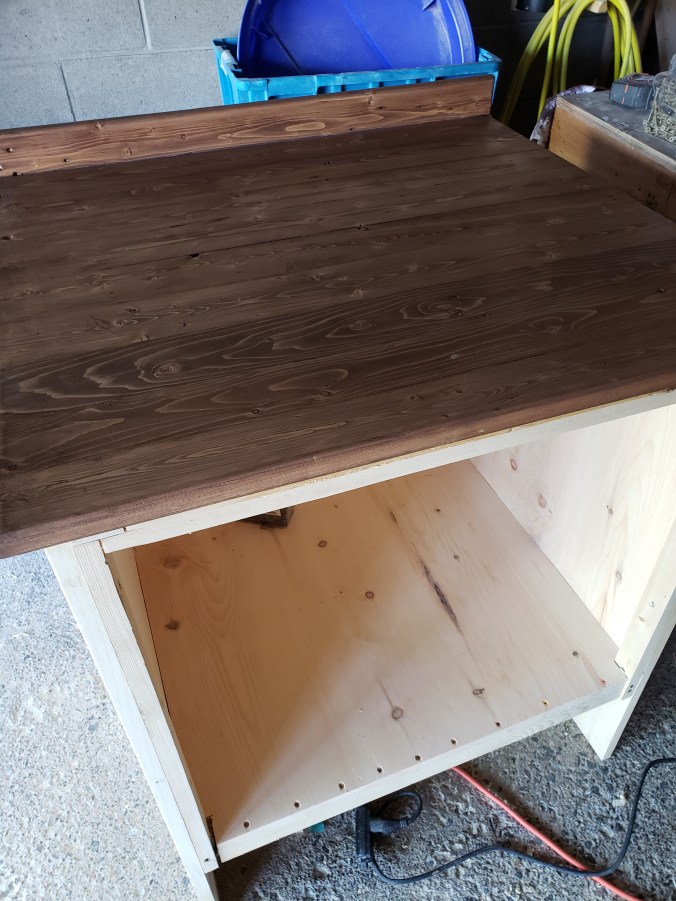
And … Phil’s trying his hand at making a cabinet.

It’s been very hot up here in northeastern Ontario. It’s been hovering around 30 degrees Celsius with the humidity driving the temperature up as high as 41. For those of you who only relate to Fahrenheit, that’s between 90 and 105 degrees. Every day. For two weeks. We don’t have central AC, but we do have a portable unit we use in the bedroom so that we can sleep at night. We’ve been feeding Torvi ice cubes and we bought her another kiddie pool—which she has not chewed! She just steps in to wet her feet, but we’re good with that. Dogs cool through their panting and their paws.

The month in writing

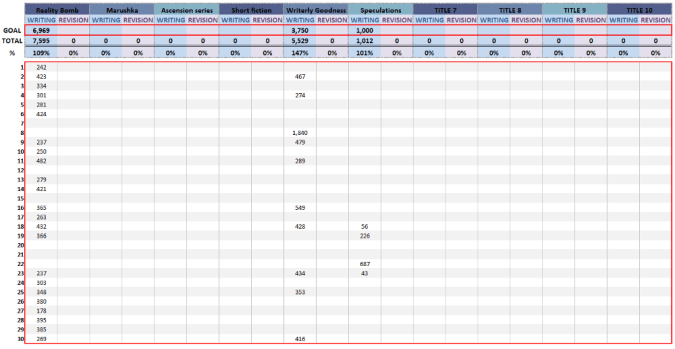
I exceeded my modest goals again this month, but I STILL haven’t finished my rewrite of Reality Bomb (!) I’m over 100k on the draft, now. This will mean some MASSIVE cuts. I’ve been making notes, though, and I have a good idea of where I’ll be going, but I HAVE TO FINISH THE GODDAMNED THING FIRST!

I set my goal at 6,969 words and wrote 7,595, or 109% of my goal.

My blogging goal was 3,750 words and I wrote 5,529, or 147%.

Finally, I wrote my latest Speculations column. It came in at 1,012 words, or 101% of my 1,000-word goal.

Overall, my goal was to write 11,719 words on the three projects, and I wrote 14,136 words. That’s 121% of my goal. Not as fabulous as the 161% I achieved last month, but, interestingly, more words written. Go figure.

JuneProgress

Initially, I was intending to have finished with RB back in March and handed it off to my critique group so I could move on to working on revisions of Marushka. Marushka will be another rewrite and so I’m thinking that I’m going to have to set aside my plans to get back to the revisions on my epic fantasy series and focus on Marushka for the remainder of the year.

Though I was working on the series bible and revision notes for Ascension, that work screeched to a halt when covid-19 hit.

So, I just took a few minutes to revisit my goals and figure I’ll continue working on RB through the end of August and then focus on Marushka for the remainder of the year. I’ll pick up work on Ascension in 2021.

So there, ambitious goal-setting brain. So there.

Filling the Well

Lots to report here this month 🙂

First, I attended the Renaissance Press Virtual Con over the weekend of June 5 – 7. It was all on Zoom and all Canadian. I attended sessions on tropes, eco-fiction, bad writing advice, mystery, characterization, and podcasting.

The following weekend, June 11 – 14, I attended TorCon, and took in sessions with Christopher Paolini and Brandon Sanderson, Neil Gaiman and V.E. Schwab, worldbuilding with a group of awesome authors of colour (Tochi Onyebuchi, Bethany C. Morrow, P. Djèli Clark, and Charlotte Nicole Davis), another Panel with Kate Elliot, Andrea Hairston, Alaya Dawn Johnson, and Ryan van Loan, and another fabulous conversation between Cory Doctorow and Nnedi Okorafor. *chef kiss*

I also watched Mary Robinette Kowal record the audiobook for The Relentless Moon. I’m a member of her newsletter community and jumped at the chance to take part, even though I had to view the videos after the fact (‘cause work). From June 16 – 26, I viewed between two and six hours of awesome footage a day, often catching up on the weekends. It was fascinating to watch the process and the bloopers were hilarious.

Finally, on June 20, my lovely sister-in-law invited us out for another family get together in her lovely yard. We’re now allowed to gather in groups of 10 or less and we’ve formed a “bubble group” of six (me and Phil, sis and spouse, and the moms). We played kubb, another yard game that Phil made, and ate burgers and fresh-cut fries.


What I’m watching and reading

After last month’s epic end-of-season bonanza, I have amazingly few shows to report on.

Phil and I watched through to the end of Supernatural, season 14. We dreaded the introduction of Jack, the Nephilim, because we knew the destructive potential of an overpowered character. So, of course, Jack loses his powers when Lucifer steals his grace, forcing Dean to let Michael possess him and kill Lucifer. And then, because Jack’s a Nephilim, his grace doesn’t regenerate like any other angel’s would. Then, because he drags down the story without purpose grace, he contracts angelic tuberculosis and dies. And, of course, soft-hearted Sam can let him die and resurrects him with magic that links his soul to his use of power. So, he can’t use his powers without burning up his soul. So … of course, Michael possesses (repossesses?) Dean and then Rowena, killing the team of Apocalypse World hunters, and Jack has to burn off what remains of his soul to kill Michael. At that point, we could see that Jack would be the big bad of the season (we were mostly right and not happy about it). Jack burns Nick alive in front of Mary when Nick tries to use Jack’s blood to resurrect Lucifer, and when Mary tries to tell him what he’s done is wrong, Jack kills her. Through another series of shenanigans, Jack goes rogue and finally, God/Chuck shows up, revealing to Sam and Dean that, after all this time, in all the universes he’s created, Sam and Dean are his favourite “show.” He just loves to watch the drama. Instead of resolving the situation himself by restoring Jack’s soul (Chuck says he can’t) Chuck gives Sam and Dean a Nephilim-killing gun and tells them to kill Jack. Jack is ultimately remorseful and kneels passively, waiting for Dean to kill him. Sam tries to intervene and Chuck eggs Dean on. At the last moment, Dean turns the gun on Chuck and shoots him, so Chuck smites Jack and apparently sets off the final apocalypse.

We were disappointed.

I finished watching The Witcher. Not horrible, but not great. I did not appreciate all the unmarked time travel of the first episodes.

I finished last year’s season of Anne with an E in time for this year’s episodes to cue up. I like the additions they’ve made to the story (Black, LGBTQ+, and Indigenous storylines). I think the creators had to add these elements in order to make the series unlike any other iteration of Anne of Green Gables.

I also finished last year’s run of Homeland. It’s getting a little long in the tooth for me, but I am curious to find out what happens to Carrie now that she’s been incarcerated in Russia for months without proper medication.

I only read three books this month.

The 7 ½ Deaths of Evelyn Hardcastle was an interesting mystery along the lines of Russian Doll or Groundhog Day. The concept is too intricate to explain briefly, but it reads well, and the tension is high throughout. Thoroughly enjoyable.

Then, I read Robin LaFever’s Grave Mercy about a sect of assassin nuns in medieval Brittany.

Finally, I read Rohinton Mistry’s A Fine Balance. It’s a sweeping epic set over several tumultuous decades in India’s history. I enjoyed it, but it broke my heart because everyone suffered, no one was happy in the end, and the climactic suicide was senseless. It’s stayed on my mind because I keep trying to make sense of it. I think that may have been the point.

And that brings me to the end of the month in this writer’s life.

Until next time, be well and stay safe, be kind, and stay strong. The world needs your stories.

The Next Chapter