The peace reporters. Videos of police violence at #BLM protests with the testimony of the people who took them. Content warning on this one. The videos of police violence are difficult to watch. They’re optional, though. You can just read the words of the people who took the videos and get a sense of what it means to be a witness in these difficult situations. The Verge
Starting a short week with a Tuesday-that-feels-like-a-Monday is tough. Fortify yourselves with some informal writerly learnings.
First: Black lives matter. Indigenous lives matter. All lives cannot matter until Black and Indigenous lives matter.
#pandemiclife is entering its sixth month and there’s no end in sight even though everyone has covid brain and is exhausted by the restraint and safety restrictions.
Today marked the return to schools for most children in Ontario. I wish them well, but I still worry. We’ve been told to expect a bump in infections, like it’s acceptable to sacrifice children’s and teachers’ and their families’ health.
Please wear your masks, respect social distancing, wash your hands, and stay safe.
Another month has passed. I am experiencing covid time. Sometimes, it feels like March was only yesterday. At others, the second drag on. Though I’ve made my monthly goals more manageable, and revised my yearly goals every month, I’ve gotten more done than I thought I would.
Before we get to the month in writing, we have to make a brief stop in covid-ville.
Pandemic life
Black and Indigenous lives matter. All lives cannot matter until Black and Indigenous (and indeed, all marginalized or racialized people’s) lives matter. White privilege and white supremacy are real. We must interrogate our biases, listen, learn, and do better.
Tomorrow marks the return to school for students in Ontario. I’m not optimistic, and I can only wait to see how things turn out.
Working from home continues. I finally, after nearly six months, received my work laptop. The process was poorly organized and involved calls to the service desk. My system was still not working properly at the end of Friday and I ended up returning to the virtual desktop so I could get some work done.
I hope that all of my programs will have been downloaded by tomorrow morning and I can finish reconfiguring the laptop the way I want. Because I only have the one desk and no room to set up a second in my office, Phil will be making me a unit to raise my monitors above the level of the laptop, which has to remain on, open, and connected to our network so that updates can be pushed after working hours.
I have one of my monitors set up so that I can switch inputs between the laptop and my computer. It’s funny. When we were told we were going to be getting dual monitors at work, I and most of my colleagues questioned the necessity. Now, it’s difficult to conceive of working without them. We have so many programs, it really is easier to have them spread out over a larger visual area.
These are all first world problems of privilege. I just have to put on my big girl panties and git ‘er done. It’s interesting how little is takes to throw me off in these covid times. I can’t imagine how teachers are dealing with the possibility of turning on a dime and converting their lessons for online delivery in the event of an outbreak, which we’ve been told to expect.
The exciting events of July have not resulted in any news. That’s to be expected. Sometimes these assessment processes take months to sort through, and I believe the unit has been since slammed with other priorities.
Work itself is still frustrating and fraught. ‘Nuff said about that.
The month in writing
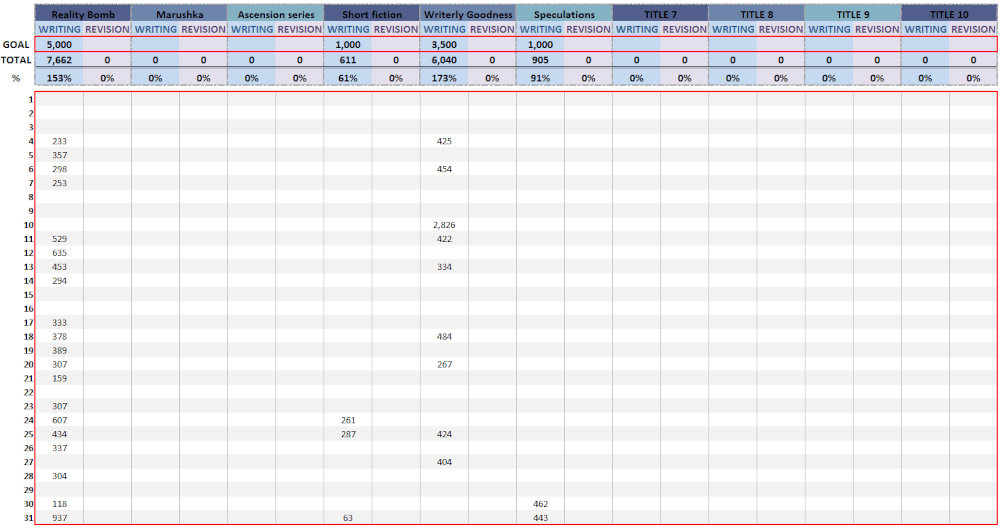
The never-ending novel is never-ending. I’m now over 116k words and not yet finished with the story. It’s going to be a hell of an edit. I did achieve 153% of my writing goal on Reality Bomb, however, writing 7,662 words of my 5k-word goal.
I wrote 173% of my 3,500-word blogging goal, writing 6,040 words in August.
I wrote 905 words for my latest Speculations column, which, though only 91% of my 1k-word goal, I count as a win, because I’m forever going over my 1k-word limit 🙂
Finally, I drafted 611 word on a new short story. I had wanted to write 1k words, but I ran out of spoons, or maybe hands, by the end of the month.
Overall, I wrote 15,218 words, or 145% of my 10,500-work goal.
Filling the well
There were just a few virtual events in August.
The first was When Words Collide, from the 14th to the 16th. They opted to provide the entire weekend of programming free this year because they had to cancel the in-person event. I only attended one session live, with Swati Chavda, on burnout. Unfortunately, the unsecured Zoom account WWC borrowed from the Alberta Romance Writers Association meant the intrusion of a Zoom bomber, which was not fun even though the session was great.
Phil and I were invited out to his sister’s backyard paradise for a bubbled day of social fun on the Saturday, so I wasn’t able to take in any further live sessions. I’m waiting for them to be edited and posted to WWC’s YouTube channel. The Aurora Awards were presented on Saturday evening. That’s the only session that’s been posted so far.
On the 16th, I watched Lavie Tidhar and Silvia Moreno-Garcia in conversation.
On the 18th, I started a free online course on short fiction from Steven L. Sears offered in conjunction with the Roswell Awards. This was the impetus for the new short story I started working on. The last of the classes is tomorrow.
On the 19th, I enjoyed Melissa Yuan-Innes’s workshop on How to Build Worlds without Boring your Readers to Death.
Finally, on the 24th, I attended a Penguin Random House Star Talk with Saleema Nawaz about her book Songs for the End of the World, which is now out.
I’m doing a lot more of these virtual events, I find. I’m enjoying them and they’re doing the job of inspiring me to keep on with the keeping on.
What I’m watching and reading
Phil and I watched the second season of Doom Patrol. It seemed to be one of the shows that was interrupted by covid. It ended at episode 9, and in a bit of an odd way. Sure enough, I found confirmation online that they were in the middle of filming episode 9 when production shut down. The cliff-hanger at the end of season one was apparently intentional. The cliff-hanger at the end of season two was not.
It was okay. We like most of the characters, though we both agree that Cliff is useless. The disappointment was that after the whole of season one was spend delving into the personal traumas of the various heroes and the big reveal that the Chief actually caused all of their “accidents” in one way or the other, or took advantage of their circumstances in a kind of hero syndrome on steroids, the whole of season two was more of the same. The heroes made progress, but several of them were still stuck in the mire of their various issues.
We’re hoping for actual progress in season three … please?
The Umbrella Academy season two was admittedly better than season one, but it, too, suffered from many of the same problems. Again, all the heroes struggle with trauma associated with their upbringing by Hargreaves—who is revealed to be an alien in this season—and most of them end up exactly where they started.
At the end of season one, the rest of the team take down Vanya, but fail to stop her from ending the world. Five’s solution is to take them back in time, but his time travel abilities malfunction conveniently, scattering the UA members over several years in the early 60’s. While they do eventually get together again, because, of course, there’s another apocalypse, they’re all as deeply messed up as they ever were.
They deal with Vanya’s overpowered and ill-defined abilities by giving her amnesia, but she’s still nearly the cause of the apocalypse—again. Five’s powers continue to malfunction, until they don’t. And even though he’s trapped in the body of his pre-teen self, he’s actually in his 50s and should know better, especially when the Handler screws him over—again. Allison feels so much guilt over abusing her abilities to manipulate her daughter in the future that she proudly refuses to use her powers. Until she doesn’t and goes on a power trip that includes a “shopping spree” and getting a racist diner owner to scald himself. Luther uses his super strength to win fixed fights for Jack Ruby. Diego is so obsessed with saving the soon-to-be-assassinated Kennedy that he winds up in an asylum. Klaus starts a cult with dead Ben’s help and tries to prevent the man he fell in love with during the Vietnam War from enlisting.
And that’s not mentioning the Swedish assassins, the Handler’s daughter, or Harlan, whom Vanya inadvertently endows with her powers.
At the end, apocalypses apparently dealt with, Five manages to get them back to 2019, except Hargreaves, having met his failed experiments in the 60s, decides to go with a whole different set of enhanced babies (except for Ben), who are now The Sparrow Academy.
I watched the final season of Agents of S.H.I.E.L.D. and enjoyed it, though I felt that they had lost their way as far back as the Inhumans storyline … which they resurrected in this final season. In fact, it’s like they picked bits and pieces from all of the previous seasons and brought them together, intending to tie everything up with a nice bow, only to fumble the bow like a three-year-old. No, honey, the rabbit goes into its hole. The show ended in a similar way to iZombie, with the team having a virtual reunion. It was satisfying and there are intimations that there might be some kind of tie in to the MCU/Disney+ (which has thus far ignored everything the networks or Netfix has put out), but we’ll have to wait and see.
Lost in Space wasn’t bad. I was left thinking that the Robot is kind of like the TARDIS, taking the Robinsons where they need to go, despite where they might tell him to go.
Finally, I watched the limited series Unorthodox. It was an interesting window into orthodox Hasidic culture, but it’s nothing like the true story it’s based upon. The writers were not unsympathetic to Esty’s husband, but they didn’t offer any resolution with regard to her aspirations in the music program she’d auditioned for. It was good, and I was riveted, but I was left wanting more.
In the reading department, I read seven books in August.
First, I finished Joe Abercrombie’s The Blade Itself. It was good and definitely an epic fantasy, but something didn’t sit well with me for most of the book. I think it’s that there were only two women characters of note, one with a history of abuse who resorts to alcohol for self-medication and the other a feral warrior who was enslaved and abused in the past.
Ardee West seems to serve no purpose but to provide motivation to the male characters of the novel. To her brother Collem West, she is burden and a source of guilt. To Jezal, she is a potential love interest and borderline obsession. To Sand, she is a bittersweet reminder of what might have been.
Ferro Maljinn is a powerful woman, but she is the ultimate wild card, hating everyone without cause or reason, and bent on her personal quest for revenge even though she understands the bigger issues at stake.
Also, the book was very much the first act of the larger story that is the trilogy. It could never have stood on its own. I was, accordingly, ambivalent.
I read Kai Ashante Wilson’s A Taste of Honey. Though it is the second in series, it was a complete story on its own. At first, I thought that it was an alternate world historical fantasy, but part-way through, there was math and advanced science. So, science fantasy, then? I liked it, regardless, and the first novella is on my TBR list.
Then, I read Bethany C. Morrow’s A Song Below Water. I loved it. Though it was YA, it didn’t suffer from the agonized romantic subplot that most YA novels feature. Instead, it focused on the emotional journeys of its two young Black protagonists. Tavia is a siren living in hiding. Sirens are the most feared of the supernatural peoples because of their ability to rob their victims of their free will. Effie, who’s lived with Tavia’s family since her mother’s death, swims like she was born to the element and plays a mermaid at the annual Renaissance Fair.
Set in Portland, the story explores both girls’ trauma, not only as Black women in a mostly white city, but also as women who must unravel secrets—which their families actively keep from them—in order to become the people they were meant to be. Ultimately, it’s the girls’ friendship that gives them the strength to succeed. Morrow doesn’t shy away from the complexities of racism and intersectionality in various contexts.
Then, I read two Lawrence Hill books. The Illegal tells the story of a runner, Keita Ali, from the fictional country of Zantoroland, where dissidents are held for ransom, tortured, and killed by their corrupt government. Keita escapes to another fictional country, Freedom State, where he attempts to achieve his goal to become a competitive marathoner, when he discovers that his sister has been kidnapped and is being held in Zantoroland. If Keita can’t come up with the ransom, she’ll be killed, and so he runs, not just for his own life, but for that of his sister.
Based on a true story, The Book of Negroes is about Aminata Diallo, stolen from her home in Bayo (in Mali) by other Africans, and sold into the slave trade. She is bought by a cruel indigo plantation owner in South Carolina, her first child is taken from her, and she is subsequently sold to a Jewish man who, though he ensures she has work worthy of her skills and education, nonetheless abuses her after his own fashion. When Aminata discovers that he was responsible for selling her child, Aminata escapes while they’re in New York as the America Revolution begins.
Aminata works for the British during the war and once hostilities cease, becomes scribe, noting the names of the slaves freed through service to the British in the titular book. Pregnant with her second child, she is prevented from joining her husband on their way to Nova Scotia when her previous owners make claim upon her. Though eventually emancipated in truth, by the time Aminata makes it to Nova Scotia, she cannot find her husband and learns that circumstances in Canada are little better than they were in America.
Her second child is abducted during the chaos of a white attack on the Black settlement, and Aminata is once again on her own. Abolitionists come and recruit Nova Scotian Blacks, none of whom have been given the land promised them by the British, to create a free Black settlement in Sierra Leone. Aminata signs up because it has been her dream to return to Africa since she was first stolen from her home.
Again, the repatriated settlers of Sierra Leone are denied land and must endure the continuing slave trade that goes on around them. Aminata travels inland with guides and though she fails to find Bayo, she does find an African village where she stays for a while before eventually returning to Sierra Leone and accepting an offer to travel to England and help the abolitionists end the slave trade.
In a beautiful ending, Aminata is reunited with her daughter May, writes her story for the abolitionists, and helps to end the slave trade, though not slavery itself. This is a novel that everyone should read. Full stop.
Then, I read Danielle Jensen’s The Stolen Songbird. Cécile is kidnapped and magically bonded to the troll prince in the hope of ending a curse that a human witch places on the trolls centuries ago. The bonding does not break the curse and Cécile must navigate troll politics and a rebellion in the attempt to win her freedom. But, of course, she falls in love with the troll prince.
Finally, I marked as read Mary Robinette Kowal’s The Relentless Moon. I didn’t actually read it this month, but I was involved in the beta read last year and was invited to the live streaming of Mary Robinette’s recording of the audiobook this summer.
This is the third in Kowal’s Lady Astronaut series and focuses on Nicole Wargin during Alma York’s journey to Mars (in The Fated Sky). Earth first is sabotaging Artemis Base and Wargin must uncover the plot while dealing with the effects of the sabotage, personal injury, and threats to her husband, the governor of Kansas, on Earth. It was gut-wrenching and wonderful. I won’t say anything more about it. Read.
And that was the month in this writer’s life.
Until next time, be well and stay safe, be kind, and stay strong. The world needs your stories.
Sarah Midkiff goes inside the Portland protests, separating fact from fiction. This is almost a month old. I think election hijinx are overtaking #BLM related news. Until this past weekend, when protests took precedence again. Refinery 29
Welcome to tipsday 🙂 Pick up some informal writerly learnings to get through your week.
Black lives matter. Indigenous lives matter. All lives cannot matter until Black and Indigenous lives matter. I don’t want this to be a “performative wokeness” thing. I believe it wholeheartedly. I’m going to keep putting this message out there until real change happens.
Next week will see Ontario students return to class. Though additional money has been allocated to help schoolboards prepare, there still doesn’t seem to be a firm plan across all schoolboards. We’re going to have to wait and see.
Welcome to another week of informal writerly learnings!
Black lives matter. Indigenous lives matter. All lives cannot matter until Black and Indigenous lives matter. This is a fundamental truth.
The EI ERB and CERB have been extended for the third time and three new transitional benefits are being created to support Canadians in this crisis. It’s resulted in chaos at work, but chaos has been the rule since March 15th.
Wear a mask. Wash your hands. Stay within your bubbles and avoid crowded events. Take care and stay safe. You don’t know who you could be putting at risk with careless behaviour.
Welcome to another week of informal writerly learnings.
Black lives matter. Indigenous lives matter. All lives cannot matter until all Black and Indigenous lives matter. Truth.
Dr. Tam has stated that we should prepare for a second wave of infection in the fall and that we’ll probably be living with covid until 2022 (at least). And young people have been out partying without health precautions in the hundreds in BC.
Children and youth have been getting sick more often, and now they’ve confirmed that young people are more likely to be asymptomatic carriers. Provincially, there has been additional money given to school boards to improve HVAC systems and hire more teachers, but, you know, too little, too late. How do they expect all this work to be accomplished in two and a half weeks (and less, for some school boards)?



 Always Looking Up