Tipsday: Informal writerly learnings, Aug 14-20, 2022

Week four of August is here along with your weekly batch of informal writerly learnings! Enjoy!

K.M. Weiland explains how to write emotional scenes (without making them cringey). Helping Writers Become Authors

Lisa Norman reveals how to painlessly generate dozens of blog ideas. Then, Sandy Vaile digs into research: how far will fiction authors go for facts? Laurie Schnebly Campbell wonders how much does genre matter? Writers in the Storm

Joanna Penn interviews Becca Puglisi about writing conflict. The Creative Penn

How to write a plot summary and a synopsis. Reedsy

Roz Morris considers using real people in historical fiction—how much can you invent? Nail Your Novel

Barbara Linn Probst wonders what does “award-winning author” mean—and does it matter? Then, Marcie Geffner discusses aphantasia and writing fiction with no “mind’s eye.” Writer Unboxed

AJ Harper helps you get in front of your readers’ doubts and objections. Jane Friedman

Good characters are overrated. Tale Foundry

Christina Delay: small focus. Big creativity. Becca Puglisi wants you to use your character’s career to support your story’s theme. Writers Helping Writers

Nathan Bransford says don’t outsource your agent search.

Kris Hill considers fairy tales and once upon a time. Manuela Williams: what is the poetry of witness? Then, Daria White proposes an alternative to traditional time management for writers.  Abigail Cutter suggests five ways to get inside your historical characters’ heads. DIY MFA

This fight changed everything … Jill Bearup

Angela Ackerman: does conflict really belong on every page? Jami Gold

Tiffany Yates Martin explains how to write a query letter (without losing your mind). Fox Print Editorial

Kristen Lamb examines the priority parallax: what’s truly important?

Chris Winkle lists ten reasons your characters might stop communicating. Then, Oren Ashkenazi analyzes five stories with well-written families. Mythcreants

How to write your first novel. Reedsy

Chris Martin discusses poetry, autism, and the joy of working with neurodiverse writers. Literary Hub

Peter Kafka: the newsletter boom is over. What’s next? Vox

S.L. Huang investigates the ghost of workshops past: how communism, conservatism, and the Cold War still mold our paths to SFF writing. Outstanding essay! Tor.com

Thank you for spending some time with me. I hope you found something to support your current work in progress.

Until Thursday, keep staying safe and well!

Tipsday: Informal writerly learnings, April 10-16, 2022

Welcome to tipsday, your opportunity to stock up on informal writerly learnings.

Ann Marie Nieves: book PR & marketing questions answered, part VII. Jim Dempsey wants you to exploit your hero’s flaws. Then, Kathleen McCleary is getting over it. Kathryn Crafts says foreshadowing is a revision skill to love. Later in the week, Desmond Hall drops some more writerly wisdom on us. Writer Unboxed

Shaelin shares seven ways to level up your writing process. Reedsy

K.M. Weiland shares 14 tips for dealing with the passage of time in a story. Helping Writers Become Authors

Lisa Norman introduces us to the magic of World Anvil. Then, Monica Corwin suggests eight ways to stay open to story. Jenny Hansen: the extraordinary blessings of asking for help. Writers in the Storm

Have humans always feared sharks? Monstrum | PBS Storied

Jane explains why so many blogs and newsletters aren’t worth the writer’s effort. Then, Lisa Cooper Ellison explains how to gracefully leave your writing group. Jane Friedman

Sue Coletta: what is rhythmic writing? Emily Young shares six tips for writing compelling action scenes. Writers Helping Writers

Crafting as a magic system. Tale Foundry

Abigail K. Perry poses seven questions to ask about your first chapter. Then, Gabriela Pereira interviews Claire Stanford about character development in literary fiction. Angela Yeh wants you to embrace your inner poet-activist! Then, Lewis Jorstad suggests five secondary character arcs to strengthen your cast. Later in the week, Linda Dahl explains how to inject humor to relive narrative tension. DIY MFA

The Heather trope and why we’re so obsessed with her. The Take

Story beats: the key to line-by-line writing. Morality genre: altruism stories of redemption, punishment, and testing. Performance genre: stories about sports, music, business, and art. Four Core Framework: the foundational elements of storytelling. Story Grid

How to write realistic male characters. Jenna Moreci

Tiffany Yates Martin explains how writers Liz Fenton and Lisa Steinke survive. Fox Print Editorial

Chris Winkle says the best characters eat their spinach—and their candy. Illustrated by Bunny. Then, Oren Ashkenazi critiques five inexplicable planets from Star Trek. Mythcreants

The three planes of story and creating causal connections. A very personal literary theory. Shaelin Writes

Kristen Lamb warns that bloated writing makes readers sick.

Nina Munteanu shares example steps for keeping a nature journal.

Anne Delaney examines chronemics and the nonverbal language of time. JSTOR Daily

Thank you for spending some time with me. I hope you took away something to support your current work in progress.

Until Thursday, be well and stay safe!

Tipsday: Writerly Goodness found on the interwebz, March 7-13, 2021

We’re half-way through March and heading for the vernal equinox. Reward yourself with some informal writerly learnings.

K.M. Weiland continues her archetypal character arcs series with part five: the king arc. Helping Writers Become Authors

Janice Hardy shows you five places to find your novel’s theme. Then, Janice lists four steps for choosing what details to describe in a scene. Later in the week, Angela Ackerman recommends you do this one thing to write unforgettable characters. Fiction University

Princess Weekes: Lovecraft Country … was just not that good. Melina Pendulum

Lisa Cron returns: still crazy after all these years. Then, Jim Dempsey lists five reasons you need a professional editor. Juliet Marillier celebrates wild women. The Cailleach and Baba Yaga, two of my personal favourites! Later in the week, Kathryn Craft explains how authenticity builds a satisfying author career. Then, David Corbett looks at two approaches to dramatizing character change: Emma vs. Hamlet. Writer Unboxed

Shaelin explains how to convey emotion in your writing. Shaelin Writes

Jane Friedman considers which is better for authors, blogging, or an email newsletter. Then, Lisa Cooper Ellison shares three traps that subvert our ability to receive feedback. Jane Friedman

C.S. Lakin explains how to face down writer fear. Live, Write, Thrive

The ice queen trope, explained. The Take

Kris Maze offers five dialogue quick tips for page-turning fiction. Later in the week, Piper Bayard and Jay Holmes list ten common bedroom object to use as weapons. In a pinch. Writers in the Storm

Jami Gold discusses setting as character. Later in the week, David Duhr wonders, do you focus on the doing or the having? Writing process vs. product. Writers Helping Writers

In defense of basic. What does it meme? The Take

Laura Highcove wonders, why does it feel like you can’t write after a writer’s conference? Then, Manuela Williams explains how to nurture your reader community. Later in the week, Elly Griffiths advises you to follow the feet. Then, Angyne Smith shares five things that saved her novel from oblivion. DIY MFA

Jenna Moreci shares her structuring method.

Lucy V. Hay offers a comprehensive guide of ALL. THE. STORY. STRUCTURES. Informative and somewhat overwhelming. Bang 2 Write

Chris Winkle explains why you should watch out for hindrance characters. Then, Oren Ashkenazi points out five problems with focusing on internal conflicts. Mythcreants

Kristen Lamb extols the art of embracing the suck: commitment matters.

Julian Lucas shows how Octavia Butler reimagines sex and survival. The New Yorker

Stephanie Burt: we live in the world of WandaVision. The New Yorker

Thanks for stopping by and I hope you found resources to support your current work in progress.

Until Thursday, be well and stay safe!

Tipsday: Writerly Goodness found on the interwebz, Aug 16-22, 2020

Welcome to another week of informal writerly learnings!

Black lives matter. Indigenous lives matter. All lives cannot matter until Black and Indigenous lives matter. This is a fundamental truth.

The EI ERB and CERB have been extended for the third time and three new transitional benefits are being created to support Canadians in this crisis. It’s resulted in chaos at work, but chaos has been the rule since March 15th.

Wear a mask. Wash your hands. Stay within your bubbles and avoid crowded events. Take care and stay safe. You don’t know who you could be putting at risk with careless behaviour.

K.M. Weiland shares five exercises for honing your story instincts. Helping Writers Become Authors

Vaughn Roycroft explains why he prefers novels with prologues. Dave King is discussing fiction in the time of plague. Then, Sarah Penner shares the results of a working-from-home survey: navigating changes to our work environments. Later in the week, Porter Anderson discusses emergent voices. Writer Unboxed

Shaelin Bishop shares some of her favourite writing techniques. Shaelin Writes

Tasha Seegmiller: every novel needs a village. Then, Barbara Linn Probst advises us to read like a writer and write like a reader. Later in the week, John Peragine explains the vital importance of your writing community. Writers in the Storm

The muse trope, explained. The Take

Rochelle Melander suggests some tools for revision. Fiction University

Christina Delay uses the lyrics of “Yesterday” to look back at the first act. Writers Helping Writers

Helen J. Darling helps you build your author newsletter list. Then, Pamela Taylor helps you figure out whether you’re writing historical fiction, or something else. Later in the week, Chere Hughes describes the key features of a no-fear critique. DIY MFA

Susan DeFreitas explains what your first 50 pages reveal. Jane Friedman

Nathan Bransford wants you to be very careful with dreams and hallucinations in novels.

Chris Winkle explains why story structures like the Hero’s Journey don’t work. Then, Oren Ashkenazi analyzes five stories with anticlimactic endings. Mythcreants

What English can’t do. NativLang

Alexandra Alter: “We’ve already survived an apocalypse”: Indigenous authors are changing science fiction. The New York Times

Thanks for visiting and I hope you’re taking away something that will support your current work in progress.

Until Thursday, be well and stay safe.

Tipsday2019

The next chapter: April 2018 update

Hey, all you writerly people 🙂

Here we are in May, Cinco de Mayo, in fact, and it’s time for my next chapter update.

It’s been a weird few weeks since I made my decision to stop posting every weekend. I had one weekend that was fairly restful, caught a flu and was sick for a week, and have spent the last week frantically catching up at work and at home.

I still think it was a good decision, but I’ll likely have to give it more time before I see real results.

I have formally announced my intention to hand off responsibility for the Sudbury Writers’ Guild newsletter, but elections (newsletter-er isn’t an elected position, but volunteer positions are filled at the same time as elected ones are voted upon) aren’t until the May meeting at the end of the month. Also, whoever decides to take over for me won’t do so until the beginning of the new SWG year in September. We usually break for the summer, so the June newsletter would be my last.

I’m still on the program committee and one of its sub-committees for the Canadian Authors Association, but my obligations have not been too onerous there. For now. If that changes, I’ll have to bow out.

On another front that I haven’t discussed much, I’m sad to report that my critique group has imploded. Well I’m two parts sad to one part relieved. I’m sad because I had great hopes, and relieved because it’s one less commitment to fulfill.

Several members were in the process of moving (some internationally) in January and February and so we delayed the start of the critiquing year. One submission has been made and I’ve read and critiqued it, but I haven’t heard from anyone else in the group about an online conference to actually discuss the submission, or anything else moving forward. I’m going to read through the submission one more time, finalize my written comments, and return them to the author. And then I’m going to pull the plug.

I may check out the novel critique group that the SWG runs. I need something. Writing in a feedback void isn’t getting me anywhere. I can continue to write and revise, but unless I can get some other eyes on the work, my revisions will lack direction and I’ll take so much longer to get anything ready for an editor, or for submission to agents or small publishers.

I got my taxes wrangled and, for the first time in a number of years, I’ve has absolutely no income to report from my creative work. No workshops. No panelist honoraria. No prize money. No sales of short fiction or even contributor copies. It’s a bit distressing. I’ve never had much income to report, but I’ve generally had something. It just makes me feel like I’ve been falling back, that it’s not just been my burnout, but something more insidious going on with me.
AprilProgress

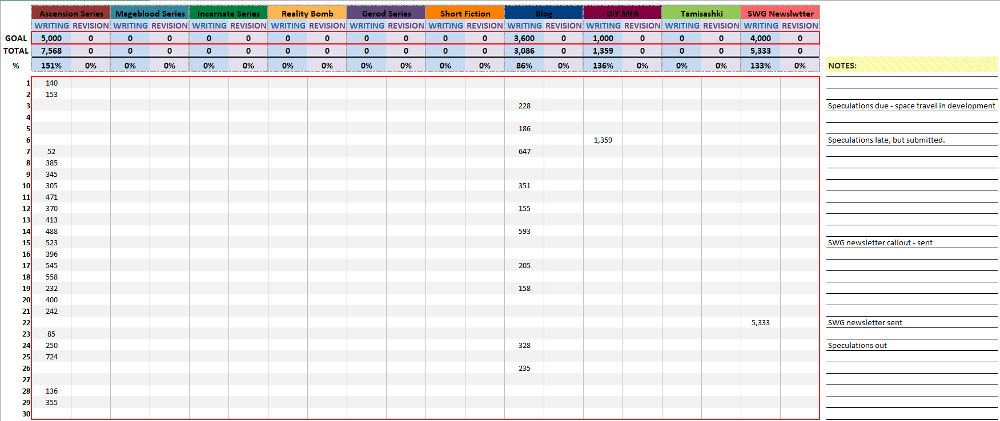
I have, however, made strides with regard to my writing practice. For April, I set (or reset) the modest goal of 5,000 words written on Playing with Fire. I managed to write more days than not, and wrote 7,568 words, or 151% of my goal.

I also adjusted my writing goal for the blog given that I’m not posting most weekends. Even though I adjusted my blogging goal to 3,600 words, I wrote only 3,086 words, or 86% of my goal.

My DIY MFA post came in at 1,359 words of my 1,000-word goal, or 136%, and the SWG newsletter was 5,333 words of my 4,000-word goal, or 133%. Admittedly, the newsletter is not all my writing. I have submissions from the membership and the contests and inspirational quotes are found online and copied. Still, I have to fill in gaps, edit, format, and cobble all the disparate parts of the newsletter together into a more or less cohesive whole.

Overall, I wrote 128% more in the month than I set out to, and that makes me happy.

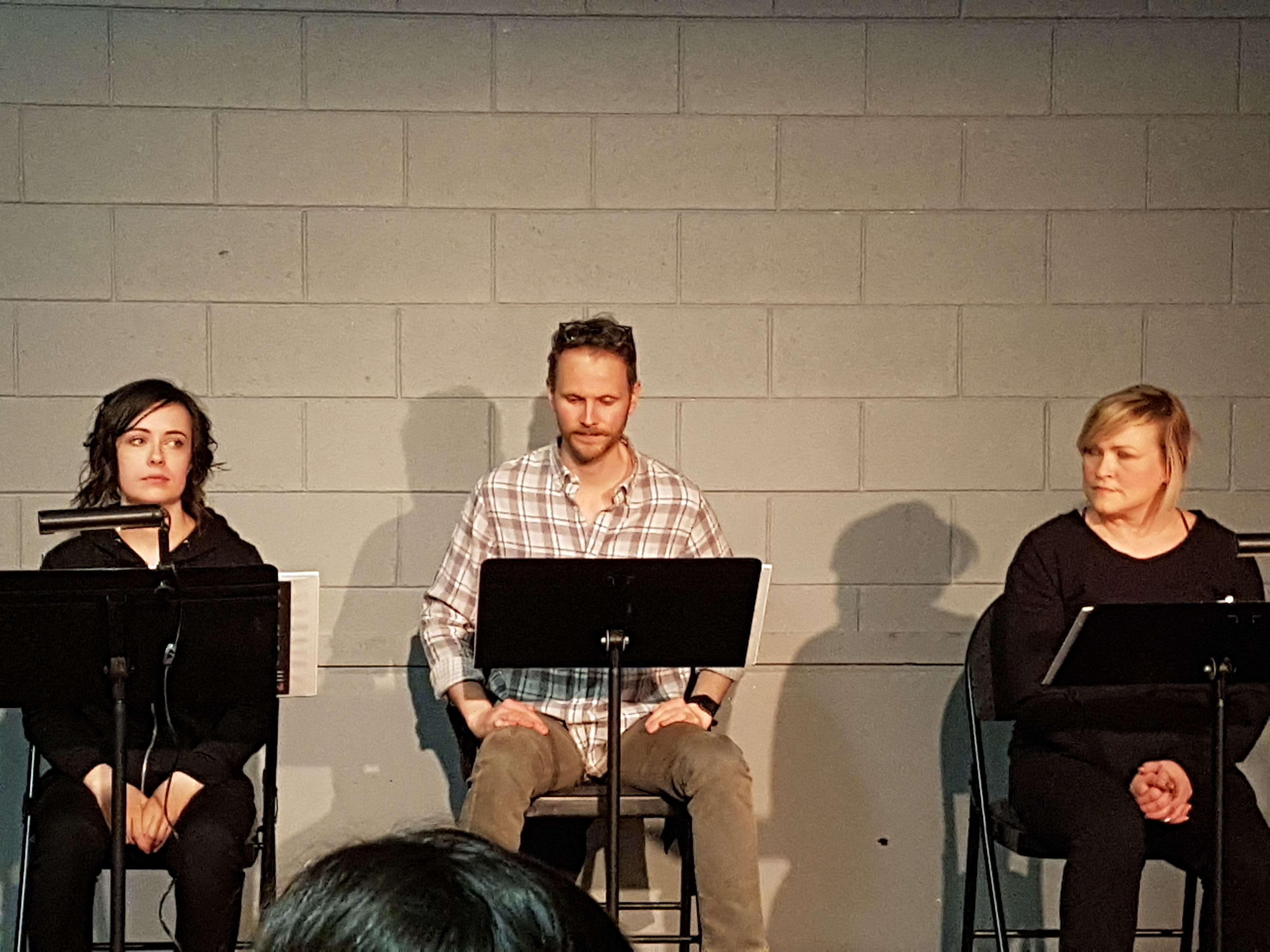
Though it was May 1st, I was able to attend one literary event, the staged reading of the latest iteration of Kim Fahner’s play, “Sparrows Over Slag.”
20180501_171021

Here are the actors, Morgan St. Onge, Matthew Heiti, and Sarah Gartshore.

Kim also had an artist talk afterward during which she explained the impetus for the play and its development.

On the Torvi front, we’re one class away from graduating from the beginner obedience class at Skiplyn Kennels, only to jump right into the intermediate class. Torvi is still a challenge. The second biggest problem now is her propensity to get up on counters, tables, desks, grab whatever she can get her teeth on, and run. She also jumps on people. We’ve been persistent with telling her to get off, and pushing her off, but she still hasn’t gotten the message.

The biggest problem is that she’s started peeing in the house again. We thought we had this licked, but no. So now we’re pacing around the yard reciting “do your pee” until she complies. She’s still distracted by everything. Even if she asks to go out, she forgets what she’s there for once she sees a bird, or squirrel, or a truck or a motorcycle goes by.

She’s showing steady improvement in all other areas, but those are the two stubborn problems.

Here’s a comparison: Torvi at seven weeks and Torvi at seven months 🙂
20180505_164010

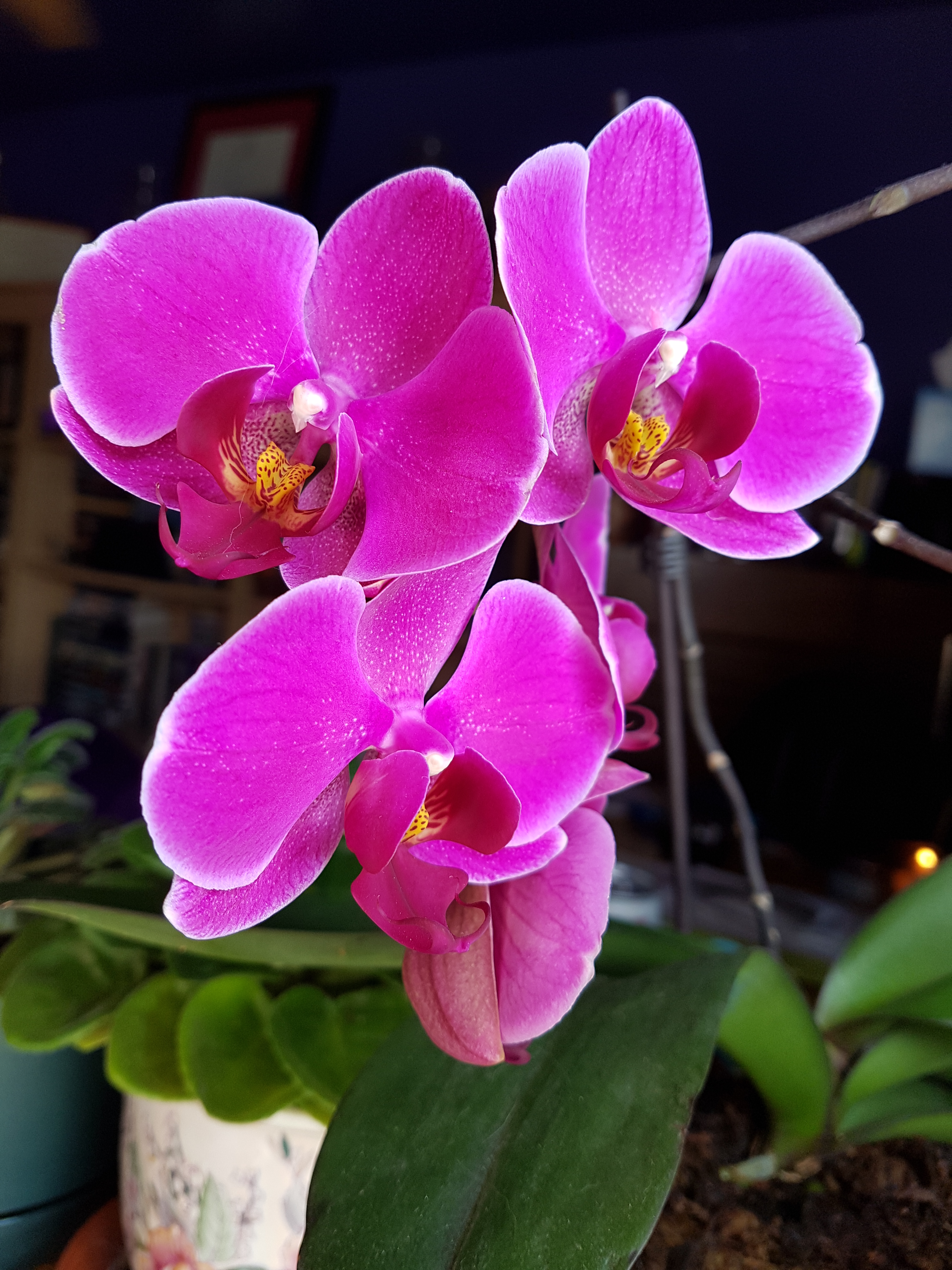
As for the orchids, it’s all the fuchsia phalaenopsis. The pink has dropped all its blooms now.

And that’s all I have to report for this month. It’s been mostly good and I’m looking forward to better yet to come.

Until Tipsday, be well, be kind, and stay strong. The world needs your stories!
The Next Chapter