Feeding my creativity

Here’s the prompt Gabriela sent this week for the DIYMFA launch team:

“Coming up with ideas takes practice. You have to train your brain to get creative on demand. You can’t sit around waiting for your muse to show up because she might take her sweet time. Instead, you have to go after your muse. Hunt her down and show her who’s boss. One writer told me he “keeps his muse chained to his desk.”

While I find that mental image of the muse-prisoner hilarious, I prefer to think of it a little differently. I have a shrine to my muse, a small box I call the ORACLE. (Like most things in DIY MFA, ORACLE is an acronym that stands for outrageous ridiculously awesome creative literary exercises.) Just like the ancient Greeks made pilgrimages to oracle temples so they could get guidance and wisdom from their gods, I visit my ORACLE whenever I feel the creative well going dry.

These contents have changed over time, but a few things have stayed constant:

  • Dice: I use dice for writing exercises whenever I need to leave something up to chance. I’ll assign each number an option, and then do whatever the roll decides.
  • Word Box: This small box contains slips of paper with words on them. I pull a few words out of the box at random, and then write a short piece that uses all those words.
  • Image Box: I keep an old chocolate tin filled with photos I clipped from magazines or postcards I picked up at museums. Whenever I’m stuck for ideas, I use those images to spark a story.

These are just a few things I keep in my ORACLE. I also have a paper prototype of the Writer Igniter app, a Writer Igniter deck of cards (also an early prototype for the app), a stack of fortune cookie fortunes, and a pocket-sized book of prompts.

Do you have an ORACLE? If not, treat yourself and start putting one together this week. It took me several years to refine and build my ORACLE, so don’t feel like you have to fill it overnight. Go out, get a nifty container, and start assembling materials to put in it.”
Muse-inks

I don’t have an oracle. I’ve bought decks of story cards, but, I have to confess that I don’t use them. I’m not fond of prompts, honestly, though the idea for one of my novels did result from a prompt. It was a Natalie Goldberg prompt, though, so that may have had an impact on how things turned out 😉

A lot of my story ideas come from my dreams, which, when I can remember them, are quite theatrical/cinematic in scope.

Other ideas come from articles that I read that trigger interesting connections in my head. I talked about the reasons I started my Thoughty Thursday curation a couple of weeks ago. I keep this curation going for myself as much as for others.

I share the posts and articles that make me think, start the mental corn a-popping. Some of those pops ignite story ideas.

I’ve always had story ideas, and more ideas than I knew how to write, especially when I was young. I used to write my stories (so-called) in Hilroy exercise books. I still have them. I still have most of the stories I wrote for school, too.

When I had an idea that I wasn’t sure how to write, I’d write as much as I could about it in one of those notebooks. Eventually, spiral bound notebooks and loose leaf paper replaced the exercise books.

That was the beginning of my idea file.

I mentioned last week as well was that when I was in university, I started making those thoughty connections with all the things I was learning in my classes. Psychology fed into sociology fed into Taoism fed into Old English fed into genetics fed into astronomy.

I started keeping my first journal in those years.

I have a stack of them now.

I keep one beside my bed to capture dream ideas.

I carry one in my purse so I can write down ideas that occur at work or when I’m otherwise away from other means of capturing them. I could use my smart(er than me) phone, but I like the feel of pen on paper. I take all my conference and convention session notes by hand as well.

Also during my university years, I worked in libraries. I learned a lot about research in those years, and, in the course of processing books and magazines to put on the shelves, if I came across an article that elicited a pop, I’d copy it. I called it being a clip rat.

These, too, went into my idea file.

I once clipped an entire series from a newspaper on families living on welfare. I also copied articles on the future of economics. And yes, both of these have story ideas that go along with them.

When the library’s collection was culled, I bought whatever books I could afford from the resulting sale. I accumulated a number of interesting, if slightly out of date, reference books, including an etymological dictionary (in two volumes), a name dictionary, and a couple of collections of popular quotations.

Currently, I read a number of blogs using Feedly. Before Feedly, I used Google Reader (when they announced the end of Google Reader, I was in a panic until Michael Hyatt mentioned Feedly in one of his blog posts).

Things that inspire an idea for a story, I clip to Evernote.

When I start working on a story, outlining, drafting, revising, I do my research in dribs and drabs. I use Evernote to capture online research as well.

Finally, my husband is a great source of ideas. We watch a lot of science fiction, fantasy, historical, and anime series. We have discussions about them. Because my man is Mr. Science, he’ll often have a few things to say about the poor science in a science fiction series. One of my stories was inspired by a discussion we had about Star Trek: The Next Generation.

He’s also very critical of story/plot quality. We can have animated conversations about what writers do and fail to do in the series we like to watch.

I can also fact check some of my SF ideas with him. He’s awesome that way 😀

So, I have lots of ideas and a lot of the resources I need to refine them.

I find that the best way to come up with story ideas is to be present, pay attention, and capture them however you can.

I like to keep things simple.

Tomorrow: It’s next chapter update time 🙂

Next week: DIYMFA will be out on the 10th! I’ll be posting my review to Amazon and Goodreads, and posting it to Writerly Goodness on Saturday.

Have a great weekend!
Wordsmith Studio Homecoming 2015: What are you reading?

For the best effect, please read the headline of this post with an incredulous tone 😉

WSS Homecoming 2015

1) What are you reading?

Just like I work on multiple project in my writing, I read multiple books, both ebooks and print, cause I kind of have this problem. I can’t stop buying books of any variety (!)

So here’s my current reading list:

  • 1Q84 by Haruki Murakami. Although I’m sure it suffers in translation, I’m enjoying this novel immensely.
  • InFusion by Scott Overton. I’m beta reading this SF novel for an author friend. I’ll save my specific feedback for him, but, just so you know, I think it’s great 🙂
  • The Art of Work by Jeff Goins. On finding your calling. It’s kind of serendipitous that I found out about this book back in January.
  • Moon Called by Patricia Briggs. I picked this up last year after seeing Patricia at Ad Astra. I figured I should get off my butt and read it . . .
  • Pain, Porn, and Complicity by Kathleen McConnell. An academic work on SF&F movies and television series. It’s been a while since I dipped my toes in that particular non-fiction pool.
  • Lock In by John Scalzi. I’m listening to this on Audible. Narrated by the inimitable Wil Wheaton.

2) What was your favorite read in the last year (or month, or…)?

My favourite reading of recent recall is A Turn of Light by Julie Czerneda. I rated it five stars, though I haven’t written a proper review. Yet. This is the kind of fantasy novel I love to read. It’s also the kind I write and there were a lot of similarities between Czerneda’s Jenn Nalynn and Ferrathainn Devlin, the protagonist from my WIP. I was enthralled to the end 🙂

3) Do you have a favorite genre?

Yes and no. I favour fantasy novels of any age range, but I also read science fiction, historical fiction, the classics, mysteries, and romance novels (though I must say I haven’t read many of those recently). I try to alternate fiction and non-fiction reading, as well. Again, most on my non-fiction reads tend to be writing craft books, but I also read as a form of research for my various works in progress, and sometimes, stuff that I’m just interested in. I learn something from everything I read, even if I don’t particularly enjoy the book. In other words, I read as a writer.

4) Bend one step further: are there alternative forms of writing or art that you have found inspiring or even dabbled in?

In my “searching” phase of university (the undeclared years) I majored in music and art at different times. Performance anxiety put the brakes on my music career, though I still love to sing. I was summarily drummed out of art class when my professor called me nothing more than an “illustrator.” From time to time, I still sketch, but I’ve honestly never been very good. I’ve sunk all my creativity into my writing for a number of years now. In 2000, I did the crazy, being in between jobs, and auditioned for a Theatre Cambrian production of Hair (Y2K). I sang and danced in that, for what it’s worth 😉

6) Back to your main inspiration: Do you have “mentor” titles for the writing you are working on?

I’ll reframe this in terms of “comps,” or comparative works. As I mentioned above, I learn something from every book I read, so I don’t have any “mentor” titles, per se, though I would identify several novels/authors whose work I aspire to.

  • The above-mentioned Julie Czerneda and her A Turn of Light. I’ve committed to read more by Julie.
  • Juliet Marillier’s Celtic legend inspired Seven Waters series.
  • Guy Gavriel Kay’s novels. Though he writes in a created world, it is based on painstaking historical research. I’m not that dedicated, but I love the stories he writes. He’s actually made me cry in the reading.
  • Sherri S. Tepper. Just anything she writes. I love her ideas. Or should I say lurve?

6) If you didn’t already do this for #4, what music inspires your writing?

Okay, now you’re going crazy. Or you will if I offer up all 963 songs on my iPod (!) Suffice it to say that any music I like is generally something I’ll add to my playlist. I have music from the 60’s, 70’s, 80’s, 90’s, and the new millennium. I like some pop, a lot of alternative, celtic, and world music. I also have more eclectic selections on CD: The Rites of Spring, Satie’s gymnopedies, The Symphonie Fantastique, Carmina Burana, Gregorian chant, a number of Sequentia recordings (including the Eddas), gamelan music, Tibetan singing bells, shakuhachi flute music . . .

My favourite artists (I’ll pick up just about anything they release):

  • Imogen Heap
  • Tori Amos
  • Sarah Slean
  • Florence + the Machine

7) Have you ever thought of this: what book is your main character reading?

Interesting question. I’ll even answer it.

  • Ferathainn Devlin: Sadly, all of Fer’s reading would be studying for her forthcoming initiation, so all of it would be history, scholarly works on magic, or non-fiction works on herbs and simples, astronomy, and the like.
  • Charlene Kalveras: School textbooks, and, because of what’s happened to her father, true crime.
  • Gerod: Owing to his impoverished upbringing in an environment of medieval feudalism, Gerod doesn’t know how to read. He learns, though.
  • Marushka: She hasn’t had any formal schooling, hopping around the world in a magical hut, so she’s had to teach herself everything. She steals books from libraries and reads omnivorously.

8) Do you have a favorite book, article or magazine for writing advice?

Again, I have several 🙂

  • Writing the 21st Century Novel, Donald Maass. Currently on loan to a member of my critique group. Actually all of Maass’s books have helped me immensely.
  • Any of K.M. Weiland’s writing craft books.
  • Any of Roz Morris’s Nail Your Novel series.
  • And the books that have helped me find my way to the writing life: Natalie Goldberg’s Wild Mind and Writing Down the Bones; Julia Cameron’s The Right to Write; Heather Sellers’ Page After Page and Chapter After Chapter; Stephen King’s On Writing; Terry Brooks’s Sometimes the Magic Works; Jane Yolen’s Take Joy; and Ursula K. Le Guin’s The Wave in the Mind.

Powered by Linky Tools

Click here to enter your link and view this Linky Tools list…

Alrightie, then!

I’ll have a wee Sundog snippet tomorrow about miscellaneous stuff, ‘cause sometimes you need miscellaneous stuff, you know?

Muse-inks

Three great books on self-editing

(A.K.A. more writing-book porn!)

Since I started serious writing practice and got down to the business of trying to turn my idea into a publishable work, self-editing has been an obsession of mine.  I started out with a good grounding (2 degrees in English), but soon learned that there is always room for improvement.  Always and forever.

When the publishing boom of the 80s and early 90s changed directions, agents and editors state one principle requirement: write a damn good book, and write it well.

Here are, in no particular order, three books that have helped me immensely.  Just ask my Author Salon critique group, I am the queen of nitery-pickery (I’m not sure why I choose to write it like that, but I suspect it might have to do with the character of Rockery Hud-Peck from The Fintstonesthat’s just how my brain rolls).

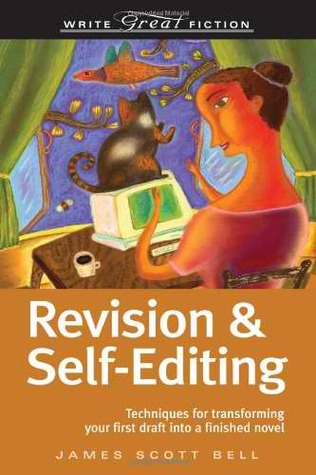
1. Revision & Self-Editing: Techniques for transforming your first draft into a finished novel by James Scott Bell (The Write Great Fictions Series, Writer’s Digest Books, Cincinnati, OH, 2008).

Bell divides his book between self-editing and revision, which he states are two separate processes.  They are 🙂

In his introduction, he references Browne and King’s Self-editing for Fiction Writers: How to edit yourself into print, another of my selections (see below), as well as a slew of writing gurus ranging from Brenda Ueland to Natalie Goldberg and Ray Bradbury.

Bell begins each section by presenting his philosophy of the task, then proceeds through self-editing with various chapters on each aspect of the work (character, plot, POV, etc.), asking probing questions along the way to get the writer deeper into their novel, and offering exercises to assist with the understanding of the element at hand as well as its relevance in self-editing.

When he gets to revision, it’s more about process than elements and analysis, but Bell is equally insightful in his discussion.

Bell is a skilled author and editor.  He writes from his experience in self-editing.  This perspective is what sets my first pick apart from the others.

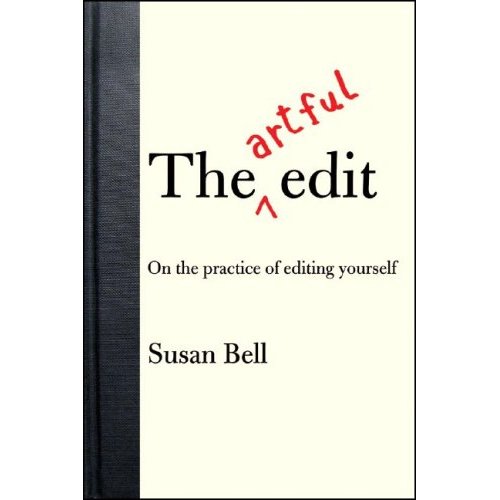
2. The artful edit: On the practice of editing yourself by Susan Bell (Norton, New York, 2007).

Susan Bell is a veteran editor and author, but her authority and perspective derive from the former role.

She breaks the self-editing task into Macro and Micro phases, again, providing examples, checklists, and exercises to deepen understanding. Then Bell offers what she calls her Master Class, provided in the form of experts in different creative fields (photographer, film, etc.) and what each can teach writers about how to make their story come alive.

Finally, she provides an overview of the evolution of editing, fascinating in itself.

Bell applies investigative zeal to her book, and it offers unique insight into the world or authors and editors, their relationships, where one begins and the other ends, and what the writer can do to become both.

3. Self-editing for Fiction Writers: How to edit yourself into print by Renni Browne and Dave King (Second Edition, William Morrow, New York, 2004).

First published in 1994 by HarperCollins, Self-editing for Fiction Writers is seen by many as one of the definitive works on the subject.

As with the James Scott Bell’s book, Browne and King’s breaks the task of self editing into its elements (characterization, dialogue, voice, etc.) devoting a chapter to each with examples and exercises.

One thing that I appreciate is the first chapter: Show and Tell (emphasis mine).  The point is made, and I fully agree, that while the writer should endeavour to show, that there are some places in your novel where telling is not only appropriate, but necessary.  It is the skilled writer who knows the difference and knows what technique should go where.

I also enjoyed the collaborative tone of the book.  When the authority is identified by “we” and not “I,” something rhetorical and clever happens: readers begin to feel that they are a part of the illustrious editorial team that wrote this book.

It’s an inclusive way of writing that empowers reading-writers to believe in their ability to self-edit.  The doors of the country club have opened, my friends, and we have all been invited in for drinks 🙂

The Wordsmith Studio Goodreads group is currently reading this book and it’s been a wonderful opportunity for me to get reacquainted with some old friends.

I recommend all three books highly (not to show favouritism or anything).

Do you have any books on self-editing that you would recommend?  Share their titles and maybe a few choice words of review in the comments so everyone can benefit from your experience 🙂

Writerly Goodness is calling it a night.

Some of my favourite books on the craft

Several months ago, I read a post called “Confessions of a Craft Book Junkie.”  I had no choice but to comment, because reading books on the craft of writing is an addiction for me.  I’m always buying more!

I have no idea what brought this issue up for me again, but having thought of it, I’ve decided to share some of my favourite craft books with you, and may you reap their myriad benefits! I don’t care if you get them as ebooks, or from a used book shop.  Just get ‘em 🙂

In the beginning …

There was Natalie GoldbergWriting Down the Bones and Wild Mind were the first two books I read about writing, and they’ve stuck with me through the years.  Goldberg espouses a philosophy of “first thoughts.”  Writing in your journal first thing when you wake up.  Sound like morning pages to you?

Goldberg introduced me to free-writing, and weaves in wonderful exercises for journal writing with Buddhist philosophy.  Monkey mind and wild mind is a concept I come back to again and again.  Monkey mind is the nattering, distracted place in our heads we occupy most of the time. 

Wild mind … well, draw as big a circle as you can on a piece of paper.  Put a wee speck of a dot in the middle of it.  The dot is monkey mind.  The rest of the circle—you guessed it—that’s wild mind, the cosmic consciousness that will endow your writing with greatness.

The key is to let go.  Don’t worry.  Don’t pin all your hopes on the greatness you might achieve.  Just be in the moment and do it.

Word after word

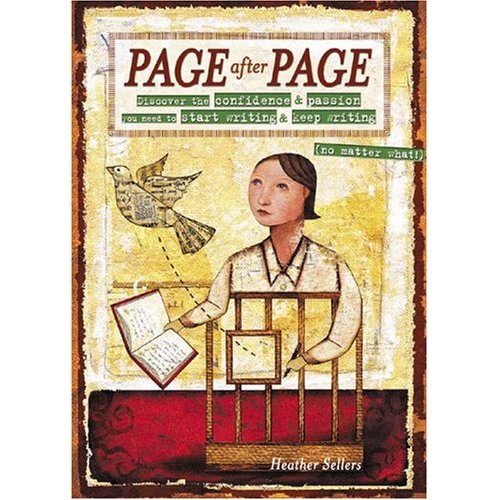
Heather Sellers two books: Page After Page and Chapter After Chapter really changed my writing game.  It was time for some tough love, and Sellers delivered.  She was the first author I read who asked the question: do you want to be a writer, or are you a writer?  She made the distinction very clear.

Wanting to be a writer means that you’re letting things get in the way, making excuses, because the phrase is always followed by the word “but.”

If you are a writer, you write.  You write every day.  You’re dedicated to your craft and you don’t let excuses get in the way.

Sellers also writes about her struggles, how the disapproval of peers and professors affected her, how relationships, good and bad, can influence your work, and how serious life incidents like car crashes and disease can change things forever.

In the end, you can only keep writing, word after word, page after page, and chapter after chapter 🙂

The Maass Oeuvre

Donald Maass is an industry expert and he turned his expertise into several wonderful books.

His first, The Career Novelist, delved into the changing face of the publishing industry.  No longer the land of monster advances, runaway auctions, and multi-book contracts, Maass discussed the kinds of writers, the kinds of agents, the kinds of editors, and publishers that were emerging, how they might survive the new era, and he offered a lot of practical advice about the mathematics of publishing (what do the numbers mean and why should I care?).

In the current market, this book has lost some of its relevance, but I would argue that it is still an important read.  Understanding the changes that led to the current state of publishing offers the reading writer insight.  Learning from history, we hope not to repeat it.

Writing the Breakout Novel gets more into the mechanics of how to write a damn good novel.  Using his personal experience and that of some of his well-known clients, Maass explains what agents and publishers are looking for, and gives the reader tools to achieve their goals.

The Fire in Fiction is more of the same, but deeper.  Maass really asks the writer to dig deep in this one and offers exercises to deepen your understanding of exactly what it is you’re doing.  Analysis.  Critical thinking.  If you’re willing to work for it, Maass tells you how to write a novel that will WOW.

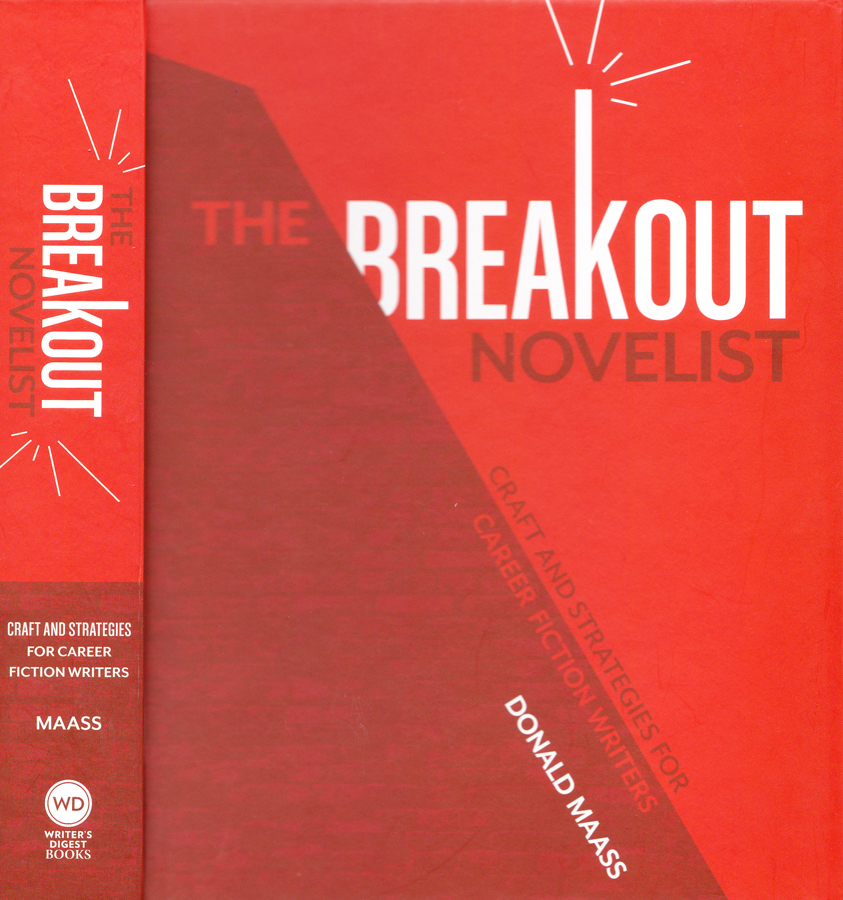
Finally, The Breakout Novelist, Maass’s most recent publication, is more of a workbook and reference than some of his other books.  It combines the best of Writing the Breakout Novel and The Fire in Fiction with extra exercises.  If you’re having trouble with a particular aspect of your novel, flip to that section and start working through the exercises.

Obviously, I’m a fan.

I’ll have more of these coming in future months.  I just thought I’d start with what I think are the best of the best 🙂

What are some of the craft books that you value and why?  How did they speak to you?  And as always, like, comment, share, subscribe!