Muse-Inks: Still striving for balance

Greetings all you writerly people!

July is off to a good start. My plan seems to be working. By focusing on one revision and one short fiction project, I’ve been able to get back on the horse, so to speak.

On Thursday evening, there was a special meeting of the Sudbury Writers’ Guild to attend, so I took that night off revision and writing, but made up for it on Friday.

I’m also busily drafting my next piece for DIY MFA. Like the last one, it’s going to be a bit long, but I have a strategy that will hopefully keep it manageable and leave me with material for a second post on the topic. Stay tuned 🙂

Unfortunately, it wasn’t a good week for quality sleep. I guess I have to take the bad with the good.

Looming (less than 3 weeks away!) is my great adventure to the Baltic. Yes, early, early, on the morning of July 27th, I’ll be flying down to Toronto in enough time to find the Air Iceland kiosk, get through customs, and board my flight to Hamburg, via Reykjavik.

The Writing Excuses Cruise will be visiting Copenhagen, Stockholm, Tallin, and St. Petersburg, with tonnes of writing workshops in between, from July 29 to August 5. Then I hop a short flight from Hamburg to Helsinki on the 6th, rent a car to run up to Marttila (yes!—isn’t that awesome?) on the 7th, tour around Helsinki all day on the 8th, and then take in the amazing that is WorldCon from August 9 to 12 (it runs to the 13th, but my return flight takes off early that day … ).

It’ll be my first time outside of continental North America. I’m excited and nervous, and, let’s just be honest here, scared out of my wee gourd. I know I’ll have a fabulous time. This is a bucket-listy kind of writerly adventure, after all, but iz still escared.

I’m not afraid to fly, or of the plane crashing, or anything like that. I’m afraid that I’ll miss one of my connections, and therefore the cruise, altogether. I’m afraid my boarding passes, which, to this point, are all virtual, will not materialize, or that my embarkation form for the cruise won’t arrive. I’ve received confirmation that some of the forms were late. I should be hearing about my embarkation form soon.

Oh, and did I mention? I’m going by myself. Sweet baby Jesus.

I’m getting jittery just writing about it.

Went out for dinner with a dear friend, Kim, on Friday night and she says the trip will empower me. I don’t doubt it. But I’ve travelled on my own before. Just not such a big trip so far away with so many moving parts.

In other news … we’ve been enjoying the fruits (and vegetables, and herbs) of our labours. The strawberry harvest is just about done, and the raspberries are about to start. Friends have been dutifully decimating the rhubarb, and we’ve been harvesting greens for salads and sandwiches. And lots of herbs. Chives, parsley, lemon thyme … We’re almost overrun by the sage. And our beans are starting to climb the trellis.

GardenJuly

I’d show you the patio garden, but I haven’t finished weeding it yet and so it mostly looks like purple clover. *blushes*

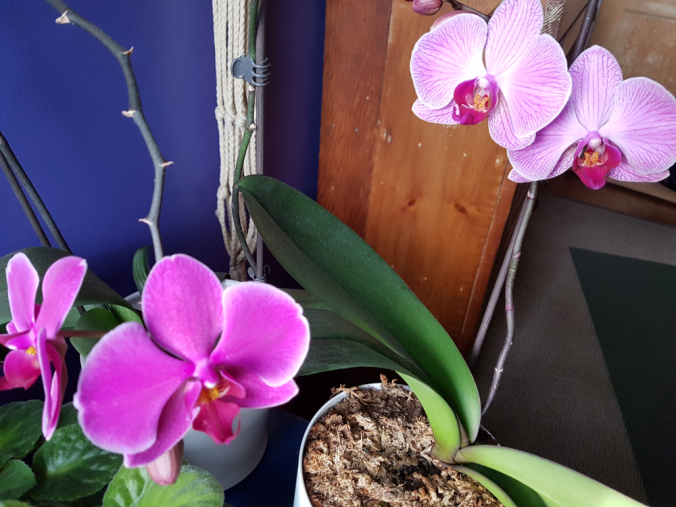
Inside, I’ve been enjoying my orchids. I have no idea how, but I’ve managed to get two plants to flower. I’ll take it 🙂

OrchidsBloom

That’s it for this week in the writerly life.

Next week, I think I’m going to do a series discoveries post, just to shake things up a bit.

In the meantime, be well, be kind, and stay strong. The world needs your stories 🙂

Muse-inks

Muse-Inks: A week in this writer’s life and more lessons in vulnerability

Greetings, writerly folk!

Fun stuff first.

On Tuesday of this past week, the Sudbury Writers’ Guild held its annual picnic on the lovely patio of one of our members 🙂 This is the first year in … several, that we’ve actually had a picnic outside. In recent years, because we’ve paid for the rental space, we’ve held the “picnic” in our regular meeting room.

Though the point is to get together and socialize before our summer break, it was nice to enjoy the lovely weather we’ve had recently.

Also on Tuesday, my latest column for DIY MFA went live. It was on time travel. I kind of gravitated to the topic because one of my works in progress deals with time travel, in a way, and so I’ve been researching the various theories. I’m kind of proud of this one. I’m proud of all of them, really 🙂

On Wednesday, I took part in the quarterly DIY MFA call. Gabriela has a number of new columnists and interns. It was great to get in touch with everyone and meet all of the new additions to the team.

Thursday was the final meeting of the Canadian Authors Association CanWrite! sub-committee prior to the conference. That’s next weekend, and will necessitate a brief blogging vacay. Just for the weekend. Curation will go on as usual 🙂

Then, just today, I participated in my first urban hike, a cooperative event put on by the Rainbow Routes Association and The Greater Sudbury Poet Laureate, Kim Fahner. The poets from the Sudbury Street Poetry Project were invited to accompany hikers on a downtown route which visited the various businesses and organizations where our poems were posted.

PoetryHike

We paused to read our poems at each location, and chatted between. Just after my stop at NISA, it started to drizzle, and then to rain. We ended up at the Farmer’s Market and the drumming circle performing there, where Louise Visneckie crashed the performance and read her work with drum accompaniment 🙂

As I mentioned last week, I was courting burnout and so, I decided to take a break from writing and revision for a while.

In the meantime, writers have continued to post their thoughts about writing every day, especially if the writer has a day job. Even for writers who work on their craft full time schedule days off. It’s important to give yourself space.

What I discovered this week is that even if I’m not writing and revising, I’m still writing and revising. I carry a small moleskine with me all the time and I made a number of notes on my various works in progress. Even when I’m not writing, it’s where my heart and soul live.

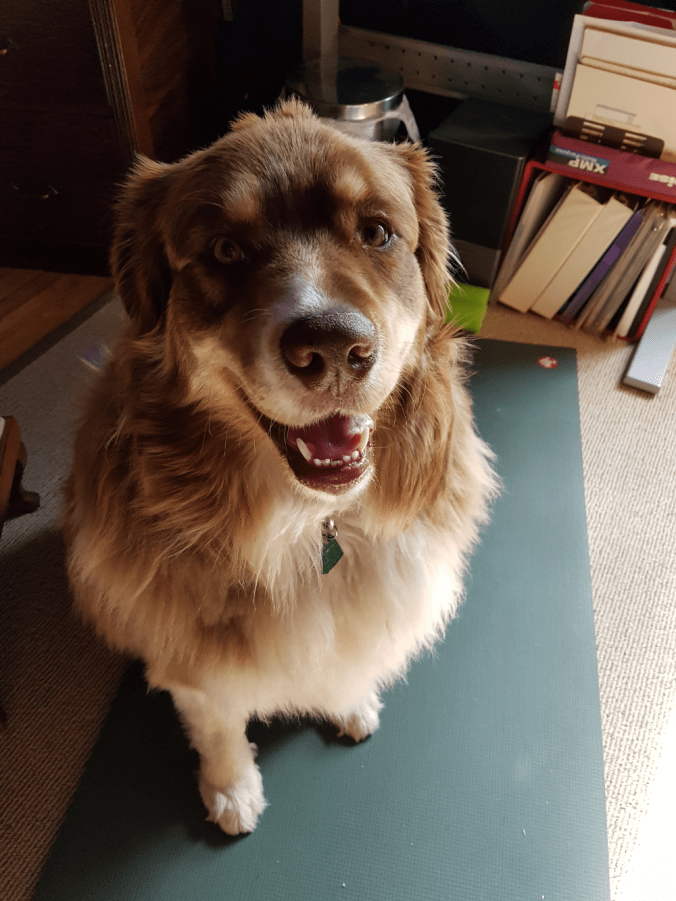
This weekend, Phil and I are also pupsitting for Phil’s sister.

Buster

Isn’t Buster a lovely boy?

So, I’d thought that, perhaps, I’d get back into the habit this weekend, but I have to put the final SWG newsletter together, and I think I might defer until Monday.

I’ve been considering giving myself a regular day off. Perhaps Friday.

I am feeling better, though. More centred.

Another reason for this is that I’ve continued to listen to Brené Brown’s The Power of Vulnerability sessions.

Stuff I’ve learned:

I’m addicted to shame. I said this last week, but now, I want to unpack that statement. When things go to shit, it’s always my fault. I don’t think, “It’s unfortunate this happened.” I think, “I’m a bad person because I let it happen/couldn’t stop it.”

That’s the core difference between guilt and shame. In guilt, you’re accountable, you take responsibility but, because it’s the action that was thoughtless or hurtful, you can take ownership and change your behaviour. With shame, it’s not the action, but the actor, who is thoughtless or hurtful. It’s much more difficult to change behaviour when the story you tell yourself is that you’re hardwired that way.

I live in a continual state of low expectation because it’s easier than getting excited about things and being disappointed.

You can’t love anyone else more than you love yourself. This gets people’s backs up, but it’s true. If you don’t have compassion for yourself, how can you ever show it to others?

I overshare as a defence strategy. Brené Brown calls it spotlighting. I don’t know if I do it consciously, with intent, but I’m very open with some parts of my life, sometimes with people who might be classed more as acquaintances, than as friends. It makes people back off and confirms my bias that I’m a bad person. I’m not worth knowing.

I’m not sure what I’m going to do with all this new insight. Yet. I now know that I have these issues and I’m learning some strategies to address them. I’m just not sure how I’ll get from point A to point B.

Mindfulness and baby steps. Like anything else, it’s a matter of patience and practice.

I also think I’m going to start gratitweeting. Blame Brené Brown and Kim Fahner, who is half way through her second year of the daily gratitude practice. I’m not sure when, but I think it’s a way to bring the good stuff to mind. It’s too easy to take those things for granted, and then you can too easily slip into hopelessness and depression.

I don’t expect the transformation to be immediate, but I do expect that it will help me manage my mood.

As always, I’ll keep you informed.

As I mentioned, next weekend there will be no post, and the weekend after will be July 1st (Canada Day!) and it’ll be time for my next chapter update.

Until next I blog, be well, be kind, and stay strong.

Muse-inks

Muse-Inks: My day at Graphic-Con and the struggle for balance

Greetings, writerly peoples!

Before I get to the meat of this post, I’ll give you a little update on the writerly happenings of the week.

This past week, there was just one. The Sudbury Writers’ Guild booked a table at Graphic-Con, which was held at the Sudbury Arena, Saturday, June 10th. While it’s not a huge event as comic cons go, it was big for Sudbury.

Fandom was well-represented. There were cosplayers, LARPers, gamers, table top gamers, RPGers, comic fans, art fans, and television and movie fans (Degrassi actors were in attendance). And there were readers.

SWG co-chair, Andy Taylor, committed to be present for the full day as this was our first year booking a table and he wasn’t sure whether it would be worth it or not. Liisa Kovala helped out from opening to noon. I helped out from noon to 6 pm, Clay Campbell walked over after his CKLU radio show and stayed through to 7 pm, Liisa returned to finish off the day and help Andy pack up the table, Kristan Cannon had her own table (right beside the SWG table), and members John Jantunen and Sabine Gorecki stopped by and hung out for a while. It was a team effort 🙂

GraphicCon

Andy took this picture just after Clay (Rincewind) and I arrived and before Liisa left (noonish).

We had on display various books by Guild members, including a few copies of my wee poetry chapbook, NeoVerse. We sold just about one of everything (well, except NeoVerse—I didn’t expect poetry to be a big seller, though there was some interest), sold out of Creepy Capreol, which our other co-chair, Mat del Papa edited, and sold five of the SWG anthology, Sudbury Ink.

Sales weren’t the purpose of our booking the table, however. Reaching out to the writing community in Sudbury was. In that respect, the table was a total success. We had 19 people sign up to find out more about the Guild. We’re going to try to get together in late June for a special meeting for these individuals. If the timing doesn’t work out, we’ll at least send them a copy of our June newsletter to give them an idea of who we are and what we do.

Which leads us to balance

When I got home from Graphic-Con, I was pretty much bushed. Phil had the moms over for BBQ, but afterward, I decided to forgo my usual Saturday post.

Work/home/creative balance is a recurrent issue for me.

As a writer with a day job, I’ve chosen to devote nearly all of my non-work, non-sleep time to writing. Thus, a lot of other things go by the wayside. Physical fitness, family and social events, friends, support of artistic and professional organizations and events. Still. I can’t shut all of that out of my life. So, I try to squeeze it all in. Therein lies the rub.

When I can drag myself out of bed early enough, I do yoga or other exercises in the mornings. When the weather and other commitments permit, I walk home from work. I spend time with Phil and with my mom. I volunteer for the SWG and for the Canadian Authors Association. I try to get out and do something creative and soul-feeding in the community.

I try to get out and garden, or use my summer office. I try to keep the house clean(ish). My standards have fallen significantly in recent years …

I also try to write or revise my novels and short stories daily, keep up with my blog posts, keep up with my commitments to DIY MFA, read, study my craft, improve, attend writing workshops in person or online … and it all takes its toll.

Add to that my persistent issues with depression and anxiety which I must manage carefully, and a myriad of aches and pains that only seem to multiply the older I get, and there are times when I have to step back.

Phil’s supportive. He does the cooking, the groceries, the heavier household chores, and the renovation on his own. He knows my writing time is mine and, except for the odd hug or kiss—we need a fairly steady supply—he leaves me to do my thing. He doesn’t insist on coming along (he hates travelling and would just be miserable) or that I stay home when I have a conference or convention to attend. He listens when I have to blow off some frustration about work or professional obligations. He’s learned, for the most part, not to try to offer solutions. I’m very fortunate.

The heady rush of positive feeling and energy that returns with the sunlight in spring gives way to my first bout of burnout around this time every year. The second battle with burnout usually hits in the fall. This is why I have usually tried to take a self-funded leave from work every 18 months or so, May into June and then October into November.

It’s how I’ve managed my physical and mental health.

It’s been two years now since my last self-funded leave and the continual issues with our pay system at work have meant that I’ve had to defer my plans to take a leave yet again. I won’t be able to manage much longer if I can’t get a leave this fall. I’ve pushed through before, but never longer than two years. I used to work part time when I was in the call centre. That’s probably a better long-term strategy, but this next leave will involve a new pup as well, I don’t have enough leave aside from the self-funded to house train a pup.

I’m hoping that the larger part of our pay issues will be resolved by then and that it will be a possibility. Even if it’s not, I can’t afford not to make the request.

For now, all I can do is take things easy for a few days, give myself a break, and then get back to it.

I’ve been listening to Brené Brown’s The Power of Vulnerability sessions on Audible. Vulnerability is at the core of a satisfying life, of contentment (which is always my goal, not happiness—I’m pretty sure that’s a mythical beast), and of achieving healthy goals. And self-love is at the heart (lol) of vulnerability.

Unfortunately, I’m kind of addicted to shame and I tend to wall myself off from other people so I don’t have to be vulnerable with them, one on one. Everyone else thinks I’m doing great. I’m that high-functioning person living with mental illness. I can simulate vulnerability on this blog because it doesn’t cost me as much as opening up in person can. All the self-hate takes place in private. I operate from a scarcity mindset. There’s never enough time, energy, you name it, and I am certainly never enough.

I know that none of this is true, intellectually. I know time can be managed, found. A healthy lifestyle can provide me with more energy. I can tell my friends and family that they are enough often, but I can rarely turn that compassionate lens on myself.

So I’m going to goof off for a few days, except for the absolutely necessary stuff, like blogging and housework, professional obligations, and, well, the day job. I’m going to try to be present enough to listen and be kind to myself and to others. I’m going to try to enjoy myself.

We’ll see how it goes and I’ll check in with you next weekend after the poetry walk. The post may go up on Sunday again, but that’s just my way of shifting things to give me enough intellectual and emotional space to recover.

In the meantime, be well, be kind, and stay strong.

And I’ll “see” you on Tipsday!

Muse-inks

Why you should enrol in Writing the Other

Disclaimer: I’m a total newb at trying to express my thoughts and feelings on diversity and cultural appropriation. If I inadvertently write anything offensive or harmful, I invite you to let me know. But I have to start somewhere, try and fail, or I might never improve. Thank you, in advance, for your time, attention, and kind intervention (if required).

I’m not rolling up content as I have in other posts of this nature.

Out of the gate, I’ll recommend Writing the Other (WtO) to any writer concerned about writing inclusive fiction with respect and dignity accorded to characters unlike the authorial self. If you’re not concerned with these vital aspects of craft, then stop reading this post now. There’s nothing for you here.

K. Tempest Bradford and Nisi Shawl deliver an amazing and thought provoking course, the point of which is not to police creativity, but to ask authors to examine their fears, context, and assumptions, and to do their best to write inclusively. WtO will give you the tools to write characters of other ROAARS (race, sexual orientation, age, ability, religion, and sex) characteristics with integrity, and the resources to deepen your knowledge and understanding.

The point is that writing well is hard work, and writing well and respectfully of otherness takes effort and practice, like any other aspect of the craft. You have to be open, willing to learn, willing to practice, and willing to think critically about the creative choices you make in your fiction.

Those of us who come from a background of privilege (white, male, heterosexual, able-bodied, etc.) and those of use who align fairly closely with the unmarked state, still want to write inclusively. If we do so without due consideration, education, or research, we run the risk of harming the people from the same communities as the characters we write from sheer ignorance.

This can take the form of tokenism. Only have one character who is a person of colour? Why not include two, or even three, so readers can see that these characters are, first and foremost, people? Explore the experience of these characters in a fully-fleshed and respectful way. Give them voices. Compare and contrast them. Give them as much attention and thought to them as you give your main character. They may not have as big a role to play in your story, but they deserve to be real.

If your one gay character just happens to be the antagonist, you may inadvertently send the message that you think all gay people are like the antagonist. If your one trans character is the sidekick who gets killed, they become disposable, and that is another negative message you may unintentionally send.

If you have a disabled character who is “cured” by technology or magic, you effectively erase the character’s identity and struggle. If the character has to be able-bodied for the story you’re telling, then tell the story with an able-bodied character. Think about why you want to write a disabled character. If it’s to honour their struggle, then honour it. If you just think it’s cool, that may be true, but your choices may bear more thought.

Recently, in Canada, there was the “appropriation prize” debacle. [I’ve been curating articles and posts on the issues, in Tipsday and Thoughty Thursday, for the past few weeks. Peruse, if you’re so inclined.]

Last year, there was the Lionel Shriver controversy. [And yeah, I curated that one, too.]

Cultural appropriation happens when you take a story that belongs to a culture other than your own without permission and consultation (both are required) and write about it in a way that dishonours the originating culture.

This can happen in any of the arts.

The word diversity has been thrown about in publishing and writing so much in recent years that the word has almost lost its meaning. I’ve heard of speakers who have retreated from panels on literary diversity because they are often attacked or their statements taken out of context for the sake of theatrics or sensationalism.

Diversity, to me, means that people of colour, of other sexual orientations, of differing ability, age, religion, or sex, should write their own stories. And they should be welcomed into the publishing world. We need more editors, agents, and other publishing professionals who are from different backgrounds, too.

This doesn’t mean that no one should write a character that doesn’t share their background. If they do, though, they should be prepared to take the time and do the research to represent that character authentically.

For myself, I’ve decided that I won’t write a protagonist that is significantly different from me. That’s my personal choice, though. I won’t prohibit anyone else from doing that. And there are some writers who have written the other brilliantly, so I won’t say that it can’t be done. I choose not to.

But I want to write inclusively about a world that’s like the one I see every day. To do that, I have to educate myself. And WtO was a first step on that path.

As always, be well, be kind, and stay strong.

Muse-inks

Story Masters: May 11-14, 2017

This lovely workshop came to my attention last year through Jenny Madore, a writer friend. It was put together by Lorin Oberweger and Free Expressions. Jenny sent me a notice last spring, yes, that was waaaay back in March of 2016, with the notification and a special early-bird discount.

The notification? Christopher Vogler, James Scott Bell, and Donald Maass would be coming to Toronto to present their Story Masters workshop. Needless to say, I registered on the spot.

Fast forward to May 10, 2017, and I was on my way to the Crowne Plaza Airport and excited to learn from these three masters of story.

Day one: Christopher Vogler

ChristopherVoglerI’ve read The Writer’s Journey (and Campbell’s Hero with a Thousand Faces, Murdock’s The Heroine’s Journey and The Hero’s Daughter, as well as watching Campbell’s series with Bill Moyer, The Power of Myth), and I was looking forward to meeting Christopher Vogler in person.

One thing I’d forgotten, having read his book years ago, was that Vogler is a screenwriter. He’s been working with the hero’s journey for forty years, since his film school days.

Highlights of the presentation:

  • A knowledge of structure will help you see the bones of a story.
  • The map is not the journey.
  • Get all five senses on the page – Ray Bradbury.
  • They won’t remember your words but they’ll remember how you made them feel – Maya Angelou.
  • Economy of language.
  • Make invisible things visible.
  • Use dissonance.
  • Theme – boil it down to one word.
  • The chakra system can be used to orient where your story comes from. There’s a parallel between the chakras and Maslow’s Hierarchy of Needs.
  • Vogler’s rule – the story’s good if two or more organs are leaking fluids. Visceral, but accurate (blood, sweat, tears, vomit, pee—from fear or laughter, and, erm, sexual fluids—it’s true; a well-written sex scene gets the juices flowing, doesn’t it?).
  • A story should be focused, “in alignment with the grid,” a term from dance.
  • How your protagonist/main character enters the story is critical. Classically, protagonist means the first person to struggle. Now, that’s your hero or main character.
  • A story should evoke catharsis. The classical definition of catharsis was vomiting. Now it’s an emotional cleansing.
  • How stories work: want vs. need. Want is generally external or physical. Need is internal or emotional. There are two story questions, one inner and one outer. It creates suspense. There’s always a price.
  • Every world/milieu is polarized. The hero brings synthesis.

Vogler also showed us a number of movie clips to illustrate the 12 stages of the hero’s journey, discussed the two founders of screenwriting, Aristotle and Syd Field, three-act structure and how the hero’s journey works with it, storytelling aesthetics, and his own meeting with Campbell.

Day two: James Scott Bell

I’ve read some of Bell’s writing craft books and followed his collective/blog – Kill Zone. Again, I was looking forward to meeting JamesScottBellsomeone I’d only ever known as a virtual presence.

  • A writer needs to have an edge. What is it? Unforgettable writing. Seductive believability.
  • Write from the middle. The mirror moment. What’s happening to the character at that moment is what the story’s about.
  • The mirror moment can focus on one of two things: 1) Who am I? What have I become? What will I become? [emotional/spiritual struggle] Or, 2) I’m going to die. [Physical] The death can be metaphorical. Both result in the transformation of your character.
  • Once you know what your story’s about, you have your focus, your theme.
  • Pre-story psychology. Does your character have a moral flaw to overcome? Do they change or get their comeuppance? Is your character ordinary? What circumstances force the character to change?
  • Short fiction is about a shattering moment rather than a mirror moment.
  • Bell’s golden triangle: pre-story psychology leads to the mirror moment, which leads to the transformation. It can be applied in an individual novel, or over the course of the series, or both.
  • The shadow story – what’s happening elsewhere?
  • Keep a story journal to keep track.
  • Great characters jump off the page. They’re unpredictable, burning, wounded, complex, resourceful, courageous, noble.
  • Bell’s corollary to Vogler’s rule: you must have a fluid fight inside your character.
  • Ways to develop character: 1) The closet search – what’s the skeleton? 2) Throwing the chair (out the window) – why do they do it? 3) Best day/worst day. 4) What tattoo do they have, where, and why? Or, why would they never get a tattoo? 5) what would they do or think about in jail?
  • Opposition character: you must know what they yearn for, why they deserve it, and then make your closing argument (convince the reader).
  • Cut the boring parts, or, make them interesting.
  • Fear is a continuum. It raises the stakes. Fear of the known. Fear of the unknown.
  • Scene structure: every scene must have an objective, obstacles, and an outcome [yes, but/no, and].
  • SUES = something unexpected in every scene.
  • Every scene has a reaction: time for thought, perception, emotion, backflash (short remembrance), or flashback (full scene – use sparingly).
  • Dialogue: every character has an agenda. If those agendas are conflicting, even better. Dialogue creates conflict/tension, subtext, sets the tone for the scene, and sets the tone for the characters. Specific concerns: vocabulary, expressions, syntax. They should vary between characters. Dialogue should be unpredictable and compressed. Dialogue should reveal character webs, backstory, and theme.
  • Tools: Orchestration, transactional analysis (Google it), curve the language.

Bell, also from a screenwriting background, showed us clips from Casablanca and Now, Voyager and cited a number of novels (ranging from Gone with the Wind to The Hunger Games) to illustrate his points, linked to Vogler’s hero’s journey, and set us up for Donald Maass’s presentation on the next day.

Day three: Donald Maass

DonaldMaassI think Donald Maass was the story master I was most excited to meet. I’ve bought and read all of his books (except The Emotional Craft of Fiction, which I bought at the event), and I’ve read and shared all of his Writer Unboxed contributions.

I’m such a fan that when I met him in the elevator, I blurted out, “I’m here to see you!” like a total fangirl.

He paused. “Do I know you? You look familiar …”

“We’ve never met in person, but you may have seen me online—the white hair’s distinctive. I share all of your posts. I’m a big fan.” And then, mercifully, we reached the lobby and debarked. I was completely mortified, certain Maass thought I was a stalker.

It reminded me of a recent post by my friend, Kim, who said she becomes so distracted in the presence of a writer that she says the most inappropriate things. Happens to me all the time.

For those of you who haven’t been to a Donald Maass presentation, it’s a bit different from what you might expect. He presents a topic, speaks briefly, and then, he begins to ask questions. The questions are intended to guide you into the heart of your characters, your scenes, your story.

It’s very meditative, very zen. And totally effective.

Unfortunately, after a few hours, the brain stops working and you just write down the questions for future review and examination. At least, that’s what happened to my brain.

I just wanted to give you a flavour of Maass’s style.

Openings

  • Too many novel openings are written objectively despite the prevalence of first and close third person narration.
  • Where does the story truly begin?
  • Story does not equal plot.
  • What’s different and how does your protagonist know things will never be the same? What symbolizes this? What do they do differently? What needs to be explained? What expertise does your protagonist have? What do they know that the reader needs to know? How does the trouble come? Why?

Voice

  • Writers adopt a voice that suits the genre, but not the story.
  • What happens? What’s unique to the setting? What anchors you? What wakes you up to your reality? What’s unique to the character? Name, role/occupation, what task/goal/purpose do they think they have? What’s on the “to do” list of your character?
  • [We then did an exercise in which we rewrote the beginning of our works in progress with three different voices: ironic, academic, and spiritual.]
  • The inner life of the character is the true story.
  • Plot does not equal story.

Emotion

  • You have to write with emotion about emotion in a way that deeply engages readers.
  • What makes you angry?
  • Your protagonist feels a new emotion. Pause. Slow things down. Go deeper. How does that change your protagonist? What will they never do again? What will they never feel again? What will they never feel the same way about again?
  • How do you create the sense of an evolving human being rather than someone to whom stuff happens?
  • Does your character have flaws?
  • My Writer Unboxed colleague Lisa Cron wrote a book called Story Genius that I highly recommend. She states every character has a misbelief that shapes their story. What is your character’s misbelief? Who will be hurt because of their misbelief? What does the character get wrong? What do they believe that will cost them dearly? Who will walk away from them because of the misbelief? What will they lose? What can they do that shows they’ve changed? Is it big? Symbolic? What’s the secret they’ve never told anyone? Is your protagonist concealing something from someone else?
  • What’s the character’s origin story?

Other facets of novel construction

  • Summary. Lorin Oberweger posted on Writer Unboxed about this. When should you use it?
  • Scene structure. Things have changed by the end of the scene. Subvert expectations. Show the inner shift in the novel. Scenes must change either the plot or the character.
  • Enhancing the story world. What’s the environment? What does your protagonist see that no one else sees? What does your antagonist see? Is there a class structure? How does that play out with your characters? What historical events have shaped the world? What are the political structures? What is just not done? Is there a code of honour? How do you make a deal? How do you pay respect?
  • Telling and showing. Both have value.

What do readers want?

  • They want an emotional experience. They want to engage with your protagonist. They want a satisfying payoff. They want aesthetic value. They want a challenge. They want to figure it out. They want a feeling of success.
  • Readers have their own journey.

Third level emotion

  • Pick a pivotal scene in your novel. What is the character feeling? What else are they feeling (cancel out any similar emotions)? And again, what else (that is like neither of the first two)?
  • Use the third emotion you identify to frame the character in the scene. It seems counterintuitive, but it’s very effective. Readers use cognitive evaluation.

Mythic roles (archetypes)

  • What fairy tale character is your protagonist most like? Shakespearean? Biblical? Greek or Roman mythos? Indigenous or other cultural figure? Urban legend?
  • What symbology have you built around your character?

The four things your story must do

  • The macro level: structure/plot/character arc.
  • Scene level: structure and goals.
  • Microtension: every page, every line. Court cognitive dissonance.
  • Subvert reader expectations.

The big event

  • Think of the event that changes everything for your protagonist and the story world. What causes people to think it’s never going to happen? Think of three reasons why. How do we know it will happen? Think of three reasons.
  • Take out foreshadowing. Include misdirection. Manipulate expectations.
  • Choose a secondary character who is good. Invent a way to create doubt. Cast suspicion.
  • Make the reader wait for the payoff. What are three reasons it might be the wrong thing for your protagonist to do? Build a case for doing something different.
  • Every story has a moral map. Point the reader down the path. What makes a reader care even when nothing is happening? Hope. What is good? What can be saved?

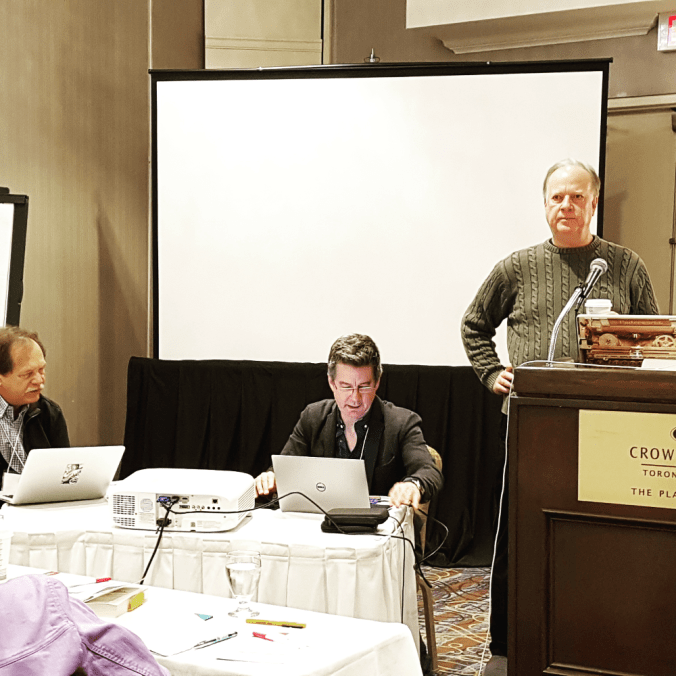
StoryMasters

Day four was an analysis of To Kill a Mockingbird in which all three story masters brought their individual strengths to bear.

My brain was mush by the end, but I brought a lot of awesome back with me and twice as many pages of notes as what I’ve shared with you here.

RobertJSawyerOther writerly goodness: I met Jenny Madore in person, saw writer friends Jeanette Winsor and Sue Reynolds, and hung out with Robert J. Sawyer for a bit. It was comforting to know that someone I consider a story master in his own right is still learning 🙂

I had a fabulous time and suggest you check out the Free Expressions web site if you’re interested in attending one of their workshops.

As always, my friends, be well, be kind, and stay strong. The world needs your stories.

Muse-inks

Changing things up and the reasons why

A few years ago, I decided to change things on the blog. I started curating Tipsday and Thoughty Thursday, and then, on weekends, I mostly blogged my session notes from various conferences and conventions I’d attended.

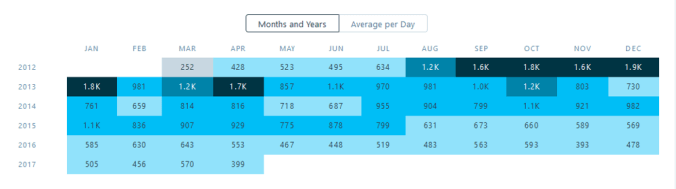
It was easy for me, with respect to generating content, and I sincerely thought I was offering something of value to my readers. My WordPress stats do not bare this out, however. Round about 2014 (when I started the curation and session notes), my views drop and are consistently below a thousand per month.

views

Views dropped again after Nuala died in 2015. My pupdates were clearly some of my more popular posts, as well.

Even looking at it by day, I only seem to have a peak in views (40+/day, which I know is nothing when it comes down to it) about once a month. When those peaks occur varies. It could be after a Tipsday post (most often), or a Thoughty Thursday post. Sometimes, it’s on a weekend, but it could be session notes, or a monthly update. There’s really no pattern that I can pull out.

But clearly, this means I’m not doing my job.

I have therefore decided that it’s time to shake things up again. Not too much. ‘Cause I’m cautious that way.

I’ve had the most views, likes, and comments on my curation posts, so I’m going to keep blogging those. I’ve created better graphics for them (thank you, Canva) and I still believe they have value.

It’s the weekends I’m going to rethink.

I’m also going to continue my monthly updates. I like sharing my progress on various projects and it keeps me accountable.

I’m no longer going to blog session notes, though. Instead, I’ll do a summary/highlights post of any writerly events I attend. There are enough of those that it will keep me producing quality content. In the past couple of years, I’ve actually glossed over some of these events, or only given them a passing mention in my monthly updates, because I really haven’t had the time to write a post devoted to every event I attended.

I’m going to revisit some of the topics from the blog posts that, even five years on, continue to receive the most traffic.

I’m also going to post a referral to my DIY MFA columns when they come out.

Finally, I’ll fill in the gaps with Movie Madness, Series Discoveries, and the odd book review. There may also be the occasional Muse Inks post on this writer’s life, which won’t focus on the writing, but the other stuff that fills up my life around writing.

When Phil and I get our next fur baby (this fall is the new goal … we hope) Sundog posts may even return 🙂

Because writerly goodness is a solo effort, though, I’m still going to have to take the occasional blogging vacay for some of the bigger events I attend. It’s the way things have to go while I’m still working a day job.

If I want to set the time aside to write and to attend my various writerly professional development opportunities, I really don’t have the time to generate a lot of content to pre-schedule and fill in the gaps. I find myself at the limit as it is, but that may be because of the various commitments I’ve made to some of the professional writing organizations of which I’m a member.

I’m considering a re-envisioning of those commitments, too. There’s only so much of me to go around. Do I want to be writing, or do I want to be contributing to the success of writing organizations? It’s going to be a tough decision, ‘cause I’m like Eek! the cat. I always think it never hurts to help. Until it does.

The next few weeks in writerly goodness:

Next weekend, it will be my monthly Next Chapter update. The weekend following, I’ll be away at Story Masters and won’t be posting, but I’ll tell you all about it the weekend after. I’ll have a few more events to discuss in upcoming weeks, but I’ll get into that in my Next Chapter post.

So stay tuned as I work my way through this transition.

And let me know what you think, please. Will this shift be a pleasing one for you? Perhaps only time (and stats) will tell, but if you have any thoughts to share, I’d love to hear them. And if you have requests to make, I’m all (virtual) ears. I know I can’t please everyone, but I’m willing to incorporate some of your suggestions into my ongoing plan.

Thanks for your time and attention.

You’re the bestest!

Muse-inks

Catching up with the DIYMFA Launch Team

Since I was away last weekend, I have a leetle catching up to do. So you get twice the DIYMFA QotW this week.

Let’s start with the week 11 prompt:

QOTW 11: What’s Your Favorite Supporting Character Archetype, and Why?

As you already know, at DIY MFA, we’re big on archetypes. We’ve talked about protagonist archetypes and supporting character archetypes on the site and podcast. We even created our Storytelling Superpower quiz by understanding what different protagonist archetypes want (and how that want drives the story). This week, I want you to turn your attention to the supporting cast. What’s your favorite supporting character archetype and why?
Muse-inks

We’ve established previously that my storytelling superpower is the Protector. All of my protagonists are trying to protect, or save something. Interestingly, I think they all start out as survivors and make the transition to protector. Check out Gabriela’s Storytelling Superpower video series (it’s free!) to find out more 🙂

I’ll approach this by going through each of my WIPs and look at who I’ve written by way of supporting characters. I’ll also limit it to the main supporting characters. For example, my epic fantasy has a lot of characters. It’s the nature of the beast; so I’ll do y’all the favour of not covering all of the supporting cast members.

By the way, I’ve based my assessment on the 12 character archetype system. I know there are a lot more potential archetypes out there, but I, like Gabriela, wanted to keep it simple 😉

Interestingly, these are mostly groupings of three (protagonist + 2 supporting characters). Nice how I managed to get the whole power of three thing without even thinking about it (!) If you want to find out more about the power of three, check out the DIYMFA book, coming soon!

Initiate of Stone/Apprentice of Wind

Protagonist: Ferathainn Devlin. She’s an uninitiated mage from whom war takes everything. She starts out wanting to take revenge on the man she believes to be responsible, but when she realizes there’s more at stake, like, the fate of her world, she has to choose between revenge and sacrifice.

Eoghan: Eoghan doesn’t fit neatly into one archetype. This is because he is physically transformed over the course of the first novel.

He starts out as an innocent, a postulant monk living in a dormitory with a bunch of other orphans, waiting to be called to serve. His much older brother, a priest, is accused of, and executed for, heresy. Eoghan is exiled, and then the goddess Auraya calls him to become her Kas’Hadden, her hammer of light. That’s where the transformation comes in.

On his way, though, fleeing the destruction of war and trying to help the wounded and dying left in the wake of it, he finds Ferathainn, apparently dead. He decides to make her his last stand. He will save her no matter what. And he does, though it involves months of care to nurse her back to health. So he becomes caregiver.

And once Auraya insists, he finally goes to her where she waits, at the Well of Souls, and she transforms him into her holy warrior, her hammer of light. And he becomes a hero/warrior. He has been made to spare his goddess the indignity of murder.

Dairragh: Dairragh transforms, too, though not in the same way as Eoghan. He starts out as the son of an aging lord, eager to prove himself and inherit Gryphonskeep and its lands. He’s been taking care of things in all but name for years now, and is impatient for his father to recognise that he is worthy. He is the ruler without anything to rightly rule.

After Gryphonskeep is destroyed, his father killed, and the gryphons slaughtered, he is taken in by the anogeni, the hidden people, and through their influence, he learns shamanism.

When he meets Ferathainn, Dairragh is becoming the magician.

Figments

Protagonist: Charlene Kalveras (Chas). Chas has been pretty messed up since her father was murdered. Depression and nightmares have yielded to insomnia. When she starts to see things the other kids can’t, she’s worried she’s had some kind of psychotic break. When her figments turn out to be real, though, she discovers a whole other world, and truths about herself and her father that she could never have suspected.

Chas is a protector-mage, an hereditary group of magic-using humans devoted to maintaining balance between Earth and Regnarium (think Plato’s world of ideals mashed up with Jung’s universal unconscious—crazyworld of myth, fairy tale, and, of course, gods).

Ben: Ben is one of Chas’s two best friends. They’ve known each other all their lives. He’s an athlete and a beautiful brown boy who’s smart enough to get by without studying and has developed an unrequited crush on Chas. She’s just been so damaged since her dad was killed, he can’t help himself. He wants to fix things for her.

Though there are shades of the caregiver and lover in there, Ben’s pure everyman. He’s the realist. He keeps Chas grounded.

Finn: The other of Chas’s life-long friends, Finn, might seem to be another everyman. Every person? Whatever, that’s not her. She’s perfectly average, in most respects, but she has a secret fondness for dreams and dream interpretation. Finn also has no internal censor. She says everything she thinks and has to really struggle to be polite sometimes.

When Chas finally reveals what’s happened to her, Finn is on board. She is the creator, the visionary. It’s no surprise to any of them that she has some of the mage-blood in her family, too.

To make the dynamic of the threesome just a little more problematic, Finn’s crushing on Ben, and Chas is aware of the awkeird love triangle but she doesn’t feel anything romantic for Ben and wants nothing more than for Ben to shift his moony gaze to Finn.

Marushka

Protagonist: Marushka. She’s a weirdo, but anyone would be, in her place. Stolen at birth by Baba Yaga (who then ate her mother—shudder), she’s lived in Baba’s sentient hut, Khizhina (literally, hut), all her life. She has no idea how old she is and aside from a few adventures into the normal world to attempt to go to school, or get some books to read, she’s never left Khizhina. Until, that is, Khizhina tells her she has to take Baba Yaga’s place.

Khizhina has mercifully segregated Marushka from her horrid kidnapper/captor, who regularly dines on young, homeless people. Marushka can’t bear the thought of becoming a cannibalistic hag and runs away.

Out in the world, though, she learns she can’t escape her destiny. First, her latent powers begin to express themselves. Second, a patriarchal shadow organisation, bent on destroying goddess-power and subjugating all women for all time, targets Marushka and tries to take her out of the game before she becomes the next Yaga.

She’s socially awkward and doesn’t make friends.

Declan Russell: Declan’s parents decide to foster Marushka. He’s never met anyone like her before and is pretty much instantly smitten. He’s a computer geek/gamer-boy, loves death metal, and is a brown belt in Aikido. His younger sister, Cindy, is the pain in his ass.

In a home invasion and arson (an attack by the shadow org) Declan’s family is killed and only he and Marushka are rescued. Kind of. They’re not allowed to go out, even to the police. Marushka’s birth father, Alex Solomon, who led their rescue, calls it protective custody.

Who the heck is this girl?

He’s the lover.

Yuki Oshiro: Yuki is the Matriarch of the Oshiro family, one of a number of Old Families who have been tasked with the preservation of goddess-power and women’s agency in the world. Her mother actually represents the Oshiros on the Matriarch Council, because boring, and because Yuki would much rather have boots on the ground. She has to be doing something concrete and meaningful. She leaves the political manoeuvring to the Council.

When Marushka suggests a clandestine invasion of the shadow organisation’s stronghold, Yuki can’t resist. Now if they could only dump the kid . . .

Yuki’s another hero/warrior.

This one’s not such a neat grouping. Marushka’s constantly moving, constantly changing circumstances, from Khizhina, to a Children’s Aid Society group home, to foster care, to her (surprise-surprise) birth father’s other family home, and then finally to the Oshiro’s. She doesn’t have a lot of time to make friends, not that she’s any good at it. Declan attaches himself to her, and, after the Russells are killed, Marushka feels responsible for him.

Another attack happens while Marushka and Declan are with the Solomons and after Marushka manages to save them, Yuki, who’s been on patrol, takes them to her family’s home. Yuki’s a bit of an odd duck herself, and so she kind of likes Marushka. That whole goddess thing—bonus. Until Declan proves himself, which he does, she’d as soon turn him over to the CAS.

Reality Bomb

Protagonist: Brenda O’Connell. Brenda is a PhD candidate in physics and astronomy who becomes aware that a fellow candidate, Simon, is attempting to prove that time travel into the past is possible. She tries—and fails—to stop him resulting in the destruction of their reality and the relocation of her consciousness into her alternate self in another reality, nearly a year in the past.

Her alternate self is nothing like her and Brenda has no idea how she’s going to make her situation known to her other self, let alone how she’s going to try to figure out if Simon’s alternate self is heading toward the same disastrous experiment in this world.

B2: This is another weird one. Brenda’s alternate self is in the fashion design program at an art school co-located with Brenda’s university. She’s a cool girl, fashion whore, hard partier, and pretty much everything Brenda’s not, including straight (!)

When Brenda finally is able to make contact, B2’s first reaction is to think she’s insane. Understandably. They fight each other over everything, initially, but eventually come to an uneasy understanding. Brenda can’t do anything without her alternate self.

Over time, they start to influence each other—until disaster happens.

B2 is the explorer/hedonist. Truthfully, Brenda’s a little repressed. She needs B2’s influence.

Morgan Estys: Morgan was the woman Brenda was in love with in her reality. In the alternate world, she’s in the journalism program, and the key to uncovering Simon’s secret lab where he is trying to prove that time travel into the past is possible.

Morgan is the sage.

Gerod and the Lions

Protagonist: Gerod Tucker. Gerod is the youngest boy and the second youngest child of the very large Tucker family. His father, Old John, values strong hands and strong backs, neither of which Gerod possesses. He’s small for his age, not that anyone knows what that is, and makes it his business to try to take care of his family, who all work on Lord Somber’s land and estate. Still, the Tuckers are destitute.

It’s a lean year, and the Child Merchants always come in lean years to buy the ‘surplus’ children of the poor and sell them to the noble families and merchants in the big cities, far away.

Gerod’s been working on a plan, and a hiding place for himself and his little sister, Annabelle, but the Child Merchants come to his village before Gerod is ready, and when Old John sells Annabelle in Gerod’s absence, Gerod chases after the Child Merchants, determined to rescue his sister.

Unfortunately, by himself he can’t fight the large and well-armed Child Merchants. In desperation, he attempts a night rescue, but the cries of the frightened children alert the Child Merchants, sending Gerod running, pell-mell through the woods, into an enormous tent, and right into the paws of a lion.

Maisy: Maisy is the lioness whose enclosure Gerod stumbles into. Prior to her capture in her distant home, Maisy was the queen of her pride, and proud mother of many cubs. A rival fought her and beat her, killing her cubs and driving her out of the pride. She doesn’t mind being in a cage so much. It saves her from having to think about her home and her poor babies . . .

She quite likes this furless cub that fell into her cage. He understands her. He can speak to her. She thinks she’ll keep him.

Maisy is another caregiver, a mother-figure who will actually defend him.

Brawn: Brawn is the lion-tamer of Melchior’s Arcadia of World Oddities. Maisy is his best girl and the one he performs with most for the villagers who come to see them. He also has Tefta and Neruk, but those lionesses belonged to royalty and have never taken well to training. When he sees a boy in the cage with his Maisy, he knows the child must be something special and he’s not disappointed. He brokers a deal between Gerod and Master Melchior. The Arcadia will help Gerod find his sister and get her away from the Child Merchants if Gerod will perform with the lions.

Brawn is a mentor, another kind of caregiver.

So I think the caregivers have it, followed by the hero/warrior.

I wouldn’t say I have a favourite character archetype. As a plantser (combination plotter and pantser), everything starts with the characters for me. I start with my protagonist and the other supporting characters just seem to appear around her or him as the story world forms around them. And then I make bad things happen to them, muwahahahahaha!

I’ll be back in a few with QotW #12!

Tomorrow: Ad Astra 2016 reportage continues with ‘How to get an agent,’ and I’ll have a long overdue post of the home and garden variety 🙂

Best practice epic fail

How’s that for a sensational headline? 😛

Until Gabriela’s book comes out, I’ve decided to tackle her question of the week on Saturdays, and do the Ad Astra reportage on Sundays. We’ll see how things go. I just find that I can’t manage two posts in a day and combining them doesn’t do justice to either topic.

Here was this week’s question:

QOTW 6: What’s one “Best Practice” that didn’t work for you?

“There are a lot of people spouting “best practices” about writing. Write X number of words per day. Write every day. Don’t reread what you write. Don’t share your work until you’ve perfected it. And so forth. Have you ever tried one of these “best practices”? How did it go? Write about that experience.”

I had to think about this for a while.

It was a lot harder than I thought it would be.

Why?

This was the interesting part for me, so I’ll dig in a bit here.

Before I really committed to the writing life, in 2006 or so, I was creatively damaged. Wounded even.

Before that time, I took every piece of writing advice or critique I was given as literary law. I couldn’t differentiate between opinion, advice, personal experience or preference, and what would actually work for me as a writer.

I’ve always been a keener. I like to learn. I also like to be praised for learning well, being a do-bee. I used to feel that any teacher put before me would somehow magically be able to intuit what I needed to know, and give me the tools I needed to achieve my goals.

Yes. I was naive.

During my MA years, I took the opinions of my fellow students, and those of my advisor, a well-respected author of literary fiction and eighteenth century scholar, to heart. My chosen genre (a crime in itself in a literary environment) was crap; my writing was crap; ergo, I was crap.

It’s the progression that many inexperienced writers make.

When, following a few workshops by some award-winning, bestselling authors (Canadian and American, literary and genre), I committed to writing something, every day (I set my sights low at first, aimed for one page and didn’t castigate myself if I only managed a few sentences), I began to examine my process.

I also started to read a lot of writing craft books, follow authors online. I joined social media with an eye to developing my “platform.” I started to take control of my learning.

In my day job, it’s called informal learning.

Formal learning is like a classroom, or a workshop. There are good classes. There are excellent workshops. In these, the instructor offers their knowledge and experience in context and with the caveat that what works for one writer may not work for every writer.

At their worst, though, the teacher—the expert—is the talking head, mama bird, and the students are the baby birds, waiting for ‘dinner’ to be stuffed down their throats. It’s all about trying to consume, or memorize, every bit of wisdom that comes out of the instructor’s mouth.

In informal learning, the learner enters into the learning contract on their own terms and in their own time, having identified what they want to accomplish in the learning experience. Everything is filtered through that goal, and the learner takes or leaves knowledge as they see fit.

It may involve experimentation. What sounds good on the page (or webpage) may not work in practice.

Since my entry into the realm of regular writing practice, I’ve been an informal learner. I never take anything at face value, no matter the source, without examining it critically. If I think it will improve my process, or my writing, I’ll try it out. That’s the acid test. If it works, or I derive some value from the technique, I keep it. If not, I discard it, with all thanks to the teacher for the learning opportunity.

In that light, there hasn’t been much in the way of best practices or writing advice that, if it made it through my filter and I tried it out, didn’t work for me. There are a few things on which my internal jury is still out on, but I haven’t completely discarded the possibility that they could work. Some things take time.

Now, back to the QotW.

The piece of writing advice that I can say that I have considered and discarded, because I knew it wouldn’t work for me, was to dress for success. I’ve written about this before, and the post is still one of my most popular.

The idea was that being a part of the “pyjama patrol” was not showing respect for your art and craft. The writer not only has to show up, but has to “report to work” as a professional writer.

I can see the perspective of the workshop facilitator, an author whom I like and respect, but she writes full time. If I didn’t have a day job, I’d probably feel differently, but since I spend my most productive hours working for someone else, I need to make a clear demarcation between that work and my calling.

When I get home, the business casual clothes I wear to the day job come off and the flannels go on. My husband calls it becoming comfort woman. I want to come to the page having created an environment for myself that says, “this is my time.” I want to be comfortable, cozy even.

In my own way, I do dress for success, but not in the way the workshop facilitator intended 😉

Tomorrow: I’ll be looking at the relationship between self-publishers and editors.

Next week: I’ll be debunking creative myths 🙂

Muse-inks

Muse-Inks: Honouring my reality and mid-season follies

This week’s DIYMFA question has to do with honouring your reality. The prompt is this: Tell a story about a time when you had to honour your reality. Rather than focus on one time, I’ll address the topic generally, with specific examples.

There are times when you simply have too much going on in your life or are too worn down by circumstances to stick to your writing practice.

It can happen when you’re overloaded at the day job and have nothing left when you return home. Exhaustion can leave you empty. This happened to me last year when I was training out of town for two and a half weeks. Previously, and since, I’ve been able to write while travelling, but, on this occasion, I was flat out of juice.

Burnout, creative or otherwise, can leave you in the same situation. Doing too much can drain your creative well and leave you ‘blocked.’

It can happen when you or a loved one feels ill. Wellness comes first. Still, I have been known to write even when I’m sick.

When my dad was struck with the illness that landed him first in the hospital, and from there into an alternate level of care facility, and then a nursing home, I have to say that my writing practice wasn’t consistent, but I did write.

Even when I was sitting vigil, when Dad suffered the attack of acute congestive heart failure that would eventually take his life, I brought my lap top and notebook with me.

It may sound callous, or selfish, but writing is how I process the events of my life.

It’s not like I sat there writing obsessively while my father died, either. Though he was unconscious for most of his final journey, there was a lot of hand holding, many quiet, one-way conversations, visitors to comfort, and support measures to attend to.

But when I had a moment, I pulled out my journal and committed a few of my swirling thoughts to paper, or opened up the lap top and typed a few lines.

The only time I’ve not written for extended periods was when I’d lost touch with my passion for writing, following my MA. It was something I had to learn to understand before I could overcome it. It involved depression and therapy and meds and a lot of what I call ‘self-work.’

I tried, and failed, to achieve a consistent writing practice for years before I finally found my way to it. Since then, though, writing has been my companion.

The take-away from all this is that dry spells happen, for whatever reason. Every writer, without exception, has them, whether they admit to it or not. Be kind to yourself. This, too, shall pass.

If you’ve been away from your practice for a few days, or a few weeks, or even for a few years, start slow and build slowly on your successes. Forgive yourself for the times you falter. And always, approach the blank page with love in your heart and fire in your soul.

Muse-inks

Mid-season follies

First, a quick and ecstatic anime/animation note: Netflix has added Legend of Korra to its Canadian service. Just the first two seasons, but I’m all a-squee 🙂 Watching now. Giddy.

The mid-season isn’t quite over at this point, with Game of Thrones about to resume this weekend, but I probably won’t have a chance to share my further thoughts until later in the year.

The Expanse

This adaptation of the James S.A. Corey series of novels was gritty and realistic. It had a real noir feel to it and enough twists and turns to keep viewers tuned in week after week.

It was good storytelling, though dark.

I’ll leave it there, because this is a series I think y’all should really watch.

Childhood’s End

I wouldn’t recommend this adaptation. It was okay. I know decisions have to be made to present a written work on television, but I didn’t appreciate the decisions made in this mini-series.

‘Nuff said.

The Magicians

Love, love, lurved this series. C.S. Lewis, grown up, turned on its head, and painted black.

I know there were significant variances from Lev Grossman’s novels, from which this series was adapted, but these choices are, well, choice.

Another one I want everyone to watch.

Very well done.

Magical, even 😉

Bitten

This was the final season of Bitten, and warnings were issued that the writers were going ‘off-book’ with this one.

It was ok. They got back to centring the story on the pack and wolf dynamics.

The Russian pack have made themselves comfortable and so Jeremy, fearing a hostile takeover of the worst kind, sends Elena, Clay, and Nick to gather the lone werewolves and bring them into the pack.

A strange wolf and his family shows up and turns out to be Elena’s father.

There’s a lot of what I saw as unnecessary killing in this season, and the pack is decimated, even after Elena becomes Alpha.

The red-eyed wolf was truly terrifying, but when push came to shove, his take-down was unspectacular.

So like I say, ok. I wasn’t even too concerned about getting spoilery.

Marvel’s Agent Carter

I enjoyed it, though I hear that it wasn’t as well-received as the first season. The relocation to LA was a bit contrived, but the story arc was interesting and tied into Marvel’s Agents of S.H.I.E.L.D. and some of the other Marvel properties.

I appreciated Peggy’s relationships with the various men in her life, particularly Jarvis, and I liked that there were women characters who could hold their own beside our hero.

I wasn’t as taken with Whitney, though I believe the writers did the best they could to create a complex villain in as few brush strokes as possible.

We’re supposed to hear in May whether the series will be back for a third season or not.

You, Me, and the Apocalypse

This was funny! And quirky (and I loves me some good quirk)! Rob Lowe as a Cardinal? That made it for me, right there. The evil twin schtick didn’t feel tired in this series, either.

This is another story told, like How to get away with murder and Quantico, from two ends. One story line follows the lives of several people as they learn that an asteroid is heading on a collision course with Earth, and the other frames the chronological narrative from the perspective of the protagonist (we think—spoiler!) as he sits in a bunker, waiting for the impact.

As the episodes progress, viewer learns how all of the apparently disparate characters are connected. It was very well done.

DC’s Legends of Tomorrow

Rory Pond gets to be a time master 😉 Yup. This one is another positive-ish DC show that features a number of the supporting characters from The Flash and Arrow, teaming up with time master Michael “Rip” Hunter to defeat Vandal Savage before he destroys the future.

It’s a bit repetitive as Rip and his team travel from time to time hunting Savage, or run from time to time trying to evade the other time masters Rip defied when he went on this crazy quest, but there have been some entertaining episodes.

The series may have a limited time (pun intended).

Vikings

I’m not as happy with this season as I have been with past ones. Ragnar is pretty pathetic this season, but other characters, like his son, Bjorn, and ex-wife Lagertha, are coming into their own.

Rollo has become a Frankish Duke and is actually defending the French against his brother Ragnar.

The intrigues of the courts of Wessex, Mercea, and Northumbria are interesting, but something is definitely lacking since Floki murdered Athelstan last year.

Can I just come back to Ragnar for a moment? Thought to be mortally wounded after the last attack on Paris, he recovers (somewhat), befriends a Chinese slave, becomes addicted, and essentially loses it. He redeems himself by coming up with a crazy idea to portage the Viking fleet past Rollo’s defences, but I’m thinking this may be it for the clever Ragnar I admired.

The season’s not over yet, though.

Orphan Black

This series has only just returned. I’m enjoying the ride, so far, though. Going back to the beginning and delving into the original mysteries around Neolution is a good way to reorient the show.

I’m not so sure I’m keen on Felix’s one-eighty, though. Searching for one’s birth family doesn’t mean you turn your back on the family that you have and get all broody. I suspect there’s more to it than what’s been confessed at first blush, though.

Outlander

We’re only a couple of episodes in, so I don’t have much to report. If the cast, crew, writers, and costume designers keep up with last season, however, I’ll be well-pleased.

The Good Witch

This sweet Harlequin production just returned this past Thursday.

Despite featuring a protagonist who is a witch, this series is really a Christian romance in pagan trappings.

I can’t explain it. My tastes generally run darker and more twisted, but I kind of like The Good Witch.

And . . . just so you know, I don’t watch all of the television that comes out. I can only watch so much without cutting into my writing time. I have to be picky. And there are some shows I just don’t get into. Or they don’t hook me at all.

So there you have it.

The only series I didn’t get to were the Netflix/Shomi series we watch. I may have to recap those in the fall before I dive into the new fall season shows.

As I mentioned before, I’ll be at Ad Astra next weekend. Unless a miracle occurs, I won’t be blogging. The weekend of May 7, I’ll be serving up my April next chapter update, and then I’ll be getting on with the convention reportage, such as it is.

I’ll be back with more Tipsday and Thoughty Thursday for you in the meantime.

Smiles, everyone, smiles! (Don’t ask me where that came from. Seriously, don’t.)

Muse-Inks: Do you need an MA/MFA?

(And a couple series discoveries)

Yeah, so I kind of fibbed again on Thursday because I wasn’t aware of some of my deadlines and involvements.

Today, I’m going to be doing double duty. I’m posting my first DIYMFA launch team post and covering the two series that hadn’t debuted/returned before I went to CanCon last October and then plunged into the lost month that is NaNoWriMo (binge writing).

I’m also reading the ARC of Jane Ann McLachlan’s new YA SF, The Salarian Desert Game, as part of her launch team. That review is due up on the interwebz on Monday, and it will be, but I’ll be holding off on putting it up on my blog until next Saturday.

So. Let’s get to it, shall we?

I’ve written about my MA experience as part of the My history as a so-called writer category, which has been a bit of a confessional/lessons-learned-from-the-writing-life kind of thing.

 The story of my MA

I was in my last year of my BA in English, Rhetoric emphasis, and I was rocking it. I’d gone into university this time (I’d started, dithered, and left to learn some life lessons) with the focused intention of becoming a better writer. I’d been writing for years, since I was in grade three, but had only recently come up with my first idea for an epic fantasy novel.

That intention had provided me with the fuel to really begin my writing life in a more serious way. I’d placed in a local writing contest with a science fiction short story, excelled in my academic writing, and been asked to write an editorial piece for one local magazine and a science fiction short story for the debut issue of another.

Through the creative writing course I’d taken, I would have another fantasy story published in an anthology. I’d written poetry and read my work at various open mic nights and reading series.

In retrospect, I should simply have continued to write. I was developing a kind of momentum that further schooling would only disrupt, but I had no idea about that then.

My friends had all departed for further schooling, teachers’ college and literature MAs, and I was still at that tender stage in the process where I had no confidence in myself. I thought I needed further validation. I thought that attaining my MA would make me a more attractive property.

I was wrong.

In Canada, at the time, there were only four universities offering MFAs: the University of New Brunswick, Concordia University, the University of British Columbia, and the University of Victoria. Two others, Windsor and Saskatchewan, offered the option of doing a creative thesis along with your degree in English literature.

Initially, I just thought I’d apply, see if anyone would accept me, and then make my decision whether to go or not. I’d just gotten married the year before and my husband wasn’t finished his undergraduate degree yet. I wasn’t so keen on being separated from him for so long.

All the MFA programs rejected me out of hand (I should have seen that as a sign). Only one of them, UNB, threw me a bone: we’ll take you in the English Literature program, but not creative writing. Windsor was the only university that accepted me. It was the closest, too, though it was still a nine hour drive away.

I thought at the time that it was doable. I’d be back for breaks and summers. Phil was supportive. We could do this, if it was what I really wanted.

I went for it without giving serious consideration to my chosen genre. I write science fiction and fantasy. Even my more literary efforts contain the element of the otherworldly, ghosts, dreams, visions. I thought that, just like my BA, my MA would yield to my passion and desire.

Then, I attended my first critiquing class. My fellow hopefuls were all of a more mainstream, if not literary, mind. One eventually defended her thesis which was a collection of poetry, all sonnets. I never learned what the other students had chosen to work on.

No one was particularly keen on what I wrote. Well, there was this one guy, but he wrote genre as well. I got stubborn and dug in. My advisor looked at my submitted stories in dismay. What is this? What is real about this story? We weren’t on the same page. We couldn’t relate to each other. He couldn’t help me become a better writer. He just wanted me to be a different kind of writer.

I did my graduate assistantship, which was essentially teaching the first year composition course (without supervision), took my classes in methodology, pedagogy, and English literature of various eras, and tried to write.

I didn’t get a lot of fiction written in those years. I basically revised already existing material and scribbled poetry, the only form of writing I could manage in the time I had between other obligations.

I eventually had a blow out with my advisor, who told me to stop wasting his time (and mine). I withdrew from the program, worked contract jobs, and collected employment insurance in between.

A year later, one of my former students emailed me, telling me that my advisor was going on sabbatical. A Canadian poet, a woman, would be taking his place. I reenrolled, and, over the next year, emailing, and flying down at intervals to meet in person, I wrote my creative thesis, defended it, and fulfilled my final requirement to achieve my MA in English Literature and Creative Writing.

Even so, I’d compromised. I chose the more literary of my stories and, framing the collection in the context of shamanism and shamanic awakening (anthropology and religious studies), I cast an academic light on my fantastic tales.

In the wake of that experience, though, I went into creative withdrawal. I’d internalized the criticisms of my first advisor and was, essentially, blocked.

Throughout the years of my MA and afterward, I continued to win writing contests, in both fiction and poetry, and continued to get published. I tried my hand at publishing a poetry journal with another writer friend of mine, but, after a couple of years, the effort folded.

I continued to work contract jobs until I was invited to apply for my current job by my sister-in-law. Once I worked full time, the writing went underground altogether.

It took me six years and a bout of depression to begin to come back to writing as something I loved, something I needed in my life, rather than an unrealistic dream. I began with a few workshops, and graduated to conferences and conventions. I took online courses. I started to build my platform (such as it is). I tried online critiquing. I tried beta readers. I tried freelance editors.

I pretty much try anything that I think might help me improve.

I’m a writing craft book junkie and I’ve learned over the years that my process is my own. I never take anything at face value. Like a writerly scientist, I experiment. I try a new technique and see if it has value for me. If it does, I incorporate it into my process. If it’s only partly useful, I’ll adapt those pieces to my process (note, my process does not change to accommodate a particular technique, the technique is adapted to fit my process). If it doesn’t work at all, I discard the technique and chalk up the time and effort to a learning experience. We have to fail—many times—before we succeed.

Two of my science fiction short stories were published in paying markets in 2014. I’ve participated three times in NaNoWriMo, “winning” twice. I now have six novels drafted, one of which I’m actively querying. The rest are in revision.

The bottom line is that writing is a way of life for me. It’s not a get rich quick scheme. It’s not my grab for fame and fortune. I’m going to do this for the rest of my life regardless of whether I get the publishing deal I want or not. I’m doing the work and spending the time to make it happen, though. The two short stories weren’t a fluke.

I’ve been published quite a lot over the years. It’s just that most of those were not paying markets. I just haven’t connect with the agent or publisher who thinks my novel is the bee’s knees yet. Yet. It will happen. And if it doesn’t happen with the novel I’m querying now, it will happen with one of the others.

I persist in hope and continue to revise.

And, I continue to learn. I’m a bit of a learning mutt that way 😉

Muse-inks

Bonus content: Series discoveries Fall 2015 con’t

There were only two series that I didn’t get around to reviewing before CanCon and NaNoWriMo monopolized my time in the fall. I’ll try not to be spoilery.

Supergirl

This is another entry in the DC Comics universe, or should I say universes.

Supergirl started out sunny and entered some darker territory toward the end of the season. On the spectrum, it’s between The Flash and Arrow, but, as The Flash has also started treading dark waters, I guess Kara Danvers is closer to Barry Allan than Oliver Queen.

There’s an almost cloying sense of hope in the series, though, that keeps it from being compelling for me. If I miss an episode, I’m not distressed.

I like the character of Cat Grant, who can be surprisingly inspirational. I also appreciate Kara’s adoptive sister, Alex (so nice to see Lexie Grey back on screen), who works for the DEO, a government agency dedicated to defending earth from alien threats. Kick ass, but real, women characters are something I like in a show.

Bringing Dean Cain (the Superman of Lois & Clark) in as Alex’s father was a fun and smart bit of homage.

Sadly, some of the other elements of the show are lacking. The love triangle (no, quadrangle, no, sorry quintangle) is a bit trite and while I believe Kara’s crush on James Olsen, I never quite bought into James and Lucy Lane, Winn and either Kara or Siobhan. Oh, and I forgot the brief flirtation between Kara and Cat Grant’s son, Adam. Man, it’s a soap opera (!)

Hank Henshaw/J’onn J’onzz is underwhelming. My Martian Manhunter is so much more awesome.

Astra/Non have been weak sauce as Kara’s enemies. Maxwell is a bit better, but still one dimensional.

So it’s a solid meh. My apologies.

Grimm

Things took a left turn last season. Sure, Nick and Juliette’s relationship wasn’t going anywhere, so they had to do something. Her transformation into a Hexenbeist was actually a good thing.

Until it wasn’t.

Juliette’s abrupt departure from sanity and eventual (and apparent) death at the hands of Trubel (the other Grimm) felt more of a convenience than true plot development.

The big question for Nick last season was how he, a Grimm sworn to protect humanity from the evil wessen that roam the world, could live with and love a Hexenbeist, the wessen that is the basis of all wicked witches, ever.

So what do they do this season? They pair Nick with Adalind Schade, a Hexenbeist whose wessen aspect has been temporarily suppressed by Rosalee’s folk cure (herb craft).

Yes, Adalind is the mother of Nick’s child (conceived in a convoluted magical plot that resulted in Juliette’s transformation into a Hexenbeist in the first place), but things progressed quickly from “I have to protect my child and therefore the woman who gave birth to him,” to “I’m having sex with the mother of my child while he cries in the other room.”

Yeah. That’s what I thought.

Worse, Juliette returns, somehow deprogrammed, as Eve, who is more Terminator than either human or Hexenbeist.

While the Black Claw plot line holds promise, things aren’t happening fast enough as the writers insist on offering a monster of the week for Nick and his fellow detective, Hank, to fight. Even a trip to the Black Forest and the recovery of an ancient Grimm artefact haven’t saved the show for me.

There are too many moving parts, too many players, to discern the true core story arc.

I wouldn’t be surprised if Grimm doesn’t return next year.

So that’s what I thought of the final two shows I chose to watch in the fall 2015 television season.