Tipsday: Writerly Goodness found on the interwebz, Sept 6-12, 2020

Welcome to tipsday, my humble curation of informal writerly goodness.

Before we get to the resources, Black and Indigenous (and all other racialized or marginalized) lives matter. All lives cannot matter until Black and Indigenous lives matter.

We’re officially six months into #pandemic life and here in the northeast, we’re waiting for the other show to fall following the return to school last week. We’re already experiencing a bump in infection numbers, likely due to covid exhaustion and the relaxation of safety measures over the Labour Day long weekend.

Wear your masks, maintain physical distance, and wash your hands. We don’t have a vaccine yet.

Now let’s move on to supporting your creative endeavours.

Jael McHenry: is writing work? The answer is not as simple as you’d think. Jim Dempsey wants you to edit at your own pace. Then, Juliet Marillier offers some advice on writing a many-stranded story. Kathryn Craft shares a quiz actually helpful for writers. Later in the week, David Corbett discusses love, hope, and the dystopian darkness. Writer Unboxed

The “bury your gays” trope, explained. The Take

K.M. Weiland shares the 15 steps she uses to self-publish. Helping Writers Become Authors

Yen Cabag is creating believable characters. Elizabeth Spann Craig

The Disney princess trope, explained. The Take

Laurence MacNaughton shares the three-minute scene fix. Fiction University

Jami Gold wants you to explore your options for story conflict. Writers Helping Writers

Inigo vs. Westley: perfectly subversive. Why is this in tipsday? It’s all about storytelling through fight scenes! Jill Bearup

Angela Yeh believes that poetry can change the world. Later in the week, Sara Farmer interviews Ausma Zehanat Khan. DIY MFA

Chuck Wendig muses on plot and character (and giving writing advice at the end of the world). Terribleminds

Piper Bayard and Jay Holmes: fiction faves of the espionage pros. Writers in the Storm

Chris Winkle explains how our stories abandon morality for gray-colored lenses. Then, Oren Ashkenazi analyzes the terrible movie climaxes from Marvel’s phase one. Mythcreants

Shaelin Bishop shares six misconceptions she had about writing. Shaelin Writes

Nina Munteanu considers cymatics and how frequency changes the very nature of matter and energy.

Anne Ray takes us on a journey from La Jetée to Twelve Monkeys to covid-19. JSTOR Daily

This first episode of the new season was awesome! Desmond Cole, Saleema Nawaz, and John Elizabeth Stintzi. Shelagh Rogers, The Next Chapter, CBC.

Thank you for stopping by. I hope you found something to support your current work(s) in progress.

Until Thursday, be well and stay safe!

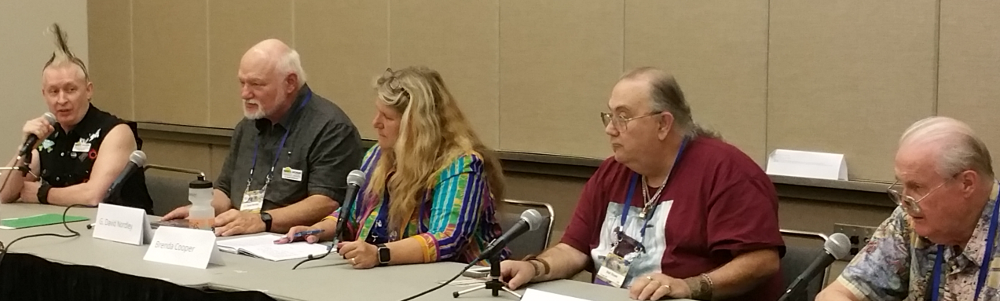
WorldCon 2016: Humans and robots

Disclaimer: I am not perfect and neither are my notes. If you notice anything that requires clarification or correction, please email me at melanie (dot) marttila (at) gmail (dot) com and I will fix things post-hasty.

Panellists: Kevin Roche, G. David Nordley, Brenda Cooper (moderator), Walt Boyes, Jerry Pournelle

humansandrobots

Joined in progress …

KR: They have built and programmed competent bartending robots.

GDN: There’s an S-curve with any technological development. If you picture the letter S and start from the bottom of the letter, robotics is at the first upsweeping curve.

WB: Google is the largest robotics company in the world. Boston Robotics sells services in robotic hours.

JP: With regard to artificial intelligence (AI), every time we started something that looked like AI, people said nope, that ain’t it. Unemployment is higher than the statistics report. In the near future, over half of jobs will be replaced by robots or other automation. The unemployable won’t be visible. They won’t be looking. We’ve not lost jobs to overseas corporations, or not as many as we think. We’ve lost jobs to automation. The “useless” class is on the rise. Look at it this way, an employer saves an employee’s annual salary and spends maybe 10% of it to maintain a robot doing the same work. They’d need one human to service 20 robots.

BC: How do you assign value to human work?

WB: In 1900, the second industrial revolution saw farm workers move to the cities and the factories. The real issue is a philosophical one. We’ve been assigning value to people by the work that they do. A corporate lawyer has, subjectively, greater value than a garbage man. What happens when automation and artificial intelligence replaces both?

KR: When workers are underpaid, the social contract bears the cost. Increasing the minimum wage and increased automation are exposing the dirty little secret. People need to be valued differently. Teachers and artists, in particular, can’t be replaced.

GDN: The top level docs of our society assign value to every citizen. The big question is how do we realize that? The recession has meant fewer tax dollars dedicated to the arts and infrastructure. We have to have the social conversation.

JP: Will advances in artificial intelligence implement Asimov’s three laws? Drones don’t use the three laws. IBM created an AI that beat a human at go [the game]. They took two machines, programmed them with the rules of the game, and let them play each other. After ten million games, they could functionally beat anyone. If you ask a robot to stop humans from killing each other, what’s to stop the robot from coming up with the solution to kill all humans? We have to proceed carefully.

KR: Watson won Jeopardy. Its job is to parse huge amounts of information and look for patterns. It’s humans who decided to test the system by putting it on the show.

GDN: Right now, computers are still, by and large, working on bookkeeping tasks. As we get to the point where we have to consider the three laws, we have to be cautious.

WB: We have to expand out definition of robotics. We have the internet of things with programmable thermostats and refrigerators we can access through our phones. Though still imperfect, we have self-driving cars. We need to figure out how to program morality.

GDN: Human beings don’t consistently make the same moral choices. Fuzzy logic and data sets would be required. Positronic brains would have to deal with potentialities.

KR: We don’t have an algorithmic equivalent for empathy.

And that was time.

Next week, we’re going to explore the steampunk explosion 🙂

Until then, be well, be kind, and be awesome!

Ad Astra, day 2 (yes, still): What makes a great villain?

Panel: Ada Hoffmann, Matt Moore, Rob St. Martin, Thomas Gofton

AH: I write short stories and other things.

MM: Science fiction and horror writer.

RSM: Author of three horror, three urban fantasy, and five steampunk novels.

TG: Film producer, actor, and editor. Heroes are no fun to play.

RSM: Do villains drive the plot? What makes a great villain?

AH: The villain opposes the hero, but in some way, is secretly like the hero.

MM: A good villain is someone readers want to know more about.

RSM: The villain is the active force in the novel. The hero is reactive. Nobody thinks they are a villain. Villains are the heroes of their stories.

MM: Villains can be forces of nature, like Jaws or the T-Rex in Jurasic Park.

TG: It’s great when heroes have to dip into their inner darkness to defeat the villain. A great villain inspires fear. Mordred, for example.

RSM: The villain should instil fear in the reader. What will happen if the villain wins?

TG: Sometimes a villain never gets comeuppance. There was one character in The Messenger who was an absolute prick, but he gets off Scott-free.

MM: Think of great villains, like Hannibal Lector, or the Joker. They are completely foreign to the audience, fascinating. The universe is not necessarily just. It has no morality. It’s realistic.

TG: In terms of comics, the DC villains are cool while the heroes suck. In Marvel comics, it’s less black and white. Xerxes from 300 is a great villain, too.

Q: What traits do you choose?

MM: Look at some of your favourite villains, Beloque from Indiana Jones, or Hans Gruber from Die Hard. Pair your hero and villain, give them opposing character arcs. Everybody wants something. If the hero and villain want the same thing, but for different reasons, it gets interesting. Villains should be larger than life.

RSM: Hannibal is a monster, but he’s so charming. His relationship with Starling is what draws us in. Lestat was originally a villain, but he became the hero in later Anne Rice novels.

Q: What are your thoughts on moral greyness? For example, the monster as hero, the human as villain?

RSM: Look at King Kong, or Godzilla.

MM: After 9/11, everything became grey. Can the villain rehabilitate? Sideshow Bob from The Simpsons is a great example and a redemption story.

AH: Work out your novel’s morality.

MM: Alfred Bester from Babylon 5 was a fascinating character study. I’d like to point out that every human villain we’ve discussed so far has been a man. What about women villains?

A brief discussion ensued about the stereotypes of women villains, Disney’s wicked stepmothers and witches, which led into a discussion of some truly awesome women villains, but I must confess I became so engrossed by the discussion, I forgot to take notes (!) Now, a month later, I can’t remember what was said 😦

Mea culpa. I have c.r.a.f.t. disease: can’t remember an f-ing thing 😉 I’m too young for this shit.

If any of the panellists care to weigh in, please comment and fill in the gaps.

Other than that, if you, my dear readers, have some examples of absolutely fabulous, or terrifying, women villains, please share.