Grades seven through twelve

Art became a kind of salvation for me.  I wasn’t the best, but I was good.  My art teacher said that I was a colourist, and I had no idea what she meant, but I was nonetheless flattered.  If I did know what a colourist was, I might have been even more flattered, because I still liked comic books and graphic novels.

I also started guitar lessons.  I was never quite comfortable with the instrument, but again, I was comfortably mediocre.

I kept on writing and entered a student poetry contest I didn’t place in.

My first attempt at public speaking was lost in a fit of giggles.  My speech was on winter camping, and the best way to keep warm while you slept was to sleep without clothes–oh my!  My classmates enjoyed the effort though, and graded me highly for the entertainment factor alone 🙂

A guest speaker came to my grade seven class.  Unfortunately I don’t remember who he was, though I believe he was a journalist.  I guess you could call it my first workshop.  I wrote a supernatural murder mystery in one sitting and read it out to the class.  I really got into it, dramatizing the voices and everything.  Though empowering, I felt a little like a freak.

Grade eight brought more luke-warm success with a few of my stories read out in class.  My teacher’s final report of the year called me apathetic, however, and I had to fight to get into the advanced level classes in high school, despite having the grades to be so placed.  Just because I’d rather be in a book than in class …

I was bored.  I’d do the work I was supposed to do in class, then pick up whatever book I was reading at the time.  My instructors would approach, I’d show them that I was done, they’d advise me to do my homework, so I’d do that, and pick up my book again.  Then, I’d be advised to work ahead.  I hated school then.  Extra study was the last thing I wanted to do.

None of my writing was ever given into the dubious custody of any of my classmates.  I was even cagey with Margaret and took every well-meant criticism to heart.

I can’t remember exactly when, but I caught the Dungeons & Dragons bug.  Margaret’s Dad got her the Player’s Handbook, and shortly thereafter, we picked up the Dungeon Master’s Guide and Monster Manual.  We started to attend the weekend meetings of the Sudbury Gaming Club at Cambrian College, and eventually tried out other games.  I was a dedicated gamer well into my 20s.

Suddenly, I had another group of people I could consider friends!  And none of them knew me from school.  Bonus.  We went to concerts: Headpins and Helix, Iron Maiden, Twisted Sister …  I was a burgeoning head banger in those days.

When high school hit, with my part time job, boyfriends, and everything else that came with it, my writing started to take a back seat.  I became interested in the visual arts again.  I still wasn’t the best, but I was better than some, and I did well enough.

I didn’t stop writing.  I kept on dreaming and I kept on writing down my dreams.  I have several ideas-in-waiting from those days.

Emotional drama, serious illness, and the death of my grandmother kept me unstable, and unable to see clearly enough to commit to what I loved.  Heck, I couldn’t even figure out what that was …

Also enter into my life great teacher number two, Ms. Chapman.  Her classes instilled in me a passion for literature that while slow to kindle, saw me through the rest of my academic career, such as it was.

Chronologically, what happened next was my first year of university.  You can get that bit of detail by reading How it all started in my Work in progress category.

I’ll pick up the tale again next week with Laurentian University.

High school did not constitute the best years of my life.  Really, I kind of hated it.  My saving grace was Margaret.  Despite all the relationship crap and growing apart that always happens in the fraught teenage years, Margaret remains one of my best friends.

How did your high school years affect your development as a creative person?

I failed the test

Back in December, Robert J. Sawyer shared this: http://www.rinkworks.com/fnovel/

Rinkworks warns the following:

Ever since J.R.R. Tolkien and C.S. Lewis created the worlds of Middle Earth and Narnia, it seems like every windbag off the street thinks he can write great, original fantasy, too. The problem is that most of this “great, original fantasy” is actually poor, derivative fantasy. Frankly, we’re sick of it, so we’ve compiled a list of rip-off tip-offs in the form of an exam. We think anybody considering writing a fantasy novel should be required to take this exam first. Answering “yes” to any one question results in failure and means that the prospective novel should be abandoned at once.

The problem is … I answered yes more than once.

Specifically:

4. Is your story about a young character who comes of age, gains great power, and defeats the supreme bad guy?

Well, it’s about three young characters, two who “come of age” and one who just figures out what his damage is, spanks his inner moppet and gets on with it, all three of whom have roles to play in the defeat of the dark god Yllel, and his sourcerous servant Kane.

12. Does “a forgetful wizard” describe any of the characters in your novel?

Yes, Aeldred is dithering and occasionally confused, but he is the exception and considerably younger than most of the magickal movers and shakers in my novel.  Plus, he’s not even close to being a main character.

21. How about “a half-elf torn between his human and elven heritage”?

That would be Aislinn, actually and she’s not torn so much between the two peoples as derided and feared by both because she is the first child born of a Tellurin (my version of humans) and an eleph (my version of elves).  She’s actually going to be pivotal in uniting the two peoples.

39. Does your novel contain orcs, elves, dwarves, or halflings?

Actually, all of the above.  I’ve changed the names slightly and given them different origins.  My orcs are called okante and are peaceful tribes-people who generally live in harmony with the Tellurin tribes of the north.  They’re only drawn in as villains because Yllel tricks them into soul-slavery.  My elves, as mentioned above, are called eleph and they come from a different world.  One of my gods tries to do something good, but ends up tearing a hole in the world and sucking half the population of Elphindar into Tellurin before the gap can be closed.  The eleph are not pleased.  Dwarves are called dwergen, and are the children of the elemental Gods of earth and fire.  Rather than halflings, I have gnomes I call dwergini and they are the children of earth and air.  Neither race is terribly differentiated from their fantastic forefathers, but they’re certainly not dour and I try not to make them overtly stereotypical.

Enough of the justification, but I can tell you that I was not a little disconcerted by saying yes even those four times.

Fantasy Forest

Fantasy Forest (Photo credit: ozjimbob)

Then, in January, Author Salon posted this for the benefit of the Fantasy and YA Fantasy peer groups, two of the more active in the AS fold: http://www.authorsalon.com/page/general/fantasytropes/

Again, I shook in my metaphorical boots because my story is fairly littered with orcs, trolls (which I call krean), ogres (the gunden), etc.  Will renaming be sufficient?  It’s not like any of them play a significant role, but they are there in their standard and stereotypical glory.

I started questioning the value of my novel in a serious and neurotic way.  Then I sat back and tried to put things into perspective.  My story is not “about” any of these tropes, save perhaps for my protagonists coming of age, finding power, and defeating the big bad.  Renaming will likely be sufficient in most cases.  I don’t have to throw the baby out with the bath water.

I almost failed another one

AS says it wants thick-skinned writers.  Though I do tend to take some criticism more to heart, or react poorly to some of their advice (largely because I think that it’s being posted because someone has looked at my work and though poorly of it, even though I “know” I’m not that important to anyone), I’m learning to understand being thick-skinned in the same way I understand being courageous.  Being brave doesn’t mean that you’re not afraid; being brave means that you act despite your fear and try not to let it limit you.  I’m taking the same, long view of being thick-skinned.  It doesn’t mean that my confidence isn’t shaken; it means that even when it is, I get my shit together and soldier on.

Then Rachelle Gardner posted this in March:

http://www.rachellegardner.com/2012/03/do-you-have-a-thick-skin/

It’s good to know that agents feel the same way us writers do sometimes 🙂

Writing well is the best revenge 🙂

Then I came across a very helpful blog post:

http://www.writersdigest.com/whats-new/writing-rules-10-experts-take-on-the-writers-rulebook?et_mid=538945&rid=3085641

I’ve always aspired to be transgressive; sometimes in a good way, and sometimes not so much.  I think ultimately, I have to focus on writing the best novel I can, so that when I do break the rules, I’ll be forgiven.  It is easier to ask forgiveness than permission, right?  It’s such a relief to know that I can write my way out of the corner I seem to be getting scrunched into.

Coming up on Writerly Goodness

In future posts, I want to get a bit into the background of the novel, stuff that won’t necessarily be in it, but all of the window dressing I developed so that my world would work fairly consistently.  Stuff like cosmology, the historical timeline leading up to the novel, religion, the way magic works, my various peoples and their origins (in more detail than above), naming conventions, and some of the unique things about Tellurin.  In other words, I’m going to write about world-building.  Have any interest in that?

What are your feelings about tropes and their use/overuse?  Would you fail Rinkworks’ test?  What about the Author Salon article?  Does it give you pause?

If you liked this post, feel free to use the “like” or sharing buttons below.  Or, you may consider subscribing via email, or RSS feed (there are links below each post, or on right side menu on my home page).

Until next week!

Will the third draft be the charm?

Nope.

I finished the second draft in September 2009 and devoted some time to writing other things.  I entered a few contests, but was unsuccessful.  In December, I printed everything out and began to reread, make notes, and chart things out as before.  I invested in a bulletin board, pinned all my bits of paper to it this time and had a really good look at the structure.  The puzzle still wasn’t together in the right way.

More changes.

Without the prologue and the framing pieces, nearly 100 pages disappeared from the manuscript.  Third time through, I cut mercilessly, and though I also wrote considerably to add to the novel, the net reduction was over 300 pages.  I was now below the 1000 page mark, an accomplishment in itself.

Finished in October of 2010, I was feeling fairly good about this draft.  Once again, I turned my attention toward writing other things and once again submitted a few short stories. Unsuccessfully.

I decided that I would attend the 2011 CAA CanWrite! conference and booked a 20 page manuscript evaluation.  Though the conference wasn’t until May, I started reading and making notes all over again.  This time, I played with POV.

I had the first two chapters revised by the time the conference came around.

What I learned:

  • If the changes that occur as you revise are substantial, then you still have work to do.
  • The value of a bulletin board for structural rework is immense.
  • Always have backups of the work.
  • Prologues and framing pieces are about telling.  Consider carefully.

Books on editing that have been helpful:

Fusion: An Ekphrastic Experiment

July 1, 2009.

In light of the Willisville Mountain Project and the Cross-Pollination Series, the Sudbury Writers’ Guild decided to try their collective hand at ekphrasis.  For the curious:  Ekphrasis is the graphic, often dramatic interpretation of a work of art, thank you Wikipedia.

I became interested in ekphrasis in graduate school during a course on the Rossetti’s.  Dante Gabriel Rossetti was founder and member of the Pre-Raphealite Brotherhood and their paintings frequently feature poetry either in the artwork itself or as part of the frame.  The verse typically described the subject of the painting. So when I had a chance to participate in something similar, I jumped at the chance.  While not true ekphrasis, the Fusion project was nonetheless interesting and fun to participate in.

Essentially, writers and artists pair up and create a composite work of writing and art.  The written work can be either prose or poetry, and the visual component, while usually painting or photography, could be anything.  In our group’s case, quiting, stained glass, and a place setting of tea and cookies on china were included in the mix.  Each interested writer from the Guild paired up with an area artist in January of 2009 with the goal of having a composite work assembled by July 1st.

My partner in crime was Robert Luopa, fine arts teacher at Espanola High School.  You might say that what we worked on was the reverse of ekphrasis.

Due to our limited ability to get together and work in a truly collaborative fashion, Robert felt that creating a painting based on one of my unpublished pieces of poetry might work out better.  I sent him a likely selection of suspects and he chose “Fire and Ice.”  From there, I described the original inspiration for the poem and Robert then when out and took some pictures.  He drew up some concept sketches and we further discussed the eventual form of the final painting.  In addition to presenting the poem with the painting, I used one of Robert’s photos and Gimp‘ed it into a background for the poem.

The Fusion Project was first displayed at Art Berries and Jazz in Espanola July 1, 2009 and then was displayed a second time at the Sudbury Theatre Centre for the month of August 2009.

Have you ever collaborated with another artist?  It doesn’t have to be ekphrastic in nature.  My poet-friend Kim Fahner had one of her poems set to music.  Some people have their stories turned into short films.  It’s good to get out of your own art-form sometimes.  I’ve found it offers respite and perspective.  What did you learn from your creative experiment?

Adventures in SharePoint

Last time on Breaking open the mind: Mellie got a SMART Board.  New tool, new game, and boy does the learning mutt like to play 🙂 (Fetch, girl, fetch!)

I’d just got started, or restarted with the SMART Board when my attention was drawn to Microsoft SharePoint.  I think I mentioned in other posts that I’m a little ADHD?  I’d just taken an introductory course in August 2010, and in December, I decided that I needed to refresh my memory, or lose all of that wonderful learning.

Microsoft SharePoint

Microsoft SharePoint (Photo credit: Wikipedia)

The thought had been with me since September, when my acting manager arranged for the shell site on our employer’s server before leaving for another acting assignment.  Unfortunately, I was about to co-facilitate six sessions of systems training to staff across the province.  I wouldn’t have time to look at SharePoint, or the site again until after I’d wet my appetite for the learning with the SMART Board.

Come December though, I went to town.  I reviewed all the training material, and read the text that had been given to us with the course:  I played.

After populating the site with a few document libraries, a picture library, a wiki library, some announcements, a discussion group, setting up emails for lists, and playing with the content types to install templates into some of the libraries I created, I put together a wee utilization document and a survey to find out how my team might want to use SharePoint in their work.

Given the limitations placed on us (the best I could hope for was design privileges, and those would be curtailed by security and other concerns) I laid out what I thought were the options at the time.  They turned out to be dreams and hopes, but at least I got my fellow trainers thinking about SharePoint and the course that they’d taken.  It would be important in the coming year.

I got five responses, and then my team got its first permanent manager in more than two years and new priorities demanded my efforts.

Do you use SharePoint at your workplace?  For what purpose?  What do you think of it?  I’ll have more adventures in SharePoint coming and I’ll let you know then what I did with the tool next.

More guardians, more growing up …

I’ve always dreamed very vividly, and in story.  As a child, I was an insomniac, mid-cycle onset.  I’d wake at two or three in the morning and rehearse my dreams until I went back to sleep.  Either that, or tell myself new stories if it wasn’t a dream that woke me.  I told my dream-stories and nightdreams (as opposed to daydreams) to my best friend, Margaret, at lunch and recess.  I dreamed about characters and settings from my favourite television shows and movies: G-Force and Star Wars mostly.

Resources for dreaming and creativity:

I was also big into comics at the time.  Not the typical ones.  I wasn’t fond of the male heroes, and instinctively disliked the groups, in which the women were neither strong, nor independent.  I gravitated toward Wonder Woman, Huntress, Batgirl, and other solo heroines.

Unfortunately, my waking daydreams were also populated by Greg Evigan from “BJ and the Bear,” and Shawn Cassidy from “The Hardy Boys Mysteries.”  For better or worse, Margaret shared in all of that too, and was a regular reader of my stories.

Though I was a huge “Doctor Who” fan, Tom Baker never made it into my dreams, go figure.  More recently though, David Tenant’s made the short-list 🙂

I read C.S. Lewis, Lloyd Alexander, Madeline L’Engle, Zylpha Keatley Snider, and even checked out Pierre Burton‘s The World of OgJoan Aiken, Phyllis Reynolds Naylor, Lois Duncan, and Joan Lowery Nixon joined the list soon after.

Grade six was a rough patch.  Though I’d auditioned and made it into the choir, which was great because I liked to sing, the practices were after school, and one day, I was in an unfortunate situation.  **Those of delicate constitution may want to skip this next part.**  I’d gotten my period, always painful and heavy, even then.  Feeling like crap, and on the verge of bleeding through my clothes, I needed to go home.

My teacher came out into the hall where I was at my locker, preparing to leave, while other students walked the halls and the rest of the choir waited in the room, right next to me, and asked me what I was doing.  “Going home,” I said.  With increased volume, she asked me why.  I tried to tell her that my mom needed me at home.  I wasn’t about to tell her, and everyone else, the real reason.  She berated me for my fickle loyalties and tried to bully me into staying.  I committed to the choir and that meant that I had to be at every practice.  Did I want to be a part of the choir, or not?  Cornered like that, I had no choice.  I quit.  Once again, I was left out of the performance, and the choir, for the rest of the year.

Though I was terribly upset, there was no going back.  I would not be allowed to explain the situation in private.  That wasn’t my teacher’s style.  I wasn’t about to reveal my shame to the class, and wasn’t going to ask my parents to intervene for the same reason.  So I remained embittered for the year.  It was my own fault.  I hadn’t learned the trick of standing up for myself yet.  At the time though, it felt like persecution.

It was another low point on the teacher graph for me.

English: A bottle of Liquid Paper correction fluid

English: A bottle of Liquid Paper correction fluid (Photo credit: Wikipedia)

That same year, someone I thought of as a friend asked to read my stories, and flattered, I consented.  She used an entire bottle of Liquid Paper to obliterate my words.

Another guardian, another lesson: even your friends can’t be trusted.

As you can see, I identify with the hero/heroine’s journey, writer’s journey, or whatever else you’d like to call it.  My guardians have been the defining, or crisis, moments in my creative development.  In that respect, I’m a slow learner.  It took me years to realize that what these people did to me, or to my work, had nothing to do with its value or my own.  I let those formative lessons inform my inner critic (the worst guardian of them all) and it told me that I was worthless.  I believed it for far too long.

So again, I will ask you to share guardian experiences.  Who has put a roadblock in your creative path?  What lessons did you learn?  Did you find a way to overcome your guardians?

Draft two and what it taught me

I printed out and read through my first draft.  It was painful.  I made notes all over it and as I went, made additional notes on scrap paper.  Afterward, I physically mapped out my next revision.  At that point, it was just a bunch of pieces of paper floating around like a free-form puzzle on the table.  I looked for the pattern, made sense of it, and put the papers in ordered groups.

My scrap paper novel map

My scrap paper novel map

I revisited all of my previous work: the character sketches, plot sketches, and timeline.  The title changed again, finally to Initiate of Stone.  This emerged from the text itself, organically, the way I like it.

There were a number of metaphors and events that related to the earth element: taking shelter in caves and underground, the hidden people, who have a special skill with shaping the stone, whose father was the elemental spirit of the continent, now entombed in the mountains awaiting rebirth and acting as a kind of gatekeeper to the otherworld at the Well of Souls, the seal that must be broken to free the dark god is buried beneath the desert sands.

I decided to reinforce the theme and add to the images.  I made even more notes for all the changes I wanted to make and dove back into writing.

I wrote more, started playing with the prologue, nearly 50 pages on its own.  Each chapter now had a framing piece about the world, its history, and other things that I thought I couldn’t bring out in the story but wanted to share.  Characters developed further, names changed, existing plot lines developed, and new plot lines evolved.

I started sharing this revision out to select readers.  In retrospect, it was too early, but I got some excellent feedback from Scott Overton, then president of the SWG.

Part-way through, I abandoned the preface pieces, and decided that the prologue, though important for me to have written, was largely cut-worthy.  I redacted whole sections and added new ones.  I rearranged their order to make more sense with the timeline.

This time, the draft was close to 1200 pages.  I’d done a lot of cutting, so this was a surprise.

What I learned:

  • Step away from the novel between drafts.  You need figurative “space” to approach it fresh.
  • It’s okay to murder your darlings, especially if you keep previous drafts stored on your computer and backed up onto CD.  That way, you haven’t done away with them altogether.
  • Physical mapping is liberating.  Being able to see the structure of your novel, and to play with it, is extremely helpful.  It’s like putting a puzzle together.  Some pieces may seem similar, but they only fit together in one way.  Looking at the story in its concrete representation can help you to find the best fit.
  • Sometimes, you write things that don’t make sense, and you don’t see it until revision.  That doesn’t necessarily mean that to have to throw them out.  If there was a reason that you wrote it, try to figure out what the core intention was.  Don’t put too much intellectual pressure on it or you risk forcing it the wrong way, but if you realize why it was important to write it in the first place, that will give you the key to revising the section in a way that improves your story.

What has your revision process taught you?

Sue Harrison

September 2008.

I don’t even remember specifically where I heard about the workshop.  It might have been through the Sudbury Writers’ Guild, or through the Sudbury Arts Council.  In any event, I learned of a relatively small event called the W.O.W. workshop.  I believe that it stood for writers on the water.  It took place in Bruce Mines, Ontario.  It was a one day workshop and the featured speaker was Sue Harrison.

The first part of the workshop focused on character development and was excellent.  Sue had several exercises worked out and all of the participants, regardless of their respective levels of professionalism, gained valuable insight into what makes a character come to life on the page.  Sue read not only from Mother Earth, Father Sky, but from a new novel that she was working on.

The next part of the workshop was presented by Sue’s husband and focused on the publishing business and the important lessons they learned from their experiences.

Sue’s story is a fascinating one.  She had been working on a novel based on the lives of the prehistoric Aleut tribes who populated the islands of the Alaska Panhandle.  When she had it to the point where she felt she was ready to shop around, Sue started looking for an agent.  She took the directory and started at “A,” sending out queries five at a time.  Eventually she found an agent: her name began with a “W,” Rhoda Weyr I believe (yup, just checked the acknowledgements).

Sue was told that what she was presenting as her novel was in fact three novels crammed together.  Sue was assigned the daunting task of dissecting her work and reconstructing it into three separate but coherent novels.

A confluence of events began to swirl around Sue’s work.  The first was the runaway success of Jean Auel‘s prehistoric novels which created a ready audience.  Another was a publishing industry in boom, able to invest in its authors.  The third was an agent willing to find and fight for the best possible deal for her author.  After finding several publishers interested in the novel that would become Mother Earth, Father Sky, Sue’s agent initiated an auction for the novel.  The result was a phenomenal advance and promotional budget.  Knowing that there were two other novels in the series made Sue’s first work an attractive commodity in the publishing world.

The road was not all paved with gold, however.  Agents and editors changed.  At one point, her work was “orphaned” by an editorial shift, jeopardizing publication.  Sue and her husband were forced to become experts in publishing and contract law to protect their interests.

I can’t begin to tell you how informative the workshop was or how much I gained from the experience.

Sue was fantastic.

Have you met an expert in your creative field whose story you admired and were inspired by?  Who was it, where did you meet, and what was the impact on your creative life?

It wasn’t even my birthday

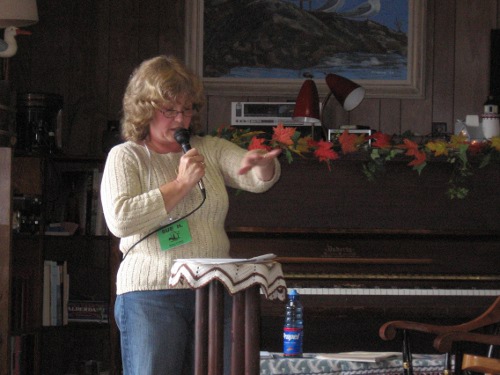
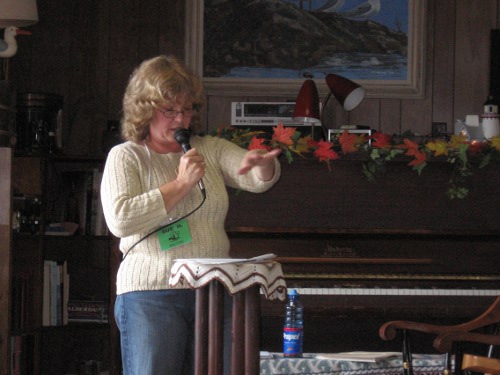
I started working in my current position in April of 2009.  For the most part, I was coaching new staff, post-training.  In June, I co-facilitated my first class, and I really enjoyed it.  My years as a poet, giving public readings, and my years teaching composition at university helped me immensely.

One thing I learned is that most trainers, like most writers, are quite shy.  We don’t like to be in the spotlight, but once there, something happens.  In my more poetic days, I thought of it as the goddess of poetry.  She inhabited me for a while and when I left the stage, she’d move on to the next wallflower.

Now I understand the phenomenon a little differently.  I let the passion for the subject I’m teaching take the reins.  When you love what you do, it isn’t hard to be dynamic, entertaining even.  I pour on the happy, sunshiny energy in public situations.

I got my first taste of Participant Centered Training in August, and then in December, became one of three trainers delivering systems training via NetMeeting to all of our staff in the province.  It was a grueling month of 3-hour session after 3-hour session, morning and afternoon, every day.  I’m surprised I didn’t get laryngitis.

Ultimately, that first year was just about getting acclimatized to the unit and my place in it.

In January and March of 2010, I co-facilitated a newly redesigned version of some of our operational training.  Of course, there was more coaching to do, a never-ending stream of it 🙂

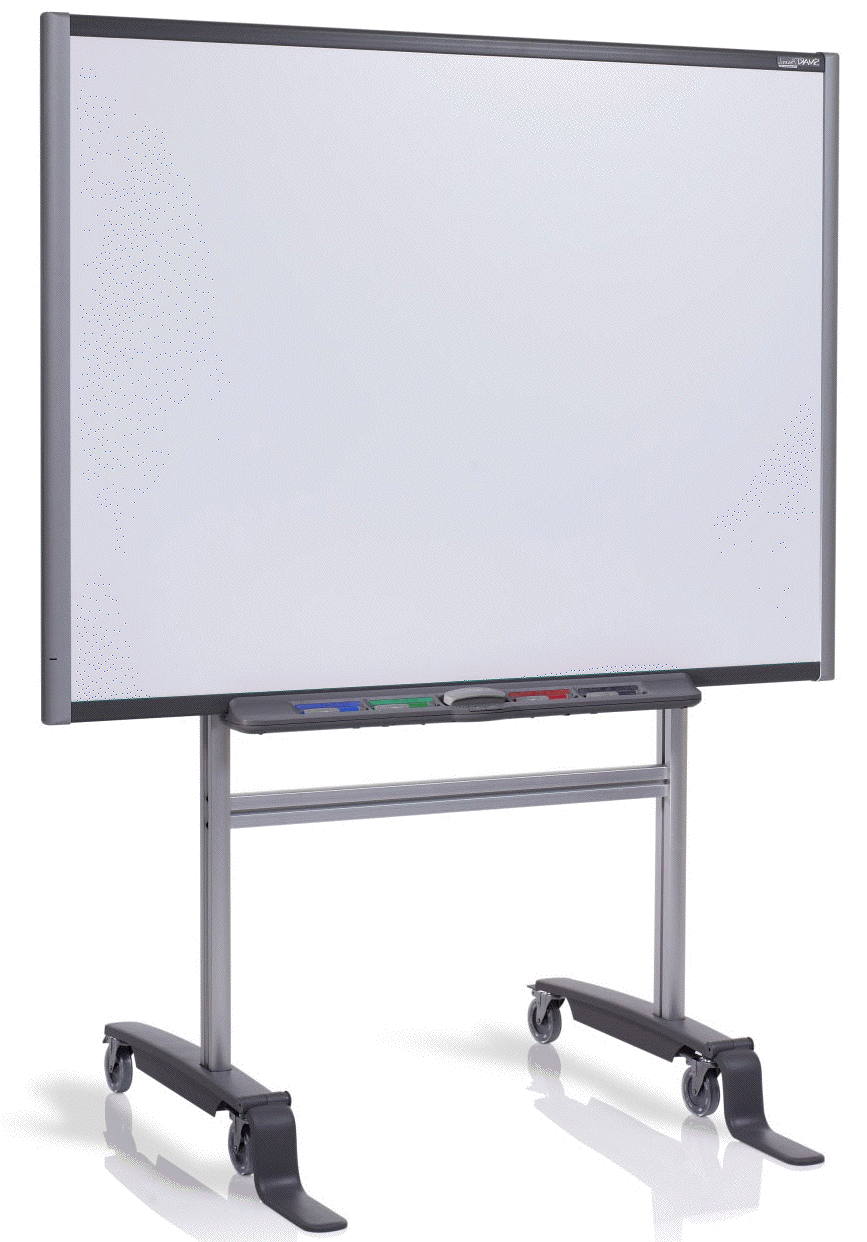
Then, in May of 2010, I received a present: a SMART Board.  Our department received six of them; each delivered to a separate location.  To my knowledge, I was the only one to unpack the boxes, assemble the SMART Board, call IT to install the drivers and software, and give the dear thing a test run.

Basic functionality was all I had time to master, however, as other priorities emerged.  Involvement in a working group, the development of a brief introduction to the SMART Board for my colleagues, an in-person team meeting (I work on a virtual team), training in SharePoint, and preparation for and execution of three and a half months of intensive training kept me busy until the end of November.

When I finally had a little time, I returned to the SMART Board, registered the operating software, updated it, and learned a little bit about Notebook.  Then my hungry mind found something else to play with.

Have you received a work-related present, or a new toy that was a game-changer for you?  What was it?  How did it change your game?


The first draft

Last time on Work in progress: I finally found a way to wedge my butt in the chair!

I wrote through, just like Nino said.

In the years previous, I’d tried a number of different tactics: outlining, character sketches, plotlines for the major characters, world building, timeline, research.  None of it got me writing … like writing.

I’d always heard that if you want to write, then write.  I’d even said it to students.  It’s true, but you have to be ready to see the truth, to accept it fully, and live it.  After years of struggling with my inner critic, informed as it was with all of my weaknesses and doubts, all my past experiences … I finally got it.  I finally wrote.

I’d never gotten past the first hundred pages before.  They were written and rewritten many times, but I’d never gotten past them.  This time, I tried a new strategy: ctrl-g 🙂  I’d note the page I stopped on, and went right to it the next day.  Starting from the beginning every day merely trapped me in an endless loop of editing.  Another authorial truism: the work is never finished, only abandoned.  The first draft isn’t the time to tweak and fine-tune, it’s the time to get the words out.

By September of 2008, I’d written my way to 1000 pages.  It was scary, and exhilarating.  Then it was called Initiate of Wind.  As a reward, I treated myself to a writing workshop with Sue Harrison at the W.O.W Retreat in Bruce Mines.  Loved it, loved it, loved it!  Watch Authorial name dropping for my post on the lovely Sue 🙂

I’d started out writing the novel as I’d intended, changing point of view in sections, cycling between the major characters.  Then, some of the plot points started to change as I wrote.  New sections wanted to be included.  New characters.  Toward the end, I was working on fumes and dropped all the fancy stuff.  The last three chapters were written in the same p.o.v.  I just got the words out.  All of them, good or bad, were out.

That year, I went as "The Sander" for Hallowe'en

My refractory period was the renovation of my office.  Five weeks of nothing but physical work: demolition, insulation, vapor barrier, mudding, sanding, painting, floor refinishing, and furnishing.

At the end of it, I had a room of my own.  An office.  A place to write.  I think that helped me to keep at the writing too, but by then, I’d been writing every day for two years, so I guess the office was a kind of reward too.

A room with a view, no less

Then it was back to real life, back to work, and back to writing.

What I learned: Write.  The first draft is no place for revision.  Write.  Commit to your relationship with your creativity, and you will go back to it, every day.  Write.  Just write.

Have you completed the first draft of a novel?  What did it teach you and how did you feel?  What did you do to reward yourself/celebrate?