The Narcoleptic Madonna Launch, Dec. 7, 2012

Lovely night!  Music, poetry, and beautiful art.  Inspiring in all kinds of ways 🙂  Thanks, Kim, for putting together a wonderful evening.

My apologies though, for being late (!)  I knew I needed $6 for parking, but I was hoping that I’d be able to pay on exit and get some change at the launch, or, failing that, there would be some place on campus to get change, whether it be a change machine or store.  There was a store, but the vague directions of “down the hill” didn’t really help.  So I ended up stopping at a couple of different places and essentially going most of the way back home before I got the change I needed, returned, paid, parked, and finally got in.

It’s all on me, but I missed some of Kim’s opening remarks, including some very kind ones about myself.  If it’s possible to kick yourself in the ass, toe first (‘cause, come on, that’s the only way to do it so it counts), then I’d be doing it.

The day itself was a bit of a crap shoot for me.  I was ill (still am), but damned if I’d miss Kim’s launch and I am SO glad I made it.  Enough about me.
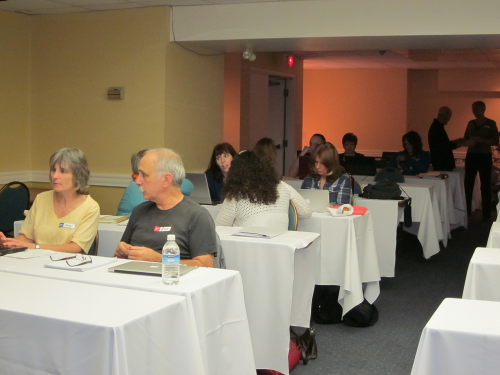
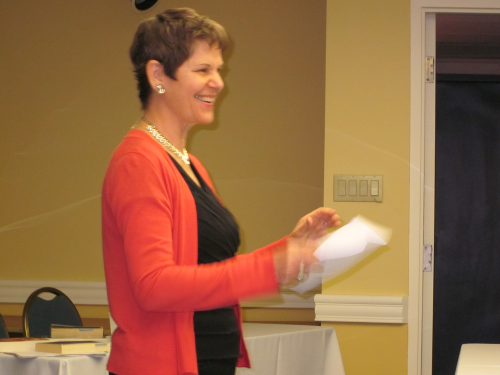
Kim Reading1Ever the gracious hostess, Kim started off with her acknowledgements to the people in her life who’ve been teachers, mentors, and friends on the way, to the artists who have influenced her and the experiences she’s had that have shaped her craft.

As mentioned in the interview I posted last week, The Narcoleptic Madonna has been twelve years in the making, and most of that time, Kim has been primary care-giver for her parents, both of whom have passed away.  Kim also struggled with depression.  This journey of love and loss, recovery and the process of reclaiming the self is the journey that Kim describes in the pages of TNM.

I’m not going to share any of her poetry here.  For that, you can friend Kim on Facebook, follow her blog, The Republic of Poetry, or, best of all, buy TNM, Braille on Water, and You Must Imagine the Cold Here, or any of the other anthologies that her work may be found in.  The experience of reading Kim’s poetry is well-worth the price of admission.

Kim reads with wit and élan, the genesis and process of her work as much a part of her presentation as the poetry.  At several points, she had the audience in stitches, and reached out to specific communities within her fandom (Catholic, fellow teachers, students, family, Irish heritage, etc.) with particular poems.

After Kim’s first set, she invited The Wild Geese of the Sudbury Branch of the ComTheWildGeesehaltas Ceoltoiri Eireann up to perform.  She sang “The Fields of Athenry” with them, her soulful vibrato pulling the tenderness and sorrow out of each verse and chorus.

In the second set, Kim delved into some of the darker moments of the past twelve years.  Then she moved into the process of how she began to reclaim her life and happiness.  She also read one poem that emerged from her recent visit to the Anam Cara Artist’s and Writer’s Retreat.

A second set of music from The Wild Geese followed in which Kim sang “Red is the Rose.”

After a brief but heartfelt thank you, we were released to refreshments, book-purchasing, and the long line-up for the signing.  Kim also made available a family “puffed wheat” recipe for those who’d been clamouring for it 🙂

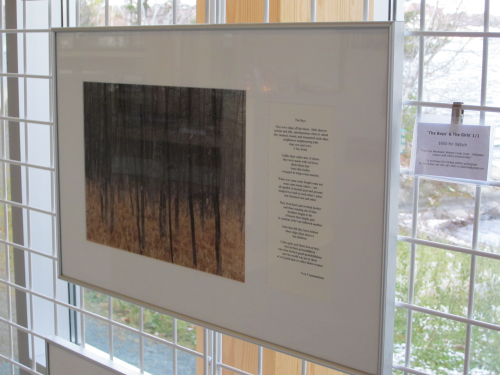
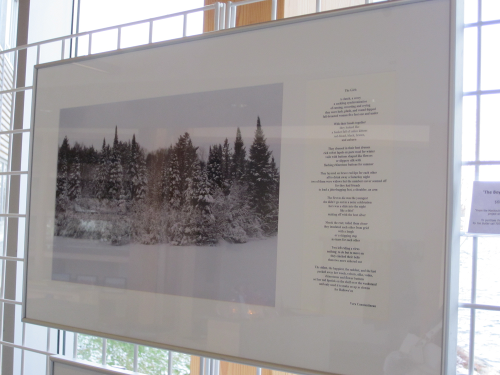
TrishStenbaughArt2I took a few moments to appreciate the backdrop for the event, the evocative art of Trish Stenabaugh, who contributed the cover art for TNM.

In the line-up, I had a chance to chat with a number of friends, Doctors Shannon Hengen and Marilyn Orr from Laurentian University, Karen Baglole, a mutual friend and owner of The Ultimate You, one of the best aesthetician/day spa joints in town, Irene Golas and Vera Constantineau from the Sudbury Writers’ Guild, and some other mutual friends.

By the time I reached Kim with my five copies, I could tell that the wrist cramps were KimSigningsetting in, but she bore up well and continued to smile and share a laugh with her friends throughout.

Several of the attendees have been posting to Facebook since last night that Kim’s event was the Best. Launch. EVAR.  I tend to agree.  Kim puts on a launch like she would a dinner party, inviting us into her world, asking us to make ourselves comfortable, and sharing her life and love generously.  Kim gives us gifts and we are happy to reciprocate.

Bask in the glow, my poetic soul-sista!  Ya done good 🙂

An interview with Kim Fahner

Kim FahnerKim Fahner lives and writes in Sudbury, Ontario, where she teaches English at Marymount Academy.  She had published two books of poems, You Must Imagine the Cold Here (Your Scrivener Press, 1997) and Braille on water (Penumbra Press, 2001).  This new book, The Narcoleptic Madonna, is also being published by Penumbra Press (2012).  Kim is a member of the Writers’ Union of Canada, The League of Canadian Poets, and PEN Canada.  She worked with Timothy Findley through the Humber School for Writers back in the late 1990s.  Most recently, she served on the editorial board of the ezine, terra nord/north.

_______________________________________________________________________

WG: First, hugs and thanks for virtually gracing me with your poetic presence here on Writerly Goodness.  I’m really excited about the launch of The Narcoleptic Madonna on Friday, December 7, 7pm, at Thorneloe University Theatre.

TNM will be your third poetry collection.  Could you comment on how, from the poet’s perspective, your work has evolved from You Must Imagine the Cold Here, through Braille on Water, to TNM?

KF:  If I consider how my work has evolved over the years, since the publication of my first little book of poems in 1997, I find some aspects echo through all three collections, but I also find that I have grown both as a person and as a poet.  This is to be expected.  My early poems were often lengthy, wordy and more narrative in nature.  I still have narrative work, but it might be more of a ‘narrative lyric’ in style and form.  My most recent poems, some unpublished, are purposeful experiments in poetics.  In August of this year, I attended an ekphrastic poetry workshop at the Anam Cara Writers’ and Artists’ Retreat in Eyeries, on the Beara Peninsula, Co. Cork, Ireland.  I had, prior to that, written a few ekphrastic poems, but now I am very enamoured of the genre.  That wonderful retreat was led by Seattle poet, Susan Rich, and attended by poets from around the world.  Since then, I’ve been playing with the idea of persona poems and dabbling more and more in the ekphrastic field.  I’m trying to stretch out in a poetic yoga pose, so to speak.  I want to continue to challenge myself to evolve as a poet.

WG: How or from where do the ideas for your poems come to you?

KF:    I think, as many poets might say, my ideas for poems come from life itself.  I find that I am always observing others.  Poets need to be in the world, but not always of the world, if that makes any sense.  We must hover on the margins, so as to better see how people behave in the world.  I get poetic ideas when I’m walking my dogs.  I find inspiration in nature, something that is prevalent here in Northern Ontario.  I also love to travel and I find that traveling often inspires me to write.

WG: What themes does TNM address?

KF:  This new collection, The Narcoleptic Madonna, seems to have a few key thematic threads running through it.  The most obvious, to me, is that of the idea of journeying to find oneself.  I often find that I must journey outwardly in order to go inside.  By traveling, I journey within myself and uncover new layers of being.  Sounds elitist, but it’s not.  It’s just a heightened awareness of who and what you’re made of, and how you fit into the world around you.  The collection covers poetry that was written over a twelve year period of time.  During the last ten years, I spent a great deal of time taking care of my parents as they became ill and then died.  This was transformative to me, in terms of how I defined myself and how I saw myself.  As a result of that, a number of the poems in NM deal with life, love, death, and the recreation of spirit that comes after death.  It really is a collection that speaks to the phoenix-like quality of life itself.  There are endings, but those endings always seem to spawn new beginnings.  I’m not saying it’s easy to recreate oneself after losing someone you love, but it’s necessary and unavoidable.  That process, of walking someone through the last years of their life, isn’t an easy one, but it did serve as inspiration for poetry and for reflection on lessons learned.  I also spent a great deal of time dealing with depression.  This, too, was a painful, but transformative process for me.  Sometimes you have to hit rock bottom in order to recreate yourself.  That seems to have been part of my process, as a person, and that process is reflected in my work.

WG: I’m a big fan of writing process.  Could you say a few words about your process as a poet?

KF:   I’m not the best at revision.  Usually, when I’m not experimenting with purposeful poetic exercises like ekphrasis or persona, I tend to find that lines discover me!  Usually, when I’m walking, images come to visit.  Sometimes they come to me in dreams, but if I don’t write them down, they disappear.  Other times, when I’m driving through the city on the way to work, I see people and begin to wonder at their lives.  A poem comes to me quickly, in a rush of lines or a first stanza.  Then, I might leave it for a day or so, but whenever I return to it, the poem writes itself in a rush.  I fiddle with it a bit, initially, but then it sits on its own for a few days.  When I return, I slice and dice it a bit, but I’m nowhere near the expert at revision as some of my poet friends are.

WG: Given all of the above, how long did TNM take to come together for you?

KF:  The final part of the collection, its acceptance by publisher John Flood and Penumbra Press, has birthed itself over the last ten months or so.  I had submitted the manuscript to another press, but it was rejected.  Then, I sent the collection to John and he had it for a while.  He emailed me in January or Februrary of 2012 and said he was interested in publishing the work.  I was thrilled.  The last few months, from September onward, has been a time or editing, proofreading and revision.  I love working with John because he has decades of experience in working with poets, so he often sees things in my work that I would rather ignore.  He’ll suggest revisions that, initially, I might resist.  That’s all ego, though, as I always initially feel ‘Oh, I can’t change that….it’s my poem.’  Once I get past the idea of resisting the suggested revision of my work, I always get to a place where I see that his edits are things that make my poems stronger, leaner, and more than what they were before.  I trust him implicitly now and I know he sees my work with more objective eyes.

The actual writing of the manuscript, though, has stretched over a twelve year period.  The topics of the poems vary, but I notice that I am always a keen employer of metaphor in my work.  It’s my favourite poetic device, I am sure!  I think in metaphor on a daily basis, and I know I teach through metaphor as well, so it makes sense that metaphor plays such a key role in my work.

WG: Is there anything else you’d like to share about NM?

KF:   I’m just very excited to have this book come into the world.  My only regret is that my parents aren’t here to share in it.  Without them, without their support, I would never have come this far in my life as a poet.  They were always supportive of my creative sidnarcolepticcovere.  When I decided not to do a PhD in English years ago, in my mid-twenties, because I was worried about what academia would do to my creative work, they were the first to reassure me that I wasn’t making a mistake.  The certainty that they had in my gift, in my talent, was comforting.  I just wish they were still here to see NM arrive in the world.  I think they would have loved it.  It’s dedicated to their memory and I hold them close to my heart.

WG: Thank you for dropping by Writerly Goodness, and for your time and thoughtfulness in sharing these insights.

_______________________________________________________________________

The countdown to Kim’s launch has begun!  In six days she’ll be at Thorneloe University Theatre reading from her brand-spanking new book.  Will you be there?  I certainly will!

Creative connections: On pomegranates, movies, and books

Pomegranate Fruits. Español: Una granada, frut...

Pomegranate Fruits. Español: Una granada, fruto del granado (Punica granatum). Eesti: Granaatõun. Français : La grenade, fruit du grenadier. Русский: Плод граната. (Photo credit: Wikipedia)

I love a pomegranate, tearing into one and slowly devouring every pip over the course of an hour or so.  Inevitably, I wear as much as eat 🙂  There’s something visceral, exotic, and, frankly, erotic about the fruit.  Juices drip, stain fingers, lips, and clothes in a rich purple.

I can see why some Biblical scholars make the argument that it was the pomegranate and not the apple in the garden of Eden.

There’s also an element of the meditative about the pomegranate though.  To eat one, patiently cracking open and tearing apart the fruit, bursting each pip between the teeth, crunching down on the seeds, it takes time.  It takes focus too.  The act of consumption is totally absorbing.  It opens the mind and clears the palate.  It nourishes more than the body.

My assignment for any of you creative types: eat a pomegranate.  Take your time.  Let the act take on meaning beyond the obvious.  Journal it.  Create something from the experience.  It’s pretty cool 😉

Twilight to date and The Woman in Black

Onto movies now.

The same weekend I had my mind blown by the Cloud Atlas, I also had the opportunity to catch up on the Twilight franchise to date.

I’ve only read the first book, and while I did enjoy it, I can understand some of the criticisms levelled against it.  I do intend to read the rest of the series at some point, but I’m in no particular rush to do so.

I saw the first movie a few years ago when it was first out on demand.  I thought it was cheesy, to be honest.  I thought the effects were poorly done, and the whole visual of the sparkly vampire left me … cold.

It just so happened though, that Space was airing New Moon that Saturday, and the movie

Cover of "New Moon (The Twilight Saga, Bo...

Cover of New Moon (The Twilight Saga, Book 2)

channels were playing Eclipse, and Breaking Dawn, part 1 on Sunday and Monday respectively.

New Moon was the least enjoyable of the three with all of Bella’s moping.  At least the film makers tried to collapse that into a montage.  I can see how this will be tedious in the reading.  Not looking forward to that.  The continuing story line developed, however, and I enjoyed the depiction of the Volturi.

Eclipse was very much a “middle of the series” movie.  The plot continued to evolve, the characters and their various factions were further defined and solidified in Bella’s world.

Breaking Dawn, part 1, was, in my opinion, the most enjoyable of the three.  It was pretty much non-stop action from the beginning, and yes, I do see the wedding and honeymoon as action pieces, plot-critical events did unfold, if not as dynamically as the “battle for Bella” that makes up the remainder of the movie.

Overall, it wasn’t bad, but I wouldn’t have paid to see any of them in the theatre.  Sorry for the heresy.  Just sayin’.

Also watched The Woman in Black that weekend (yes, it was a barn-burner of a weekend for ole Mel) and quite enjoyed it.

I liked the atmospheric gloom and suspense, the mystery, and in particular, the movie’s ending.

*Spoiler alert*

Although the young lawyer manages to figure out the impetus of the ghost’s rage and the reason she abducts and murders children, and although he does what many ghost stories of the past have taught us, that is to right the wrongs of the past, the spirit of vengeance is not appeased.

Instead, she does not forgive, and kills the young lawyer and his son.  Though this turns out to be a kindness, as the family is reunited with the predeceased wife and mother in death, it is clear that the titular character will not end her predations.

I like it when my expectations are turned on their collective ear 🙂

Disappointments that I’m not sure what to do with

I have to get this out.

I’ve read a couple of books recently by authors I’ve met and admire precisely because they’ve accomplished what I have yet to do, and that is publish.  Cover blurbs and positive reviews aside, despite the careers these books have launched, I found myself disappointed.

For that reason, I will not disclose the names of the authors, nor the titles of the books.  And don’t bother parsing my Goodreads account.  You won’t find them or their reviews there.  I don’t put all the books I read on GR.

I think it comes down to poor editing.

When I come across a clear error that was not caught by author or editor, and that repeats several times over the course of the novel, it ticks me off.

When a character’s name changes several times, I’m (I think understandably) peeved.

It pulls me out of the experience of the novel to a degree that robs me of my enjoyment of the book.

Other issues: the plot of the one was not particularly inspired, came across as episodic, and left me wanting more.  In a bad way.  The plot of the other was truly epic, ambitious, and had so much potential that the author failed to realize that I again found my teeth clenching in consternation.  Point of view issues also plagued one of the two books, making me remember why I’ve sworn never to write a novel in a truly omniscient POV.

I read all kinds of books and I try to learn something about either the art or craft of writing from each one.  Sometimes the lessons are more in the way of what not to do.  I’ll take ‘em.

Never stop reading, writing, watching movies, or engaging in the arts in your community (real and virtual).

You never know where the most important gems will be unearthed.

Cover of "The Right to Write: An Invitati...

Cover via Amazon

Coming soon: Julia Cameron’s The Right to Write (yes, Kasie, I’m reading it and will post on GR post hasty); An Interview with Kim Fahner; blogging the Launch of The Narcoleptic Madonna, and more!

This is Writerly Goodness, signing off.

Stay well everyone, and enjoy your “end” (what’s left of your weekend by Sunday).

La Cloche Spirit: The Equivalent Light

This afternoon, for a creative date, I treated myself to Jon Butler’s exhibit at the Living with Lakes Centre, La Cloche Spirit: The Equivalent Light.  I did some visiting with the photographer and some of my friends from the Sudbury Writers’ Guild, did some Christmas shopping, and generally had a lovely time.

Jon’s exhibit remains at the Living with Lakes Centre through to Friday, November 30, 2012.  Go consume the visuals.  They are eminently tasty 🙂

The photograph that lent its name to the exhibit is, I think, my favourite.  A thick fog rolls over the mountains, pools between them, as the sun rises through clouds, casting a purple strier effect across the sky.  Against the shadows of further mountains, two wisps of fog chase one another, the lead one almost looking as if it has a head.

If I had enough disposable income to blow, I’d be installing the mounting hardware about now and ‘La Cloche Spirit’ would be hanging in my office in short order.

I first heard of Jon a number of years ago, through my SWG friend Vera Constantineau.  She and Jon worked together on an ekphrastic collaboration for the Manitoulin Writers’ Circle’s Cross-Pollination project.   She’s since teamed up with Jon again, and here are the wonderful results.

The two photographs reminded Vera of her family with the right number to reflect her aunts and uncles.  Her poems, entitled “The Boys” and “The Girls” were inspired by Jon’s photography.  “The Girls” has subsequently been published in The Antigonish Review.

Jon does a little of his own ekphrasis too.  In these two photographs, he’s written haiku on birch bark and inserted them into the frame.

In addition to the framed photographs, art cards are available for purchase, and Ian Tamblyn’s Willisville Mountain CD, also inspired by Jon’s work.

Apparently only a few copies of his coffee table book of photography remain at the Art Gallery of Sudbury, so if you’re in the market for a lovely Christmas gift, hit the AGS before they’re all gone.

It’s well worth your while to visit the exhibit, even if it’s only to gaze longingly at and be inspired by Jon’s beautiful photography.  Of course, you can also visit his web site or find him on Facebook if you want to know more about Jon and his work.

There’s still time if you want an evocative and uniquely northern Christmas gift 🙂

Business Writing Made Easy in techno-colour

I mentioned back in the spring when I took the training-for-trainers version of the course that I would eventually be delivering Business Writing Made Easy.

The idea was that the two of us advisors from the training team would teach the course to a combination of processing staff, team leaders, and other advisors and consultants, to build capacity, so that the advisors and consultants could then turn around and help us train the entire business line.  It was to be a kind of domino effect, wherein the burden of the training would not fall to any individual or small group of specialists.

Then I was fortunate enough to get this acting gig as training coordinator, which left one advisor on the training team to do the job.  At that time, I was given dispensation to assist in the training.  There would be three sessions offered to staff in all sectors.  The training plan was developed and received approval.

Then Business Transformation (BT) kicked in and not only threw our organization into chaos, but also created new training demands and pressures.  Two of the three sessions would be cancelled.

The organization’s College which had designed and delivered the training-for-trainers for the course transformed in its own way, outsourcing its training and adopting a greater emphasis on e-learning (which I laud, btw—it was just inconvenient in this particular instance).

Part of my personal goal in delivering this training was to achieve my training certification in the process.  While the College would still administer the certification program, its delivery would be in the hands of a partner school and its trainers.  I’m still not sure how this will work out in the “real” world and what it will mean for me as a certified trainer.

Then my fellow advisor, potentially “affected” by BT, took an opportunity of her own and also left the training team.  Plans were amended.  I and two other consultants from another business line would deliver the training across both business lines.

Prep commenced, and as all of us worked in locations 4 to 8 hours’ travel apart, most of it was conducted at a distance.  2-hour conference calls, time stolen from our in-person meeting, and other opportunities were taken.

Then (yes then) my mentor accepted a position that meant that she would be less available to me for coaching.

As the time of delivery neared, I made contact with my mentor in the certification program and she arranged for someone from the college to come in and “observe” me during the training.  The point of this was to assess whether I could be ready to make my first attempt at certification with my next delivery (in February).

Nerves set in.

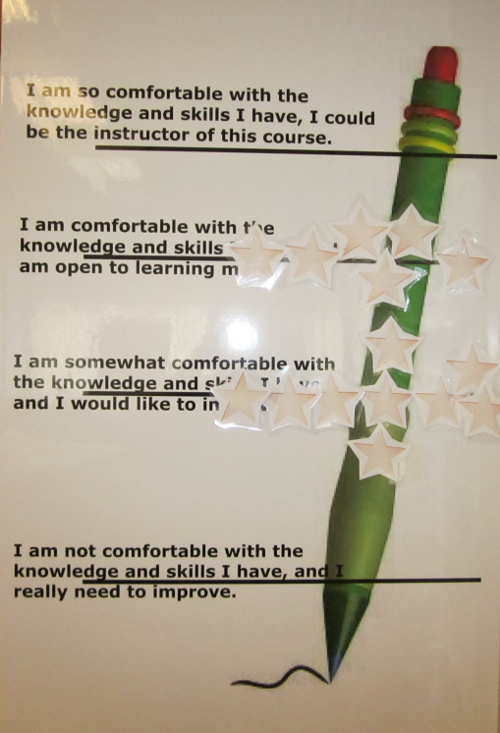
See, I took the first step toward certification in September 2011.  Incumbent upon me were the tasks of completing post-course assignments, 30 hours of training in a participant-centred training (PCT) style, coaching sessions, co-facilitation of the introductory PCT course, eventually leading to an in-person assessment and the hoped-for certification.

Subsequently, the training that I was to complete in Q3 and Q4 last year was cancelled.  My first opportunity to conduct any training was in May 2012, just prior to my accepting my acting position.  Though I’ve tried to implement PCT in my training, I hadn’t had the opportunity to really exercise my abilities in PCT.

Also, the restructuring of our College meant that the introductory PCT course would not be trained in-house anymore.

So I headed down Monday and had a day to help my co-facilitator set up the room.  I reviewed my sections of the training and met with the observer to schedule her visit and time for our debrief afterward.

Day one went well.  We were actually able to let the class out a little early.  Once again, I took my trainers’ guide back to the hotel to review.

I showed up early, organized our materials, our observer arrived, and we began.

At morning break, which was also about a half hour early, the observer came forward with some tips.  I felt my hopes of certification before the end of fiscal slipping out of reach.  After the break, however, my co-facilitator and I rallied.  We immediately implemented the observer’s suggestions, and even after she departed at lunch, we continued on our streak of epic win, ending the day on time and on a fairly high note.

The debrief was thankfully less painful than I expected, and a plan was settled on.  I still had a lot of work ahead and if my current mentor wouldn’t be able to continue coaching me, then our observer offered to help me out.  An opportunity to deliver the introductory course would be coming up in January.  The planned February delivery of Business Writing would be a chance for me to further hone my skills in delivering the course, and another opportunity to deliver the course to the other business line was identified.  That would be in March, and my opportunity to certify.

My co-facilitator is a people-oriented person.  Though she wasn’t in the program or seeking certification, our observer had as many tips, tricks, and kudos for my co-facilitator and she did for me.  It was pointed out, however, that my preference for facts meant that the kind of interaction that came naturally for my co-facilitator, was difficult for me to muster and maintain.  I hadn’t thought about that.  I enjoy training, but I do find it tiring.  It was an important personal realization for me.

Admittedly, the final day of training posed a few problems for us, but my co-facilitator and I, buoyed by our encouraging review, went with the flow and adapted on the fly.  Ultimately, the participants were what made the course so much fun.  We had a bunch of stars in the class.

In the end, the training was a success.  Our observer happened to be in the bathroom following the class’s dismissal, and heard some positive, off-the-cuff reactions to the course.  It’s interesting where you receive some forms of validation 🙂

The Learning Mutt is still in recovery mode.

Back into the fray on Monday!  Have a great weekend, everyone.

Mel’s movie madness

Beware! Here be spoilers!

Cloud Atlas

Cover of "Cloud Atlas"

Cover of Cloud Atlas

Last Sunday, I attended the film with my mother, mother-in-law, and sister-in-law.  I was blown away.  Loved it.  Like any good meal, fine beverage, or other work of art, it wants savouring.  It takes time to digest.  And so, here I am, a week later, blogging about it.

First, a word about music.

In a previous life (only about 25 years ago), I was a music major.  Total miscast, that one 🙂  But I learned a few things that have stood me in good stead as a writer.

In my first year, I was introduced to the structure of symphonies.  Like most other art forms, symphonies tell stories.  They’re told in several movements and bound together thematically by the leitmotif.

Think of Bethoven’s Fifth.  The opening bars provide the listener with the motif.  The motif appears throughout the work in its rhythm and interval, but it transforms through key and tonality.

Another example is Berlioz’s Symphonie fantastique.  The leitmotif appears first as a lilting flute line, reflecting the main character’s beloved.  Through the movements, the motif transforms into a parodic witch’s dance on the main character’s grave and ultimately to the main character’s redemption.

Classical music is a wonderful exercise in structure.  Get into a music appreciation/analysis class sometime and you’ll see.

All kinds of good to be taken away to the writer’s desk.

So back now to Cloud Atlas.

Based on David Mitchell’s novel of the same name, the movie is a masterful symphonic composition.

Six stories play out simultaneously, weaving back and forth between one another and bookended by a seventh.

The movie begins with an old man telling a story around a camp fire under a starry sky.  His face bears markings reminiscent of Maori, or other aboriginal cultures, and he speaks in a form of pidgin English.

Though the movie moves back and forth between the stories constantly, I’ll lay them out in a more or less chronological fashion.

In 1849, lawyer Adam Ewing travels to the Chatham Islands to conclude a business contract for his father in law, Haskell Moore, a man famous for his tracts on the moral rectitude of slavery.  While on the islands, Ewing is horrified by the manner in which the slaves are treated.  He meets Dr. Henry Goose as he digs for evidence of cannibals and subsequently contracts some form of parasite, which Goose promises to treat for him.  One of the slaves stows away on Ewing’s ship and convinces Ewing first to hide him, then advocate for him.  Goose is actually poisoning Ewing in an attempt to steal his gold, and the slave saves Ewing’s life.

In 1936, gay composer Robert Frobisher leaves his lover in Cambridge and becomes amanuensis to famed composer Vyvyan Ayres in Edinburgh.  His goal is to complete his own work and while under the thumb of Ayres, he becomes embroiled in the drama of Ayres’s “Jewess” wife (remember this is pre-WWII), and seeks solace in the travel journal of one Adam Ewing.  He writes letters to his lover, Rufus Sixsmith.  Ayres hears Frobisher’s composition, The Cloud Atlas Sextet, and attempts to take credit for it.  Frobisher shoots Ayres and flees, completes his masterpiece living under the assumed identity of Adam Ewing, and ultimately commits suicide, leaving his work to Sixsmith.

We leap to San Francisco (coincidentally the home of Adam Ewing) 1973, where journalist Luisa Rey bumps into a much older Sixsmith, who is now a nuclear physicist.  Sixsmith wants to disclose something to Rey, but before he can, he is murdered.  As she follows the clues, Luisa discovers Frobisher’s letters to Sixsmith and falls in love with their story.  This leads her to a second hand record store where the proprietor plays The Cloud Atlas Sextet for her.  She determines to solve the mystery of Sixsmith’s murder.  At the reactor where Sixsmith worked, Rey meets Isaac Sachs, who gives her incriminating evidence against the plant’s owner who is purposefully looking to engineer a failure to feed Big Oil interests.  Though Rey becomes a target of the assassin, a war buddy of her father’s helps her out and she survives to write her expose.

In 2012, publisher Timothy Cavanaugh watches one of his authors throw a critic off a balcony in front of a room full of witnesses.  The spendthrift wastes the ensuing windfall and when the author’s criminal family come to claim their share of the profits, Cavanaugh flees to his long suffering brother, who institutionalizes him in a nursing home reminiscent of One Flew Over the Cuckoo’s Nest.  Eventually, in a series of comedic misadventures, Cavanaugh escapes and pens a screenplay of his story which becomes a major motion picture.  He also writes of Alexander Solzhenitsyn in his screenplay.  I believe Rey is one of his other authors.

In dystopian Neo Seoul of 2144, Sonmi-451, a fabricant waitress, comes to the awareness that she is a member of a slave race.  Freed by Hae-Joo Chang, a member of the resistance, she studies Solzhenitsyn and Cavanaugh’s movie as she is inducted into the underground.  Fabricants, told that they are going to ascend, are in fact slaughtered and recycled into the food that feeds them.  As the final battle between Neo Seoul military forces and the rebellion plays out before her and she watches Chang die, Sonmi-451 broadcasts her message of hope and freedom.  When she later tells her tale prior to being executed, she influences the man who interviews her.  He now believes as she does.

Finally, the post-apocalyptic Hawaiian Islands (approximately 2321) form the setting of the final story.  Zachry, a devotee of the goddess Sonmi, is plagued by visions of “Old Georgie,” his tribe’s version of the devil, after failing to save his brother-in-law Adam from the cannibalistic Kona.  A Prescient (the remnants of technological society after “the fall”) named Meronym visits from the mainland.  She is on a mission to save humanity by activating a distress beacon located on the island.  The beacon will send a call to humans who have settled off-world.  Radiation will kill everyone on Earth if they can’t evacuate.  In the process Zachry and Meronym find the recording of Sonmi-451’s broadcast.

We return to the even later, where the old storyteller, Zachry, finishes his epic tale.  His audience is composed of his many grandchildren.  At the end of the tale, Zachry shows one of the children where Earth winks in the sky, then ushers them inside where Meronym waits to embrace him.

While it may seem that I’ve spelled everything out here, I haven’t.  The story, or stories, are much more complex than that.

On Theme

When I first emerged from the movie, in a bit of a daze I must admit, my first thought on its theme was: The truth shall set you free.

While I still think this holds true, there are many themes in Cloud Altlas, just as there are many stories that intertwine throughout the movie.  Slavery appears overtly in Ewing’s story as well as in Sonmi-451’s, but prejudice and the abuse of power go hand in hand with it.

Homophobia and anti-Semitism appear in Frobisher’s story and the abuse of the elderly in Cavanaugh’s story.  Zachry’s tribe lives in ignorance and is victimized by the Kona.  Cannibalism features in Ewing’s tale as well as Sonmi-451’s and Zachry’s.

The abuse of power shows up in all the stories one way or another, from Haskell’s assertion that slavery benefits the enslaved, through Ayres’s attempted appropriation of Frobisher’s work, corporate espionage in Rey’s story, Cavanaugh’s commitment, and the “right” of the Neo Seoul hierarchy to create a slave race to serve society, to the Kona’s slaughter of Zachry’s people and the abuse of secrets withheld from them by the Prescients.

Knowledge is power could also be a theme as well as the enduring power of the creative work.

With regard to the leitmotif, the endurance and influence of the creative work is one.  Each story connects in some way to the next through the creative medium.  Ewing’s travel journal, Frobisher’s letters to Sixsmith and The Cloud Atlas Sextet, Rey’s expose and resulting career as a mystery novelist, Cavanaugh’s screenplay, and Sonmi’s broadcast.

The actors form another set of leitmotif, as most appear in every story.  The make-up and effects are stunning.

If I was still in school, I’d be writing a thesis on this movie 🙂  It is that good.

Best movie I’ve seen this year. It’s the true-true.

Writerly goodness, signing off.

My first SciFi Saturday: Killing with Kindness

Hi there.

Trying something different today.  A new acquaintance, Melanie Fountain, has her own publishing company: Fountain Blue Publishing.  In conjunction, FBP has a blog.  You should have a look and see what you think.

The blog encourages guest bloggage and has several opportunities to keep your writerly chops in shape.  One is SciFi Saturday.

So I’m giving it a try.

____________________________________________________________________________

Killing with Kindness

The boots don’t fit.  Far from being small, I’ve had to wrap my feet in strips of cloth to keep them on at all, but the wrappings have come loose and bunched up around my ankles and the arches of my feet, possibly the most uncomfortable places they could be.  Every fold and wrinkle has become the occasion for a blister, or a pressure sore.

The persistent rains have made it worse, turned the inner surface of the leather into sandpaper.  Every inch of skin on my body has pruned.  Much longer, and we’ll all have to start worrying about fungus and infection.  Not that we don’t already have worse to contend with.

We can’t stop though.  There’s no shelter out here on the wide plains that would hold twenty people.  We haven’t come across a town with standing buildings in days.

Besides, if we stop, the Radios—the radioactive people—will catch up.  As slow as we’re moving, their mutations slow the Radios even more.  As long as we keep moving, we’ll be okay.  If we stop, we’ll all die.

It’s not that the Radios want us dead.  I think they’re just looking for friends, family, mates, but their long exposure and adaptation to the radioactivity that’s killed just about everything else on the planet has changed them, and not just physically.  I don’t think they understand that the very thing that saved them will kill the rest of us.

When the shelter doors opened a month ago, the curious Radios flooded in, and though we were preparing to leave, and more than a little horrified by their melted and tumour-riddled appearance, we were curious ourselves as to what had become of the human race on the surface.

The constant pain they lived in had made them kind and amiable sorts, willing to help and learn in exchange for food and warmth.  The shelter’s reserves were almost used up, though.  That’s why the doors opened.  Though there could be no certainty, the scientists had given us as much time as they could to wait out the worst of the fallout and nuclear winter.  For better or worse, we would have to see if we could survive on the surface.

The Radios set up housekeeping though, and at first, we didn’t have the heart to leave them.

Within days of the Radios’ arrival, the children and the elderly became ill, over half our scant population.  Too late we realized that the people from the surface were still strongly radioactive.  How they survived to reproduce, we could only speculate, but now the entire shelter was contaminated and we didn’t have enough anti-radiation medication to save everyone who already showed signs of sickness.

Half of those who remained healthy eschewed the drugs, chose to stay and die with their loved ones.  The rest of us took the medication and fled.

If the Radios would only give up, but here on the prairies, we can still see them on the horizon, following like a bunch of forelorn puppydogs, just trying to bring their friends back home.

Now we’re all getting sick from mutated viruses and exposure that the anti-rad drugs are no proof against.

One way or the other, it’s going to end soon.

I don’t know where we’re going, but we’re almost there.

_____________________________________________________________________________

This was actually something I wrote for the Canadian Authors Association Virtual Branch Given Line flash fiction contest.  I’m trying to break the epic novel-writer’s mojo and see if I can get a proper short story written one of these days.  A friend suggested flash fiction as the fix.

We’ll see how this goes.

Let me know what you think.


Three bits of Writerly Goodness in October 2012

I’ve been on the road quite a bit this month.  Specifically, from Oct. 16-18, 24-28, and 29-31.  So I hope you’ll forgive the lack of posting.  I did warn you 🙂 Normally, blogging while I’m away isn’t a huge problem, but recently, I’ve been travelling so much that I’m plain exhausted.

I think the cold I caught Thanksgiving Day (here in Canada) is finally going away, but the fact that I got sick at all (first virus in two years) tells me that I’m overdoing it.

So here is the first of two catch-up posts for the month of October.  Tomorrow, I’ll blog on various things that have been happening on the learning mutt side of my life.

We Grow Media’s “Build Your Author Platform” course

I signed up for this in September, having missed the course earlier in the year.  Knowing what a busy few months I’d have ahead of me, I probably should have waited until the next one, but it doesn’t look like things will get much better at work, so ultimately, there was no time like the present … then.

Dan Blank’s course was enlightening with respect to narrowing focus, targeting our ideal audience, and making use of tools like Google Analytics.  The weekly insider calls were productive and encouraged community building within the course.  Unfortunately, these and the specialist calls took place during the day and I couldn’t take part in most of them.

They were recorded, however, and so even though I couldn’t participate in them, I could still reap the benefits of the calls with Joanna Penn, Joel Friedlander, Jeff Goins, and Jane Friedman.  Those calls were worth the cost of the course alone.

I can’t really give much more away without starting to discus the materials in depth and those belong to Dan.  Suffice it to say that while I wasn’t able to participate in October as much as I wanted to, I have the course materials on hand and will make use of them often in the months to come.

Having said that, I think the course is best suited to those with some technical savvy but just getting going, and who also have a product to promote (novel, non-fiction, poetry collection, etc.).  The participants who had no background in social media or blogging whatsoever tended to have greater difficulty, and those like myself, who do not have a recently published work to promote couldn’t necessarily narrow down our focus sufficiently to make the most of Dan’s lessons.

For the former group, I might recommend Dan’s Social Media 101 and Blogging 101 courses offered through Writer’s Digest University.  Links to these can also be found on the We Grow Media site (linked above).

Khara House’s October Submit-O-Rama

I intended to get some submissions done over the course of October anyway, so I thought I’d join in the fun of Khara House’s October submit-o-rama.

The challenges varied from three submissions per week, through to a submission every day of the month, to the alpha-challenge in which you’d do the same but submit to magazines, contests, and journals in alphabetical order.  There was also a name game challenge to submit to publishers according to the letters of your name, and a create your own challenge.

I chose the last and settled on one submission a week.  I cheaped out, I know, but I honestly couldn’t manage more.  Anticipating the travelling I’d have to do in the latter half of the month, I submitted twice in the first two weeks and then decided I’d try, but not kill myself, for the remainder of the month.  That way, I met my challenge and didn’t overwhelm myself further.

I’ve received one rejection so far and the remaining ones are still up in the air.  Fortunately, my rejection included a request for other material, so I’m looking at it as a positive.

Khara had forums up on her site: Our Lost Jungle (linked above) as well as an event page on Facebook.  There were a handful of dedicated but insane writers (my opinion only) who managed 31 submissions in the month through various challenges.  Kudos to them!  They worked so hard and I’m sure they’ll be reaping the rewards for some time to come.

Now most of them are onto the November challenges of NaNoWriMo (national novel writers month) and PAD (poem a day).  I wish them the best and am sure that they will do smashingly!  And of course, our dear Khara deserves praise for putting everything together and giving everyone the kick in the pants they needed to get their work out there!

New York Comes to Niagara

I wanted to attend this conference last year, but ended up not being able to due to work commitments.  So when the conference Web site announced that applications were being accepted, I jumped on board.

NYCtN is an Algonkian pitch conference and writers first have to apply, submitting a short synopsis and writing sample before they are accepted and able to register.  When I made it through that stage, I immediately registered and booked my hotel room. 

Then came the 88-page guide and half a dozen emails with accompanying assignments.  My work was set out for me.

Now I have to make something clear.  My goal in going the conference was just to find out what the heck a pitch conference was, how it worked.  I’m an experiential learner and sometimes reading about something just doesn’t cut it.  So again, to be clear: I had no expectations.  I fully expected to have every agent and editor in the place reject me out of hand.

And I went prepared for that outcome.  This is not to say that I wrote anything but the best pitch I was capable of or that I blew off any of the assignments.  I’m a keener.  That would be impossible.  I just wasn’t pinning my hopes or self worth on the result of the conference.

Until it started.

Once the first pitch panel took place, which I, keener that I am, volunteered for, I was caught up in the hype.  I forgot about my humble goal and suddenly, I felt the pressure to sell.  It didn’t help that I was told in no uncertain terms that my novel was dead in the water and that traditional fantasy of any variety wouldn’t sell to anyone.

Nor was it particularly useful that I was advised to either throw out my created world and place the story in a historical setting (not my novel), or failing that, that I should set aside Initiate of Stone and focus on a more commercial project until my money-making capacity could be well-established and that I could then bring out the snoozer and rely on my reputation to coast me through what would surely be a slump in my writing career.

Please note: this was my interpretation of the advice, not the actual advice given.  You’ll understand if I wasn’t particularly clear-headed about it.

I lived in that illusory and completely self-induced angst for two days until, thanks to a friend, I remembered why I came to the pitch conference in the first place.

I revised my pitch but did not alter my project and I was true to my original intention and to IoS.  I pitched it and received some positive response.  Then I had to disappoint (seriously, the worst thing I can do to anyone in my book and pure torture for me) the person who had done everything in his power to guide me in the direction of success.

Here’s what I learned:

  • A pitch conference is all about the commercial viability of the pitch and its ability to obtain the interest of an agent or editor.  You have to back your pitch up of course, but the only thing that anyone will hear at the conference is your pitch.  For all intents and purposes, your novel might as well not exist.
  • It’s best not to bring only one idea/pitch, and if for one reason or another you only have one, you can’t be invested in it.  If you are, then a pitch conference may not be your best bet.  There are often opportunities to have your pitch critiqued before the pitch session opens.  If one idea doesn’t pass muster, keep pulling them out and throwing them against the wall until something sticks.
  • It’s common to pitch an idea for a novel that you haven’t written yet.  So long as you have the time and dedication to bang it out, this is acceptable, even expected.  I might go so far as to suggest that it’s a good idea to have your novel ideas plotted out and maybe even a few key scenes written, but that you may need to be flexible enough to accept suggestions that will drastically alter your novel.  This is harder to do with a project that you’ve invested months or years in writing.
  • If you’re like me, and reading these pieces of advice isn’t really enough, if you have to experience a pitch conference for yourself and you only have one project, one you’ve invested time in and are attached to, then stay true to your intent and be prepared to hear some things that you won’t want to accept.  Keep in mind that these things are going to be said to you with the best of intentions: to make you a viable career author.  If you’re not ready for that, so long as you understand that and keep all the excellent advice you receive in mind, you’ll be fine.

One way or the other, you and your work will emerge stronger on the other side.

Algonkian conferences have helped many writers achieve success.  Just visit their site and read the testimonials.  It’s a great opportunity that if you’re ready for, you shouldn’t pass up.

Besides, you usually get excellent advice outside the pitch panels and sessions as well.  In this case, Barbara Kyle delivered several sessions on plot and structure and Amy and Duncan McKenzie delivered an informative and entertaining session on improvisational techniques.

I even got some sight-seeing in 🙂

I highly recommend attending an Algonkian conference, or any pitch conference, and found it had the potential to be profoundly life-changing.

Writerly Goodness, signing off 🙂

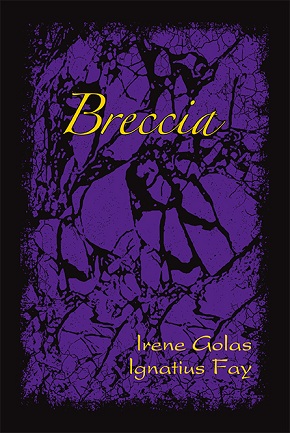
Breccia: An interview with Ignatius Fay and Irene Golas

Irene Golas discovered the world of haiku when she purchased a slender volume of Japanese nature poetry in a gift shop in Elmvale, Ontario. She was immediately drawn to the brevity and concision of the haiku form. Her first haiku were published in 2005, followed by her first tanka in 2006.

Ignatius Fay is a retired invertebrate paleontologist who began writing haiku and related forms of poetry primarily for his own pleasure and as a means of personal expression. His first published poem appeared in 2008, the same year he published a small book of haiku/senryu, Haiga Moments: pens and lens, with photographs by Ray Belcourt, of Leduc, Alberta. In 2011, he published Points In Between, an anecdotal history of his early years.

Irene and Ignatius have been published in many print and online journals, including Acorn, Eucalypt, Frogpond, and The Heron’s Nest. Irene’s poems have also been chosen for a number of anthologies. Both authors reside in Sudbury, Ontario.

___________________________________________________________________________

WG: How long have the two of you been working together?

Irene: I’d known about Ignatius since 2008, but it took me a while to find any contact information. I emailed him in the summer of 2010, asking if he’d be interested in corresponding about the art and craft of haiku. There aren’t many haiku poets in town! At first we talked in general terms about books, haiku and other poetry. Soon we were exchanging haiku books and journals and some of our unpublished work. By the fall of 2011, we had developed a mutual trust and a respect for the other’s judgment. This is when the idea of a collaborative publication first came up.

Ignatius: Irene and I are alike in that we are straightforward when asked an opinion. Our intent is always positive, to help each other become better poets. I don’t think a collaboration would have worked had we not first gone through this process.

WG: Whose idea was Breccia? When did you actually begin work on it?

Ignatius: I suggested we consider doing something jointly. After toying with the idea for a time, we got down to it in January 2012.

Irene: We were ready to prepare the manuscript for publication by the end of July. Since then we’ve spent good chunks of time writing promotional material and otherwise spreading the word about Breccia.

WG: By the way, who came up with the name, Breccia? What is its significance?

Ignatius: Irene suggested the title. She was unfamiliar with the term when she read it in one of my poems. I was referring to the Sudbury Breccia, a rock formation that is part of the Sudbury Basin. Both the basin and the breccia were formed by an asteroid impact about 1.85 billion years ago. The nickel-iron-copper ore bodies of the Sudbury area are all associated with this rock.

A breccia is made up of fragments of preexisting rock that have been re-cemented. By analogy, our collection may be considered a haiku ‘breccia,’ poems from two sources cemented together to form a unique whole.

Irene: When Ignatius sent me his manuscript, there were a few poems about his childhood in Levack. They shone a light on a way of life that was unique. It occurred to me that the Sudbury area should have a larger presence in our book. Sudbury is our home, after all, and has shaped our lives in so many ways. I encouraged Ignatius to write more. He did, expanding his focus to include details of miners’ lives and the changing face of Sudbury. I added several of my own and soon we had a ‘Sudbury Breccia’ section.

WG: This type of collection is rather rare in that it is a collaboration and in the way your poems are intermingled. What made you decide on this format?

Ignatius: Our original intention was to put together a small collection of selected and new haiku and senryu. A poem had to satisfy us both to make the cut. A fair number of poems were edited or rewritten.  We ended up with more good poems than expected. Then we complicated matters by deciding to include tanka and haibun.

Irene: At the same time, we began to discuss layout. We wanted Breccia to be a true collaboration rather than a joint publication with two sections, one for his poems, one for mine. We also wanted something different from the traditional grouping by season, something with a more organic feel. Eventually we decided to integrate our poems, creating several extended sequences in which each poem suggests some relationship to the immediately preceding poem.

WG: Breccia is 208 pages long. That’s a lot of poetry. Did you find the sequencing difficult? How long did it take?

Irene: Sequencing turned out to be the longest part of the process. And the most satisfying. We spent hours trying to get short bits of sequence to feel right, then emailed it to the other. Often the response brought suggested changes. Occasionally, emails passed each other in cyberspace and we found we had very different ideas for the next part of the sequence. This process alone took more than two months.

WG: How did you like the experience of collaboration?

Ignatius: Delightful. We’re a good match. Sure, there was lots of hard work, but we work well together. We share an interest in the English language and a commitment to our art.

Irene is an extremely efficient editor…far better than I. She has such patience and attention to detail. Many of my poems have benefited from her insights. She is straightforward in her criticism, encouraging growth. And she doesn’t hesitate to praise something I’ve written that she likes.

Irene: We both look for honest assessment of our work. We strive for improvement, which includes acknowledging a weakness in our poetry when it is pointed out and being open to editorial suggestions.

WG: Why did you choose to self-publish Breccia?

Irene: We both got the same story when we looked into traditional publishing. Finding a publisher for your first book can be a long, drawn-out process. Then it may take a couple of years for the book to appear. Our biggest concern was getting our work out there. And Ignatius had some experience with the process, which is becoming increasingly popular.

Ignatius: Another problem with using a traditional publisher is the need to travel and do personal appearances to promote the book. My inability to do that lowers our prospects significantly.

WG: This was a strictly do-it-yourself project. Did the two of you also design the cover and do the layout?

Irene: Yes, we did everything. From the beginning, we agreed we wanted this to be 100% our project. But I have to give credit to Ignatius for carrying the weight when it came to the actual layout and other aspects of desktop publishing. He’s been in graphic layout and design for 22 years.

WG: What was the most difficult part of publishing Breccia?

Irene:  Definitely the promotional writing. First we had to distill the essence of what Breccia is about – a slow process. Then we had to present that essence – sell it, really – in a catchy way, often in a hundred words or less. Too often we found ourselves reverting to a dense academic style of writing, or reaching for clichés.

Another challenge was reworking this material into different packages – a flyer, a press release, and at least half a dozen blurbs. To avoid sending out carbon copies, we had to rephrase, augment, emphasize or completely delete things from one piece to the next. A case of “how many ways can you serve hamburger?”

Ignatius: For me, the most difficult part was not being able to work regularly with Irene in person. Face-to-face, so much more can be accomplished in a short time. But my health and Irene’s other obligations were limiting factors.

Thank goodness for email! Much of the work was done through the back and forth of emails. It could be frustrating, waiting for a response or trying to iron out a miscommunication, but it allowed us to proceed. We may never have completed the project without it.

_______________________________________________________________________

You can purchase Breccia on Lulu.

Related articles:

The launch of Dead Air, Pontypool, and other Writerly Goodness

Last night was the official launch of my writer friend Scott Overton’s first novel, Dead Air.  I bought my official copy, Scott signed it, officially, I hung out with the other members of the Sudbury Writers’ Guild who came out to support Scott (his official fan club?), and he even got the official CTV interview 🙂

Before I get to particulars, I wanted to share a few more views of the Living with Lakes Centre at Laurentian University where the launch was held.  Yes, that’s the same place that Scott read with John Forrest and Mark Leslie last week for the LUminaries reading series.

I won’t say that I arrived early, but it looked like I had some time to walk around the grounds and I took a couple of pictures of the centre from a different angle, and then another looking out over Lake Ramsey from the centre’s dock.

Upon entering, I immediately gravitated to the huddle of SWG members.  We chatted and caught up a bit before the flurry of purchasing and signing got underway.

There were beverages, but word soon spread that the caterer hadn’t shown up yet.  Ever the consummate showman, Laurence Steven of Your Scrivener Press gathered the crowd and ushered us into the room for the reading.

One of the SWG members had thoughtfully brought cookies and just as Laurie apologized for the lack of provisions, the caterer arrived, the result of an understandable miscommunication.

With that sorted, Laurie made a brief but gracious introduction of Scott and brought him to the podium.

Scott first introduced his wife, Terry-Lynne, to whom his book is dedicated, his co-host for his morning radio show, and then he read three selections from his novel.  Afterward, he opened the floor to questions.

Scott spoke of his inspiration, the process of writing the novel, and the interesting things he learned on the way.  He also spoke about the editing process and how he and Laurie had negotiated that.

Overall, it was a very entertaining evening.

But I got this cold, see?  So when I got home, I crawled into bed like the little illen-filled chicklet I am and settled in for the evening.  In cruising the channels, I came across Pontypool.

In the movie, adapted from Tony Burgess’s novel of the same name, a morning radio host (sound familiar, Scott?) is trapped in his radio station while people in the town around him succumb to a strange virus.

Far from the scads of zombie-related virus movies, Pontypool takes a left turn.  The virus is spread in the form of words, and the infected begin to babble and fixate on a particular word or sound.  Through the timely visit of a doctor to the studio, the protagonist learns that it is the understanding of a word that seems to trigger the infection and that speaking in another language is an effective means of evading the illness.

As everyone around them succumbs, the protagonist and his producer are hiding from the hordes and she (the producer) begins to babble, “kill, kill, kill …”  The morning man, twigged by the words of the visiting doctor, begins to try to break his producer’s loop, telling her that kill isn’t kill, that it’s sun, dress, flower, and finally he settles on kiss.  Kill is kiss.

He knows he’s been successful when she says, “kill me.”

I just found the premise fascinating.  A semiotic virus.

You may have noticed me dropping that academic bomb from time to time on my blog, and the reason for it is that I love semiotics.  It’s the study of meaning, to put it simply.  Ultimately all language is invented and arbitrary.  Language is a series of signs or symbols that we chose to mean things so that we can communicate with others and think about them.

We accept that the letters D O G spell dog and that means a certain class of canine quadrupeds that many of us choose to coexist with, but why is it dog and not cap or tree of bazooka?  Who came up with the word and why did everyone accept that this wee beastie should be called dog (and not tomato)?

Two things: have you ever repeated a word to yourself over and over again until the word loses all meaning and just becomes a sound?  Have you ever written or typed a word that you’ve written or typed thousands (perhaps millions) of times before only to think immediately that the word is somehow wrong?  Have you been so convinced of this illusion that you look the bloody word up in the dictionary just to make sure you’ve not gone insane?

That’s semiotic confusion, or uncertainty and may just lead to the thought that it’s not the experience that’s the illusion, but all language and meaning lumped together.

That’s the kind of mind-blowing awesome of a movie like Pontypool.  Not to mention the eerie serendipity of coming from the launch of my morning radio show host friend Scott, whose novel is about a morning show host who receives what turns out to be a very serious threat and finding a movie about a morning radio show host in the middle of a semiotic virus breakout.

Gave me dreams, man …

One last thing, well two really, but they’re related.

I’ve been so busy guest blogging, hosting guests, blogging events, and interviewing that I forgot to mention that Brian Braden of Underground Book Reviews interviewed me last week!  And this week, as the result of the number of comments and likes, he’s posted an excerpt from Initiate of Stone, my work in progress.  Sure, he may have misspelled my name, but everyone does 🙂  Hazard of being me.

So if you want to find out what my WIP is made of, go read for yourself!

Need to curl up with my dog and some wicked cold meds.