Reprioritizing

This week, I had an epiphany. The tension has been building for some time and, really, it should have happened years ago, but I had to come to this place in my life to be able to wrap my head around it fully.

Now that I’ve come to a decision, though, I feel stupid for not having realized this sooner.

I’m a writer (duh).

What, you say? I thought you figured that one out already. Yes. I had. But it’s one thing to know something and another to become it, to take action to make your dreams reality.

Let me ‘splain.

C’mon, people, by now you should realize that everything’s a story with me 😉

Back when I was still a wounded creative (oh, poor me), even though I’d been published as a poet, and completed my MA in English Literature and Creative Writing, I couldn’t establish a regular writing practice. I knew that I wanted to be a writer, but I couldn’t find my way there.

I’d been working contract jobs interspersed with employment insurance claims and then I started working for my current employer. At last, I had a job that could pay the bills. The hand-to-mouth existence ceased.

I finally started to sort out my damage, got into therapy, went on antidepressants. I did a few other things to help myself health-wise, and then, thanks to a writing workshop arranged by the Sudbury Writers’ Guild, I found my way to the page.

I drafted my first novel, went to more workshops and conferences, read my way though one writing craft book after another, and joined professional associations.

At work, I was successful in an assessment process, and, after a relatively short period of time, another.

I started this blog and began to work on creating a “platform.”

By this time, I was in my late 30’s and I was under the impression that I could do everything. I could be awesome in my day job, my personal life, and in my creative life.

The truth? You can only run on all cylinders all the time for so long before you need a tune up.

I thought that taking the occasional self-funded leave would be enough, but each time I returned to work, exhaustion crept up on me more and more quickly.

I hit forty and travelling for training started to become less enjoyable. I applied for process after process, getting screened out of most of them, and eventually landed an acting consultant position that drove me a little crazy. I got my training certification.

Then the certification program ceased and I wondered what I had spent all that time and effort on.

Our internal college is undergoing a transformation of its own, by the way, and may be losing more than just the training certification program.

Creatively, I started working on other novels and started to get my short fiction published again.

And now, I’m in another acting consultant position.

I’ve just spent a week in Toronto, training. Introvert me was so drained, I had nothing left for the page.

That was when it hit me.

I’m spending my energy on the wrong thing.

Last year, I wrote about how my creative life was feeding me in a far more meaningful way than my work life. Dan Blank, from whom I learned a lot about platform, made particular note of that statement. He saw it was the light that would eventually become a revelation. As usual, I was a little slow on the uptake.

I’d just returned to my substantive position as an advisor with the training unit and my employer was in the midst of a business transformation process. On the heels of that, they engaged in a massive hiring process that required a lot of training for the newly hired employees.

Retirements at the executive level caused another kind of upheaval and only eight months after getting our manager back from an extended leave, we lost her to a management shuffle. Nearly everyone was moving around; nearly everyone was acting in one capacity or another. There was no stability.

We’re still in chaos. I think that’s supposed to be the new normal, but I don’t deal well with that much upheaval.

I had just decided that I would be happy not getting another acting consultant position, because there were geographical restrictions and I was not willing to move. My friends in the pool were being offered indeterminate positions and I was happy for them.

Then this position came up.

I think the same thing has happened at work that happened back when I was finishing my BA.

At that time, I was moving into a good place creatively. I was starting to get published. I thought I needed the validation of an MA, though.

So, I put myself through hell and though I got the damned degree, it’s still one of my biggest regrets.

Now, I think I need the continuing validation of promotions. I don’t. I so don’t.

What I need is to settle in as advisor for the rest of my career, however long that may be. No more special projects that either get abandoned or taken over by other departments. No more assessment processes that have nothing to do with the jobs they result in. No more acting positions in which I fail to the degree that the lessons learned are no longer within my grasp.

More than that, I don’t want to travel anymore. It simply drains me too much. I’m even considering a parallel move into quality monitoring, which would not involve training or travel, though I would be willing to help out with training in my office, if my new manager would be agreeable.

I’m planning on another self-funded leave this year, but after I’ve paid that off, I’m considering part-time work as well. My work/life/creative balance has been off for so long I can’t see how screwed up things have gotten.

This is not to say that I’m going to coast, or dog it, for the rest of my career. I don’t think that would be possible. It’s just not in me to purposefully do a poor, or inadequate, job. I’m a perfectionist, after all.

I just don’t want a day job that depletes me to the point that I can’t do what it is that I’ve been put on this spinning orb to do.

I still have to work for a few years yet to make sure our remaining debts are paid off, but once we’re in a good place, financially, I intend to make an early retirement of it and get on with the business of the rest of my life.

I’m a writer and the day job is a means to that end. I have to keep my priorities straight. I can’t afford to be putting good energy after bad.

I just have to make it through the remainder of my current acting assignment with my sanity intact first.

Wish me luck?
Muse-inks

This is what we do: On gatekeepers, rejection, and resilience

Once again, a writer friend has inspired this week’s post. So indebted. Many thanks.

Gatekeepers

I’m using gatekeeper in the Campbellian/Hero’s Journey sense, here: the Threshold Guardian archetype. At the point where the hero/ine stands at the threshold, ready to cross and gain the object of her or his quest, someone or something pops up and prevents the hero/ine from passing.

These gatekeepers must be defeated or circumvented, removed or converted to allies.

Mel’s note: To find out more, please read Joseph Campbell’s The Hero with a Thousand Faces, Christopher Vogler’s The Writer’s Journey, Maureen Murdock’s The Heroine’s Journey, or all of them.

Every writer I know has at least one.

It might be a teacher who tried to shape either the young writer or her work in an inappropriate way. It might be the friend or friends who ridiculed the young writer out of jealousy. It might be the mentor who is not equipped to truly help the writer and rather than admitting his gap in knowledge or ability discourages the writer from pursuing his calling.

More insidious is the above mentioned variety of mentor who continues to encourage the writer, praises the writer’s work, but sympathetically explains that the writer’s work will never find a market. They do this as a kindness, to spare the hapless writer the agony of further rejection.

It could be an editor who likes nothing the writer submits for review. It could even be someone who sets herself up as an expert but only misguides the writer to justify the fee the writer has been charged.

This is not an exhaustive list. Explore your past and you will discover your gatekeepers.

If you’ve had to face them before you were truly prepared, you may have failed to pass the challenge and reach the threshold.

Don’t despair. You haven’t lost your chance. The door remains. The gatekeeper leaves. Another may take her place, but on the next attempt, armed with your experience, you have a better chance of succeeding.

I was turned away repeatedly as a young writer and because of my introverted nature, it took me a long time to understand the ultimate lesson of the gatekeeper.

Mel’s note: If you want to find out more about my struggles, you can read my posts under the category, My history as a so-called writer. If you go back to the earliest post, Three Blind Mice, and read forward, it will all make much more sense 😉

What is the ultimate lesson of the gatekeeper? I’m so glad you asked.

The gatekeeper only has the power we give to them. If you do as I did and internalize the lessons of the gatekeepers in your life, you become your own worst enemy, your own biggest, baddest gatekeeper.

Don’t let that happen.

Even if you retreat from the gatekeeper at the time of your confrontation, keep your eyes on your goal and the reasons it is important for you to achieve it. Yes, you’re allowed to hurt, to grieve, to lick your wounds if you need to, but don’t lose sight of your dream.

Find a true friend, you know, the kind of person who would tell you if you have spinach stuck between your teeth, or if the outfit you chose to wear was absolutely hideous? Find your person (and yes, that’s a Grey’s Anatomy reference). Tell them about your struggle and the reasons it hurts so much to have backed down.

Then, tell your person about your dream and the reasons why it’s so important to you.

Even if they just listen, you will feel so much better afterward, but you will have reminded yourself, in telling your true friend, exactly why you write in the first place and exactly why you can’t give up.

Then you pick up the pieces and try again. Because that’s what we do.

Rejection sucks

There’s no way around it. Rejection sucks.

Rejection, particularly when it arrives as a form letter, is just a specific example of a non-human form of gatekeeper. Yes, there’s a human on the other end of that letter, but you don’t know them, and they don’t know you (most of the time).

That rejection has kept you from being published or winning a contest.

And it hurts.

Another writer friend, Nina Munteanu, has just completed a two-part post on the subject of rejection. In part one, she discusses how to accept rejection, and in part two, she discusses how we can learn from rejection.

In fact, a lot of writers have posted about it. Just Google it. You’ll see. A number of them counsel the writer to develop thick skin.

I’d like to call shenanigans on that.

No offence.

Resilience, not rhino-hide

Suck it up, buttercup, they say. Really?

If it was that simple, we’d all just grow ourselves a fine second skin of rhino-hide and the slings and arrows of outrageous fortune would mean nothing. Less.

Telling someone, anyone, to toughen up after suffering a loss (no matter how insignificant it might seem to others) is telling that person to shut down their feelings. That’s not a good thing. As writers, we kind of need those. Hell, as human beings we need our emotions.

We have to learn to acknowledge our feelings, to accept them, and process them. We can’t deny them. That way lies madness. Literally. It’s called depression. I know what I’m talking about here.

We have to figure out why it hurts, what’s at the root of the problem. Once we understand that, we can work, through reason and by respecting our emotional well-being, to heal the wound.

Rejection, as many writers have pointed out, isn’t personal. It’s a matter of subjectivity and timing.

Usually a rejection means not right for the publisher, for the project, for the theme of the anthology or issue, for the other stories that have already been accepted. And it means not right now. It doesn’t mean never.

Timing and subjectivity.

It’s not personal.

Why does it hurt then?

Because of how we react to it. Because of the insecurities and doubts we harbour about our ability, our craft.

The good news is this: we can control the way we react to rejection. Not right away, but with time and practice, by understanding and honouring our emotional response to rejection, it gets easier to process.

More good news: if the reason we get rejected is because our craft and skills are not at the level they need to be, we can control that too. We keep practicing, we keep learning, we keep moving forward.

That’s the real danger of rejection: that you let it stop you.

You have to continually connect with who you are as a writer and the reasons you write. You have to, at the core, be completely okay with not getting published. It’s kind of Zen. Let go of your desire.

Write because you’re a writer. Commit to being the best writer you can be. And yes, the work is hard, but you can do it if you’re a writer. You can’t not do it.

So the key is to develop, not rhino-hide, but resilience, the ability to bounce back. It’s something you can learn to do.

This might help. Or not.

This is going to sound like cheese. Like some really old, smelly cheese, like Limburger, or Roquefort.

Writing is like falling in love.

See, the biggest risk of falling in love is that you open yourself up and you become vulnerable. You risk getting hurt. But that’s the only way to love is with your whole heart plastered on your sleeve. It’s the only way love becomes anything lasting or good or true.

Writing’s like that.

Writing is that.

So just like you know that any relationship requires work, and sacrifice, and time, know that the thing you love to do requires the same.

You’ll get your heart broken, sure, but breaks heal.

The other great thing is that every great protagonist is wounded. Pour your learned experience into your writing. It will be amazing.

“The world breaks everyone, and afterward, some are strong at the broken places.” ~~Hemingway.

Weirdmaste (the weirdo in me recognizes the weirdo in you), writing geeks.

Now go hug your words. Get romantic with your words. Create beautiful bouncing baby words.

Because this is what we do.

Muse-inks

Bits and pieces

A.K.A. catching up on a bunch of stuff.

First of all, happy Valentine’s Day, to all of you lovely people out there!

Work

They say you’re not learning unless you’re failing. I must be learning BIG TIME at work these days.

That’s all I’m going to day about that.

Spirit

On February 1st, St. Brigid’s Day, or Imbolc, I attended Wooing the Soul, a day-long workshop and storytelling session intended to help women connect with their inner goddess. I enjoyed the storytelling, which was based on The Wooing of Etain. We danced, we sang, we invoked the spirit of Brigid, saint and goddess, and we shared food and experience.

I reconnected with a few friends whose circles I’ve moved away from in the past years.

While it was a good day, I found it was a bit long. I kept finding myself thinking, I could be writing, which is, incidentally, how I connect with my inner goddess. It’s a problem I have. Instead of talking about something, or listening to others talk about it, I’d rather be doing it 😛

I won’t write more about the day because others have done a better job than I could, namely, my friend Kim Fahner on her Republic of Poetry blog, and the facilitator herself, Ann Kathleen McLaughlin, on her blog, SophiAwakens.

Training of a different sort

On February 3rd, I delivered a workshop on getting published for the Northern Initiative for Social Action (NISA) as part of their Arts Intensive art education week.

I haven’t delivered a creative workshop in some time and I was looking forward to it. I’d love the opportunity to do more of these in the future. *hint, hint, universe*

I was far more nervous than I usually am before a training gig, which is to say I was a bit of a wreck, but the class was an intimate group.

The workshop was only two hours, and I had trouble keeping things on track, because the training I deliver for work is rarely less than a day. It wasn’t too bad, however, as the class was largely not at the querying stage yet, so the fact that I wasn’t able to discuss that aspect of getting published at length wasn’t a huge issue.

I also shared my notes and PowerPoint after the class, so everyone received all the bits I wasn’t able to discuss at length in the class.

I’m quite happy with how things turned out.

There are always lessons learned attached to any learning event, though, and I’ve got those tucked away for next time 🙂

The writing life

In writing news, I received my second rejection of a short story this year. I try to take the view that I am one more rejection closer to ‘yes,’ but honestly, things that been going so poorly in general of late that it’s been a little difficult to maintain a positive outlook.

Still, I continue to forge ahead with writing, revising, and submitting. It’s what we writers do.

Pupdate

Nuala had another glucose curve back in January and the result is that we increased her insulin by four units a day and tried reducing her prednisone.

The former is working well (we think) but we had to resume her previous dosage of pred as her ears were beginning to close up again.

Otherwise, our pup-child is doing well and we’ll return to the vet in March for another glucose curve and general checkup.

A clarification on the dream thing

I just wanted to be clear that I have ‘normal’ dreams, too.

The other night, for example, I dreamed that my sister-in-law invited herself over to our house for a sleepover, which was to take place, at her request, in the storage area of our unfinished basement, which barely has room for us to stand or move around in, let alone three adults and camping gear—oh, didn’t I mention, the sleepover was actually a camp-out, in the middle of one of the coldest winters we’ve had recently, in an uninsulated basement with a drafty window . . .

I’ve also had work-related dreams in which the office has moved into a shopping mall and I’m there, after hours, with Phil, moving my own office furniture. I’m wearing a power suit, have short, dark hair, and I’m skinny in that way only women who spend several hours a day working out are skinny. But I’m still me. No one else is there.

Or, I’ve dreamed that my boss gets a promotion, and she invites me along for the ride, literally, as she’s boarding a Lear jet and I’ve been summoned to the runway on the assumption that, of course, I’ll want to drop everything and go.

Inside the jet, she lounges like Cleopatra, a platoon of virile, young military men seeing to her every desire. I wish her well and get the heck out of Dodge, happy to have escaped the ‘trap.’ Oh yes. Hellish trap, that would be . . .

I’ve had stress dreams, falling dreams, chase dreams, abandonment dreams, and nightmares I’m not going to repeat, because, while they are all perfectly clear in my memory, I don’t want to feed those particular beasts.

It’s just those rare few per year that are well developed stories in their own rights that have little, if anything, to do with my waking life.

Just so you know. I’m mostly normal. Mostly (she says in a voice like Newt’s in Aliens).

So that’s it for this week. My mom’s coming over for supper in a bit, and then I’m going to throw my hat in the ring of another writing contest.

Break a pencil in all of your creative endeavours this week!

Muse-inks

The next chapter: January 2015 update

Technically, I could have written this post last Saturday, but I was still writing into the evening and I count everything up until go to sleep on the last day of the month. As is often the case, better late than never, right?

January 2015 progress

As you can see, I’ve continued to work on Marushka, the project I started for NaNoWriMo 2014. I had indicated in last month’s next chapter post that I wanted to work away at finishing my first draft of Marushka (total goal 75k words) and figured I’d manage this at about 5k words a month.

Well colour me blown away, I wrote almost 10k new words in January alone (!)

I continued to blog, but have stuck to my weekly curation posts and posting on Saturdays. I like this amount of output and time dedicated to the blog. It’s reasonable.

I also restarted my final pass on Initiate of Stone. It’s interesting. Back in December (I think), I shared a post in Tipsday by another writer who uses Jamie Raintree’s Excel worksheet. He had some excellent suggestions for tracking revisions.

One of them was that two words of revision = one word on the worksheet. I’ve implemented this, but in a way, it feels like cheating. In any given chapter I revise, I might, at most, change 500 words.

For example, I one chapter I revised, I cut out a page and a half to two pages of a battle scene that was a little long in the tooth, plus a few words here and there, tightening things up, etc. The chapter was over 3,800 words, however, and so when I entered my 1,950 words in the IoS column for that day’s revisions, it felt to me like I hadn’t done the work to earn that entry.

I’m still struggling with the idea, but revisions and editing are their own beasts. There has to be some way I can recognize the effort without artificially inflating my word count. I think the two-for-one word scheme is the closest I can come to doing that for now. We’ll see how that works out as the year progresses.

I also revised one short story for submission to an anthology call.

Totals for January:

  • IoS: 7,789 words
  • Marushka: 9,462 words 😀
  • Short stories: 34 words
  • Blog: 8,432 words
  • Grand total: 25,717 words (17,928 without IoS revisions)

Even without considering my revisions, it’s one of my best months outside November since I started tracking my word count. I’m amazed.

Progress summary as of Feb 7

This is something new that Jamie added to the 2015 worksheet that was not in last year’s: a place to put goals and track overall progress. I think it’s cool.

With IoS, I halved the total current word count of the last draft and entered that number as my goal in the drafting progress table (as per the two-for-one word scheme). This table pulls data from the monthly sheets, so I kind of had to do that in order for the table to make any sense.

I did the same thing for Apprentice of Wind and Figments. I do intend to proceed to those revisions after I’ve settled IoS. Because Marushka and Gerod and the Lions are still in the drafting process, I subtracted the word count as of the end of 2014 from my goal word count and entered that in the table.

I intend to write a few new short stories this year in addition to revising my existing ones for submission, so I figured 5k would be a good number of new words to aim for. NaNo is and always will be 50k.

Seeing how many words went into my blog last year, I thought 100k would be a good, round number to aim for there.

There is also a separate table for tracking revisions, specifically, this in pages. This table does not pull data from the monthly sheets. So I’ve entered the number of pages revised and the total number of pages manually. I’ll only be tracking IoS, AoW, and Figments in this way.

Because the table pulls data from the monthly sheets, the following progress reflects everything I’ve done up until today, not including this blog post.

  • IoS: 10,145 words/72 pages, or 16% of goal
  • Marushka: 10,522 of 40,192 or 26% of goal
  • Short stories: 46 words, or 1% of goal 😛
  • Blog: 9,078 words, or 9% of goal

That’s pretty awesome.

In other writerly news

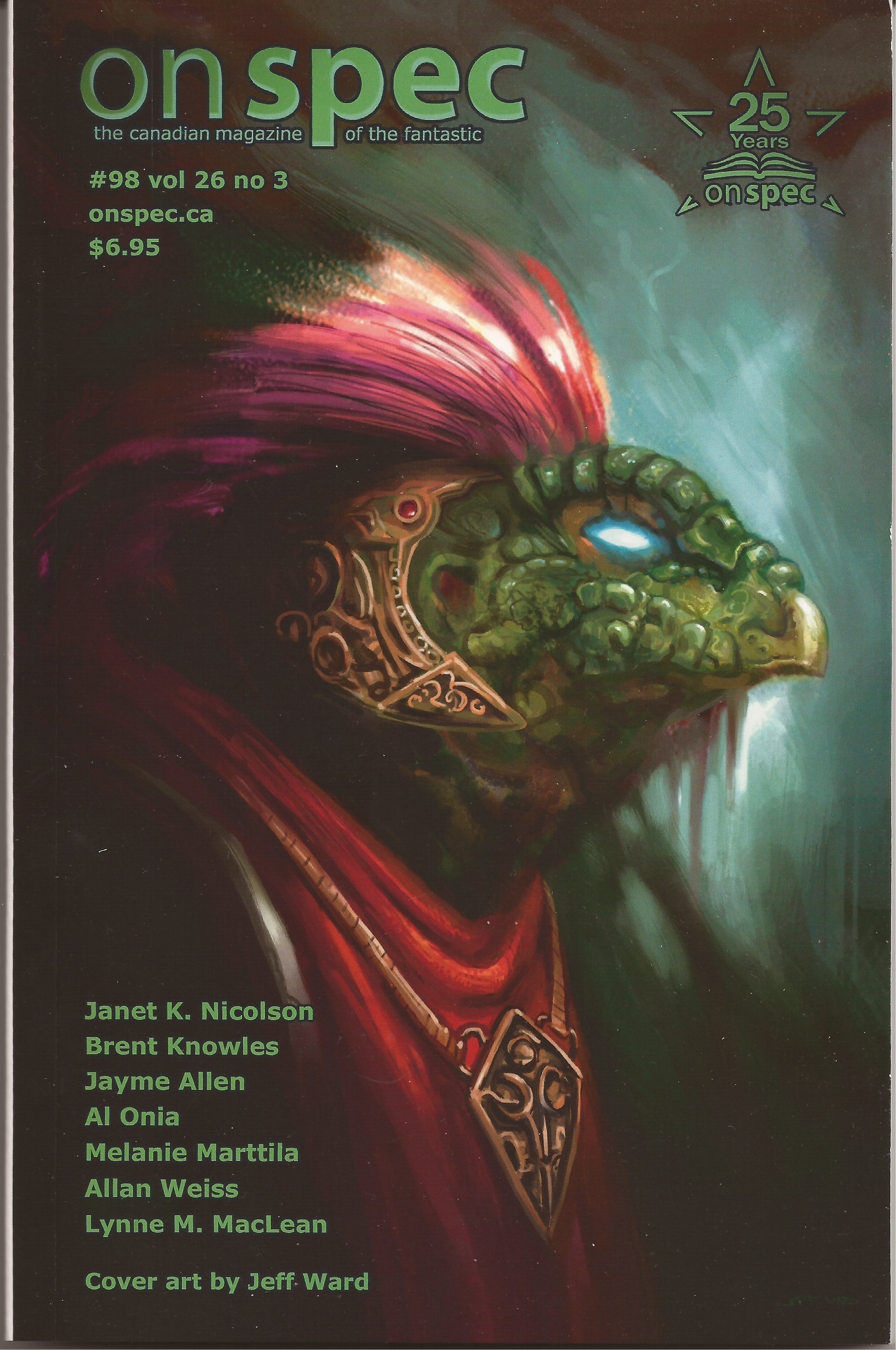
January saw the publication of “Downtime,” the short story On Spec purchased back in 2013. And, yes, I’m going to put that sexy Skeksis in your way again. As they say in one of my associations, I’m chuffed.

On Spec Fall 2014

Days afterward, I received a rejection of another short story, which, despite my best efforts, took the wind out of my sails. I know I should cultivate rhino-skin, but I’ve tried and I don’t think the goal possible. For me. At this time.

I missed one deadline for a special speculative issue of another magazine. It kind of blew right past me.

I did get my story submitted to Tesseracts 19, and I’ll be waiting on tenterhooks to see if this time will be the charm. I’ve been submitting to the anthology since 14, and I keep trying.

It’s what you have to do as a writer, keep writing, and keep trying.

And otherwise

Work has been a bit of a grind and it does not show signs of slowing up. For February, anyway.

I signed up for a five-session yoga class, and finished the last one this past Thursday. I enjoy yoga, but not the expense, or the time it takes from my already hectic life. So this is the only treat I’ve given my poor old body for now. I may well join up for the summer, if they offer the discounted membership again.

But life is good, overall. I’m making greater progress toward my goals that I thought I would, especially with the work hell.

Today, after I post this lovely thing, I’m progressing to IoS revisions, more Marushka, and perhaps working on one of those brand new short stories I told you about. Plus, the new season of Bitten (based on Kelley Armstrong’s series of novels) starts tonight, and I may fit in an episode or two of Log Horizon.

Tomorrow, another meeting of my writing/critique circle will take place, and I’ll be writing some more.

I’ll say it again. Life is good.

And so the chapter closes. See you next month!

The Next Chapter

Something awesome and dreaming up new story ideas . . . literally

Earlier in the week, a friend of mine posted to Facebook that he’d received his copy of the Fall 2014 issue of On Spec—with my short story, “Downtime,” in it!

On Spec Fall 2014

Woohoo! See—that’s my actual name on the cover!

Further, my friend (also an SF writer, incidentally) said he liked it 😀

Heck, my mom was enthusiastic about it. You would expect that, but my mom would tell me if she didn’t like it.

I brought one of my precious copies with me to work, and my coworkers said they’d have to buy copies and get me to sign.

I have yet to convince Phil to read it. He will or he won’t and I’m cool with that. I’m just curious to see what Mr. Science makes of my science fiction-y self. To be honest, he hasn’t read anything I’ve written, and he’s only heard my poetry because he was kind of obligated to be at the book launch.

Of course, I read my “love” poems, the ones he’d inspired, and that embarrassed him. Maybe that’s why he’s so gun shy of my fiction . . . Trust me, dear, my fiction is not based in real life to any recognizable extent.

In any case, to any of you who live in Canada and are interested in seeing my story, you should be able to find it at your local Chapters, or your local indie shop.

For those of you outside of Canada, please visit On Spec’s web site to find out how you might be able to get your wee mitts on some of the best SF&F in Canada.

If you like speculative fiction, you might consider a subscription.

Gettin’ dreamy with it

For those of you who haven’t been following me for very long, one of my main answers to the question, where do you get your ideas? is, from my dreams, of course.

Although it doesn’t happen very often now that I’m an adult with a full time job and stress (tends to mess up my sleep), I dream in story. There are ususally one or two really good ones a year, but I’ll dream partly formed stories an additional four to six times a year.

I’m not going to tell you the content of my dream, per se, except that it’s a new adult science fiction romance (didn’t see that coming, did you—I didn’t see it coming) and the working title would be The Reality Bomb.

I’ll probably slot it in for 2015’s NaNoWriMo and let things ruminate for most of the year.

That’s what happened with Marushka. Though her story is a YA urban fantasy/fairy tale retelling, I dreamed her up January 1, 2014. TRB was a dream of January 4, 2015.

There was another dream, which I’ll call Bright and Far Away that was a space opera story with military elements, but that one didn’t grab me as firmly as either Marushka or TRB.

So dreams coming true. It’s a theme.

Tomorrow, I’ll be wooing my soul (more on that in a future post) and Tuesday, I’ll be delivering a workshop. This is a good time for creative Mellie.

How have your creative lives been going?

Under pressure

Warning: This is a mega-post.


The content of this video really spoke to me and reminded me that I certainly could have it worse. First world problems and all that.


A few weeks ago, I reported that I’d been “called up” for another acting assignment as a consultant. I was a little wary when I first heard of the offer because it came not from the manager of the unit, but my then-current manager.

See, although I’d made the pool, the process of awarding indeterminate positions (something I’m not likely to get by virtue of my location and unwillingness to move) was ongoing and so I would be appointed as a result of an unadvertised process. It’s a fancy way of saying they couldn’t wait for the formal appointment process to get to the acting positions.

The last two times I was given an acting consultancy, I was acting in the role of training coordinator. It was not something I enjoyed. In fact, you could say that it drove me crazy.

This time, I would be committing to three specific projects:

  1. create an 18-month training plan for three business lines;
  2. help manage the overtime for the training team; and
  3. administrate a SharePoint tool created to capture and calibrate performance management ratings.

I would have no further involvement with the three training plans other than to create them. This was important to me because it was the maintenance of the plan that really got to me before (make the plan, change the plan three times before it’s even approved, then change it at least once a week thereafter, but keep all activities and escalating costs within the original budget request).

I was okay with that and decided to accept the four-months-less-a-day appointment. This will take me into the first week of May.

There was a tacit understanding that I could be appointed another acting consultancy from the pool through the formal process. We agreed to cross that bridge if it was erected.

So I started collecting information from business expertise and operational management on training needs for the proposed plan. Due to a restructuring of our internal college and learning networks, the planning process has been delayed pending the completion of a new tool (also a SharePoint site, incidentally) to help in the planning process.

I got a handle on the overtime process fairly quickly, organized the drive folders to reflect the (fairly simple) process, and track the overtime budget. This last is a bit of a sticking point. Almost a month into the fourth quarter I still don’t have a definitive number as to what our Q4 OT budget is . . .

I met with the then-administrator (going on parental leave as soon as his baby arrived, hence the urgency of my appointment) of the performance management SharePoint site and tool. I was given a brief tour and told that everything was set up and ready to go. All I had to do would be to watch the dear thing tick away.

Oh, yeah. And as a bonus fourth task, I was to write a nomination for the Service Excellence Awards.

My work of the first few days, aside from orientation, was to write up the nomination, due in a couple of days. Though stressful, my writing skills carried me through the nomination form and I met the deadline.

The OT process seemed to order itself fairly well.

After my initial consultation with the then-administrator of the performance management SharePoint site, he disappeared. The news came out a few days later that his wife had had her baby and he was officially on parental leave.

That was when issues started to emerge from the cracks like cockroaches in the dark.

I had already requested Designer Plus permission of the site (the highest a non-IT employee can receive) and for SharePoint Designer to be installed on my computer. The last time I had done any serious SharePoint admin, Desiger was off-limits. I didn’t know how to use the program and so turned to my friend Lynda.com to help me learn it.

I was asked to validate the management structure so that the appropriate accesses and permissions could be set up and set the deadline for noon on Thursday.

I became aware (belatedly) that a new set of custom list templates had to be imported into the site. This was not something I could do, and I have to put in a third service request to IT to have one of their specialists take care of that.

Once the templates were on the site, I created the new lists from them. Unfortunately I wasn’t advised that I could not change the names of the lists without breaking the cascading lookups and Kwiz forms customizations. Of course, when I tried out my newly created lists, they didn’t work.

Not having learned how to use either third party app (Cascading Lookup Plus or Kwiz), I was understandably at a loss as to how to proceed.

So I went ahead and amended the security list with the most recent changes to management structure.

On Friday of my second week in the acting consultancy, there was an information session by the creator of the tool, someone self-taught, like myself, but far more adept.

In that session, I learned about the naming issue, but when I’d created another new set of lists with proper names after the meeting, they still did not work. Before the day ended, I was finally informed that I would have SP Designer installed on my computer over the weekend.

On Monday of my third week, I confirmed the presence of Designer on my computer.

Then I received a call from one of the Directors indicating that the tool had to be ready to go for Wednesday. The creator of the tool was otherwise engaged for the day (two other business lines were setting up similar systems and his expertise was required).

Understandably, I panicked.

I thought my inability to get the lists to work properly meant that I had to get the templates reinstalled. I contacted the person who had imported them and asked for his help. I put in another service request to have the templates reinstalled ASAP. I got an emailed and cursory response to some of my questions from the tool’s creator, which didn’t help me much.

I initiated yet another service request for a custom permission level to be created for the site. This was another piece of the puzzle I was apparently missing. I was informed, however, that the properly named lists should work and that no reinstall was necessary. I called to cancel that service request, at least.

But the day ended without further action and the last word from my manager was to make it happen. I’d have to get the tool in functional shape by Wednesday at 9 am. I was authorized to work overtime, if necessary. How I was going to manage it, I didn’t have the first clue.

Needless to say, I hardly slept. The next day, I frightened everyone in my immediate area (sorry ladies) by having a full-blown freak out.

The creator of the tool was able to spend some time with me in the morning sorting things out. We fixed the three lists by deleting and recreating the cascading lookup columns in all of them.

I was shown how to import the three custom workflows using Designer. Running out of time, the creator fixed up two of the three and told me I’d be able to take care of the last one myself. Then, my sole support had to go help the other business lines. He said he’d try to get back to me later in the day.

So I fixed up the last of the workflows to the degree I could.

My manager called for an update and I was honest with her about the status of the project. We might be in trouble for the 9 am deadline.

Shortly after, the creator of the tool called back about ten minutes before he left for the day. He confirmed that I’d done a good job on the last of the workflows but said that we wouldn’t be able to go any further without the custom permission level (remember the second service request from Monday?) and two custom security groups for the lists themselves.

He said to add the security groups to my permission level request and try to get them all actioned right away. He committed to working with me first thing in the morning to finish off everything.

So I called IT and got them to change the service request and expedite its assignment. I informed them I’d be working late and so someone in BC might be able to help me out. It was all I could do.

I turned to fixing up the instructions and wording on the SharePoint site around the use of the tool.

About an hour into my overtime, one of the people from the other business lines, also tasked to have the tool up and functional for the following morning, called and asked me about the workflows.

I shared what I could with her and in return, she advised me who I could contact to have the permission level and security groups set up. Unfortunately, that person was in Quebec and had already left for the day.

I updated my manager at her home and, not being able to go further on my own, called Phil to pick me up.

My sleep was only marginally improved and the next day dawned a weary one.

My first order of business Wednesday morning was to get in touch with the IT person I was referred to the night before. He was very helpful and the work was completed quickly, but not in time for the 9 am deadline.

I called the creator of the tool and he finished two of the three workflows. Again, he had to leave to help others and said he’d call back as soon as he could.

I tried to follow his set up for the final workflow, but received an error when I tried to run it on the sample entry we’d made to test the tool.

The creator of the tool called back just before noon and fixed the last of the workflows. We ran it and everything was working. My relief was intense.

My manager called and I reported our belated success. We then turned our attention to the wording on the site and the three official communications pieces that should have been sent out at 9 am that morning.

I made notes for the rewording of the site, and then we worked together to revise the three email communications for our business line.

After two hours of work, my manager’s email crashed and she lost the drafts. There were tears.

We reconstructed the communications in record time (the second time around) and were able to send them for translation before I left work. My manager would not be at work Thursday or Friday, so I was the point person for approval of the communication content before they were sent on to the executive director for final approval and release.

Thursday presented its own challenges, but the communications were released just after noon. In the late afternoon, I started to receive requests for access to the tool.

Everyone should have had access.

Another panicked call to the tool’s creator and he helped me sort out part of the problem. The other was an issue that wasn’t related to anything I had done (or not done) on the site.

Friday morning saw the resolution of the access issues, and I was finally able to implement my manager’s suggested revisions for the site messaging from Wednesday afternoon.

Can we say WHEW?

This was, by far, the most stressful week I’ve experienced at work in the fourteen years I’ve worked for my employer.

Phil was incredibly supportive through the whole week. I’m so lucky to have such a great guy. I survived and am back to my usual, laid-back self, but this is not an experience I’m eager to repeat.

Lessons learned: I must get detailed documentation on any project I’m parachuted into the middle of in the future. This was a situation in which I literally didn’t know what I didn’t know (and what I needed to know to be able to do the job). Being deemed a SharePoint “expert” has its drawbacks.

And that is my tale of woe and triumph for the week.

Next weekend, I’m attending an event on Feb 1 (Imbolc for the paganish), and then, on Feb 3, I’m delivering my ‘how to get published’ workshop. It’s been moved from the afternoon to the evening and reduced to two hours, but it’s still going forward.

All is once again well in Mellie-ville.

How about you? Have you had (seemingly insurmountable) work challenges that you’ve been able to meet? Have you been able to surface from a sea of overwhelm and make your way to shore?

The Learning Mutt

Why is shifting point of view (POV) problematic?

For the second time in as many weeks, a writer friend has suggested a post to me. This time, it was about POV. In a short story I recently critiqued, the POV (third person, past tense) shifted from a mother to her daughter. I recommended either sticking with one POV, or marking the change with more than just textual cues.

My writer friend indicated that she had a film background and asked if the omniscient POV wouldn’t allow her to shift her focus between characters in a scene.

What follows is my response.

A wee caveat: this is based on my own craft learning to date. I’m happy to lay the burden of expertise at the feet of others 🙂


First, you should check out CS Lakin’s blog: LiveWriteThrive

You may have to go fairly far back in her archives, but she did a series on writing based on film techniques last year. She turned this into a book, Shoot your novel, which you can find on Amazon.

This might appeal to your filmic aesthetic.

Now, having said that, film techniques aren’t the same as POV in writing. Parallels can be drawn, but really, they’re two different things.

POV in writing is about who’s telling the story. Whomever the story belongs to is generally the POV you use.

Why is a shifting POV problematic?
I’ll let you do a little research on this yourself. So many people have written about it. It’s called “head hopping.”

Here’s a starter from our friend Google: https://www.google.com/search?q=head+hopping&ie=utf-8&oe=utf-8

My recommendations? The Write Practice, Marcy Kennedy (she’s Canadian), the Editor’s Blog (Head-Hopping Gives Readers Whiplash), and The Write Editor (The Difference Between Omniscient POV and Head Hopping). Jami Gold and WriterUnboxed are awesome too.

Go ahead. Check them out. I’ll wait while you scan a few of the articles 🙂

In a visual medium, the POV is omniscient, or at most limited third simulated by a voice over. You can’t really “show” the inner thoughts and feelings of a character on screen. So in film, the POV is the camera’s and by extension, the director, producer, and/or editor may have a hand in influencing the final product.

There is such a thing as an omniscient POV in writing, and it used to be used, but it’s not really popular anymore. Further, it’s hard to do well.

In cinematic terms, omniscient translates to the page as a wide shot, interspersed with close ups on various characters, but it’s all external observation. Visually, you have the zoom or cut to give you a clue as to which character or characters are the focus of the scene.

In writing, you have to do something that simulates the zoom to cue the reader that the focus of the scene is now changing. Otherwise, you could end up confusing your reader (who’s talking now? why do I have to hear from this character? why is this important to the scene/story?).

Readers have changed over the last century. This is primarily due to movies and television (where a complete story is told in 30 minutes, an hour, or two hours), video games (complete action smorgasbord), and the internet (e.g. Twitter: describe your day in 140 characters anyone?). Flash fiction and micro fiction now have journals devoted to them. Books have been written in Tweets.

Readers like shorter forms of fiction because they can read a complete story in a limited period of time (think CommuterLit.com).

If the story isn’t short, then the author must continually hook the reader and keep them interested in the story. Part of this is engaging the reader in the story (what’s at stake?) and the character (why should I care?).

Omniscient POV requires readers to pay attention and do a little more work than they might otherwise be inclined to do. It’s not personal. You don’t stick with any one character long enough for the reader to become invested in that character and you’re observing like a camera, never delving into a character’s thoughts or feelings.

A limited third POV focuses intimately on one character: She ran to his side and thought, Is he dead? Oh, please, no.

Some writers, for example George R. R. Martin in Game of Thrones, shift between characters in the limited third POV, but you will find, generally, that an entire chapter will be from one character’s POV.

If an author changes POV characters in the middle of a chapter, the POV will change when the scene changes (therefore one POV per scene) and there will often be a visual cue such as an extra line between the paragraphs, or a symbol like # or * set off in the middle of its own line. Barbara Kyle, Canadian author of historical thrillers set in the Tudor era, uses this latter technique.

A lot of young adult fiction uses first person POV (I, me, my) because it sinks the reader immediately into the thoughts and feelings of the character. This can either cement the relationship (he’s just like me!) or alienate the reader (why won’t he stop whining?). Most first person narratives stick with one character through the entire story.

Then you have the experimental authors who will mix third and first person POVs. Deborah Harkness does this in A Discovery of Witches. Diana Gabaldon did it first, however, in her Outlander series. The protagonist is written in first person and all other POV characters are written in third.

Hardly anyone can write well in the second person POV (you look in the closet and find a boy huddling in the corner). It has been done, but it requires a deft hand and mind. If any form is going to use second person POV, it’s likely a short, flash, or micro fiction story.

This gets even more complicated when you add tenses to your POV. Past and present are the usual choices. I can’t think of a novel written in the future tense in any POV. Again shorter forms may take the pressure of future tense but it feels awkward to read no matter what.

For short fiction, I’d recommend figuring out whose story you’re telling and sticking with that character throughout. If you lose the reader, they’ll put your story down.

If that reader is an editor or a contest judge, your chances of publication may be shot.

I’m just saying 🙂


Was this post helpful to anyone else? Please let me know in the comments. Also, as I mentioned last week, if you have any burning writing questions, I’ll be happy to do my best to answer them. Or refer you to the experts who answer them better than I ever could 😀

And that’s a wrap for this weekend!

Muse-inks

Passive voice avoidance strategies

A friend asked me if I had any posts about passive voice. Realizing that I didn’t, I answered her question and then put the post on my task list.

Interestingly enough, a day later, I was reading Victoria Mixon’s The Art & Craft of Fiction (yes, I read the second one first—sue me, or rather, don’t) and she wrote about the very topic 🙂

Before we get going, I just want to say that I meant to have this post up yesterday, but life intervened. A visit from some friends from out of town necessitated the cleaning of the house and shovelling of the drive. A sick mother required groceries. Not wanting to cook after cleaning, Phil and I went out to supper. And so the day disappeared. I got most of the post written yesterday, but not all of it.

Today, I need to get this post up, compile my curation posts for the week, and then I have to work some on the course I’m going to be facilitating at the beginning of February, return to revising IoS, and write a few more words in Marushka.

Nothing like having ambitious plans for what should be a day of rest 😉

Let’s start with passive sentence structure

Think of a relatively simple sentence.

The dog licked my ice cream.

Most likely, you thought of a sentence with a straightforward structure, as I did: Subject (noun) and predicate (verb and possibly object, or receiver of the action depicted by the verb).

Here is the same sentence written with a passive structure:

My ice cream was licked by the dog.

See what I did there?

A passive sentence switches the positions of the subject and object in the sentence and so the verb also has to change, generally, we have a “to be” verb and by. That’s how you recognize passive sentence structure: “to be” plus by.

Now, you may be thinking: I don’t write like that. I don’t try to write that way. Is this really an issue?

Well, some people want to sound more educated and awkward sentence structure sounds smart. Counterintuitive, but it’s kind of what we’ve been taught.

Academic texts and books from past centuries tend to use English that is a little different from what we speak and write commonly today. It sounds strange, awkward, but these writers are held up as authorities, paragons, or otherwise people-who-know-how-to-write.

So we learn (unconsciously) that strange or awkward means better. That’s where the tendency to passive structure can come from.

Also, in the work world, business writing may utilize passive structure to avoid sounding accusatory, or to distance the writer from an unpopular policy that the writer may not agree with but must nonetheless enforce.

You have to be critical about your thought process around phrasing. Both academic texts and classic literature are written in the way they are because they are serving a specific purpose, or because language changes over time. Business writing is all about rhetoric, purpose, and audience.

Using passive structure may have been acceptable at the time a particular book was written, and it may be required in academic or business contexts. It’s not wrong. It’s just not something you should do in the short story or novel you write today.

In fiction, you want to effectively simulate the way people speak.

An extension of passive structure included in “passive voice”

Passive structure is more clearly displayed in a sentence that has a predicate including an object. That’s where you see the “to be” plus by tell.

What if you don’t have an object in your sentence?

The dog ran.

Passive version:

The dog was running.

This is where you get the prohibition against “to be” verbs or progressive verb forms (-ing verbs) in general.

If you excise all “to be” verbs from your writing, you will find that you have a HUGE problem. Sometimes you need to use them.

With regard to progressive verb forms, don’t use them if a simpler version of the sentence can be written instead.

Zero words

Also roped into passive voice by some editors are words like “only” or “just,” or phrases like “began to,” “started to,” or “tried to.”

In general, “only” and “just” are called zero words. They can be removed from the sentence without changing the meaning of the sentence from which they’ve been removed. Try a simple Find exercise to remove these words from your text. It will be rare that you absolutely must have either of those two words.

The other group of phrases are symptoms of what I like to call the Yoda fallacy. In The Empire Strikes Back, Yoda says to Luke, “Do, or do not. There is no try.”

Like “just” and “only”, “tried to,” “started to,” or “began to” can often, though not all the time, be removed without changing the essential meaning of your sentence.

These words sap the energy from your sentences.

Other verb forms and contractions

If you write a passage describing past events, a flashback, chunk of backstory, or to convey essential events that don’t need the full scene treatment, you have to use the pluperfect verb form.

I had run.

Like the deadly “to be” verbs, the “had” of the pluperfect is vilified. Some people will tell you to eliminate every last one of them.

The thing is, they do serve a purpose, that of indicating that the events you write about using that verb form occurred in the past. This is especially important if you write in the past tense to begin with.

The solution? Contract those pluperfect hads.

I’d run.

It makes the “had” fade into the background. It sounds more natural when read silently in the head, too.

The same thing applies to the conditional verb forms.

Thus, “I would run” becomes “I’d run,” and “I would have run” becomes “I’d have run.”

People speak in contractions. It’s how we roll.

Basically, you squish more zero words out of your sentences.

What it comes down to

  • If you stick to a simple sentence structure where the subject comes first and is closely followed by its verb, you’ll be in good shape.
  • Avoid progressive verb forms (“to be” plus –ing).
  • Delete zero words.
  • Do or do not. There is no try (begin, or start).
  • Contract what makes sense to contract.

When editing, if you read your text out loud, you’ll be able to hear all of the above, potentially pacifying problems.

I really enjoyed writing this post. If you have any questions you’d like answered, please let me know. I’ll be happy to answer in post form 🙂

Have a good “end” everybody. Most of the weekend has already passed 😦

See you on Tipsday!

Muse-inks

The Next Chapter: December 2014 update and a year in the writerly life

Janus has two heads so he can look back and ahead. Plus, you really can’t make meaningful progress unless you take some time to reflect on your accomplishments and understand where your journey has brought you to this point.

Let’s start with December, shall we?

In the wake of NaNoWriMo, I needed a wee respite from the purely creative writing. I kept up with my regular blog posts and caught up on a few things that happened in November that I had set aside posting about because of the aforementioned NaNo.

I returned to Marushka after a few days, though, because the force is strong in this one 😉 Also, I have to finish my shit (Wendigism).

Toward the end of the month, though, I wanted to get another short fiction submission revised and sent.

December 2014 writing progress

So at the end of the month, I’d written a total of 15,167 words, 8,812 of them on the blog, 6,234 on Marushka, and 121 on the short story.

What about 2014?

It was a good year, I think.

Since it was the first year I tracked my writerly output, I really have nothing to compare it to, but I know I’ve written more words in this year than I did in 2013 or any year before that.

The highlights:

“The Broken Places” was published in Bastion Science Fiction Magazine in its June issue.

“On the Ferry” won second place in the In Places Between contest.

“Downtime” will be in the fall 2014 issue of On Spec Magazine. The issue hasn’t come out yet (long story short—please subscribe or support them on their Patreon page), but I’m still pleased as punch.

I have writerly income to report on my tax return for the second year in a row!

I’ve put “The Broken Places” and “Downtime” in the short story category in the Auroras. It’s my first year doing this kind of thing, so we’ll see how it goes.

Overall, I submitted six short stories for publication. This is fewer than in past years, but given my greater focus on my larger projects, I’m happy with this.

I attended Ad Astra, CanWrite!, and When Words Collide conferences, and workshops by Brian Henry and The Humber School for Writers.

In 2014, I have written:

  • 110,361 words on this blog
  • 34,589 words on Marushka
  • 21,464 words on Gerod and the Lions
  • 3,521 words of short fiction
  • 3,161 words on Apprentice of Wind
  • 2,384 words on Figments
  • Total: 175,480

2014 Summary

That’s a fuckload of words. Sorry. I felt the profanity appropriate.

Plus, I mapped out and reverse engineered both IoS and Figments, and revised some of IoS.

I am still eternally grateful to Jamie Raintree for her wonderful Excel spreadsheet. This year’s has enough project slots that I don’t have to modify it 🙂 Also, it appears to have a way to track drafting and revisions. I’m excited to see how it works out.

For the second year in a row, the most popular posts on my blog have been those I wrote back in 2012. Dress for Success has been consistently popular. I didn’t think a post about writing in my pyjamas would have been so compelling. Go figure.

Eight Metaphors for Persistence . . . is also a heavily viewed post. I appreciate that a bit more because it was the first post on this iteration of the blog and spoke to how I picked up the pieces after being hacked.

Still, I would like to see some of my book reviews, or conference reportage posts, rank higher.

My overall views on the blog went down from last year. In 2013 I filled the Sydney Opera House five times. In 2014 I only filled it four times.

I take all this with a grain of salt, however, as the number of my followers through WordPress has only grown and at 373, I’m closing in on 400 followers. That’s not bad for three years of blogging when I don’t have a book to sell.

Those who receive my posts via email, or who can read them through WordPress may not be counted because they haven’t actually visited the site.

Personally, as long as you’re enjoying what you read, I’m good. I’m a fan of the slow build.

What’s ahead for 2015?

I’ve you’ve read me for any length of time, you’ll know I don’t go in for resolutions. I set goals and manage my projects on an ongoing basis, sometimes re-evaluating and adjusting my goals to account for the dreaded scope creep 🙂

That’s all stuff I learned from the project management I have to do for work. It’s also similar to the dreaded underwear creep (damnit, not another wedgie).

In all seriousness, I intend to revise and submit several more short stories throughout the year. I also intend to write a few new ones.

I intend to finish my first drafts of Marushka (goal length approximately 76,000 words) and GatL (goal length approximately 50,000 words). I can manage this at a pace of about 5,000 words a month. I’ll finish Marushka first, because it’s where my head is at the moment, and then return to work on GatL afterward.

I will revise IoS and finally (FINALLY) start querying. This is so long overdue, I can’t even. Can’t. Even.

I will move onto revisions of Figments once I start querying IoS.

I will map and reverse engineer AoW and probably Marushka.

I don’t think I’ll be able to manage much more than that for the bulk of the year.

I will again engage in the NaNoWriMo Challenge, even though I will be working through the month of November. I was very pleased with the 2014 results, even though it wasn’t a “win,” per se.

For financial reasons, I’m going to stay close to home this year with conferences and conventions. Most likely Ad Astra and Can-Con.

My big expense, professional development-wise, will be a writing retreat in the summer (if I can swing the leave from work—summer’s a peak time and it’s always a big deal), also local.

I’m facilitating my first writing workshop in years in February. You know I’ll be blogging that one 🙂

And the rest will be based on opportunities as they come my way.

I like preparing my Tipsday and Thoughty Thursday curation posts on the weekend for easier distribution (and more writing time) through the week.

Aside from that, the bloggage will come out of my writerly life, as it usually does.

I have one more post to go before the night is over.

See you shortly 🙂

The Next Chapter

2014 in review

The WordPress.com stats helper monkeys prepared a 2014 annual report for this blog.

Here’s an excerpt:

The concert hall at the Sydney Opera House holds 2,700 people. This blog was viewed about 9,900 times in 2014. If it were a concert at Sydney Opera House, it would take about 4 sold-out performances for that many people to see it.

Click here to see the complete report.