Best practice epic fail

How’s that for a sensational headline? 😛

Until Gabriela’s book comes out, I’ve decided to tackle her question of the week on Saturdays, and do the Ad Astra reportage on Sundays. We’ll see how things go. I just find that I can’t manage two posts in a day and combining them doesn’t do justice to either topic.

Here was this week’s question:

QOTW 6: What’s one “Best Practice” that didn’t work for you?

“There are a lot of people spouting “best practices” about writing. Write X number of words per day. Write every day. Don’t reread what you write. Don’t share your work until you’ve perfected it. And so forth. Have you ever tried one of these “best practices”? How did it go? Write about that experience.”

I had to think about this for a while.

It was a lot harder than I thought it would be.

Why?

This was the interesting part for me, so I’ll dig in a bit here.

Before I really committed to the writing life, in 2006 or so, I was creatively damaged. Wounded even.

Before that time, I took every piece of writing advice or critique I was given as literary law. I couldn’t differentiate between opinion, advice, personal experience or preference, and what would actually work for me as a writer.

I’ve always been a keener. I like to learn. I also like to be praised for learning well, being a do-bee. I used to feel that any teacher put before me would somehow magically be able to intuit what I needed to know, and give me the tools I needed to achieve my goals.

Yes. I was naive.

During my MA years, I took the opinions of my fellow students, and those of my advisor, a well-respected author of literary fiction and eighteenth century scholar, to heart. My chosen genre (a crime in itself in a literary environment) was crap; my writing was crap; ergo, I was crap.

It’s the progression that many inexperienced writers make.

When, following a few workshops by some award-winning, bestselling authors (Canadian and American, literary and genre), I committed to writing something, every day (I set my sights low at first, aimed for one page and didn’t castigate myself if I only managed a few sentences), I began to examine my process.

I also started to read a lot of writing craft books, follow authors online. I joined social media with an eye to developing my “platform.” I started to take control of my learning.

In my day job, it’s called informal learning.

Formal learning is like a classroom, or a workshop. There are good classes. There are excellent workshops. In these, the instructor offers their knowledge and experience in context and with the caveat that what works for one writer may not work for every writer.

At their worst, though, the teacher—the expert—is the talking head, mama bird, and the students are the baby birds, waiting for ‘dinner’ to be stuffed down their throats. It’s all about trying to consume, or memorize, every bit of wisdom that comes out of the instructor’s mouth.

In informal learning, the learner enters into the learning contract on their own terms and in their own time, having identified what they want to accomplish in the learning experience. Everything is filtered through that goal, and the learner takes or leaves knowledge as they see fit.

It may involve experimentation. What sounds good on the page (or webpage) may not work in practice.

Since my entry into the realm of regular writing practice, I’ve been an informal learner. I never take anything at face value, no matter the source, without examining it critically. If I think it will improve my process, or my writing, I’ll try it out. That’s the acid test. If it works, or I derive some value from the technique, I keep it. If not, I discard it, with all thanks to the teacher for the learning opportunity.

In that light, there hasn’t been much in the way of best practices or writing advice that, if it made it through my filter and I tried it out, didn’t work for me. There are a few things on which my internal jury is still out on, but I haven’t completely discarded the possibility that they could work. Some things take time.

Now, back to the QotW.

The piece of writing advice that I can say that I have considered and discarded, because I knew it wouldn’t work for me, was to dress for success. I’ve written about this before, and the post is still one of my most popular.

The idea was that being a part of the “pyjama patrol” was not showing respect for your art and craft. The writer not only has to show up, but has to “report to work” as a professional writer.

I can see the perspective of the workshop facilitator, an author whom I like and respect, but she writes full time. If I didn’t have a day job, I’d probably feel differently, but since I spend my most productive hours working for someone else, I need to make a clear demarcation between that work and my calling.

When I get home, the business casual clothes I wear to the day job come off and the flannels go on. My husband calls it becoming comfort woman. I want to come to the page having created an environment for myself that says, “this is my time.” I want to be comfortable, cozy even.

In my own way, I do dress for success, but not in the way the workshop facilitator intended 😉

Tomorrow: I’ll be looking at the relationship between self-publishers and editors.

Next week: I’ll be debunking creative myths 🙂

Muse-inks

The next chapter: April 2016 update

April was a steady month of revision. I made it to the two thirds mark in Marushka by the time I left for Ad Astra.

Drafting with Scrivener, as I mentioned before, has resulted in more, but shorter, chapters. It’s meant a more casual pace.

Though I missed a few days of revision for the convention, I made up for it by doubling up for a few days upon my return. I should be on track to finish up with this first run through of Marushka by the Victoria Day long weekend (May 21-23).

Then, I’m moving on to the first run though on Reality Bomb 🙂

I’ll probably need a couple more passes for each work in progress before I’m ready to send them out for editing . . . And I have my eye on a couple of people for that. We’ll see how that progresses, but probably not until next year.

AprilProgress1

Total words revised for April: 37,478, just a hair under 100% of my goal

Total words written (for this blog): 10,498, 187% of my goal (!)

I sent out more queries, and received more thank you but no thank you rejections.

Work on the Sudbury Writers’ Guild anthology, which the guild wants to release in time for the next Wordstock Sudbury in the fall, progresses. We want to have the content and cover ready for June. I have two speculative short stories in the anthology (yay, me!).

There are some more opportunities coming up for short fiction, so I’ll try to get something together for those deadlines.

In June, I’ll be heading to the Canadian Writers’ Summit (June 17-19) and . . . my leave for WorldCon has been approved. W00t! So I’ll be heading down to Kansas City in August (17-21). That’s one of the things I have to do now: book my flight. And check with my buddy. She’s moved recently, so I want to make sure she’s still available for visitations. It will be my first WorldCon, so I’m very excited.

I got an early start on next year’s writing events by registering for Story Masters, May 11-14, 2017. Christopher Vogler (The Writer’s Journey), James Scott Bell (author of LOTS of writing craft books, member of The Kill Zone), and Donald Maass (agent to the literary stars, Writer Unboxed member, and author of numerous publishing and writing craft books). Four days of workshops. Yum!

And that’s all that’s new in this writer’s life.

See you Tipsday!

The Next Chapter

What’s my storytelling superpower and my writer’s Kryptonite?

Because I was away last weekend, I didn’t have a chance to cover my DIYMFA question of the week (QotW) and now I have two to answer (!)

Note, before I begin: superpower and Kryptonite come into play in this context with respect to the kinds of characters I create and the weaknesses in writing those kinds of characters. I have other writerly strengths and weaknesses, but I’ll limit this post to the questions asked.

QOTW 4: What’s Your Storytelling Superpower?

I’ve done the quiz three times so far, and it’s been Protector every time 🙂 Here’s what the result of the quiz says:

Your superpower is writing superheroes! Your favorite characters see their world in danger and will do whatever it takes to protect it and those they love in it. These characters may not wear spandex and capes, but they show almost superhuman fortitude in their quest to prevent disaster, whatever the cost to themselves. From Scarlett O’Hara to James Bond to Iron Man, you’re drawn to characters who stand up to the forces of evil and protect what they believe in.

Looking at the protagonists of my novels (so far) they are all protectors, to a one.

In terms of her series arc, Ferathainn (Fer), is ultimately going to heal the world (literally, the planet). She just doesn’t do it the way the spirit of the world wants her to 😉 In Initiate of Stone—by the way, I’m considering a change in title, but I’ll hang on to IoS in terms of discussing the book on this blog—Fer is out to avenge her friends, family, and the destruction of her village. In Apprentice of Wind, Fer defeats Yllel (temporarily); Book three sees her trying to stop a continental power struggle and war while trying not to become the god-killer her father has told her she will be; In book four, she helps to stop a civil war among the dwergen and liberates the dragons; and in book five, Yllel escapes his temporary prison, forcing Fer to confront the monumental task of healing the world, which will eliminate the threat of the mad god for good. It all revolves around Fer’s solution to god killing, which is what she faces from book two on.

She’s all about saving the world, to a greater, or lesser, degree.

Charlene (Chas), protagonist of Figments, starts out trying to solve the mystery of her father’s murder and ends up becoming a protector-mage, defending the balance between Earth and Regnarium.

Marushka runs away from a distasteful destiny (becoming the next Baba Yaga) but, once out in the world, struggles with her emerging powers and a shadow organization bent on the subjugation of all womankind.

Brenda, protagonist of my new adult science fiction (and yeah, I know it’s a genre stretch, but I have seen them out there), Reality Bomb, fails to stop a fellow PhD in physics candidate from conducting his experiment to prove time travel is possible. As a result, her reality is destroyed, and she is thrown into the past of a parallel reality in which nothing is the same, especially her alternate self . . . except that her former colleague is still working toward his fateful experiment and the destruction of another reality.

Finally, Gerod, protagonist of my MG fantasy, Gerod and the Lions, just wants to save his sister from the Child Merchants. He ends up convincing the king that he should outlaw the Child Merchants altogether.

All protectors. They each become larger-than-life characters and they each want to preserve something or someone. But . . . the way in which they preserve often involves changing the way things are, or are done. So they’re all a bit on the disruptor side of things as well.

DIYMFASuperpower

QOTW 5: What’s Your Writer’s Krpytonite?

The elaboration of the question indicates that the writer’s weakness is often related to her greatest strength.

So I guess the problem for me would be that my characters, by virtue of their talents and abilities, might come off as too perfect to the reader, the stereotypical Mary Sue or Gary Stu.

Not to worry, my characters all have their challenges and foibles.

Fer fears she might become a monster because of her magickal talent (origin story stuff). She has to overcome the trauma she experiences from witnessing the destruction of her village and the murders of the people she loves. It’s some serious PTSD. Though she has to fight battles, physical and magickal, she firmly believes that killing is wrong and has to overcome a lot of self-loathing to come to terms with the reality that killing, right or wrong, is sometimes necessary to serve a greater good.

Charlene has been suffering from depression and insomnia since her father’s death and is obsessed with finding her father’s killer, which she sees as the solution to all her problems. She’s willing to lie and steal (literally—she commits a B&E) to bring the killer to justice. And when she learns that the murderer is one of her parent’s friends, that her mother might be involved, and that she’s the monster to her father’s magical Frankenstein, things get complicated.

Marushka, having been raised in isolation by what most people would understand as a supernatural serial killer and her sentient, chicken-legged hut, is just strange. She doesn’t know how to relate to people. She doesn’t understand body language or facial expressions. Her reactions are very clinical. She just wants a normal life, but comes to understand quickly that it won’t be possible for her, and not just because she’s inheriting Baba Yaga’s powers.

Brenda faces a unique challenge in the alternate reality she’s thrust into. She’s trapped inside her alternate reality self, a woman who is so different from her it shouldn’t be possible. Brenda first has to discover some common ground and a way to reach her alternate self without making her think she’s lost her mind before they can find a way to stop the time travel experiment from unravelling another reality.

Gerod is simpler. He’s small, and, as a consequence, weak, and this frustrates him to no end. Though he tries, he can’t protect either himself or his sister from the Child Merchants, only luck saves him, initially. He can’t rely on his parents, who sold his sister in the first place. Stubbornly, he follows the Child Merchants out of his village, but they are several men who know how to fight, and they have many more children than the ones they bought in Gerod’s village. A failed attempt at a night time rescue ends with Gerod fleeing through the woods . . . and right into the paws of one of the titular lions.

You could say I like being mean to my characters. They kind of have to become bigger-than-life to face the challenges I put in front of them.

My next chapter update will have to wait for tomorrow.

See you then!

An origin story and series discoveries, anime edition

As I mentioned last week, I’m on Gabriela Pereira’s DIYMFA launch team (yes, the book is coming out shortly). In preparation for the launch, Gabriela has been asking us weekly questions related to DIYMFA (the site, the newsletter, the course, and the book).

This week’s question is: What is your origin story?

How this ties into DIYMFA: Gabriela has recently asked what our writerly superpower was. For the record, mine is character, which I consider to be the well-spring of all things story. In keeping with that theme, all superheroes have origin stories.

Here’s mine.

Author origins

Even pre-origin, I was a creative wee bug. Read, I was a big fibber. The other kids were more honest. They called me a liar.

It wasn’t anything big or flashy. When I was a kid, in grade one (five years old), I really wanted a pet. I was obsessed with cats and took those books out of the library to read, well, gaze at longingly. I was just learning to read.

In show and tell every day (practically) I’d tell the tale of the latest stray cat I’d found and taken in. When the other kids (and teacher) asked me about the last cat, it invariably, and conveniently, had run away.

By the time I was in grade three, I wrote a little essay (well, I was seven), on my puppy, Friskey. I named her and misspelled her name. I’d like to say it was purposeful, but I rather think I just didn’t know how to spell.

Also in grade three, there was a special presentation by the grade five students. They’d all written and illustrated story books.

The moment I saw Siobhan Riddell’s version of St. George and the Dragon, I was hooked. Hard. I made my first submission, to the CBC’s “Pencil Box,” later that year.

And that was it. I’ve been writing—and in love with writing—ever since.

Series discoveries: Anime update

Series Discoveries

Phil and I have eased off on the anime, but we still watch Fairy Tail, and now World Trigger, as they are released (weekly). Actually, they are both now in hiatus as the animators work on the next seasons.

Fairy Tail went through some backstory in this season with Fairy Tail: Zer0. It is the tale of how a young Mavis met with some intrepid treasure hunters and through a series of adventures founded the wizard guild, Fairy Tail. Zeref even makes an appearance.

Next season promises to be about the rebuilding of the guild, which, after the Tartaros arc, had disbanded and all of its members departed for parts unknown.

The storytelling is decent, but, as with most anime, there are gaps in logic or plot that irritate. It’s still all about the power of friendship, though.

World Trigger focused mostly on rank wars, which is where the manga dwells these days as well. Osamu, Kuga, and Chika are trying to make it to A-rank so they can go on away missions to the neighbour worlds in the hope of rescuing Chika’s brother and friend, who disappeared and are assumed abducted. They’re also in search of Kuga’s companion, Replica, an autonomous trion soldier, who’d sacrificed himself to save Osamu and Chika when Aftokrator, a neighbour world, attacked.

As the season ended, not one, but two other neighbour worlds would be coming into contact with Mideen, where World Trigger takes place. Rank wars were to continue, but the A-rank Border teams  would have to defend against the neighbours.

Osamu and his team of three are in a bit of a crisis as well. Osamu, though a good strategist, has very little trion, the energy that allows Border agents to use the neighbour triggers. He also has very little experience and has come up against a wall. He is struggling, and holding his team back.

Chika, though she has an amazing amount of trion, is young and kind enough that she can’t bear to target people.

Kuga, a neighbour himself, has lots of trion and lots of experience and so the team’s success has rested largely on his shoulders.

Osamu has tried to recruit a fourth member for their team, but has so far been unsuccessful.

Log Horizon has still not returned.

We watched the second season of RWBY and the story is getting darker. The huntresses in training have watched their academy, and their world, come tumbling down around them.

At the end, Yang had her hand cut off and she and Ruby were recovering at home with their father after the attack that destroyed their academy. Blake had run away after her confrontation with her former boyfriend and his terrorist faction ended disastrously. Weiss had been recalled to her family’s estate in the city.

The enemy, still a little too amorphous and mysterious for my liking, controls the beasts of Grimm and has stolen the powers of one of the four maidens, Spring.

Ruby, unwilling to let the enemy’s apparent victory go unanswered, takes off with two other former students from the academy to try to set things right.

We’ll see if the third season appears and if it answers any of the outstanding questions the series has so far left viewers with.

A new addition to our viewing line-up has been God Eater.

Post-apocalyptic Japan has been overrun by the Aragami, fearsome beasts that seem to revel in mindless destruction. With the exception of a few huge, very powerful Aragami, they don’t exhibit much intelligence.

To combat these fearsome beasts, scientists isolated the genetic material that mutated animals into Aragami in the first place. Though early experiments were disastrous, they eventually figured out that there were certain humans who would be enhanced by this genetic material rather than be taken over by it.

Lenka Utsugi is one of these humans, a God Eater. He is trained and given a weapon called a God Arc, which bonds with the wielder.

When an Aragami is killed, its ‘core’ is harvested. These cores can be used to power God Arcs, but are more important in the construction of Aegis, a domed settlement in which the remnants of the human race are to shelter.

There’s a lot more to it than that. Suffice it to say that Phil and I are enjoying it and watching the show while we wait for the others to return. We’re getting a little deeper into backstory, but the conspiracies in this series are still a little hazy for my liking.

And that’s it for this week.

I’ll see what the next DIYMFA question of the week is, but I may tackle that and midseason follies (to date). The week following is Ad Astra, and so I probably won’t blog that weekend. I’ll be too busy taking notes of the sessions I attend so that I’ll have lots of reportage ready to go after April’s next chapter update.

Muse-Inks: Do you need an MA/MFA?

(And a couple series discoveries)

Yeah, so I kind of fibbed again on Thursday because I wasn’t aware of some of my deadlines and involvements.

Today, I’m going to be doing double duty. I’m posting my first DIYMFA launch team post and covering the two series that hadn’t debuted/returned before I went to CanCon last October and then plunged into the lost month that is NaNoWriMo (binge writing).

I’m also reading the ARC of Jane Ann McLachlan’s new YA SF, The Salarian Desert Game, as part of her launch team. That review is due up on the interwebz on Monday, and it will be, but I’ll be holding off on putting it up on my blog until next Saturday.

So. Let’s get to it, shall we?

I’ve written about my MA experience as part of the My history as a so-called writer category, which has been a bit of a confessional/lessons-learned-from-the-writing-life kind of thing.

 The story of my MA

I was in my last year of my BA in English, Rhetoric emphasis, and I was rocking it. I’d gone into university this time (I’d started, dithered, and left to learn some life lessons) with the focused intention of becoming a better writer. I’d been writing for years, since I was in grade three, but had only recently come up with my first idea for an epic fantasy novel.

That intention had provided me with the fuel to really begin my writing life in a more serious way. I’d placed in a local writing contest with a science fiction short story, excelled in my academic writing, and been asked to write an editorial piece for one local magazine and a science fiction short story for the debut issue of another.

Through the creative writing course I’d taken, I would have another fantasy story published in an anthology. I’d written poetry and read my work at various open mic nights and reading series.

In retrospect, I should simply have continued to write. I was developing a kind of momentum that further schooling would only disrupt, but I had no idea about that then.

My friends had all departed for further schooling, teachers’ college and literature MAs, and I was still at that tender stage in the process where I had no confidence in myself. I thought I needed further validation. I thought that attaining my MA would make me a more attractive property.

I was wrong.

In Canada, at the time, there were only four universities offering MFAs: the University of New Brunswick, Concordia University, the University of British Columbia, and the University of Victoria. Two others, Windsor and Saskatchewan, offered the option of doing a creative thesis along with your degree in English literature.

Initially, I just thought I’d apply, see if anyone would accept me, and then make my decision whether to go or not. I’d just gotten married the year before and my husband wasn’t finished his undergraduate degree yet. I wasn’t so keen on being separated from him for so long.

All the MFA programs rejected me out of hand (I should have seen that as a sign). Only one of them, UNB, threw me a bone: we’ll take you in the English Literature program, but not creative writing. Windsor was the only university that accepted me. It was the closest, too, though it was still a nine hour drive away.

I thought at the time that it was doable. I’d be back for breaks and summers. Phil was supportive. We could do this, if it was what I really wanted.

I went for it without giving serious consideration to my chosen genre. I write science fiction and fantasy. Even my more literary efforts contain the element of the otherworldly, ghosts, dreams, visions. I thought that, just like my BA, my MA would yield to my passion and desire.

Then, I attended my first critiquing class. My fellow hopefuls were all of a more mainstream, if not literary, mind. One eventually defended her thesis which was a collection of poetry, all sonnets. I never learned what the other students had chosen to work on.

No one was particularly keen on what I wrote. Well, there was this one guy, but he wrote genre as well. I got stubborn and dug in. My advisor looked at my submitted stories in dismay. What is this? What is real about this story? We weren’t on the same page. We couldn’t relate to each other. He couldn’t help me become a better writer. He just wanted me to be a different kind of writer.

I did my graduate assistantship, which was essentially teaching the first year composition course (without supervision), took my classes in methodology, pedagogy, and English literature of various eras, and tried to write.

I didn’t get a lot of fiction written in those years. I basically revised already existing material and scribbled poetry, the only form of writing I could manage in the time I had between other obligations.

I eventually had a blow out with my advisor, who told me to stop wasting his time (and mine). I withdrew from the program, worked contract jobs, and collected employment insurance in between.

A year later, one of my former students emailed me, telling me that my advisor was going on sabbatical. A Canadian poet, a woman, would be taking his place. I reenrolled, and, over the next year, emailing, and flying down at intervals to meet in person, I wrote my creative thesis, defended it, and fulfilled my final requirement to achieve my MA in English Literature and Creative Writing.

Even so, I’d compromised. I chose the more literary of my stories and, framing the collection in the context of shamanism and shamanic awakening (anthropology and religious studies), I cast an academic light on my fantastic tales.

In the wake of that experience, though, I went into creative withdrawal. I’d internalized the criticisms of my first advisor and was, essentially, blocked.

Throughout the years of my MA and afterward, I continued to win writing contests, in both fiction and poetry, and continued to get published. I tried my hand at publishing a poetry journal with another writer friend of mine, but, after a couple of years, the effort folded.

I continued to work contract jobs until I was invited to apply for my current job by my sister-in-law. Once I worked full time, the writing went underground altogether.

It took me six years and a bout of depression to begin to come back to writing as something I loved, something I needed in my life, rather than an unrealistic dream. I began with a few workshops, and graduated to conferences and conventions. I took online courses. I started to build my platform (such as it is). I tried online critiquing. I tried beta readers. I tried freelance editors.

I pretty much try anything that I think might help me improve.

I’m a writing craft book junkie and I’ve learned over the years that my process is my own. I never take anything at face value. Like a writerly scientist, I experiment. I try a new technique and see if it has value for me. If it does, I incorporate it into my process. If it’s only partly useful, I’ll adapt those pieces to my process (note, my process does not change to accommodate a particular technique, the technique is adapted to fit my process). If it doesn’t work at all, I discard the technique and chalk up the time and effort to a learning experience. We have to fail—many times—before we succeed.

Two of my science fiction short stories were published in paying markets in 2014. I’ve participated three times in NaNoWriMo, “winning” twice. I now have six novels drafted, one of which I’m actively querying. The rest are in revision.

The bottom line is that writing is a way of life for me. It’s not a get rich quick scheme. It’s not my grab for fame and fortune. I’m going to do this for the rest of my life regardless of whether I get the publishing deal I want or not. I’m doing the work and spending the time to make it happen, though. The two short stories weren’t a fluke.

I’ve been published quite a lot over the years. It’s just that most of those were not paying markets. I just haven’t connect with the agent or publisher who thinks my novel is the bee’s knees yet. Yet. It will happen. And if it doesn’t happen with the novel I’m querying now, it will happen with one of the others.

I persist in hope and continue to revise.

And, I continue to learn. I’m a bit of a learning mutt that way 😉
Muse-inks

Bonus content: Series discoveries Fall 2015 con’t

There were only two series that I didn’t get around to reviewing before CanCon and NaNoWriMo monopolized my time in the fall. I’ll try not to be spoilery.

Supergirl

This is another entry in the DC Comics universe, or should I say universes.

Supergirl started out sunny and entered some darker territory toward the end of the season. On the spectrum, it’s between The Flash and Arrow, but, as The Flash has also started treading dark waters, I guess Kara Danvers is closer to Barry Allan than Oliver Queen.

There’s an almost cloying sense of hope in the series, though, that keeps it from being compelling for me. If I miss an episode, I’m not distressed.

I like the character of Cat Grant, who can be surprisingly inspirational. I also appreciate Kara’s adoptive sister, Alex (so nice to see Lexie Grey back on screen), who works for the DEO, a government agency dedicated to defending earth from alien threats. Kick ass, but real, women characters are something I like in a show.

Bringing Dean Cain (the Superman of Lois & Clark) in as Alex’s father was a fun and smart bit of homage.

Sadly, some of the other elements of the show are lacking. The love triangle (no, quadrangle, no, sorry quintangle) is a bit trite and while I believe Kara’s crush on James Olsen, I never quite bought into James and Lucy Lane, Winn and either Kara or Siobhan. Oh, and I forgot the brief flirtation between Kara and Cat Grant’s son, Adam. Man, it’s a soap opera (!)

Hank Henshaw/J’onn J’onzz is underwhelming. My Martian Manhunter is so much more awesome.

Astra/Non have been weak sauce as Kara’s enemies. Maxwell is a bit better, but still one dimensional.

So it’s a solid meh. My apologies.

Grimm

Things took a left turn last season. Sure, Nick and Juliette’s relationship wasn’t going anywhere, so they had to do something. Her transformation into a Hexenbeist was actually a good thing.

Until it wasn’t.

Juliette’s abrupt departure from sanity and eventual (and apparent) death at the hands of Trubel (the other Grimm) felt more of a convenience than true plot development.

The big question for Nick last season was how he, a Grimm sworn to protect humanity from the evil wessen that roam the world, could live with and love a Hexenbeist, the wessen that is the basis of all wicked witches, ever.

So what do they do this season? They pair Nick with Adalind Schade, a Hexenbeist whose wessen aspect has been temporarily suppressed by Rosalee’s folk cure (herb craft).

Yes, Adalind is the mother of Nick’s child (conceived in a convoluted magical plot that resulted in Juliette’s transformation into a Hexenbeist in the first place), but things progressed quickly from “I have to protect my child and therefore the woman who gave birth to him,” to “I’m having sex with the mother of my child while he cries in the other room.”

Yeah. That’s what I thought.

Worse, Juliette returns, somehow deprogrammed, as Eve, who is more Terminator than either human or Hexenbeist.

While the Black Claw plot line holds promise, things aren’t happening fast enough as the writers insist on offering a monster of the week for Nick and his fellow detective, Hank, to fight. Even a trip to the Black Forest and the recovery of an ancient Grimm artefact haven’t saved the show for me.

There are too many moving parts, too many players, to discern the true core story arc.

I wouldn’t be surprised if Grimm doesn’t return next year.

So that’s what I thought of the final two shows I chose to watch in the fall 2015 television season.

The next chapter: March 2016 update

In my 2015 year-end update, I said that 2016 would be the year of revision. To this point, I’d only ever revised the one novel, Initiate of Stone. I revised IoS eight times and I recently got a few ideas on how to improve it further as a result of my first run through of Apprentice of Wind.

In the first few days of March, I finished that first review of AoW. I’m going to return to it again, but this time, as I mentioned last month, I’m going to apply what I hope to be improvements to IoS and then move on to AoW.

My idea is to reinforce my voice over the two novels, which is quite different to the other novels I’ve drafted so far. Most of those are in a modern setting. Urban fantasy of various stripes. Though I’ve worked with IoS for so long, when it came to reviewing AoW, because I’d drafted the five other novels in between, I found I’d lost touch with the voice of the series and its characters.

We’ll see how that turns out, later in the year (I hope).

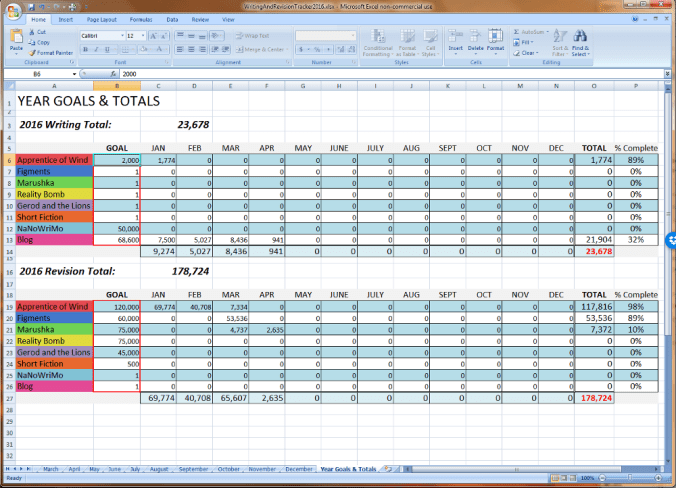
YTDProgress

Year Goals and Totals page

The current draft of AoW stands at 119,590 words. So 120K, which is reasonable for an epic fantasy.

I then moved onto Figments, my YA urban fantasy. It’s considerably shorter, nineteen chapters, and 53,536 words. I know I’ll have to punch that up a bit, but I have a number of ideas to make that happen.

Both of these novels were drafted, let to sit, printed out, read through, mapped, let to sit again, read through again, and then reviewed. I just changed some of the major things, POV, character deletion, consistency over the novels (in the case of AoW), and notes for future revision.

I don’t think I’ll need as many drafts of either AoW or Figments as I needed with IoS to finish them to my satisfaction.

I’m trying something different with Marushka, which I moved on to in the last few days of March.

My revision plan so far has been to review a chapter a day, which was challenging for AoW and Figments, because a number of the chapters of both were several thousand words long. I often found myself up until midnight on a weekday trying to get my work finished before I went to bed.

Marushka was the first novel I drafted using Scrivener and it really changed the way I drafted. The chapters are comparatively tiny (1000 to 1500 words so far) but there are a lot more of them (54).

I didn’t print Marushka out. I didn’t read it through or map it. As I review each chapter, I’m reading it through for the first time and mapping it as I go.

We’ll see if this is more or less productive than printing the draft out, and reading and mapping it out prior to my first run through.

I’m approaching this year of revision as an opportunity to experiment. My process is in continual evolution and, as I learn, from both success and failure, I’m seeing improvement in my process and in my writing overall.

I’m not looking for short cuts as much as efficiencies. I’m not doing any less work, I’m just doing it differently.

Again, we’ll see how it goes.

So here’s how the month breaks down.

MarchProgress

MarchProgress1

Want your own Writing and Revision Tracker? Visit http://jamieraintree.com/writing-revision-tracker

  • AoW – 7,334 words revised
  • Figments – 53,536 words revised
  • Marushka – 4,737 words revised
  • Blog – 8,436 words written.

I achieved 141% of my writing goal and 177% of my revision goal.

At this rate, I’ll finish the first run through on Marushka part way through May and move onto Reality Bomb and finally, Gerod and the Lions. Once I’ve got everything reviewed once, I’m going to take a break (which I tend to need in the summer months) and work on my outline for Mistress of Waves, the third book in my Ascension series and NaNo 2016 project 🙂

Then I’ll get back to deeper revisions until November arrives. I may not be able to conquer more than IoS/AoW. Maybe I make it as far as Figments.

Querying continues. I’ve not devoted much time to short fiction recently, though.

As far as conferences and conventions, I’m hitting Ad Astra (April 29-May 1), The Canadian Writers’ Summit (June 15-19, though I’ll only be attending June 17-19), and WorldCon, AKA MidAmericon II (August 17-21). I have paid my fees and reserved accommodation, but it’s all pending leave approval.

I’m holding my breath until I know it’s approved. Once it is, I’ll be able to book my flight to Kansas City.

My employer asks us to apply for leave every six months. We apply in March for the first half of the fiscal year, April to September, and in September for October through March. Approval is subject to seniority and operational demands (peak seasons).

I should know whether this first round of leave requests has been approved by the end of April.

My plans for fall and winter will have to wait on the approval of the second round of leave in October.

I’ll save those potential plans for a later update.

For the remainder of this month, I’ll be offering some Series discoveries posts (fall season, part two, mid-season follies, and anime) and at least one book review (Jane Ann McLachlan’s second Kia novel, The Salarian Desert Game).

As of Ad Astra, the convention reportage will resume.

So there’s lots of Writerly Goodness to look forward to, and of course, Tipsday and Thoughty Thursday curations will continue through the week.

In the meantime, break a bunch of pencils, you wonderful, creative people.

The Next Chapter

Mel’s Movie Madness: March 2016 edition

Though I have seen more movies recently, I’m going to focus on four: Ant-Man, Deadpool, Sword of Destiny, and Pixels (believe it or not).

Ant-Man

I watched it recently on cable and enjoyed it. Marvel is doing a fairly consistent job of offering an entertaining movie experience, in my opinion, anyway. [Please note: I’ve also watched Avengers: Age of Ultron, but I wasn’t as thrilled with that movie and other reviewers have done a much better job than I can of pointing out its shortcomings.]

I liked the brief frame at the beginning of the movie with a young Dr. Hank Pym facing off against an aged Peggy Carter and Howard Stark, denying them, and the government, access to his technology.

I also appreciated the decision not to pursue this as Hank Pym’s story, per se. I think it makes for a much richer backstory in a more global sense.

Paul Rudd does a good job portraying Scott Lang, an engineer turned ethical thief burglar, who, upon his release from prison determines that he will not, for the sake of his family, continue to pursue his criminal ways. Sure, he was a geeky Robin Hood, stealing the ill gotten gains of corporate America and returning them to the victims customers from whom they were originally obtained, but his ex-wife, now dating a cop with a hate on for Lang, would never let him see his daughter again.

Re-enter Hank Pym, now retired and attempting to foil his former protégé from enacting a corporate takeover and selling Pym’s secret technology (which he has reverse engineered) to the highest bidder.

Pym needs someone expendable, not his daughter, Hope, who has remained in the family tech firm as a spy and who would like nothing more than to carry on her father’s legacy. In short, Pym needs Lang.

Pym’s been hiding more than the Ant-Man suit, though. Hope’s mother, A.K.A. Wasp, was lost in the quantum realm (not adequately portrayed, but we have no scientific context, so what the hey) during her last mission with Pym and was the main reason Pym decided the technology had to be hidden.

Lang is recruited in a so-convoluted-as-to-be-absurd sting operation and his determination to go straight crumples at the first real challenge, but overall, I found the movie entertaining and the denouement satisfying in a sappy way. The teaser in the credits was also satisfying and sets up the next instalment nicely.

Deadpool

I had to drag Phil out to see this one in the theatre. I knew from the trailers that it was going to be all kinds of irreverent, politically incorrect, and infantile humour. Right up our alley (lol).

From the opening freeze frame to the Ferris Beuller’s Day Off teaser in the credits (there was a second, plot-oriented one as well), we loved it. I know a lot of critics have stated their disappointment in the film, but I respectfully disagree. Let them say there’s no accounting for taste. I’m good with that.

Wade Wilson is a killer. He manages to function because of his startlingly off-colour and scatological sense of humour. Post Special Forces, he works as a mercenary, but we have a perfect “save the cat” moment when we get to see the nature of (at least one of) his current assignments. He protects children from bullies.

After he finds the love of his life, the clichéd hooker with a heart of gold (but really, isn’t it a perfect match?), karma catches up with Wade in the form of cancer. There is no cure. So, in desperation, he signs up for the experimental treatment of all experimental treatments, enforced genetic mutation.

Wade’s lucky (kind of). His genetic mutation expresses itself as immortality. He can, essentially, survive any physical injury, even dismemberment. His cancer is cured. The price? He now looks “like an avocado had sex with an older avocado . . . your face is haunting.” It’s really not that bad. Admittedly, he looks like he’s had first degree burns over 100% of his body, but it doesn’t make me want to vomit (c’mon, it’s Ryan Reynolds).

Then, the guy who transformed Wade and tried to kill him kidnaps Wade’s girl. The game is on.

Colossus and Negasonic Teenage Warhead are there mostly to highlight the contrast between the typical X-men we’ve met to this point and Deadpool. Actually, they may provide analogues for the two negative reactions audience members might have to Deadpool as well.

Deadpool exacts his revenge without remorse. He kills. Unapologetically. Even as Colossus tries to “show him a better way” and Negasonic Teenage Warhead reacts with a solid “meh” to everything he says and does, Deadpool bulldozes through his nemesis’s minions, has an epic throw down, and saves his girl.

Of course, he must then face said girl’s displeasure because he left her without a word months ago.

It’s all good in the end, though.

You just have to leave your maturity at the door and enjoy the movie. Seriously.

The Sword of Destiny

This is a Netflix original movie and a sequel to Crouching Tiger, Hidden Dragon. Michelle Yeoh returns as Yu Shu Lien, the only survivor of the first movie. [This is the Chinese tradition. Most stories, except those for children, are tragedies. Please don’t hate a movie because of its genre or tradition.]

Li Mu Bai’s legendary sword, the Green Destiny, becomes the focus of a warlord who wants to possess its power in order to ensure his military domination of the region.

Yu Shu Lien once more becomes involved when she travels to honour the death of the man who has been entrusted with the sword’s protection. She is soon reunited with Meng Sizhao, also known as Silent Wolf, the man she was to marry prior to the events of Crouching Tiger, Hidden Dragon. She thought he’d died fighting the warlord Hades Dai, but Silent Wolf only thought to offer her the choice to marry her true love, Li Mu Bai, and let everyone think he’d died.

There is another young, star-crossed couple, witches, vendettas, and a lot of fabulous martial arts battle scenes. The Sword of Destiny isn’t as epic in scope as the first movie, but it is a solid follow up.

Though it may be a spoiler, they eschew the traditional ending for one more suited to Western audiences.

Pixels

This movie surprised me. I hate Adam Sandler movies on principle, but this one was bearable. Colour me amazed. There were many cringe-worthy moments and a number of huge plot holes, the effects were cheesy (but that’s probably because they were all based on 80’s video arcade games), and the acting was over the top, but it actually has some storytelling chops. And I laughed my ass off. Peter Dinklage in a mullet—gah!

Crazy, eh?

Warning: This one is totally spoilery.

The movie begins with critical backstory. In 1982, Sam Brenner and Will Cooper attend the World Video Arcade Gaming Championships where Ludlow “The Wonder Kid” Lamansoff joins them and they dominate the competition until, in the final, Eddie Plant, the returning champion, defeats Brenner at Donkey Kong.

From this experience, Brenner learns that he is a loser, and it is the lie that defines his life.

Flash forward to adulthood and Brenner is a member of the Geek Squad while his buddy, Cooper, is President of the United States (yes, strains credulity, but bear with it. It’s actually one of the least absurd events in the movie).

After meeting up with his bud, the President, at a local media event, Brenner has to install a new gaming system. The boy, Matty, informs Brenner that he’s received the system not because it’s his birthday, but because his parents are getting a divorce.

Brenner bonds with Matty over gaming, and comforts Matty’s mother, Violet, by revealing his own sad story on infidelity and betrayal. They are both called away after an awkward personal moment and each accuses the other of following them all the way to the White House, where Violet, Lieutenant Colonel Van Patten, has been summoned to an emergency meeting, and Brenner has been called in for moral support.

A strange alien attack has taken place, pixelating a US Military Base in Guam. Brenner recognizes the form of the attack as one of his 80’s video games, but his insane suggestion is dismissed, and so is he.

Lamansoff, now a conspiracy theorist, has hidden away in Brenner’s Geek Squad van and reveals himself to Brenner. At Lamansoff’s basement lair, he reveals a video taped message from the alien enemy. They’ve used 80’s television to deliver their ultimatum.

After the World Video Arcade Gaming Championships, a time capsule of all the arcade games was sent off with one of the deep space probes. Aliens retrieved it, and interpreted it as a declaration of war. They have created light weapons based on all of the 80’s video games and Earth will have three lives, and three chances to beat the aliens. If Earth fails, it will be destroyed.

Brenner and Lamansoff take the tape to President Cooper, and while the military dismisses them again, the aliens attack and destroy the Taj Mahal with Araknoid. They only have one chance left and the President gets the military on board. Violet creates light canons to fight the aliens and Brenner and Lamansoff try to train Navy Seals to fight them.

When the aliens attack next, using Centipede, the Seals prove unable to master the patterns of the game and anticipate the attack. Brenner and Lamansoff must take over and use their expertise to defeat the enemy.

The next challenge is issued. Pac Man will attack New York. Eddie Plant, who is serving time for fraud, is sprung from prison and Toru Iwatani, the inventor of Pac Man, is recruited. Though the team, now called the Arkaders, defeat Pac Man, Toru is injured and Eddie ends up in the drink.

At the victory celebration, Matty discovers that Eddie had cheat codes etched into his aviator shades. Eddie confesses that he used the same trick to defeat Brenner in 1982. The aliens announce that the Arkaders violated the rules of the game and Earth is now forfeit. They abduct Matty.

The Arkaders are stripped of weapons and abandoned; the military will take things from here. Cooper absconds with four light canons, and joins Brenner, Lamansoff, Violet, and a contrite Eddie in an attempt to avert disaster.

The final confrontation pits Brenner against the alien leader in—you guessed it—Donkey Kong. Matty and two other captives stand in the place of the princess as the prize. Brenner struggles until Matty reveals Eddie’s cheating during the battle against Pac Man and back in 1982.

Brenner rallies, beats the game, and saves the world.

Like I said at the outset, this is a deeply flawed movie, but the storytelling works well enough to save it.

I won’t necessarily recommend it, but I had to mention it in this review because it demonstrates the power of solid storytelling.

Yeah. That’s kind of the way I felt O.o

See you on Tipsday.

Mel's Movie Madness

The next chapter: February 2016 update

February is always a struggle for me, even in this year, when we didn’t have snow until after Christmas. By the time February rolls around, the dimness of winter has resulted in some degree of seasonal affective disorder (SAD). I’m tired of being cold. I’m tired of slogging through the snow. I’m just tired.

Just a note here: We’ve had more snow in January and February that we had by this time last year, and last year, the snow started in the last week of October. That’s global warming for you.

Add to that Phil’s health issues (which are steadily showing improvement, so we’re good on that score), my illness, and my subsequent discovery that I’m anaemic, and we have a perfect storm of personal stress.

I suspect that I’ve been anaemic for some time. Persistent exhaustion and difficulty sleeping (among numerous other symptoms) have supported this hypothesis. Heck, in the days when I used to donate blood, I remember being turned away on several occasions because of low iron.

Then there’s work. The problems there are mostly political in nature and not anything I have either control or influence over. It’s frustrating and disappointing more than anything else, but that’s contributed to my desire to leap-month over February and get on with things.

Creatively, I’ve still managed to exceed my revision goal, but was unable to meet my writing goal in February. I’m not going to go into the reasons for that because it doesn’t have an impact on you, gentle readers, nor would there be any nugget of wisdom to be pulled from those events.

My challenge in February was in trying to continue my coursework in Story Genius while proceeding with my writing and revision goals, which were set prior to the course, and (for me) take precedence. I also committed to another, shorter course from Jamie Raintree, and though I enjoyed it, I think I simply took on far too much. Far. Too. Much.

I had a rough week during which I felt stupid because I couldn’t effectively implement the Story Genius lesson. It blocked me. I couldn’t even revise for a number of days because I could see my failures too clearly in front of me. I could see all the ways in which my existing work sucked ass (sorry, but that was the exact thought in my head at the time).

There are several reasons for this:

  1. I’m a keener and I have been learning my entire life. I’m a perfectionist. I’m used to doing well. I’m so much harder on myself than anyone else can be. My confidence is easily shaken. Usually, I can write through the malaise, but this time, I balked.
  2. I chose to work on a finished draft rather than a new story idea. Worse, I chose the second book in a series. I set myself up for failure because the focus of the course is to develop an idea from, “oh, this is cool,” to a realized story map given the specifics of the Story Genius methodology. It would have been much easier if I had chosen to do this. I was stubborn and thought I could both revise Apprentice of Wind and use it as the basis for my work in the course. Silly rabbit.
  3. This was an opportunity I couldn’t pass up, but I had neither budgeted for the expense of the course, nor, because of my day job, could I budget sufficient time to do a good job.
  4. Illness played a role, both mine and Phil’s. My personal circumstances have made me less able to cope with what would otherwise be a minor disappointment.

Ultimately, I’ve stepped back. I have the lessons, transcripts, examples, etc., and I’m going to take the time to do the learning, and incorporate it into my creative process. In my own time. Benefits will be reaped, just not tomorrow.

There’s one week left and I’m not going to ignore it or dog it. I’m going to do the best I’m currently capable of and be content that, with practice, the true learning will occur.

My difficulties have been completely of my own making and I could have prevented them from happening by waiting for the next time the course was offered, or the time after that. If I’m able to prepare properly, I can meet (and sometimes exceed) my own, admittedly high, expectations.

Learning nugget for y’all: If we fail to plan, we plan to fail. Thank you, Benjamin Franklin.

Mel’s version: If you’re keen on something that’s popped up unexpectedly, sit back and really assess the situation. What will happen if you don’t do it this very minute? Are there future opportunities you could take advantage of? Do you really have the resources (time, money, focus) you need to invest? If not, is there a way you can shift things around to make those resources appear? Look at the long game. What part in your career does this opportunity have? Will things look any different in five years (or ten, or twenty) if you don’t “do all the things” now?

Above all, be kind to yourself.

Having said that, Story Genius is a mind blowing course and I value the opportunity to learn from Lisa Cron and Jennie Nash, both incredible experts in writing and editing. My assigned editor is also a fabulous guy and he’s been very supportive. It’s well worth the investment in time and money.

I’ll reiterate what I wrote above: my problems are of my own making and should not in any way reflect on Jennie and Lisa’s amazeballs course.

So. What did I get done in February?

I have finished the first run-through of Apprentice of Wind. There is at least one more structural edit I have to do, in which I will make use of the Story Genius method, but I’m going to let the work relax for a bit before I dive back in. In fact, I’ve seen some further areas for improvement in Initiate of Stone, as well. I might start at the beginning and work straight through both novels on the next round. It will keep me in the Ascension series headspace and voice, too, something I feel is lacking in AoW.

In the meantime, I’ve moved on to Figments. Reading through it, it’s a lot better than I remember, which has been comforting. I’m going to apply Story Genius to that, too. Before I get to the actual revision, so I’m not mucking up one process (planning) with the other (revision).

I think that repeated practice will be the key to successful implementation. Eventually, it will become second nature. Then, I will actually be able to say that I’m a story genius 😉

I resumed querying, and I submitted more short stories.

I also received more rejections. Some of them were positive (this story isn’t suitable, but please send something else), but it still results in no further publications.

This hits home in tax season, during which one becomes acutely aware of how little income one has made from one’s creative efforts.

It doesn’t help, either, that nominations for various awards have opened. Even though I really don’t have a chance in hell of getting on a ballot, it would be nice to be able to put my name beside the title of a story I wrote (and was paid for), and then stand back and say, like a proud five year old, “I made this.” 😀

FebruaryProgress

Here’s how the numbers break down.

I achieved 108% of my revision goal with 40,708 words revised.

I achieved 90% of my writing goal with 5027 words, all written on this blog.

I sent out five queries and one package for a publisher’s open call.

I submitted short stories to one anthology call, and one magazine.

And that was my month in review.

This month, as I mentioned, I’m moving on to revising Figments, and will be submitting more queries and short stories.

And I’m going to give myself a break. I’m making progress. It’s enough. So am I. I just have to remind myself what would happen if publishing was taken out of the equation.

That’s right. I’d still be writing.

If you don’t love what you’re doing, why the hell are you doing it?

Have a good week, everyone.

Hugs all around.

You’re awesomesauce, each and every one of you.

The Next Chapter

Thoughty Thursday: Things that made me go hmmmm on the interwebz, Jan 31-Feb 6, 2016

I’ve been sick. Maybe that’s why I’m a little light-headed this week 😛

February 1 was St. Brigid’s Day, or, for the other pagans, Imbolc. Irish Central.

This is a great article on the Granny Women of Appalachia. Hub Pages.

I didn’t share the news last week, but Canada has school shootings, too. Wab Kinew writes about using our grief for good, after LaLoche. The Globe and Mail.

Celebrating 100 years of enfranchised women in Canada. The Toronto Star.

Brian Hiatt reviews David Bowie’s final years. The Rolling Stone.

Photographer Donal Maloney shares his photo essay of Ireland’s abandoned psychiatric hospitals. Irish Central.

BuzzFeed wonders what it would look like if male scientists were written about like female scientists.

I had no idea this was even a thing. Why the outcry (yes, outcry) about Susan Sarandon’s breasts is bullshit. Harriet Hall for Stylist.

Lady Gaga’s new release: Till it happens to you.


A BBC film crew captures deadly ‘brinicle’ in action.

This is cool. Bailey Henderson sculpts sea creatures from medieval maps. Hi-Fructose.

Live by these four rules if you want to be happier. Rachael Yahne for The Huffington Post.

Steven Page’s Surprise, surprise.

See you Saturday!

Thoughty Thursday

The next chapter: January 2016 update

First, a note about the non-writing parts of my life

Well, the new year has gotten off to a bit of a shaky start, not with respect to my writing and revision goals, but with respect to other stuff.

In the last week of December, Phil got sick enough he had to go see a doctor. He hadn’t been in a very long time and in the process of diagnosing the illness he went to see the doctor for in the first place, the doctor diagnosed him with two other, fairly serious, illnesses. Three for the price of one. Yay?

I won’t go into the details, because it’s not my story to tell, but he’s on several medications, we’ve had to change our diet (not significantly, but still), and we’ll have to commit to several more lifestyle changes in the coming months. It’s going to be a good thing, ultimately, but I’m a creature of habit. Change is stressful.

Phil’s been told not to tackle everything at once, and so we’re dealing with things one issue, and one day, at a time.

I’ve gotten a cold for the first time in about three years. Since I don’t get them often, I tend to get doozies. I’m also in the process of seeing whether I’m anaemic or not, and my gall bladder is acting up.

I guess this is my reaction to the stress of everything else.

Which includes learning that I’ve been screened out of the consultant process at work. We’ve had a general information session, because many of the over three hundred people who applied were screened out, but I’m still getting an informal discussion of the specific reasons I was screened out. That happens Tuesday.

I’ve really been trying not to get upset. Work is work and I’ve tried to prioritize my creative work over the day job, but having been successful in the last three processes and had four acting assignments in as many years, I can’t help but feel that I’ve been kicked in the teeth. They still have testing and interviews to go, and if the eventual pool ends up being as small at I suspect it will be, there will be another process in the future. I have to question the point of putting myself through the wringer again, though.

My current acting assignment ends next Friday and at that point, so far as I know, I’m heading back to the training and advice & guidance team, but everyone keeps saying that I’m not going back and even managers aren’t including me in the training plan and no one is telling me anything. I’m kind of suffering from mushroom syndrome.

I’m trying to be Zen, but I’m not very good at that, in all honesty. I am a lot more laid back than some people, but I internalize a lot. Hence, the illen.

Now, onto the Writerly Goodness 🙂

I took some time over the holidays to plan out my writing year. Using Jamie Raintree’s amazing new Writing and Revision Tracker, I set writing and revision goals for the year, and for each month.

As I mentioned in my last Next chapter update, 2016 will be the year of revision. As I return to the querying process with Initiate of Stone, I realize I want to have some of my other five finished novels revised and edited and ready to go so that I can keep working toward my dream of a traditional deal.

What I did was to add up the current word totals of all my drafts and divided them up according to what I figure will be my productive months. I also estimated what my blogging totals would be per month and add in my NaNo 2016 writing goals.

What that worked out to was 37,550 words of revision each month (except November and December), between five and seven thousand words of blogging each month (except November), and 50k words drafted in November and December (NaNo this year will be book three of the Ascension series I figure it will take me two months to complete the draft).

So this is what January looked like.

JanuaryProgress

And I even took a few days off (!)

The month started with a couple of days devoted to reading through my draft of Apprentice of Wind, and then I set to. I’ll probably have the first run through done within the next couple of weeks, and then I’m probably going to go through it at least one more time.

So at 9,274 words, I wrote 141% of my writing goal and at 69,774 words, I almost doubled my revision goal (186%).

I also revised and sent out two short stories, and heard that another short story is still under consideration from a submission last year. So that’s awesome.

I also sent out IoS packages to open submission periods for a couple of publishers. As of the end of last year, the three Canadian small publishers I’d pitched last fall had either declined or failed to respond.

We’ll see where all of that gets me.

Other excitement

I’ve attended a few events this past month. The first was Last Stop at the Sudbury Theatre Centre, in which a couple of writer friends had their plays in progress workshopped in front of a live audience (us). It was awesome.

Then, I attended a Skype workshop with Barbara Kyle through the Sudbury Writers’ Guild on adding magic and verve to your first thirty pages. Barbara is an excellent presenter and so knowledgeable about her craft. It’s a pleasure to learn from her.

Finally, I attended a lecture by singer/songwriter Steven Page at Laurentian University on ending the stigma around mental illness. He sang a couple of songs from his new album and discussed his struggles with mental illness.

I’m also currently enrolled in two online courses.

First, I couldn’t resist signing up for Story Genius with Lisa Cron and Jennie Nash. It’s based on Lisa’s new book (of the same name) and is eight weeks long. I’m working on my week four submission this weekend. It’s hard (like, it hurts my poor, tender head hard), especially negotiating the day job and health issues Phil and I are facing right now, but I can see how it’s going to improve my ability to write a novel that will hook readers and keep them reading.

Second, I signed up for Jamie Raintree’s Design a writing career you love workshop. I’m trying to keep one foot in the business side of things. Jamie’s an excellent instructor and I always enjoy her courses.

I’ve booked my hotel for both Ad Astra in April and WorldCon in August and am still waiting for the registration information for The Canadian Writers’ Summit to emerge.

So, I guess it’s no wonder I’m under the weather at the moment.

By and large, though, I love my life. The creative part of it anyway 😉

Next week, the CanCon 2015 reportage continues.

Hope your creative endeavours are moving full steam ahead and that you’re all well on your ways to meeting your goals. Feel free to share your trials and triumphs in the comments below.

The Next Chapter