Tipsday: Writerly Goodness found on the interwebz, May 8-14, 2016

All kinds of writerly goodness for you this week!

K.M. Weiland has made no secret of her disappointment in the Star Wars prequel trilogy. In classic Kate fashion, she gleans writerly goodness from the experience. Planning your story: what George Lucas can teach you (not) to do. Helping writers become authors.

Later in the week, she offered eight tips for writing child characters.

Jessi Rita Hoffman explains how to write a thrilling action scene for Writer Unboxed.

Sophie Masson shares the building blocks of great young adult fiction. Writer Unboxed.

Lisa Cron advises: don’t accidentally give your characters a time out. Writer Unboxed.

Margaret Dilloway explores overcoming impostor syndrome for Writer Unboxed.

Christine Frazier shows you why your hero should eavesdrop and make a bad assumption (in four steps). The Better Novel Project.

Janice Hardy looks at writing a character with a gender not your own. Fiction University.

Dan Koboldt offers some tips for creating fundamentalist religions in fantasy.

Chris Winkle offers strategies for defeating the contrivance boogeyman. Mythcreants.

Jami Gold wonders if your plot obstacles are too easy, too difficult, or just right?

Jennie Nash studies great opening lines. The Book Designer.

Chuck Wendig advises us to defy reality and become artists. Terribleminds.

Jami Gold explores how to reach your potential through writing feedback.

Angela Ackerman offers six rules that will keep your critique partnerships golden. Writers helping writers.

Gabriela Pereira interviews Charlaine Harris for the DIYMFA podcast.

Annie Neugebauer says, don’t hate the query—master it! Writer Unboxed.

Janet Reid shares a checklist of things you need to be thinking about between offer and acceptance.

Susan Spann offered some advice on royalty clauses in publishing deals and how authors get paid. Writers in the Storm.

Karina Sumner-Smith guest posts on Janice Hardy’s Fiction University: is a quick release schedule right for you and your books?

My friend, Kim, is back on the road. This time, she spends an afternoon with Margaret Atwood.

Micah Solomon offers three books that will help you to radically improve your writing. BookBaby

Cory Doctorow shares his vision of how publishers, libraries, and writers could work together. BoingBoing.

Delilah S. Dawson wrote this beautiful post on writing and grieving: someday this pain will be useful to you.

Natalie Zutter shares Nnedi Okorafor and N.K. Jemesin in conversation: masquerade, initiation, and science fiction and fantasy. Tor.com

Bustle wants you to diversify your reading list with these 23 LGBTQ books with a person of colour as a protagonist.

What Bustle says your to-be-read list says about your personality.

Ferris Jabr revisits the lost gardens of Emily Dickinson. The New York Times.

Kathryn Hughes looks at the dystopian world of Beatrix Potter. The Guardian.

Shakespeare and death:


Women swept the Nebulas! i09.

Jo Walton reviews Ada Palmer’s Too Like the Lightning for Tor.com.

A Ken Liu short story will be made into a movie. i09.

John Marcotte reports that Marvel is committing to a Black Widow movie (at some unknown point in the future). Heroic Girls.

And, speaking of Marvel, the next X-Men movie is due out May 27th: X-Men Apocalypse.

Here’s the teaser:


And the official trailer:


Buzzfeed shared what was a sneak peek of Outlander’s next episode (I saw it Sunday) but I thought I’d post it anyway. “Ovaries explode!” – funnee.

See you Thursday for some thoughty stuff 🙂

Tipsday

Tipsday: Writerly Goodness found on the interwebz, April 10-16, 2016

I can’t believe how much writerly goodness I have for you this week. WTF’s going on here, anyway?

Angela Ackerman wonders, why do characters resist change? Writers helping writers.

David Corbett argues that conflict isn’t the engine of story. Writer Unboxed.

Lisa Cron explains what ‘let it go’ really means. Writer Unboxed.

Sarah Callender helps us create delightful, messy characters with the humble ampersand. Writer Unboxed.

Lance Schaubert talks talecraft on Writer Unboxed.

Jami Gold explores paragraph breaks and voice in her building blocks of writing series.

Janice Hardy helps you get what’s in your head onto the page. Fiction University.

Margie Lawson shows us how to make strong writing stellar. Writers in the Storm.

Chris Winkle shares some tips on narrating layout and position. Mythcreants.

Kelly Simmons explains how your personality type wreaks havoc on your writing and offers ten things you can do about it. Writers in the Storm.

In times of doubt, Chuck Wendig advises you to write what you love. Terribleminds.

Leanne Sowul offers some tips to keep writing when times are tough. DIYMFA.

K.M. Weiland shares twelve ways to rock your novel research. Helping writers become authors. Later in the week, she explained how to moderate reader reactions to character sins.

I’m curating the curators, now 😉 Elissa Field shares a number of quirky research sources for writers on her Friday links for writers.

Jamie Raintree offers the three most common query mistakes and advice on how to fix them.

Roz Morris shares a discussion on the benefits of editors from Author Fringe 16.

Nina Munteanu writes part two of her ecology, women, and science fiction post: praxis. Great discussion with some of Canada’s best women SF writers and editors.

Kim Fahner shares some of her lessons learned from her week in Banff with Lawrence Hill (and meeting with Alice Major). Upon her return, she struggled with decompressing and managing her creative energy.

The first of three posts by Jim C. Hines on trigger warning shenanigans inspired by Stephen Fry’s poorly thought out comments: Trigger warnings are censorship, and other nonsense. He returned the next day with Trigger warnings as an impediment to healing and mental health. Here’s the third instalment: when trigger warnings attack!

John Grisham and Donna Tartt headline the author protest of Mississippi’s anti-LGTBQ law. Electric Lit.

Doctors and psychiatrists may soon prescribe fiction to help youth with mental illness. <This is me, cheering like Kermit—yaaaaaaaaaaay!> The Guardian.

Rod McDonald, Canadian designer of the typeface Classic Grotesque, heads for Manhattan launch party. The Toronto Star.

An interview with transplanted Sudburian, Matthew Murphy. Quebec reads.

Sian Cain covers Sir Terry Pratchett’s memorial for The Guardian.

Hedgehogs are the keepers of order and knowledge in Slavic fairy tales. Tiny Donkey.

Ten facetious book dedications that actually got published. Books rock my world.

Orna Ross shares a Celtic creation story.

This is awe-inspiring: The librarian who saved Timbuktu’s cultural treasures from al Qaeda. The Wall Street Journal.

Film dialogue from 2000 screenplays, broken down by gender and age, shows how sexist movies are. Polygraph.

No trailer for this yet, but Story of Your Life looks like it might be a good SF film to check out. Movies.com

Cheryl Eddy previews another fairy talish movie due out this year: A Monster Calls. i09

We have to wait until November (no way I’m wishing is here any sooner—love spring, summer, and fall!). Fantastic Beasts and where to find them.


But this weekend! Eeeeeee! Game of Thrones, season six. I really hope they make up for last year.


And that is Tipsday for this week.

Hope you are all well and writing wicked stuff 🙂

Tipsday

Tipsday: Writerly Goodness found on the interwebz, March 6-12, 2016

A nice bit mix of craft, career, and creativity 🙂

K.M. Weiland continues her most common writing mistakes series with number 49: weak conjunctions. Helping writers become authors. Later in the week, she helps us keep things straight: Plot isn’t story.

C.S. Lakin explores cinematic scene openings in her scene structure series.

Lisa Cron tells us the shocking truth about info dumps. Writer Unboxed.

Christine Frazier helps us take charge of our novels’ symbolism. The Better Novel Project.

Janice Hardy offers the basics of punctuating dialogue. Fiction University. Later, she talks about getting readers to the end and making them glad they came.

Chris Winkle shares five haunting backgrounds for creating deep characters. Mythcreants. Then, Oren Ashkenazi shares five more reasons your story is sexist.

Laura Drake overcomes rejection: Don’t give up your power. Writers in the Storm.

Jaym Gates talks about making hard decisions and refocusing on what matters.

I’m so glad more writers are blogging about this. So important. Self-care for writers, by Jami Gold.

This is the dystopia we’ve built. Kameron Hurley reflects on life experiences and reviews The United States of Japan.

Laini Taylor offers some writing advice. The Book Life.

Publishing business news from Publishers Weekly: The Supreme Court rejects Apple’s appeal.

BBC presents ten women who changed science fiction for the better.

Bustle shares eight feminist science fiction novels. Moar recommended reading (!)

This is just amazing storytelling. The Maker.


Another brilliant piece of storytelling, but with a dystopian bent. iMom will creep you out. i09.

Entertainment Tonight online interviews Sam Heughan and Caitriona Balfe on season two of Outlander.

Thanks for stopping by.

Come back for some inspirational material on thoughty Thursday.

Tipsday

The next chapter: February 2016 update

February is always a struggle for me, even in this year, when we didn’t have snow until after Christmas. By the time February rolls around, the dimness of winter has resulted in some degree of seasonal affective disorder (SAD). I’m tired of being cold. I’m tired of slogging through the snow. I’m just tired.

Just a note here: We’ve had more snow in January and February that we had by this time last year, and last year, the snow started in the last week of October. That’s global warming for you.

Add to that Phil’s health issues (which are steadily showing improvement, so we’re good on that score), my illness, and my subsequent discovery that I’m anaemic, and we have a perfect storm of personal stress.

I suspect that I’ve been anaemic for some time. Persistent exhaustion and difficulty sleeping (among numerous other symptoms) have supported this hypothesis. Heck, in the days when I used to donate blood, I remember being turned away on several occasions because of low iron.

Then there’s work. The problems there are mostly political in nature and not anything I have either control or influence over. It’s frustrating and disappointing more than anything else, but that’s contributed to my desire to leap-month over February and get on with things.

Creatively, I’ve still managed to exceed my revision goal, but was unable to meet my writing goal in February. I’m not going to go into the reasons for that because it doesn’t have an impact on you, gentle readers, nor would there be any nugget of wisdom to be pulled from those events.

My challenge in February was in trying to continue my coursework in Story Genius while proceeding with my writing and revision goals, which were set prior to the course, and (for me) take precedence. I also committed to another, shorter course from Jamie Raintree, and though I enjoyed it, I think I simply took on far too much. Far. Too. Much.

I had a rough week during which I felt stupid because I couldn’t effectively implement the Story Genius lesson. It blocked me. I couldn’t even revise for a number of days because I could see my failures too clearly in front of me. I could see all the ways in which my existing work sucked ass (sorry, but that was the exact thought in my head at the time).

There are several reasons for this:

  1. I’m a keener and I have been learning my entire life. I’m a perfectionist. I’m used to doing well. I’m so much harder on myself than anyone else can be. My confidence is easily shaken. Usually, I can write through the malaise, but this time, I balked.
  2. I chose to work on a finished draft rather than a new story idea. Worse, I chose the second book in a series. I set myself up for failure because the focus of the course is to develop an idea from, “oh, this is cool,” to a realized story map given the specifics of the Story Genius methodology. It would have been much easier if I had chosen to do this. I was stubborn and thought I could both revise Apprentice of Wind and use it as the basis for my work in the course. Silly rabbit.
  3. This was an opportunity I couldn’t pass up, but I had neither budgeted for the expense of the course, nor, because of my day job, could I budget sufficient time to do a good job.
  4. Illness played a role, both mine and Phil’s. My personal circumstances have made me less able to cope with what would otherwise be a minor disappointment.

Ultimately, I’ve stepped back. I have the lessons, transcripts, examples, etc., and I’m going to take the time to do the learning, and incorporate it into my creative process. In my own time. Benefits will be reaped, just not tomorrow.

There’s one week left and I’m not going to ignore it or dog it. I’m going to do the best I’m currently capable of and be content that, with practice, the true learning will occur.

My difficulties have been completely of my own making and I could have prevented them from happening by waiting for the next time the course was offered, or the time after that. If I’m able to prepare properly, I can meet (and sometimes exceed) my own, admittedly high, expectations.

Learning nugget for y’all: If we fail to plan, we plan to fail. Thank you, Benjamin Franklin.

Mel’s version: If you’re keen on something that’s popped up unexpectedly, sit back and really assess the situation. What will happen if you don’t do it this very minute? Are there future opportunities you could take advantage of? Do you really have the resources (time, money, focus) you need to invest? If not, is there a way you can shift things around to make those resources appear? Look at the long game. What part in your career does this opportunity have? Will things look any different in five years (or ten, or twenty) if you don’t “do all the things” now?

Above all, be kind to yourself.

Having said that, Story Genius is a mind blowing course and I value the opportunity to learn from Lisa Cron and Jennie Nash, both incredible experts in writing and editing. My assigned editor is also a fabulous guy and he’s been very supportive. It’s well worth the investment in time and money.

I’ll reiterate what I wrote above: my problems are of my own making and should not in any way reflect on Jennie and Lisa’s amazeballs course.

So. What did I get done in February?

I have finished the first run-through of Apprentice of Wind. There is at least one more structural edit I have to do, in which I will make use of the Story Genius method, but I’m going to let the work relax for a bit before I dive back in. In fact, I’ve seen some further areas for improvement in Initiate of Stone, as well. I might start at the beginning and work straight through both novels on the next round. It will keep me in the Ascension series headspace and voice, too, something I feel is lacking in AoW.

In the meantime, I’ve moved on to Figments. Reading through it, it’s a lot better than I remember, which has been comforting. I’m going to apply Story Genius to that, too. Before I get to the actual revision, so I’m not mucking up one process (planning) with the other (revision).

I think that repeated practice will be the key to successful implementation. Eventually, it will become second nature. Then, I will actually be able to say that I’m a story genius 😉

I resumed querying, and I submitted more short stories.

I also received more rejections. Some of them were positive (this story isn’t suitable, but please send something else), but it still results in no further publications.

This hits home in tax season, during which one becomes acutely aware of how little income one has made from one’s creative efforts.

It doesn’t help, either, that nominations for various awards have opened. Even though I really don’t have a chance in hell of getting on a ballot, it would be nice to be able to put my name beside the title of a story I wrote (and was paid for), and then stand back and say, like a proud five year old, “I made this.” 😀

FebruaryProgress

Here’s how the numbers break down.

I achieved 108% of my revision goal with 40,708 words revised.

I achieved 90% of my writing goal with 5027 words, all written on this blog.

I sent out five queries and one package for a publisher’s open call.

I submitted short stories to one anthology call, and one magazine.

And that was my month in review.

This month, as I mentioned, I’m moving on to revising Figments, and will be submitting more queries and short stories.

And I’m going to give myself a break. I’m making progress. It’s enough. So am I. I just have to remind myself what would happen if publishing was taken out of the equation.

That’s right. I’d still be writing.

If you don’t love what you’re doing, why the hell are you doing it?

Have a good week, everyone.

Hugs all around.

You’re awesomesauce, each and every one of you.
The Next Chapter

Tipsday: Writerly Goodness found on the interwebz, Feb 7-13, 2016

Load up your plates my friends, I have lots of nommable readables here 🙂

K.M. Weiland shares her insights into being a person with obsessive-compulsive disorder and a writer. She also offers some tips on how to remain healthy even if you live at a desk.

C.S. Lakin explains how writers can benefit from outlining their scenes. Her scene structure series continues with the opening hook.

Janice Hardy shares five common problems with novel beginnings and how to solve them.

Jamie Raintree shows how the power of consistency builds writing careers.

Lisa Cron shared an older post with our Story Genius class: Three misunderstood pieces of writing advice that can derail your novel. Writer Unboxed. And here’s her most recent post for WU: Where real drama comes from.

Anne R. Allen lists five reasons writers need to use Google+ even though the new Google+ is awful. I must admit, I’ve fallen out of love with G+ these days. I still post there, but if I’m in a time crunch, it’s the first SoMe to be sacrificed.

Kameron Hurley admits her fallibility: We all drop the ball. Another excellence post on the importance of self-care and forgiveness in times of stress.

Related: Allie Larkin writes about the myth of balance for Writer Unboxed.

Jim C. Hines explores the pros and cons of antidepressants.

Chris Winkle gleans lessons from the cinematic writing of I Am Number Four. Mythcreants.

Local author and writerly friend, Paulette Dahl, publishes Love Letters. The Northern Life.

Ken Pisani says, finding an agent is the worst this ever. Publishers Weekly.

You should read this chat on diversity in publishing from The Toast.

The Kenyon v. Clare court case has been all over the feeds this week. Here’s where I heard about it first. Courthouse News Service.

J.K. Rowling will be publishing the script of Harry Potter and the Cursed Child. Publishers Weekly.

This is cool. Mental Floss lists eight things invented by famous authors.

Mental Floss also lists eleven authors who hated the movie adaptations of their books.

Bitch Media presents, Anya to Zombies, an alphabet of graphic novels by women.

This video is sad and beautiful and all kinds of wonderful: The Life of Death. Great storytelling.

Fantasy Fiction Focus features Tim Reynolds.


Historical novelist Tracy Chevalier calls Charlotte Brontë her hero. The Guardian.

William Gibson shares his experience writing Neuromancer. The Guardian.

The secrecy and speculation around the Doctor’s new companion (or not). Radio Times.

A Discovery of Witches series is in development. Deadline Hollywood.

I can hardly wait! Outlander, season two, begins April 9! And here’s the official trailer in case you need a little something something to get excited about 😉

Now, to settle down with some tea and let all this awesome digest!

I’ll be back with some thoughty for you on Thursday 🙂

Tipsday

The next chapter: January 2016 update

First, a note about the non-writing parts of my life

Well, the new year has gotten off to a bit of a shaky start, not with respect to my writing and revision goals, but with respect to other stuff.

In the last week of December, Phil got sick enough he had to go see a doctor. He hadn’t been in a very long time and in the process of diagnosing the illness he went to see the doctor for in the first place, the doctor diagnosed him with two other, fairly serious, illnesses. Three for the price of one. Yay?

I won’t go into the details, because it’s not my story to tell, but he’s on several medications, we’ve had to change our diet (not significantly, but still), and we’ll have to commit to several more lifestyle changes in the coming months. It’s going to be a good thing, ultimately, but I’m a creature of habit. Change is stressful.

Phil’s been told not to tackle everything at once, and so we’re dealing with things one issue, and one day, at a time.

I’ve gotten a cold for the first time in about three years. Since I don’t get them often, I tend to get doozies. I’m also in the process of seeing whether I’m anaemic or not, and my gall bladder is acting up.

I guess this is my reaction to the stress of everything else.

Which includes learning that I’ve been screened out of the consultant process at work. We’ve had a general information session, because many of the over three hundred people who applied were screened out, but I’m still getting an informal discussion of the specific reasons I was screened out. That happens Tuesday.

I’ve really been trying not to get upset. Work is work and I’ve tried to prioritize my creative work over the day job, but having been successful in the last three processes and had four acting assignments in as many years, I can’t help but feel that I’ve been kicked in the teeth. They still have testing and interviews to go, and if the eventual pool ends up being as small at I suspect it will be, there will be another process in the future. I have to question the point of putting myself through the wringer again, though.

My current acting assignment ends next Friday and at that point, so far as I know, I’m heading back to the training and advice & guidance team, but everyone keeps saying that I’m not going back and even managers aren’t including me in the training plan and no one is telling me anything. I’m kind of suffering from mushroom syndrome.

I’m trying to be Zen, but I’m not very good at that, in all honesty. I am a lot more laid back than some people, but I internalize a lot. Hence, the illen.

Now, onto the Writerly Goodness 🙂

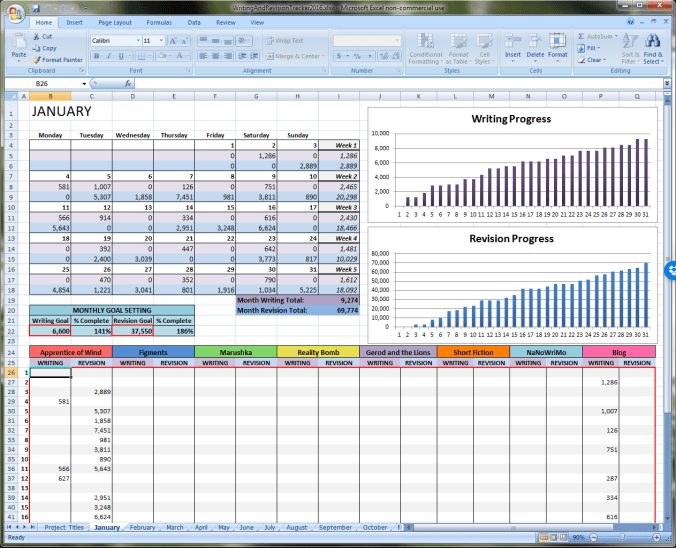
I took some time over the holidays to plan out my writing year. Using Jamie Raintree’s amazing new Writing and Revision Tracker, I set writing and revision goals for the year, and for each month.

As I mentioned in my last Next chapter update, 2016 will be the year of revision. As I return to the querying process with Initiate of Stone, I realize I want to have some of my other five finished novels revised and edited and ready to go so that I can keep working toward my dream of a traditional deal.

What I did was to add up the current word totals of all my drafts and divided them up according to what I figure will be my productive months. I also estimated what my blogging totals would be per month and add in my NaNo 2016 writing goals.

What that worked out to was 37,550 words of revision each month (except November and December), between five and seven thousand words of blogging each month (except November), and 50k words drafted in November and December (NaNo this year will be book three of the Ascension series I figure it will take me two months to complete the draft).

So this is what January looked like.

JanuaryProgress

And I even took a few days off (!)

The month started with a couple of days devoted to reading through my draft of Apprentice of Wind, and then I set to. I’ll probably have the first run through done within the next couple of weeks, and then I’m probably going to go through it at least one more time.

So at 9,274 words, I wrote 141% of my writing goal and at 69,774 words, I almost doubled my revision goal (186%).

I also revised and sent out two short stories, and heard that another short story is still under consideration from a submission last year. So that’s awesome.

I also sent out IoS packages to open submission periods for a couple of publishers. As of the end of last year, the three Canadian small publishers I’d pitched last fall had either declined or failed to respond.

We’ll see where all of that gets me.

Other excitement

I’ve attended a few events this past month. The first was Last Stop at the Sudbury Theatre Centre, in which a couple of writer friends had their plays in progress workshopped in front of a live audience (us). It was awesome.

Then, I attended a Skype workshop with Barbara Kyle through the Sudbury Writers’ Guild on adding magic and verve to your first thirty pages. Barbara is an excellent presenter and so knowledgeable about her craft. It’s a pleasure to learn from her.

Finally, I attended a lecture by singer/songwriter Steven Page at Laurentian University on ending the stigma around mental illness. He sang a couple of songs from his new album and discussed his struggles with mental illness.

I’m also currently enrolled in two online courses.

First, I couldn’t resist signing up for Story Genius with Lisa Cron and Jennie Nash. It’s based on Lisa’s new book (of the same name) and is eight weeks long. I’m working on my week four submission this weekend. It’s hard (like, it hurts my poor, tender head hard), especially negotiating the day job and health issues Phil and I are facing right now, but I can see how it’s going to improve my ability to write a novel that will hook readers and keep them reading.

Second, I signed up for Jamie Raintree’s Design a writing career you love workshop. I’m trying to keep one foot in the business side of things. Jamie’s an excellent instructor and I always enjoy her courses.

I’ve booked my hotel for both Ad Astra in April and WorldCon in August and am still waiting for the registration information for The Canadian Writers’ Summit to emerge.

So, I guess it’s no wonder I’m under the weather at the moment.

By and large, though, I love my life. The creative part of it anyway 😉

Next week, the CanCon 2015 reportage continues.

Hope your creative endeavours are moving full steam ahead and that you’re all well on your ways to meeting your goals. Feel free to share your trials and triumphs in the comments below.

The Next Chapter

Tipsday: Writerly Goodness found on the interwebz, Jan 10-16, 2016

Of Writerly Goodness, there is much 🙂

Do you re-read your favourite books? K.M. Weiland shares five tips on how you can up the re-readability factor for your novel.

Janice Hardy explains (ha!) what you need to know about show, don’t tell. Fiction University.

C.S. Lakin shares the five essential components of scene structure. Live, write, thrive.

Later in the week, she offers an older post on the same subject: your opening scene.

Jane Friedman shares Mary Buckham’s advice on how writers can craft effective settings.

Chuck Wendig offers five lessons learned from Star Wars: The Force Awakens.

Continuing his ruminations on shame and guilt, David Corbett writes the broken arc for Writer Unboxed.

Lisa Cron wonders, why do we write? Writer Unboxed.

Sarah Callender writes about when to ditch the jammies on Writer Unboxed.

Delilah S. Dawson explains what you really need to call yourself a writer.

Porter Anderson uses Erik Anderson’s discussion of diversity—or the lack thereof—in his reading as a jumping off point to explore the issue of diversity in writing. Writer Unboxed.

Dean Wesley Smith offers some tough love for writers who think they’re starting too late.

Carly Watters compares the various methods of pitching and querying. Which one is best for you?

Susan Spann drops by Writer Unboxed to share some tips for writers on how to obtain reversions of your publishing rights.

Delilah S. Dawson writes about using mindfulness and flow as a way to overcome depression.

Later in the week, she continues with this post: ‘just breathe’ is my new motto.

Inspired in part by Delilah’s posts, Chuck Wendig offers his unique take on self-care for writers. Comfort food for your big, squishy brain.

David Bowie’s death (and her own near-death experience) inspired Kameron Hurley to write this post on creation and legacy: Yes, we’re all going to die.

A horse trainer points out the most common writers’ errors with regard to horses. Dan Koboldt.

Two hundred linguists from the American Dialect Society have declared the singular ‘they’ as word of the year. The Washington Post.

A visual timeline of the future based on famous fiction. Brainpickings.

i09 lists their top 40 science fiction and fantasy books coming out in 2016.

And that was Tipsday!

Come on back for Thoughty Thursday, y’all. Hear?

Tipsday

Tipsday: Writerly Goodness found on the interwebz, December 6-12, 2015

It’s been another great week of Writerly Goodness.

Jane Friedman offers her thoughts on privilege and luxury with respect to her productivity. This is particularly interesting in light of my The next chapter update of last week.

Here’s one of the articles Jane links in her post (above): The writing class by Jaswinder Bolina for the Poetry Foundation. I actually shared one of the others last week . . .

Jane later tries to answer the question; do men receive bigger book advances than women?

Why I choose to write publicly about my anxiety. Kameron Hurley.

K.M. Weiland returns to her most common writing mistakes series with this entry: Anticlimactic endings.

David Corbett explores shame, guilt, and hope, referencing other excellent posts by Tom Bentley and Donald Maass, in this post for Writer Unboxed: The redemptive arc.

Lisa Cron continues her exploration of backstory on Writer Unboxed: What we’ve been taught about backstory and why it’s wrong.

Tor.com offers their list of the SFF characters they couldn’t stop talking about in 2015.

Sherman Alexie: How storytelling can create social change. The Take Away.

Elizabeth Gilbert discusses not getting an MFA on The MFA Project.

Open Culture shares 48 hours of Joseph Campbell lectures for free.

Mental Floss offers Edison’s footage of Mark Twain in his home.

Charles Dickens once created an entire library of fake books. He titled them all himself. Someone was wearing his clever trousers. Open Culture.

Karin Scheper wonders whether to conserve or not to conserve on the Medieval Books blog.

Ah, another lovely entry in the Dictionary of Obscure Sorrows. Kudoclasm:


And with that bit of poetry, I leave you.

Until Thursday, mes cheres!

Tipsday

Tipsday: Writerly Goodness found on the interwebz, Nov 8-14, 2015

I’m a curating machine 🙂

Roz Morris discusses the differences between British, Canadian, and American English and why writers should know when to use each. Nail Your Novel.

Writer tech: How to storyboard in Scrivener. Matt Herron for The Write Practice.

K.M. Weiland offers six steps to create a fantastic narrative voice in her lessons learned from Storming series.

Katie then discusses the easiest character she’s ever had to write.

Lisa Cron gives us the inside story on what grabs readers. Writer Unboxed.

Sophie Masson helps us get the most of mentoring, from both sides of the fence. Writer Unboxed.

Christine Frazier shares ten traits of the mentor archetype on the Better Novel Project.

Kameron Hurley was never in this for the parties.

Then, she wonders if Goodreads ratings correlate to sales.

Next, she reassures us that everything is not awful.

Finally, Kameron explains why having a writing-related day job does not ‘ruin’ you for fiction. Silly rabbits.

Mary Robinette Kowal helps us discern when writer’s block is depression. And when it’s not.

Madeleine Dore shares fifty ways to take care of yourself in the arts. Performing Arts Hub.

Dan Blank discusses the three essential ingredients to creative success. Writer Unboxed.

Building a better world through science fiction: the new utopians. New Republic.

Carly Watters shares fifteen things she’s learned in her five years as an agent.

Declining ebook sales hit home with the big five. Publishers Weekly.

Erin Lindsey is in search of a more nuanced discussion of women and gender in SFF: When Mary Sue failed the Bechdel test. Tor.com.

Margaret Atwood addresses the lack of diversity in fiction: In Tolkien, there are hardly any women at all. The Guardian.

Buffy Ste. Marie recommends eight books she loves. CBC.

Neil Gaiman stops by Buzzfeed to offer writing advice.

100 pieces of writing advice from Chuck Wendig.

The Myers-Briggs types of 101 famous authors. BookRiot.

It’s going to be okay. I did not know this. The Oatmeal.

Judging medieval books by their covers.

Finding Dory’s going to be a-dory-ble 🙂 Space.

Krysten Ritter kicks all the butt as Jessica Jones. i09. <Starts this Friday, guys!>

Tor.com lists all the TV series and movie adaptations of SFF books in the works.

Ima check out SyFy’s new series The Expanse. Tor.com.

Come back next week for more Writerly Goodness.

Tipsday

Tipsday: Writerly Goodness found on the interwebz, October 4-10, 2015

Another wonderful week of Writerly Goodness.

Roz Morris takes a snap-shot from her self-editing masterclass: Do you have a plot, or a premise? I’m currently reading Larry Brooks’s Story Physics, and this is one of his big issues 🙂

K.M. Weiland offers seven ways NaNoWriMo can help you be a better writer all year long.

The Myers-Briggs Type Inventory (MBTI) isn’t just for figuring out who you are. Katie shows how you can use it to analyze your characters. BTW, I’m an INTJ, if you wanted to know.

Katie posted later in the week about ‘the call’ and the questions you want to ask when considering an offer of representation.

It was a good week for Katie: Why weak plot points are like the Bush-Gore vote-counting debacle.

Jordan Rosenfeld and Martha Alderson team up on Writer Unboxed to review master scene types for page-turning plots.

Lisa Cron makes her long-awaited (and triumphant) return to Writer Unboxed with this post. Who knows more about story: writers or The Pentagon?

Catherine Ryan Howard shares her year of amazing productivity. This was the post that got me Muse-Ink last Saturday.

Benjamin Sobieck guest posts on Christine Frazier’s The Better Novel Project to talk about how to write fantasy weapons.

Ben Thompson gives us a two part post in response to the NYT article that reported the faltering of ebook sales in the face of strengthening print sales. Disconfirming ebooks, and Are ebooks declining, or just the publishers?

Kristine Kathryn Rusch takes a look at the latest Author Earnings report.

Jane Friedman shares five observations on the evolution of author business models.

Lachesism. From the Dictionary of Obscure Sorrows.

iDiva presents some women science fiction authors you should read.

I’m looking forward to checking out Jessica Jones. Here’s the preview on i09.

Come on back for a short and sweet Thoughty Thursday.

Tipsday