Fairy tales, Snow White and the Huntsman, and Mirror, Mirror

Once more, I find myself a day late and a dollar short, but for good reason.  Last night, I attended the Sudbury Writers’ Guild meeting and caught up with my fellow writers in arms 🙂

A lot is happening up here in the north.  Matthew Del Papa published Green Eyes through Capreol, a collection of short stories based on life in the railway town.  Scott Overton had one of his short stories accepted into the recently published Tesseracts 16, will have his first book, Dead Air, launched October 11, 2012, and next week, he will take part in the LUminaries reading series at Laurentian University along with Mark Leslie and John Forrest presenting on the topic “The Power of Popular Fiction.”

Several members are nearing completion of their various works in progress (yay!) and the Guild is moving forward on an anthology of northern writers.

Exciting creative times in Sudz!

____________________________________________________

Last week, I was a little out of sorts.  My response to stress seems to be to heap more of the deadly stuff on until my overwrought brain insists on a break.  Thanks to the kind comments of my writer friends, I embarked on a dedicated weekend of relaxation, and as part of that, I watched a couple of movies: Snow White and the Huntsman, and Mirror, Mirror.

In the beginning

Both movies are based on the fairy tale of Snow White.  Now the original story is much the same as the one most of us have become familiar with through Disney.  With a few subtle differences.

A young queen, desperate to have a child, sits spinning at her wheel.  She looks out through the ebon-wood frame of the window, onto a snowy field.  So distracted, she pricks her finger and three drops of her blood fall.  In that moment she wishes for a child black as ebony, white as snow, red as blood.

She has the child, but dies in childbirth.  The king remarries a vain woman who owns a magic mirror.  As the child grows in beauty, the new queen grows jealous and orders her huntsman to murder the girl.  The huntsman, touched by her beauty, cannot kill her, and she runs into the woods.

The huntsman figures the girl will be killed by wild animals in any case and shoots a deer with his bow, taking its innards (not just heart) to present the queen.  In the meantime, Snow finds her way to the home of the dwarfs and they allow her to stay if she will cook and clean for them.

The queen learns from her mirror that Snow still lives, and the artefact is so kind as to tell her where.  So she disguises herself and visits the dwarfs’ home while they are away working.  First, she gives snow a lace collar that once tied around the girl’s throat, chokes her.  The dwarfs return and remove the collar, restoring Snow.

They warn the girl not to receive strangers but the naive thing does so twice more, once to be poisoned by a comb placed in her hair, which the dwarfs also remove, and then to be poisoned by an apple, a mouthful of which lodges in her throat.

The dwarfs cannot revive her this last time, and determine to encase her body in a glass coffin.  As they transport the coffin to a mountain top, a traveling prince literally runs into them, upsetting the coffin, and dislodging the poisoned apple.

The prince announces he will marry Snow and invites everyone in the land.  The queen, preparing to attend the great feast and not knowing the identity of the bride, checks once more in her magic mirror, and is told once again that Snow White and not she is the fairest in the land.  The mirror neglects to tell her where Snow is this time, however, and she goes to the wedding still ignorant.

At the feast, the queen and her treachery are exposed and she is presented with a pair of iron shoes that have been heated in the fire.  She must dance until she dies.

Clarissa Pinkola Estes, in her anthology of the Tales of the Brothers Grimm, writes:

A tale invites the psyches to dream upon something that seems familiar, yet often finds its origins in a far away time.  In entertaining the tales, listeners are re-envisioning the meanings of them, “reading with the heart” these important metaphoric guidances about the life of the soul.

As my recent foray into Fairy tale blogging madness will attest, fairy tales have an enduring fascination.  Snow White has been given homage in many novels and movies as a result.

Snow White and the Huntsman

This movie is quite faithful to the original fairy tale at the outset, but then takes a radical departure.

**Warning: Spoiler alert!**

Snow White & the Huntsman

Snow White & the Huntsman (Photo credit: Ludie Cochrane)

The queen, a fearsome sorceress who drinks the life force of beautiful maidens to remain young and beautiful, murders the king and keeps Snow White a prisoner for ten years while the country grows desolate around them.

When Snow White escapes into the dark forest, where she has no power, the queen recruits a huntsman and binds him with the promise that she will resurrect his dead wife if he will kill Snow White.

In the forest, Snow meets the dwarfs, who have fallen on hard times.  The huntsman finds Snow White, but Snow convinces him that the queen has deceived him and that they will both die if he takes her back to the queen.

They flee with the dwarfs, through various adventures, and joined by Snow’s childhood playmate, the son of a neighbouring duke, they defeat the queen’s brother and his men.  The queen, however disguises herself as the duke’s son and offers Snow the fateful apple.

When she is revived, Snow convinces the Duke to go to war against the queen and in a final confrontation, a Snow that appears more like Joan of Arc than a fairy tale princess, kills the queen.

What I liked about it:

  • The queen.  She was a brilliant villain, made more complex by a back story of abuse and tragedy, and more creepy by implications of incest with her brother.
  • The dwarfs.  They were a mystical, gruff bunch.  Bob Hoskins was fantastic 🙂
  • The lord of the forest.  At one point, the group enter fairy lands, and the lord of the forest blesses Snow.  It was a scene reminiscent of Princess Mononoke, with the lord of the forest appearing as a giant white stag with gloriously branching antlers, though I much preferred Myazaki’s Puff ‘n’ Fresh-like head rattlers to Huntsman’s eerie fairies that crawled out of the bodies of animals.
  • The scarred women.  To protect themselves from the queen’s predations, the widowed and orphaned women of the land scar their faces.
  • The awakening kiss.  Though it is the duke’s son who loves Snow, his kiss does not awaken her.  It is the huntsman’s kiss that proves to be the kiss of true love, but not because he loves Snow.  It is a kiss born of his sorrow for failing Snow as he failed his wife before.  I liked that a lot.
  • The ending.  Snow White, having defeated the queen and reclaimed her kingdom, sits on the throne, no man by her side, not the duke’s son, and not the huntsman.
  • The song.  Breath of life by Florence + the Machine is awesome!

What I didn’t like:

  • Some of the plot points were too convenient.

Why keep Snow White a prisoner?  The queen could have just killed her, or better still, take the girl’s life force to maintain her beauty.  It’s only when the mirror reveals to her (ten years on) that Snow’s heart will keep her forever young that she thinks to do anything with her rival.  Why did the mirror wait so long to tell her?
The queen has no power in the dark forest, so she recruits the huntsman, but she still sends her brother in after Snow.  Why didn’t she just send her brother in the first place?
The duke’s son gets himself recruited to the queen’s brother’s hunting party, but when they find Snow, he’s more concerned about maintaining his cover than in helping her.

  • The fairies creeped me out.
  • Snow is innocent and pure.  It’s that purity that allows her to defeat the queen, but for the final battle, she’s done up in plate mail.  It promises bad-assery that Snow fails to fulfill.  The queen tosses her around like a rag doll and she only succeeds in killing the queen because she’s lucky.

Mirror, Mirror

Mirror, Mirror, from the outset, seemed a movie that didn’t know what it was trying to accomplish.  It starts with the queen, narrating her own story in a British accent, which she doesn’t maintain.

There are moments in it that are potentially dark, but they are overwhelmed by the silly.

In this revision of the fairy tale, Snow is merely locked away while the queen fritters away her money on parties and trying to look young.  She is advised by a maid to go out and have a look at the kingdom herself.  Snow is horrified by the poverty she sees.

When the prince comes on the scene, the queen settles on him as a means to continue her wastrel ways.

The prince, however, has fallen in love with Snow (who rescued him after the bandit dwarfs left him hanging), so the queen decides to get rid of her, sending her chief boot-licker out to do the job.  That part is faithful to the fairy tale.  The boot-licker is unable to kill Snow, but leaves her to the beast that lives in the forest and shows the queen some organ meats that were left in the kitchen.

The dwarfs are highwaymen in this version.  They rob the prince twice, and in keeping with the fairy tale, permit Snow to stay with them if she cooks and cleans for them.

As the queen tries to seduce the prince, Snow becomes a highwayman herself, insisting that the dwarfs return the money they steal to the townspeople to whom it truly belongs.

The queen eventually sends “the beast” out after Snow and the beast turns out to be her father.  Snow breaks the enchantment, marries the prince, and when the queen sneaks into the wedding feast and offers Snow the gift of an apple, Snow sees her for what she is, and refuses to be fooled.

What I liked:

  • The mirror.  In this version, the mirror is a kind of portal to another place where the queen communes with the mirror, which is herself.  Kinda nifty.
  • Snow as a highwayman.  She delivers on the kick-ass, though not terribly convincingly.
  • The beast/the king.  It was Sean Bean!  He got to live, for once!

What I didn’t like:

  • The queen.  Shallow and careless.
  • The prince.  He’s depicted as a doofus from the beginning and totally unworthy of Snow.
  • The dwarfs.  Though they’re thieves, they run around on stilts and do circus stunts.
  • The potion.  In the queen’s attempt to seduce the prince she gives him a potion without first examining what it is.  It turns out to be puppy love.  More doofus action for the prince.
  • The puppets.  The queen sends marionettes after Snow and the dwarfs.  Lame foes and once Snow sees their strings, she easily cuts them and saves everyone.
  • The Bollywood production at the end.  Totally misplaced.
  • The soundtrack.  Very traditional orchestral stuff.  Probably very good, but easily ignored given the ridiculousness of the movie.

Takeaways

  1. Villains that have a reason to be villainous and who do truly terrible things as a result are always better than purely selfish divas.
  2. In the same vein, flawed heroes are better than the goody-two-shoes, but …
  3. Heroes need to be heroes.  No doofaci (the plural of doofus, don’t ya know?) need apply.
  4. Convenient plot points will always be noticed and called out by the faithful reader.
  5. Go for the subtle twist.  The kiss of true love doesn’t necessarily mean what you think it means.
  6. The trails that your characters go through have to be dangerous, dire, challenging.  If no one is truly in danger, the reader won’t care.
  7. Even minor characters can be awesome: the scarred women.
  8. If in doubt, borrow from Anime before going to Bollywood for inspiration 😉
  9. Similarly, go for the quirky new artist rather than the traditional soundtrack for inspiration.
  10. Your story doesn’t have to end with a kiss, or even a relationship beyond mutual respect.

Have you seen any movies lately that got you thinking?  Do you watch movies for plot?  Learn anything about your craft in the process?

Writerly Goodness must hit the hay.  Reading at the 100 thousand poets for change event in North Bay tomorrow!  And you know I’m going to blog about that 🙂

A virtual tour of Mel’s office

I was inspired to blog this after seeing two similar posts from people in my writers’ learning network (hey professionally I can have a personal learning network, or PLN; why can’t I have a WLN?) Brian Braden, one of my critique partners from Author Salon, and Diana Gabaldon, one of my favourite authors.

I’d intended to do this as a vlog, or video blog, but I haven’t figured out my new tablet sufficiently to do a creditable job.

I’m going to do this a little differently than my compatriots though.  As with everything I blog, there’s a little story to go with this virtual tour.

Starting with the street on which I live.

My intent was to go out and take a picture of the street sign, but someone crashed into the post on which the sign used to hang last year, and while the post has been replaced, the street sign hasn’t.  So Googlemaps is the best I can do.  You can go there yourself and get the street view, but it’s from a few years ago.

But … did you notice anything about the street name?  That’s right!  It’s my last name.  It provides endless entertainment for just about everyone, and then I have to explain: yes, my grandfather bought the property that became Marttila Dr and then subsequently sold the lots to the city, who named the wee street after him.

And it is a wee street.  Please don’t go assuming I’m rich or something.  I don’t “own” the street, nor does anyone in my family.  I own the little house on the corner with the chunk of pre-cambrian shield in the unfinished basement and my mom owns the house next door.  Poor financial decisions on the part of a number of our family (myself included) mean that the house is all I have.

Sure, I’m gainfully employed and so is my husband, but all we have to show for our collective life’s work is a 2 bedroom bungalow on one of the busiest street corners in town.

We’ve made the best of her though, slowly renovating, inside and out.

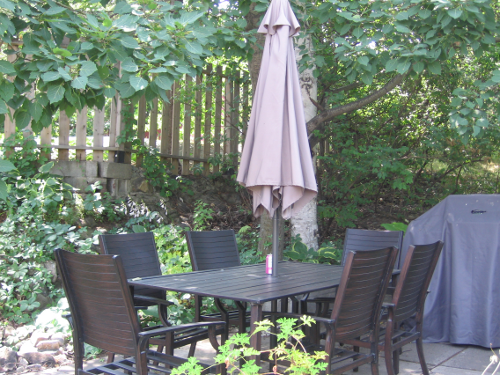
Before we head inside, I’d like to point out my summer office.

When it’s not insanely hot (like it’s been this year), I’m outside most weekends, days off, and even evenings with my lap top.  If you’ve ever heard that relocating for revision is a effective way of shifting your creative mind out of writing mode and into editor mode, I’m here to tell you it’s abso-frickin’-lutely true.  Works a charm for me at any rate 🙂

Now let’s move into the office itself.

The first thing that every office needs is a door.  Right now, my office door is one of the originals that came with the house and is painted white … over blue … over white … over ?  When I have a significant period of time off, I want to strip the door and polish up the brass handle like I did last year with the door to our bedroom.  So this is what it eventually will look like when I get it done 😀

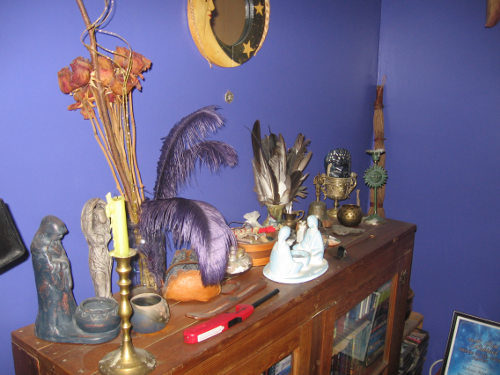
The first thing you see upon entering my office is this. Yes, it’s an altar.  I have distinctively pagan-ish, shamanic leanings.  What you may notice if you look down is that it’s also a bookshelf.  Another one of my stripping and refinishing projects, this cabinet used to hang on the wall of my mother’s  sewing room.  Originally, it was from the local school board.  My grandfather used to work there, and when they dismantled one of the schools, he nabbed this cupboard.  It’s crammed, top to bottom, with paperbacks.

Also, in the lower right corner of the picture, you’ll see my honourable mention from Ron L. Hubbard’s Writers of the Future contest.  Having just refinished the room (down to the studs and rebuilt from there) I’m still reluctant to poke holes in the walls, even for cool stuff like degrees and awards.

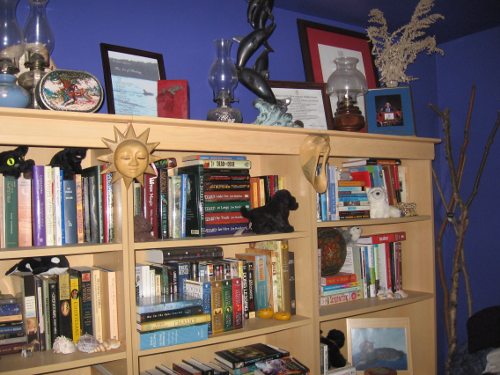
On the far wall are my three additional bookshelves, purchased to harmonize with the massive desk (in a moment, hold your horses …) I inherited from my mother-in-law when she moved about ten years ago.

The first shelf from the left houses historical and spiritual research books.  The bottom row is devoted to books on gardening and herbalism.  The middle shelf is overflowing with fiction I don’t want to store away, or haven’t read yet.  Like the paperback bookshelf, it runs the gamut from fantasy and SF, YA, classics, UF, to mysteries and literary fiction, etc.

The final shelf is populated with a number of my books on the craft.  Interspersed on the shelves are a number of objects I value: artefacts from family and friends, old tins, kerosene lamps, masks, my degrees, my picture from the alumni address I gave a Laurentian University a few years ago, and a couple of framed poems, “Fire and Ice” which was featured in the ekphrastic art project Fusion, and “The Art of Floating,” the poem I wrote for my dad.

The rest of my books are stored in approximately twelve Rubbermaid tubs in the basement.  Yup.  I’m a book addict, and happily so.

In the corner, you will notice three staves.  Actually, it’s one poplar staff, and one birch and one maple stang. All generously donated by the trees in my back yard (resulting from lightning strikes and wind storms).  Another project for the future: stripping the bark from these lovlies and waxing them to preserve.

Now comes the organized chaos I call my desk.

The first picture shows a collection of journals (the ones I write in and the ones I have subscriptions to), a few key reference books including the Guide to Literary Agents and Novel and Short Story Writer’s Market, research DVDs, binders containing three earlier versions of my novel, my BIG binder of AS critique material, my Brother inkjet printer, and various pens, pencils, highlighters, clips, push-pins, and other tools that I make use of at my desk.

The keen observer may notice the ashtray and the wine glass.   Yup.  You caught me.  I’m a vile smoker and I drink wine on occasion.  Once again, unapologetic about it.

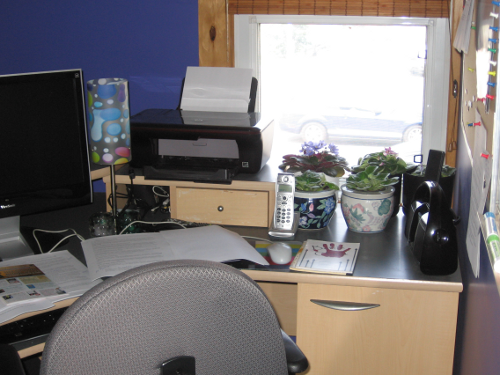
The second picture doesn’t look quite so chaotic, but shows the rest of what’s on my desk.  My computer, whatever project I’m currently working on (in this case, Rachel Walsh’s The Last Scribe) underneath which hides my laptop, my colour printer/scanner/copier (currently on the fritz), a couple of my poetry books, my African violets (green things essential), and my i-pod (in the corner, also essential).

Behind my desk, on the wall, are my cork board and white board.  On my first and second revisions (after the draft has been completed) I use these extensively to map out my story and make notes.  As each piece of paper is addressed, it comes down for shredding and as each note is incorporated into the novel, it’s erased.

Right now, the board it just reminding me of outstanding submissions I haven’t heard back about yet, my blogging schedule, and calendar.

And that’s it.  I didn’t clean up on purpose, because I thought I’d let everyone see what I really work like.

So I hope you enjoyed this little tour.  Take comfort in the chaos!  My office is as much a part of my process as a writer as anything else.

What does your office/writing space look like?  How does it reflect your process?

Dream a little dream … and go from there

I was going to write something about where I get my ideas from because a lot of people out there have done that recently, but it really depends on where I am, what I’m doing, and what the idea ends up becoming. So I think I’ll focus on one of the best places I get my ideas: my dreams.

When I was a kid, I had very vivid dreams. The earliest I can remember, occurred after I had my tonsils out. Actually, it occurred after my stitches ripped open and I was rushed back to the hospital for emergency surgery.

In the wake of that experience, I had a dream in which I actually died in the process of that surgery, but I still woke up the next morning.  Only, in the world I woke up in, I dreamed of this one.  It’s hard to explain.  Essentially, I dreamed that this world was nothing but the dream of my sleeping self in another world.

Pretty multidimensional/existential for a four-year-old, eh?

I had insomnia, the kind where you wake up in the middle of the night and can’t get back to sleep.  I’d lay there and rehearse my dreams, or tell myself stories until I eventually got back to slumber town.

When I dreamed of falling, I woke up several inches off the bed.  What I know of dreams now tells me that the sensation of falling in the dream was so intense I felt that I was still falling when I woke.  I wasn’t actually levitating 🙂

A visit to a Christian book store led to me reading a comic book about an African missionary.  The barbarism with which the artist depicted the rituals of the native tribesmen made such an impact on me that I dreamed of the scar-faced man, had nightmares about him really.  You know the ones, where there’s a man standing at the foot of your bed, staring at you?

I often had out of body experiences (OBEs) when falling asleep, or waking.  I remember these distinctly.  I was like a balloon, tethered, but being flung around (or was I trying to escape?).  That’s how my young mind interpreted it, but when I later delved into meditation and eastern spirituality, I realized that this is classic OBE.

I didn’t keep a dream journal then, but many of my childhood dreams and nightmares have stayed with me nonetheless.  I often dreamed of being abandoned: driving in a van with my family and then one by one, everybody but me disappeared, and I was too small to drive the van (couldn’t reach the pedals).  Stuff like that.

I actually dreamed in story sometimes.  Full, 3-act drama.  If my dreams stayed with me long enough, I wrote them down, but often the delay meant I lost critical pieces.  I’d tell my dreams to my friend Margaret at recess as a way to keep some of them alive.

I started to record my dreams (among other things) when I went away to university for the first time.  I have a number of story ideas that have emerged from those journals.

In university, my room mate, Sandra, enlightened me regarding another aspect of my nocturnal life.  I talked in my sleep, and often sat up and did things as well.  Once, she reported that I sat up in bed, said, “It’s really not that bad … ,” reached around to open the closet door (right beside my bed), looked frowning into the mirror on the door, looked at her, then closed the door, and went back to sleep.

I had night terrors too.  Once I dreamed that something (what I can’t remember) was escaping from me.  I reached up to snatch it back, and when I woke up, I’d torn down a mobile that was hanging in the window.  I dreamed of insects (or other things) crawling on me, or of not being able to find something important.

The first time I went to camp (Southerners read cottage) with my boyfriend (now husband), I sat up and started searching the bed frantically for something.  I kept saying, “I can’t find it.  Help me find it.”  That kind of freaked Phil out, but it wasn’t the most bizarre thing I did while I was sleeping.

When we were living in Married Students’ Residence at Laurentian University, we had a 1-bedroom apartment.  In the middle of January, I got up in the middle of the night and opened all the windows. Phil woke up at 4 am shivering, realized what I’d done, and rushed to close the windows before the radiators burst.  It was a very cold night.  I had no memory of doing that.

One of my favourite courses was one regarding the Surrealists (writers primarily, but artists to a lesser extent).  I really fell in love with the way the surrealists let loose with their subconscious and tried to capture the world of dream on the page.

Since I started working full time and sorted out my depression (that’s another story), my dream life has been less vivid.  I dream more of stress and work-related issues (repetitive loops of action) or of terrible things happening to me or someone that I love.  I still have insomnia, but it’s more troublesome because I can’t afford to sleep in to catch up, and I don’t like what sleeping pills do to me …

I’ve started reading before I go to bed and have noticed I’m having more creative dreams.

I don’t necessarily want to start sleepwalking, having night terrors, or fall into depression again, but it would be nice to have the old story-dreams back again.  I’ll let you know how it goes.

An interesting book about writers and their dreams:

A selection of dream/depression/creativity links:

A dreamy soundtrack:

  • California Dreamin’ – The Mamas and the Papas, 1966
  • Dream a Little Dream – Mama Cass, 1968
  • Dreamboat Annie – Heart, 1976
  • Dream On – Aerosmith, 1976
  • Dreams – Fleetwood Mac, 1977
  • Dreaming – Blondie, 1979
  • Sweet Dreams – Eurythmics, 1983
  • These Dreams – Heart, 1986
  • Don’t Dream it’s Over – Crowded House, 1987

There are hundreds more, but these are my favourites 🙂

How have your dreams influenced you as a creative person?  Have your dreams/sleeping habits  changed over the years?  How has that affected your writing?

NEOVerse

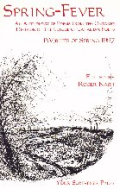
One of the contests I entered while I was struggling through grad school was for the League of Canadian Poets.  Through that competition, one of my poems was selected for publication in the 1997 (W)rites of Spring.

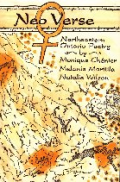
I read at their gala (with Valerie Senyk, Roger Nash, Sonja Dunn, Katerina Fretwell, and others) and subsequently submitted my poetry to Dr. Laurence Steven, who was now the proud owner of Your Scrivener Press.  He accepted my work and along with the work of two other northeastern Ontario poets, Monique Chenier and Natalie Wilson, he published NeoVerse (1999).

It stood for northeastern Ontario verse, but in a way, it was the beginning of a whole new life for me creatively.

I traveled all over the north giving readings that year: North Bay, Timmins, Sault Ste. Marie, and Parry Sound.  Due in part to my reading activity, I was invited to participate in an event in Caledon called Word Harvest, where several other poets were performing.

Thanks to the publication of my poetry in chapbook form, I was able to become an associate member of the League of Canadian Poets.

Also around that time, I was writing articles for the Sudbury Arts Council (SAC) in the Sudbury Star, after having served on the newspaper’s readers board for a term; I wrote interviews for the Laurentian University Alumni Magazine, and articles for Georgian Bay Today.  GBT didn’t last long.  The way I was to be paid was to sell advertising to local retailers.  I was not then, nor am I now, a salesperson, by any stretch of the imagination.

I put together a few workshops for elementary and high schools, and even one for the Manitoulin Writers’ retreat.

I was also putting together Web pages for the Huntington University Library and for the Art Gallery of Sudbury.  This was the old-fashioned (ha!), type-your-tags-out-in-Wordpad, HTML Web pages.  Eventually I adopted Microsoft FrontPage.

I started to write reviews for the Canadian Book Review Annual, took another short-term contract at the Cambrian College Library, and then two of my Laurentian professors contacted me with an offer of employment.  It would only be a part-time contract, but I could be the executive assistant for an organization called ACCUTE, the association of Canadian college and university teachers of English.

There, I developed another Web site, published the quarterly newsletter, and helped to coordinate their annual conference.

My first year with ACCUTE I did the crazy and auditioned for Theatre Cambrian’s production of Hair.  It was hard work.  Dancing, singing, and acting.  It was also one of the most fun, most amazing experiences of my life.

How about you?  Was there a time in your life when you became creatively fecund? What happened?  If you’re blogging about it, link through in your comments.  I’d love to see what you’ve been up to 🙂

Like, comment, share, subscribe! (The social media equivalent of think-do-create-BE!)

The Windsor years and what they really taught me

Last time on My history as a so-called writer: I found awesomeness at Laurentian University 🙂

I should have just kept writing.   

Unfortunately, I was still insecure about my craft and all of my friends were either heading to teachers’ college, or graduate school, or had already left.  So I thought it was the thing to do, something that had to be done to show that I had “the chops.”

Still living at the mercy of events, I applied to UVic, UNB, and Windsor.  Victoria rejected me outright, New Brunswick said that they would accept me to their academic program, but not to the creative one, but Windsor said they’d take me, so that’s where I went.

Phil was still completing his degree in computer science at Laurentian, so I was on my own.  We took a trip down in August apartment hunting and I signed a lease for a year for a room in a house that was within a five-minute walk of the campus.

I started off filled with hope, but struggled.  My courses in research and methodology, the Pre-Raphealites, and the new Canadian writers were great, but early Canadian women writers was a bomb and because my primary interest was in writing genre, the creative writing part of things did not go very well either.

I even tried to resurrect pieces of the novel idea I conceived of at Guelph, but a very dim view was taken of my fantasy.

I was nearly shamed away from my novel.  It wasn’t worthy.  I wasn’t worthy.  I kept on being asked questions like, “You have this character smoking.  You know that tobacco wasn’t discovered until Europeans reached the New World, right?”  It was all about historical detail.  But my fantasy world isn’t this world, and its history has little to nothing in common with the real world.  “But you just can’t go picking and choosing what you want from history …”  Why not?  Seriously.  What’s to say that I have to write my fantasy like a historical novel?  If I wanted to write historical fiction, then I would.  But I don’t.  (At least not right now.  I have this idea though …)

Therein lay the difficulty.  Submitting two to five pages of my novel at a time wasn’t allowing anyone to really get into the story.  Things would just get to a point where they were developing into something interesting, and then everyone would have to wait until the next week.  Momentum was lost and most of my classmates felt nothing but contempt for my chosen genre.

A lot of comments focused on the impossibility of what I was writing.  “She couldn’t survive what happened to her.”  “That defied the laws of physics.”  My characters are heroes in the epic sense, though.  Their survival hinged on the fantastic nature of their gifts and talents.  They have to be “bigger than life” in order to merit their place in the overall plot.  And magic does defy physics.  Actually, my magick has its own physics (more on that in a future world-building post).

Fantasy, especially the high, epic fantasy that I like to write, is all about the impossible.  I wasn’t trying to straddle the improbable but plausible line that defines most science fiction.  (Although I have an idea or two in that direction as well …)

I tried other stories and genres:  A YA fantasy about a girl whose figments turn out to be real; a post apocalyptic tale featuring a male protagonist; poetry; more traditionally literary short stories.  With the exception of my poetry, my work was largely panned.

My classmate, Laurie Smith, got me involved in the Wayzgoose reading series and some of my poetry was published in the Wayzgoose anthology.  I became editor of Generations, the student-published poetry anthology, and tried my hand at presenting a paper at the ACCCSAL conference (speculative fiction).  So it wasn’t a complete bust.

I have to admit though, with respect to the idea that would become Initiate of Stone, that my characters had no character.  They were merely vehicles to move the plot, which was also evolving at the time.  Theme was also a work in progress.  Still, by the time I was finished at Windsor, or rather by the time Windsor was finished with me, I was well and truly wounded.

My advisor at the time, Alistair MacLeod, did not hide his dismay regarding my choices, and to his credit, I’m sure he was doing his best to guide and support me.  He praised my poetry, and I’m certain that if I’d chosen to move in that direction, we would have gotten along swimmingly.  As it was, the presentation of the work I chose to do, confused him at best, and disappointed him, in the most tragic of senses, at worst.

He was a mentor, a writerly father figure, and his dismay was hard to take.  I was still tender then, and I retreated in defeat.

I’ve talked a lot about teachers, the good, the bad, and the ugly.  You may get the idea that I dislike them, but I don’t.  I’ve had as many positive and supportive teachers as I’ve had teachers that just didn’t understand me, and it’s a matter of timing and circumstances as anything else.

What I took away from my experience at Windsor, though it took me years to discover, is that a teacher’s job is to teach.  The teacher may not agree with the way in which the student wants to apply their knowledge and experience, but that should not be the issue.  Even if the teacher believes that the student is only setting themselves up for failure, it is not the teacher’s responsibility, or even right, to deny the experience of that failure to the student.

Instead, what the teacher should do is his or her best to impart the skills that will enable the student to meet that failure and learn from it, rather than being crippled by it.  If the teacher has such strong reservations that he or she feels that they can honestly not discharge their duty to the student, then she or he should refer the student to someone who can.

It’s not too much to ask.

Mind you, the student should stand up for herself and demand the help she needs.  I still wasn’t very good at confrontation and fled at every turn.  What happened at Windsor was my fault more than anyone else’s.  I have to take responsibility for my poor choices.

I took a year off and once again tried to sort things out, but I was badly damaged.  I worked at both the Huntington and Cambrian College libraries and subsequently became unemployed.  I was entering contests again though and won several, in short fiction and in poetry.  I participated in more readings, and more writers’ groups.

With Kim Fahner, I embarked on what might have been a foolish enterprise: a poetry journal.  The aptly named … like lemmings … only lasted 2 years.  The name was more about the editors than about the poetry, but I’m sure you get the idea.  Kim and I moved on to bigger and better things after that.  It was brilliant while it lasted though.

Then Dani Harris, a former student of mine (I was a Graduate Assistant at Windsor—doesn’t every grad student teach?) let me know that there was a new professor in the English department, Di Brandt.  With Dani’s encouragement, herself and excellent poet, I registered for another year and determined that this time, I would succeed.

I found a new mentor, but I still couldn’t bring myself to trust her fully.  My experiences in writing to that point had only taught me that editors, friends, and teachers couldn’t be trusted with my work.  They’d also taught me that the stories I wanted to tell weren’t the stories that should be shared with anyone.

So I compromised and chose stories that I thought I could tell, that I thought would be accepted.  That was my problem though and not something that I would overcome for some time.  My stories were all of young women finding their way by means of dream, and spiritual quest, and damn good friends.

The one risk was a story that did cross the line and tread into the dreadful world of fantasy.  Initially presenting with obsessive-compulsive disorder and insomnia, my protagonist developed precognitive dreams and telekinesis.  It was the one risk I couldn’t refuse to take.

I wrapped the collection up in shamanism and called it Whispers in the Dark.

Di Brandt was the teacher I needed .  She encouraged me and saw me through to the successful completion of my master’s degree.  For that, I will be forever grateful.

As you might be able to guess, my next great teacher in life was Di Brandt.  With her assistance, I conquered my fears, defended my thesis, and completed that chapter of my life.  I also met Miriam Toews, a friend of Di’s and author of the Governor General’s Award-winning A Complicated Kindness.

Was there a time when you cut and ran?  Did you rally and fight back?  What did you learn from the experience?

Finding awesomeness at Laurentian University

It was a brave new world and I had a newfound dedication to my studies.

Phil didn’t turn out to be a distraction at all, but facilitated my work with his support, and by providing me with a computer on which to write my many essays.  Soon I was spending a lot of time at his place, locked up in the basement with his 286.  I had a computer too, thanks to one of my correspondence courses, but it wasn’t even that powerful.  Seriously.  My mind boggles when I try to remember what life was like back then.

In any event, my renewed academic career was full of B’s, B+’s, A-‘s, and A’s.  I started entering writing contests … and won third place in one.  I wrote a column for Lambda, the Laurentian University Student Newspaper.  My essays began to be featured in the English Literature Society’s annual academic conference, and a couple were recognized by the English department as among the best of the year.  I entered the President’s Award Essay Writing Contest and received and honourable mention.  I also participated in a colloquium on the future of the university.

Enter great teacher of my life number three, Dr. Susan Dobra.  She was from California and ended up returning there after a few years.  While she was at LU, I considered her to be my most significant influence and one of the reasons why I excelled.

Unfortunately, my appreciation of her approached the stalker-ish.  I do hope she’ll forgive me 🙂

Another reason was Dr. Hoyt Greeson, with whom I studied Old English and Chaucer.  I and several of my fellow students joined him on a road trip to Kalamazoo, MI for an academic conference in medieval literature.  It was a great experience to be exposed to the theses and dissertations being written by some of the best and brightest in the field.

A third positive influence and support was Dr. Laurence Steven.  Through him, I entered a program whereby I became a writing assistant.  I essentially taught the composition portion of the first year English literature survey course for a couple of years.  Yes, as an undergrad.  I also tutored through the Writing Across the Curriculum Program.  Laurie was my advisor for my honours thesis project as well, which received the departmental award for best honours project that year.

Honestly, I can’t think of any professor I had at LU that wasn’t a great influence on me.  There was one I didn’t see eye to eye with, but I still benefitted from his class.

I also gained a couple of special friends on the way, Yana and Kim.  Yana was (and remains) a wunderkind.  Yana knew what she wanted from the first: to be a teacher.  Everything she did was focused on that goal and she was a brilliant student.  She also had an interest in writing science fiction.  She was president of the English Literature Society the year I joined.  Through Yana, I started working at the Huntington music library.  It was a student job that would see me through several years.

Kim is a poet and in many ways, a kindred spirit.  We were TA’s and tutors together.

All of us participated in several ELS events including a particularly memorable poetry sweatshop in competition with the professors.  Together we had some grand adventures, becoming groupies of Great Big Sea and following them around the province for a summer.

With Yana, I took karate lessons, and for myself, I joined the Bel Canto Chorus.  Creativity is fed in different ways.

Phil proposed, and we were married July 15, 1994.

Margaret, though she had moved to Port Elgin with her spouse, continued to keep in touch and keep tabs on my creative efforts.  She invited me down to Port Elgin for a workshop with Susanna Kearsley, author of the recently published Mariana and winner of the Catherine Cookson Award.

I took a creative writing course with Dr. John Riddell–Siobhan’s father; don’t you love synchronicity?–and had one of my stories published in an anthology as a result.  I started participating in writers’ groups and became ELS president in my last year of study.  I wrote a short article for Slin Roller magazine.  Thanks to my short story prize and publication, I was invited to write a science fiction story for the flagship issue of Parsec Magazine.  By the time I graduated cum laude in 1995, I was on my way.

Focus is a wonderful thing.  Sometimes it doesn’t happen in school, but at work, or at home.  When you have a particular goal in mind, it’s amazing what you can accomplish.  When and where did the pieces of your creative puzzle first come together in awesomeness?

A visit from Valerie Senyk

March 25, 2010.

Throughout the year, the Sudbury Writers’ Guild brings in guest speakers.  That year, there had been some interest from the membership in learning how to read one’s work more effectively.  One of our members, and past president, Janice Leuschen, had just started up her business and had delivered a session for the Guild already, but there were still rumblings and mumblings.

At the September meeting, where the year’s creative agenda was hashed out, I suggested Valerie Senyk as a possible speaker.  She is associate professor of theatre arts at the Georgian College University Partnership Centre as well as a poet, a playwright, a director, and a fantastic performer.

The members in attendance showed interest, so I got in touch with Valerie, who was also interested and coming to Sudbury to see her son in March.  We firmed things up and made the date.

I’d known Valerie since Spring Fever: the (W)rites of Spring in which our poetry was published.  Subsequent readings, events like the Northern Lights Festival Boreal, which featured not only our motley crew of spoken word performers, but her creative performance poetry collaborations LipSkinDance and Poemotion, and our association through Your Scrivener Press publisher Laurence Steven, often put us together.

At the time of our first association, Valerie was a professor in the Drama Department at Thornloe University, one of three federated universities within Laurentian University.  I’d seen her perform and attended several of her students’ productions at Thornloe.

Valerie did an evening workshop for the Guild and everyone in attendance read a work of short fiction or poetry and received excellent feedback and tips from Valerie.  Though I considered myself an experienced reader, she had some insightful advice for me as well.  It was a lovely evening, and it was great to see an old friend again.

It is always a pleasure to work with Valerie.

If you enjoyed this post, Like, Share, or Comment.  I invite you to subscribe, or easier still, add me to your Google Reader subscriptions.  Google Reader has saved my social networking sanity so I’m not shy about the plug 🙂

Grades seven through twelve

Art became a kind of salvation for me.  I wasn’t the best, but I was good.  My art teacher said that I was a colourist, and I had no idea what she meant, but I was nonetheless flattered.  If I did know what a colourist was, I might have been even more flattered, because I still liked comic books and graphic novels.

I also started guitar lessons.  I was never quite comfortable with the instrument, but again, I was comfortably mediocre.

I kept on writing and entered a student poetry contest I didn’t place in.

My first attempt at public speaking was lost in a fit of giggles.  My speech was on winter camping, and the best way to keep warm while you slept was to sleep without clothes–oh my!  My classmates enjoyed the effort though, and graded me highly for the entertainment factor alone 🙂

A guest speaker came to my grade seven class.  Unfortunately I don’t remember who he was, though I believe he was a journalist.  I guess you could call it my first workshop.  I wrote a supernatural murder mystery in one sitting and read it out to the class.  I really got into it, dramatizing the voices and everything.  Though empowering, I felt a little like a freak.

Grade eight brought more luke-warm success with a few of my stories read out in class.  My teacher’s final report of the year called me apathetic, however, and I had to fight to get into the advanced level classes in high school, despite having the grades to be so placed.  Just because I’d rather be in a book than in class …

I was bored.  I’d do the work I was supposed to do in class, then pick up whatever book I was reading at the time.  My instructors would approach, I’d show them that I was done, they’d advise me to do my homework, so I’d do that, and pick up my book again.  Then, I’d be advised to work ahead.  I hated school then.  Extra study was the last thing I wanted to do.

None of my writing was ever given into the dubious custody of any of my classmates.  I was even cagey with Margaret and took every well-meant criticism to heart.

I can’t remember exactly when, but I caught the Dungeons & Dragons bug.  Margaret’s Dad got her the Player’s Handbook, and shortly thereafter, we picked up the Dungeon Master’s Guide and Monster Manual.  We started to attend the weekend meetings of the Sudbury Gaming Club at Cambrian College, and eventually tried out other games.  I was a dedicated gamer well into my 20s.

Suddenly, I had another group of people I could consider friends!  And none of them knew me from school.  Bonus.  We went to concerts: Headpins and Helix, Iron Maiden, Twisted Sister …  I was a burgeoning head banger in those days.

When high school hit, with my part time job, boyfriends, and everything else that came with it, my writing started to take a back seat.  I became interested in the visual arts again.  I still wasn’t the best, but I was better than some, and I did well enough.

I didn’t stop writing.  I kept on dreaming and I kept on writing down my dreams.  I have several ideas-in-waiting from those days.

Emotional drama, serious illness, and the death of my grandmother kept me unstable, and unable to see clearly enough to commit to what I loved.  Heck, I couldn’t even figure out what that was …

Also enter into my life great teacher number two, Ms. Chapman.  Her classes instilled in me a passion for literature that while slow to kindle, saw me through the rest of my academic career, such as it was.

Chronologically, what happened next was my first year of university.  You can get that bit of detail by reading How it all started in my Work in progress category.

I’ll pick up the tale again next week with Laurentian University.

High school did not constitute the best years of my life.  Really, I kind of hated it.  My saving grace was Margaret.  Despite all the relationship crap and growing apart that always happens in the fraught teenage years, Margaret remains one of my best friends.

How did your high school years affect your development as a creative person?

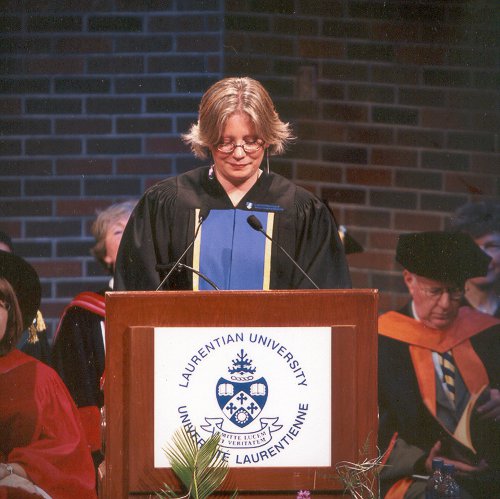
Laurentian University Convocation 2007

June 2, 2007.

A friend of mine and fellow writer, Kim Fahner, much involved with the Laurentian University Alumni Association was scheduled to give the Alumni welcome address at the June 2 ceremony.  She was unable to fulfill the commitment and suggested me as a replacement.

Though the occasion required me to read a bilingual speech, I believe that I did so competently, thanks to the gracious assistance of another friend, Sue Brunet 🙂

The true opportunity arising from this event was the chance to meet Robert J. Sawyer who was the key speaker and honourary doctorate recipient that day.

While I must admit I was incredibly shy and probably came off as a bit of a doofus, I was very pleased to meet Mr. Sawyer and his address regarding the future and his vision of it was excellent.

What got me going again

Last time on work-in-progress:

In an environment rich in creativity and ideas, I started to write my first novel.  When I left that environment, I abandoned the project … sort of.

The thing is that those two spiral-bound notebooks full of my scribbling, typewritten pages full of corrector tape, and the few scattered dot matrix print-outs, never really left me. The novel was called Rain then, after the main character.  As the title might tell you, my idea started with my protagonist.  The story was hers, and all about her journey.  All the other characters grew out of her story.

Over the next years, I tried refining my opening paragraphs.  I worked on a prologue, and a couple of pivotal scenes.  I wanted scope, breadth, space.  I felt I had to develop my world and my characters kind of got lost in the shuffle.

I enrolled in a creative writing course by correspondence and received my first computer as a part of that deal.  In between writing assignments, I worked at my novel again.  It was in fits and starts though, no dedicated time.  I wasn’t really sure what I wanted to do with the story and where I wanted it to go.  The name changed to Rayne.  Could that count as progress?

After some soul searching about what I wanted to do with my life, I decided to complete the bachelor’s degree I started at the University of Guelph.  I chose Laurentian University in Sudbury, and felt that focusing on an English degree would be my best bet.  My ambition was to become the best writer I could be.  I’d turn the academic world to my purpose.

My writing improved substantially during my years at LU and workshops like Susanna Kearsley‘s gave me a boost.  So too, did my slew of writing successes: a contest win; a short story written for the premiere issue of Parsec Magazine; a regular column in Llambda (LU’s student newspaper); an article in Slin Roller Magazine.  It never translated into my opus though.

I made another fateful (and ultimately foolish) decision to pursue my education by completing a master’s degree in English literature and creative writing at the University of Windsor.  Though I trotted out my novel (and other novel ideas) there, because my chosen genre was fantasy, my work was disparaged.  After leaving discouraged, and returning to complete my degree with a thesis composed of vaguely literary short stories framed by the shamanic journey, I felt defeated rather than victorious, and couldn’t look at my novel for a long time.

After Windsor, I had some modest success in other creative endeavors: poetry and short stories.  Every once in a while, though, I’d have to pull out the old notes.  Once I got my lap top computer, things took off a little more.

By the time I’d joined the Sudbury Writers’ Guild in 2004, and attended Rosemary Aubert‘s workshop in 2005, I’d closed in on the fifty-page mark (oft-revised and agonized over).  I still wasn’t writing every day though.  I just couldn’t get my butt wedged firmly enough in the chair.  There was always something else that needed to be done first.

Then came Nino Ricci.  One of the SWG had met him and managed to arrange for him to come to Sudbury.  It was to be a weekend of workshopping our stories/novels/poetry.  In the course of the workshop, Nino talked about his own development as a writer, his years at York University, and his own challenges with his thesis advisor.  From that weekend, I learned that perseverance and passion win out.  I also knew that I had a long way to go on my novel, but the only way I could get there would be to write it.

Writing

Writing (Photo credit: J. Paxon Reyes)

Another thing Nino said that settled in was that his first drafts, at least at that time, were written to get his ideas out.  Sometimes the next draft was completely different.  Sometimes, he didn’t even refer to the first.  I’d heard the message many times over the years that first drafts didn’t have to be perfect, or even particularly well-written.  First drafts have to be written, though.  I finally understood.

I started writing every day and was amazed at how easy it was.  I made a commitment, a decision.  I was finally taking control of my creative life.  The initial goal was simply to write.  Once my practice was consistent and the habit ingrained, I aimed for a page a day, then two.

I emailed Nino after the workshop to thank him for the opportunity and to let him know the influence he’d had on my creative life.  Always gracious, Nino wrote back with some kind words of his own.

Even though I had a full time job by this time, I kept at it, and two years later, I’d finished my first draft.

How did you start writing your novel?  Was it a focused effort, or did you struggle?  Did mentors appear to guide you, or were you confronted by guardians at the gates?