Tipsday: Writerly Goodness found on the interwebz April 27-May 3, 2014

Tipsday

As I compile this, I’m listening to “Hall of Heads” by They Might be Giants. Just to let you know where I’m at tonight 😉

Last week was a treasure trove of writerly goodies!

Publishing dish of the week: HarperCollins to buy Harlequin, from Publisher’s Weekly.

George R.R. Martin’s Rolling Stone interview.

Brent Weeks: New writing advice. This is really about process, and you know how much I lurve that stuff! Plus, he has a standing desk with a treadmill.

Mel’s note: I’ve finally placed my order for a standing desk (goodbye tax refund). I won’t have a treadmill, but it could be a future consideration. Good to know I’m in such distinguished company. Jane Friedman uses a standing desk and treadmill, too.

Elizabeth Gilbert on Success, failure, and the drive to keep creating.


K.M. Weiland’s back with part 11 of her creating stunning character arcs series: The second half of the second act. As with all instalments of her series, you can read the post, or listen to the podcast.

Are your plot points too weak? Also from Katie.

And here’s another, just for good measure: Why you should bully your protagonist.

Roz Morris on the long and the short of writing novels.


And … she shares her experiences creating My Memories of a Future Life audio books with ACX.

Then, Laura Pepper Wu interviewed Roz for The Write Life.

The root of prolific by Julianna Baggott on Writer Unboxed.

What are you doing to improve? All about continuous learning from Liz Michalski, also on Writer Unboxed.

One of my Australian writer friends, Gemma Hawdon, did a guest post for The Write Practice blog on emotional conflict.

Marcy Kennedy’s entry in the writing process blog hop.

Dialog tags of doom on Query Quagmire.

Chuck Wendig ‘splains why he speaks up about diveristy, direct from heteronormative white dude mountain.

Jim C. Hines, also on diversity and cultural appropriation. They were part of the same panel at Pikes Peak Writers’ Conference. Go figure 😉

Then Sword & Laser interviewed Mr. Hines. I met him at the Surrey International Writers’ Conference last year. Such a genuine, sweet man.


Kristen Lamb’s series on Flashbacks: Part 1, Part 2, and Part 3.

Felicia Day’s Vaginal Fantasy Hangout on Juliet Marillier’s Daughter of the Forest. Not only was this irresistible because DotF is one of my favourite books, but the discussion about rape scenes in fiction was also fierce. Very worthwhile.


Then Felicia got a tweet. This video was her response:


She just posted today that she watched her own video for inspiration 😉

Carly Watters offers her top 8 writing craft books. I’m proud to say I own and have read several of them 🙂

19 jokes only grammar nerds will get.

Gravitas. For the word nerd from Daily Writing Tips.

Enjoy!

Tipsday: Writerly Goodness found on the interwebz April 20-26, 2014

TipsdayLinking has won the day, if not the poll.

Got yourself a Franken-draft? There may be hope. Dianne K. Salerni on Writer Unboxed.

K.M. Weiland’s Creating Stunning Character Arcs series, part 10: The Midpoint.

9 tips to entice readers to your author blog from Anne R. Allen.

Everybody Arcs! How it all comes down to character. Kristen Lamb.

Carly Watters with 6 reasons you need an agent now more than ever.

12 realizations every writer must come to from 12 Most.

The Atlantic. The appeal of science fiction. A.K.A. why do people look down at the genre of Orwell and Atwood?

Is literary fiction just good marketing? The Guardian. More on the literary/genre debate.

Time. 21 women authors you should be reading.

And that’s it this week. Linking certainly makes for a shorter post!

Tipsday: Writerly Goodness found on the Interwebz April 13-19, 2014

TipsdayLet’s see what we gots here …

Part 9 of K.M. Weiland’s Creating Stunning Character Arcs series:

http://www.helpingwritersbecomeauthors.com/2014/04/character-arcs-9.html

the 10 Commandments of Social Media Etiquette for Writers. Anne R. Allen’s blog.

http://annerallen.blogspot.ca/2014/04/the-10-commandments-of-social-media.html

Agent Carly Watters on why you want an agent who reads:

http://carlywatters.com/2014/04/14/agent-who-reads/

Eight steps to an agent, a publisher, and a two-book deal by Becca Puglisi.

http://writershelpingwriters.net/2014/04/eight-steps-agent-publisher-two-book-deal/

Brevity in Science Fiction – Veronica Sicoe. She was my new discovery this week, thanks to MJ Bush 🙂

http://www.veronicasicoe.com/blog/2014/04/brevity-in-science-fiction/

Jami Gold wonders whether genre fiction can be art:

http://jamigold.com/2014/04/can-genre-fiction-be-art/

Justine Musk on Beauty in the broken places.

http://justinemusk.com/2014/04/17/wounds-to-light-the-art-of-making-beauty-in-the-broken-places/

(Mel’s note: I write an SF story called The Broken Places. Not sure if it’s beautiful, but I’m biased.)

Patty Jansen on how she writes:

http://pattyjansen.com/blog/how-i-write-so-many-books/

And Roz Morris on hers. Follow the strange. LOVE!

http://writerlycommunity.azurewebsites.net/following-strange-write/

6 things you should know about your story.

http://lopopololiterary.com/2014/04/17/some-things-you-should-know-about-story-six-to-be-precise/

The WoMentoring Project. Just check it.

http://womentoringproject.co.uk/

Rochelle Sharpe: Be relentless.

http://rlsharpe.wordpress.com/2014/04/17/writing-tip-wednesday-be-relentless/

Muses rejoice!

Tipsday: Writerly Goodness found on the interwebz April 6-12, 2014

TipsdayAnother eclectic bumper-crop here on Tipsday.

Wired podcast with Elizabeth Bear:

http://www.wired.com/2014/04/geeks-guide-elizabeth-bear/

MJ Bush’s WritinGeekery. A balance of strengths to take your story higher.

http://www.writingeekery.com/strength/

Robin Lafevers on Writer Unboxed. Dear soon-to-be-published author.

http://writerunboxed.com/2014/04/11/dear-soon-to-be-published-author/

And Lisa Cron on The importance of letting ‘em see you sweat.

http://writerunboxed.com/2014/04/10/the-importance-of-fear/

And … Jael McHenry on the relative value of writing craft books.

http://writerunboxed.com/2014/04/07/should-you-read-about-writing/

3 tips for writing better action scenes from BookBaby blogs.

http://writerunboxed.com/2014/04/10/the-importance-of-fear/

Wlater Benjamin’s thirteen theses from Brain Pickings.

http://www.brainpickings.org/index.php/2013/04/15/the-writers-technique-in-thirteen-theses-walter-benjamin/

Agent Carly Watters answers the question, Can I write fiction for a living?

http://carlywatters.com/2014/04/07/q-can-i-write-fiction-for-a-living/

Patty Jansen offers her thoughts on when hiring an editor isn’t necessarily the answer.

http://pattyjansen.com/blog/get-your-book-edited/

The Outlander fan gathering. If you’ve been drooling over the coming Starz series as much as I have, you’ll want to see this 🙂 BTW, for my Canadian friends, Showcase will be broadcasting (eeeee!). this summer. Can hardly wait.

http://www.starz.com/videos/video/388

How to be the lord of your novel’s timeline (timelord, get it?) from Roz Morris.

https://nailyournovel.wordpress.com/2014/04/05/an-easy-way-to-make-your-plot-plausible-control-your-novels-timeline/

10 ways pre-published authors can start their careers now, from Anne R. Allen.

http://annerallen.blogspot.ca/2014/04/10-ways-pre-published-writers-can-start.html

K.M. Weiland on the elephant in the room. Are you ignoring your writer’s instincts when it comes to revision?

http://www.helpingwritersbecomeauthors.com/2014/04/story-revision.html

Enjoy, my friends.

Tipsday: Writerly Goodness found on the Interwebz March 30-April 5, 2014

TipsdayCreating Stunning Character Arcs, part 8:

http://www.helpingwritersbecomeauthors.com/2014/03/character-arcs-8.html

And more Katie, this time on NPR. Listen, or read the transcript. As you wish, dear reader.

http://www.npr.org/2014/04/05/298728897/how-to-kill-a-character


R.A. Salvatore interview with Bryan Stearns from Oct 16, 2010. The interview is actually in three parts, but parts 2 and 3 will populate the YouTube sidebar when you watch this first one.

Roz Morris received an anguished Tweet. Here is her response.

http://nailyournovel.wordpress.com/2014/03/30/how-many-words-do-you-write-a-day-and-do-you-have-to-force-yourself-how-successful-authors-do-it/

The Sword & Laser spotlight on Chuck Wendig 🙂

Ruth Harris on Anne R. Allen’s blog. It’s all about the blurbage.

http://annerallen.blogspot.ca/2014/03/8-tips-for-writing-that-killer-blurb.html

Orna Ross and Kobo’s Mark Lefebvre discuss the “Open Up to Indie Authors Campaign.”

http://www.ornaross.com/2014/04/chatting-with-kobos-mark-lefebvre-about-our-open-up-to-indie-authors-campaign/

Look for more inspirational curation on Thoughty Thursday!

Tipsday: Writerly Goodness found on the interwebz March 23-29, 2014

TipsdayK.M. Weiland’s Creating Stunning Character Arcs series, part the seventh:
http://www.helpingwritersbecomeauthors.com/2014/03/character-arcs-7.html

Lessons culled from the Undercover Soundtrack. Roz Morris.
http://nailyournovel.wordpress.com/2014/03/24/7-essentials-for-writing-a-good-novel-notes-from-the-undercover-soundtrack/

Tom Bentley’s Anatomy of a Writer. Writer Unboxed:
http://writerunboxed.com/2014/03/25/anatomy-of-a-writer-2/

The do’s and don’ts of copyeditors past:
http://mentalfloss.com/article/55850/dont-use-pants-pantaloons-19-surprising-rules-copyeditors-used-enforce

The creepy side of libraries …
http://www.mediabistro.com/galleycat/harvard-discovers-old-library-books-bound-in-human-skin_b84050

Top 10 quotes from Oscar Wilde:
http://www.irishcentral.com/roots/Irish-genius-Oscar-Wildes-10-best-sayings.html

Incidental comics. Writing styles. I like the ghost writer, personally 🙂
http://www.incidentalcomics.com/2014/03/styles-of-writing.html

Bookcase hides a secret writer’s retreat. Pure coolness.
http://www.viralnova.com/home-with-hidden-library/

One writer’s musings on marketing:
http://katemoretti.blogspot.ca/2014/03/in-which-i-theorize-on-marketing.html

What can I say? It was an eclectic week.

Good night, everyone!

Tipsday: Writerly Goodness found on the Interwebz March 16-22, 2014

TipsdayAway from home this week and free wifi is slooooow.

I’d just posted about seasonal affective disorder (SAD) myself when Lydia Sharp posted this to Writer Unboxed:
http://writerunboxed.com/2014/03/16/seasonal-writing-disorder/

On the changing role of agents and new submission guidelines from Anne R. Allen’s blog (with the fabulous Pam Van Hylckama Vlieg):
http://annerallen.blogspot.ca/2014/03/the-changing-role-of-literary-agents.html

Part 6 of K.M. Weiland’s Creating Stunning Character Arcs series:
http://www.helpingwritersbecomeauthors.com/2014/03/character-arcs-6.html

Two from Elissa Field. Is teaching a good day job for a writer? http://elissafield.wordpress.com/2014/03/16/writers-day-job-is-teaching-a-good-day-job-for-writers/ and Friday Links for writers 03.14.14 http://elissafield.wordpress.com/2014/03/15/friday-links-for-writers-03-14-14-quirky-info-sources/

Hey, who says I can’t curate the curators?

And here’s a third for good measure: novel revision strategies: http://elissafield.wordpress.com/2014/03/19/novel-revision-strategy-retyping-the-novel-draft/

The science of emotion in marketing. The article speaks to me more of braiin science and the power of story.
http://blog.bufferapp.com/science-of-emotion-in-marketing

Improve your vocabulary.
http://justenglish.me/2014/03/10/important-infrequently-used-words-to-know/

Stephen King’s top 20 rules for writers, ‘cause you know, we can never break too many of them 😛
http://www.barnesandnoble.com/blog/stephen-kings-top-20-rules-for-writers/

Agent Carly Watters explains what she looks for when she Googles a prospective client.
http://carlywatters.com/2014/03/17/q-what-do-agents-like-to-see-when-they-google-writers/

Roz Morris on the dangers of over-dependence on your thesaurus.
http://nailyournovel.wordpress.com/2014/03/16/bring-on-the-empty-horses-handle-synonyms-with-care/

The neurological similarities between writers and the mentally ill. Get your critical thinking caps on people.
http://thoughtcatalog.com/cody-delistraty/2014/03/the-neurological-similarities-between-successful-writers-and-the-mentally-ill/

5 charts that show how publishing is changing from Jane Friedman.
http://janefriedman.com/2014/03/21/5-valuable-charts/

5 insightful writing tips from Paul Harding.
http://publishersweekly.com/pw/by-topic/industry-news/tip-sheet/article/60070-5-writing-tips-paul-harding.html

5 reasons your platform may be spinning its wheels from Michael Hyatt.
http://michaelhyatt.com/traction.html

WOW! Did I find a lot of good stuff on the interwebz last week or what?

That’s the thing with me. Sometimes, I’ll be all over that. Sometimes I won’t. This week, for instance, being on the road, I don’t think will be very productive for the linkage. We shall see.

And this is me, saying goodnight.

Review of K.M. Weiland’s Dreamlander

I’d been meaning to get K.M. Weiland’s Dreamlander and read it for a while now.  Well, not long ago, Katie posted on Wordplay about Story Cartel, where readers can get free books in exchange for an honest interview.

I missed the deadline for her challenge, which might have won me an Amazon gift certificate (moar books!), but since I always intended to write the review up anyway, I figured I’d just carry on and post when I actually finished the book.

I don’t read as fast as I used to.  I blame it on the day job, but I have a feeling that even if I wasn’t working I wouldn’t be consuming a book a day like I used to. Besides, I wanted to savour Dreamlander.  If that doesn’t give away the nature of my review, I don’t know what will 😉

One of the reasons I was so keen was the concept: a man goes to sleep in this world and wakes up in a parallel world.

Any of you who have followed my blog for any length of time will know about my tonsillectomy trauma and the dream that I had upon my return from my second visit to the hospital.

For those of you who haven’t seen the post and don’t want to take the time to read it, here’s the short version: I had a near-death experience, and as a result, I dreamed that I had, in fact, died.  I fell asleep in one world and woke up a new person in another world.

So you can see how Dreamlander kind of fed into my life-long fascination with dreams and dreaming.

DreamlanderThe Amazon blurb:

What if it were possible to live two very different lives in two separate worlds?

What if the dreams you awaken from are the fading memories of that second life?

What if one day you woke up in the wrong world?

Only one person in a generation may cross the barrier of dreams to reach the other world—a world of war-scarred countries and fallen faiths. When a Chicago-born journalist finds himself on the far side of his dreams, he must hurl himself into battle to save a princess from her own people, two worlds from annihilation, and himself from a dream come way too true.

My thoughts:

I loved Dreamlander (did you see that one coming?).  Weiland has created a flawed protagonist in Chris Redston who wins our hearts over as he attempts to undo the damage caused by the mistakes he’s made.

Having lost his mother and one sister in a car accident he survived, and having subsequently lost his father to alcoholism, Chris is done with alternately lending his father money and bailing him out of jail.  He can’t find his focus though.  Once a talented writer, Chris finds himself blocked and unable to support himself.  Then there are these bizarre dreams he keeps having…

Chris turns out to be The Gifted, a rare man who can cross over into the land of his dreams, a very real world where he lives an alternate life.

Allara Katadin, princess of Lael and Searcher, is equally damaged.  The last Gifted who crossed over sent her world spiralling into chaos and she feels it was her fault.  She can’t trust Chris not to be the man his predecessor was, and when he initially proves her right, she shuts Chris out, not understanding that life is about taking chances and about giving second ones when it matters most.

Dreamlander is true epic fantasy, with not just one, but two worlds in jeopardy.  Chris and Allara must work together and sacrifice everything to do the right thing, even as Allara’s own people cry for her blood and that of the Gifted.

The denouement was both heart wrenching and satisfying, Weiland proving that the writer must be cruel to her characters to be kind to her readers.

My highest recommendation.

My rating:

5 out of 5 stars.

About the author:

K.M. Weiland grew up chasing Billy the Kid and Jesse James on horseback through the hills of western Nebraska, where she still lives. A lifelong fan of history and the power of the written word, she enjoys sharing both through her novels and short stories. She blogs at Wordplay: Helping Writers Become Authors, where she mentors other authors and shares the ups and downs of the writing life.

Now I’m off to post my review to Story Cartel, Amazon, and Goodreads 🙂

Later, ‘taters!

Caturday quickies: What I did this afternoon

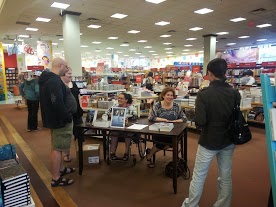
Hi all!  I went to the local Chapters and hung out for a bit with my friend Kim Fahner, who was doing a book signing with her new writing friend Sarah Lashbrook.

Kim and Sarah talking to fans :)

Kim and Sarah talking to fans 🙂

Of course, I bought Sarah’s book, Where the Stream and Creek Collide, and asked her if she wouldn’t mind doing an interview on Writerly Goodness 🙂  Look forward to that in the coming weeks.

Of course, I had to feed my book addiction and spent $80 altogether on Sarah’s book, YA fantasy and adult fantasy novels.  In the past couple of weeks I also scavenged a pile of books from the several boxes my mom was taking to a book sale, and got the StoryBundle of ebook classic SF for a nominal donation (excellent deal – go, consume).

Yes, I read procedurals, classics, and other stuff as well as fantasy ;)

Yes, I read procedurals, classics, and other stuff as well as fantasy 😉

Did I mention addiction?

Yeah.

In other news, I’m going to take a short blogging holiday next weekend.

I’m off to a friend’s pre-wedding celebration in Michigan City, IN on Saturday.  If I was independently wealthy, I’d be going to her destination wedding, but this seemed a happy compromise for both of us.

Try not to miss me too much 😉

Next up: I’m finally finished K.M. Weiland’s Dreamlander and I’ll be reviewing that today.  I joined Story Cartel and got the ebook free for an honest interview.  This is another great ebook site I’d highly reccommend.  Free books!  ‘Nuff said 🙂  I also hope to have a guest blog coming up for you tomorrow.

Upon my return, I’ll get Sarah’s interview up and continue on my merry way.  There are a couple of fun things coming up in August: a Dala concert and a Great Big Sea concert.  I’ll be blogging those as well as keeping you up to date on the work sitch.

My current acting will be up as of August 31 and I still have no idea whether I’m heading back to my old unit (absolutely fine with me), if the pool I’m in will result in a new assignment, or if my application on an internal competition will result in something else.  I’m not good with uncertainty.

So lots of Writerly Goodness yet to come 🙂

Two approaches to novel structure I recommend you check out!

I’m no expert with regard to writing a novel.  Admittedly, I’m still revising my first one, and while I’ve had some modest success with my poetry and short stories, I’m a complete n00b when it comes to the mechanics of the novel.  I’m learning as I go and I’ll share these bumbling lessons in my Work in Progress category, but for this week’s Alchemy Ink, I thought I’d do a little curating.

In the past couple of weeks, I’ve come across two of approaches that attracted me and that I intend to follow through to their blogging conclusions.

Why did I gravitate to these two writing bloggers?

The short answer is that I’m floundering.  I’m working with a peer group in Author Salon and part of that entails the presentation of my project in a formatted profile.  I’ve never queried an agent before, never participated in a pitch slam, or in a workshop that focuses on developing a pitch, hook, synopsis, or any of the other components of the profile.

In recent weeks, both the critiques of my peers and the advice of AS staff have brought several things to my attention:

  • My synopsis misses the mark.  The synopsis we’re asked to produce for the AS profile must be between 200 and 300 words and so is what’s been described to me as the short synopsis.  This is something that might fit into a query letter and could be analogous to the blurb on the back of a book.  The specific form still escapes me at the moment.
  • My hook line doesn’t ‘hook.’
  • My conflict statement isn’t well-defined.  My plot is very complicated and I can’t seem to distil everything into a concise, yet clear statement that addresses internal, interpersonal, and plot level conflicts.
  • I didn’t have a series title, and the title of the novel didn’t resonate with most of my readers.  This is still in flux.  I’ve chosen a series title and changed the working title of the novel, but there were reasons that I chose the original.  I won’t go into those here, but at least one peer thinks the original was better.
  • My original novel was far too long.  I’ve had to cut it in half and that’s changed a whole whack of things.  When initially confronted with this, I was defensive, and unwilling to move, but after my initial panic, I recognized that I didn’t have to take the scorched earth policy and destroy what was a 295,000 word opus.  So I’ve chosen to break the novel up, using the mid-point as the new climax and am editing down from there to a neat 110,000 words.
  • My climax and denouement are not well defined.  This owes to the above re-envisioning of my novel.  Reworking a mid-point to a climax has brought with it its own challenges.

Other issues have become apparent to me in the process:

  • My protagonist’s story arc is not dynamic in its early stages.  There’s a lot of internal conflict, and some interpersonal, but not much that relates overtly to the plot.  It all relates to the larger story arc, but that doesn’t become apparent until later on in the novel.
  • There’s a lot of disembodiment going on.  This is a tough one.  I can fix the POV issues that contribute to some of this, but dream/out of body experiences and shamanic journeying are central to the story.  I’ll have to let this incubate for a while and write through some of the possibilities.

I’m going to need some help working through all of this.

So what are the two approaches already?

Karen Woodward and the Starburst method

I caught on to Woodward with Part 3 and backtracked through her blog posts from there.  There are ten parts/steps to the process, so I’m going to be following Woodward through them from here on out.

Part 1 entails creating a one sentence description of your story.  This equates to what, in screenwriting circles, is called a log line, or what AS is calling the hook line.  That alone made my Writerly Goodness ears perk up (Didn’t know my authorial alter ego was a dog?  Take a look at the site mascot 😛 ).

Part 2 takes that one sentence and creates from it a five sentence paragraph.  This might make a zippy short synopsis.  Woodward discusses the three act structure here as well, another takeaway from the screenwriting world that has been successfully applied to novel writing.

Part 3 expands each sentence into its own paragraph.  By now, I think I have a decent idea of where the Starburst method is heading, but I’m still curious enough to follow through with it and see where it leads me.

K.M. Weiland and the Secrets of Story Structure

Late to the party with Weiland as well, I didn’t pick up on her series until part three, and was reminded of it this week when Porter Anderson reposted a link to part five in this week’s edition of Jane Friedman’s Writing on the Ether.

Why I like Weiland’s approach

What struck me immediately was that Weiland’s secrets are both organic in nature, having emerged from her own process and experience, and very clear.  Ideas and insight started to pop as soon as I read her first post.

Part 1 answers the question: Why should authors care?  It made complete sense to me.

Part 2 deals with the hook in its story structure form as opposed to the hook line that AS wants.   Still, the way Weiland describes the hook offers insight into what (perhaps) should and shouldn’t be present in a hook line.  It’s the question that the protagonist, and therefore the reader, needs to answer.  For the writer, it propels the plot; for the protagonist, it sets her feet on the hero’s journey; and for the reader, it keeps him or her reading until the question is answered.
Part 3 covers the first act.  How do you introduce your characters, the setting, and the plot stakes?

Part 4 defines and illustrates the first plot point.  What is the first major plot point and how does it differ from the inciting incident and the key event?

Part 5 goes into more detail with regard to the inciting incident and the key event.  At each stage, Weiland uses the same set of examples to illustrate what she’s talking about and solidifies the takeaways in point form at the end of her posts.  Excellent blogging form 🙂

These last three together are important factors to consider in writing the first part of your novel, what AS calls your “First 50 Pages,” but admits could be as many as 100 pages.  This is also part of what’s critiqued  in the AS process and something I may have to rewrite substantially.

I’ll summarize by reiterating my invitation to check out both of these blogs.

Have you come across any excellent online resources regarding novel or story structure?  Please share!