Tipsday: Writerly Goodness found on the interwebz, July 3-9, 2016

Some very interesting posts and articles this week 🙂

K.M. Weiland continues her most common writing mistakes series with part 52: stagnant story conflict. Helping writers become authors. Becca Puglisi guest posts later in the week with four ways to choose the right story setting. Kate returns with more lessons from Marvel: how to transform your story with a moment of truth.

Must you have conflict in every scene, disaster in every act? Roz Morris says, yes, and no. Nail your novel.

Kathryn Craft shares ten ways to add a spark of fire to your fiction. Writer Unboxed.

Donald Maass explores how to stay ahead of yourself . . . and your reader. Writer Unboxed.

Heather Bouwman writes (in the) happy middles. Writer Unboxed.

Annie Neugebauer begins a new series for Writer Unboxed. The query letter, part one: the pitch.

Sara Letourneau looks at the protagonist-antagonist relationship in DIYMFA’s developing themes in your stories series.

Data mining reveals the six basic emotional arcs of storytelling. MIT Technology Review.

“The six basic emotional arcs are these:

A steady, ongoing rise in emotional valence, as in a rags-to-riches story such as Alice’s Adventures Underground by Lewis Carroll. A steady ongoing fall in emotional valence, as in a tragedy such as Romeo and Juliet. A fall then a rise, such as the man-in-a-hole story, discussed by Vonnegut. A rise then a fall, such as the Greek myth of Icarus. Rise-fall-rise, such as Cinderella. Fall-rise-fall, such as Oedipus.

Susan Spann busts some popular copyright myths. Writers in the storm.

Hugh Howey writes about an idea, broken. The Wayfarer.

Shakespeare and music.


Underwritten female character: the movie. (Bwahahahaha!)


What Mallory Ortberg learned about heterosexual female desire from decades of reading. The Toast.

Ted Ed: What makes something Kafkaesque?


Airship Ambassador interviews Colleen Anderson in four parts: part one, part two, part three, and part four.

Jen Doll explains how A Wrinkle in Time changed science fiction forever. One of my formative reads. Who’d a thunk it? Mental Floss.

Shawn Taylor wonders why Hollywood is ignoring Octavia Butler. Fusion.

The New York Times called this guy daring for “daring” to tackle slavery through science fiction. (Includes the author’s response.) J. Hotham for Slate.

Jonathan Barkan celebrates 30 years of Big Trouble in Little China. Bloody Disgusting.

Emily Asher-Perrin: Jupiter Ascending is a chilling look at our future, in more ways than one. Tor.com

Phil and I are looking forward to checking this one out. Netflix’s 1980’s science fiction throwback Stranger Things is must (binge) watch TV. i09

Until thoughty Thursday!

Tipsday

Tipsday: Writerly Goodness found on the interwebz, June 26-July 2, 2016

Easing back on the overwhelm of writerly goodness this week. You’re welcome 🙂

K.M. Weiland shares five secrets of creating complex supporting characters. Helping writers become authors. Kate returns with more lessons from the Marvel movies: use minor characters to flesh out your protagonist.

Bonnie Randall guests on Janice Hardy’s Fiction University: the Pandora ’s Box of having ‘been there.’

Steven Pressfield: The Dude abides, but in what genre?

Jami Gold helps you strengthen your writing with rhetorical devices (and the angels sing—I lurve rhetorical devices).

Angela Ackerman guest posts on DIYMFA: the top five mistakes writers make when it comes to setting.

Oren Ashkenazi offers a counterpoint to his post of last week. Five bad ideas science fiction teaches us to love. Mythcreants

Kristiana Willsey says that hunger is the beginning of every folktale. The Toast

Tim Grahl: how to use fear to beat resistance.

Marcy Kennedy asks, is it important for writers to be readers? Spoiler: It’s an emphatic, duh, yes!

Jeff Goins tell us everything we need to know about Facebook Live on the Portfolio Life podcast.

Alice Adams considers the question, why does anyone write? Literary Hub

Lincoln Michel teaches you everything you wanted to know about book sales but were afraid to ask. Electric Lit

This is shameful. The journalist who risked her life going undercover in North Korea had her expose marketed as an Eat, Pray, Love-style memoir. Anna Merlan for Jezebel.

Alison Stine explores Labyrinth and the dark heart of childhood. The Atlantic.

I think these Game of Thrones/Legend of Korra mash ups are amazing. What about you? Movie Pilot

The Game of Thrones finale confirms game-changing fan theory. Entertainment Weekly.

Also, Game of Thrones showrunners confirm that there are only 13 to 15 episodes left. Wah! They really pulled last year’s plot poopers out of the fire this year. Oh well. i09

Germain Lussler wonders why more people aren’t talking about the Preacher series. Phil and I are enjoying it 🙂 i09 Later in the week, he reports that Preacher season two will return with 13 episodes. YAY!

AMC’s Preacher series is different from the comics, but you’ll probably really like it anyway. James Hibberd for Entertainment Weekly.

And that was your informal writerly earnings for the week.

See you Thursday!

Tipsday

Tipsday: Writerly Goodness found on the interwebz, June 19-25, 2016

I have no idea where all this came from. It was a bountiful week for Writerly Goodness.

Julie Glover guest posts on Jami Gold’s blog: four steps to break grammar rules with style.

Anne Janzer guest posts on Jane Friedman’s blog: how to create an internal mindset conducive to writing.

Barbara O’Neal conducts an experiment in fostering creative flow. Writer Unboxed.

When you don’t want to write: Heather Webb on Writer Unboxed.

Joanna Penn discusses how to banish writer’s block with K.M. Weiland. The creative Penn.

How to plot a book: start with the antagonist. K.M. Weiland’s Helping writers become authors. Later in the week: how (not) to write satisfying action scenes. More lessons from the Marvel Universe movies.

Jami Gold wonders why “unlikable” can be a deal breaker for readers.

MJ Bush offers her keen insight into writing the perfect flaw. Writingeekery.

Dave King explores the work of a master for Writer Unboxed: Jaime Lannister and sympathetic monsters.

Kayla Dean explains how to use story archetypes to subvert expectations. DIYMFA.

DIYMFA radio, episode 100: Unleash your storytelling superpower with Gabriela Pereira.

C.S. Lakin takes a look at the first turning point in your novel. Live, write, thrive.

Chris Winkle offers three painless ways to patch plot holes. Mythcreants.

Jamie Raintree delves into the process of overcoming the emotional obstacles to a writing career. Writers in the Storm.

Five good ideas science fiction teaches us to fear. Oren Ashkenazi for Mythcreants.

Katherine Langrish shares some thoughts on writing meaningful fantasy. Tor.com

Women at WorldCon


Dan Blank: celebrate the arts where you live. Writer Unboxed.

Janet Reid lists the reasons she rejected 25 queries so you can avoid them. She later confesses: so I didn’t get it right the first time . . .

Sarah Negovetich: it’s not you, it’s really not.

Jonny Gellar’s Ted Talk: What makes a bestseller?


This is a weird story from the MFA world. Steven Galloway, chair of UBC’s creative writing program, was fired after an investigation, but under mysterious circumstances. Nobody’s willing to say exactly why. I think anyone reading the articles can infer, but . . . I’ll let y’all judge for yourselves.

Susan Spann explores the legal side of writing for anthologies. Writer Unboxed.

The Active Voice shares the story of Pauline Creeden, who lost her Amazon publishing account through no fault of her own.

Sadness. Lois Duncan died on June 15th at the age of 82. I loved her books. Publishers Weekly.

Jim C. Hines writes about racism and the backlash against black Hermione.

Cory Doctorow revisits Writing the Other, intensely practical advice for representing other cultures in fiction. BoingBoing

The Witch explores America’s essential fear of female power. Dianca Potts for Lenny.

Brainpickings presents Virginia Woolf’s thoughts on the connection between loneliness and creativity.

She-Ra and the fight against the token girl. Maria Teresa Hart for The Atlantic.

Publishers Weekly: Fall 2016 adult announcements in SF, fantasy, and horror.

Indie presses are starting bookstores. Jon Sealy for Literary Hub.

Chemistry explains why old books smell so good. Robin Burkes for Tech Times.

The short film, The Birch, may be creepy, but I think it’s rather heart rending warming 🙂 Rebekah McKendry for BlumHouse.com

James Whitbrook shares Geroge R.R. Martin and Stephen King in conversation: how the fuck to you write so fast? i09. Watch the whole talk. It’s awesome.

Who’s afraid of female Ghostbusters? Dave Itzkoff interviews the cast for The New York Times.

Michael Livingston gets medieval on Game of Thrones’ ‘battle of the bastards.’ Tor.com

Entertainment Weekly shares a sneak peek of the actors who will play Roger and Brianna on Outlander.

Exhausted? I am.

Until Thursday *waves*

Tipsday

Exposing my essentials with the DIYMFA Launch Team

How’s that for a provocative title? As Geroge Takei would say, oh, myyyyyy!

So here was week 12’s prompt:

QOTW 12: What Are Your Essentials?

You don’t need to own every book in the world, but there are some essentials that every writer should have on his or her shelf. Today, I want to know: What are your essentials? What are your go-to “read like a writer” resources?

content_QOTW-12

Okay, and here I defect to another of my writerly mentors, K.M. Weiland. Kate wrote this post back in 2014: the ten commandments of reading like a writer. I’d start there. But then, I’d grab a paperback of Jane Eyre: Writer’s Digest Annotated Classics. You won’t really be able to get the most out of it with the ebook version.

Kate, in analysing and annotating Jane Eyre for WD, shows you how to read like a writer. And, she gives you worksheets and questions, and—well, let’s just say I learned a lot from this book 🙂 I reviewed it, too.

Another a-MA-zing (and yes, you heard the angels singing on that capitalized MA) resource is her Story Structure Database. In each entry, a different novel or movie is analyzed in terms of story structure. Most entries Kate writes herself, but some are submitted by readers. Treasure trove.

And that, my friends, is all you’ll ever need to help you dissect a story with your big, squishy, writer brain.

Essential writing craft books:

Anything by Donald Maass

Anything by Natalie Goldberg

Anything by Ursula K. Le Guin (she’s written a lot about writing—LURVE!)

All the Nail Your Novel books by Roz Morris

Outlining your Novel and Structuring your Novel, plus both workbooks by K.M. Weiland

Page After Page and Chapter After Chapter by Heather Sellers

Take Joy by Jane Yolen

On Writing by Stephen King

The Right to Write by Julia Cameron

Self-editing for Writers by Browne and King

The Artful Edit by Susan Bell

Sometimes the Magic Works by Terry Brooks

Adventures in the Screen Trade and What Lie did I Tell? More Adventures in the Screen Trade by William Goldman

Story by Robert McKee

I think I’d better stop there. I have to confess to being a writing craft book junkie. It’s half of my informal learning on the subject 🙂

As far as novels and stories that I read . . . egads, I have five shelves full in my office alone. You don’t want to know how many Rubbermaid tubs I have in my basement (cause I don’t have room for them anywhere else). And don’t get me started with ebooks.

In short, I read everything. Most of my reading will be in my chosen genre, but even so, I try to alternate YA and adult fantasy, and different sub-genres of fantasy. I read classics, historical fiction, the occasional mystery and even romance novels. I read literary novels, science fiction, and the occasional horror, though I can’t confess to loving that last. I read thrillers, though I don’t enjoy them as much as some of the other genres I read. I’ll read short stories, but again, they don’t tend to be my favourites, at least so far.

I try to learn something from everything I read.

I also do the nutty and read multiple books at once. I’ll even listen to them on Audible while I walk, or work at something non-noisy, like stripping and refinishing stuff. I usually have to pause for the sanding bits, though 😀

I can’t even list my favourite authors anymore without filling a page.

And since I read so much, I have to be selective about the books I review, because I’d really rather be working on my WIPs. You know, day job and all.

So that’s Mellie’s wild world of reading.

See y’all tomorrow! Have a lovely, warm summer night!

Tipsday: Writerly Goodness found on the interwebz, June 12-18, 2016

Your writerly goodness for the week.

Most common writing mistakes, part 51: one-dimensional characters. K.M. Weiland. Helping writers become authors. Kate returns with these eight tips for editing other writers’ work while remaining friends. And . . . for the hat trick: grab readers with a multi-faceted characteristic moment.

Writing “linked novels,” a series of standalones sans spoilers. Katy Rose Guest Pryal on Writer Unboxed.

Cassandra Khaw is vexed about voice. Terribleminds.

Kristen Lamb explores using time as a literary device.

Angela Ackerman guest posts on Writers in the Storm: how to deliver critical backstory using setting.

This is where I was last weekend: Mark Medley reports on the Canadian Writers’ Summit. The Globe and Mail.

I’m also a professional member of the CAA, so here are a couple of CWS bits of news relating to the CAA literary awards (which were presented there):

Alexis Daria covers the do’s and don’ts of querying your novel. DIYMFA.

Janet Reid warns against shopping an offer. And over on Query Shark, she posted no, no, and no.

Kameron Hurley engages in some real publishing talk: author expectation and entitlement.

Choosing the best categories for your book sales on Amazon. BookBaby.

Ceridwen Dovey wonders if reading can make you happier. The New Yorker.

Misc Magazine: The future according to women.

The Heroine Bookstore interviews A.M. Dellamonica.

John Glover writes about the life and afterlife of horror fiction on Postscripts to Darkness.

J.K. Rowling’s Harvard commencement speech.


Now it’s time to get writing 🙂

Tipsday

Tipsday: Writerly Goodness found on the interwebz, June 5-11, 2016

June already? OMG! Where has the year gone? Oh well, console yourselves with some writerly goodness.

C.S. Lakin explains how writers can bring setting to life through personification. Live, write, thrive.

K.M. Weiland: how to write the perfect plot (in two easy steps). Helping writers become authors.

Chris Ebock teaches us how to develop a great story in three (or four) steps. Fiction University.

Chris Winkle shares seven rules of effective prose. Mythcreants.

All the world’s a book: acting for writers. Allie Larkin on Writer Unboxed.

Write about inner demons without boring your reader into a coma. I love Kristen Lamb’s sense of humour 😀

Chuck Wendig’s inimitable writing advice: what exactly makes a damn good story? Terribleminds. Now when this was shared on the listserv of one of my writing associations, the following was quoted: “A man catches a fish isn’t much of a story, because his problem isn’t a problem.” And responded to: erm, Old Man and the Sea? Moby Dick? Yeah, well. Read it in context.

With Pooh’s demise last year, I’ve been missing the distinct feline voice in writing craft. Welcome Harper Hodges to The Write Practice: Seven steps to write more.

Emily Wenstrom shares some marketing magic with the seven points of contact for authors. DIYMFA.

Janet Reid offers her thoughts on this question: so, how do you know if you’re a good writer?

Susan Spann offers a warning about non-disclosure clauses on Writers in the Storm.

A.J. Hartley: writing people of colour as a white author. Tor.com

Stephen Burt reviews Catherynne M. Valente’s Fairyland series for The New Yorker.

Kim Fahner shares some of the things she learned at the Alice Munroe Festival of the Short Story.

Kameron Hurley shares an excerpt from The Geek Feminist Revolution on the Tor blog: what are you fighting for?

Chimamanda Ngozi Adichie at the Girls Write Now awards ceremony: fuck being likeable. Jezebel.

Dear broke reader: your sense of entitlement is killing me. Sarah Madison.

The British Fantasy Awards shortlists are revealed. The Guardian.

The Sunburst Society releases its 2016 longlist.

Ken MacLeod for Orbit Books: Is science fiction past its sell-by date?

Molly Mcardle interviews Daniel José Older for Brooklyn.

X-rays reveal 1,300 year-old writings inside later book bindings. The Guardian.

The 1,000 year-old manuscript of Beowulf has been digitized and is now available online. Open Culture.

Shakespeare and the supernatural.


Benjamin Dreyer annotates Shirley Jackson’s sublime first paragraph in Hill House. Signature Reads.

Lisa Rosman asks, can a movie about editing be Genius? Signature Reads.

Jamie prepares for the battle of Prestonpans on Outlander. Vanity Fair.

Until next week, cheers!

Tipsday

Tipsday: Writerly Goodness found on the interwebz, May 29-June 4, 2016

Your Writerly Goodness for the week!

Bonnie Randall upcycles and upends clichés on Janice Hardy’s Fiction University.

K.M. Weiland offers six tips for how to organize your novel’s edits. Helping writers become authors. Later in the week, she provides three resources to help you unlock fascinating character goals.

Leanne Sowul explores learning through failure for DIYMFA.

Kristen Lamb looks at botched beginnings and common first page killers.

Ruth Harris lists nine ways editors can make you look good and seven ways they can make you miserable. Anne R. Allen’s blog.

Julia Munroe Martin asks, are we having fun yet? Why can’t the work of writing be fun? Writer Unboxed.

OMG, I love this! Lauren Carter explores the difference between discipline and devotion.

Juliet Marillier writes about focus, and how to regain it. Writer Unboxed.

Donald Maass characterizes the difference between literary and genre as the difference between scenes and postcards. Writer Unboxed.

Jami Gold wonders, can we track out improvements in writing quality?

Becca Puglisi covers this entry in Emotional Wounds for Writers Helping Writers: Being Stalked.

Here I am, curating the curators again 🙂 Elissa Field shares some great resources in her Friday Links for Writers.

Porter Anderson interviews Aron Levitz of Canada’s WattPad Studios. Porter Anderson Media

Debut novelist Anakana Schofield wonders why media is more interested in her than her novel, and . . . why can’t she get paid? The Guardian.

Sachiko Murakami interviews Anita Anand on the hardest thing about being a writer. Writing So Hard.

This is BEAUTIFUL. Astronomers attempt to date Sappho’s Midnight Poem using the stars. Carey Dunne for Hyperallergic.

Elizabeth Alsop says, the future is almost now. On the power of science fiction storytelling. The Atlantic.

Kim Stanley Robinson explains the technology behind his novel, Aurora. BoingBoing

Storytelling sadness for me: Makiko Futaki, the animator behind some of Studio Ghibli’s best anime, has died 😦 Konbini

Yum! Brit Mandelo wrote an amazing essay about Maggie Stiefvater’s Raven Cycle. Please do not read this if you haven’t read the full series. Major Spoilers! But it’s so good 🙂 Tor.com

This goes in Tipsday. One of my favourite ballads that tells a lovely story 🙂 The Once: Maid on the Shore.


Have fun! See you Thursday.

Tipsday

The next chapter: May 2016 update

The year of revision is progressing steadily.

MayProgress

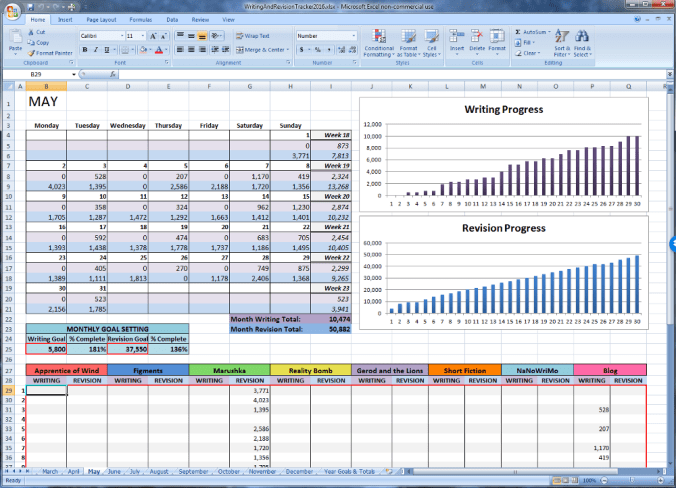
I finished my first run through of Marushka, which ended up at 75,473 words total, 33,258 of which were revised in May, and moved on to Reality Bomb. I revised 17,624 words on that manuscript.

I achieved 136% of my revision goal for May with 50,882 words revised.

All my writing was on Writerly Goodness, and, because I joined Gabriela Pereira’s DIYMFA launch team and have been posting twice each weekend, I’ve achieved 181% of my writing goal for May with 10,474 words on the web.

In other news, I’ve let my querying slip. I’ve received enough form rejections that I have this feeling I need to return to Initiate of Stone and give the manuscript another run. I’ve come up with some ideas to improve my first pages (and other stuff) as a result of working on Apprentice of Wind and I’m not sure I should burn any more agent bridges . . .

At the same time, I want to continue on the chance that I haven’t presented IoS to the agent that will love it. I’ve had success pitching the novel in person to both agents and small publishers, so the idea has merit. It must be the execution that needs work.

Accordingly, I’m probably going to take a break from revising RB for a few days to focus on reworking the first chapter and query of IoS and then get back at it.

I’ve booked my flight to Kansas City in August. I’m one step closer to WorldCon and a visit with a friend who lives in KC. So looking forward.

In the meantime, the Canadian Writers’ Summit is taking place in less than two weeks. I’m looking forward to that, as well, but the scheduling is a bit strange. Because the

CWS is a joint conference between a number of professional writing organizations in Canada, some of the sessions are overlapping. It will make things challenging, but I’m also going to get to attend a great session by Robert J. Sawyer, as well as key note addresses by Jean Little, Kenneth Oppel, and Nalo Hopkinson.

If I had more leave, I might have gone down Wednesday evening to see Lawrence Hill, but I had to make a choice between the CWS and WorldCon/friend visitation. Seeing a new city and an old friend won out 🙂

A new short story idea is brewing for an anthology call later in the year, but I haven’t been paying a lot of attention to short fiction this year, as was the plan. We’ll see if I can keep the idea from blowing up into a novel-sized concept and premise.

I’ve signed up for another online course, this time from one of my favourite authors/writing craft experts, Kate Weiland. It’s another thing I’m looking forward to. We’ll let you know how things go in future updates.

And that’s it for now.

I’m doing too much, as usual, but enjoying every minute of it. I’m really not happy unless I’m learning something/pushing my boundaries.

Hope everyone has a productive, happy-making month!

The Next Chapter

Tipsday: Writerly Goodness found on the interwebz, May 22-28, 2016

Another wonderful week of writerly goodness!

Roz Morris helps writers avoid this plotting pitfall when writing drafts at speed. Nail Your Novel.

Everyone’s getting into video. Should you? Jane Friedman on Writer Unboxed.

Barbara O’Neal makes the case for journaling. Writer Unboxed.

Dan Blank advises you to invest in yourself. Writer Unboxed.

John Vorhaus tells us how to write like the Buddha. You guessed it. Another great post from Writer Unboxed.

Lawrence MacNaughton guest posts on Janice Hardy’s Fiction University. Five questions you need to ask if your story is stuck. Later in the week, Janice is back with how to keep your characters compelling beyond the first draft.

Angela Ackerman explains how to deepen your protagonist by challenging her moral beliefs. Writers helping writers.

Sara Letourneau offers part six of the developing themes in your stories series: the inciting incident. DIYMFA. Later in the week Amy Bearce shares five marketing tips for introverts.

K.M. Weiland also wrote about theme this week: how to create a complex moral argument for your story’s theme. Helping writers become authors.

Chris Winkle shares seven great sources of conflict for romances. Mythcreants.

Steven Pressfield offers his advice on drafting: cover the canvas.

Nina Munteanu shares part two of her writer-editor relationship series: five things writers wished editors knew—and followed.

Marcy Kennedy guest posts on Christine Frazier’s Better Novel Project: five times Katniss nailed deep point of view.

Kameron Hurley confesses that she’s thought about quitting . . . but, don’t quit.

Over on Tor.com, she shares an excerpt from the recently released Geek Feminist Revolution. It’s awesome. You should read the post. And then you should buy the book 🙂

All of us toilers need reminders like this: Rick Riordan on his ‘overnight’ success. It’s from 2007, to give context.

Emma Straub was born to be an author. Alexandra Alter for The New York Times.

Kim Vandels shares the secret to writing great science fiction. The spinning pen.

Airship Ambassador interviews Kate Heartfield about her story “The Seven O’Clock Man” in the Clockwork Canada anthology.

BookBaby offers some tips on how to promote your science fiction on social media.

Good Night Stories for Rebel Girls is an Indigogo success story. The Guardian.

Mental Floss explains why reading makes you a better person with an infographic 🙂

Leila Fadel reports on the delicate task of restoring one of the world’s oldest libraries. NPR.

Louisa Young grew up in J.M. Barrie’s house: we longed for Peter Pan to come for us. The Guardian.

Judith Shulevitz reveals the Bröntes’ secret for The Atlantic.

The teaser trailer for Disney’s live action version of Beauty and the Beast. I’m looking forward to seeing what Emma Watson does with Belle 🙂


Here’s the Ghostbusters UK trailer.


The Little Prince is coming to Netflix August 8 🙂


Laura Prudom explains how Outlander created its most powerful and devastating episode yet. Variety.

And that was Tipsday.

See you Thursday. *waves*

Tipsday

Tipsday: Writerly Goodness found on the interwebz, May 15-21, 2016

Fact and fun, all rolled into one . . . curation post 😉

K.M. Weiland shares strategies for writing faster (and why maybe you shouldn’t). Helping writers become authors. Later in the week she shares her number one tip for writing books readers can’t put down.

Chuck Wendig explodes more writing myths as he invites us to crotch-punch the creative yeti. Terribleminds.

Kristan Hoffman puts forth an argument for letting your creativity rest. Writer Unboxed.

Kameron Hurley writes about fame, publishing, and breakout books: dancing for dinner.

Jami Gold helps us understand how plot obstacles affect character agency.

Dave King continues to explore historical fiction pitfalls with this post for Writer Unboxed: sympathetic characters in unsympathetic worlds.

Carly Watters shares five secrets to publishing your debut novel.

Porter Anderson looks at book prices and writing value. Should we have been careful what we wished for? Writer Unboxed.

Five signs your novel may be sexist – against men. Chris Winkle brings a little balance to the table for Mythcreants.

The establishment has always hated the new kids. Kameron Hurley.

Monica Alverado Frazier wonders, do you know how to use a curandera?

Modern witches are so much more than Maiden/Mother/Crone. Natalie Zutter for Tor.com

Daniel José Older reads from Half Resurrection Blues. This man reads like a poet. I could listen to him all day 🙂


John Mullan explores how plots grip us, from Dickens to Line of Duty. The Guardian.

Women swept the 2015 Nebula Awards. Andrew Liptak for i09.

Five science fiction and fantasy novels that treat mental illness with compassion. Barnes & Noble.

This is COOL. Boston’s sidewalks are covered in secret poems. Atlas Obscura.

Lincoln Michel explains why fairy tales are magic for modern fiction. The Guardian.

Dig at the Curtain theatre unearths a Shakespearean surprise. Jill Lawless for Phys.org

Do overused words lose their meaning? Jonathon Sturgeon for Flavorwire.

CBS passes on Nancy Drew adaptation for testing “too female” for line-up (whatever that means). Carly Lane for The Mary Sue.

The BBC shares nine life lessons from Doctor Who.

Two of the shows I liked got cancelled. Fortunately, the end is only the beginning for Supergirl and Marvel’s Agent Carter. Alisdair Stuart for Tor.com

Honest trailers – Game of Thrones, vol. 1 Bewbs!


Come back Thursday for your weekly dose of thoughty!

Tipsday