Tipsday: Writerly Goodness found on the interwebz, Dec 11-17, 2016

Holy cannoli, your informal writerly learnings are back on track this week 🙂

K.M. Weiland shares another way to look at scene structure. Helping Writers Become Authors

Wordplayer Liberty Speidel guest posts on Kate’s blog later in the week: five steps to a thorough book edit.

Jami Gold is now a writing coach on Writers Helping Writers! The revision circle: does my story have too many problems?

Chris Winkle helps us master evocative telling. Mythcreants

Alex Limberg guest posts on Kristen Lamb’s blog. Finish that novel: tips to help you go the distance.

Angela Ackerman explains how to use symbolism to elevate your storytelling. Writers in the Storm

Piper Bayard offers some guidance about what to do after NaNoWriMo. Writers in the Storm

Chuck Wendig, as always, has thoughts on how to create art and make cool stuff in times of trouble. Terribleminds

Andrea Phillips guest posts on Terribleminds: the high goddamned responsibility of fiction.

Orly Konig-Lopez shares her thoughts on Writers in the Storm: why it’s not always about the writing.

Janice Hardy offers five tips to fight your end-of-year writer’s fatigue. Fiction University

Sara Letourneau examines fate versus free will as a literary theme. DIYMFA

Now y’all know, if you’ve been following me for a while, what I think about resolutions, but Bess Cozby shares five strategies you can implement to rock your resolutions in 2017. DIYMFA

Oren Ashkenazi reviews five failed animal companions in science fiction and fantasy. Mythcreants

Devon Murphy interviews Madeleine Thien about her process. Banff Centre for Arts and Creativity

The Globe and Mail interviews A.M. Dellamonica on occasion of the publication of her latest novel.

Scott Dadich announces Wired science fiction dedicated issue 🙂

The changing faces of science fiction and fantasy. The New Inquiry

Sheila Liming shares her memories of Octavia Butler, neighbour. Public Books

Martin Shaw shares his midwinter night’s dream. Medium

Maria Alexander introduces us to the witches of winter. Tor.com

James Whitbrook has this breaking news: David Tennant is the voice of Scrooge McDuck in the rebooted Ducktales. i09

Tilda Swinton sent Jezebel the unedited email exchange between her and Margaret Cho about Doctor Strange, diversity, and whitewashing. Rich Juzwiak reports.

Evan Narcisse: the Sense8 Christmas special says, “happy fucking New Year.” Phil and I are FURIOUSLY HAPPY! i09

Happy holidays to everyone!

We’ll see you back here, next week, for more writerly goodness 🙂
tipsday2016

Tipsday: Writerly Goodness found on the interwebz, Dec 4-10, 2016

Think I’m still in recovery from NaNoWriMo.

K.M. Weiland continues her most common writing mistakes series with part 54: story events that don’t move the plot. Helping Writers Become Authors

Later in the week, Kate shares her advice on what to do when your antagonist takes over your story.

Densie Webb shares her experience receiving (and addressing) the dreaded editorial letter. Writer Unboxed

Donald Maass: putting your purpose on the page. Writer Unboxed

Lisa Cron explains why story is more important now than ever before. Writer Unboxed

Jamie Raintree reviews Lisa Cron’s Story Genius.

Susan Spann returns to Writers in the Storm with this post on finding your agent match.

Gabriela Pereira goes solo on this edition of DIYMFA radio: platform doesn’t have to be painful.

J.M. Frey writes about the terror of the mushy middle book. Fuse Literary

Judith B. Herman lists 25 words that are their own opposites. Mental Floss

Inderjeet Mani: when robots read books. Aeon

I hope you enjoyed your informal writerly learnings for the week 🙂

See you Thursday for some thoughty!

tipsday2016

Tipsday: Writerly Goodness found on the interwebz, Nov 27-Dec 3, 2016

And it’s the triumphant return of Tipsday!

K.M. Weiland continues her how to outline for NaNoWriMo series with this instalment: how to write a scene outline you can use. Not to worry, links to all previous posts in this series are included. Helping Writers Become Authors

A.E. Siraki guest posts on Jami Gold’s blog. NaNoWriMo: good or bad, let’s move forward.

Jane Friedman asks, do you know what you’re capable of? Writer Unboxed

Julia Munroe Martin shares one of her takeaways from the Writer Unboxed Unconference: how do you want your novel to change the world?

Anne Greenwood Brown examines the pinch point in this post for Writer Unboxed.

Cathy Yardley helps us write when life sucks. Writer Unboxed

Juliet Marillier shares her struggle following the review of her latest series proposal at the Writer Unboxed Unconference: when bad news is good news.

Jo Eberhardt explores intertextuality: stories within stories (within stories). Writer Unboxed

Roz Morris offers three ways to get maximum impact from a story. Nail Your Novel

Oren Ashkenazi examines five characters with too much spinach, and offers advice on how you can avoid the same pitfalls. Mythcreants

Chris Saylor explains the proper use of ellipses and dashes on Marcy Kennedy’s blog.

Heidi Ulrichsen reports on Greater Sudbury Poet Laureate, Kim Fahner’s project to bring poetic grafiti to storefronts downtown. The Northern Life/Sudbury.com

Amanda Michalopoulou looks at how literature teaches us to understand “the other” in these divided times. The Guardian

Ian Failes explains how designers created the stunning alien language in Arrival. Thrill List

Aimee Bender shares her thoughts on why fairy tales still inspire modern female writers. Wired

Bryan Washington wonders why there aren’t more famous black science fiction authors. The Awl

Beth Elderkin (and the whole i09 crew) is hooked on the latest Guardians of the Galaxy, Vol. 2 trailer. Baby Groot is ADORBS!

Referring back to Jo Eberhardt’s piece on intertextuality, Tom Blunt parses Westworld’s literary references. Signature

That’s it for your informal writerly learnings this week. Come back next week for moar. MOAR, I tell you!

By the way, what do you think of my new graphic (keep in mind that I’m not a professional graphic artist)?

Be well until Thursday, when I’ll have a little thoughty for you 😉

tipsday2016

Tipsday: Writerly Goodness found on the interwebz, Oct 23-29, 2016

The informal writerly learnings are here!

Your #NaNoWriMo round up for the week:

Danielle Daniel discusses her memoir, The Dependent, with the ladies of The Social.

Sudbury’s Poet Laureate, Kim Fahner, writes in defense of school libraries. The Republic of Poetry

K.M. Weiland: how to properly motivate your bad guy. Helping Writers Become Authors

Roz Morris shares some thoughts on book marketing. Nail Your Novel

Robin Lovett explains why deadlines are not your worst enemy. DIYMFA

James Scott Bell: writer, this is your job. Kill Zone

Barbara O’Neal explores writing with the knowledge of time. Writer Unboxed

Dan Blank: dealing with a slump. Writer Unboxed

Karen Woodward writes in defense of constraints.

Janice Hardy guest posts on Writers in the Storm: how filtering point of view affects show, don’t tell.

Marcy Kennedy blogs about conflict.

Veronica Sicoe continues her storyworld design series with transportation technologies.

Chris Saylor returns to Marcy Kennedy’s blog with his monthly editorial clarification post: “I could care less.”

Jamie Raintree shares her path to publication (part two!).

Janet Reid addresses the issue of young writers. “Publishing will break your heart. Writing will fill your heart.” Truer words . . .

Joanna Penn interviews Kristine Kathryn Rusch and Dean Wesley Smith on The Creative Penn podcast.

Tamerra Griffen unpacks a situation of academic racism on Buzzfeed: a professor circles the word “hence” on Tiffany Martinez’s paper and notes “This is not your word.” Bonus: here is Tiffany’s response to the incident (linked in the Buzzfeed article).

Foz Meadows explores the relationship between romance and queerness, and the difference between genre and device. Shattersnipe

Meg Elison: if women wrote about men the way men write about women. McSweeney’s

Katherine Langrish explores death in classic fantasy. Seven Miles of Steel Thistles

Sadness. 2016 has taken so many great creators from us. Sheri S. Tepper, 1929-2016.

Award news:

The Governor General’s Award winners announced.

The OAC presents its indigenous arts protocols:


Joseph Boyden speaks out for the #WeMatterCampaign


Baihley Grandison shares a lovely infographic with untranslatable words from other languages. Writer’s Digest

Rajeev Balasubramanyam states that the Nobel committee got it wrong: Ngugi wa Thiong’o is the writer the world needs now. The Washington Post

Christopher Marlowe will be credited as Shakespeare’s co-author in New Oxford editions of the Henry VI plays. Dalya Alberge for The Guardian.

Connie Verzak considers Tobias Menzies to be the Snape of Outlander. The Daily Record

And that concludes my first and last Tipsday for the month of November.

The next Tipsday will be coming your way on December 6th, after the furor of #NaNoWriMo has subsided.

Be well until then, my writerly friends.

Honour your creative path.

Virtual hugs to the awesomesauce that is you!

tipsday2016

Book review: K.M. Weiland’s Creating Character Arcs

What Amazon says:

Have you written a story with an exciting concept and interesting characters—but it justcreatingcharacterarcs isn’t grabbing the attention of readers or agents? It’s time to look deeper into the story beats that create realistic and compelling character arcs. Internationally published, award-winning novelist K.M. Weiland shares her acclaimed method for achieving memorable and moving character arcs in every book you write.

By applying the foundation of the Three-Act Story Structure and then delving even deeper into the psychology of realistic and dynamic human change, Weiland offers a beat-by-beat checklist of character arc guidelines that flexes to fit any type of story.

This comprehensive book will teach you:

  • How to determine which arc—positive, negative, or flat—is right for your character.
  • Why you should NEVER pit plot against character. Instead, learn how to blend story structure and character development.
  • How to recognize and avoid the worst pitfalls of writing novels without character arcs.
  • How to hack the secret to using overarching character arcs to create amazing trilogies and series.
  • And much more!

Gaining an understanding of how to write character arcs is a game-changing moment in any author’s pursuit of the craft.

My thoughts:

Creating Character Arcs: The Masterful Author’s Guide to Uniting Story Structure, Plot, and Character Development is a fabulous writing craft book.

K.M. Weiland digs deep into the three types of character arcs and how they work with and influence story structure.

Then, she offers a few ideas on how to use character arcs in your main and supporting characters (and whether it’s worth making the assay with the latter instance), layering character arcs, how to use character arcs over series, and whether or not it’s possible to write a story without a character arc (*spoiler alert,* it is, but there are specific considerations the writer must address).

At the end of each chapter, Kate has a slew of helpful questions that will focus your new understanding of character arc and apply it to your current work in progress. As she has with Outlining Your Novel and Structuring Your Novel, I wouldn’t be surprised if a Creating Character Arcs Workbook is in development 🙂

As with Kate’s other writing craft books, Creating Character Arcs emerged from a blog series on the same topic. Even if you’ve read/listened to the entire series, there’s something about having the reference at your fingertips.

This book works well in conjunction with the other Helping Writers Become Authors books and each builds on the others to form a rich body of writing craft knowledge.

For me, every story begins with the characters and they inform everything else. Creating Character Arcs will help you to connect the dots between your characters, their arcs, and your plot. Using Kate’s method, you can craft a tight, compelling story that works on multiple levels.

Every writer should own a copy.

My rating:

Five out of five stars!

About the author:

kmweilandK.M. Weiland lives in make-believe worlds, talks to imaginary friends, and survives primarily on chocolate truffles and espresso. She is the IPPY and NIEA Award-winning and internationally published author of the Amazon bestsellers Outlining Your Novel and Structuring Your Novel, as well as the portal fantasy Dreamlander, the historical/dieselpunk adventure Storming, the medieval epic Behold the Dawn, and the western A Man Called Outlaw. When she’s not making things up, she’s busy mentoring other authors on her award-winning blog http://www.helpingwritersbecomeauthors.com. She makes her home in western Nebraska.
Book review: K.M. Weiland’s Structuring Your Novel

So I lied. Again.

I thought I was going to proceed with my WorldCon reportage, but I realized I have a book review due (not this one, it’s yet to come). So I’ve decided to write two book reviews today, both for K.M. Weiland books 🙂

The reason for this is that I read Structuring Your Novel and Creating Character Arcs together. I would recommend the practice to anyone, because character arcs and story structure work with each other to deepen the writer’s understanding of story overall.

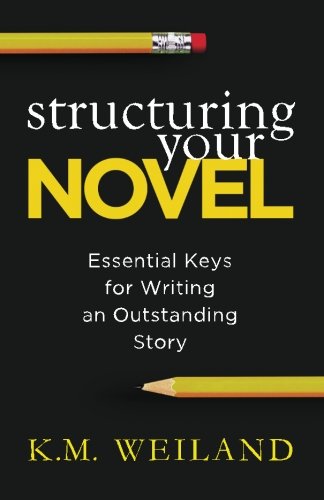
First up: Structuring your Novel: Essential Keys for Writing an Outstanding Story

What Amazon says:

structuringyournovel

Is Structure the Hidden Foundation of All Successful Stories?

Why do some stories work and others don’t? The answer is structure. In this IPPY and NIEA Award-winning guide from the author of the bestselling Outlining Your Novel, you will learn the universal underpinnings that guarantee powerful plot and character arcs. An understanding of proper story and scene structure will show you how to perfectly time your story’s major events and will provide you with an unerring standard against which to evaluate your novel’s pacing and progression.

Structuring Your Novel will show you:

  • How to determine the best techniques for empowering your unique and personal vision for your story.
  • How to identify common structural weaknesses and flip them around into stunning strengths.
  • How to eliminate saggy middles by discovering your “centerpiece.”
  • Why you should NEVER include conflict in every scene.
  • How to discover the questions you don’t want readers asking about your plot—and then how to get them to ask the right questions.

My thoughts:

I’ve been following K.M. Weiland’s blog and podcast for a number of years, since, in fact, she started her series on story structure.

Yes. Everything you will read in this book was originally on Kate’s blog, Helping Writers Become Authors, and you can easily access the whole series (because she’s so organized and so focused on her audience), but it’s so much more convenient to have a condensed, edited, and physical copy of the book, accessible to you at any time, so you can refer to it as you work on your story.

Kate has cracked the code of story structure for me. I’ve read a lot (a freaking lot) of writing craft books and methodologies and Kate’s is the only one that has enabled me to get inside my stories, even those that are already written.

Using Kate’s method, I can dissect my novel structurally and reassemble it in a better, more compelling form. I also use it when preparing for my annual #NaNoWriMo challenge, and when I think about outlining a new work in progress.

I’ve also read a number of her other books, both fiction and writing craft. Each work builds on the others and, because they’re all written in the same voice (excepting the fiction), it helps to form a cohesive body of knowledge that can be accessed and utilized as you need.

With respect to her fiction, you can see that she practices what she preaches. Kate doesn’t instruct from a “do as I say, not as I do” position. She’s field tested everything she presents. You can trust her. I do. Implicitly.

Kate is very much a writerly friend and mentor and this comes across in her authorial voice. She’s all about building writers up, not tearing them down.

Suffice it to say, I loved Structuring Your Novel, and I would recommend it to any writer at any stage of development.

My rating:

Five out of five stars!

About the author:

K.M. Weiland lives in make-believe worlds, talks to imaginary frienkmweilandds, and survives primarily on chocolate truffles and espresso. She is the IPPY and NIEA Award-winning and internationally published author of the Amazon bestsellers Outlining Your Novel and Structuring Your Novel, as well as the portal fantasy Dreamlander, the historical/dieselpunk adventure Storming, the medieval epic Behold the Dawn, and the western A Man Called Outlaw. When she’s not making things up, she’s busy mentoring other authors on her award-winning blog http://www.helpingwritersbecomeauthors.com. She makes her home in western Nebraska.


Tipsday: Writerly Goodness found on the interwebz, Oct 16-22, 2016

Just to let you know. I’m participating in #NaNoWriMo this year, but I wasn’t able to take much time off in November. So I’m working. And, I’ll be out of town, training for the day job, for the first week. And I’ll be at Wordstock Sudbury the weekend I get back. And I’ll be helping to launch the SWG anthology, Sudbury Ink. On the weekend of the 12th/13th (the day/date is yet to be determined).

So, it’s going to be a busy month.

As a result, I’m not going to be blogging at all in the month of November. I will be able to complete and schedule the curation posts for the first week (Tipsday on Nov 1st and Thoughty Thursday on Nov 3rd), but, after that, you won’t be seeing another post until December 3rd, when I’ll be doing a double monthly update for October and November.

I just wanted to let you know ahead of time, so you won’t be expecting posts, or wondering where the heck I am.

I’ll be well, and writing 🙂

Your #NaNoWriMo round up for the week:

K.M. Weiland reviews the WriteMind Planner (plus a chance to win!). Helping Writers Become Authors

Janice Hardy guest posts on Kate’s blog: three ways to instantly spot telling.

Chris Winkle shares five ways to hide your foreshadowing. Mythcreants

Vaughn Roycroft suggests the synopsis as a way to revision success. Writer Unboxed

Dave King helps you meet your characters on Writer Unboxed.

Janice Hardy asks, which character is the heart of your story? Fiction University

Writing a series: how much do you need to plan ahead? Jami Gold.

Alex Bloom makes a guest appearance on The Write Practice: what most writers don’t know about screenplay structure.

Steven Pressfield: what works and what doesn’t.

Gail Carriger discusses one of her literary influences, Mercedes Lackey.

Sabaa Tahir picks Patrick Rothfuss’s brain about writing sequels and impostor’s syndrome. Tor.com

Sarah Gailey wants to see more mentally ill women protagonists. Tor.com

Authors share their views on cultural appropriation. The Guardian

Marlon James: why I’m done talking about diversity. Literary Hub

Finally! An infographic that breaks down the big five and their imprints.

Kelsey Campbell-Dollaghan reports on a gorgeous typeface that drove men mad and sparked a 100-year mystery. Gizmodo

Charles Dickens and profanity. Bryan Kozlowski for The Millions.

Azhar A. Alkazwini documents the influence of the Norman Conquest on the English language. Medievalists.net

Five portmanteau words you want to start using. Sad and Useless

Hephzibah Anderson settles in with The Wide Sargasso Sea, the book that changed Jane Eyre forever. BBC

Looking forward to Guardians of the Galaxy, vol. 2? Check out this teaser trailer! Brian Raftery for Wired.

Women will direct every episode of Jessica Jones, season 2. Beth Elderkin for i09.

All the best until Thursday 🙂

See you then! *waves*

Tipsday

Tipsday: Writerly Goodness found on the interwebz, Oct 9-15, 2016

Another harvest of informal writerly learnings for you 🙂

Moar Wordstock Sudbury 2016 news from Kim Fahner, Sudbury’s Poet Laureate. CBC

Emily Franceschini interviews Danielle Daniel for Our Crater.

This week’s #NaNoWriMo round up:

Eleana Sbokou guest posts on Kate’s blog: seven things you need to know about writing and editing.

Roz Morris provides a blueprint for keeping the reader gripped. Nail Your Novel

Juliette Wade guest posts on Janice Hardy’s Fiction University: backgrounding your world through point of view.

Veronica Sicoe continues her series on storyworld design with this instalment on communication technologies.

Gabriela Pereira interviews Amor Towles for DIYMFA radio: worldbuilding from the inside out.

The book monster, or, when writing gets hard. Kate Moretti on Writer Unboxed.

Allie Larkin writes about finding confidence. Writing Unboxed

David Corbett shares what he learned at the beach this summer. And I have another book for the TBR pile 🙂 Writer Unboxed

Lisa Cron explains where drama really comes from. Writer Unboxed

Orly Konig Lopez gives three reasons quitting is an option, and the one reason you won’t. Bonus: guinea pig pictures! Writers in the Storm

Steven Pressfield reminisces about writing “as if.”

Ok. I just can’t resist Harper Lee Hodges. The four steps cats use to explain how to do something. The Write Practice

Julie Phillips: the fantastic Ursula K. Le Guin. The New Yorker

Jamie Raintree shares her story: from agent to publisher, part 1.

Why is it so difficult to get an agent? Liza Dawson Associates

Kristen Lamb explains why we need a synopsis before we write the book.

Catherine Ryan Howard explores her hate/love relationship with writers’ workshops.

Susan Spann helps us understand advances in publishing deals. Writers in the Storm

Adrienne Raphel: a history of punctuation for the internet age. The New Yorker

Four writers share their stories about the search for happiness. The Telegraph

Claire Kirch reports on We Need Diverse Books new curated reading app. Publishers Weekly

The publishing industry risks becoming irrelevant. Tom Welson of Penguin Random House UK. The Guardian

Here’s a lovely bit of storytelling for you. Dia de los muertos from Film School Shorts.


And another  video on the role of geometry in visual storytelling. Now you see it


The indigenous science fiction film, Northlander, will be screened across Canada. CBC

Kameron Hurley digs into the first couple of episodes of Westworld.

Alex Cranz reviews the season premiere of Supergirl. i09

James Whitbrook says that DC’s Legends of Tomorrow is trying to be Doctor Who with superheroes, and that’s just fine by him. i09

Clara and Eleven were a couple. What we’ve all known, finally confirmed. Caitlin Busch for Inverse.

Katharine Trendacosta reviews the first Iron Fist footage from NYCC. i09

And The Nerdist shares the Iron Fist trailer.

Katharine Trendacosta shares what she learned about The Dark Tower trailer (leaked). i09

The Outlander, season two, gag reel 😀


I hope that you find some news you can use to help improve your craft.

All the best.

See you Thursday!

Tipsday

Tipsday: Writerly Goodness found on the interwebz, Oct 2-8, 2016

This week was just yummy 🙂

The Wordstock Sudbury 2016 schedule is up 🙂

Prism International interviews George Elliott Clarke, one of our Wordstock guests of honour.

Your #NaNoWriMo prep posts for the week:

Nina Amir guest posts on K.M. Weiland’s Helping writers become authors: how to get up close with your characters.

Chris Saylor guest posts on Marcy Kennedy’s blog: how to punctuate dialogue.

Roz Morris shares her insights on how to write emotions. Nail your novel

Donald Maass looks at four kinds of pace. Writer Unboxed

Joanna Penn: how to find and capture ideas for your novel. The Creative Penn

Janice Hardy guest posts on Writer Unboxed: a ten step guide to plotting a practice novel.

Therese Walsh explores dehumanization in fiction using one of my favourite movies, The Shawshank Redemption. Writer Unboxed

Cathy Yardley: just say yes. Writer Unboxed

Chris Winkle thinks the surprise kiss must go. Why? It’s a matter of consent. Mythcreants

Chuck Wendig offers some good writing (and life) advice: control what you can control. Terribleminds

Later in the week, he shares ten quick story tips to use or discard at your leisure.

Kameron Hurley shares her experience: five years a novelist.

Sarah Waters shares her ten rules of writing fiction. Aerogramme Writing Studio

Last Sunday I spent the day online in a short fiction intensive with Mary Robinette Kowal (!) Here’s one of the resources she shared on critiquing:


Carly Watters offers ten ways to personalize your query letter.

Kristen Lamb: what the dreaded synopsis reveals about our writing.

Anna Davis: how to prepare your submission package. Curtis Brown Creative

Awards news!

Ursula K. Le Guin has stopped writing fiction, but we need her more than ever. Zoë Carpenter for The Nation.

When Steven Musil reported that Amazon was cracking down on incentivized reviews, everyone panicked, until it was clarified that this policy change would not apply to ARCs provided for book review purposes. cnet

Sarah Gailey: why we write about witches. Tor.com

Lisa Rosman: what The Girl on the Train is really about. Signature Reads

Angelica Jade Bastièn says the price of fandom can be too high for women of colour. New Republic

Julia Alexander examines sexism in television in the microcosm of Adult Swim. Polygon

Shane Parrish: what you read changes your brain. Medium

If you can correctly pronounce every word in this poem, you speak English better than 90% of English speakers in the world. I must admit, I flubbed two or three <blushes>. The Poke

Ephrat Livni for Quartz: a linguist’s love letter to profanity and why it’s okay to swear in front of kids.

Dark Horse Comics will be producing the next two seasons of The Legend of Korra in print. Rob Bricken for i09. Moar Korra! Eeeeee!

Evan Narcisse talks to Greg Rucka about the reaction to Wonder Woman’s canon bisexuality. i09

Did you see the premiere of Westworld last Sunday? Here are a few pieces about it.

Michael Bennett Cohn looks at Westworld through the lens of the golem story. The Forward

Can Westworld do for science fiction what Game of Thrones did for fantasy? Charlie Jane Anders for Wired.

I’m watching and enjoying it. Phil, not so much, but then, he did see the original movie (which I haven’t) and he just doesn’t see how the writers can turn it into a series and so he’s closed to the possibilities.

Evan Narcisse explores how Luke Cage uses blackness for i09.

Netflix provides a release date (and teaser) for Iron Fist: March 17, 2017.

Outlander casts Marsali and adult Fergus. Entertainment Weekly

The Doctor Who Christmas special features superheroes (!) plus a wee teaser. Katharine Trendacosta for i09.

See you Thursday!

Tipsday

Tipsday: Writerly Goodness found on the interwebz, Sept 25-Oct 1, 2016

Yup. Lots of informal writerly learnings for you this week. LOTS!

K.M. Weiland answers reader questions about scenes versus chapters. Helping writers become authors. Later in the week, Kate invites Wordplayer, Usvaldo de Leon, Jr., to share his thoughts on setting up the potential for change in character arcs.

Lisa Cron guest posts on Writers Helping Writers: how your character’s misbelief drives the plot. Later in the week, Angela Ackerman provides this amazing list of resources for writers.

Karen Woodward explores C.S. Lewis’s writing advice.

Jo Eberhardt shares her lessons learned from watching Supernatural. Writer Unboxed

Kristen Lamb shows how Girl on the Train demonstrates the two elements that all great stories share.

Barbara O’Neal responds to the Merritt Tierce article I shared last week: money and the writer. Writer Unboxed

Joanna Penn interviews Toby Neal on The Creative Penn podcast.


Janice Hardy guest posts on Writers in the Storm: five reasons your revisions aren’t working.

Erika Robuck has a message for all of us about remembering why we started writing. Writer Unboxed

Steven Pressfield digs deeper into the reasons he writes.

Jami Gold explores how to strengthen your stakes. It’s not always about going big.

Veronica Sicoe discusses story world design and choosing the right time period.

Oren Ashkenazi lists six ways flight changes a fantasy setting. Mythcreants

Bonnie Randall guest posts on Janice Hardy’s Fiction University: on balance versus burn-out.

It’s NaNoWriMo prep season! Joe Bunting shares ten catalysts that will help you win NaNoWriMo. The Write Practice

Catherine McKenzie unpacks the issue of audience limiting covers for books by women authors. Writer Unboxed

More fallout from the Lionel Shriver keynote:

Stephanie Saul reports on how campuses are teaching freshmen about cultural sensitivity and microaggression. The New York Times. This was the kind of thing that Janet Reid ranted about last week.

Liz Dwyer closes the diversity gap in young adult literature. Take part

Tshaka Armstrong discusses Luke Cage, Black Panther, and why superheroes of colour matter. Rotten Tomatoes

Jenny Kay Dupuis shares her grandmother’s residential school story in honour of Orange Shirt Day. CBC

Heidi Ulrichsen interviews Danielle Daniel about her new memoir. Sudbury.com. Later in the week, Danielle was interviewed on CBC Sudbury’s Morning North.

Carl Slaughter of File 770 interviews Kelly Robson.

Haralambi Markov reviews Charlotte Ashley’s body of short fiction. Tor.com

Fran Wilde’s characters aren’t defined by their disabilities. Natalie Zutter for Tor.com.

PW Radio interviews Nisi Shawl on her novel, Everfair, and Writing the Other.

Rachel Cordasco reflects on the Three Body trilogy. Tor.com

Margaret Atwood writes about re-envisioning Shakespeare’s The Tempest in her novel, Hag-Seed. The Guardian

Laura Miller muses on the haunting of Shirley Jackson. Literary Hub

Michelle Fazekas and Tara Butters, the showrunners behind Marvel’s Agent Carter, sell series ideas to various networks, including a series based on Wesley Chu’s Tao series. Deadline

Susan Spann explains when you should walk away from a publishing deal. Writer Unboxed

Ed Nawotka of Publishers Weekly says the publishing world needs more Canada.

Wallace Immen visits the Penguin Random House offices where curling up with a good book is encouraged. The Globe and Mail

Award news! The British Fantasy Award winners announced 🙂

The Scotia Bank Giller Shortlist is announced.

Martha Schabas reviews Hannah Moscovitch’s Bunny and the play’s exploration of the double standard of consent. The Globe and Mail

Tori Amos: Trump is disrespectful to all women. The singer/songwriter talks about her response to Audrie and Daisy, the role of storytelling in her creative process, and accountability. The Daily Beast

And here’s her LA Times piece on the same issues.

Thu-Huong Ha lists 30 words and phrases that will soon be eliminated from American English. Quartz

Author Hannah Kent dives into the Irish world of faith and fantasy. Donna Liu for The Guardian.

John Plotz writes about the influence of Ursula K. Le Guin. The Guardian

Matt Santori-Griffith interviews Greg Rucka on Wonder Woman and queer narrative. Comicosity

Entertainment Weekly shares a fan-made mash-up between Stranger Things and Buffy the Vampire Slayer. Awesomesauce 🙂

Anne Perry recommends five Stephen King books you should read if you liked Stranger Things. Hodderscape

Estelle Tang talks to Sam Heughan about sweat, sheep-dipping, and Outlander spoilers. Elle

Lynette Rice of Entertainment Weekly takes a first look at Outlander’s new season. Later in the week, Lynette shares some breaking news on another actor cast for season three.

Film festival audiences say Split may be M. Night Shyamalan’s best movie yet.


Whew! I’m exhausted.

See you Thursday!

Tipsday