Thoughty Thursday: Things that made me go hmmmm on the interwebz, Jan 18-24, 2015

A first-person account of the Paris rally. Psychiatric Times.

Redefining mental illness. The New York Times.

Drink more tea. It’s good for your mental health. The Canadian Mental Health Association.

Love this comic from Everyday feminism on body policing.

The Huffington Post. The surprising cause of addiction—it’s not what you think.

The LA Times reports on the dangers of sitting all day. One of the reasons I now have an adjustable desk at home.

Why you should take notes by hand instead of by lap top. Lifehack. This is how I do all my conference learning these days. I listen, take notes by hand, and then transcribe those notes later in a blog post. That’s three exposures to the same information by three different methods. Do I remember more? You betcha!

Jane Friedman shares ten resolutions for a saner internet—and life.

The potential quantum effect of parallel worlds on our own. Mother Nature News.

Thanks to the Hubble telescope’s latest and highest resolution picture, you can now get new perspective on how vast the universe is. IFLS.

How could I resist this piece by National Geographic on animal commuters?

Keep on learning! It’s the only way to live 🙂

See you Saturday!

Thoughty Thursday

Tipsday: Writerly Goodness found on the interwebz, Dec 21-27, 2014

K.M. Weiland offers beta readers a guide.

Sarah Lovett of DIY MFA shares the reasons why you need to start a writers’ group or critique circle.

What traditional publishing learned in 2014. Kristine Kathryn Rusch.

Town hall debate: what every literary writer needs to know about the digital disruption. Hosted by Porter Anderson and featuring (among others) Jane Friedman. The focus may be on literary writers, but this is informative for all writers. Vimeo.

Steven Pinker, author of Sense of Style: The thinking person’s guide to writing in the 21st century, interviewed by the CBC’s Anna Maria Tremonti.

Steven Pressfield on his “overnight” success.

Giving yourself the gift of writing, by Barbara O’Neal.

Madeline L’Engle on creativity, hope, getting unstuck, and how studying science enriches art. Brainpickings.

This kid’s theory about The Princess Bride is AWESOME!

The ancient origins of modern science fiction tropes. Blastr.

Words that used to be considered poor English that are now accepted. Gives you a little perspective on your current grammar bug-a-boos, doesn’t it? Mental Floss.

Hope you have fun tomorrow night!

Tipsday

Thoughty Thursday: Things that made me go hmmmm on the interwebz June 22-28, 2014

Another thoughty week runs the gamut from the sublime to the absurd. Just for you, my thoughty friends 🙂

This is from the learning and development side of my life, but, I figured, why not share the love? The social learning blog offers 22 free elearning and graphic design resources.

Author Media created this infographic that gives you ALL the sizes for all images on the most popular social media. Cheat sheet? AWESOME!

New technology for books! Check out the booktrack. Posted by Laurence MacNaughton on Jane Friedman’s blog.

All work and no play makes Johnny . . . crazy? Watch this TED talk and see what you think:


Five ways animals suffer from mental illness from ted.ideas.com. Phil and I have always been convinced we raise neurotic pets . . .

From the Telegraph: phobias may be memories passed down in our genes from our ancestors. Whoa, dude.

Brainpickings presents the theology of rest. “Rest, instead of being something passive, is actually an act of resistance.”

Try the Celtic version of the zodiac. The Celtic tree calendar from Irish Central.

A literary travel guide to the UK from ShortList.

Ted.ideas.com asks which country does the most good for the planet?

Six sites gain world heritage site status. Discovery news.

How much room would we need to supply the entire world with solar energy? I Fucking Love Science has the scoop.

Have a closer look at Europa with National Geographic. I love Europa. Wrote a poem about her once 🙂

The Atlantic present more of the entrants in the 2014 National Geographic Traveler Photo Contest.

Love pugs? How about Game of Thrones? A couple of creative souls decided to put the two together and this is what they came up with:


HelloGiggles brings us an ode to sloths.

Wired’s absurd creature of the week: the assassin bug. More like creepy creature. Gives me the wiggins.

The truth about public toilet seats from Lifehacker.

And now that you’re suitably grossed out, I shall bid thee adieu!

The best in edutainment. Nothing’s too good for my writerly friends 🙂

Thoughty Thursday

Tipsday: Writerly Goodness found on the Interwebz May 4-17, 2014

Yes, you read that date correctly. It’s a double shot of Tipsday this week (since I missed out on last week).

A writer friend actually called me the queen of curation this past week 🙂 I think that title belongs to Elizabeth Spann Craig, but I was duly flattered, nonetheless.

Part 12 and Part 13 of K.M. Weiland’s Creating Stunning Character Arcs series.

Lisa Cron’s TEDx lecture, Wired for Story:


I would have posted Lisa Cron’s Writer Unboxed: What kindergarten got (and still gets) really, really wrong, but WU is having some technical difficulties right now. I’ll try to keep it in mind for next week. It’s an excellent post. Heart Lisa Cron.

A little more brain science for you here. Frank Bruni encourages kids to read, kids, read.

Anne Ursu examines the phenomenon of ‘Greenlit.’ Contemporary realism in MG and YA.

Jami Gold asks the question, when should we skip a scene in our stories? And she answers it too, clever lady.

Janice Hardy makes a case for prologues: not as evil as you think.

Victoria Mixon’s three things you should know about exposition and telling.

6 tips to modernize your prose for the 21st century reader from Anne R. Allen’s blog. This one generated a few comments. Who should be more accommodating, the writer or the reader?

Roz Morris’s tips for using Amazons keywords and categories intelligently.

Joanna Penn interviews Jane Friedman on money, writing, and life.

Publishing industry news: Pay equity and gender parity are still issues. Why Jill Abramson was fired.

Carly Watters offers 5 easy steps for formatting your next query.

Laura Pepper Wu write a guest post for Catherine Ryan Howard about 11 inspiring quotes from the world’s best writers.

10 more inspiring quotes from the Procrastiwriter.

And even more inspirational quotes from Jane Friedman:


George Saunders on the power of kindness, animated, from Brainpickings.

You may remember I posted the Rolling Stone interview with George R.R. Martin a couple of weeks ago. Well, here are the “outtakes.”

And, I know it’s been everywhere, but I love this clip about George R.R. Martin’s secret weapon.

See you all on Thoughty Thursday!

Tipsday

Tipsday: Writerly Goodness found on the Interwebz March 16-22, 2014

TipsdayAway from home this week and free wifi is slooooow.

I’d just posted about seasonal affective disorder (SAD) myself when Lydia Sharp posted this to Writer Unboxed:
http://writerunboxed.com/2014/03/16/seasonal-writing-disorder/

On the changing role of agents and new submission guidelines from Anne R. Allen’s blog (with the fabulous Pam Van Hylckama Vlieg):
http://annerallen.blogspot.ca/2014/03/the-changing-role-of-literary-agents.html

Part 6 of K.M. Weiland’s Creating Stunning Character Arcs series:
http://www.helpingwritersbecomeauthors.com/2014/03/character-arcs-6.html

Two from Elissa Field. Is teaching a good day job for a writer? http://elissafield.wordpress.com/2014/03/16/writers-day-job-is-teaching-a-good-day-job-for-writers/ and Friday Links for writers 03.14.14 http://elissafield.wordpress.com/2014/03/15/friday-links-for-writers-03-14-14-quirky-info-sources/

Hey, who says I can’t curate the curators?

And here’s a third for good measure: novel revision strategies: http://elissafield.wordpress.com/2014/03/19/novel-revision-strategy-retyping-the-novel-draft/

The science of emotion in marketing. The article speaks to me more of braiin science and the power of story.
http://blog.bufferapp.com/science-of-emotion-in-marketing

Improve your vocabulary.
http://justenglish.me/2014/03/10/important-infrequently-used-words-to-know/

Stephen King’s top 20 rules for writers, ‘cause you know, we can never break too many of them 😛
http://www.barnesandnoble.com/blog/stephen-kings-top-20-rules-for-writers/

Agent Carly Watters explains what she looks for when she Googles a prospective client.
http://carlywatters.com/2014/03/17/q-what-do-agents-like-to-see-when-they-google-writers/

Roz Morris on the dangers of over-dependence on your thesaurus.
http://nailyournovel.wordpress.com/2014/03/16/bring-on-the-empty-horses-handle-synonyms-with-care/

The neurological similarities between writers and the mentally ill. Get your critical thinking caps on people.
http://thoughtcatalog.com/cody-delistraty/2014/03/the-neurological-similarities-between-successful-writers-and-the-mentally-ill/

5 charts that show how publishing is changing from Jane Friedman.
http://janefriedman.com/2014/03/21/5-valuable-charts/

5 insightful writing tips from Paul Harding.
http://publishersweekly.com/pw/by-topic/industry-news/tip-sheet/article/60070-5-writing-tips-paul-harding.html

5 reasons your platform may be spinning its wheels from Michael Hyatt.
http://michaelhyatt.com/traction.html

WOW! Did I find a lot of good stuff on the interwebz last week or what?

That’s the thing with me. Sometimes, I’ll be all over that. Sometimes I won’t. This week, for instance, being on the road, I don’t think will be very productive for the linkage. We shall see.

And this is me, saying goodnight.

A year (and a bit) in the life of Writerly Goodness

This post is one in a series of Anniversary posts for Wordsmith Studio (WSS).

What is WSS, you ask?

It’s a group of people who originally bonded through Robert Lee Brewer’s April Platform Challenge last year and who have gone on to create a community online, not only through our blogs, but also through social media (Facebook, Twitter (#WSchat), LinkedIn, G+, Goodreads, Pinterest (sorry, not a pinner, so no link for the group there), and probably a few other places that I don’t know about yet).

Originally the MNINB Challengers, or Not-Bobbers, we slowly evolved into our own collective.

Part way through the year, a group of fabulous people got together to create the Wordsmith Studio site on WordPress.org.  Since December of last year, a number of members have been blogging regularly on the site as well as on their own blogs.

Others have been attracted to WSS who had nothing to do with the original challenge, and others who participated in the challenge have moved on to other projects.

So now you know, and knowing is half the battle Go Joes! 🙂

Prelude to a kiss challenge

One thing that amazed me was the diversity of people who participated in the challenge.  Some of them had been blogging for years already, or had several blogs.  Others, like myself, were new bloggers.  Others still didn’t start blogging and platform building until Robert’s challenge prompted them to.

I actually started my platform building in September of 2011.  I tried Joomla! first, but found it to be less intuitive than I wanted.  Plus, I was posting a blog more than anything else, and couldn’t figure out the proper way to set a blog up on a Joomla! site.  I wasn’t interested in bothering my techie husband, or in paying someone to sort this out for me, so I looked at other options.

In short order, I found WordPress, and gleefully uploaded the software to my self-hosted domain, labbydog.ca, converting all of my content into proper posts for my blog.

I learned as I went, relying heavily on experts such as Robert, Jane Friedman, and Michael Hyatt and the resources to which they referred me.

Then in February of 2012, disaster struck.  My blog was hacked, and our hosting company insisted in a complete wipe.  RIP labbydog.ca.

After playing around further, I decided, gun-shy and tender creative person that I was, to move to WordPress.com.  On Robert’s advice, I’d purchased my domain name, mapped it to WordPress.com and www.melaniemarttila.ca, A.K.A. Writerly Goodness was born.

At first I was merely attempting to recreate my content and was posting 5-6 days a week.

Enter the dragon challenge

I was already following Robert at the time, and when he announced his April Platform Challenge, I jumped onboard.

For a month, I eagerly awaited my daily dose of platform.  I’d been on Facebook since 2007, and had, as part of my amateur platform building program, already joined Twitter, LinkedIn, and G+, so the days in which the challenge task was to set up accounts on these services I had things a little easier.

It’s a good thing too; otherwise, I’d have fallen waaaay behind.

I learned about having a mission statement for my blog, about using a blogging schedule (doesn’t blogging in this sense sound like a colourful euphemism?  What the blog?  Blogging work!), about calls to action, guest blogs (hosting them and proposing them), interviews, tools like Tweetdeck and Hootsuite, hashtags and Twitter chats, mailing list, business cards, newsletters, Goodreads and other kinds of social media.

By the end of the month, I verged on the overwhelmed.

Ch-ch-ch-ch-changes

I cut down on the frequency of my posts.  A new position at work meant that I had even less time and energy to spare for my blog if I wanted to keep up with my novel and other creative writing.

Something I’ve learned is that, as a writer, the writing comes first.  Blogging is a part of that, but if I don’t get my stories, poems, and novels written, submitted, and published, the blog is tantamount to an online journal and practically useless for the purpose of promotion or true platform building.

Now I blog on weekends only, and it’s been working for me, which is the most important thing.  I’ve been getting the writing done and have achieved a greater balance between my professional, creative, and personal lives.

I have several new pages, with links to those of my books that are still available for purchase from the publisher, my blogging schedule (such as it is), an invitation for guest bloggers, awards, and so forth.

I’ve started doing interviews with a number of friends, online and in real life, and was surprised but ultimately pleased when a fantasy writer right here in town contacted me out of the blue on my blog to be interviewed.  It speaks to the unexpected impact that blogging has had on my creative life and the community that I am, however back-asswardly, building 🙂

This post will be my 190th, I have 118 followers through WordPress, and publish my posts to 243 friends on Facebook, 412 followers on Twitter, 112 connections on LinkedIn, and 90 people have included me in their G+ circles.

I’ve participated in a few challenges (October submit-o-rama, I ❤ my blog, and the Just write 2013 short story challenge) and a couple of the Goodreads group craft book discussions.

I’ve posted a grand total of once on the WSS site and am currently waiting to hear from Robert regarding a guest blog on My Name is Not Bob.  **Hint: Look in your spam folder, Robert 🙂

It’s a humble beginning, but I remind myself that platforms take years to build and that until I have something more than a couple of old poetry anthologies to shill, that I’m not likely to have a massive following.  Even then, unless I turn out to be the next big thing for real, I’ll probably only see modest growth.

Next

I’ve been threatening to move to WordPress.org for a while now.  I still haven’t found the time to parse my archives and clean up some of my old posts.  I have to rework some of my images too, since in the early days of my blog, I just did a Google search for my images.  I have to find creative commons equivalents, use my own, or remove them entirely.

Nor have I settled on a new hosting company.  The fear of hack still lives in me and I’m admittedly dragging my feet on this one.

I’m also considering a greater involvement in WSS.  The site is still in evolution and I’m not sure what I can commit to.  Want and need are two entirely different things.  Keeping that distinction in mind will help me stay sane.

What I will do is encourage all of you to visit the Wordsmith Studio site, peruse the wonderful diversity of our members’ sites and blogs (photo bloggers, pet bloggers, health bloggers, poets, fiction writers of all genres, non-fiction writers, publishers, and so much more).  A weekly round up of our anniversary blogs will be posted on the Veranda, so please read on.

Also visit My Name is Not Bob to see some of the lessons learned posts from several of the original challengers.

Many of my online friends have had amazing years, some good, some bad, some demoralizing, and some downright inspiring.  Most of them are far more eloquent than I am.

Consider liking, commenting, sharing or subscribing.  They are teh awesome, with a little awesomesauce on the side 🙂

Happy anniversary WSSers!  Love you all, even if I don’t show it often enough.

Three bits of Writerly Goodness in October 2012

I’ve been on the road quite a bit this month.  Specifically, from Oct. 16-18, 24-28, and 29-31.  So I hope you’ll forgive the lack of posting.  I did warn you 🙂 Normally, blogging while I’m away isn’t a huge problem, but recently, I’ve been travelling so much that I’m plain exhausted.

I think the cold I caught Thanksgiving Day (here in Canada) is finally going away, but the fact that I got sick at all (first virus in two years) tells me that I’m overdoing it.

So here is the first of two catch-up posts for the month of October.  Tomorrow, I’ll blog on various things that have been happening on the learning mutt side of my life.

We Grow Media’s “Build Your Author Platform” course

I signed up for this in September, having missed the course earlier in the year.  Knowing what a busy few months I’d have ahead of me, I probably should have waited until the next one, but it doesn’t look like things will get much better at work, so ultimately, there was no time like the present … then.

Dan Blank’s course was enlightening with respect to narrowing focus, targeting our ideal audience, and making use of tools like Google Analytics.  The weekly insider calls were productive and encouraged community building within the course.  Unfortunately, these and the specialist calls took place during the day and I couldn’t take part in most of them.

They were recorded, however, and so even though I couldn’t participate in them, I could still reap the benefits of the calls with Joanna Penn, Joel Friedlander, Jeff Goins, and Jane Friedman.  Those calls were worth the cost of the course alone.

I can’t really give much more away without starting to discus the materials in depth and those belong to Dan.  Suffice it to say that while I wasn’t able to participate in October as much as I wanted to, I have the course materials on hand and will make use of them often in the months to come.

Having said that, I think the course is best suited to those with some technical savvy but just getting going, and who also have a product to promote (novel, non-fiction, poetry collection, etc.).  The participants who had no background in social media or blogging whatsoever tended to have greater difficulty, and those like myself, who do not have a recently published work to promote couldn’t necessarily narrow down our focus sufficiently to make the most of Dan’s lessons.

For the former group, I might recommend Dan’s Social Media 101 and Blogging 101 courses offered through Writer’s Digest University.  Links to these can also be found on the We Grow Media site (linked above).

Khara House’s October Submit-O-Rama

I intended to get some submissions done over the course of October anyway, so I thought I’d join in the fun of Khara House’s October submit-o-rama.

The challenges varied from three submissions per week, through to a submission every day of the month, to the alpha-challenge in which you’d do the same but submit to magazines, contests, and journals in alphabetical order.  There was also a name game challenge to submit to publishers according to the letters of your name, and a create your own challenge.

I chose the last and settled on one submission a week.  I cheaped out, I know, but I honestly couldn’t manage more.  Anticipating the travelling I’d have to do in the latter half of the month, I submitted twice in the first two weeks and then decided I’d try, but not kill myself, for the remainder of the month.  That way, I met my challenge and didn’t overwhelm myself further.

I’ve received one rejection so far and the remaining ones are still up in the air.  Fortunately, my rejection included a request for other material, so I’m looking at it as a positive.

Khara had forums up on her site: Our Lost Jungle (linked above) as well as an event page on Facebook.  There were a handful of dedicated but insane writers (my opinion only) who managed 31 submissions in the month through various challenges.  Kudos to them!  They worked so hard and I’m sure they’ll be reaping the rewards for some time to come.

Now most of them are onto the November challenges of NaNoWriMo (national novel writers month) and PAD (poem a day).  I wish them the best and am sure that they will do smashingly!  And of course, our dear Khara deserves praise for putting everything together and giving everyone the kick in the pants they needed to get their work out there!

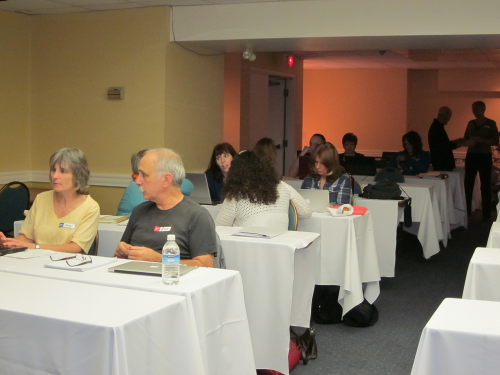
New York Comes to Niagara

I wanted to attend this conference last year, but ended up not being able to due to work commitments.  So when the conference Web site announced that applications were being accepted, I jumped on board.

NYCtN is an Algonkian pitch conference and writers first have to apply, submitting a short synopsis and writing sample before they are accepted and able to register.  When I made it through that stage, I immediately registered and booked my hotel room. 

Then came the 88-page guide and half a dozen emails with accompanying assignments.  My work was set out for me.

Now I have to make something clear.  My goal in going the conference was just to find out what the heck a pitch conference was, how it worked.  I’m an experiential learner and sometimes reading about something just doesn’t cut it.  So again, to be clear: I had no expectations.  I fully expected to have every agent and editor in the place reject me out of hand.

And I went prepared for that outcome.  This is not to say that I wrote anything but the best pitch I was capable of or that I blew off any of the assignments.  I’m a keener.  That would be impossible.  I just wasn’t pinning my hopes or self worth on the result of the conference.

Until it started.

Once the first pitch panel took place, which I, keener that I am, volunteered for, I was caught up in the hype.  I forgot about my humble goal and suddenly, I felt the pressure to sell.  It didn’t help that I was told in no uncertain terms that my novel was dead in the water and that traditional fantasy of any variety wouldn’t sell to anyone.

Nor was it particularly useful that I was advised to either throw out my created world and place the story in a historical setting (not my novel), or failing that, that I should set aside Initiate of Stone and focus on a more commercial project until my money-making capacity could be well-established and that I could then bring out the snoozer and rely on my reputation to coast me through what would surely be a slump in my writing career.

Please note: this was my interpretation of the advice, not the actual advice given.  You’ll understand if I wasn’t particularly clear-headed about it.

I lived in that illusory and completely self-induced angst for two days until, thanks to a friend, I remembered why I came to the pitch conference in the first place.

I revised my pitch but did not alter my project and I was true to my original intention and to IoS.  I pitched it and received some positive response.  Then I had to disappoint (seriously, the worst thing I can do to anyone in my book and pure torture for me) the person who had done everything in his power to guide me in the direction of success.

Here’s what I learned:

  • A pitch conference is all about the commercial viability of the pitch and its ability to obtain the interest of an agent or editor.  You have to back your pitch up of course, but the only thing that anyone will hear at the conference is your pitch.  For all intents and purposes, your novel might as well not exist.
  • It’s best not to bring only one idea/pitch, and if for one reason or another you only have one, you can’t be invested in it.  If you are, then a pitch conference may not be your best bet.  There are often opportunities to have your pitch critiqued before the pitch session opens.  If one idea doesn’t pass muster, keep pulling them out and throwing them against the wall until something sticks.
  • It’s common to pitch an idea for a novel that you haven’t written yet.  So long as you have the time and dedication to bang it out, this is acceptable, even expected.  I might go so far as to suggest that it’s a good idea to have your novel ideas plotted out and maybe even a few key scenes written, but that you may need to be flexible enough to accept suggestions that will drastically alter your novel.  This is harder to do with a project that you’ve invested months or years in writing.
  • If you’re like me, and reading these pieces of advice isn’t really enough, if you have to experience a pitch conference for yourself and you only have one project, one you’ve invested time in and are attached to, then stay true to your intent and be prepared to hear some things that you won’t want to accept.  Keep in mind that these things are going to be said to you with the best of intentions: to make you a viable career author.  If you’re not ready for that, so long as you understand that and keep all the excellent advice you receive in mind, you’ll be fine.

One way or the other, you and your work will emerge stronger on the other side.

Algonkian conferences have helped many writers achieve success.  Just visit their site and read the testimonials.  It’s a great opportunity that if you’re ready for, you shouldn’t pass up.

Besides, you usually get excellent advice outside the pitch panels and sessions as well.  In this case, Barbara Kyle delivered several sessions on plot and structure and Amy and Duncan McKenzie delivered an informative and entertaining session on improvisational techniques.

I even got some sight-seeing in 🙂

I highly recommend attending an Algonkian conference, or any pitch conference, and found it had the potential to be profoundly life-changing.

Writerly Goodness, signing off 🙂

Two approaches to novel structure I recommend you check out!

I’m no expert with regard to writing a novel.  Admittedly, I’m still revising my first one, and while I’ve had some modest success with my poetry and short stories, I’m a complete n00b when it comes to the mechanics of the novel.  I’m learning as I go and I’ll share these bumbling lessons in my Work in Progress category, but for this week’s Alchemy Ink, I thought I’d do a little curating.

In the past couple of weeks, I’ve come across two of approaches that attracted me and that I intend to follow through to their blogging conclusions.

Why did I gravitate to these two writing bloggers?

The short answer is that I’m floundering.  I’m working with a peer group in Author Salon and part of that entails the presentation of my project in a formatted profile.  I’ve never queried an agent before, never participated in a pitch slam, or in a workshop that focuses on developing a pitch, hook, synopsis, or any of the other components of the profile.

In recent weeks, both the critiques of my peers and the advice of AS staff have brought several things to my attention:

  • My synopsis misses the mark.  The synopsis we’re asked to produce for the AS profile must be between 200 and 300 words and so is what’s been described to me as the short synopsis.  This is something that might fit into a query letter and could be analogous to the blurb on the back of a book.  The specific form still escapes me at the moment.
  • My hook line doesn’t ‘hook.’
  • My conflict statement isn’t well-defined.  My plot is very complicated and I can’t seem to distil everything into a concise, yet clear statement that addresses internal, interpersonal, and plot level conflicts.
  • I didn’t have a series title, and the title of the novel didn’t resonate with most of my readers.  This is still in flux.  I’ve chosen a series title and changed the working title of the novel, but there were reasons that I chose the original.  I won’t go into those here, but at least one peer thinks the original was better.
  • My original novel was far too long.  I’ve had to cut it in half and that’s changed a whole whack of things.  When initially confronted with this, I was defensive, and unwilling to move, but after my initial panic, I recognized that I didn’t have to take the scorched earth policy and destroy what was a 295,000 word opus.  So I’ve chosen to break the novel up, using the mid-point as the new climax and am editing down from there to a neat 110,000 words.
  • My climax and denouement are not well defined.  This owes to the above re-envisioning of my novel.  Reworking a mid-point to a climax has brought with it its own challenges.

Other issues have become apparent to me in the process:

  • My protagonist’s story arc is not dynamic in its early stages.  There’s a lot of internal conflict, and some interpersonal, but not much that relates overtly to the plot.  It all relates to the larger story arc, but that doesn’t become apparent until later on in the novel.
  • There’s a lot of disembodiment going on.  This is a tough one.  I can fix the POV issues that contribute to some of this, but dream/out of body experiences and shamanic journeying are central to the story.  I’ll have to let this incubate for a while and write through some of the possibilities.

I’m going to need some help working through all of this.

So what are the two approaches already?

Karen Woodward and the Starburst method

I caught on to Woodward with Part 3 and backtracked through her blog posts from there.  There are ten parts/steps to the process, so I’m going to be following Woodward through them from here on out.

Part 1 entails creating a one sentence description of your story.  This equates to what, in screenwriting circles, is called a log line, or what AS is calling the hook line.  That alone made my Writerly Goodness ears perk up (Didn’t know my authorial alter ego was a dog?  Take a look at the site mascot 😛 ).

Part 2 takes that one sentence and creates from it a five sentence paragraph.  This might make a zippy short synopsis.  Woodward discusses the three act structure here as well, another takeaway from the screenwriting world that has been successfully applied to novel writing.

Part 3 expands each sentence into its own paragraph.  By now, I think I have a decent idea of where the Starburst method is heading, but I’m still curious enough to follow through with it and see where it leads me.

K.M. Weiland and the Secrets of Story Structure

Late to the party with Weiland as well, I didn’t pick up on her series until part three, and was reminded of it this week when Porter Anderson reposted a link to part five in this week’s edition of Jane Friedman’s Writing on the Ether.

Why I like Weiland’s approach

What struck me immediately was that Weiland’s secrets are both organic in nature, having emerged from her own process and experience, and very clear.  Ideas and insight started to pop as soon as I read her first post.

Part 1 answers the question: Why should authors care?  It made complete sense to me.

Part 2 deals with the hook in its story structure form as opposed to the hook line that AS wants.   Still, the way Weiland describes the hook offers insight into what (perhaps) should and shouldn’t be present in a hook line.  It’s the question that the protagonist, and therefore the reader, needs to answer.  For the writer, it propels the plot; for the protagonist, it sets her feet on the hero’s journey; and for the reader, it keeps him or her reading until the question is answered.

Part 3 covers the first act.  How do you introduce your characters, the setting, and the plot stakes?

Part 4 defines and illustrates the first plot point.  What is the first major plot point and how does it differ from the inciting incident and the key event?

Part 5 goes into more detail with regard to the inciting incident and the key event.  At each stage, Weiland uses the same set of examples to illustrate what she’s talking about and solidifies the takeaways in point form at the end of her posts.  Excellent blogging form 🙂

These last three together are important factors to consider in writing the first part of your novel, what AS calls your “First 50 Pages,” but admits could be as many as 100 pages.  This is also part of what’s critiqued  in the AS process and something I may have to rewrite substantially.

I’ll summarize by reiterating my invitation to check out both of these blogs.

Have you come across any excellent online resources regarding novel or story structure?  Please share!