Tipsday: Writerly Goodness found on the interwebz, June 13-19, 2021

Welcome back to tipsday, your chance to peruse all the informal writerly learnings 🙂

K.M. Weiland covers the flat archetype of the ruler in part 19 of her archetypal character arcs series. Helping Writers Become Authors

Sue Campbell offers a guide for how to be a great podcast guest. Jane Friedman

Shaelin shares her long journey with confidence as a writer. Shaelin Writes

Elizabeth S. Craig is checking in on goals half-way through the year.

Dave King is managing a motif. Then, Barbara Linn Probst is pausing at the border of fiction. Later in the week, Kristan Hoffman posts on not letting ambition take over. Writer Unboxed

What people get wrong about African American English. Otherwords | PBS Storied

Becca Puglisi has some advice for revising your plot after the first draft. Fiction University

Lucy V. Hay shares eight ways to write your novel’s outline. Then, Jessica Conoley returns to complete your writing support triangle with part 3: accountability. Writers Helping Writers

Nathan Bransford: writers are storytellers, not theme-tellers.

Jane Eyre: why we keep reading it (featuring Princess Weekes). It’s Lit | PBS Storied

Anita Ramirez shares the life of a writer—episode 2: the unthinkable. Then, Angela Yeh is discovering ekphrastic poetry. Later in the week, Marissa Levien says, focus on the story, not the word count. Then, Kate Allen shares five tips for balancing writing and your full-time job. DIY MFA

Barbara Linn Probst is bringing a character to life. Jenny Hansen shares five “rules” that may change your writing future. Writers in the Storm

Kristine Kathryn Rusch continues her fear-based decision-making series with part 6: FOMO and the indie writer.

Chris Winkle shares six ways to add stakes to a mystery. Oren Ashkenazi: what a panic on Twitter revealed about writers today. Mythcreants

Why we need the manic pixie dream boy. The Take

Colleen Romaniuk peruses Painted Voices: Sudbury writers publish chapbook about St. Joseph’s Hospital. The Sudbury Star

Claire Cock-Starkey: a star is born (on the history of the asterisk). Lapham’s Quarterly

Ashawnta Jackson: James Baldwin and the FBI. JSTOR Daily

Open Culture shares a never-televised profile of James Baldwin.

Keyaira Boone compiles this list of 18 books to celebrate Juneteenth. Essence

How Jane Austen’s writing reveals her spiritual side. CBC’s “Tapestry”

Kevin Griffin reports that English Bay’s Berkeley Tower to be covered with Douglas Coupland’s murals. Vancouver Sun

Thank you for taking the time to visit. I hope you found something to support your current work in progress.

Until Thursday, be well and stay safe, my writerly friends!
Tipsday: Writerly Goodness found on the interwebz, May 2-8, 2021

It’s another full week of informal writerly learnings. Enjoy!

E.J. Wenstrom explains the relationship between engagement rate and your author platform. Then, Sara Farmer says there’s an Eyre for every era, from cozy to cold-blooded. Later in the week, Leslie A. Rasmussen goes from television writing to novel writing. Then, Melissa Haas suggests five items for cats and the authors who live with them. DIY MFA

Obi-Wan vs. Stabby Crab fight analysis. Jill Bearup

Janice Hardy shares five reasons you’re struggling with your revisions (and how to fix them). Timely! Then, Jenna Harte offers some easy tips to incorporate backstory in your novel. José Pablo Iriarte explains how to punch readers in the feels (a case study). Fiction University

Shaelin shows you how to assess your manuscript. Reedsy

Greer Macallister: the responsibility of world building. Then, Sarah Penner shares 100 content ideas for every stage of your writing career. Donald Maass: it’s inevitable. Desmond Hall has a new edition of Desmond’s Drops for May. Writer Unboxed

Erica Brozovsky: can computers really talk? Otherwords | PBS Storied

K.M. Weiland examines the crone’s shadow archetypes in part 13 of her archetypal character arcs series. Helping Writers Become Authors

Elizabeth Spann Craig explains what it means to show up as an author.

The age of fanfiction. The Take

September C. Fawkes helps you balance your cast of characters. Then, Angela Ackerman shows you how to set yourself up for success before you write a single word. Writers Helping Writers

Janice Hardy shares five ways to keep your protagonist proactive. Later in the week, John Peragine discusses Vella in part 2 of his serializing storytelling series. Writers in the Storm

Jenna Moreci hosts Iona Wayland to discuss writing mental illness.

Desiree Villena shares five tips for crafting an irresistible first line. Flogging the Quill

Kristen Lamb says that characters are the emotional touchstone readers crave.

John B. Thompson shares an excerpt from Book Wars: the new Holy Grail for traditional publishers is direct-to-reader relationships. Jane Friedman

Chris Winkle: your plot s fractal. Then, Oren Ashkenazi analyzes five baffling tech explanations in speculative fiction. Mythcreants

Thank you for taking the time to visit and I hope you took away something to support your current work in progress.

Until Thursday, be well and stay safe, my writerly friends!
Tipsday: Writerly Goodness found on the interwebz, June 25-July 1, 2017

Happy Independence Day to all my friends in the US!

Here’s a new crop of informal writerly learnings for you 🙂

K.M. Weiland helps you calculate your novel’s length before writing. Helping Writers Become Authors

Then, Kate hops over to Writers Helping Writers to share her three step plan for outlining a novel.

Back on her own site, Kate asks six questions to help you choose the right POV. Helping Writers Become Authors

Jane Friedman unpacks the advice to follow your passion: what does that even mean?

Kathryn Craft: four times inaction can help your writing life. Writers in the Storm

Jamie Raintree extols the virtues of camp nano on Writers in the Storm.

Jami Gold explores chronic problems: writing and burnout.

Janice Hardy continues to share her process: clarifying the idea. Fiction University

Elizabeth Foster visits Writers Helping Writers to discuss overcoming negativity bias.

Susan Spann explains the truth behind popular copyright myths. Writer Unboxed

Gabriela Pereira interviews Karen Dionne for DIY MFA radio.

Emmie Mears visits Terribleminds to share what writing the Alaya Storme series taught her about mental illness: you have comrades in this trench.

Jenna Moreci: how to write antagonists and villains.


Eleanor Wachtel interviews Arundhati Roy about love, war, and the fragility of happiness. CBC

John Pfordresher explores the possibility that Jane Eyre was written as a secret love letter. Literary Hub

Denise Frohman – Accents.


Fran Wilde convenes an engineering in science fiction and fantasy round table. Tor.com

And that’s it until Thursday.

Be well until then.

tipsday2016

Tipsday: Writerly Goodness found on the interwebz, April 16-22, 2017

And here we are with another week full of informal writerly learnings 🙂

K.M. Weiland: what does it mean to move the plot? Helping Writers Become Authors

Later in the week, Kate shows up with three ways to test your story’s emotional stakes, the latest in her lessons from the Marvel Cinematic Universe series. This post focuses on Doctor Strange.

Parul Macdonald shares six myths and truths about what editors at publishing houses are looking for. Writer Unboxed

Dave King tells you how to wrap it up. Writer Unboxed

Colleen M. Story explains how to use writer’s intuition to strike creative gold. Writers in the Storm

Jenny Hansen profiles social media personalities for Writers in the Storm.

Laura Drake helps you write a great last line. Writers in the Storm

Jami Gold looks at fixing big problems with small changes.

When is the right time to start building your platform? Kristen Lamb

Gabriela Pereira borrows a pop quiz from Kristen Lamb: are you an aspiring writer? DIY MFA

Stacy B. Woodson: when is a story a romantic suspense? DIY MFA

Gabriela Pereira interviews K.J. Howe about writing strong female characters. DIY MFA

Sara Letourneau shares five reasons to attend the Iceland Writers Retreat. DIY MFA

Kris Spisak guest posts on Jane Friedman’s blog: five commonly confused words starting with A.

Angela Ackerman says, to become a successful writer, you have to develop your intuition. Writers Helping Writers

Adam Haslett examines the perpetual solitude of the writer. Literary Hub

Oren Ashkenazi: five perspective mistakes to avoid. Mythcreants

Chuck Wendig shares the wisdom he’s gained over 5 years and 20 books. Terribleminds

Why isn’t Irish mythology more popular? Tale Foundry


Kaitlyn Johnson: mastering the dreaded synopsis. Writer’s Digest

Steve Fahnestalk: where do I send the SF/F book I just wrote? Amazing Stories

Charles Chu lists the six strategies Isaac Asimov used to write almost 500 books in his lifetime. Quartz

Nisi Shawl continues her crash course in black science fiction series by revisiting Samuel R. Delaney’s The Jewels of Aptor. Tor.com

Martin Rezny: how (and why) to write realistic magic and aliens. A-MA-zing! Electric Lit

Laura Miller reviews Jeff Vandermeer’s Borne. The New Yorker

Jane Eyre – Thug Notes Summary and Analysis (funny, but fabu)


Terri Kapsalis offers a brief history of hysteria, witches, and the wandering uterus. Literary Hub

Emily Temple: The Handmaid’s Tale adapts more than the novel. Literary Hub

The Outlander season 3 trailer (I can’t wait!):


Emily Asher-Perrin reviews the series 10 Doctor Who premiere. Tor.com

AutoCrit shares some writing memes.

I hope you picked up some tasty bits that will help you improve you craft, open your mind, or that entertained you in that special, writerly way 😉

Be well until next I blog!

And virtual hugs all around 🙂

tipsday2016

Tipsday: Writerly Goodness found on the interwebz, Oct 16-22, 2016

Just to let you know. I’m participating in #NaNoWriMo this year, but I wasn’t able to take much time off in November. So I’m working. And, I’ll be out of town, training for the day job, for the first week. And I’ll be at Wordstock Sudbury the weekend I get back. And I’ll be helping to launch the SWG anthology, Sudbury Ink. On the weekend of the 12th/13th (the day/date is yet to be determined).

So, it’s going to be a busy month.

As a result, I’m not going to be blogging at all in the month of November. I will be able to complete and schedule the curation posts for the first week (Tipsday on Nov 1st and Thoughty Thursday on Nov 3rd), but, after that, you won’t be seeing another post until December 3rd, when I’ll be doing a double monthly update for October and November.

I just wanted to let you know ahead of time, so you won’t be expecting posts, or wondering where the heck I am.

I’ll be well, and writing 🙂

Your #NaNoWriMo round up for the week:

K.M. Weiland reviews the WriteMind Planner (plus a chance to win!). Helping Writers Become Authors

Janice Hardy guest posts on Kate’s blog: three ways to instantly spot telling.

Chris Winkle shares five ways to hide your foreshadowing. Mythcreants

Vaughn Roycroft suggests the synopsis as a way to revision success. Writer Unboxed

Dave King helps you meet your characters on Writer Unboxed.

Janice Hardy asks, which character is the heart of your story? Fiction University

Writing a series: how much do you need to plan ahead? Jami Gold.

Alex Bloom makes a guest appearance on The Write Practice: what most writers don’t know about screenplay structure.

Steven Pressfield: what works and what doesn’t.

Gail Carriger discusses one of her literary influences, Mercedes Lackey.

Sabaa Tahir picks Patrick Rothfuss’s brain about writing sequels and impostor’s syndrome. Tor.com

Sarah Gailey wants to see more mentally ill women protagonists. Tor.com

Authors share their views on cultural appropriation. The Guardian

Marlon James: why I’m done talking about diversity. Literary Hub

Finally! An infographic that breaks down the big five and their imprints.

Kelsey Campbell-Dollaghan reports on a gorgeous typeface that drove men mad and sparked a 100-year mystery. Gizmodo

Charles Dickens and profanity. Bryan Kozlowski for The Millions.

Azhar A. Alkazwini documents the influence of the Norman Conquest on the English language. Medievalists.net

Five portmanteau words you want to start using. Sad and Useless

Hephzibah Anderson settles in with The Wide Sargasso Sea, the book that changed Jane Eyre forever. BBC

Looking forward to Guardians of the Galaxy, vol. 2? Check out this teaser trailer! Brian Raftery for Wired.

Women will direct every episode of Jessica Jones, season 2. Beth Elderkin for i09.

All the best until Thursday 🙂

See you then! *waves*

Tipsday

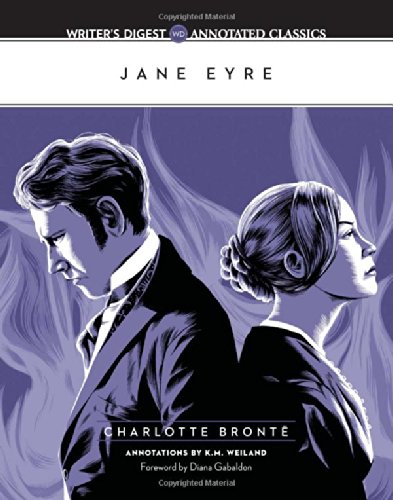
Review of Jane Eyre: Writer’s Digest Annotated Classics by K.M. Weiland

I read Charlotte Brontë’s Jane Eyre for the first time when I was in high school. At the time, though I enjoyed it, I wasn’t yet reading with the critical mind of an author. I wasn’t reading for craft.

The second time I encountered Jane Eyre, I was in university and, having read it before, it was one of the books I set aside from my massive stack of reading. I managed well enough in the course and placed the book on my shelf.

Years later, I read the book a second time. Though I was a writer, and published, it was as a poet, and again, I read for enjoyment rather than for craft.

Now, I read for craft and I find I mentally dissect books as I read them. I don’t mind knowing the ending, and in fact, I often flip forward in a book. Rather than spoil the reading experience, knowing the climax allows me to see more clearly where the author has foreshadowed events.

I can see the structure of a novel like a glowing thread. Here is the hook, the inciting incident, the first major plot point. Reading for craft is more enjoyable for me than reading for pleasure.

It’s like daily writing practice. Once you start down the path, it’s hard to stop, and, after a while, you no longer want to.

K.M. Weiland and her blog, Helping writers become authors, have been instrumental in my development as a reading writer.

You could say I’m a groupie, if there is such a thing. It’s a bit more than being a fan. I share nearly all of Katie’s posts. I want all my writer friends to benefit from her insight and technique.

So, of course, when Katie emailed me and asked if I would mind reading and reviewing her upcoming book, Jane Eyre, annotated with an eye to technique I instantly agreed.

Onto the review . . .


What Amazon says:

AnnJaneEyreCover

“I am no bird; and no net ensnares me; I am a free human being with an independent will…”

One of the most sweeping and enduring novels in English literature, Charlotte Brontë’s Jane Eyre has become a beloved classic and a must-read for fans of period romance. Filled with memorable characters, witty dialogue, emotional scenes, social commentary, and intriguing twists, Brontë’s novel, written in 1847, still has much to teach writers about crafting exceptional stories.

As part of the Writer’s Digest Annotated Classics series, this edition of Jane Eyre features hundreds of insightful annotations from writing instructor and author K.M. Weiland. Explore the craft and technique of Jane Eyre through the lens of a writer, and learn why and how Brontë made the choices she did while writing her iconic novel. The techniques learned from the annotations and accompanying study guide will aid in the crafting of your own celebrated works of fiction.

My thoughts:

I’ve read Jane Eyre a couple of times, once in high school and once in university, but I’ve never read it as a writer.

Weiland’s annotations were an eye-opener.

Initially, I considered a couple of what I saw as lapses on Weiland’s part to be creative or editorial decisions, and there is an element of that present. What I was amazed to discover is that Weiland’s annotative decisions are artful, or perhaps I should say crafty, in a way I never expected.

Very quickly, her annotations have the effect of tuning the reading writer’s eye to Brontë’s creativity and craft. The reader begins to pick out additional examples of the same techniques as they occur, and may even, as I did, page back through the book to see where Brontë employed the same technique in the past and to what effect.

Jane Eyre: Writer’s Digest Annotated Classics is not only a writing craft book, but an instructional manual on how to read critically, as a writer.

Under Weiland’s ever-gentle guidance, the reading writer learns that analyzing a text for craft does not have to be a negative experience nor even an academic one.

Those of us who suffered through textual dissection in university will be grateful to Weiland for showing us, in the best authorial sense, that analysis can be fun, and even exciting, as our minds race back to our own works-in-progress to apply lessons learned.

On that subject, the worksheets in the back are, in my opinion, worth the price of the book. Covering setting, character development, structure, indeed, every aspect of writing a novel, Weiland asks questions, assigns tasks, and refers back to Brontë’s work if we need a little help figuring out how to apply the technique in our writing.

This is a top-notch writing craft book and a spectacular start to a new series for Writer’s Digest. Diana Gabaldon’s introduction doesn’t hurt either 😉

My highest recommendation.

My rating:

Five out of five stars.

About the Author:

KMWeilandLooking-Back

K.M. Weiland is the internationally published author of the Amazon bestsellers Outlining Your Novel and Structuring Your Novel, as well as the western A Man Called Outlaw, the medieval epic Behold the Dawn, and the fantasy Dreamlander. When she’s not making things up, she’s busy mentoring other authors through her award-winning blog HelpingWritersBecomeAuthors.com.

The next chapter: May 2014 update

This is going to be a short update.

May's Word Count

All of the new words I produced this month were from blogging (7503), even though I didn’t blog for a whole week because of chaos. It was good chaos, but nonetheless.

I worked on revisions for the short story I submitted to Bastion Science Fiction Magazine, “The Broken Places,” at the beginning of the month, but that was actually trimming and, just for sanity’s sake, I’m not counting negative words.

By the way, the story is now in the June issue, available online here: Bastion Science Fiction Magazine. You can also get a single issue through Amazon, a subscription through Weightless Books, or just donate to a cool publication.

*Hint, hint. Nudge, nudge. Wink, wink.* Bastion is also a great place to submit if you’re into that speculative fiction stuff 🙂

Needless to say, there is much happy dancing on Marttila Drive.

The biggest part of the non-blogging writing work I did was on Initiate of Stone. I executed my plan of going through and eliminating the one character, giving all her important bits and pieces to other characters, and making notes for the revisions. I also went through my novel in reverse order, using Victoria Mixon’s holographic structure.

This is a technique she recommends in her Art and Craft of Story, and after Roz Morris posted that she’s had to draft her scenes out of order for her latest WIP, Ever Rest, even working backwards, I had to give it a try.

It’s a very interesting technique, and allows you to make sure that plot events and foreshadowing are in their proper places. It’s great for consistency too. I caught a few things that I hadn’t taken into account writing forward.

In other news, my adjustable desk is working out great. If you haven’t been following, the arrival of the desk and the necessity of reorganizing my office to suit it was one of the reasons for my blogging vacation. I can stand for an hour and a bit before I have to sit down for a rest. I’m training myself up.

I’ve also purchase a summer membership for the yoga studio I’ve joined, and I’m hoping that the desk and the yoga will help me stave off future back issues.

Totally unrelated to writing, Phil and I had to purchase a new clothes washer this past week. Our’s was pooched. While at the store, Phil decided he also wanted an upright freezer. He was getting tired of losing stuff at the bottom of the chest freezer we had.

So that’s a chunk of change down the drain.

I tried to write a couple of non-speculative pieces this month, and my interest just wasn’t there. I had ideas, certainly, but the one contest required me to write from a prompt, which I’m not overly keen on. I couldn’t find one that really helped me get anywhere. The other would have been a non-fiction piece, or perhaps creative non-fiction, but again, the idea just couldn’t sustain me.

Sad but true. I guess I’m way beyond the SF/F pale. There are worse places to be. Trust me 🙂

Two opportunities came my way this month that I have to share.

The first kind of blew me away. K.M. Weiland emailed me and asked me to read and review her new book, The Writers Digest Annotated Jane Eyre. Of course I said yes! I love Jane Eyre and have read the book a couple of times. Plus, I’m really attracted to the way Katie analyzes a piece of fiction. It didn’t hurt that she said she respected my opinion (head inflating, unattractively).

So far, it’s great, and I’m learning a lot about how to read as a writer.

It’ll be out July 19th. Watch for it.

The second opportunity came in another email, this one from someone I’d recently started following on Twitter. A Rewording Life, is Sheryl Gordon’s project in honour of her mother, and all those afflicted with Alzheimer’s disease.

She’s recruiting logophiles and creative, wordy people of all stripes to contribute a sentence to her book. I did, and my word was psychopomp 🙂 A portion of the proceeds will be donated to Alzheimer’s research. Check out her site. Follow her on Twitter @ARewordingLife.

And here I thought this was going to be a short post 😛 I am a wordy girl!

This month, I’m moving on to work on my other two completed (more or less) drafts as I did with IoS this month. The Canadian Authors Association’s CanWrite! Conference will be June 18-22, 2014. I hope to bring back lots of Writerly Goodness from that event.

I’m going to try to get back into the fiction writing swing of things. Most of my ideas these days are trending novel length, though. Maybe I’ll just finish the draft of Gerod and the Lions before starting another new project. That sounds like a plan.

How are your projects going, my writerly friends?

The Next Chapter