The next chapter: December 2016 update and year in review

My goodness, here we are in 2017 (!) and now it’s time for me to take stock of my year. Did I accomplish what I hoped to at the beginning of the year?

We’ll get back to that in a few.

First, I have to sum up (‘cause there is too much—I live by PB references) December 2016.

I knew when I decided to tackle Wavedancer, the third book in my epic fantasy series, for NaNoWriMo 2016 that I wouldn’t even come close to finishing the draft (it is EPIC fantasy, after all) in November. I was, however, foolish enough to think, initially, at least, that I’d write another 50k words in December and finish the draft by the end of the year.

I should have known better.

This is the fourth year I’ve done NaNo, and my third win. Each year, I enter December in a fog, still half-living in the world of my novel. I work a day job. There’s no way I could keep up the NaNo pace for another whole month.

Accordingly, I adjusted my expectations to 500 words a day and, though there were two days I didn’t write at all and a few assorted low-count days in the mix, there were also five days in which I wrote over a thousand words, so it all came out in the wash.
decemberprogress

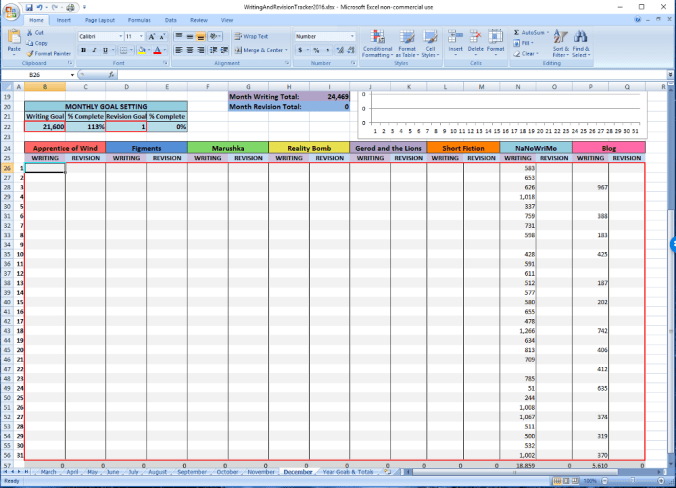
To be more specific, of the 15,500 word goal for the month, I wrote 18,859 words, exceeding my goal by 3,359 words 🙂

Blogging 5,610 words brought my writing total for the month to 21,600 words.

Not 50k, but not bad at all 🙂

Back to my year-end review.

2016 was the first year that Jamie Raintree incorporated separate columns and totals for revision in her Writing Tracker, now called the Writing & Revision Tracker.

Though I’ve looked back at 2015’s and 2014’s trackers, the totals were skewed because in 2014, I didn’t track my revisions, and in 2015, I was tracking my revisions at one counted word for every two words revised. So there’s no real point in trying to compare.

What I set out to do at the beginning of 2016 was to go through all of my written novels to date and start to revise.

I’m happy to say that I accomplished this goal, but things didn’t go quite as I’d hoped. They never do. Quite.

For most of the novels, it was more of a getting reacquainted with the stories and the characters. I didn’t do a lot of revising, but now that I have the lay of the land, so to speak, the next passes will all be more in-depth.

I already mentioned that, having revised my goals post-NaNo, I did write two thirds of Wavedancer. To be specific, I wrote 71,157 words between November and December, and I will continue in that vein until the draft is done in my estimation.

I continued to query Initiate of Stone, but finally got it through my thick skull that it’s not the best project to use when trying to get a deal. So I’m changing gears and going to prepare another project for querying this year. We’ll see how it goes.

How did all this shape up as far as numbers went?

yearend

Of my 138,100 word writing goal, between all projects, I wrote 169,288 words, or 123%. Considering all the revision I was doing, that’s a lovely total.

With respect to revision, I managed 359,114 words of my 375,000 goal, or about 96%.

Some things happened in the year that I didn’t plan on, however.

Though it didn’t happen until July, I wrote a new piece of short fiction. I hadn’t expected that with my focus on the novels. It was a good surprise 🙂

January through March, I participated in the first offering of the Story Genius course created by Jennie Nash and the story genius herself, Lisa Cron. It was something unexpected, but I couldn’t let the opportunity pass. I had to try to make space for the course in my overall plan for the year and ended up making some poor decisions that didn’t serve me well.

While my experience in the course wasn’t, overall, a positive one, I still love the Story Genius method (and book—go get it!) and I would recommend it highly to anyone who can devote 100% of their time to the work. You will reap the benefits.

I just learned, in the most ego-wrenching way possible, that I cannot learn on someone else’s schedule. Especially while I’m working full time. I also made the decision to use Apprentice of Wind, the second in my epic fantasy series, as the project for my work in the course. Story Genius, in the form I took it, was not intended for novels that are already drafted, or for books other than the first in a series. I understand that strategies and approaches for projects of this type have been developed since.

These issues were entirely of my own creation and should not cast any doubt on the excellence of the course, of Lisa or Jennie, or of their dedicated team of editors.

I signed up for K.M. Weiland’s Character Arcs course through the Digital Freedom Academy. It’s entirely self-paced and Kate has loaded her usual extras into the course materials. Her Creating Character Arcs book also came out in the fall, and I definitely recommend both. I am a fangirl, though.

In August, I signed up for another Nelson Literary Agency course on the first five pages. NLA courses are excellence sources of feedback from professional agents who know what makes a successful submission.

At the end of September, I enrolled in a Mary Robinette Kowal Short Fiction Intensive. Blew my mind.

Finally, as far as courses go, I signed up for a course by Kristen Lamb on writing query letters and synopses.

I also tried my hand at #PitchWars for the first time with Reality Bomb, and while I didn’t make the extremely competitive cut, I did have a positive experience thanks to the team who considered my proposal, Michael Mammay and Dan Koboldt. It’s quite an eye-opener, and I’d recommend it to anyone who wants to test the waters with one of their novels.

It was a lot of fun and another pleasant surprise.

As far as conferences and conventions, I attended Ad Astra, The Canadian Writers’ Summit, and my very first WorldCon last year.

I was also pleased to participate as a panellist at Wordstock Sudbury 2016.

And I had two stories published in the Sudbury Writers’ Guild anthology, Sudbury Ink, which launched in November.

Complicating all that, Phil had some significant health issues to deal with at the beginning of the year (now resolved), and, from August through to November, he renovated our living room after work and on the weekends.

We’re still waiting for the last pieces of furniture to be delivered, and he’ll be working on building wall-to-wall bookshelves, as the weather allows (he’s working in the unheated garage) throughout the winter. Pictures will be forthcoming in a future post.

Looking at all of that written out, I accomplished a helluva lot last year.

I think I’m going to have to ease back a bit in 2017, work smarter instead of harder.

Yeah, that’s the ticket.

What are my plans for 2017?

Well, you know I’m not one for resolutions. I have goals that I work steadily toward and amend as required.

First, I’ve nabbed my copy of Jamie Raintree’s 2017 Writing & Revision tracker. I’m setting up the projects in series this year, and will identify different novels in my Ascension series with different colours so I’ll be able to distinguish them and extract the numbers I need to feed my production geek.

I’ll continue to finish drafting Wavedancer, as I mentioned (way) above. At my current rate, I should be finished by the end of February.

Once drafting is done, I’m going to return to revising. I should be able to get through all of the novels in the course of the year. Again, as I mentioned above, I intend these revisions to be more in depth and to address some of the structural issues, as I see them, in the stories.

I’m going to be working with a coach to get Reality Bomb reworked. It’s something else I’m trying in my quest to improve my craft. My hope is that I’ll be able to query RB later this year.

With the short fiction surprise last year, I’ve actually had another idea I want to work on, and some other ideas for revising a couple of my other stories to improve them. Accordingly, I’ve made some room for these projects in my plan.

For NaNoWriMo, I’m going to tackle the fourth novel in the epic fantasy series, tentatively titled Playing with Fire.

I may also have a new, semi-regular writing gig to tell you about. I don’t want to let the cat out of the proverbial bag yet, but if it materializes, you can be sure I’ll let you know all the tasty deets I can 🙂

I’ve already signed up for the Story Masters Workshop in May. Donald Maass, James Scott Bell, and Christopher Vogler are coming to Toronto. This is a squee-worthy score, in my books. It was another opportunity I couldn’t let pass.

When I heard that the No Excuses cruise was going to be in Europe this year and timed to immediately precede WorldCon in Helsinki, I was seriously considering signing up. Unfortunately some non-writerly priorities make both the cruise and WorldCon impractical. Mellie haz a sad.

In fact, I may not attend any conferences or conventions at all this year. We’ll see how things shape up.

The reason for this dialling back is that Phil, who’s in his 50’s now, wants to proceed with renovations to the kitchen and bathroom this year. Though he will continue to do as much of the work himself as he can, these two projects will require a significant financial investment. And we haven’t paid off the living room renovation yet.

We also want to get another puppy. This will depend on whether my employer sorts out their payroll issues and I can apply for another self-funded leave. I will need the time to train our new dependent, furry quadruped. Again, deets will be forthcoming as I can share them.

On that front, if the payroll issues at work are sorted, I’ll finally see my acting pay from mid-February to the end of September last year, less about a thousand dollars outstanding from my last self-funded leave.

We’ve heard that union negotiations have resulted in an offer, the terms of which look reasonable. If we vote to ratify the new contract, it will mean about two and a half years of retro pay and a signing bonus, again, dependent on when the payroll issues can be sorted.

Our car loan should be paid off in late spring, as well, and so, between it all, we’ll have a little extra money to use to pay down our debts.

Phil got a promotion and raise last year from his employer, so we figure this will be the year to finish the renovations.

As you can see, this is going to be a different kind of year, but I’m hopeful that everything will work out.

Besides, come the end of February, it will be the Chinese Year of the Rooster (I’m a rooster!) and I think the powers that be might finally be aligning in my favour 😉

Here’s to a fabulous and productive 2017 for everyone.

Love and light and loads of good words to you all!
The Next Chapter

Tipsday: Writerly Goodness found on the interwebz, Oct 23-29, 2016

The informal writerly learnings are here!

Your #NaNoWriMo round up for the week:

Danielle Daniel discusses her memoir, The Dependent, with the ladies of The Social.

Sudbury’s Poet Laureate, Kim Fahner, writes in defense of school libraries. The Republic of Poetry

K.M. Weiland: how to properly motivate your bad guy. Helping Writers Become Authors

Roz Morris shares some thoughts on book marketing. Nail Your Novel

Robin Lovett explains why deadlines are not your worst enemy. DIYMFA

James Scott Bell: writer, this is your job. Kill Zone

Barbara O’Neal explores writing with the knowledge of time. Writer Unboxed

Dan Blank: dealing with a slump. Writer Unboxed

Karen Woodward writes in defense of constraints.

Janice Hardy guest posts on Writers in the Storm: how filtering point of view affects show, don’t tell.

Marcy Kennedy blogs about conflict.

Veronica Sicoe continues her storyworld design series with transportation technologies.

Chris Saylor returns to Marcy Kennedy’s blog with his monthly editorial clarification post: “I could care less.”

Jamie Raintree shares her path to publication (part two!).

Janet Reid addresses the issue of young writers. “Publishing will break your heart. Writing will fill your heart.” Truer words . . .

Joanna Penn interviews Kristine Kathryn Rusch and Dean Wesley Smith on The Creative Penn podcast.

Tamerra Griffen unpacks a situation of academic racism on Buzzfeed: a professor circles the word “hence” on Tiffany Martinez’s paper and notes “This is not your word.” Bonus: here is Tiffany’s response to the incident (linked in the Buzzfeed article).

Foz Meadows explores the relationship between romance and queerness, and the difference between genre and device. Shattersnipe

Meg Elison: if women wrote about men the way men write about women. McSweeney’s

Katherine Langrish explores death in classic fantasy. Seven Miles of Steel Thistles

Sadness. 2016 has taken so many great creators from us. Sheri S. Tepper, 1929-2016.

Award news:

The Governor General’s Award winners announced.

The OAC presents its indigenous arts protocols:


Joseph Boyden speaks out for the #WeMatterCampaign


Baihley Grandison shares a lovely infographic with untranslatable words from other languages. Writer’s Digest

Rajeev Balasubramanyam states that the Nobel committee got it wrong: Ngugi wa Thiong’o is the writer the world needs now. The Washington Post

Christopher Marlowe will be credited as Shakespeare’s co-author in New Oxford editions of the Henry VI plays. Dalya Alberge for The Guardian.

Connie Verzak considers Tobias Menzies to be the Snape of Outlander. The Daily Record

And that concludes my first and last Tipsday for the month of November.

The next Tipsday will be coming your way on December 6th, after the furor of #NaNoWriMo has subsided.

Be well until then, my writerly friends.

Honour your creative path.

Virtual hugs to the awesomesauce that is you!

tipsday2016

The next chapter: April 2016 update

April was a steady month of revision. I made it to the two thirds mark in Marushka by the time I left for Ad Astra.

Drafting with Scrivener, as I mentioned before, has resulted in more, but shorter, chapters. It’s meant a more casual pace.

Though I missed a few days of revision for the convention, I made up for it by doubling up for a few days upon my return. I should be on track to finish up with this first run through of Marushka by the Victoria Day long weekend (May 21-23).

Then, I’m moving on to the first run though on Reality Bomb 🙂

I’ll probably need a couple more passes for each work in progress before I’m ready to send them out for editing . . . And I have my eye on a couple of people for that. We’ll see how that progresses, but probably not until next year.

AprilProgress1

Total words revised for April: 37,478, just a hair under 100% of my goal

Total words written (for this blog): 10,498, 187% of my goal (!)

I sent out more queries, and received more thank you but no thank you rejections.

Work on the Sudbury Writers’ Guild anthology, which the guild wants to release in time for the next Wordstock Sudbury in the fall, progresses. We want to have the content and cover ready for June. I have two speculative short stories in the anthology (yay, me!).

There are some more opportunities coming up for short fiction, so I’ll try to get something together for those deadlines.

In June, I’ll be heading to the Canadian Writers’ Summit (June 17-19) and . . . my leave for WorldCon has been approved. W00t! So I’ll be heading down to Kansas City in August (17-21). That’s one of the things I have to do now: book my flight. And check with my buddy. She’s moved recently, so I want to make sure she’s still available for visitations. It will be my first WorldCon, so I’m very excited.

I got an early start on next year’s writing events by registering for Story Masters, May 11-14, 2017. Christopher Vogler (The Writer’s Journey), James Scott Bell (author of LOTS of writing craft books, member of The Kill Zone), and Donald Maass (agent to the literary stars, Writer Unboxed member, and author of numerous publishing and writing craft books). Four days of workshops. Yum!

And that’s all that’s new in this writer’s life.

See you Tipsday!

The Next Chapter

Tipsday: Writerly Goodness found on the interwebz, April 24-30, 2016

Another lovely batch of writerly goodness for you!

First some Sudbury poet laureate news 🙂

Adriana Nicolucci interviews Kim Fahner for Our Crater.

More poet laureate goodness: it’s been a busy week at Sudbury’s libraries. Jessica Watts for The Sudbury Star.


K.M. Weiland asks, do you have a writing superpower (and why you shouldn’t)? Helping writers become authors. Later in the week, she helps us understand how to write scenes your readers will rave about.

Roz Morris shares tips on how to blend a parallel, allegorical fantasy plot into your novel. Nail Your Novel.

Bonnie Randall guest posts on Janice Hardy’s Fiction University: battling the block.

Marcy Kennedy returns with part two of her reading like a writer mini-series.

Chuck Wendig: What I’d like to say to young writers, part two.

Leanna Renee Hieber guest posts on Terribleminds: what to do when the bottom drops out.

James Scott Bell guest posts on Writer Unboxed: how to weave a message without pummelling your readers.

Steven Pressfield: I can’t squeeze my theme in! My favourite bit: “This is why writing (or the pursuit of any art) is, to me, a spiritual enterprise. It’s an endeavor of the soul. The stories we write, if we’re working truly, are messages in a bottle from our Self to our self, from our Unconscious/Divine Ground/Muse to our struggling, fallible, everyday selves.”

Later in the week, Shawn Coyne posts this: the designated driver. I’ve been listening to The Story Grid podcast and Tim Grahl has just finished his first draft.

Nina Munteanu explores the writer-editor relationship: editors preparing writers.

Stephen Stratford writes an essay on the dark arts of editing for The Spinoff.

Query Shark Janet Reid sounds off on why you should avoid querying services.

Author brands: Which kind of influencer are you? Carly Watters.

Martha Alderson guest posts on Jane Friedman’s blog and shows us how to use a plot planner.

Jami Gold looks at brain science from the perspective of how we, as writers, imagine.

I may have shared this before, but it’s a good article: how stories change the brain. Paul J. Zak for Greater Good.

This is long as heck, but Tor.com covers (almost) all the science fiction and fantasy adaptations in production and already on the air.

Charlie Jane Anders explores the moment when science fiction diverged from competence porn. i09.

Cassandra Clare created a fantasy realm and aims to maintain her rule. Penelope Green for The New York Times.

The secrets of medieval fonts. Medieval Books.

David Tennant as Puck. Just ‘cause it’s Shakespeare’s 400th 🙂

Shakespeare is dead: six hot takes. Literary Hub.

Rob Brydon shares Shakespearean phrases in everyday use.


The Doctor’s Long Story, a fan video with heart. Radio Times.

John Boyega and James MacAvoy to voice Netflix’s Watership Down. Comic Book Resources.

Nathan Fillion joins the cast of Guardians of the Galaxy 2, with more than just a prosthetic-covered cameo. Peoples Choice.

Electric Lit shares an infographic that explains the real history behind Game of Thrones.

Sarah Mesle reviews the first episode of season six for the LA Review of Books.

Until Thursday, be well.

Tipsday

Three great books on self-editing

(A.K.A. more writing-book porn!)

Since I started serious writing practice and got down to the business of trying to turn my idea into a publishable work, self-editing has been an obsession of mine.  I started out with a good grounding (2 degrees in English), but soon learned that there is always room for improvement.  Always and forever.

When the publishing boom of the 80s and early 90s changed directions, agents and editors state one principle requirement: write a damn good book, and write it well.

Here are, in no particular order, three books that have helped me immensely.  Just ask my Author Salon critique group, I am the queen of nitery-pickery (I’m not sure why I choose to write it like that, but I suspect it might have to do with the character of Rockery Hud-Peck from The Fintstonesthat’s just how my brain rolls).

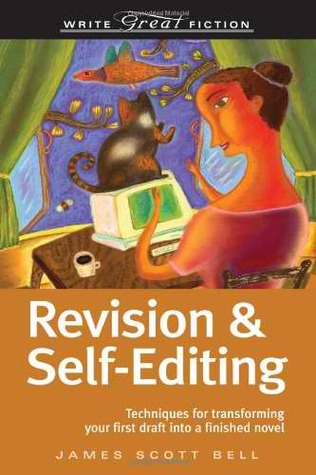
1. Revision & Self-Editing: Techniques for transforming your first draft into a finished novel by James Scott Bell (The Write Great Fictions Series, Writer’s Digest Books, Cincinnati, OH, 2008).

Bell divides his book between self-editing and revision, which he states are two separate processes.  They are 🙂

In his introduction, he references Browne and King’s Self-editing for Fiction Writers: How to edit yourself into print, another of my selections (see below), as well as a slew of writing gurus ranging from Brenda Ueland to Natalie Goldberg and Ray Bradbury.

Bell begins each section by presenting his philosophy of the task, then proceeds through self-editing with various chapters on each aspect of the work (character, plot, POV, etc.), asking probing questions along the way to get the writer deeper into their novel, and offering exercises to assist with the understanding of the element at hand as well as its relevance in self-editing.

When he gets to revision, it’s more about process than elements and analysis, but Bell is equally insightful in his discussion.

Bell is a skilled author and editor.  He writes from his experience in self-editing.  This perspective is what sets my first pick apart from the others.

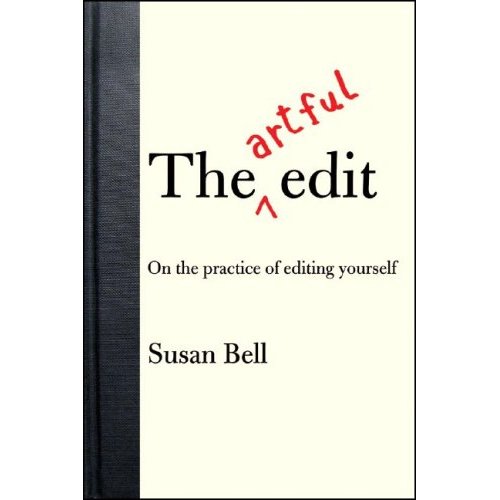
2. The artful edit: On the practice of editing yourself by Susan Bell (Norton, New York, 2007).

Susan Bell is a veteran editor and author, but her authority and perspective derive from the former role.

She breaks the self-editing task into Macro and Micro phases, again, providing examples, checklists, and exercises to deepen understanding. Then Bell offers what she calls her Master Class, provided in the form of experts in different creative fields (photographer, film, etc.) and what each can teach writers about how to make their story come alive.

Finally, she provides an overview of the evolution of editing, fascinating in itself.

Bell applies investigative zeal to her book, and it offers unique insight into the world or authors and editors, their relationships, where one begins and the other ends, and what the writer can do to become both.

3. Self-editing for Fiction Writers: How to edit yourself into print by Renni Browne and Dave King (Second Edition, William Morrow, New York, 2004).

First published in 1994 by HarperCollins, Self-editing for Fiction Writers is seen by many as one of the definitive works on the subject.

As with the James Scott Bell’s book, Browne and King’s breaks the task of self editing into its elements (characterization, dialogue, voice, etc.) devoting a chapter to each with examples and exercises.

One thing that I appreciate is the first chapter: Show and Tell (emphasis mine).  The point is made, and I fully agree, that while the writer should endeavour to show, that there are some places in your novel where telling is not only appropriate, but necessary.  It is the skilled writer who knows the difference and knows what technique should go where.

I also enjoyed the collaborative tone of the book.  When the authority is identified by “we” and not “I,” something rhetorical and clever happens: readers begin to feel that they are a part of the illustrious editorial team that wrote this book.

It’s an inclusive way of writing that empowers reading-writers to believe in their ability to self-edit.  The doors of the country club have opened, my friends, and we have all been invited in for drinks 🙂

The Wordsmith Studio Goodreads group is currently reading this book and it’s been a wonderful opportunity for me to get reacquainted with some old friends.

I recommend all three books highly (not to show favouritism or anything).

Do you have any books on self-editing that you would recommend?  Share their titles and maybe a few choice words of review in the comments so everyone can benefit from your experience 🙂

Writerly Goodness is calling it a night.

Will the third draft be the charm?

Nope.

I finished the second draft in September 2009 and devoted some time to writing other things.  I entered a few contests, but was unsuccessful.  In December, I printed everything out and began to reread, make notes, and chart things out as before.  I invested in a bulletin board, pinned all my bits of paper to it this time and had a really good look at the structure.  The puzzle still wasn’t together in the right way.

More changes.

Without the prologue and the framing pieces, nearly 100 pages disappeared from the manuscript.  Third time through, I cut mercilessly, and though I also wrote considerably to add to the novel, the net reduction was over 300 pages.  I was now below the 1000 page mark, an accomplishment in itself.

Finished in October of 2010, I was feeling fairly good about this draft.  Once again, I turned my attention toward writing other things and once again submitted a few short stories. Unsuccessfully.

I decided that I would attend the 2011 CAA CanWrite! conference and booked a 20 page manuscript evaluation.  Though the conference wasn’t until May, I started reading and making notes all over again.  This time, I played with POV.

I had the first two chapters revised by the time the conference came around.

What I learned:

  • If the changes that occur as you revise are substantial, then you still have work to do.
  • The value of a bulletin board for structural rework is immense.
  • Always have backups of the work.
  • Prologues and framing pieces are about telling.  Consider carefully.

Books on editing that have been helpful: