Once again, here’s some November catch up displaced by other priorities.
On November 6th and 7th, I travelled down to Humber College in Etobicoke (Toronto) to attend the How to get published workshop Hosted by Cythia Good and Jennifer Murray.

About the presenters: Cynthia Good is the former president and publisher of Penguin Canada and current director of Humber’s Creative Book Publishing program. Jennifer Murray is the former director of marketing at Penguin and vice-president, marketing at Kids Can Press.
As with any of my transcribed sessions, discretion is advised. I fully acknowledge my humanity and there may be errors. If you see any, please be kind enough to let me know so I can make corrections, post-hasty.
You can’t make a living creative writing alone. (Mel’s note: It is possible to make a living writing, even in Canada. I know several people who do it, but it usually involves a fair amount of risk that most of us are not prepared to take. Do not lose heart if it is your goal to quit your day job. You just have to plan carefully and understand what level of risk you are comfortable with. As ever, do your research. /end rant)
It’s a brave new publishing world since the advent of digital publishing.
Publishing used to be a paternal system. Now it’s more like a partnership. Much more business and marketing knowledge is required of the average writer.
There have been a few big sea changes in the publishing world.
Two years ago Random House and Penguin merged (Mel’s note: officially, it’s Penguin Random House, or P/RH, but I still like Random Penguin). It’s a 51% to 49% balance of the controlling interest in the company and a shift from primarily German to primarily English oversight.
More recently, HarperCollins (HC) announced that it would be shutting down its Canadian distribution centre. This will mean the layoff of 120 people including the former president of sales, distribution, and administrative finance.
What does this mean for HC? They bought Harlequin last year. Another merger of sorts.
Another recent bit of news is that the government has disallowed new foreign publishers to set up operations in Canada. This is affecting Simon & Schuster (S&S) and their imprints, resulting in the departure of several key employees.
A Canadian publishing company that started up eight months ago may not be able to make it in this increasingly hostile publishing environment.
Will we see a HC and S&S merger?
The thing about mergers is that in order to support their infrastructure, publishers depend on authors whose sales will finance that support. Midlist authors are being dropped. Fewer chances are being taken on new authors.
These authors are going to small and boutique Canadian publishing houses.
In Canada, a bestseller is about 5,000 copies. Really, if you take into consideration returns, the print run should be anywhere from 7,500 to 10,000 copies and at least 5,000 of those must sell. 5,000 is the break-even point.
Why go for a traditional deal?
If you write non-fiction, there’s still money for public speaking. Though marketing and promotional budgets are disappearing, there is still some money to be had.
Traditional publishers are also branching out into digital. Hazlitt is an online magazine put out by RH.
They’re also getting into providing author services. Author Portal, through RH again, is much like Kobo Writing Life and offers similar metrics. Penguin bought Author Solutions (Mel’s note: BOO!) because selling author services ala carte is more lucrative.
Marketshare by format (Canada)
- 18% ebook (24% in the US)
- 58% paperback
- 24% hardcover
Booknet keeps the statistics and only publishers and booksellers have access to that.
Ebooks have hit a plateau and are expected to hold. Pricing is not expected to hold, however.
Scribd, through HC, is billed as the Netflix for books. Amazon also offers a subscription-based service (Kindle Unlimited) whereby you can loan unlimited material.
In general, Amazon sells ebooks at a low price. Print prices are also falling.
Publishers in Canada can’t compete and can’t survive without government grants.
Three years back, in the battle between what was then the Big 6 and Amazon resulted in an Amazon win.
In part, it comes down to discoverability. How do readers find their books?
The traditional path between author and reader: author -> agent -> publisher -> distributor -> bookseller -> reader.
Now authors can go directly to the reader.
There are also book apps. Apps based on popular books. No one is making money on boo apps yet.
E.L. James’s success led to trends in erotica. Young adult and new adult are still strong categories.
Wattpad is a Canadian company and you can post your novels on there, chapter by chapter, for free. You can get great reader feedback that way. There are no stats currently on how releasing material on Wattpad may affect sales of ebooks or print books later on.
Of the Big 5 publishers, Canadian authors have access to three:
- P/RH – both still take submissions seperately for the main publisher and all imprints. RH has Vintage, DoubleDay, Knopf, McClelland and Stewart, Tundra, etc. Penguin’s imprints include Viking, Allan Lane, Hamish-Hamilton. Collectively, they publish 100-150 books annually.
- HarperCollins, which has recently acquired Harlequin.
- Simon & Schuster, though they are, as mentioned, in the midst of transition.
There’s also Scholastic. They’re US-based, but Canadian authors can access them.
Small or independent publishers
- Dundurn in Hamilton. Their focus in on history. They are in growth mode.
- ECW publishes everything.
- ChiZine is a niche publisher of horror.
- Bundoran and Edge Science Fiction and Fantasy.
Micropublishers, or boutique publishers
- Biblioasis
- Gaspereau
- Freehand
- Goose Lane
- Pedlar Press
- Bookthing
- Tightrope
- Insomniac
- Mansfield
- Groundwood
- Pyjama Press
- Second Story
How do you choose?
If you aim for a big publisher, you will usually get a better deal.
With smaller houses, you get more attention and they will take more risks on new authors. Smaller presses are more agile and have specialties.
Editors
It’s a matter of match-making. The editor needs to make money for their publisher. They have a lot to read and a lot of work to do for their current clients.
Make sure your first page is memorable.
A well-written book with excellent sales can make an editor’s career. They receive bonuses based on sales, awards, and word-of-mouth (reviews). They usually have “stables” of writers.
They curate their authors’ best work.
Agents
Do you need one? For the big publishers, yes. The best way to get an agent is to get a publisher (ironic, isn’t it?).
You can approach editors directly. They’re always looking for new authors.
Think about why you want an agent. They can offer:
- Emotional support
- Editorial support
- Career counselling
- Access to big publishers
- The ability to negotiate a good deal
- Contract review
- Interpretation of your royalty statements
- The ability to negotiate for marketing budget or cover input
- Advice on next books
For all this (sometimes more, sometimes less) they get 15% of every sale. Foreign rights, television, movies, audio, etc. (all subrights) generally demand 20%.
Agencies:
- Westwood Creative Artists
- Cooke Agency
- Transatlantic Literary (primarily children’s)
- Anne McDermid
- Helen Heller (commercial)
- Rights Factory (experimental/literary)
- Rick Broadhead (practical/non-fiction)
- PS Literary
- Beverley Slopen
Always check the agency’s submission guidelines.
Other resources that might give you additional information on agents are the Association of Canadian Publishers and the Writers’ Union of Canada.
Make sure that your manuscript (ms) is complete and polished. N.B. Non-fiction should be queried with a proposal.
Why might you not want an agent?
- Control over your career
- Direct relationship with editor or publisher
A Baker’s Dozen (things to do before you query)
- Perfect your manuscript
- Get feedback
- Attend writers’ workshops and courses
- Hire an editor (freelance). N.B. Humber is launching its own Publishing Services.
- Submit to journals and magazines
- Research and submit to competitions
- Attend conferences or conventions
- Volunteer for or attend literary festivals like Word on the Street (WotS)
- Read
- Get to know local bookstores and librarians
- Have a presence on the internet
- Be prepared to give it away.
- Learn everything you can about publishing (Publishers Weekly, Quill & Quire)
Preparing to write your query
Research your comparatives/competition. Market research.
Be professional.
Submit to multiple agencies. Have your A list, your B list, etc. It’s also good to identify what you’re not interested in.
Have a strategy.
Query letters
Start with the story. Make it compelling. Get to the facts (word count, genre, etc.) at the end.
- Introductory paragraph – if you have met or been referred to the agent. If not, show your research. Why do you think you’ll be a good fit?
- Pitch/short synopsis – be as interesting as possible. Don’t give away the ending.
- Comparables – be realistic.
- Biographical info – keep it relevant.
- Closing.
Agents will not appreciate it if you do not state the word count, call your book a “fiction novel,” use poor spelling, and/or poor grammar.
Self-publishing
This is not new. Virginia Woolf and Walt Whitman self-published.
Keep in mind that for every Hugh Howey there are thousands of self-published wannabes. Only 400 out of every 1.5 million books published sell more than 100 copies.
Consider your motivation. You may be:
- An oft-rejected writer (this doesn’t necessarily mean your book is badly written, but consider the possibility)
- Someone who wants to establish credibility
- Someone who wants to help others
- Disappointed with traditional publishing
- Interested in establishing a legacy
If you self-publish print books, you generally need as many as 2,000 books for distribution.
Advantages
- Certainty/total control
- Speed to publishing
- Increased income
Disadvantages
- Up-front costs
- No advances
- Time consuming
- Marketing and promotion are entirely on you
- Distribution
- Liability
- Access to prizes and grants
Terry Fallis states he spent $1,400 for editorial review, cover layout and $2,000 for additional editing.
Use Wattpad to get reader feedback.
Use Kickstarter or Indie-go-go to fund your publication.
Check out James Altucher’s blog. Start with this post on Publishing 3.0.
Be prepared to become an authorpreneur.
Consider partner publishing with a company like Iguana Books.
As I said at the outset, my notes are not complete. I can’t write down everything said in the course of a day and a half. We also wrote query letters and critiqued them in class, as well as learning how an agent sells your book to a publisher. We also went over non-fiction book proposals, which I chose not to share with you here. There was a lot I couldn’t include.
That was the first day and a half. The last half of the second day was given over to Jennifer Murray to discuss marketing and promotion.
I’m sorry, but I didn’t take notes for the marketing piece.
You’ll have to register for the next session if you want to find out about that 😉 I’d recommend it if you’re in the Toronto area.
And that’s it for Writerly Goodness tonight. Toddling off to Bedfordshire.
 I participated in the author readings at noon, attended the genre fiction panel at 1 pm, volunteered at the indie book table until 4 pm, and then caught the graphic novel panel.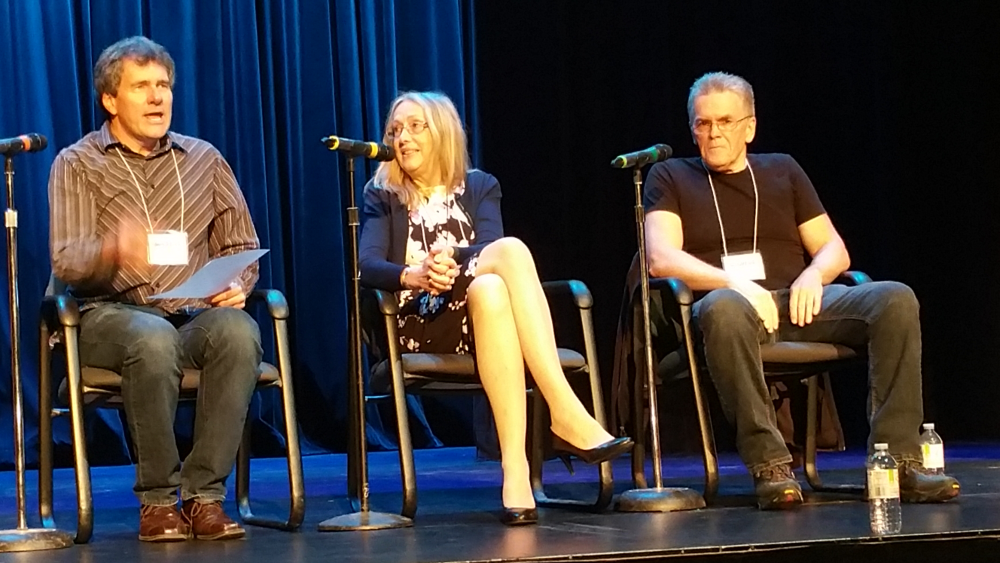



 Always Looking Up