This was a fun panel with an author, an agent, and two editors. They took us through the publication process at each stage, author, agent, and editor explaining how their part of the puzzle looks. Then they fielded questions.
I’ve attended panels before that featured all publishers, or all editors, or all agents. While informative, how everything dove-tailed was missing. Occasionally, panelists might say that they couldn’t comment or speculate on what others in the process might do or experience.
‘Twas excellent.
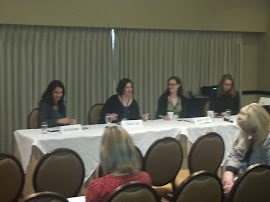
The behind the curtain panelists
Panelists: Emily Ohanjanians, editor with Mira Books, the commercial fiction imprint of Harlequin; Eileen Cook, author of YA novels with Simon & Schuster and HarperCollins; Rachel Coyne, agent with Fine Print Literary; Sara Sargent, associate editor with HarperCollins’s children’s imprint, Balzer & Bray.
EC: We’ll start with the author’s search for an agent. First you have to understand what an agent does. Most are busy with their current authors and are not actively looking for new authors. Do your research to find the best fit. Newer agents will be more available. Ultimately, it comes down to personal taste. One agent may not like your voice or style, but another might love it.
RC: I receive 150 to 300 queries per week. It’s impossible to respond individually. When I started, that was my intention, but it just can’t be done. Agents get rejected too, by editors. There’s a certain disappointment when another agent snags an author from you, especially one that receives an award or does really well. After I’ve agreed to take on an author, we have a one on one call to discuss next steps. There is a two page author agreement. It’s not a contract per se. Standard percentage is 15% for domestic sales and 20% for foreign, TV, film, and other rights. Most houses have one agent who is dedicated to subsidiary rights. Once an author has signed on, the editing begins. This could mean several rounds, back and forth. Then the agent will submit to her first round editors. Usually these are people the agent has an established relationship with. Sometimes, if several editors are interested, an auction takes place.
SS: At HarperCollins, there are several meetings, one with the acquisitions team during which a profit/loss statement is generated. The agent is advised of the proposed deal, and negotiation begins. At the acquisition meeting, everyone sees the property.
EO: It’s the same at Mira, the meeting with the editorial director is followed by the acquisition board meeting, the agent is informed of the proposed deal, and negotiation follows.
Q: Once the book is sold, what happens?
RC: I would make recommendations to the author based on what they hope to achieve. Usually there is a year between the deal and the publication date, so there is time to implement an author web site or blog, develop social media following, or begin on the next book. The contract can take anywhere from two weeks to nine months to hammer out. An advance might be $10,000. Royalties could be 10%. First you earn back your advance, then you begin to receive regular cheques.
Q: How does the editor work with the writer on further revisions?
EO: When the launch date is decided upon, it might be a year, or a year and a half, we work backwards, get our endorsements in place, schedule substantial, line, and copy edits, proofing, typesetting, cover art, blurbs, back cover copy, determine the meta data for online sale.
Q: So what happens when you write an editorial letter for the writer, and the writer refuses to budge?
SS: Usually I’ll read and mark up the copy, then prepare a three to ten page editorial letter for the author. The author will usually sit with it for a few days, then I’ll meet with the author by phone and the author will indicate what they are willing to do and what they are not. The biggest issue that comes up is characters that are not received as the author intended. The next is the market: similar books may have tanked for specific reasons that have nothing to do with the quality of the writing.
EC: We work together to reach a solution. e.g. I hate the character! My character is brilliant! How do I show it?
RC: The biggest asset a writer can have is the willingness to be edited. I like to meet annually with my authors to find out what their plans are for the coming year.
Q: Describe your ideal author.
EO: An insecure author can become overwhelming. 20 emails a day can be draining. An author coming out of another house might cause me to do some research. Were there reasons for this?
EC: You have to own your neuroses as an author. You must be open to communicate.
Q: If your author had to choose between a Canadian and American publisher, which would you recommend?
EC: Commission can be less with a Canadian publisher. Most American publishers will include Canadian distribution. The deal is for North American rights, not Canadian or American. Canada is not considered a foreign market. Really, your agent is a match-maker, trying to find the best possible home. It used to be that agents had to be in New York, now they can be anywhere.
RC: There is a right agent and a right publisher for every author/project.
Q: What about e-rights?
SS: They are considered subsidiary rights.
Q: How often do you have to meet in person?
RC: Never if you don’t want to or can’t afford it.
Q: What is your education/experience?
SS: Placement with Disney/Hyperion, BA in English, then an MA in Journalism.
RC: Writer’s Digest Books, Donald Maass Agency, Forward Literary, then Fine Print Literary.
EO: BA in English literature/linguistics, job in finance, but I always wanted to be an editor. I started working for magazines, then got on with Harlequin, took some courses from EAC and Ryerson in editing, and at every stage, working up through the ranks.
Q: What’s the difference for non-fiction?
EO: It’s based entirely on platform. Not voice. Not skill. Who’s the audience for the book?
RC: Blog-books have been happening recently as well. Narrative non-fiction works the same as fiction.
EC: With a novel, you have to have the novel completed before you can query.
RC: With non-fiction, a proposal and platform is often enough.
Q: What should your word count be, and do you talk about series?
SS: Word count isn’t critical. I’ve never rejected a book on the basis of length. You should concentrate on one novel per query and treat it as a stand-alone. It’s important to have a vision, though of how your writing future will look.
RC: We’re not looking so much at the concept, but the creativity of the author.
SS: With children’s literature, you have to be aware of the market.
EC: Not many YA novels are 300,000 words long, but submitting a 20,000 word novel would be too short.
Q: Can an author ever go direct to editor?
EO: If I have the time, I’ll always look. Why not? I could find a gem.
Q: When do you know when to stop editing and query?
EC: Write the best book you can. No matter what you write, you can find an association (RWA, SFWA, etc.). These associations will often offer editing services, or members can serve as critique partners and beta readers. When you do query, send out five at a time.
Q: Is a rejection a burned bridge?
RC: Not necessarily. If you revise and resend, there’s a chance that the agent will not remember, but if they do, they are not likely to give you a second chance. It’s better to try a new project.
Q: How long is it for an editor to respond to an agent?
RC: Between three months to a year sometimes, but the average is three to four weeks. If there is a closing date or an auction, all interested parties are called.
Q: Do agents want to have input into the author’s platform?
RC: It’s more a matter of making suggestions, showing examples.
SS: In concert with publicity and marketing, publishers may advise. But if you’re not comfortable on Twitter, you don’t have to use Twitter.
EC: Some agents will advise you with regard to your career in general. Some agents will never go there.
Q: Have there been books you just couldn’t sell?
RC: Every agent has a book that they felt passionate about, but just couldn’t move. I make every effort to sell every project, but between 60% and 90% of books signed actually sell.
EC: Hopefully you have more than one book in you.
EO: It’s often the second submission that sells.
RC: Some projects are bought on voice alone.
Q: If you’ve self-published, is it a deal-breaker?
RC: Only if it’s the self-published effort and it’s not sold well. If it’s a different effort, no problem.
EC: They call us hybrid authors now.
Q: How about posting your work in progress on the internet?
RC: It depends on how much of your novel is out there, and at what stage. If most of the novel is already “published,” I probably wouldn’t take it. Do not blog your book.
Q: Can you self-publish one book and e-publish another? Specifically, the rights on my first novel are reverting to me and I’d like to self-publish. Meanwhile, I’m in negotiations for my second book.
EC: If your first book is erotica and your second is YA, then they’re not likely to get in each other’s way.
EO: If both books are comparable, you could offer the self-published book at a deep discount.
RC: It would be wise to check with the publisher about to put out your second novel if self-publishing your first is okay.
EO: Be up front with all interested parties.
This brings us to the end of Friday’s sessions. I’ll have the Friday night and Saturday morning keynotes before moving on to Saturday’s sessions. We’ll see how far I get tonight. I’ll be travelling home tomorrow and won’t finish off whatever remains until Tuesday.

 Always Looking Up