Mage or magus, magi or mages?

Last time on work in progress: The dull detailing of days, weeks, months, and years in Tellurin.

As promised, here is my theory of magic in Tellurin.  It actually starts about thirty years ago with me in confirmation class …

You may think confirmation a strange place for this, but I started theorizing things that had nothing to do with Christianity.  And you know what?  I was indulged, even encouraged by my instructors, two wonderful, open-minded people.  Shout of gratitude going out to Rick Shore and Marg Flath!  For them, it was healthy to question, explore the questions, and come to your own conclusions.

One of the things I theorized about was the nature of energy, consciousness, the soul, what might be termed miracles, and what might happen after we die … to me it was all connected.

In science (incidentally one of my confirmation instructors was also my grade 9 and 10 science teacher) we were learning that matter and energy were the same thing.  We learned about the laws of thermodynamics, including: energy can never be created or destroyed, but only changes form.

So to me, it wasn’t that far a leap to think that if we, humans, were made of matter (therefore energy) that thought, the soul, and all the wonderful things that made each of us uniquely ourselves was a kind of energy.  It couldn’t be destroyed when we died, it could only change forms.

So how does this relate to Tellurin magic?  Well really this species of thought contributed to both the magic and religious systems of my world, but here’s what I drew from my theorizing about magic: it could exist, just like any other kind of energy.  It would all be a matter of trial and error to figure it out.  It would be a kind of scientific experiment …

You may remember from my post about the cosmology of Tellurin that my interpretation of the big bang was that something within the homogeneous whatever that existed before the universe (I called it the One) recognized its independence.  In that moment, everything else within the One had to become distinct.  Boom!

But in my universe, not all kinds of energy are distributed equally.  The thing that recognized its independence (what became Auraya) carried more than its fair share of a specific kind of energy, and Tellurin, the planet, bore an equivalent amount.  That’s why the world has its own spirit and consciousness.

So Tellurin is a magic-rich world, and potentially any of the beings living on or in Tellurin can access that energy if they have the talent.  Talents are another group of senses that allow their possessors to recognise source and influence or manipulate it in specific ways.

Aside from Auraya, Tellurin, and the other gods of the world, everything holds its own share of the source of all things, or, simply the source.  In the people of Tellurin, this energy is bound to the spirit or soul.  It’s part of what makes them what they are.

When the primitive Tellurin first discovered their talents and their ability to manipulate the source, they called themselves sourcerors.  They learned in communities, experimenting with their various talents and expressions of source, categorizing and naming them as they went.

Along came a man named Halthyon Morrhynd.  He was actually an eleph from Elphindar, crossed over into Tellurin through one of the Ways Between the Worlds.  Incidentally, these Ways are just another expression of the source in Tellurin, a natural phenomenon.   If worm-holes could exist and function in a stable manner without affecting the matter and energy around them, that’s what the Ways would be.

Halthyon, as I’ve mentioned in a previous post, is a bit of a megalomaniac.  In Elphindar, he’d tried to stage a coup against the anathas, or council of elders, and institute a kind of magocracy.  The eleph called source in their world the kaides esse, or the powers that be.  Sourcerors were called kaidin.

The result of Halthyon’s attempt to wrest power from the anathas was that he failed and was ostracized, or made shuriah.  The eleph were the only people in Elphindar.  Ostracism was generally a death-sentence.  Elphindar has no gods either, only the kaides esse, and those in significantly lower amounts than source in Tellurin.

Elphindar would not satisfy Halthyon’s ambitions, but once he found the Way and made it through to Tellurin, Halthyon saw this new world as a paradise.  He instantly made the connection between the source of all things, the kaides esse, and the gods of the new world.  He understood that if he could find a way to contain enough source within him, that he could transcend mortality and become a god himself.

The source existing in the things around him wouldn’t do.  He’d have to expend nearly as much source in the destruction of inanimate objects as he would receive from said destruction.  The gain would be negligible.  The people though, them he could use.

So he found the fledgling sourcerors of Tellurin and taught them.  In time, they “grew ripe” and he was able to “harvest” them by killing them and stealing the source carried with their souls.  The way to do this, was to call the deceased sourceror by name, and thus summon his soul.

Sourcerors began to take source-names, secret names to prevent Halthyon from learning the name that could call their soul and source to him, but Halthyon was skilled at telepathy, and could discover their secrets.

As he waited for some of them to ripen, other sourcerors grew powerful in their own rights, learned what he was doing to their fellows, and mimicked the practice to accrue their own stores of source.

The brothers Kane and Jareth were two of these surprising sourcerors.  Kane was as obsessed with gaining power as Halthyon, but he was also concerned that Halthyon would murder him before he could get very far, so he started to develop defences, the chief of them being binding.

His early experiments were with animals.  He bound his soul and source to a creature, and if he was killed, so the theory went, his soul and source would remain safe in the beast.  These he called familiars.  Kane was a good scientist, and decided to test his theory after sharing it with some of his fellow sourcerors.

Unfortunately, the consciousness of the animal interfered with that of the bound sourceror, and the animal hadn’t the capacity to use source, and so quickly fell prey to the predatory sourceror.

His next experiments involved people who had no noticeable talent.  These he referred to as homunculi.  Sadly the same thing happened with them as did with the animals, and these too, he discarded as a failed experiment.

Then he started playing with constructs, which he called golems.  These experiments were never wholly successful.

In the meantime, Kane’s brother Jareth, whose primary talent was geomancy, or manipulating the earth element, conducted experiments of his own.  He decided that inanimate objects would make better subjects for binding.  There would be no consciousness to interfere with the bound sourceror’s, but this would necessitate having a partner who would be able to release and restore the sourceror after the death of his or her body.

Jareth’s experiment was much more successful than Kane’s and was widely adopted, even by Kane himself, but no solution was perfect.

Sourcerors like Halthyon and Kane, after killing another sourceror, would search out the partner, and torture them until they revealed the secret of unbinding their victim.  If the partner was stubborn enough, or faithful enough, to keep the secret, then they could simply be killed.  Although the murderer would never benefit from the source of their victims this way, their victim would forever remain trapped in whatever object they’d bound themselves to.

This is eventually what happened to Jareth.  Halthyon slew him in sourcerous combat and went in search of his partner.  Kane got to her first.  Laleina was not only Jareth’s binding partner, but they were also lovers, a relationship that Kane always envied.

Laleina wasn’t cooperative and would not divulge Jareth’s secrets.  Kane knew, to his regret, that he could not keep her alive.  Halthyon would eventually come calling and Kane wasn’t ready to face the eleph.  In a twisted bit of experimentation, Kane bound Laleina’s soul and source to one of his failed golems.  He’d noticed that metal tended to dampen the effect of source.

And so Laleina was trapped in the thing that would eventually become the Machine.

The sourcerous world continued along the same violent lines for centuries, but Auremon eventually decided that he couldn’t let things go on this way.

His idea was to voluntarily surrender his godhood, and his god’s share of source, to Tellurin, hoping that more source in the world would allow Tellurin to even the playing field among the sourcerors, and keep the power-hungry ones from victimizing the rest.

It didn’t work out as well as he thought.  Too close to one of the Ways Between the Worlds, he tore it open and half the population of Elphindar was sucked into Tellurin before the Way could be repaired by Auraya.  The sourcerors didn’t behave any differently, and Auremon had to concede his failure.

The only thing he could think to do, was to teach young sourcerors how to use their powers responsibly.  So he set himself up as a sage in a mountainous island off the western coast of the main continent.  Auraya created a great castle for him there, and eventually all sourcerors found their way to Auremsart.

Auremon taught ethics more than anything else.  It was the sourcerors themselves who thought that if they changed the names of things, that they could change the way people behaved more effectively.  So source became magick, sourcerors became magi, and they instituted a rigorous initiation process that would so instil Auremon’s ethical code into their students that there would be no risk of any of them becoming monsters.  They called their new discipline Agrothe, the followers of the code, in the old language of the land.

They policed themselves too, and started setting up schools of magick in other cities.  Business was booming.  And then Yllel came in disguise and killed his father.  Auremsart crumbled, became the Spire, and two kindly elementals from Elphindar resurrected Auremon and bound his spirit to the stone that was all that remained of his earthly home.

How the Agrothe functions in Tellurin at the time of the novel:

  • As soon as the prospect’s talent begins to manifest, training begins.  This can be anywhere between five and thirteen suns of age.  The prospect becomes an aspirant.
  • This period is one of intense theoretical and ethical training, highly structured, lasting thirteen suns. This phase of training does not guarantee initiation.  If evidence of cruelty or insanity is detected by the Master, the aspirant is taken to a mind-mage, and their talent crippled.
  • The aspirant is initiated.  This phase of the training introduces the initiate to their talent(s) in a gradual, disciplined fashion, and also lasts thirteen suns.
  • The initiate is apprenticed, gains some autonomy and is allowed to experiment in a limited fashion.
  • After thirteen more years, the apprentice could become a master in his or her own right.  If further training is deemed necessary, an interim period of guided practice could be instituted.  The mage operated independently, but under the watchful eye of their master.  This period could also last thirteen suns.
  • At any time, if the student decides, they can withdraw from training, once more having their talent crippled so that it cannot be used in an unauthorized or unethical fashion.
  • This is why most women, wanting a family and life outside of the Agrothe, never make it to initiation.

Aeldred sensed Ferathainn’s potential at the eleph ceremony of Shir’Authe, when she was only a day old and newly abandoned in Hartsgrove.  Her talent was prodigious and he began her training when she was four suns old.

Most aspirants only evidence one or two talents, the rest developing with age and experience.  Most full-fledged magi might have five talents at their disposal, but it will be the one or two that showed themselves first that will be the mage’s primary talents.

Ferathainn possesses aliopathy, or the ability to speak to the spirits of things, which in turn feeds into her talent at evocation and summoning.  She is uncommonly talented in mind magick, able to communicate through thought speech with those who do not share the talent, and can travel in spirit with ease.

Aspirants are not allowed to use their talents prior to initiation, but Aeldred does not want to lose Ferathainn as a student, so he allows the girl latitude.  Besides, mind-magick is not one of his stronger talents, and he cannot prevent her from doing what comes naturally to her.

He does not want to call one of his Agrothe brothers in for fear that Fer will be taken away from him.  Further, he fears reprimand for his unorthodox training methods.  For similar reasons, he has not prevented Ferathainn from becoming betrothed or married.  He feels that if anyone can balance a life of magick and domesticity, it will be Ferathiann.

He hasn’t explained much of this to Ferathainn.  He hasn’t even explained her talents to her.  In truth, he’s a little afraid of what she might become, and that his lenience may lead her to the forbidden ways of sourcery.

She will be the first Agrotha initiated in two hundred suns.  That’s too great a prize for Aeldred to resist.

Next week: Everything little thing she does is magick!

Have a great weekend everyone!
The Initiate of Stone rogues gallery

Previously on Work in progress:  Character sketches part 1: Ferathainn Devlin; Character sketches part 2: Eoghan MacDubghall; Character sketches part 3: Dairragh McKillian.

So the deal is this: as I started to write, all three of the above emerged as protagonists to one degree or another.  Ferathainn remained my primary protagonist, because it was her story that everything else emerged from, and I intend to adhere to that.

Eoghan and Dairragh were strong supporting characters, though, and I felt I had to provide them with antagonists (antagoni?) of their own.

Originally …

The character that became Khaleal was Ferathainn’s main antagonist.  He was the servant of Kane, who is known as The Black King, but Khaleal was only a servant, and acted wilfully and maliciously in Kane’s service.

The initial origins of the favrard people (they can have viable offspring with Tellurin and are therefore not a separate race/species from my perspective) were that they were created, from time immemorial, to be predatory.  Their genetics are dominant, but they needed a non-favrard to mate with, someone who possesses power, and similar physical traits, to reproduce.

Originally, this was the impetus for his rape of Ferathainn, because she was a suitable subject for the continuance of his people.  It was a biological imperative, and eventually, this seemed to me to be too contrived.

Kane was the mastermind behind the war that Khaleal is a perpetrator of, and he experimented on people.  Initially, this was a purely scientific experimentation: how much weight could a healthy specimen hold before his or her strength gave way and she or he was crushed?  How far could various joints be bent before they broke?  Things like that.  Kane was just plain cruel.

Yllel was originally called Greymon, or known to the peoples of Tellurin as “The Grey Man.”  He was the traditional devil figure and tricked people into selling their souls for various dispensations.  He was always imprisoned to prevent him from harming people/destroying the world, but initially his passion for destruction was mindless.  It just was.  There was no reason for his need to bring the world to ruin.

Eventually, I conceived of a way to bring these three villains together when I thought about the deities of Tellurin and its magick system (yes, they’re both coming in future world-building posts).

For Eoghan, Kane and Yllel (as Greymon) were the people he was assigned to defeat because as the Kas’Hadden, it was his duty to protect the world and fight the people who posed a threat to it.  Khaleal would be an obvious antagonist because of Eoghan’s love for Ferathainn.  He wants to protect her.

When I developed Tellurin’s religious system (also coming in a future post), I realized that organized religion would also be an antagonist for Eoghan.

I gave it form in the personages of Archbishop Hermann Manse and High Inquisitor Alphonse de Naude (which I will not be offering sketches of here).  Later, I also instituted a rival religion for the Faithful, the adherents of the Holy Mother Church, of whom Queen Amalthea became the main antagonistic figure.  She does not appear until the next novel in my series though.

The Fathithful could be equated to Christianity in general.  They share the most in common with High Anglican practice, but there are points of divergence.  The Faithful do not really believe in the existence of the gods, but perpetuate belief for the better governance of the people.

The HMC is more of a political body.  They believe in the gods in the clock-maker sense.  The gods set everything in motion, but the Tellurin are the ones who rule the world on their behalf.  Magick and its practitioners are blasphemous.  The Faithful are blasphemous.  Any people not purely Tellurin are blasphemous.  They are looking to foment holy war.

In thinking about Dairragh and his potential conflicts, I decided to make Halthyon into his primary antagonist.  They have a long and strange association.  As I mentioned in Dairragh’s sketch last week, Halthyon enters Dairragh’s life when he is very young.  The sourceror seduces Aline, Killian’s wife, impregnates her, and then leaves.

Not having any knowledge of where her lover went, Aline eventually runs away when Killian realizes that her baby is not his.  Halthyon returns years later and Aline willingly runs away with him, but he is not interested in her, only the child she bore.  Aline refuses to disclose where she left her baby, and dies at Halthyon’s hand.

Halthyon leaves her body for Killian and Dairragh to discover and disappears again.  When Halthyon returns to Gryphonskeep a third time, it is as the captain of a regiment.  Dairragh recognizes him, and tries to kill the author of his life’s tragedies, but only succeeds in setting off the attack, destroying everything he knows and loves.

Dairragh is also at odds with Killian, who, after his betrayal by Aline and Halthyon, becomes abusive and cruel.

When I decided to make Ferathainn and Dairragh half-brother and sister, I knew Halthyon had to be her father.  That got me thinking about how he could also play the antagonist role for Ferathainn …

Raven Margrove is Dairragh’s cousin (born Nicholas de Corvus), and a minion of Kane’s.  He is the one responsible for the destruction of Aurayene, and he leads the largest company of the Black King’s army.  It is his goal to kill King Romnir Raethe and assume the throne of Tellurin.  Eventually he and Dairragh come into direct conflict, but not in the first novel of the series.

The sketches

Name:  Khaleal bin Nasir

  • Birth date/place: 30 suns ago

    Think Oded Fehr, but with auburn hair.

  • Character role:  Secondary antagonist
  • Age:  30
  • Race:  favrard
  • Eye colour:  Green
  • Hair colour/style:  Red, long and wild.
  • Build:  Athletic, 6’ 2” 200 lbs
  • Skin tone:  dark, sun-weathered
  • Style of dress: armour, articulated plate and chain
  • Personality traits:  Khaleal is insane.  The dark god Yllel has insinuated himself into his mind as he has done with all favrard since the race sold their collective souls to him.  Khaleal is an honourable man and tries to be true to himself whenever he can, but the near-constant pressure the god can exert on him has unbalanced Khaleal to the point where he no longer has control over his own actions.
  • Background:  Khaleal was raised by his amah, Illiden, in seclusion and had what would be considered a normal childhood until he came of age.
  • At the age of 12, Khaleal felt the first stirrings of Yllel in his mind.  Over the course of the next months, Khaleal was twisted by the dark god until he was driven to seek out and kill his own mother.
  • After that, Khaleal was Yllel’s slave.
  • He harbours the secret wish to free his people from Yllel’s slavery.
  • Internal conflicts:  Insanity/Yllel.  Tortured by the things Yllel forces him to do.  His rape of Fer is what starts to send him over the edge.
  • When he sees Fer, he feels that she will be instrumental in the defeat of Kane, or Yllel, or both.  Why else would Yllel want to subvert her to his purpose?  He determines to use Fer to achieve his goal (the freedom of his people) if he can.
  • External conflicts: The Black King seeks possession of Yllel’s soul contracts and thus control of Khaleal and all his people.  Khaleal sees this as an opportunity.  Kane will certainly be easier to kill than Yllel, and then his people can be free.
  • Ferathainn wants revenge for the slaughter of Hartsgrove and her rape.
  • Eoghan and Dairragh want to kill him for Fer’s sake.
  • Yllel possesses and tortures his slaves frequently.

Name: Kane

  • Nickname: The Black King

    I picture Kane as Marlon Brando/Kurtz from heart of darkness. Just give him black eyes and pale skin, and that’s pretty much Kane.

  • Birth date/place: Thousands of suns ago
  • Character role: Secondary antagonist
  • Age: Kane’s not even certain
  • Race: Once Tellurin, but years of magick abuse and experimentation have turned him into something else.
  • Eye colour: black
  • Hair: None
  • Build: obese, 265 lbs, 5’8”
  • Skin Tone: White, so pale, it’s almost translucent
  • Style of dress: Immaculate, reflective of his self-endowed title: King.
  • Characteristics/mannerisms:  Perpetually nervous, paranoid, physical tics throughout his body.
  • Personality Traits: Methodical, cruel, patient.  Megalomaniac.  Aristocratic.  In modern psychological terms, he’s a psychopath.  Power and its exercise over others is his sole goal and the only thing that can give him any pleasure.  War and physical violence are beneath him, but he will resort to such methods if required.
  • Background: Kane was once Tellurin, became a sourceror, studied hard and learned all that he could, and then became to experiment with the source, extending his life, becoming something that was no longer Tellurin.  He developed the technique of binding to the point of perfection.  Then he began to cultivate an interest in mechanics.  But to what end to use all of his knowledge?  Kane began to quest for something worthy of his new skills.  The domination of Tellurin seemed to be the logical next step.
  • He battled and slew his fellow sourcerors, gathering source enough to sustain himself and his experiments.  Kane spent the next years experimenting on people, creating living weapons from them that were utterly subservient to his will.  He calls them grotesques.  Everyone else calls them abominations.  He made various artefacts and mechanical weapons by enslaving the souls of other sourcerors within them.
  • Eventually, Yllel found the sourceror.  Kane learned of the god’s incarceration, resources, and desire for revenge.  Kane offered to free the dark god in exchange for a piece of the world remaining after Yllel was done with it.
  • Kane’s true ambition is to free Yllel from the void only to trap him in an even more impenetrable prison: the Machine.  The instant that Yllel made his deal, the idea of the Machine rose into Kane’s consciousness.  He knew already from his earlier experiments that machines naturally dampened the flow of the source.  A maze-like Machine that was carefully sealed to control whatever source it contained could effectively imprison Yllel forever.  Or at least as long as the Machine could be maintained and repaired.
  • He fabricated the Machine from his brother’s beloved, Laleina.  He lusted after her, but prefers her ghost in his machine to any physical form of intercourse.
  • He began to create his “army” of misshapen creatures, once Tellurin, eleph, okante, or whatever other basic material came to hand.
  • All he needs now is control of Yllel’s soul contracts.
  • He plans to take control of the soul contracts, then Yllel himself.  He will not just have a small piece of the playground.  Kane will own the entire thing.
  • Internal conflicts: Fear of discovery by Yllel.  As powerful as he is, the god could still kill him.
  • External conflicts: Yllel doesn’t trust him and can kill him if Kane doesn’t watch himself.
  • Ferathainn, Eoghan, and Dairragh all want to stop the war and prevent Kane from freeing Yllel.
  • Once Kane holds the soul contracts, Khaleal will have to kill him to free his people.  Halthyon wishes to kill Kane because he is an aberration.  Halthyon also sees Kane as one of the impediments to his own goals.

Name: Yllel

  • Appearance: currently formless, but he can appear in any form
  • Background: Created by Auraya and Auremon along with Tryella his sister, Yllel is actually a piece of Auraya.  Inadvertently, the goddess instilled in her son all of her worst qualities.  He too, is psychotic.
  • Auraya, Auremon, and Tryella devoted themselves to Tellurin and its people.  Yllel had no such interest and saw their absence as abandonment, then a betrayal.  He killed his father after Auremon relinquished his godhood and became mortal; he killed his sister, Tryella, when Auraya trapped him in the void.  He’s been plotting his escape ever since.
  • Thought is the only way he can affect Tellurin now, but a god’s thoughts carry a great deal of power.  The Way Between the Worlds that leads to his prison must be opened from the outside and for that, he has recruited Kane.  He uses his enslaved peoples to work his will in the world.
  • Yllel’s goal is to escape the void and destroy Tellurin while his mother watches.  This alone might kill her, but he hopes that she survives so that he can do the deed with his own hands.  He hasn’t given much thought to what he will do afterward, but will likely recreate the world in his own twisted image.
  • Lately, he’s been plagued by visions of a girl.  She has power.  Not a god’s power, but more than most Tellurin will ever have.  He wants to possess her, and failing that, he will destroy her.
  • There is no image for Yllel, because he can look like anyone he wants to …

Name: Halthyon Morrhynd

  • Birth date/place: Thousands of suns ago/Elphindar

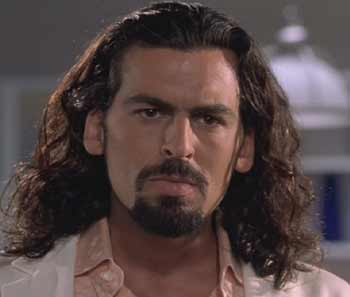
    I think of Halthyon as a cross between Luke Goss as Nuada in Hellboy 2 and …

  • Character role: Secondary antagonist
  • Age: unknown
  • Race: eleph
  • Eye colour: Ice Blue
  • Hair: Beautiful, luxurious, white hair.  Long and flowing.
  • Build: 6” 160 lbs.  Tall, slim, but very strong, though he rarely uses his physical strength.
  • Skin tone:  Lovely ivory skin protected from the sun.  Perfect complexion.
  • Style of dress: Flowing robes, traditional, elaborate sourceror’s garb.
  • Characteristics/mannerisms:  A flair for the dramatic.  He likes to think he is the director of the lives of others.  He’s taken a particular interest in Dairragh.
  • Personality traits:  Confident, quiet, necessarily cruel.  Halthyon takes some

    Harry Lloyd’s Viserys from Game of Thrones.

    pleasure in the work that he does but not from meaningless cruelty.  He also takes care with everything he does.  Meticulous planner.

  • Background:  Much like Kane, Halthyon is a self-made man.  As a child and bearing a name he has since discarded, he suffered heinous abuse at the hands of his father, Galag, who he suspected also killed his mother.  When Halthyon came into his power, he killed his father and determined that no one would ever be able to abuse him again.  His quest for power was driven by this need.  His history draws him to Dairragh, who has also been abused by his father (though not to the same degree, so there is contempt too).
  • Exiled from Elphindar (after a failed coup attempt), he wandered until he found one of the fabled Ways Between the Worlds.  He used it to travel to Tellurin where he found himself a kaidin, or eleph sourceror, in a world rich in the kaides esse (powers that be), and among a people who had great talent to manipulate those powers.  The Tellurin had already discovered and learned to tap the source.  He studied long and diligently and learned everything he could about sourcery in his new home.  Interestingly, as he taught the Tellurin, the Tellurin taught him.  He too, learned about the battle of the gods and Yllel’s incarceration, but from arcane sources (Halthyon is also a bit of an archaeologist).  He, too, was able to prolong his life sourcerously.  Eleph are already long-lived.  He didn’t have far to go to achieve immortality.  The source of other sourcerors and magi is his primary sustenance.
  • Halthyon was present when Auremon sacrificed his godhood and released his source into the world, permanently rupturing the Ways Between the Worlds.  He watched his people spill over into Tellurin in terror.  He watched them battle with the Tellurin and withdraw into the Deep Forest.  Halthyon watched as Auremon became a great teacher among mankind.  Halthyon watched as Yllel approached his divine father, disguised as a student, and murdered Auremon.  He watched as Yllel slowly gathered his power and then struck out at his grieving mother and sister.
  • Halthyon observed as each act of godly creation or destruction diminished the gods.  He began to study the ancient philosophers, some of whom posited that the Gods would eventually become as mortals, and as mortals became more powerful, they would eventually become gods.
  • Halthyon believes that he is destined to become one of these new gods.
  • He will be rid of Kane, the aberration, take Yllel’s power for himself by using Kane’s Machine to siphon off the dark god’s power, and then he will ascend.
  • Halthyon also suspects that Ferathainn, as his daughter, could become a new god and he wishes to have her by his side.
  • Internal conflicts: Conceited, a bit of a megalomaniac.  Thinks entirely too much of himself.
  • He has to be careful to maintain his deception.  He has to appear a willing and devoted servant of Kane and Yllel.
  • Childhood molestation by his father resulted in Halthyon committing patricide and permanently messed him up.
  • External conflicts:  Dairragh wants revenge.
  • Everyone else believes he is working for Kane to help conquer Tellurin and free Yllel.  When the truth is revealed, however, even Kane and those who see him as an ally will be his enemies.

Name: Raven Margrove (Nicholas de Corvus)

  • Date/Place of birth: 35 suns ago in Aurayene.
  • Appearance: Black hair, brown eyes, otherwise, he and Dairragh could be brothers
  • Background: Raised in a family that was devoutly Faithful (a de Corvus was the first Kas’Hadden to be called), but possessed of magickal talent, Nicholas was torn.  His father and uncle were both magi, but deemed his talent insufficient to develop (truthfully, they found his personality unsuitable—Nicholas would use his power to hurt others).  His mother wanted him to become a priest, but Nicholas wasn’t interested in a life of sacrifice and self-deprivation.  He wanted to be a mage.
  • To fulfil what he believed was his destiny, Nicholas left home and went in search of a master who would be willing to train him.  There were no takers on the continent.  Eventually, he took to the sea and found his way to a barren and desolate island.  There, in the midst of horrible creatures and marvellous inventions, Nicholas found Kane, who promptly agreed to train him to the degree his talent allowed.
  • In return, Nicholas chose a new name, Raven Margrove, and pledged himself to serve the only man who saw fit to grant his fondest wish.
  • In Kane’s service, Raven learned first the necessity of cruelty, and then the love of it.  Kane has made him general of his largest company, and field marshal of the army.  He’s promised Raven the crown in return for his service, and Raven intends to have it.

For the visual, please refer back to my post on Dairragh last week.  They could be brothers.

Next week: The cadre of secondary/supporting characters.

TTFN!  Have a great Victoria Day Weekend everyone!