 Irene Golas discovered the world of haiku when she purchased a slender volume of Japanese nature poetry in a gift shop in Elmvale, Ontario. She was immediately drawn to the brevity and concision of the haiku form. Her first haiku were published in 2005, followed by her first tanka in 2006.
Ignatius Fay is a retired invertebrate paleontologist who began writing haiku and related forms of poetry primarily for his own pleasure and as a means of personal expression. His first published poem appeared in 2008, the same year he published a small book of haiku/senryu, Haiga Moments: pens and lens, with photographs by Ray Belcourt, of Leduc, Alberta. In 2011, he published Points In Between, an anecdotal history of his early years.
Irene and Ignatius have been published in many print and online journals, including Acorn, Eucalypt, Frogpond, and The Heron’s Nest. Irene’s poems have also been chosen for a number of anthologies. Both authors reside in Sudbury, Ontario.
___________________________________________________________________________
WG: How long have the two of you been working together?
Irene: I’d known about Ignatius since 2008, but it took me a while to find any contact information. I emailed him in the summer of 2010, asking if he’d be interested in corresponding about the art and craft of haiku. There aren’t many haiku poets in town! At first we talked in general terms about books, haiku and other poetry. Soon we were exchanging haiku books and journals and some of our unpublished work. By the fall of 2011, we had developed a mutual trust and a respect for the other’s judgment. This is when the idea of a collaborative publication first came up.
Ignatius: Irene and I are alike in that we are straightforward when asked an opinion. Our intent is always positive, to help each other become better poets. I don’t think a collaboration would have worked had we not first gone through this process.
WG: Whose idea was Breccia? When did you actually begin work on it?
Ignatius: I suggested we consider doing something jointly. After toying with the idea for a time, we got down to it in January 2012.
Irene: We were ready to prepare the manuscript for publication by the end of July. Since then we’ve spent good chunks of time writing promotional material and otherwise spreading the word about Breccia.
WG: By the way, who came up with the name, Breccia? What is its significance?
Ignatius: Irene suggested the title. She was unfamiliar with the term when she read it in one of my poems. I was referring to the Sudbury Breccia, a rock formation that is part of the Sudbury Basin. Both the basin and the breccia were formed by an asteroid impact about 1.85 billion years ago. The nickel-iron-copper ore bodies of the Sudbury area are all associated with this rock.
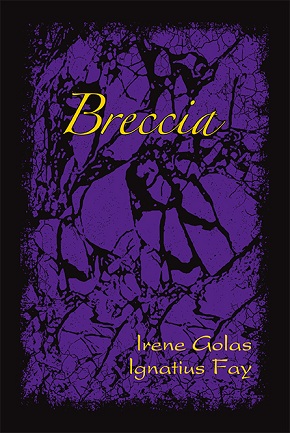
A breccia is made up of fragments of preexisting rock that have been re-cemented. By analogy, our collection may be considered a haiku ‘breccia,’ poems from two sources cemented together to form a unique whole.
Irene: When Ignatius sent me his manuscript, there were a few poems about his childhood in Levack. They shone a light on a way of life that was unique. It occurred to me that the Sudbury area should have a larger presence in our book. Sudbury is our home, after all, and has shaped our lives in so many ways. I encouraged Ignatius to write more. He did, expanding his focus to include details of miners’ lives and the changing face of Sudbury. I added several of my own and soon we had a ‘Sudbury Breccia’ section.
WG: This type of collection is rather rare in that it is a collaboration and in the way your poems are intermingled. What made you decide on this format?
Ignatius: Our original intention was to put together a small collection of selected and new haiku and senryu. A poem had to satisfy us both to make the cut. A fair number of poems were edited or rewritten. We ended up with more good poems than expected. Then we complicated matters by deciding to include tanka and haibun.
Irene: At the same time, we began to discuss layout. We wanted Breccia to be a true collaboration rather than a joint publication with two sections, one for his poems, one for mine. We also wanted something different from the traditional grouping by season, something with a more organic feel. Eventually we decided to integrate our poems, creating several extended sequences in which each poem suggests some relationship to the immediately preceding poem.
WG: Breccia is 208 pages long. That’s a lot of poetry. Did you find the sequencing difficult? How long did it take?
Irene: Sequencing turned out to be the longest part of the process. And the most satisfying. We spent hours trying to get short bits of sequence to feel right, then emailed it to the other. Often the response brought suggested changes. Occasionally, emails passed each other in cyberspace and we found we had very different ideas for the next part of the sequence. This process alone took more than two months.
WG: How did you like the experience of collaboration?
Ignatius: Delightful. We’re a good match. Sure, there was lots of hard work, but we work well together. We share an interest in the English language and a commitment to our art.
Irene is an extremely efficient editor…far better than I. She has such patience and attention to detail. Many of my poems have benefited from her insights. She is straightforward in her criticism, encouraging growth. And she doesn’t hesitate to praise something I’ve written that she likes.
Irene: We both look for honest assessment of our work. We strive for improvement, which includes acknowledging a weakness in our poetry when it is pointed out and being open to editorial suggestions.
WG: Why did you choose to self-publish Breccia?
Irene: We both got the same story when we looked into traditional publishing. Finding a publisher for your first book can be a long, drawn-out process. Then it may take a couple of years for the book to appear. Our biggest concern was getting our work out there. And Ignatius had some experience with the process, which is becoming increasingly popular.
Ignatius: Another problem with using a traditional publisher is the need to travel and do personal appearances to promote the book. My inability to do that lowers our prospects significantly.
WG: This was a strictly do-it-yourself project. Did the two of you also design the cover and do the layout?
Irene: Yes, we did everything. From the beginning, we agreed we wanted this to be 100% our project. But I have to give credit to Ignatius for carrying the weight when it came to the actual layout and other aspects of desktop publishing. He’s been in graphic layout and design for 22 years.
WG: What was the most difficult part of publishing Breccia?
Irene: Definitely the promotional writing. First we had to distill the essence of what Breccia is about – a slow process. Then we had to present that essence – sell it, really – in a catchy way, often in a hundred words or less. Too often we found ourselves reverting to a dense academic style of writing, or reaching for clichés.
Another challenge was reworking this material into different packages – a flyer, a press release, and at least half a dozen blurbs. To avoid sending out carbon copies, we had to rephrase, augment, emphasize or completely delete things from one piece to the next. A case of “how many ways can you serve hamburger?”
Ignatius: For me, the most difficult part was not being able to work regularly with Irene in person. Face-to-face, so much more can be accomplished in a short time. But my health and Irene’s other obligations were limiting factors.
Thank goodness for email! Much of the work was done through the back and forth of emails. It could be frustrating, waiting for a response or trying to iron out a miscommunication, but it allowed us to proceed. We may never have completed the project without it.
_______________________________________________________________________
You can purchase Breccia on Lulu.
Related articles:

 Always Looking Up