Tipsday: Writerly Goodness found on the interwebz, Oct 9-15, 2016

Another harvest of informal writerly learnings for you 🙂

Moar Wordstock Sudbury 2016 news from Kim Fahner, Sudbury’s Poet Laureate. CBC

Emily Franceschini interviews Danielle Daniel for Our Crater.

This week’s #NaNoWriMo round up:

Eleana Sbokou guest posts on Kate’s blog: seven things you need to know about writing and editing.

Roz Morris provides a blueprint for keeping the reader gripped. Nail Your Novel

Juliette Wade guest posts on Janice Hardy’s Fiction University: backgrounding your world through point of view.

Veronica Sicoe continues her series on storyworld design with this instalment on communication technologies.

Gabriela Pereira interviews Amor Towles for DIYMFA radio: worldbuilding from the inside out.

The book monster, or, when writing gets hard. Kate Moretti on Writer Unboxed.

Allie Larkin writes about finding confidence. Writing Unboxed

David Corbett shares what he learned at the beach this summer. And I have another book for the TBR pile 🙂 Writer Unboxed

Lisa Cron explains where drama really comes from. Writer Unboxed

Orly Konig Lopez gives three reasons quitting is an option, and the one reason you won’t. Bonus: guinea pig pictures! Writers in the Storm

Steven Pressfield reminisces about writing “as if.”

Ok. I just can’t resist Harper Lee Hodges. The four steps cats use to explain how to do something. The Write Practice

Julie Phillips: the fantastic Ursula K. Le Guin. The New Yorker

Jamie Raintree shares her story: from agent to publisher, part 1.

Why is it so difficult to get an agent? Liza Dawson Associates

Kristen Lamb explains why we need a synopsis before we write the book.

Catherine Ryan Howard explores her hate/love relationship with writers’ workshops.

Susan Spann helps us understand advances in publishing deals. Writers in the Storm

Adrienne Raphel: a history of punctuation for the internet age. The New Yorker

Four writers share their stories about the search for happiness. The Telegraph

Claire Kirch reports on We Need Diverse Books new curated reading app. Publishers Weekly

The publishing industry risks becoming irrelevant. Tom Welson of Penguin Random House UK. The Guardian

Here’s a lovely bit of storytelling for you. Dia de los muertos from Film School Shorts.


And another  video on the role of geometry in visual storytelling. Now you see it


The indigenous science fiction film, Northlander, will be screened across Canada. CBC

Kameron Hurley digs into the first couple of episodes of Westworld.

Alex Cranz reviews the season premiere of Supergirl. i09

James Whitbrook says that DC’s Legends of Tomorrow is trying to be Doctor Who with superheroes, and that’s just fine by him. i09

Clara and Eleven were a couple. What we’ve all known, finally confirmed. Caitlin Busch for Inverse.

Katharine Trendacosta reviews the first Iron Fist footage from NYCC. i09

And The Nerdist shares the Iron Fist trailer.

Katharine Trendacosta shares what she learned about The Dark Tower trailer (leaked). i09

The Outlander, season two, gag reel 😀


I hope that you find some news you can use to help improve your craft.

All the best.

See you Thursday!

Tipsday

Tipsday: Writerly Goodness found on the interwebz, Sept 11-17, 2016

Tipsday is chock full of informal writerly learnings!

K.M. Weiland digs into subtext and gives practical examples for how you can identify and apply subtext in your stories. Helping writers become authors

Later in the week, Kate shares more lessons from the MCU: how to choose the right antagonist for your story.

Roz Morris offers an exercise to show how you can shape your tone in your novel. Nail your novel

Vaughn Roycroft discusses the importance of storytelling in turbulent times. Writer Unboxed

Sara Letourneau helps you find the “why” behind your story. DIYMFA

David Corbett helps you fill linguistic holes with some super fun words. Writer Unboxed

Carly Watters shares four ways to write better dialogue.

Jami Gold: when is backstory necessary? Later in the week, Jamie returns with tips on balancing your story elements.

Margie Lawson offers her rule #17: finessing backstory. Writers in the storm

David H. Safford guest posts on Writers Helping Writers with advice on hunting down story holes using a novel journal.

Janice Hardy continues her blog tour on Marcy Kennedy’s blog. Create an editorial map to make revisions easier. This is, incidentally, part of my process 🙂

Karen Woodward explores short story structure.

Gabriela Pereira interviews Jerry Jenkins on DIYMFA radio.

Christine Frazier compares Star Wars: A New Hope and Star Wars: The Force Awakens. The Better Novel Project

Janet Reid shares six reasons she said “no,” recently.

Frances Caballo guest posts on Jane Friedman’s blog. A social media strategy that works: CARE about your readers.

Tim Grahl shares his perspective on the effectiveness of Facebook as a marketing tool for authors.

Authors offer their best writing tips. The Guardian

The Baltimore Sun shares John E. McIntyre’s “trigger warning” from his editing class at Loyola University, Maryland.

Moira Donegan covers the Emily Books Symposium session: what is women’s writing? The Awl

Kerry Gold’s L’affaire Galloway explores the UBC incident in its context and subtext (because there’s so much that hasn’t been stated). The Walrus

Janet Reid shares her thoughts on the difference between racism and using potentially offensive language in context in response to one college’s unequivocal idea of cultural sensitivity.

Mary Robinette Kowal offers a textile metaphor for cultural appropriation.

Jim C. Hines unpacks Lionel Shriver’s speech on cultural appropriation.

And here’s Foz Meadows’ response to Lionel Shriver.

Related (because it occured at the same literary festival): a journalist quotes a writer without permission. Liz Spayd for The New York Times.

Award news! Sunburst Award winners announced!

Literary Hub interviews the Biblioasis Bookstore in Windsor.

Wordstock, Sudbury’s literary festival. Nov 3-5, 2016. CBC

Canadian literati are coming to Sudbury for Wordstock. South Side Story

Last week marked the centenary of Roald Dahl’s birth. Here are a couple of the articles that were posted in tribute.

Shane Koyczan: 152 (audio only)


Wasn’t sure where to put this mixed bit of news. Sad to have lost him, but end-of-life issues are never simple and I honour his right to make this decision. Author W.P. Kinsella ended his life last week under Canada’s new assisted dying legislation. The Guardian

Take a look at Salvador Dali’s paintings of Alice in Wonderland. The Earth Child

Seanan McGuire digs into Pamela Dean’s Tam Lin. Tor.com

Joel Minty offers advice to first-time readers of Steven Erikson’s Gardens of the Moon. Tor.com

Alex Brown reviews the fall 2016 television SFF line up for Tor.com.

Germaine Lussier reports that Disney’s new production of A Wrinkle in Time has its lead. i09

The Curiosity is a fairy tale film about selkies 😀 Germaine Lussier for i09.

Connie Verzak offers some fodder for Droughtlander sufferers. The Daily Record

Hope you enjoyed, my creative friends.

See you on Thursday for some thoughty 🙂

Tipsday

Tipsday: Writerly Goodness found on the interwebz, Aug 28-Sept 3, 2016

We are once again full of the informal writerly learnings.

K.M. Weiland offers six reasons you need to make way more writing mistakes.* Helping writers become authors

Kate returns later in the week with more lessons from the MCU. This time it’s all about backstory, the number one key to relatable characters.

Ollie, as transcribed by his human, James Stack, prefers to frame rejections as declines.* Sir Oliver of Skygate Farm

Regine Ward shares seven common truths that will help writers handle rejection productively. Live, write, thrive

On the other side of the coin, Pamela Hodges shares six ways to let go of past writing and tackle something new. The Write Practice

Kellie McGann: why we write. The Write Practice

Kassandra Lamb offers four ways to add depth to your stories on Jami Gold’s blog.

Gabriela Pereira interviews Delia Ephron on DIYMFA radio. On Friday, Emily Wenstrom shares her top five takeaways from the Writer’s Digest Conference.

Victoria (V.E.) Schwab: this book is broken and other things I tell myself while writing.*

Anna Elliott shares four ways to recapture the joy of writing.* Writer Unboxed

Last week’s Spark in the summer replay was episode 299, which features an author who live-streamed the writing of a book, and an interview with David Mitchell on how Twitter played a role in the creation of his novel, Slade House. Awesomesauce. CBC

Nora Jemisin (N.K. Jemisin): I would just love to write and not have everything turn into a political battle. David Barnett for The New Statesman.

The Library of America will publish Ursula K. Le Guin’s The Complete Orsinia. David Streitfeld for The New York Times. The actual title of the article is misleading, implying that Le Guin is denying that she’s a science fiction author (something of which she’s accused other writers in the past). Not so. She’s tired of the epithet being used as a reason to exclude writers of excellence from the literary canon. As she says, she won’t be pushed out. Kudos!

Locus interviews Kelly Robson.

And then, THIS: On being a late bloomer.* Kelly Robson in Clarkesworld. Really, I want to give this article ALL THE STARS. I think Kelly single-handedly saved me last week.

Christine Schrum: what growing up in sulphur city taught me about beauty.* Latitude 46  We’re still strange children, by the way.

Julie Czerneda posts on The Black Gate about the challenges of living a #rurallife.

Beth Cato explains why we need more trans heroes in genre fiction. The MarySue

A Writing the Other Roundtable: how to stay in your lane.


John Scalzi asks some special guests to post about writing the other. Whatever

Jim C. Hines says, don’t look away: how we fight sexual harassment in the science fiction and fantasy community. i09

Jo Walton writes about science fiction, innovation, and continuity. Tor.com

Meir Solovichik gives us some insight into the secret “Jews” of The Hobbit. Carnage and Culture

You have to read this letter Josh Corman wrote when uncomfortable parents asked his school to ban The Handmaid’s Tale. Bookriot

Jessica Stillman reports on more evidence to support the link between reading and empathy. Inc.

Jake Parker: finished, not perfect.*


Another brilliant entertainer, gone 😦 i09’s Germaine Lussier revisits five of Gene Wilder’s defining film roles. Note: If the video isn’t in the frame, scroll back to see it.

Shakespeare and performance. Oxford University Press.


Outlander has cast Lord John Grey. Entertainment Weekly

Netflix announced that they were renewing Stranger Things on Tuesday last week. On Wednesday, the creators shared this first teaser for season two. They had no idea what was in the pipe, no, they didn’t 😉 Katharine Trendacosta for i09.

Tim Stack has additional details about season two on Entertainment Weekly.

Writers Relief celebrated National Dog Day with pictures of these book-loving hounds.

*posts that comforted me this past week.

I hope you’ve found some comfort here as well 🙂

Have an awesome week until Thursday and then come back to fill up on thoughty!

Creative sustenance. It’s what I’m all about.

Tipsday

Tipsday: Writerly Goodness found on the interwebz, Aug 21-27, 2016

Sorry to have missed a week of curation, but life happens. I’m back now, though, and here with your informal writerly learnings for the week 🙂

Jane Friedman explores discourse communities as a means of distinguishing yourself among agents and editors. Writer Unboxed

Heather Webb writes about revision and how to make it through. Writer Unboxed

We need to give ourselves permission to begin, courage to continue, and forgiveness to try again. I so needed this, Dan Blank. Bless you. Writer Unboxed

Angela Ackerman offers some advice on creating mood in a scene using light and shadow. Writers helping writers

Later in the week, Angela announces the expansion of One Stop for Writers.

Roz Morris shares three surprising to measure your progress when you’re writing a slow burn book. Nail your novel

Susan Brooks guest posts on Janice Hardy’s Fiction University on the importance of being genre-specific. Part one of a new series. Later in the week, Janice guests on Jody Hedlund’s blog, sharing five reasons your plot stalled. Then, Marcy Kennedy stopped by to explore indie choices: writing in multiple genres or specializing.

Jenny Hansen guest posts on Jami Gold’s blog (while she recovers) and offers some strategies for overcoming fear, the writer’s enemy number one.

Leanne Sowul writes about the importance of quality sleep. DIYMFA

Gabriela Pereira interviews MJ Rose for the DIYMFA Radio podcast: build buzz around your book.

Jamie Raintree guests on Writers in the Storm: the career mindset comes before the writing career.

Love this woman’s big squishy brain 🙂 Kameron Hurley shares her thoughts on why being a writer is an exercise in cognitive dissonance.

K. Eason shares six tips for writing a science fiction series. Writer’s Digest

Steven Pressfield studies stuff that works: True Grit and Paper Moon, which are essentially the same movie . . .

DBC Pierre lists ten books all writers should read. With the exception of a couple, they’re not what you’d think. The Guardian

John Bradley evokes Marshall McLuhan’s statement, “the medium is the message” to examine how we read and how it affects us. The Wild Detectives

Brandon Taylor states that there is no secret to writing about people who do not look like you. Literary hub

Sarah Gailey encourages SFF writers to “do better” when it comes to writing sexual violence. Tor.com

Laurie Garrison’s #women_writers manifesto aims to build the community of female authors. Lara Williams for The Guardian.

It was the 101st anniversary of James Tiptree Jr. (Alice B. Sheldon)’s birth. Tachyon Publications offers this tribute to her work and influence. Leah Schnelbach writes this article on Tiptree and the power of the SF community for Tor.com.

Fiona Macdonald reports on the secret libraries of history for the BBC.

Alexandra Alter interviews Hugo award winner, N.K. Jemisin, for The New York Times.

J.M. Frey explores how fantasy tropes can bring out the power of being a fan girl. The MarySue

And here’s the cover reveal for her new novel 🙂

Cheryl Eddy presents all the new science fiction and fantasy books you must read this fall. i09

Charlie Jane Anders previews Dominik Parisien’s new fairy tale anthology, The Starlit Wood for i09.

Katharine Trendacosta shares photos of some of the set pieces for the Ready Player One movie for i09. I have to say that this was one of my favourite novels I read last year. So looking forward. Here are some more from Collider.

And that was Tipsday.

See you Thursday!

Tipsday

Tipsday: Writerly Goodness found on the interwebz, Aug 7-13, 2016

Bumper week here at Writerly Goodness 🙂

The week previous, K.M. Weiland shared the reasons she believes writing is important, last week, she collected her readers’ thoughts on the issue. Helping writers become authors

On a related note: what do we write when the world feels insane? Sarah Selecky’s Story is a state of mind.

K.M. Weiland returns with more writing lessons from the Marvel Cinematic Universe (MCU) with the single best way to write powerful themes.

Roz Morris offers ten eye-opening tips to add impact to your storytelling. Nail your novel

Chuck Wendig lists 25 reasons he stops reading books. Terribleminds

Then Chuck shares ten things he learned about storytelling from Stranger Things.

Related: Janice Hardy shares lessons learned about handling flashbacks from Stranger Things. Fiction University. Nick Wisseman then guests posts on Janice’s blog, explaining how to plot your pants (wait . . . that sounds bad).

Janice then hopes over to Writers in the Storm to post: using internal conflict to create plot.

Finally, Janice guest posts on Jami Gold’s blog: if you’re stuck on plot, start at the end.

Lisa Cron writes about getting out of your process comfort zone: there is no safe place. Not plotter or pantser, but seeker. Writer Unboxed

Allie Larkin shows us how to organize a second draft with note cards and Tom Petty. Writer Unboxed

Christine Frazier shows us how to write a fight scene in which the hero fends off an attack to save a friend. The better novel project

Chris Winkle shares what she knows about creating realistic cultures. Mythcreants

Sarah Callender writes about enduring the long road to publication for Writer Unboxed.

The author as busy, busy bee and other bee-filled nightmares. Kameron Hurley.

Phil Stamper-Halpin shares what the editors of Penguin Random House look for in the first page of a novel.

Jennifer Johnson Blalock offers six ways to make comp titles work for you on Carly Watters’ blog.

Susan Spann helps you understand ebook rights. Writers in the Storm.

Robin Lovett shares what she learned from a negative experience: when your book doesn’t sell. DIYMFA

Gabriela Pereira interviews Andrew Piper (not the Canadian author) on her DIYMFA Radio podcast. Will an MFA influence your chances of success as an author?

Timothy Beck Werth looks at Djuna Barnes’ 1936 novel Nightwood and what may be the first trans woman in western literature. The Awl

Lorraine Berry: the horror of female adolescence and how to write about it. The Guardian

Michael Newton leads a celebration of Alan Garner. The Guardian

Ursula K. Le Guin writes about the golden age for The New Yorker. “I . . . think it ungrateful in a writer to write science fiction and deny that it’s science fiction.”

BrainPickings looks at Le Guin’s thoughts on aging and the meaning of beauty.

“What the market wants” is code for white stories in science fiction where black writers face universal racism. Amy McNeill for The National Post.

Michael Swanick lists five fantasy novels you won’t find in the fantasy section. Tor.com

Sarah Gailey writes in defence of villainesses for Tor.com.

Writing begins with forgiveness: why one of the most common pieces of writing advice is wrong. Daniel José Older on Seven Scribes.

Every writer’s worst nightmare: Helen Gladwell died before learning that her first book had been accepted for publication. Worse, her body remained undiscovered for months. The Telegraph

I saw this article in many forms over the last week. This one, by Jenn Savedge for Mother Nature Network, was the first. Reading a minimum of 30 minutes a day can extend your lifespan.

Jacob Mikanowski examines the Oneirocritica, an ancient encyclopaedia of dreams and dream interpretation. The Awl

Anthony Jones lists 25 words for other words. Mental Floss

Abraham Riesman interviews Margaret Atwood at San Diego ComiCon. The Vulture

Katharine Trendacosta reports that The Silver Chair, the next film adaptation of C.S. Lewis’s Narnia series, is in production. Whee! i09

Germaine Lussier presents a first look at the Arrival trailer. i09

Phil and I are looking forward to September 30 for this reason: Luke Cage. i09

Laura Prudom breaks George R.R. Martin news for Variety: Wild Cards series in development.

Rogue One: A Star Wars Story trailer.


Thems was some juicy informal writerly learnings, eh?

I’m off to WorldCon tomorrow. Poor Phil’s holding down the fort. Not to worry, my mom’s going to feed him 😀 Thursday’s curation has already been scheduled, but the blog will be silent from the 19th to the 26th. For the sake of sanity, I’m not going to catch up on the curation.

Be well. Be kind.

Tipsday

Tipsday: Writerly Goodness found on the interwebz, July 24-30, 2016

Yummy, soul-feeding stuff this week.

The first post of the week for K.M. Weiland was intensely personal. It was also inspirational. It was exactly what I needed to read as the world around me seems to be falling to pieces (though that’s more apparent in my Thoughty Thursday curation posts, of late). Read it, my writerly friends, and take heart. This is why we write: five reasons why writing is important to the world. Later in the week she cautions us: don’t make this mistake with story structure.

Bonnie Randall guest posts on Janice Hardy’s Fiction University. Once more with feeling: writing emotionally strong characters.

Chris Winkle offers five ways to restore tension in your novel. Mythcreants.

Two of my favourite writerly women: Joanna Penn interviews Roz Morris for the Creative Penn podcast. Finding your author voice.

Katharine Britton guest posts on Writer Unboxed. On the road to a first draft: when you don’t know where you’re going, any road will do.

Marcy Kennedy is back with part four of her reading as a writer series.

Kelly Harms: writing a book takes how long, now? Writers in the Storm.

Jami Gold shares more lessons learned from her recent RWA conference. Do you belong, or are you a fraud?

Shawn Coyne wonders if good enough is good enough . . . This post was a bit controversial for a friend. Yes, we need mentors; we need editors. I personally don’t think there’s anything wrong with learning through experimentation, practice, and study, however. The idea that writers aren’t good enough, that they can’t be good enough without the intervention of others can result in sensitive creatives believing that they are inherently worthless. Or, it can result in the following problems, which can be just as bad . . . Just sayin’.

Karen Woodward encourages us to let go of perfectionism.

Kristen Lamb explores stress and burnout . . . and how to get your writerly mojo back.

Heather Webb has some advice on what to do when you feel like you’re treading water. Writer Unboxed.

Kameron Hurley: the wisdom of the grind.

Jane Friedman offers a definition of author platform.

Constance Renfrow writes about the do’s and don’ts of query letters. DIYMFA. AND . . . I had the opportunity to guest post on DIYMFA thanks to my participation in Gabriela’s Street Team! Five things I’ve learned from being on the DIYMFA Street Team.

Camille DeAngelis says that having her book go out of print was a pretty great thing, after all. Publishers Weekly.

Lynn Neary: can serialized fiction turn binge watchers into binge readers? NPR.

Sudburian Matthew Heiti wins the Carter v. Cooper competition! The Northern Life.

Working girls: the Bröntes. Elizabeth Hardwick for The New York Review of Books.

Alex Kulaev for BookBaby: The Jungle Book is a beautiful film with flawed storytelling.

Orange is the New Black’s Samira Wiley joins the cast of Hulu’s adaptation of Margaret Atwood’s The Handmaid’s Tale. Amy McNeill for The National Post.

Katherine Trendacosta thinks Christophe Gans’ La Belle et La Bête (Beauty and the Beast) is the most beautiful thing she’s seen in ages. i09

We are not things: shining examples of women’s autonomy in science fiction. Delia Harrington for The MarySue.

Babylon 5’s Jerry Doyle dies at the age of 60. Sadness 😦 James Whitbrook for i09.

And that was your informal writerly learnings for the week.

See you Thursday!

Tipsday

Tipsday: Writerly Goodness found on the interwebz, July 10-16, 2016

Got some goodies for you this week 🙂

Roz Morris shares three steps to a smoother writing style. Nail your novel.

If you just keep writing, will you get better? Barbara Baig guest posts on Jane Friedman’s blog. Later in the week, Elizabeth Sims guests with this post: internal dialogue is the greatest tool for gaining reader confidence.

K.M. Weiland offers seven reasons you need story theory. Helping writers become authors. She returns with more lessons from Marvel: how to write subtext in dialogue.

MJ Bush brings her usual awesome in her advanced techniques (and insights) for jaw-dropping dialogue. Writingeekery.

Sophie Masson shares a few tips on writing fiction for middle grade audiences. Writer Unboxed.

David Corbett builds on Heather Bouwman’s WU post of the week previous with Sisyphus, happiness, and the Abyss.

Lisa Cron explains why it’s crucial to write ugly. Writer Unboxed.

Marcy Kennedy returns with part three of her reading as a writer series (with links to part 1 and part 2).

Elizabeth Kauffman rounds up some of the DIYMFA launch team’s posts from the last weeks (with a lovely nod to one by yours truly). Gabriela Pereira interviews Emma Straub for DIYMFA Radio. And then Andree Neal writes a guest post for DIYMFA (you might notice her in the round up, as well).

S.L. Huang guest posts on Chuck Wendig’s Terribleminds on the subject of manpain (!)

David D. Levine: a passion for Mars. Tor.com

Posche Burke: on white writers, ‘daring’ topics, and the unappreciated legacy of Octavia Butler. The National Post.

Ayodeji Awosika shares the undisputed secret to becoming a great writer.  Creativity is a muscle. Be yourself.

How to be a writer: the map is the territory. Ramona Ausubel shares her winding path to publication. Literary Hub.

Award news!

Airship Ambassador interviews Holly Schofield.

Connie Verzak recaps the Outlander season 2 finale for Scotland Now. Oh, the feelz.

Rogue One: A Star Wars Story. Celebration reel.


See you Thursday for some weighty thoughty.

Tipsday

My favourite story archetype

QOTW 15: What’s Your Favorite Type of Story?

Now I want to know: what’s your favorite story archetype? If you need a refresher on these archetypes, look back at Chapter 11 to the section on conflict and power struggles. More importantly, I’d love to know why you chose that story type and whether you’re using it in your current work-in-progress (WIP).

content_QOTW-15

In presenting her QotW, Gabriela mentioned how much she enjoys underdog, or comeback stories.

I have to confess a fondness for the same. I tend to appreciate these stories in the context of the bildungsroman, or the classic story of a character who moves from innocence to experience, in short, the coming of age story.

In terms of the classics, a lot of Dickens’ works are of this type (Oliver Twist, Great Expectations).

I read (and write) a lot of fantasy, though. So I’ll give you a couple of examples from the genre.

I recently read (and enjoyed—a lot) Brent Weeks’s The Way of Shadows. In this novel, Azoth, a young guild rat, begins the story as a homeless orphan whose only aspiration is to stop being afraid all the time. In the attempt to attain his goal, he apprentices to a magical assassin, plays the part of a young noble in the course of his education, and eventually becomes the Night Angel, not by doing what’s expected of him, or what his master tells him to, but by doing what’s right.

Very Oliver Twist-ish, non?

An old favourite of mine is Mary Brown’s The Unlikely Ones. In this lovely fable, the protagonist, known only as Thing, is servant (slave) to a witch. She’s forced to wear a mask all the time because her mistress tells her how ugly she is.

Thing’s lie is very literal. She behaves like the Thing she’s always been told she was. Magic begins to happen when she starts to challenge the lie, however. What I like most about this novel is that Thing manages her transformation through acts of kindness.

My own novels, though I’d very much agree that my protagonists are all protectors, follow similar development and themes. Though they may all have special talents that eventually help them become ‘bigger than life’ characters, my protagonists begin their stories disadvantaged in some way. They have to learn through struggle and loss what they might become.

If you want to find out more about story archetypes, or any of the other writerly goodness that is DIYMFA visit the DIYMFA page!

Tomorrow: I’ll be sharing my notes on the final Ad Astra session I attended.

Next week: I’ll be starting on the panels and presentations I attended at the Canadian Writers’ Summit.

Trying new things with DIYMFA

Here is the QotW:

QOTW 14: Try a New Technique

Throughout the book, there are visual techniques, diagrams, and exercises to help your writing. These include story-mapping, the revision pyramid, the character compass, and so forth. This week, I want you to choose a technique that is new to you and try it out. Then report back and tell us how it went.

The technique I’ve chosen is TADA.

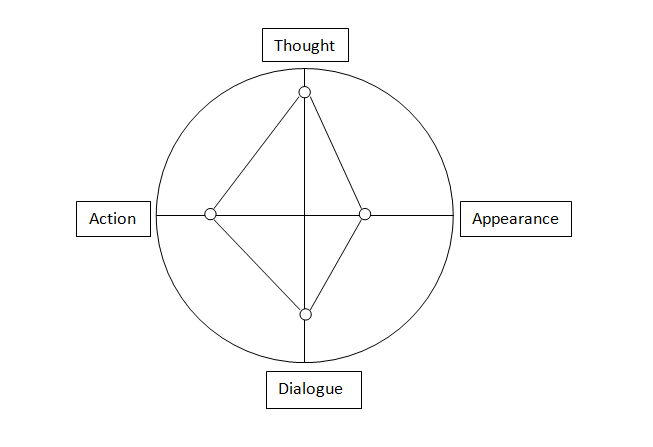
This is an acronym Gabriela created to assess character. The letters stand for Thoughts, Action, Dialogue, and Appearance.

The idea is that the writer wants to achieve a balance between all four aspects of character, and between characters, in each story. This could even be applied on a scene by scene basis.

So you can look at your characters individually, in scenes, in conjunction with one another, and overall in the story to ensure you’re keeping all of these character elements in the ratios you want.

To visualize this, Gabriela provided a graph, which she calls the character compass. It’s a circle with the letters T, A, D, and A distributed over the cardinal directions. Lines divide the circle into four with Thought and Dialogue, and Action and Appearance, in opposition to each other.

CharacterCompass

I’ve done my best to create a facsimile with Word’s drawing tools, print screen, and The Gimp 🙂

In this particular compass, I’m looking at one character, Ferathainn, in general.

She’s my protagonist and her POV is first person, past tense. There’s a lot of thought and internal monologue with Fer.

She’s studying to become a mage, but at the beginning of the novel, it’s all been theoretical. Her studies have prevented her from maintaining friendships, and so she lives in her head a lot. Part of her studies include rhetoric. Intonation and presentation can affect certain types of magick.

Fer’s been allowed (yes, allowed, it’s a plot thing) to study with her father, who is a bard, and her betrothed, who is an eleph finiris, or songmaster, because magick can be sung. She’s extended this part of her training to include dance, because she’s realized she needs a physical outlet after all this theory and rote memorization.

One of her small rebellions is that she also trains with her best friend, the forester, who teaches her how to fight. Primarily unarmed combat and survival skills.

So Fer is a heavily thinky character, with a good side order of dialogue and action. She doesn’t often consider her appearance, however. There aren’t a lot of mirrors in her little village. It’s not something she’s ever placed a lot of value on.

So I have to be careful when I write a scene about Fer alone, because she’s lopsided.

When she interacts with other characters, it’s primarily through dialogue and action, but I have to pay attention to their reactions to her physically. It’s actually very good for the show versus tell thing.

For example, Fer’s mother has to reach up to hug her, because Fer is tall. She’s of a height with her father, though. Through little interactions like this, readers form a picture of Fer in their minds over time.

When I switch POV to the other characters, they get to describe Fer, but I try not to have them do the ‘classical’ romantic inventory.

In early romances, which were often more adventure tales than what we think of as romances, when the hero meets the love interest for the first time, he waxes poetic and describes her from head to toe. Bad thing to do in a modern novel, though.

When Eoghan first ‘meets’ Fer, she’s all but dead. Having tried and failed to save victims of the war in the wake of the army’s passing, Eoghan decides he’s going to make his stand. He’s going to save this raggedy girl if it’s the last thing he does. Her appearance, other than the severity of her wounds, is secondary to his efforts.

When Dairragh first sees Fer, it’s from a distance, and it’s what she’s doing—performing magick—that makes its biggest impression on him. Dairragh hates all magi with a passion for the sake of the mage who murdered his parents and destroyed his home, including the people and gryphons that were his charge to protect.

So, of course, he hates Fer on sight and his prejudice colours his every interaction with her. At least initially.

The way I see it, readers are going to form an image of Fer in their heads that’s probably nothing like the way I see her. And that’s okay. They get ownership of my characters and my story on a reader by reader basis.

That’s what I want.

Gabriela’s TADA acronym and character compass are going to be one tool I take from the DIYMFA book and incorporate into my writing process.

Since I’m a plantser (part plotter, part pantser) I tend to pants my way through the first draft, but in revision, I can see the character compass being a very useful tool to evaluate how balanced my characters are in any given scene.

I hope I’ve given you enough of a run down that you might be able to make use of this technique yourself. Of course, you could always go buy Gabriela’s DIYMFA book and get a more detailed explanation of TADA and the character compass. The official release date was yesterday.

Jus’ sayin’.

content_QOTW-14

The next chapter: June 2016 update

Welcome to July! Half of 2016 is already past 😦

Let’s get right down to business.

June was a good month. As far as revision goes, I focused on Reality Bomb. It was another pleasant surprise. I didn’t hate what I wrote. This was just the first pass, and I’ve identified a number of things I need to work on, but I wasn’t writhing as I read 🙂 I don’t know if this means I’m a better writer now, or if I’ve just become inured to my failings (!)

I approached RB as I did Marushka before it, reading, mapping, editing, and making notes as I went. RB was my 2015 NaNoWriMo project and my second “win.”

I finished the first pass on July 1st (yes, Canada Day—the fireworks were for me, too) and the draft comes in at 282 pages and 67,808 words. Not bad for what I still consider a rough draft.

I’ve moved on to Gerod and the Lions, since. Early days, but not hating this one, either 😀 I should be finished this first run through of GatL in early August, just in time for another break—for WorldCon!

Since I’ve been a part of Gabriella Pereira’s Launch Team for DIYMFA, I’ve had extra blogging to do each weekend. As a result, I more than doubled my blogging goals for the month. I’ve also had some guest posting opportunities come my way, which has been another, validating surprise.

I went to the Canadian Writers’ Summit from June 17th to 19th and took a wee vacay from revising, blogging, and, in fact, most social media. It was a nice break.

My query, synopsis, and opening for Initiate of Stone have been revised and querying continues.

I’m starting work on some short fiction. It kind of just happened. It’s a good thing, though.

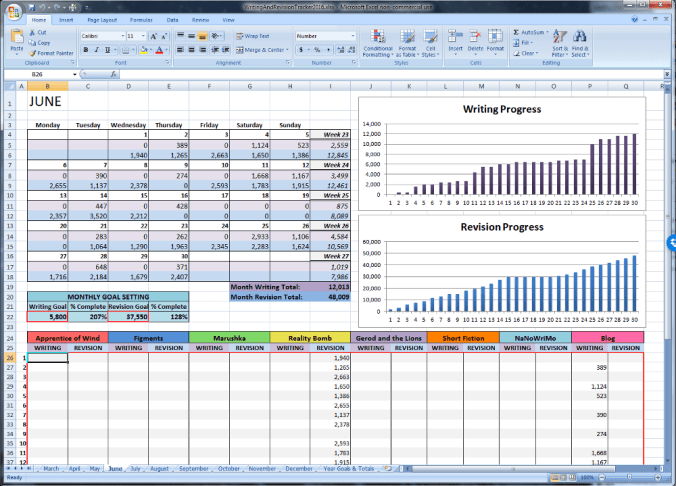
This is how the month settled out:

I achieved 128% on my revision goal with 48,009 words.

I achieved 207% of my blogging goal (yes, even with the vacay) with 12,013 words.

JuneProgress

The summer office is in operation, and I’ve been enjoying our lovely, lovely weather (so far). The garden is growing, though I haven’t been able to keep up with the weeding 😦 Still, we’ve been enjoying the fruits (literally) of what labour has been done and have had strawberries every day for the last three weeks. The raspberries are ripening. Phil’s been harvesting lettuces and herbs for the occasional meal.

It just makes you feel good to eat food out of your own garden.

In other news, I’m walking a little more, and getting some minor health issues sorted. I’ll be getting a new pair of glasses, not because my prescription has changed, but because my current pair is in disrepair. It’s time for a new perspective 🙂

Phil’s in good shape, now. He and his doctor have sorted his meds and he’s feeling well. All of his labs are showing results in the acceptable range, as well. I’m glad. Through the first few months of the year, it was not a good situation. Very stressful.

And that’s what June brought into this writer’s life.

Next weekend: I’ll be back to Ad Astra 2016 reportage.

Happy Independence Day to all of my American friends!

I’ll be back to work tomorrow.

The Next Chapter