Tipsday: Writerly Goodness found on the interwebz, July 12-18, 2020

Black Lives matter. Indigenous lives matter. All lives cannot matter until Black and Indigenous lives matter. I believe this more than ever. I’m not going to stop putting this important message out there until it’s true.

Regardless of whether your area of the world has never closed, is reopening, or is still under some degree of lockdown, please, for the love of all you hold dear, wear a mask.

As for schools, I sincerely believe the safest way forward is to keep all classes virtual. I know this isn’t a popular stance, but we know how quickly a common cold, or the flu proliferates in a classroom. And this is covid. We still don’t know the long-term effects of this virus.

I also know that virtual learning presents its own challenges. This will require a sea change for parents, teachers, schoolboards, employers, and governments and I think leaving these important discussions to this late date was naïve on the part of many. Ignoring the issue is not going to make it go away.

Having said that, Sudbury hasn’t had any new cases reported since about June 22 or so. We’ve only had 67 conformed cases and two deaths. It might be more reasonable to consider modified, in-person classes here, but I’d like to wait on the possible impact of phase three of reopening before we go there. Those numbers have yet to be publicized.

Now, onto the informal writerly learnings!

Kris Maze shares seven unstoppable YA plot ideas to make your novel fabulous. Barbara Linn Probst is editing for theme: search and employ. Writers in the Storm

Elizabeth A. Harvey explores a writer’s sense of place: where I ought to be. Jim Dempsey is writing and napping. Sophie Masson shares what she’s learned about presenting online workshops. Then, Juliet Marillier tells a tale about finding resilience: a dog story. Writer Unboxed

Gender and Jurassic Park. Cold Crash Pictures

Janice Hardy explains some story rulez: the two things every novel needs to do. Later in the week, Angela Ackerman stopps by: how emotional wounds can steer a character’s job choice. Fiction University

The female friendship revolution. The Take

Peter von Stackelberg shares an intuitive four-step process for creating vibrant scene structure. Helping Writers Become Authors

Andrew Noakes offers six principles for writing historical fiction. Jane Friedman

Lindsay Ellis looks at Tolkien’s constructed languages. It’s Lit | PBS Storied

Leanne Sowul wants you to commit to self-education about racism and anti-racism. And here’s my latest Speculations: ten Black science fiction and fantasy authors to read now. Then, Gabriela interviews Django Wexler: using fantasy to “literalize” the metaphor. DIY MFA

Chris Winkle explains why storytellers fail at grimdark and how to fix it. Then Bunny and Oren Ashkenazi team up: five reasons your story shouldn’t deny that it’s a story. Mythcreants

Deborah Ahenkora is slaying the dragons of hate with words. CBC Books

Aya de Léon: crime fiction is complicit in police violence, but it’s not too late to change. Electric Literature

Jeana Jorgensen describes what happens when fairyland is not for you: on escapism, fantasy, and survival. The Wrangler

Paula Findlen explores Petrarch’s plague: love, death, and friendship in a time of pandemic. The Public Domain Review

Thanks for visiting, and I hope that you found something to support your current work in progress (whatever stage it’s in).

Until Thursday, be well and stay safe, my writerly friends!

Tipsday2019

Tipsday: Writerly Goodness found on the interwebz, April 12-18, 2020

I hope everyone is staying safe and keeping well. Here’s your weekly dose of informal writerly learnings to help fill some of your time (I know you’re all doing what you can to keep yourselves occupied).

Helen J. Darling says that if you’re finding it hard to write, try keeping a pandemic journal. Sara Farmer considers fiction from Daphne du Maurier to Megan Abbott: the gothic horror of womanhood. Later in the week, Gabriela Pereira interviews Jeff Garvin about dismantling the stigma of mental illness. DIY MFA

Lori Freeland helps you understand point of view: P-O-What? Writers in the Storm

K.M. Weiland explains how to get some writing done: discipline vs. enthusiasm. Helping Writers Become Authors

Jim Dempsey offers a simple guide to symbolism in stories. Kathleen McCleary wants you to fuel your writing with feeling. Barbara Linn Probst shares five ways to light the spark of a novel. Writer Unboxed

Sacha Black wants you to breathe life into your prose with the sense of touch. Writers Helping Writers

Specificity and concrete language. Shaelin Writes

Susan DeFreitas shares part three of her developing a writing practice series: important.  Then, Mathina Calliope reveals the easy-to-fix tense problem that might be tripping up your readers. Jane Friedman

Jami Gold explains the difference between passive and active voice: was and not was. Later in the week, she wonders if pandemic anxiety is forcing everyone to count their spoons.

Chris Winkle breaks down act 3 of Dr. Horrible’s Sing-Along Blog. Then, Oren Ashkenazi looks at six magic systems that need stricter limits. Mythcreants

Writing fight scenes. Hello, Future Me

Chuck Wendig writes about being broken in half but wanting to be whole. Terribleminds

Steve Toase confronts the default: portraying homelessness in fantasy and science fiction. Tor.com

Thanks for stopping by, and I hope you take away something that will support your current work in progress.

Until Thursday, stay safe and well, my writerly friends.

Tipsday2019

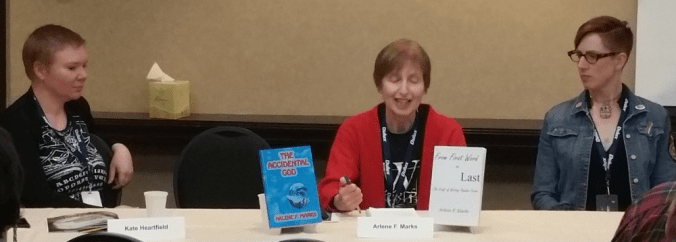
Ad Astra 2016, day 1: The influence of Shakespeare on science fiction and fantasy

Disclaimer: I am not perfect and neither are my notes. If you notice anything that needs correction or clarification, please let me know: melanie (dot) marttila (at) gmail (dot) com and I fix things post-hasty.

Panellists: Kate Heartfield, Arlene F. Marks, Kate Story

ShakespearePanel

AFM: Shakespeare’s plays were, in his time, entertainment and education. They’re lessons in history, then and now. They also were some of the earliest examples of genre. Hamlet is, in part, a ghost story. MacBeth can be seen as urban legend. A Midsummer’s Night’s Dream is fantasy.

KS: Shakespeare needed to make a living. That’s why he wrote. He was a great enabler of public discourse.

KH: You don’t have to go far to find gender queer characters in Shakespeare.

AFM: The Hogarth Shakespeare series from Penguin Random House is asking well-known authors, like Margaret Atwood, to re-imagine his plays. That’s the brilliance of Shakespeare. You can put any one of his plays into any era or milleu.

KH: A lot of adaptations of his work are coming out because it’s the 400th anniversary of his death.

KS: My father was a scholar in Newfoundland. We had a cultural renaissance in the 60’s and 70’s and we started to make some connections. Maybe we have something to offer to the tradition. I think the spirit of Shakespeare’s time was close to Newfoundland’s now. Shakespeare has always been there and has always been an influence. Shakespeare’s women were far more realistic than the women characters of many modern playwrights.

[Kate then performed the monologue from her story in Carbide Tipped Pens, edited by Ben Bova and Eric Choi. It was a variation of Romeo and Juliet, set in space. She’s currently working on the stage play. I just sat back and enjoyed 🙂 ]

Ian McKellan said in an interview, “Where in the modern world would it be so wrong for two people to fall in love?” It resulted in a 70’s production of Romeo and Juliet set in Belfast.

AFM: In Shakespearean times, it was forbidden for women to go in stage. All women’s roles were played by men, or, more often, boys. The audience was very demanding. If they didn’t like a play, or the actors, they brought rotten vegetables to throw.

KS: He was asking the audience to be clever, to know it’s a man playing a women, pretending to be a man. It engaged the audience, drew them in.

AFM: It’s the fiction of the people. The only publisher that approaches this today is Harlequin, who would hold regular “reader appreciation” luncheons to meet their most popular authors. In Shakespeare’s day, there would be nobles and prostitutes in the same audience. It was whoever had the money to pay.

KS: It was nuts for the theatre. A sixth of the population of London would attend the performances.

KH: The culture of fandom/fanfic has a lot in common with the culture of Shakespeare. There’s nothing more Shakespearean than fanfic. Most of Shakespeare’s plays were drawn from earlier works. He borrowed liberally from Ovid.

Q: Shakespeare’s plays address universal themes. The more popular ones get done. Some might say overdone, but the historical plays are ignored.

KS: My theatre did a gender-swapped Taming of the Shrew.

KH: The film industry has done a better job. My Own Private Idaho, The Hollow Ground series, Looking for Richard.

AFM: A Thousand Acres was the story of King Lear. Shakespeare was brilliant of using every member of the company. There were often comic actors. Characters like Falstaff were written for them. If there were acrobats, he’d give them something to do. They had to be very practical in terms of costuming for these reasons.

KH: Titus Andronicus and Troilus and Cressida were essentially horror. Shakespeare was a great worldbuilder. He was consistent in terms of how fairies, spirits, and witches behaved. His idea of Titania was dark, but comic. Fairies had an alien sense of good and evil.

AFM: He built on the motivations of all his characters.

And that was time.

Next week: The do’s and don’ts of writing erotica (oh, my!).

WWC 2014, day 2: Blending science fiction and fantasy

Panellists: Stacy Dooks, Nina Munteanu, Greg Bechtel, and Ian Alexander Martin

Nina MunteanugregbechtelIan Alexander MartinSD: Genres are breaking down. Clarke’s third law states: Any sufficiently advanced technology is indistinguishable from magic.

NM: Why do we have genres and should we still?

GB: Yes. It’s for the reader. How else will we know what to buy and read?

NM: Publishers and imprints have the genre printed right on the spine, though.

IAM: I say I don’t like categories and genres, but when I go to my publisher, I use them. I may not like it, but I have to use them.

SD: Genre is your navigational touchstone, your compass point. You can get tricked into reading a genre you weren’t expecting. Stephen King is known primarily for horror, but then he published the Dark Tower series.

IAM: Using categories to restrict authors or stories is bogus.

NM: Do we need to re-educate our readers, then?

GB: Word of mouth is how you find out about books. Now it’s moved online.

NM: It started with Amazon. People are finding their books in new ways now.

IAM: Chapters is its own competition. If you buy online you save 20% over the bookstore prices.

NM: Is it still germane to categorize books?

IAM: Categories in bookstores is an American invention. In the 50’s or 60’s it migrated to Canada. Before that, everything was alphabetical by author, regardless of genre or category.

NM: It’s a different way of looking for a book. When you look for a book, do you look for an author, or do you look for a genre?

Q: People who are already published can bend the rules. What about someone who’s writing?

SD: It’s important to establish the ground rules for your universe. Don’t get derailed. Take Star Wars, for instance. It’s the biggest blend of science fiction and fantasy out there. Don’t try to explain the fantasy elements, like midichlorians. Don’t let anything come out of left field.

GB: We all seem to be agreeing that blending science fiction and fantasy can be done and has been done successfully. What advice do we have for the writers in our audience?

NM: To me, it’s all about the reader. When you read my books, you know what you’re getting. It’s about consistency.

SD: You make a covenant with your reader.

NM: As soon as another writer takes over a franchise, the reader can tell.

GB: You can break your rules if you set it up. Foreshadow. (Mel’s note: Kelley Armstrong said much the same thing in her workshop on writing fantasy at CanWrite!)

IAM: You should trust your reader to “get it.”

NM: You can be subtle.

Q: Blending is one thing, but what is genre? Is it the trappings, or are there other criteria?

NM: I teach how to write science fiction at the University of Toronto. That’s one of the first things my students have to learn is how to define the genre. In science fiction, science is the premise, the ‘what if?’ Fantasy doesn’t have to have magic, but it’s based more on myth and folklore.

SD: In Star Wars, you have all the trappings of science fiction, but at its core the story is a mythic one.

NM: Even if there’s something inexplicable about it. Sometimes, it’s better not to explain.

Q: So is it the fantasy element that enables the story?

NM: Take a look at Diana Gabaldon. Her books defy categorization, but when Outlander was first published, it was stuffed in the romance section of bookstores, even though the author insisted on the more general ‘fiction’ category. Sometimes trying to pigeon-hole your novel can backfire. I wrote what I called a romantic science fiction story. An artificial intelligence ran society, but romance was the main thread. It was dark though. Both partners died. It bombed with romance readers. It was well-reviewed, but romance readers hated it (where was the happy ending?) and science fiction readers loved it.

GB: Margaret Atwood is another example. You don’t want to disappoint your readers’ expectations.

Q: Is genre mainly the concern of publishers and marketing departments? Do you need to focus on it when you’re writing?

NM: You need to understand genre and how that’s going to affect where your novel is placed. New writers who blend are not as marketable.

IAM: Not during the creative process, though. Afterward, yes.

Q: Before the 50’s fantasy had to be disguised as science fiction.

Q: As a new author, how should you present your blended novel?

IAM: I’d be more interested in your mix. Do your research. Approach those publishers that have a track record with blended fiction.

GB: Find a publisher that produces novels you like to read and approach them.

NM: Books used to be marketed by genre. Identify what your book is and sell it for what it actually is.

IAM: Online recommendations may not be accurate. Genre is important for retail, library, and the marketing department. It’s not so relevant to the end user/reader anymore. Social interaction is the key to discoverability.

Q: I didn’t understand that Star Wars was a blend. Now that I think of blending in this light, Final Fantasy nailed it. How much does the visual element contribute?

SD: Science fiction and fantasy is a marginalized genre.

IAM: The general reaction is, “You’re reading that? Read [the classics] instead (Asimov, Clark, etc.).”

NM: The visual element enables blending.

GB: Buffy the Vampire Slayer was a wonderful cross-pollination of horror and action-adventure wrapped in a coming-of-age story.

Q: Fantasy is magic-based. It doesn’t necessarily track for me. Can you make a science-based magic system?

IAM: Absolutely. You can do it if you do it well.

NM: Ultimately, fiction is story. Serve the story.

Next week: When words collide day two continues with Mark Leslie.

CanWrite! 2014: Writing fantasy with Kelley Armstrong, June 20

I took a little break last week because of the blog tour and interview with Mat, but I’m back and ready to proceed with moar CanWrite! 2014 reportage.

I’ve been interested in Kelley for years, ever since I first heard Brian Henry’s story of how he helped hook Kelley up with her agent, effectively launching her career. Kelley’s version of the tale appears later in the workshop, so I won’t spoil it.

Everybody loves a good origin story 🙂

Kelley ArmstrongKelley was a dynamic speaker, hardly ever keeping still long enough for me to snap a decent picture. I won’t torture either you or her with my attempts. Suffice it to say that by the time my phone camera took the shot, she was in mid-speech. So here, instead, is the promo pic she gave the CAA to post on the conference page.


Kelley also likes to sit on desks as she holds forth.

Overall, I found her workshop a fascinating one. She frequently asked a question of the class and had us share our expertise, as a good facilitator should (corporate trainer kudos, Kelley!).

Without further ado, here are my notes from the workshop.


What is fantasy?

Set in an alternate reality; featuring non-human characters; plausible impossibility (Mel’s note: this was my offering. It’s from Brian Aldiss’s Trillion Year Spree.); mystical elements.

What about sub-genres of fantasy?

Steampunk (think Gail Carriger); urban fantasy (what Kelley writes); epic or high fantasy (Tolkien); contemporary; paranormal romance; speculative fiction; magical realism (Alice Hoffman’s Practical Magic).

On writing rules.

There are rules for grammar, spelling, syntax, etc., but with regard to writing a fantasy novel, there are no rules, only guidelines. Following them can definitely improve your chances of being published, but we worry too much about rules.

Don’t worry about the market. Let’s look at an example of a sub-genre that has long been considered flooded.

Current market research reveals that with regard to vampire novels in the last eighteen months there have been:

  • Eighteen deals for new series or standalone titles;
  • Fourteen extensions of current series;
  • Three novels from established novelists in other genres; and
  • One debut.

The “Big Five” are still buying vampire novels. Movies and television series are still being made from these books as well.

Who are the Big Five?

  • Penguin Random House (imprint – DAW)
  • MacMillian
  • Simon & Schuster
  • HarperCollins
  • Hachette (imprints – Little Brown, Hyperion)

All of the Big Five have their imprints. You can publish different books with different imprints.

<Kelley took a few minutes to review her most recently published novels and which imprint and parent publisher each was produced by.>

Bitten was the fourth novel I’d written. The three previous were, a novel about a private investigator (Mel’s note: my notes indicate PI, but it could be something else. My apologies to Kelley if I got this wrong), a traditional fantasy, and a Harlequin Romance, written for their Intrigue line.

Never write to the market. Write what you want to write. If it’s good, it will find an audience.

It takes, on average, about two years for a novel to be published.

Research is important, even in fantasy. Research your setting, history, weapons and armour, etc. Even if your world is a created one, there’s probably something in the real one it was based on.

Here’s how I define a few terms:

Myths have to do with the gods, demigods, avatars, or other similar beings. Folklore relates to fairies and other fantastic races of creatures. Each culture has its own. Legends are real people doing amazing things, generally blown out of proportion after years of retelling.

Can you “break” a myth and retell it in an original way?

Worldbuilding is all about research. You have to have rules and you have to be consistent with them. Or you have to create a convincing “in-world” reason for the rule to be broken.

Part of my research for one of my novels was In the Sleep Room by Anne Collins, a book about sleep deprivation experiments. I also looked into MK Ultra and other military experiments as well. For those who don’t know, MK Ultra was a program that attempted to create an assassin like The Manchurian Candidate.

Urban fantasy usually deals with some form of sub-culture.

How to write your way out of a corner (A.K.A. break your own rules).

First, you have to acknowledge the issue. Then, there are four ways out of your bind:

  • The magical whatnot – a mystical device that will supersede the rules.
  • The lost spell, ritual, or other knowledge – ditto.
  • A new or expanded power – caution: do not use often.
  • Mea culpa – just take responsibility for the “mistake.”

Be careful with these. If the solution to your magical bind sticks around, it can cause trouble for your story in the future (think the transporter as used in Star Trek: The Next Generation). You also don’t want your protagonist becoming too god-like. The easy fix can become a crutch.

Do not give any unnecessary details. If you explain too much, you are bound by the new rules you’ve created. Cover your ass.

How do I know another writer hasn’t already done “this”?

Don’t worry about it. There are no new stories, only new ways of telling them.

What’s the difference between high concept and low concept?

Every agent and editor will have a different definition of this. Sometimes it’s a matter of originality. It’s all in the execution. High concept usually involves global stakes. Low concept is more personal.

<We were then assigned the task of coming up with a concept statement, or logline, for our current works-in-progress. We shared them and critiqued them. Kelley came up with some very inventive ways to rewrite these offerings for greater impact.

The floor was then opened to questions.>

Q: How are you so prolific?

When I got my first deal, my novel was accepted on the condition that I could produce the second novel in the series—as of that time not written—in a very short timeframe. The publisher wanted to release them one after the other.

I was working in the IT field at the time, and though it was a big deal financially, I talked it over with my husband and he said go for it. I also had one young child and was expecting my second. It was a very scary time.

Everyone pitched in to make sure my life didn’t fall apart while I was taking this risk. My sister, who was conveniently in search of a job, became my business manager. When I had enough money, I paid for a housekeeper.

Value your time. Would you rather be doing laundry, or writing your next novel?

Now my kids are helping out too. It’s a family affair.

Q: How did you get your agent?

I’d been writing for a while, in the evenings and on weekends, while I worked. I took a workshop with a man named Brian Henry, and I asked him where I should submit my latest novel (Bitten). He read it for me and called me up one evening to discuss options.

He said, “Helen Heller would love this.” I gulped. Helen Heller? And then Brian continued, “I just can’t tell her what it’s about.”

Later, Brian told me about his conversation with Helen. He’d known her from his work in the publishing industry and he called her up.

“Helen, I have this fabulous new novel that you would just love.”

“What’s it about?”

“Werewolves.”

“Werewolves? If it was anyone but you, Brian . . .”

She read it, however reluctantly, but she loved it and she agreed to sign me as a client.

<The rest, as they say, is history.>

Review of Finding Meara by Lara Schiffbauer

Once again, I finished Lara’s book a while ago and am just catching up on some overdue reviews.

The Amazon blurb:

FindingMearaCoverTo keep her safe, twenty-six-year-old Hazel Michelli’s parents never told her she was adopted, or that her birthplace was in an alternative land where magic and monsters exist. She found out the truth the day a ferocious winged creature stole her from her Denver apartment and delivered her to Lucian, the sadistic Lifeforce magician who happens to be Hazel’s biological father.

“Dysfunctional family” takes on new meaning when she learns Lucian must sacrifice a daughter to maintain immortality and take over the Realm. When Hazel’s younger half-sister disappears just days before the Rite, Lucian moves Hazel to the top of the sacrificial short list.

Afraid, yet compelled to protect her four-year-old half-sister, Hazel races between both worlds, searching for Meara while being hunted by Lucian. Their lives, and the future of the Realm, leave her no room for failure.

My thoughts:

At the outset of the novel, Hazel (love the name, by the way, unusual and old-fashioned, but made quirky by the character) only knows that she’s lucky, so dependably lucky that she makes a comfortable living by gambling. Then something huge and hulking bursts through the door of her apartment, calls her “Meara,” grabs Hazel, and leaps off the balcony, spreading its wings to fly her to a place she never suspected existed.

The action doesn’t relent as Hazel is taken prisoner by someone named Lucian, escapes (with the help of a talking bird and a flaming cat), finds her way back to Colorado, and reluctantly enlists her friend’s help.  When an insect-like monster attacks them on the road, it is both a validation of Hazel’s bizarre story and a warning: Lucian isn’t finished with her yet.

Though unwilling to involve her parents in this strange series of events, Hazel has questions only they can answer.  Those answers change Hazel’s life forever and send her on a worlds-spanning adventure, teaching her that her luck is only the tip of her magical iceberg, and that family is worth killing for, and dying for, if it comes to that.

The author weaves a great story, with just enough quirk to please the trope-weary reader.  She moves between Boulder, Denver, and the Realm deftly, and has created a unique and charming world that both recalls childhood favourites, and provides enough romance and danger to satisfy the New Adult audience.

I also appreciate that despite the romantic potentials (small spoiler alert!), Hazel remains happily independent at the end of the novel.  The denouement felt a little rushed, but was satisfying nonetheless.

Am eagerly awaiting Lara’s next novel 🙂

My rating:

4 out of 5 stars.  Really, I wanted to give her 4.5, but I had to give her some room to grow as an author 🙂

About the Author:

Lara Schiffbauer was born and raised in the Western United States. As a child she got in Lara Schiffbauertrouble at school for talking too much and daydreaming. She believed in Santa Claus until she was in the third grade, and thought she saw angels at the Catholic school she attended.

Unwilling to lose the magic of childhood, as a teenager she spent her years reading novels that let her live in fantasy worlds where she could vicariously experience the romance and adventure sadly lacking in her everyday life. Piers Anthony, Victoria Holt, and David Eddings were some of her favorite authors.

Many years later, after obtaining a Masters of Social Work degree and growing a family, Lara decided to recapture some of the magic found in creativity. In 2010, her horror flash fiction story “The Copier” was published in the anthology Daily Bites of Flesh 2011: 365 Days of Flash Fiction. In 2011, her erotic horror story “Phantom Deposit” was published in the anthology Steamy Screams, and in February 2012 her urban fantasy short story “Bear Hug” was published online at Hogglepot. She then turned to writing novels, and her first contemporary fantasy novel, Finding Meara, was released in March, 2013.

Lara loves connecting with others! Besides spending time on Twitter and Facebook, Lara also has accounts on Pinterest and Goodreads. All social media links can be found at her website, www.laraschiffbauer.com.

Book review of Alon Shalev’s At the Walls of Galbrieth

I’ve fallen behind in my reviewing duties, so I’m going to be catching up over the next few weekends.

At the Walls of Galbrieth

At the Walls of Galbrieth

What Amazon says: The young elf desired only to follow in his mother’s footsteps and become a healer, but when the Emperor’s army attacks his village to punish traitors and conscript youth, Seanchai flees to the mountains, seeking safe harbor with an uncle he has never met. He is shocked as many people sacrifice their lives to ensure he reaches a Wycaan Master, an enigmatic woman named Mhari, who can teach him to wield a powerful death-and-life magic that might just free the races of Odessiya. In a world defined by strict racial boundaries, where humans rule, dwarves hide deep underground, and elves are a slave nation, Seanchai must find a way to create friendships and trust, unheard of since the fall of the Wycaan Masters, and reunite the races into an alliance that will bring freedom to all. Sometimes one must choose between his companions and his destiny. Seanchai abhors his ability to kill and, in the friendships he forges, discovers something potentially more powerful than his magic. Friendship, however, can be a double-edged sword.

My rating 4 out of 5 stars.

The book starts off at a fairly quick pace, with Seanchai fleeing his home in the middle of the night to escape the predations of the Emperor’s troops.

While events continue to move quickly throughout the book, Seanchai is not always at the heart of the action, as he trains with his master to unlock his powers.  Alon took a bit of a risk here letting Seanchai’s companions take centre stage for the middle third of the book.

Some readers might be tempted to skim the sections of training if not for a few key transformations that make what might otherwise be monotonous passages startling.

Then Seanchai takes the reins firmly in hand leading up to the climax on the novel and the payoff is satisfying.

I liked the play on Irish tradition (a seanchai is a traditional Irish historian and storyteller, akin to a bard) and pagan practice (wycaan is a variation of the word wiccan, the modern tradition of witchcraft).  His training with his master is distinctively pagan and I appreciated his angle on magic.

For a first YA epic fantasy, AtWoG is a good read.  The novel is well-paced and written in straight-forward language.  Alon has room to learn and grow as an author, and I look forward to the next two books in his series.

Strictly speaking, Alon doesn’t need my help.  At the Walls of Galbrieth was Alon Shaleva quarter finalist in the 2012 Amazon Breakthough Novel Award competition, which led to his getting the novel published that same year.  Alon now has two more books in his series published.  This year, AtWoG won the YA category and was a grand prize finalist in the 2013 Eric Hoffer Book Award.

Alon, who blogs as the Elf Writer, is a staunch supporter of epic fantasy as a viable genre despite what some argue as overused tropes (Tolkien-esque writing, elves, dwarves, etc.).  I also happen to believe in the enduring power of epic or high fantasy and am very pleased that AtWoG has done so well.

Until tomorrow, my writerly friends 🙂

I failed the test

Back in December, Robert J. Sawyer shared this: http://www.rinkworks.com/fnovel/

Rinkworks warns the following:

Ever since J.R.R. Tolkien and C.S. Lewis created the worlds of Middle Earth and Narnia, it seems like every windbag off the street thinks he can write great, original fantasy, too. The problem is that most of this “great, original fantasy” is actually poor, derivative fantasy. Frankly, we’re sick of it, so we’ve compiled a list of rip-off tip-offs in the form of an exam. We think anybody considering writing a fantasy novel should be required to take this exam first. Answering “yes” to any one question results in failure and means that the prospective novel should be abandoned at once.

The problem is … I answered yes more than once.

Specifically:

4. Is your story about a young character who comes of age, gains great power, and defeats the supreme bad guy?

Well, it’s about three young characters, two who “come of age” and one who just figures out what his damage is, spanks his inner moppet and gets on with it, all three of whom have roles to play in the defeat of the dark god Yllel, and his sourcerous servant Kane.

12. Does “a forgetful wizard” describe any of the characters in your novel?

Yes, Aeldred is dithering and occasionally confused, but he is the exception and considerably younger than most of the magickal movers and shakers in my novel.  Plus, he’s not even close to being a main character.

21. How about “a half-elf torn between his human and elven heritage”?

That would be Aislinn, actually and she’s not torn so much between the two peoples as derided and feared by both because she is the first child born of a Tellurin (my version of humans) and an eleph (my version of elves).  She’s actually going to be pivotal in uniting the two peoples.

39. Does your novel contain orcs, elves, dwarves, or halflings?

Actually, all of the above.  I’ve changed the names slightly and given them different origins.  My orcs are called okante and are peaceful tribes-people who generally live in harmony with the Tellurin tribes of the north.  They’re only drawn in as villains because Yllel tricks them into soul-slavery.  My elves, as mentioned above, are called eleph and they come from a different world.  One of my gods tries to do something good, but ends up tearing a hole in the world and sucking half the population of Elphindar into Tellurin before the gap can be closed.  The eleph are not pleased.  Dwarves are called dwergen, and are the children of the elemental Gods of earth and fire.  Rather than halflings, I have gnomes I call dwergini and they are the children of earth and air.  Neither race is terribly differentiated from their fantastic forefathers, but they’re certainly not dour and I try not to make them overtly stereotypical.

Enough of the justification, but I can tell you that I was not a little disconcerted by saying yes even those four times.

Fantasy Forest

Fantasy Forest (Photo credit: ozjimbob)

Then, in January, Author Salon posted this for the benefit of the Fantasy and YA Fantasy peer groups, two of the more active in the AS fold: http://www.authorsalon.com/page/general/fantasytropes/

Again, I shook in my metaphorical boots because my story is fairly littered with orcs, trolls (which I call krean), ogres (the gunden), etc.  Will renaming be sufficient?  It’s not like any of them play a significant role, but they are there in their standard and stereotypical glory.

I started questioning the value of my novel in a serious and neurotic way.  Then I sat back and tried to put things into perspective.  My story is not “about” any of these tropes, save perhaps for my protagonists coming of age, finding power, and defeating the big bad.  Renaming will likely be sufficient in most cases.  I don’t have to throw the baby out with the bath water.

I almost failed another one

AS says it wants thick-skinned writers.  Though I do tend to take some criticism more to heart, or react poorly to some of their advice (largely because I think that it’s being posted because someone has looked at my work and though poorly of it, even though I “know” I’m not that important to anyone), I’m learning to understand being thick-skinned in the same way I understand being courageous.  Being brave doesn’t mean that you’re not afraid; being brave means that you act despite your fear and try not to let it limit you.  I’m taking the same, long view of being thick-skinned.  It doesn’t mean that my confidence isn’t shaken; it means that even when it is, I get my shit together and soldier on.

Then Rachelle Gardner posted this in March:

http://www.rachellegardner.com/2012/03/do-you-have-a-thick-skin/

It’s good to know that agents feel the same way us writers do sometimes 🙂

Writing well is the best revenge 🙂

Then I came across a very helpful blog post:

http://www.writersdigest.com/whats-new/writing-rules-10-experts-take-on-the-writers-rulebook?et_mid=538945&rid=3085641

I’ve always aspired to be transgressive; sometimes in a good way, and sometimes not so much.  I think ultimately, I have to focus on writing the best novel I can, so that when I do break the rules, I’ll be forgiven.  It is easier to ask forgiveness than permission, right?  It’s such a relief to know that I can write my way out of the corner I seem to be getting scrunched into.

Coming up on Writerly Goodness

In future posts, I want to get a bit into the background of the novel, stuff that won’t necessarily be in it, but all of the window dressing I developed so that my world would work fairly consistently.  Stuff like cosmology, the historical timeline leading up to the novel, religion, the way magic works, my various peoples and their origins (in more detail than above), naming conventions, and some of the unique things about Tellurin.  In other words, I’m going to write about world-building.  Have any interest in that?

What are your feelings about tropes and their use/overuse?  Would you fail Rinkworks’ test?  What about the Author Salon article?  Does it give you pause?

If you liked this post, feel free to use the “like” or sharing buttons below.  Or, you may consider subscribing via email, or RSS feed (there are links below each post, or on right side menu on my home page).

Until next week!