The next chapter: May 2025 update

My little love got sick, and I realized I’m not out of the burnout woods yet.
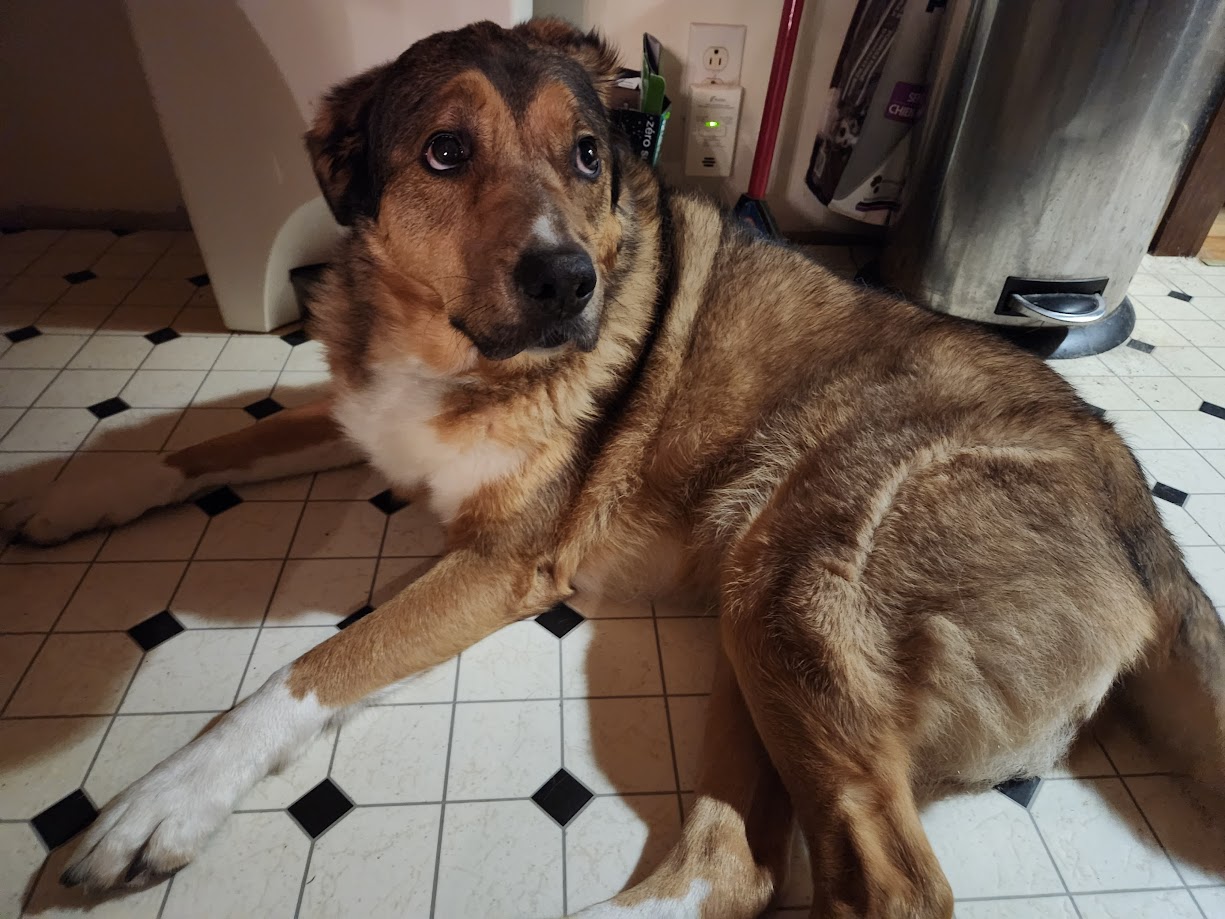
Picture of Torvi looking gormless.

Life in general

Content warning for the generalized ick of pet parenthood. Much discussion of poop.

Torvi gave us a scare at the beginning of the month. On the night of the 2nd, after some “soft serve” poops during the day, she was up all night with vomiting and diarrhea. Phil, as usual, shouldered the bulk of the work, staying up, or getting up to let Torvi out so she could relieve herself. I cleaned up the vomit in the house and took her out a couple of times. We did not feed her until supper the following day hoping her system would benefit from the “rest,” but she wasn’t interested in partaking when we put her kibbles out on Sunday. We tried to encourage her to drink so she wouldn’t get dehydrated.

If she didn’t improve by Monday, we’d call the vet. Fortunately, the continual stream of liqui-poop calmed down on Sunday and Torvi started to show interest in food again.

This was only one of several events/days that made what should have been a restorative 4-day weekend dysregulating.

I’d taken May 1st and 2nd off—‘cause I always take the quarter and cross-quarter observances off—and though the pressure seemed to be off on the big project at work, things still needed to get done, so I was still in a place where I had minimal/no spoons after work. I engaged in a little bedtime revenge procrastination on Wednesday night anticipating being able to sleep in the next day.

But Thursday started out with Phil’s cell phone ringing—since our mom health challenges last year, we both keep our phones on all the time, just in case. He hung up. Moments later, my phone rang. It was the furnace technician announcing his imminent arrival. I told Phil I was going back to sleep and he got up to deal with the tech. It was around 7:40 am.

Torvi set up a-barking when the tech arrived, and Phil locked her in the bedroom with me to keep her out of the tech’s way. It was a choice. She whined the whole time, and I did not get any more sleep.

The tech’s visit was blessedly short, but then Mom called wanting to go to the bank. She had to pay her taxes. Phil agreed to take her.

And that was it for me trying to sleep. I got up, already dysregulated out of the gate. So, I took my time with my morning ritual and felt a little calmer.

Returning from my walk with Torvi, I noticed a car in the driveway. I went to Mom’s, as I do every day, and when I got home, I saw that a friend was visiting, out of the blue. A pleasant surprise, but another disruption to my day’s plans. I had wanted to go shopping for another friend’s birthday present. I had my route and tasks all lined up but had to defer departure.

I’d also wanted to see if I could stop off at my publisher to pick up some books for review.

I set off on my planned shopping trip—and I should note here that I hate shopping—and got home just after 5. Unfortunately, I also forgot my Flare Calmer and was a bit buzzy. The publisher emailed that she was out of town, and I’d have to pick up the books the next week. Because I had taken off so late, I didn’t have a chance to deal with my email or read blog posts or anything. Supper arrived and then Torvi’s evening walk and by the time I finished clearing the daily slate it was after 11 pm.

I ended up revenge procrastinating until almost 3 am in a vain attempt to regulate before I got to bed. Surely, I could sleep in on Friday . . . Alas, no. I could not. The day was better, but when I went to ship my friend’s birthday package, the post office’s computer was down. So, no shipping and further disruption to my plans. That was the day Torvi started to have her difficulties. Though I got to bed at a reasonable time, there was little sleep Friday night.

Saturday, I managed to get the package shipped, but Mom was sick, Torvi was still sick, and Phil and I were heading to a family combo birthday celebration. The celebration itself was lovely, and the food was great, but I was masking my worry over both Mom and Torvi. Torvi slept through the night, and I slept through the night and Sunday seemed to be salvaged.

But Torvi’s health did not stabilize. Despite hand feeding and special dinners of rice, veggies and chicken, the diarrhea did not stop. We made an appointment with the vet.

It was likely Torvi had giardia, also called “beaver fever,” which is transmissible to humans.

I brought a ploop sample and came away with seven days worth of meds and a package of canine probiotics for her food. They couldn’t confirm giardia until the test results came back but were willing to treat the situation as if it was giardia and proceed with next steps when the results were returned.

As of the 9th, Torvi was eating her medicated food and the diarrhea had stopped, but we were still waiting on an even half-formed stool. Which she had on the 10th, much to our relief. She started consistently sleeping through the night, which allowed Phil and I to sleep. Things were improving.

The test results came back on the 12th, and I received a follow up call from Torvi’s vet. No parasites were found, which surprised me. We were to finish the course of antibiotics and continue the probiotics to support Torvi’s return to “normal.”

And then came the realization, thanks to Torvi’s health issues, that I had not processed or taken care of myself through the family health trials of the past couple of years. I persisted in working throughout. Though I was getting back to my creative pursuits, I was still burned out, and it was time to do something about it.

So, I made an appointment with my doctor, reached out to EAP, and started on my road. I had my first appointment on Friday, May 16th. She assigned me some reading/research on Internal Family Systems, I ordered some books and found some YouTube videos to watch.

At an ND coffee chat at work, someone shared this Substack: https://drdevonprice.substack.com/p/you-might-not-recover-from-burnout

Not gonna lie. It hit hard.

On May 20th, the Tuesday following the Victoria Day long weekend, I started a sick leave that will carry me through to the end of June. Putting my own mask on first.

On the 27th, I had my second session with EAP. Still getting stuff off my chest. My assignment before next session: get in touch with my emotions, ‘cause I’ve been repressing them too frickin’ long.

And now it’s time to move onto more pleasant topics, like the weird but ultimately lovely spring we’ve been having.

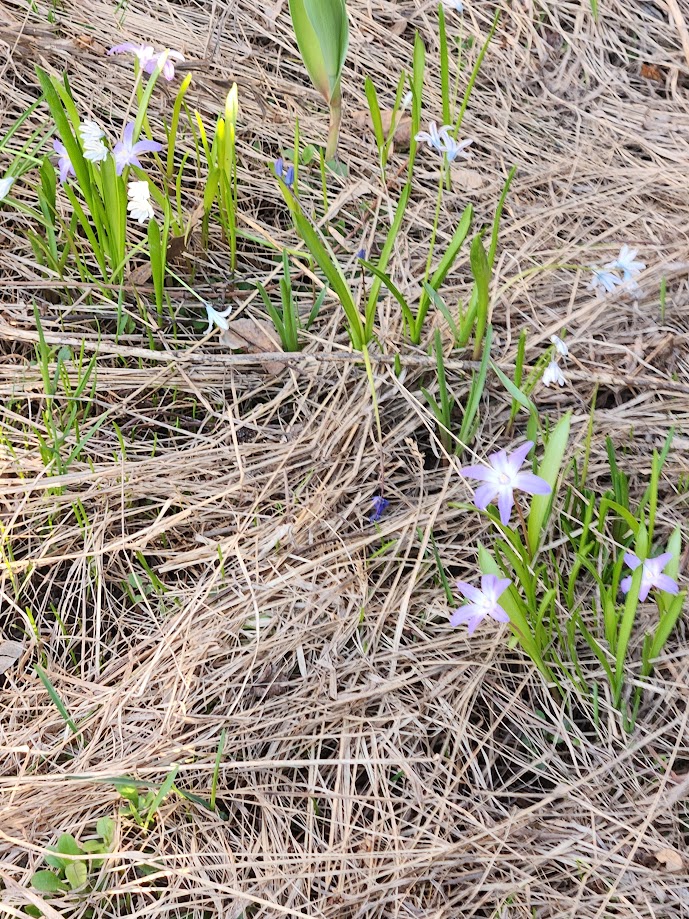
The weird part is that, despite the climate change thing, we actually had a winter this year and it held on long into spring. It’s really just been in the last couple of weeks that the plant world seems to have woken up. And now it’s playing catchup. HARD.

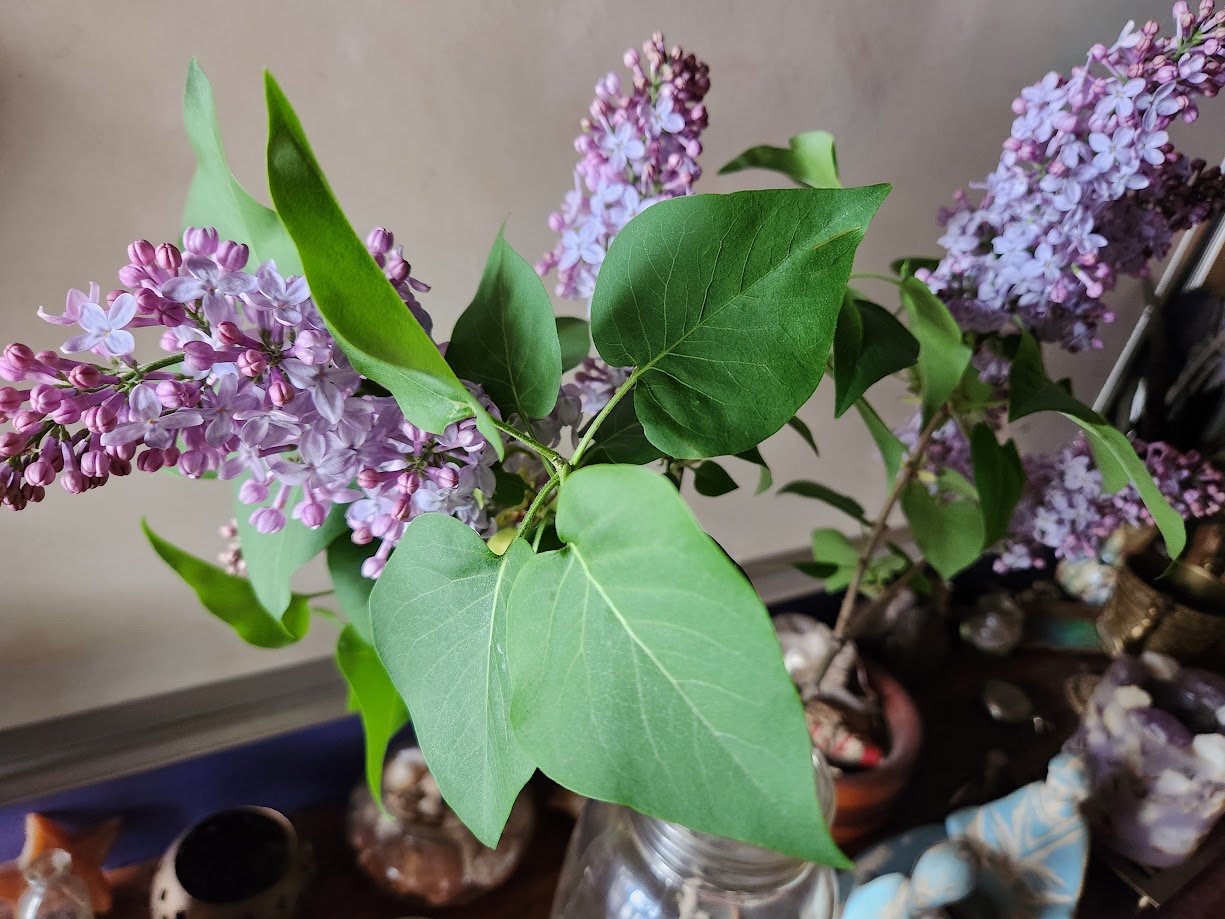
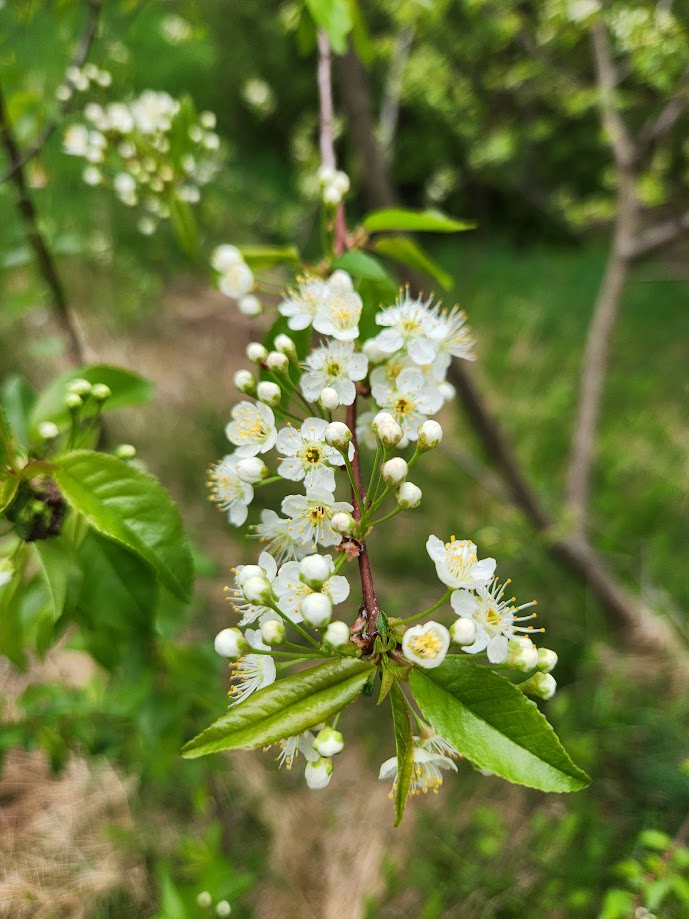
Usually, by the Victoria Day long weekend, the pin cherries and crab apples are in bloom, with lilacs in bud. We were about a week late this year, but in the last week of May, I gloried in the smells of the blossoms, and now that the lilacs were coming out, I celebrated by cutting a couple branches from the lilacs in my back yard and brought them in so I could revel in the smell even more.

I caught a spectacular halo around the sun while looking for the first sliver of the moon after the new.

Picture of a halo around the sun.

The Canada goslings are out! I walked a stretch of Lily/Junction Creek, and the families were everywhere. Every couple of metres, there was another gaggle, and because I was with Torvi, mom and dad swiftly ushered their goslings into the creek. But I caught one proud papa posturing before mama could do her duty.
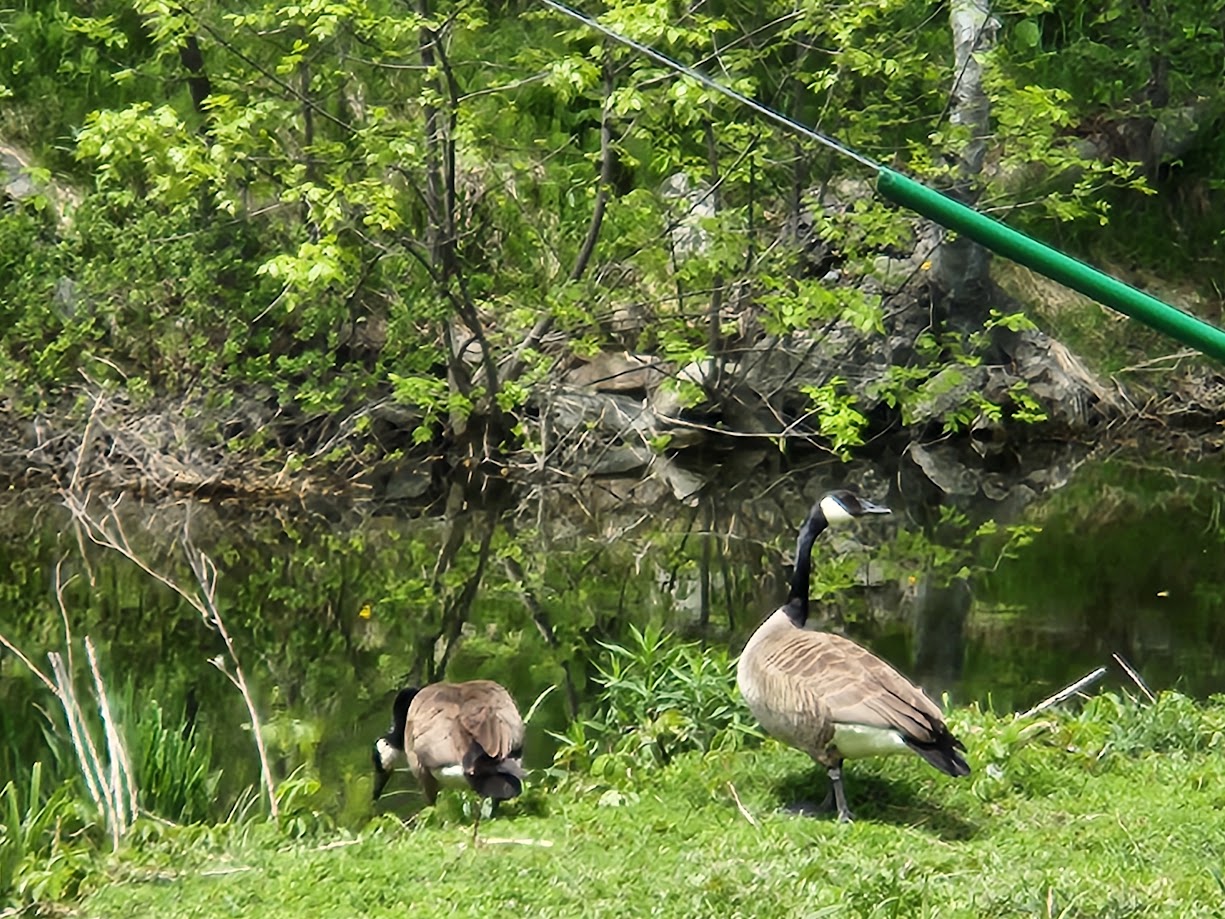
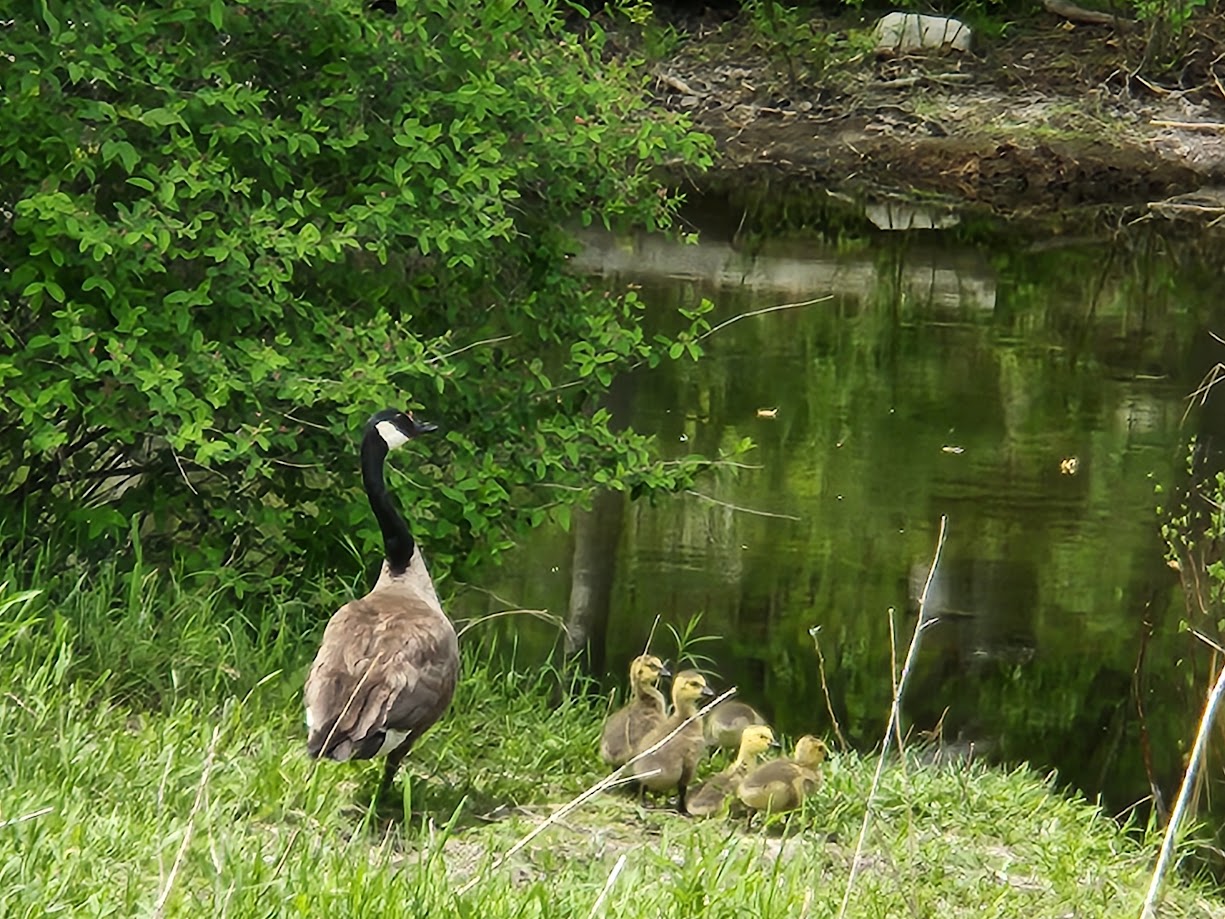
Urban wildlife makes me furiously happy.

The month in writing

I finally finished revisions on the final chapter of Reality Bomb on May 4th (may the 4th be with you!), but now the draft had ballooned to 123,077 words (!)

It was time to start my cutting pass.

At the end of the month, I’d gone through 12 and a half chapters and cut 692 words. At this rate, I’ll have to get more severe if I want to get even close to a 110k draft.

I wrote a poem and made a couple of poetry submissions before the end of the month. I also started work on a CNF flash piece that I hope to submit somewhere as well.

I received some disappointing news on the 21st. My application to the Banff Science Fiction program was not successful. This is particularly sad given that I’d withdrawn or chosen not to apply for various opportunities to make financial room for this program. I do have some available spending room for other stuff, now, but I’m not jumping in immediately. I think a low-spending year might be a good change.

In writing business, the Writers’ Union of Canada’ pre-AGM meeting fell on the 22nd and the AGM itself on the 29th.

There was an SF Canada board meeting on the 26th. Efficient, friendly. Stuff got done.

Also on the 26th, I was advised of another literary festival’s impending demise. As the special virtual meeting for this won’t be held until June, I’ll wait to disclose details.

Filling the well

The month began with Beltaine (I spell it the way I spell it). I lit up my altar and thought about growing things.

The full flower moon in Scorpio was on the 12th.

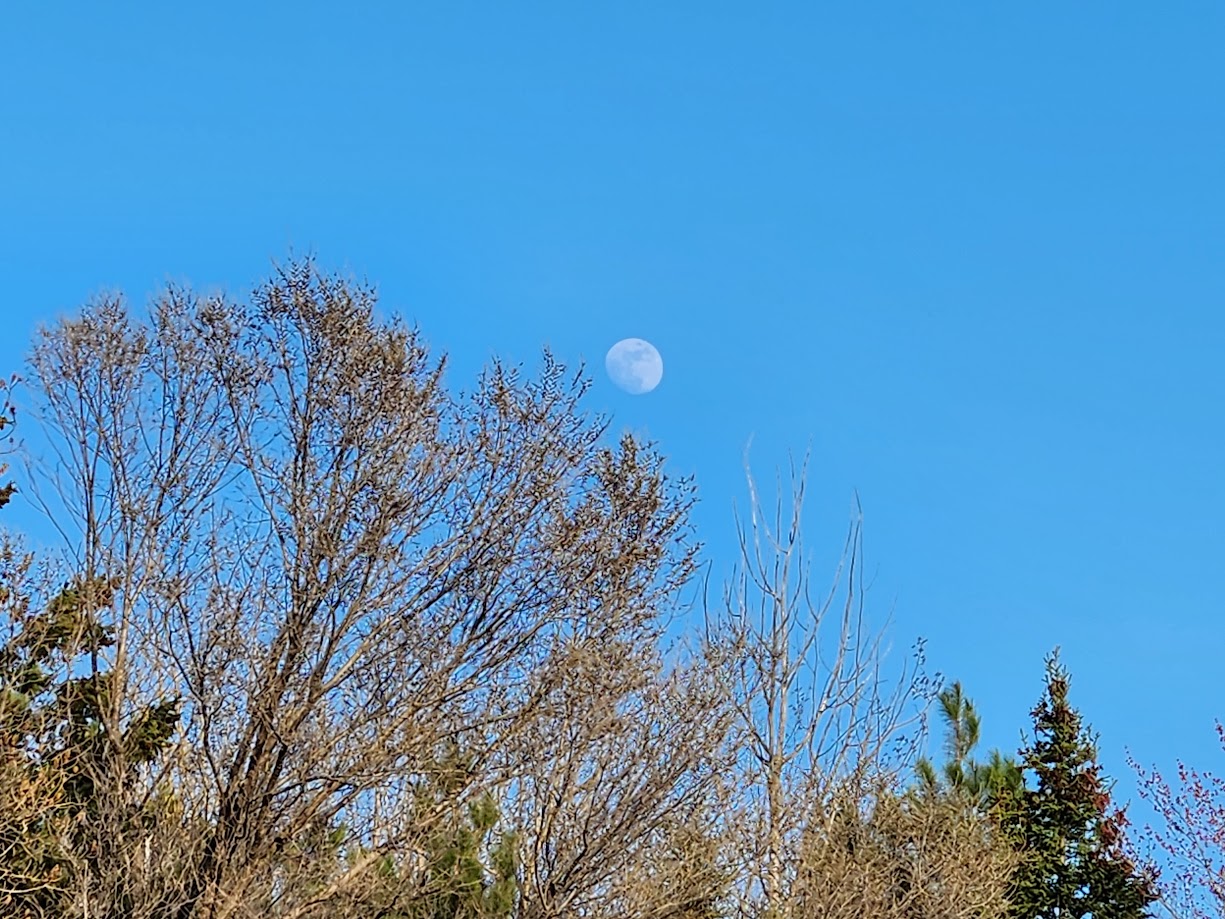
The new willow moon in Gemini was on the 26th.

Picture of a crescent moon.

The orchid I thought would never recover bloomed!
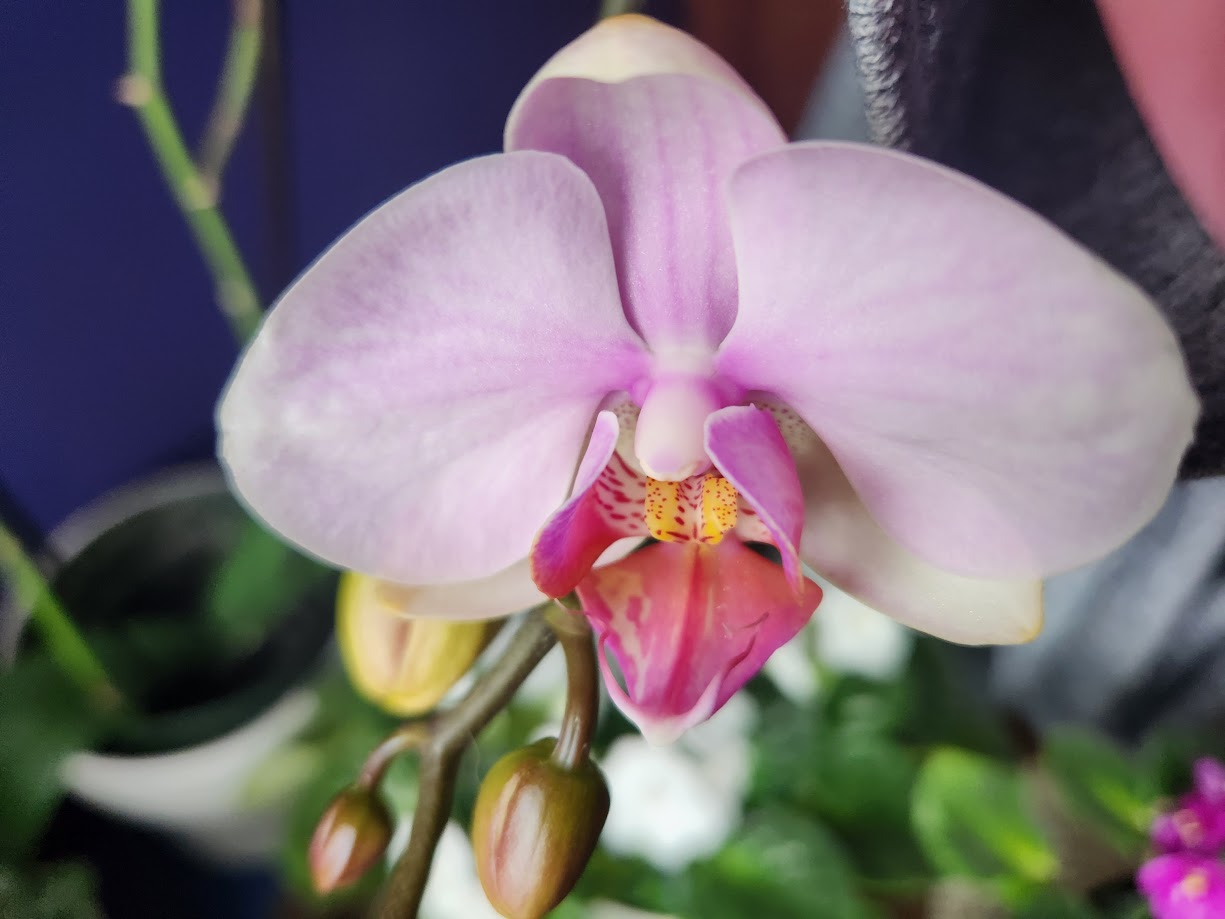
Picture of an orchid blossom.

In terms of writing-related events, I attended “Writing the World We Need” with Dani Abernathy on the 2nd. Good affirmation of the need to embrace diversity in all its forms in our work.

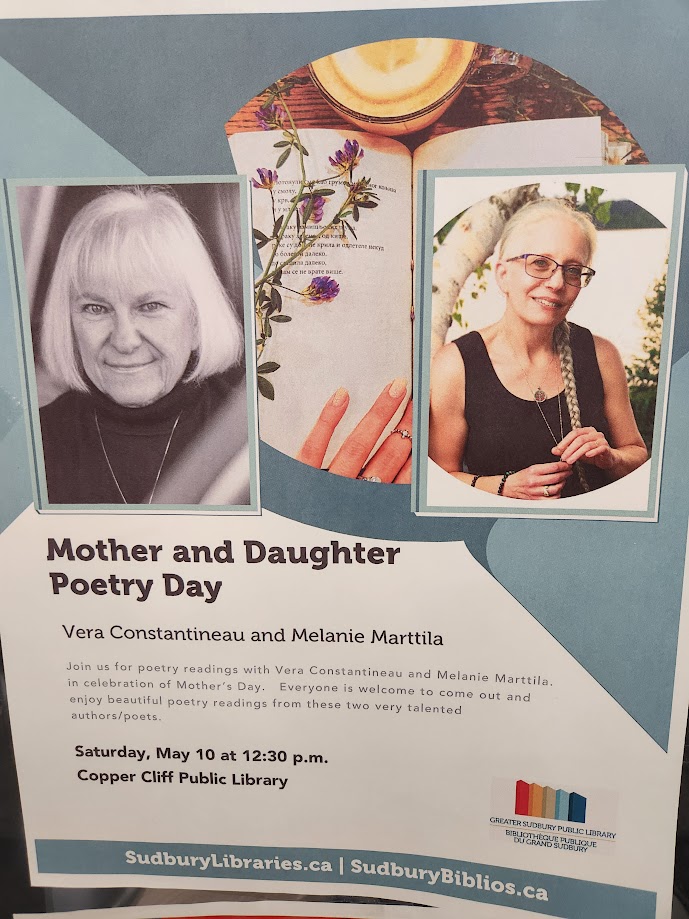
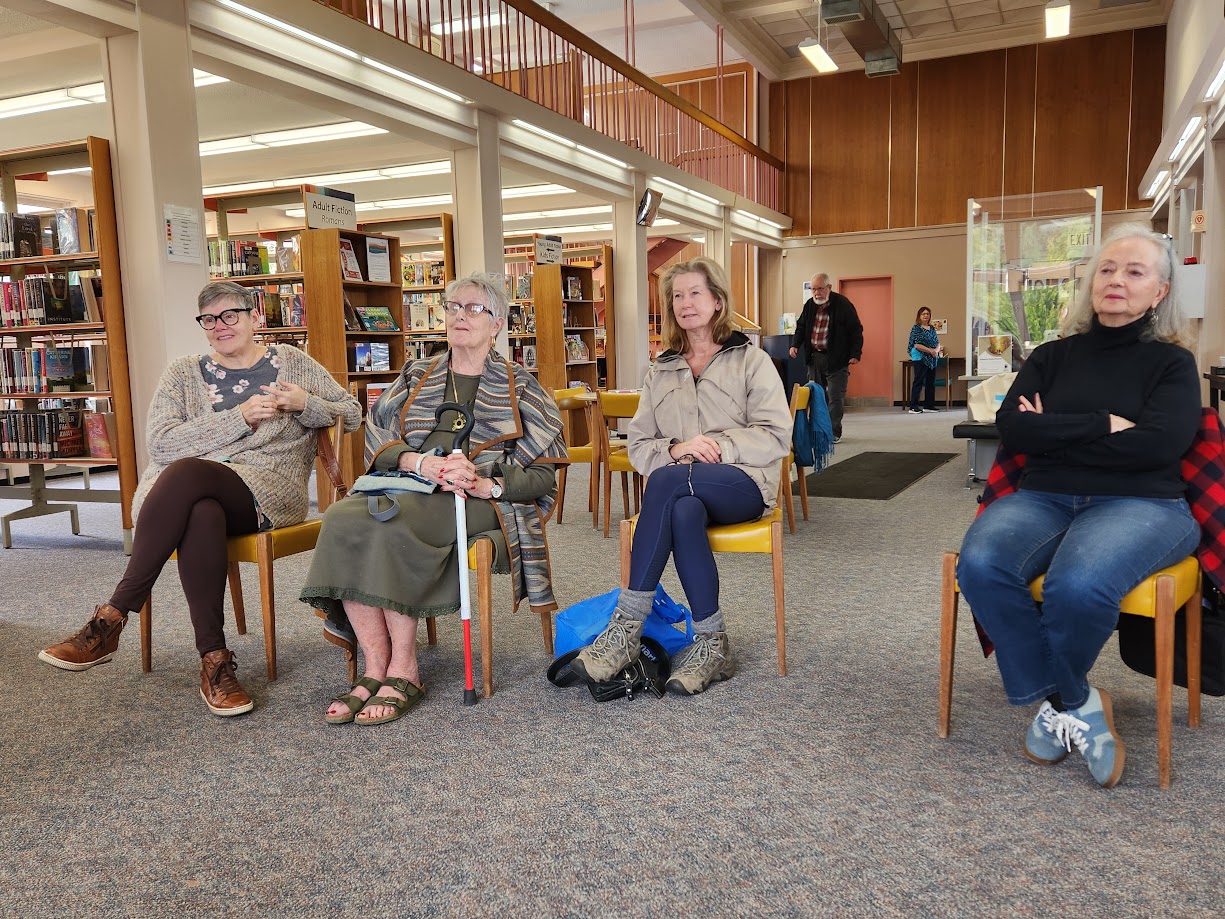
On the 10th, Vera Constantineau and I gave our Mothers Day poetry reading at the Copper Cliff branch of the Greater Sudbury Public Library. It was a lovely, intimate affair.
I signed up for a Bianca Marais webinar, “Circling the Building of Your Work” on the 13th. An interesting approach.

The final Finnish class of the spring session was on the 5th. Feeling accomplished and improved. I continued to practice with Duolingo, Inside Finnish Life, and a handful of YouTube channels. A classmate offered the link to an app, which I haven’t tried yet.

On the 3rd, I attended a combined family birthday party. We hadn’t managed to get together for Easter, so it was a nice, relaxed night out at a favourite local restaurant, Ali Baba’s.

The May Good Company meeting was on the 28th. The topic this month was about co-occurring conditions. I didn’t think I had many of these, but I have insomnia, GERD, eczema, restless legs, and I had menorrhagia and dysmenorrhea, and anemia. Just because I haven’t had EDS, MCAS, ME/CFS, IBS, fibromyalgia, chronic fatigue, or other significant issues doesn’t mean I’ve escaped co-occurring conditions altogether.

I had two days off work at the beginning of the month and Victoria Day long weekend, both of which were much-needed though only somewhat restorative (see above). Then, I started my sick leave after the May long weekend.

What I’m watching and reading

My first watch of May was The Book Thief (Disney +). It’s the sweet but harrowing tale of Liesel, whose Communist mother, after the death of her husband and son, gives her daughter up for adoption. Death, the narrator of the tale, takes an interest in the illiterate girl who will become the book thief.

I finished watching the first season of Daredevil: Born Again (Disney +). I like that it’s more or less a continuation of the Netflix series. The same darkness, the same Catholic self-flagellation, and the same bloody violence. I wasn’t as impressed by all the decisions made. To tell you which ones would be spoilers. All this to say that this was a solid entry in Marvel Television. They’ve finally found their footing after a couple of years of WTF series (Secret Invasion, anyone?).

Then, I finished watching the first season of Watson (CBS). A year after Holmes and Moriarty seemingly die by plunging off Reichenback Falls, Dr. John Watson returns to Philadelphia with a traumatic brain injury (TBI) that he’s still recovering from to open the Holmes Clinic. He’s a geneticist and has assembled a team of highly skilled young doctors to help him solve impossible medical mysteries using the deductive reasoning techniques he learned from Holmes. He’s also attempting to reconnect to his estranged wife Mary even as she asks for a divorce. And before the first episode ends, there’s evidence that Moriarty did not die and has nefarious plans for Watson, his team, and their clinic. The first episode was a bit of a fire hose, but the series settled into a pattern after that and resolved Watson’s relationship woes after a couple more episodes, streamlining the season’s throughline. Medical mystery of the week complicated by Moriarty’s machinations. It’s been renewed for a second season. I’ll watch it.

Next was the third season of Will Trent (ABC). Everyone’s dealing with the fall out from last season. You know, Will arresting Angie? No sooner is that sorted out, when Will is traumatized by accidentally shooting a kid, “saves” Faith’s son, Jeremy, from a drug bust by saying he’s a confidential informant, which he must then become, and Ormewood finds out he has a brain tumour. Add to that a fraudulent and murderous cult, a childhood friend of Will’s who’s now a gang leader (and technically Jeremy’s “boss”), and you have a wild and entertaining season. There’s more, but this series is one of the best to come out of network TV. You should catch it.

I also finished the latest season (six, I think?) of The Rookie (ABC). Bailey is hunted by her recently-escaped criminal ex. Nyla and James are trying to balance her police work with his community activism. Tim and Lucy are trying to figure out what they are. There are two new rookies, one of whom is a problem. The usual assortment of crises abounds, and a few old enemies show up to make things interesting. I’ll keep watching.

Then, I finished watching the latest season of Grey’s Anatomy (ABC). Yes, I’m still watching 20 seasons on. The usual soap opera, ending with a literal blast.

Next, I watched the first season of X-Men ’97 (Disney +). The animation is a significant improvement over the original series, and I liked the stories better. I won’t say more, but if you’re a fan of the original or the comics, you’ll probably love X-Men ’97.

I finished season two of The Last of Us (HBO). This one’s rough. If you’ve played the game, you know what happens, and though I haven’t played the game, I had some spoilery insight from New Rockstars. Still, episode two hit hard, and the rest of the season dealt with the emotional fallout of those events. Bella Ramsey is STELLAR. The final episode ends on a cliffhanger before restarting the Seattle timeline, this time, from Abby’s perspective.

Next up was the final season of The Handmaid’s Tale (CTV Drama). I’m just going to spoil it all. You have been warned. June and Serena have a moment on a train, which June then shoves Serena and her baby Noah off, albeit to save their lives. June and Nicole reunite with June’s mother in Alaska. Serena, after a brief respite with a commune, is taken to New Jerusalem. June leaves Nicole in Alaska and hurls herself back into the fight. Their first target, Jezebel’s – to kill the commanders and free the former handmaids – is foiled by a weak-willed Nick, admittedly in a tough spot, who gives away the plot to save his own skin, resulting in the mass murder of all the girls but Janine at Jezebel’s. Reeling from the betrayal, June despairs, then rallies, deciding to infiltrate Serena’s upcoming wedding to kill the commanders and free the handmaids there. While this plot is more successful, the high commanders survive and June and Moira are caught with their group of handmaids, including Janine. They’re about to be executed when Luke and a bunch of Mayday resistance fighters open fire and American troops arrive. Serena, captured in the chaos, reveals where the high commanders plan to meet. June convinces Lawrence to plant a bomb on the high commander’s plane, but the other commanders arrive, and he must board. At the last minute, Nick arrives and boards the plane too. June watches as the plane ascends and then explodes. The last episode is slow and reflective. Janine is reunited with her daughter, Charlotte, Serena is sent to a refugee camp, June’s mom arrives with Nicole, and June and Luke go their separate ways, each determined to destroy what remains of Gilead and find Hannah. They promise to reunite in Colorado, where Hannah lives. There’s some Aunt Lydia action, and Emily returns in the final episode, so we get an update on her, too. And . . . of course, June begins to write a book about her experiences. I would have liked to see more of Moira, but the focus of the last episode was firmly on the white women. Here endeth the spoilers.

I watched Mickey 17 (Crave) over several sittings. Loved this absurdist sci-fi and its message that kindness and love will overcome fascism and cruelty every time.

Finally, I watched the latest series of Doctor Who (Disney +). Phil started watching it with me, but lost interest. Ncuti Gatwa hasn’t captured him, I guess. I thought the season was interesting and, in Russel T. Davies fashion, many of the disparate episodal stories all came together in the finale. The only spoiler I’ll offer: the next Doctor is being played by Billie Piper?!


 My first listen of the month was Japanese Fairy Tales, by Yei Theodora Ozaki. While there are some similarities to European fairy tales, most notably the tale of a princess, or hime, whose stepmother wishes to kill her (like Snow White), the tales are not often as cruel or bloody. Several of the villains renounce their evil ways. Many of the tales focus on animals as helpers, and some of the tales are bittersweet.

Then, I listened to Mary Robinette Kowal’s The Martian Contingency. I love these books so hard! The last novel in the series followed Nicole Wargin on the moon while Elma York, the Lady Astronaut, was on her way to Mars. Now, we return to Elma’s story on a second Mars mission where she and her fellow colo—sorry, inhabitants—are busy paving the way for the next wave of families from Earth. She had to stay in orbit with Stetson Parker on that first mission. This time, she gets to land and work with her husband, Nathaniel (!) Seriously, stable, loving relationships are at the heart of these books. And Kowal writes them so well! But soon, gaps in the first mission logs become apparent, and as Elma investigates, the mystery deepens until an equipment failure puts future landings in jeopardy. As the truth is unearthed, Elma learns the terrible secret of the first Mars mission and must bring her crew together as Martians to get Bradbury Base back on track before Mission Control pulls the plug on Mars altogether.

Next was Traditional Irish Fairy Tales by James Stephens. These are tales from the Fenian Cycle of Irish mythology framed by an attempt by Finnian, the Abbott of Moville, to convert Tuan mac Cairill to Christianity. Tuan recounts his origins and then launches into the tales of the Fenian Cycle. Very different from the other cultural tales I’ve read recently and very good.

Then, I finished the Tensorate Series by Neon Yang. This is a collection of Yang’s three novellas, The Black Tides of Heaven, The Red Threads of Fortune, and The Descent of Monsters, which focus on Akeha and Mokoya, the twin children of the Protector. The first novella is Akeha’s story, following them and their sibling Mokoya as they are sold to a monastery as part of a deal made before they were born, from childhood to adulthood, when Akeha makes the decision to support the Machinist rebels.

The second novella follows Mokoya, grievously injured in the climactic events of the first novella and still grieving the loss of her child. She was a prophet and lost that ability, as well. She runs from her grief by hunting naga (dragons) until she is forced to face it, and a huge naga that can tens.

The third novella is an epistolary one, told through journal entries and reports, redacted and whole. It covers an investigation into atrocities committed at a classified research facility that threaten to expose secrets the Protectorate wants to remain hidden.

While I enjoyed the first two novellas, the third was a little tedious, especially when it came to the redacted reports. I loved Yang’s worldbuilding, though. Every child gets to choose their own gender and is offered state-sponsored reassignment surgery provided by tensors. Magic is called tensing, its practitioners, tensors. And they have raptors as mounts and animal companions. Very cool.

I listened to a short audiobook, Listening to the Big Bang by Brian Greene. He covers the history of the big bang theory and all the physicists who contributed to it, opposed it, and where the theory stands today.

Next, I finished the romantasy The Twisted Throne by Danielle L. Jensen, book 5 in The Bridge Kingdom series. What is it with me and reading things out of order? Because Jensen focuses on a different character’s journey every couple books (so, it’s more like a series of interconnected duologies), I started at a good time.

Book 5 tells Ahnna’a story. She’s not only a princess of Ithacana and twin sister to it’s king, Ahren, but a soldier who put her life on the line for her people. The war left Ithacana impoverished, though, and Ahnna blames herself, so she willingly goes to Harendell when its king calls in the terms of a long-held agreement between the two kingdoms. Ahnna will be wed to King Edward’s son, William, who is an irresponsible spendthrift. Still, Ahnna needs Harendell’s wealth to feed her starving people. But the longer she stays in Harendell, the more political intrigue she uncovers, and the closer she gets to the wrong prince.

Then, I listened to Great Heroes and Heroines of Hawaiian Heritage by Leilani Basham, another Great Courses and Audible Originals collaboration. Basham covers some of the key figures, men and women, of Hawaiian history from the 19th and 20th centuries and how the colonization of Hawaii was and is still being resisted and shaped by its Indigenous people. This tragically familiar history hits all the marks, from cultural genocide to the recovery of the Hawaiian language and culture. Existence is resistance.

And that was the month in this writer’s life.

Until next month, be well and stay safe; be kind and stay strong. The world needs your stories!
The next chapter: A month in the writerly life. https://melaniemarttila.ca

I acknowledge with respect that I am in Robinson-Huron Treaty territory, that the land from which I write is the traditional territory of the Anishinaabe and home of Atikameksheng Anishnawbek and Wahnapitae First Nation.

Thoughty Thursday: Things that made me go hmmmm on the interwebz, Jan 24-30, 2021

It’s Thursday, and you know what that means. Tomorrow is Friday! Prepare yourself for the weekend by getting your mental corn popping.

Dalton Walker reports how the “parade across America” has an Indigenous touch. Indian Country Today

Mali Obomsawin: this land is whose land? Indian country and the shortcomings of settler protest. Smithsonian Folklife

Mildred Europa Taylor wants you to meet the eight-year-old neuroscientist who teaches online from a lab in her bedroom. Face2Face Africa

Russell Contreras: Biden picks up his pen to change the tone on racial equity. His first set of executive orders puts a “down payment” on the promise of racial justice in America. Axios

John Haltiwanger notes that Biden administration speeding up process to put Harriet Tubman on $20 bill. Business Insider

Maudlyne Ihejirika announces that the Emmett Till childhood home is now an official city landmark. Chicago Sun Times

Stephen Humphries reveals the new museum celebrating African American music from Ella to Beyoncé. Christian Science Monitor

Amir Vera and Raja Razek: two Kenosha police officers, on administrative leave since the Jacob Blake shooting, are back on duty. No justice. CNN

Doha Madani reports that the Black woman whose children were handcuffed and held at gunpoint by police sues Aurora, Colorado. NBC News

Defense Secretary Lloyd Austin demands US military sexual assault reports. The Guardian

Lauren Frayer: protesting farmers flood India’s capital, storm historic fort. NPR

The pandemic that lasted 15 million years [Say what, now?] | PBS Eons

L.D. Burnett posits that there is no such thing as cancel culture. Only culture, shapeshifter that it is. Arc Digital

Kim Fahner responds to Bell’s let’s talk day: of whales, icebergs, and mental health … The Republic of Poetry

Sara Jaffe: notes on queer conception and the redefinition of family. JSTOR Daily

Dr. Becky shares the new evidence against dark matter.

Robert Z. Pearlman shares that Axiom Space names the first private crew to visit the ISS. Scientific American

Earth has a second magnetic field. SciShow

Fiona Harvey: global ice loss accelerated at record rate. The Guardian

These pools support half the people on Earth. Veritasium

Cal Flyn reports that as birth rates decline, animals prowl out abandoned “ghost villages.” The Observer

Nina Munteanu: when nature destroys … and creates.  

Thank you for spending some time with me. I hope you took away something to inspire your next creative project.

This weekend, I should be posing my January 2021 next chapter update.

Until then, be well and stay safe, be kind, and stay strong. The world needs your stories!

NaNoWriMo 2020, week 4 update

Holy cow! The last week of November was another week of weeks 🙂 It took me a couple of days to recover. Hope you don’t mind.

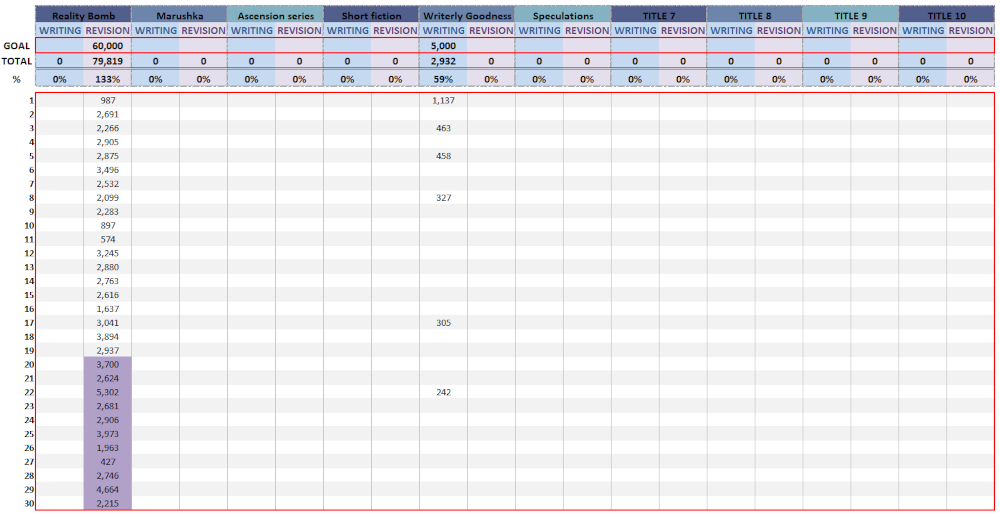
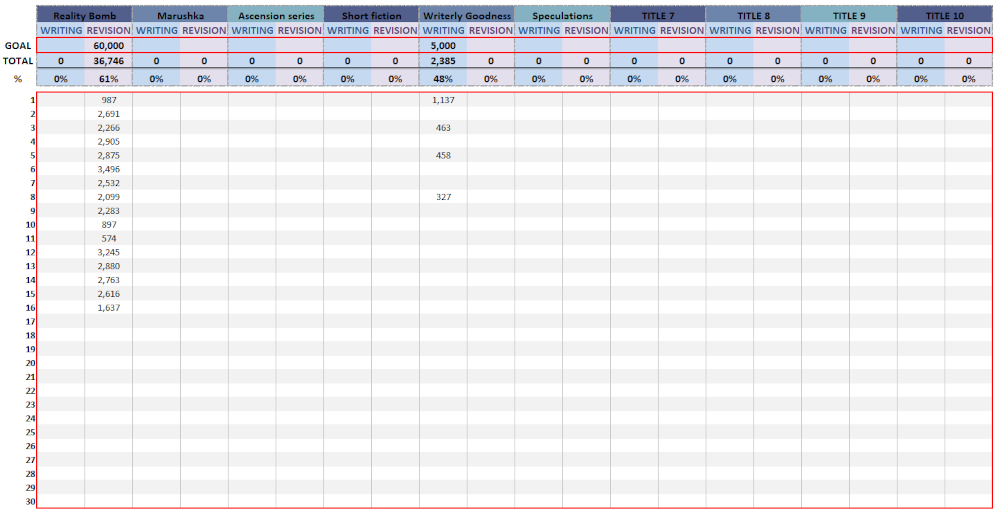
I reported last week that I’d revised my 50k to “win” on Nov 20th. On the 23rd, I met my personal goal of revising 60k. As of the 30th, I’d revised 79,819 words, though I was not quite at the end of the draft.

I’m still not at the absolute end of it, but I’m withing a couple of pages. At this point, I’ve only cut a little over 14k. I’ll give you the definitive number in this weekend’s next chapter update.

My crazy NaNo graphs.

Mom’s doing better every day and transitioning from soft foods to a normal diet. She’s gotten her proper walker and the loaner should be returned. A friend gave her a lovely bouquet of roses and she’s been chatting on the phone and taking the occasional, physically distanced visitor.

On Thursday last week, I received THE LETTER OF OFFER for a new position at my employer. It’s what I’ve been working toward for the last ten years or so. Two days in, and I’m feeling welcomed and optimistic and all kinds of good. It’s an acting position, but everyone’s hoping that everything works out.

On that note, I shall leave you with a squeeeeeee!

Curation will resume next week.

In the meantime, be well and stay safe, be kind, and stay strong. The world needs your stories.

NaNoWriMo 2020, week 3 update

Just a quick update this week, though it has been a momentous week.

Mom was released Monday evening. Though we were a bit surprised, we figured the hospital didn’t want her staying longer than necessary, because covid. Phil and I have been taking care of her (mostly Phil as I’m still working during the week) and Mom has graduated to soft foods. All is going well.

As of November 20th, right on schedule (according to the NaNo site), I “won” NaNoWriMo. That is, I edited just over 50k words. I’ve now cut 12,627 words from the draft. I have eight chapters left and don’t think I’ll meet the goal of cutting 30k this time around. Maybe I’ll make 20k, but not 30k.

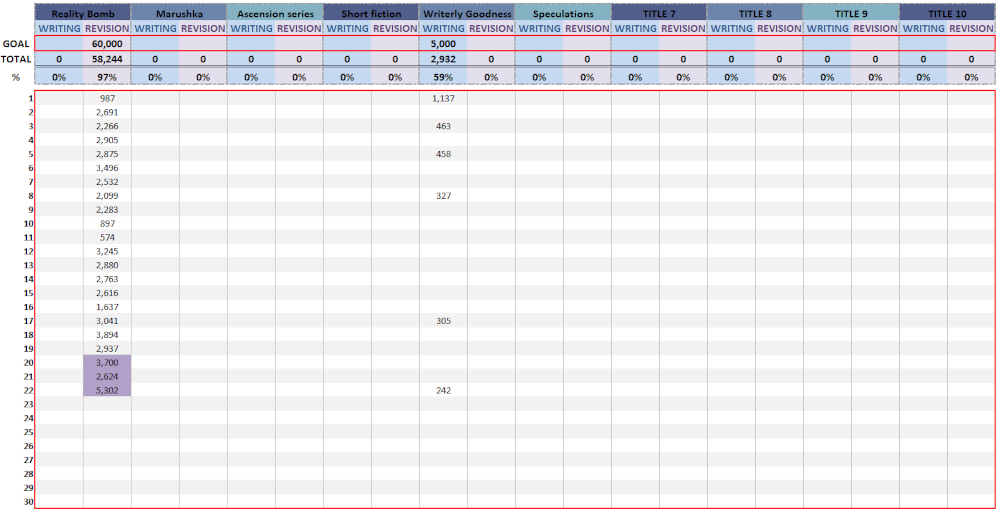
I’ve revised 58,244 words in November. I had revised 24,714 words at the end of October. I’ll keep going until I’m finished with the draft.

Fortunately, I have until Dec 25 (yeah, yeah—I’ll be giving my critique group a Christmas gift) to give the draft another sweep and cut those extra words. I think I’ve got the story structure in good shape, though. I’ll have to parse the draft at the end of the month to say for sure (are the plot points coming at the right percentages of the draft?).

So that’s my progress this week.

Until next week, be well and stay safe, be kind, and stay strong. The world needs your stories!

NaNoWriMo 2020, week 2 update

I’m late with this update (duh). For reasons.

Last Monday afternoon, my mom got sick. On Wednesday, she asked Phil to take her into emergency. Neither of us could accompany her because covid. That evening, we finally heard from the hospital. Mom was in recovery. Unfortunately, she wasn’t settled in a room until after visiting hours were over.

I didn’t find out the details about her surgery until the following day when I was screened in as her “health partner” or designated caregiver. Thank goodness my employer offers family-related leave.

Mom was discharged yesterday evening. It felt like it was a little early, but they didn’t want to keep her longer than necessary, again, because covid. Phil went to pick her up and we got her home and settled, changed her bed and got her into it, and then Phil ran around to get her prescriptions filled and the clear fluids she’ll be on for the next week or so.

Understandably, I didn’t have time to put this update together until today.

I continued to edit Reality Bomb though there were a couple low-count days (right around when Mom was admitted to the hospital, wouldn’t you know), but I kept at it, as was able.

As of yesterday, I have revised 36,746 words and I’ve taken the original draft of 120,071 words down to 110,753. So far, I’ve cut 9,318 words off the draft. NaNoWriMo predicts that I will reach my goal of 50,000 words edited by November 22. I’m at chapter 24 of 38.

I’m thinking that I might manage another four or five thousand words cut by the time I reach the last chapter. I’ll take another run at it in the time I have remaining in the month and see what additional damage I can do.

And that was my eventful week!

Until next week, be well and stay safe, be kind, and stay strong. The world needs your stories!

Tipsday: Writerly Goodness found on the interwebz, Apr 7-13, 2019

Happy Tuesday! Time to reward your hard work this week with some informal writerly learnings.

Rheea Mukherjee explains what it’s like to be the bi-cultural writer. Jim Dempsey helps you discover your characters’ goals. Sarah Callender asks, so you think you can write? Kathryn Craft encourages you to use short story collections as novel prompts. Writer Unboxed

James R. Preston has a conversation about pushing the envelope of first person. Becca Puglisi discusses first pages and character emotion. Julie Glover shares ten things she learned from ten years of writing. Writers in the Storm

K.M. Weiland: what is the relationship between plot and theme? Helping Writers Become Authors

Sara Letourneau provides some exercises for exploring the theme of family in your writing. Later in the week, Jeanette the Writer looks at five famously rewritten novels. DIY MFA

Jami Gold is worldbuilding a series but writing without a plan.

Oren Ashkenazi analyses six unsatisfying character arcs. Mythcreants

Nina Munteanu explains how walking in nature helps her write.

Jenna Moreci updates her list of the top ten worst romance tropes.


For balance, Jenna also shares her ten favourite villain tropes.


Jessica Leigh Hester: for centuries, know-it-alls carried beautiful, miniature almanacs wherever they went. Atlas Obscura

Nicola Davis reports on the latest research indicating that Beowulf was the work of a single poet. The Guardian

Alison Flood: “extraordinary” 500-year-old library catalogue reveals works lost to time. The Guardian

Thanks for stopping by and I hope you found something to feed your creative process or craft.

I invite you to return on Thursday for some thoughty inspiration.

Until then, be well!

tipsday2016

Tipsday: Writerly Goodness found on the interwebz, Feb 10-16, 2019

Here we are. How is it already the third week of February? Console yourself with some informal writerly learnings *hugs*

Louise Tondeur guest posts on Jane Friedman’s blog: the myth of plan first and write later (or, you never only write one way).

Rheea Mukherjee joins Writer Unboxed: writing characters who are “smarter” than you.

Kathryn Craft: your story’s valentine to the world (AKA, your query, synopsis, and pages). Writer Unboxed

K.M. Weiland critiques a brave writer’s work to show how paragraph breaks guide the reader’s experience. Helping Writers Become Authors

September C. Fawkes says, look forward, not backward, to pull your reader in. Writers Helping Writers

Margie Lawson stops by Writers in the Storm to help you put fresh faces on the page.

Sara Letourneau offers some further reading on the theme of family. DIY MFA

Becca Puglisi visits DIY MFA: five vehicles for showing emotion.

Chris Winkle: optimizing your story ideas for stronger engagement. Then, Oren Ashkenazi reveals six mistakes that can kill a great plot. Mythcreants

Chuck Wendig says, your ideas aren’t that interesting. This is less about making you feel bad than about making sure your ideas don’t take the place of, like, actual writing. Terribleminds

In honour of Valentines, Jenna Moreci offers her top ten tips for writing sex scenes. [Features discussion of sex and sexuality. Yeah. Even so, had to be said.]


Krista D. Ball rants: why is AUTHOR NAME taking so long to write their next book? This made me wonder if these impatient readers think they own writers? At the cost of $10 to $20 per book? Really? Gear down, people. Reddit

Later in the week, an 11:45 pm amber alert (and subsequent rescind after midnight) in Ontario resulted in a strange outcry of people who didn’t want their sleep disturbed, even after they learned that the child featured in the alert had been murdered. Seriously? Disturb me all night, every night, if it saves a life.

On that boggling note, I leave you until Thursday, when you can come back for some thoughty.

Until then, be well, my friends.

tipsday2016

How my life sentence with mortal punctuation has informed my writing

A.K.A. The period at the end of this series 🙂

I’ll preface this bit by saying that I don’t think I’m unique among writers in this respect.  In fact, I think every writer works, at core, with and through the same issues.  This past week, I read (and shared) a great interview with Chuck Wendig in which he talks about (among much other awesome) the themes that crop up in his work.  Surprise, surprise, death and family rank prominently.

In this morning’s The Sunday Edition with Michael Enright, one of the Canadian greats (with whom I was privileged to work, even though he didn’t like my genre/subject matter) Alistair MacLeod, mentioned the same influences and themes.

Think of just about any author you’re reading or have enjoyed, and I think you’ll find death and family cropping up: Rowling’s Potter books were all about death and the search for family despite its omnipresence; Martin’s Song of Fire and Ice is about a number of families and he keeps on killing off prominent members 😉 (note here: in this context, what is politics, but family drama writ large on the world stage?); Collins’s Hunger Games = Death/Family; Gabaldon’s novels are a series of time travelling family sagas and death plays a prominent role.

I could go on, but I won’t.  Search your own shelves/ereaders to find your own examples.

What’s unique about me is my story, my life, and I hope that translates to my characters so that even though the theme may be familar, the way that it is expressed through my characters and stories is something just a little different.

Death

Death finds its way into a lot of my stories in different ways:

In my first published short story, “Chlorophyll and Corruption” (which is probably the prologue to a YA sci-fi), my protagonist first saves his brother from being pushed out of their atmospheric containment bubble, then must flee an impending supernova. “For a Change” (which I have subsequently rewritten as “The Gabriel” and may yet become a sci-fi novel) my protagonist’s reaction to a world of sterile Transmat immortals is to attempt suicide, repeatedly.

In “Fox Fur,” my protagonist is trying to deal with the death of her parents by means of various encounters with foxes.  “Dead Issue,” is about a young woman who makes a personal discovery at a family funeral.

“Tonsillitis Blues” from my 1999 MA Thesis, Whispers in the Dark, is an interpretation of my adult exploration of the near-death experience prompted by my tonsillectomy trauma.  The protagonist of “Fool’s Journey” (subsequently rewritten as “A Terrible Thing” and likely a YA paranormal novel), another story from the same collection, attempts suicide because she can’t deal with the visions of danger and death she’s been gifted with.

Even my poetry is liberally sprinkled with death.

Ferathainn, the protagonist of Initiate of Stone, experiences the deaths of her best friend,

English: Colored version of the ancient Mesopo...

English: Colored version of the ancient Mesopotamian eight-pointed star symbol of the goddess Ishtar (Inana/Inanna), representing the planet Venus as morning or evening star. (Version not enclosed within a surrounding circle) Polski: Kolorowa wersja symbolu ze starożytnej Mezopotamii, ośmioramiennej gwiazdy Bogini Isztar (Inany/Inanny), reprezentujacej planetę Wenus jako poranną lub zachodnią gwiazdę. (Photo credit: Wikipedia)

fiancé, and father, and subsequently dies herself attempting to exact revenge.  She undergoes an Inanna-inspired journey into the underworld to reclaim herself and her will to live.  Eoghan witnesses the execution of his brother for heresy and when the goddess Auraya calls him to become her champion, or Kas’Hadden (hammer of light), he experiences an assassination of personality at her hands.  Dairragh, deeply affected by the death of his mother years earlier, inadvertently triggers the destruction of his home and the death of his father.  He succumbs to his wounds and is resurrected and set on a shamanic path by the mysterious anogeni.

I won’t get into the protagonists of my other unpublished works, but death and its impact are recurring themes.

Death is the period of every life sentence and so it is a universal.  Few readers will fail to be engaged by various explorations of death and its impact on those left behind.  Thrillers and mysteries are built around it and are two of the most popular genres in publishing today.

Family

Likewise, everyone has a family.  Even the only child who has chosen not to have children of her own (like me) has parents and understands the pull of the complicated legacy handed down to them.

In my, admittedly small, family, women proved to be the peace-makers, sacrificial lambs, care-takers, bread-winners, and all around protagonists of the story.

My maternal grandfather was an alcoholic and a womanizer.  He and my grandmother were unable to have children and adopted my mother and aunt.  My grandmother worked in a textile mill during the depression and worked for most of her life until her first major heart-attack forced her into early retirement.

On my father’s side, my grandfather died at a relatively young age because of heart failure and my grandmother was an entrepreneur.  I still meet people in Sudbury who hear my name and ask if it was my grandmother who owned Marttila Sewing Centre.  Yup.  That was her.  She remained fiercely independent until stroke and cancer eventually took her life.

My father was always an ill man and though he was the bread winner for most of his life, it was my mother who held the family together, getting her high school diploma and driver’s licence in her forty’s and starting a new career as a ward clerk in the hospital when my father had his breakdown.  My mother was the one who cared for her parents and my father until their respective deaths.  Though she doesn’t have to, she still takes care of me.

It’s no wonder then, that my work focuses primarily on strong female characters.

Incidentally, here are a couple of posts I came across this week from Marcy Kennedy on strong and likeable female characters.

I had trouble for many years writing strong and likeable men because that was an archetype largely absent from my experience.  I found my way to that eventually, though, because of Phil, and because I learned to recognize the good qualities in the men in my life and expand those into heroic proportions.

Everyone is a mix.  My paternal grandmother may have been a business woman, but she was a poor fiscal manager, and tried too hard to curry favour with the well-to-do women of Sudbury (read sycophantic).  She first promised my mom inheritance of her business, then rescinded the offer and sold the business to a third party.  I think this was because she was too embarrassed to let my mom see what a shambles she’d made of things.

Though family dynamics run through all of my stories and novels, I’ll just present one example, from IoS, because it’s going to take a while to break down for you 😉

Ferathainn’s family in IoS is complex.  Her parents, Selene and Devlin, can’t have children and adopted Fer when she was abandoned by a bedraggled, but clearly noble, woman who refused to speak and ran away before she could be made to explain anything.

Devlin, feeling the need of a child of his blood, fathered Fer’s half-sister Aislinn, with Willow, a family friend and eleph (read elf).  Willow is misanthropic and makes her living as a brew-master and owner of the local public house.  She readily gave Aislinn into Selene and Devlin’s care.

Aislinn is obviously a half-breed, and largely reviled by the Tellurin (human) villagers of Hartsgrove as a freak. She is destined to become a bridge between the eleph and Tellurin peoples, however, by virtue of her heritage.

When Selene and Devlin adopted Fer, the resident eleph, Willow and her brothers Oak and Leaf, invited the new family and Aeldred, the local mage, to a Shir’Authe.  The Shir’Authe foretells the destiny of the child in eleph culture.  At the ceremony, none of the eleph can see anything about Fer’s future, but Leaf sees his spirit-lights, or astara, in the baby’s eyes (if you’re an Elf Quester, this is recognition, if you’re a Meyers fan, it’s imprinting).  This is bizarre enough, because only eleph are supposed to bond with one another in this way.

Selene, understandably, freaks out, but Leaf promises never to act on this deep spiritual attraction unless Fer somehow miraculously sees her astara in his eyes, or otherwise returns his feelings once she is gown.

Aeldred senses a wild and powerful magickal talent in the infant.  He fears that he will not be able to control the child and that she will become a rogue mage.  She has the potential to wreak havoc on their world and her talents will be much sought after, by moral and immoral authorities, both magickal and political.

In an attempt to minimize Fer’s potentially negative impact, he merely tells the others that she has talent and that he will remain in Hartgrove to become her teacher.  He further tells them that Fer’s parents are powerful, but immoral, people and that they must protect the child in the event that either one, or both blood parents, come seeking her.

He gets everyone to agree to a magickal binding.  None of them will be able to speak of the circumstances of Fer’s birth or of her coming to Hartsgrove until the girl comes of age.  By then, Aeldred hopes that he will have thoroughly indoctrinated Fer in the disciplines of the Agrothe magicks and that he will therefore be able to control her chaotic potential and prevent her from doing harm.

In truth, Fer’s parents are Aline of Gryphonskeep and Halthyon, an eleph mage, or kaidin. Aline is descended from the de Corvus family and magick flows through the bloodline.  The original Kas’Hadden was a de Corvus, so the power of the gods has been passed down to Fer.  Aline is married to Killian of Gryphonskeep and mother to Dairragh (dun, dun, dun!).

Halthyon is one of those rogue magi that Aeldred worries about.  He has extended his lifespan far beyond the already lengthy eleph standard.  His goal is to accumulate magickal power (by draining it from others as he kills them) and to ascend to godhood (in the process of which he intends to kill the existing gods of Tellurin).

Halthyon is unable to extract the child’s location from Aline and subsequently kills her in the attempt.  He wants to find his child because he considers her the only person worthy of ascending with him.  In order to do that, Fer must become a god-killer as well.

Okaaaaaay.  So there, in a convoluted nutshell is the familial basis of the plot of not only

English: St. Etheldreda's Churchyard - Family ...

English: St. Etheldreda’s Churchyard – Family Plot with Snowdrops (Photo credit: Wikipedia)

IoS, but the ensuing novels in the series, which I have called Ascension.  You can see why I identify the book in the epic fantasy genre 😀

Family is an endlessly intriguing Gordian knot to unravel and I think you can see where I have mined my tapestry to create Fer’s.

It’s all variations on two essential themes.

How have your life experiences contributed to your creative work?  Do death and family inform your stories?  Do you have a family-plot?

I’d love to hear from you!

Here ends the series that was A life sentence with mortal punctuation.  I hope you have enjoyed it, and found it to be useful in your creative pursuits.

Coming soon: I’ll have a book review for Laura Howard’s The Forgotten Ones, and hopefully a couple of author interviews to throw your way.  I’ll definitely share my experience in Margie Lawson’s  A deep editing guide to making your openings pop course, and in Marcy Kennedy’s Crafting your logline and pitch workshop next weekend.  There might even be some Pupdates and Next Chapters in there.

The one where I post about Dad: A life sentence with mortal punctuation, part 9

You may have noticed that I didn’t post in my series last week.  Truth is, I needed a break from the angsty.  While I feel that this series is important to write, and that I have come to a point in my life that it is necessary to purge certain things, all this exposure of my tender bits is difficult for an introvert like myself.

In the last instalment, I wrote about some of my encounters with death I had during the sixteen years in which I sorted my depressive condition.

About Dad

I love my dad and that’s in the present tense because even though he’s gone in the physical sense, he’s still here with me every day.

In order to tell the tale of his last two years of life, I have to give it context and that begins with his birth.

Dad was the youngest of three brothers and in those days, they lived out at long lake.  Doctors still made house calls for deliveries and that day he was running late.  The woman attending my grandmother, I’m not sure whether she was an actual midwife, or just a family friend, but she told my grandmother to keep the baby in until the doctor got there.

In the story I was told, she said, “cross your legs.”

When the doctor eventually arrived and my father was delivered, he had a brain bleed (subdural haematoma) and almost died right there.  He was given a poor prognosis, but he survived.

Dad was subsequently diagnosed with epilepsy as a child and was on medication from a very young age.

When I was very young, I was his darling.  We’d watch wrestling on the weekends and he’d let me wrestle him on the couch.  Good times 🙂

Then, he fell off the car-port roof, and was hospitalized for a while as a result.

In the years that I was catching all the typical childhood diseases: chicken pox, measles, and mumps (that was terrible, I had them one side at a time so it lasted twice as long as normal 😦 ), by dad was hospitalized for various other reasons.

He had his gall bladder removed.  He developed a hiatus hernia, which was initially mistaken for a heart attack.  He had surgery for that too.  A haematoma developed after that surgery as well.

At home, he’d return from work absolutely exhausted, collapse into his recliner, and fall asleep before dinner was even ready.  After dinner and the evening news, he rarely stayed up late, or fell asleep in the recliner again.

When I hit puberty, things changed again.  I don’t think Dad really knew how to relate to me after that.  His sarcasm became biting, not only with me, but also with my friends.

By then, the malignant hyperthermia had been detected in my family and he had to get tested for that.

Only a few years afterward, Dad suffered his breakdown and was hospitalized for three months as a result.

The spectre of mental illness

For a while, Dad was doing well.  He was getting regular talk therapy and attending a support group.  He started walking everywhere: down to the corner to pick up groceries, out to his get-togethers with the support group (they had coffee klatches outside group).  It seemed, for all intents and purposes, that he was improving.

Then the therapist he was seeing indicated that their sessions would be coming to an end.  Dad should look at trying to get his life back on track, maybe going back to work.

There was a problem with that though.  His employer had disbanded his work unit and there was not job in Sudbury for him anymore.  He couldn’t imagine trying to start over and I’m sure he had anxiety attacks just thinking about it.

Plus, he’d successfully gotten on a disability pension and was, I think, comfortable not working.

Soon, he stopped attending the support group and he stopped walking.  He gained weight and developed sleep apnea.  He also got prostate cancer and though a combination of hormone therapy and radiation put the cancer into remission, Dad suffered the usual after-effects of prostate issues.

His behaviour became more erratic as he went through his manic and depressive phases.  When he was manic, he’d spend like crazy, buying things from the Shopping Channel and Readers’ Digest.  He’d enter every charity lottery he could and spent hundreds on provincial lotteries.

Toward the end of one of his manic cycles, he’d always get struck with buyers’ remorse and his guilt took an odd turn.  He’d start to accuse my mom of trying to leave him, or of hooking up with one of his friends.

When he was depressed, he slept much of the time and tried to undo his financial miscarriages until the next manic phase hit.

My mom was taking care of him as much as she was taking care of my grandfather.  And she was still working.  I worried about her.

Even after my grandfather passed away, Mom didn’t seem to get much time back for herself.  Dad demanded (without really understanding that he did it) every bit of her spare time.  Mom started to go out with friends more as a respite from his illnesses.

By then, he’s also developed an arrhythmia that required the insertion of a pace-maker and was in the early stages of Congestive Heart Failure (CHF).  He started to fall and though his knees required replacement surgery, he was too overweight and his doctor wouldn’t authorize the surgery.

The beginning of the end

On March 4, 2010, I was part of the training team at work and away training.  I got a call to my hotel room late at night.  Phil had had to take my dad to the hospital.  Nothing life threatening.  I was coming home in another day, in any case, and so it wasn’t a situation where I would have to come home, but he just wanted to let me know what was happening.

When I got home, Dad was already out of the hospital.  He was agitated and focused on financial matters.  He’d taken to bed instead of doing his taxes and Mom was worried.

Things got stranger from there and on March 18, 2010, we had to call the ambulance to come get him because he refused to leave bed and refused to eat or take his medications.  Earlier in the week, he had once again been obsessed with their financial situation.  He kept telling Mom that he’d bankrupted them, and while she assured him that was not the case, he kept insisting that she had no idea what he’d done.

At first, Dad was in what was referred to as “ground psych” at the soon to be closed St. Joseph site of the Sudbury Regional Hospital.  Due to his intransigence, he was catheterized, put on IV, and fed food and medications by syringe.  He had to wear diapers as well, because he wouldn’t get out of bed, even to go to the bathroom.

Mom and I visited daily and tried to get him to eat.  What made my heart hurt the most was how he screwed up his face like a little child and clamped his lips shut, turning his head away from the spoon.  This was definitely not my dad.

He continued to say crazy things, that the police were coming to get him; that they were going to have a news conference and put him up as an example of government fraud.  At the same time, he insisted that he didn’t need to be in the hospital.  He was still convinced that he’d bankrupted himself and Mom (not possible as Mom had separated her finances years before because of his manic spending).  He kept asking if we were living on the streets yet, had the bank not foreclosed on the house?

He thought his “fraud” so widespread that it even affected Phil and me, though we were both working full time by this time and doing well by all accounts.  I even told him that we had enough to support Mom, if she needed it, but it made no difference to Dad.

From ground psych, Dad was transferred to the Laurentian site of the hospital on their psychiatric floor.  It was determined that he had suffered a psychotic break, and though not violent, was living in delusion.

We still visited him daily and though still stubbornly clinging to his delusions, Dad eventually started to eat, got off the IV, and through our insistence started the process of getting the catheter removed and out of his diapers.

The psychiatrists on the floor could get nothing out of Dad after a while.  He decided that he’d just not talk about his delusions anymore if they got everyone into such a fluster.  They transferred him out to the medical floor as they could do nothing more for him, and he didn’t appear to be a danger to anyone.

On the medical floor, Dad succumbed to C-Difficile not once, but twice.  He was very inconsistent with his toileting, and remained in diapers.  He was so weak that he couldn’t get out of bed unassisted anymore.

At that point, we were in the position of having to get Dad into a nursing home.  The hospital couldn’t continue to care for him as a patient.  He’d already been there for five months.  Mom couldn’t care for him at home, as the hospital initially suggested.  There were stairs, and she couldn’t lift Dad on her own.  Home care could be inconsistent, and would only cover so many hours in a day.  What would happen at night should he fall or something else take place?

So, we had a family conference with the attending physician, the social worker, Mom, Phil, and me.  Dad seemed to understand what was going on and didn’t object to it.  Mom would have to do some financial manoeuvring to make the arrangement work.

You see, as soon as Dad was in the queue for a nursing home, he was considered an “alternate level of care” patient.  Even while he was in the hospital, he’d be charged the ACL rate, which was about what a nursing home would have cost.

Mom had to file papers for “involuntary separation” so that she and Dad could file their taxes completely separately, for the first time since they were married.

In ensuing weeks, the social worker guided us through the process of selecting a nursing home, and every time my mom signed a form, we were careful to ask, what does this mean?

Dad was transferred again to the hospital’s ALC facility while he waited to be placed in a home.  It was fall by then, and Dad caught C-Difficile at least twice more.  Mom and I became very adept at gowning and gloving before we went in to visit him.

Nurses redoubled their efforts to get Dad out of his diapers and physiotherapists tried to get him up and out of bed.  Sitting upright for a while was all he could manage.  He never supported his own weight again.

Eventually, Mom received the news that Dad would have a bed at Falconbridge Extendacare.  We went in for the intake meeting and left with a mass of reading material.  The place seemed ideal, though.

If Dad could eventually get mobile, even in a wheelchair, there was a pub (the main floor dining room was taken over by a musical group for the evening and they’d be allowed a beer if they wished), an interdenominational faith service several times a week, and an activity room with everything from the internet to flower arranging courses, and they kept canaries and parakeets for the residents.  There was a garden to putter around in outside if he wanted as well.  If he wanted.

The move took place in December of 2010 and Mom and I were impressed with the care he received there.  She still went out to visit him every day, but back in the summer, I’d cut back my own visits to 2 or 3 times per week.  Because of my training obligations, there were some weeks in which I couldn’t visit at all.

Things again began to look good for my dad.  The care was far more consistent at the nursing home, and they were fitting him for a wheelchair.  Mom and I were trying to figure out what his plan would cover and how much extra she could afford to pay for one when Dad set his heart on having a motorised wheelchair.

On Monday, April 4, 2011, Dad was zooming around the halls on what was to become his loaner chair pending the fitting and financial approval for the one we would purchase.  That night, Mom and I were called out to the nursing home.  Sometime after he’d been put to bed, Dad’s CHF went into overdrive and tried to drown him.

He was labouring to breathe, in-and-out of consciousness, unable to speak.  He’d shake and moan from time to time.  The doctor and the minister both came out to talk to us.

Dad was a DNR, that is, no extraordinary measures were to be taken to preserve his life.  He was declared palliative and all medication but those used to keep him “comfortable” were withdrawn.  Mom and I set up a vigil with one of Mom’s friends.

We stayed with him throughout the week and many friends came to visit him.  After the first couple of days, Dad didn’t regain consciousness.  Though I brought books and my laptop to help pass the time, I often sat and just watched him breathe for stretches, held his hand, changed the cold cloths on his head and behind his neck, swabbed his mouth with a damp sponge.

On April 9th, Mom came to relieve me for the evening shift and I went home to bed.  Just after 11, she called and told me to come back right away.  Dad passed away before I got there.

I was still able to say goodbye, though.  What was more important was that I had spent the time with him that week, bearing witness as he taught me what it was to die.  Really, he was showing me all along, and I treasure every moment I spent with him, even the difficult ones.

In memoriam

This is what I characterize as my season of sorrow: from the beginning of March, when he started to show signs of his psychotic break, through March 14, his birthday, March 18, the day he was admitted to hospital, April 4, the day he took his turn for the worse, April 9, the anniversary of his death, and April 15, the anniversary of his funeral.

In a maudlin mood, I might extend that as far as Father’s Day, but a month and a half is enough time to dwell on death.

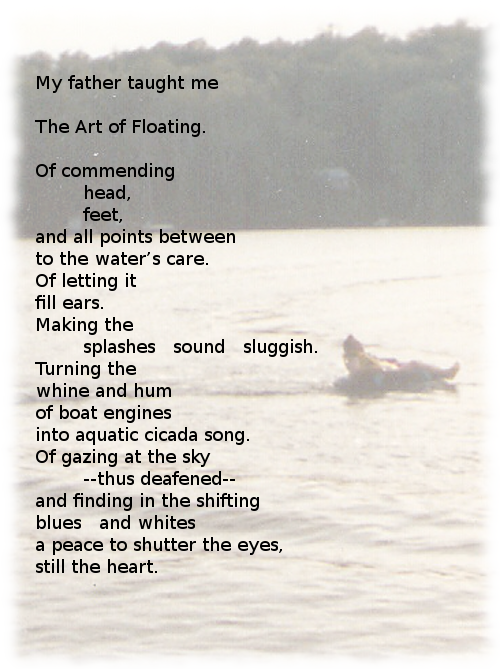
At his funeral, I read the following poem.  Afterward, I created the picture and we had copies made for the family.

ArtofFloating

The picture is one of my dad tubing at my uncle’s cottage. Sadly, we have no pictures of him floating.


Dad had a nigh on miraculous ability to float.  He could lie on his back in the water, put his hands behind his head, and just float, head, belly, and toes all poking above the surface.  He was unsinkable.  My cousin swears that he caught Dad sleeping that way.  I like to think of my Dad floating away in the afterlife, still unsinkable.

I chose The Water is Wide by Connie Dover as a song for the funeral recessional as well.  Though it’s more of a love song, the water theme prevailed.  While Dad’s gone before her, I like to think that he’ll be back for Mom with the boat when the time comes.

Sadly, I couldn’t find a version of the song to share with you, but I encourage you to give it a listen.  Connie Dover has one of the world’s most beautiful voices.

Next week, the final episode of a life sentence with mortal punctuation: Thoughts on Happiness.  That’s where I’ll tell you a bit about what my experiences with death have taught me about living.

Have a great evening, everyone.

The cadre … or should that be the cabal?

Whatever 🙂  The supporting cast.

Last week on Work in progress: I sketched out the baddies in my novel.

This week, I want to look at some of the supporting characters on the heroic side of things.  I haven’t done detailed written sketches of any of them, so this might be short and sweet!

We’ll start with Ferathainn’s family.

Selene and Devlin

Selene looks like Selma Blair … or vice versa

Selene was a child when her family and the people they were traveling with were attacked.  Only Selene survived, though injured, and was found wandering in the woods by Leaf and Oak, eleph brothers, who promptly took her back to their home in Hartsgrove.  The child could not remember anything, not even her own name.

Willow, sister of Oak and Leaf, named Selene after performing the ritual of shir’authe, the eleph way of foretelling the future of a child.  Willow knew that the girl would be a seer, a talent associated with the moon.  Selene seemed appropriate.

Years later, a young bard came to Hartsgrove.  He recited his poetry and sang his songs.

And John Butler would make an awesome Devlin

Devlin also collected stories though, and was particularly enamoured of the eleph.  Leaf was finiris, or a song master, and like a bard, finiris practiced not one, but as many of the arts as they could learn.

Though he moved on, Devlin returned often, using Leaf as his excuse, but spending more and more of his time with Selene.

Eventually, they married, but soon learned that they could not have children.  When a pregnant noble woman appeared, then ran away, shortly after giving birth, Selene and Devlin decided that they would adopt the child as their own, but they’ve never told Ferathainn that she is not theirs.

In Tellurin society, it doesn’t matter if a child is adopted or not.  The people who raise you are your parents, and fostering is a common practice.  It wouldn’t be a shameful thing if Selene and Devlin did tell Ferathainn, but they don’t.

Master Aeldred

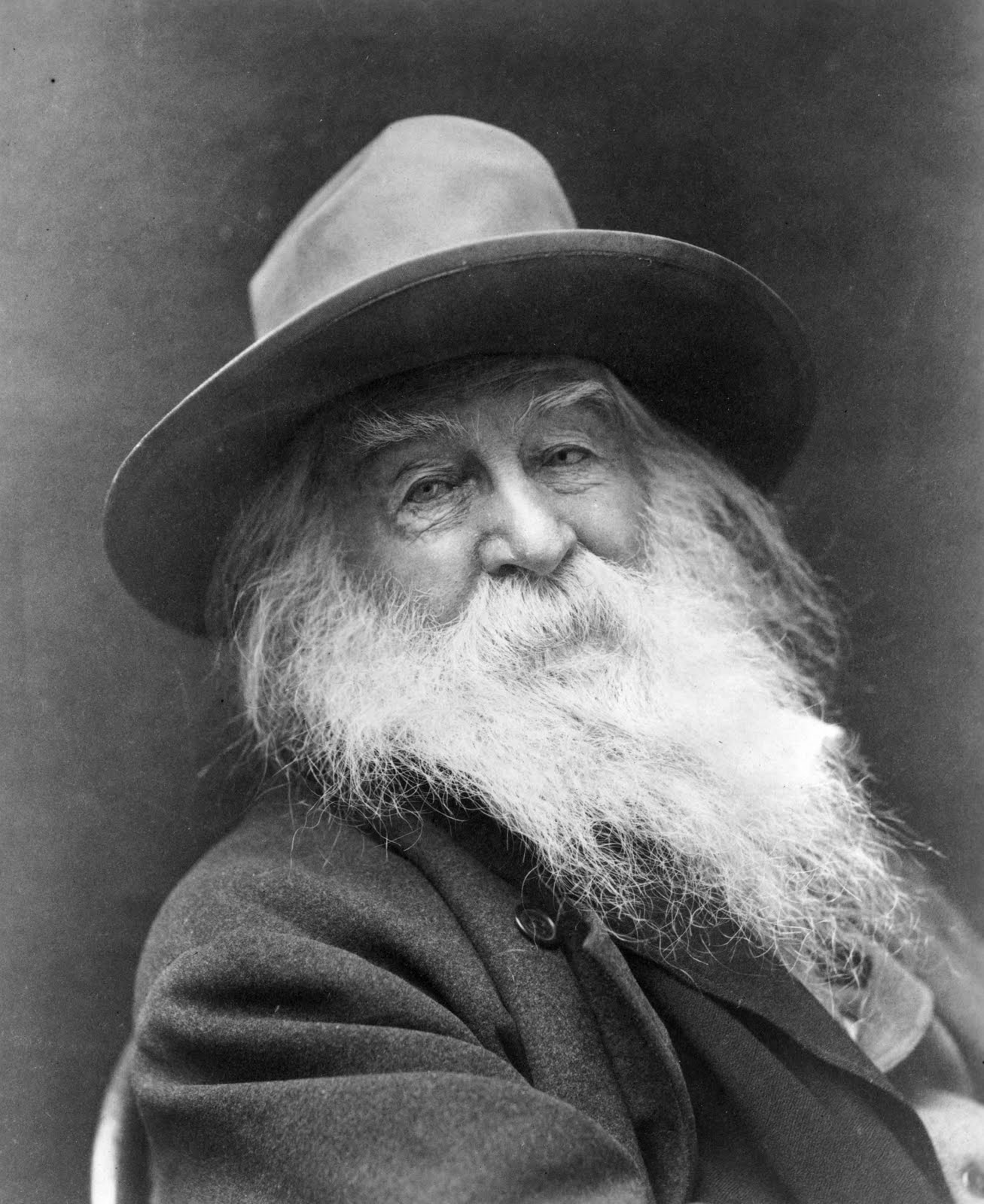
Walt Whitman reminds me of Aeldred

The old mage was a wanderer.  He’d had his degree from the King’s university, but loved research and unearthing lore.  It was coincidence that he was in Hartsgrove the Sestaya that Ferathainn was born, but as a mage, he had the right to take part in the infant’s shir’authe.  He was simply pleased to take part in an eleph ritual.

The eleph could see nothing of the baby’s future though, except Leaf, who saw his astara in the baby’s eyes.  Selene immediately took exception to this, since Leaf was already over a hundred suns old.  It seemed perverse, and no matter what assurances Leaf offered, Selene could not be appeased.

When Aeldred finally took the baby in his arms, he could sense the power in her.  It was like nothing he’d ever felt before.  To those assembled, he merely said that the child had promise and that he might be induced to stay and take her on as a student when she was older, if she wished.

Aeldred is afraid of Ferathainn, though.  Afraid of what she might become and of his inability to control her.  This he never spoke of either, not even to his colleagues back in Drychtensart, who all wondered that he’s taking on a girl as a student.  Aeldred did what he thought was best for the girl, though, and taught her in the Agrothe tradition.  He does not gawk or wonder at her talents, though inwardly he quakes.  If she does not think she is special, if she submits to the disciplines of the Agrothe, then it is likely that she will not become the monster he fears she will …

Aislinn

Devlin loves Selene, but he always wanted a child of his own, and when Willow proposed a liaison, he was definitely interested.  Willow made it clear that she had no love for him.  Lust, yes, but that was a passing thing.  If she could get the idea out of her mind, she’d never have reason to pursue the bard afterward.

In an unusual move, Devlin and Willow approached Selene.  Devlin would only proceed with her approval.  Even more strangely, Selene gave her consent.

Willow hadn’t suspected that an eleph and a Tellurin could have children together, but was pleased to discover her pregnancy.  Devlin doted on his child and unofficially adopted her into his family.

Emma Stone as Aislinn

As she grew older, though, Aislinn never exhibited an interest in his music the way Ferathainn had.  She didn’t dance and she couldn’t carry a tune in a basket.  She was what we might call a girly-girl.  She loved sewing and making her own clothes, doing her hair up in fancy styles, and giggling and gossiping.

Unfortunately, her eleph features marked her as strange.  Parents didn’t take kindly to their children fraternizing with the half-breed.  She had nothing in common with either Devlin or Leaf, did not take an interest in Oak’s scouting and hunting, or in the kishida (eleph martial arts), and she didn’t like getting dirty like her mother, Willow, who spent her time either tending her fruit, or brewing, fermenting, and distilling it into alcohol.

Aislinn’s shir’authe revealed that she could be a bridge between the eleph and the Tellurin.

Leaf, Oak, and Willow

Brad Pitt with silver hair could be Leaf

These three eleph are shuriah, or outcast from their people.  Eleph society is very rigid and those that do not abide by the rules are ostracized.  In Elphindar, where the eleph originated, there were no other people.  Being shuriah meant death in all but a very few cases.

Tellurin is full of people, though.  It’s crawling with Tellurin (named for their land), but is also populated by other races: the okante, grunden, blinsies, and favrard.  The dwergen and dwergini live beneath the mountains.

Olivia Wilde as Willow

In the west, government is sparse and centralized in a few of the larger cities.  In between, people live largely as they choose.  So it was that Ashandrel (Willow), Duriel (Oak), and Faliel (Leaf) found a small community where they could live peacefully with their neighbours so long as they contributed to the sowing and harvesting at the area farms, and contributed to the livelihood of the village.

Leaf saw his astara, or soul lights, in Ferathainn’s eyes.

Orlando Bloom could be Oak

Only eleph are supposed to see them, and only in the eyes of other eleph.  Still, destiny cannot be denied.  He is even more mystified when Ferathainn sees her astara in his eyes, but he is grateful.  He would never have disclosed his feelings for Ferathainn had she not returned them.

Shia and the anogeni

Once, the anogeni were the hands of the mountains, the fingers of the seas, but eventually, they became their own distinct people.

They resemble pygmies in stature, but have large, child-like heads.  Their eyes are large and they do not have hair, but their ebony skin is covered in a kind of down.

The anogeni way is one of love.  Everything has a spirit, and they respect the spirit of every thing.  This is how they work what others might consider magick: they ask nicely, and usually the spirit is willing to help.  They shape stone and wood, and the core of their spiritual practice centres on twelve sacred plants, or askhiwine.  These particular plant spirits are very wise, and teach lessons.

Essentially, they are shaman.  The anoashki, or great mystery, is their grandfather, the living spirit of the world.

The anogeni find Dairragh after the fall of Gryphonskeep.  He is dead, but these remarkable people bring him back to life and try to teach him the anogeni way.

The anogeni are born with all of the memories of their predecessors.  Between that and the lessons of the ashkiwine, they have a great many prophecies, and Dairragh figures into a few of them.  So they determine to save him, and try to make him a champion.

Ella and Kaaria

Really, I should reserve discussion of these two figures until I talk about the deities of Tellurin, but they are part of the cabal that help my heroes, so I’ll say a few words here.

Ella is all that is left of the goddess Tryella after her brother tried to murder her.  Kaaria, an air elemental, and her sister Naia, a water elemental, rescue Tryella, after a fashion, but the best they can do for the wounded god is to put her into the body of an yrne, or giant sea eagle.

While she can still speak, nobody but Kaaria, Naia, and their other rescue, Auremon, can understand her.  She has a little prescience, and is very long-lived, but beyond that, she is mortal.  A Tellurin with a bow and good aim could kill her.

She’s been desperately trying to find some way to prevent her brother from escaping his prison.  If he gets out, everyone is going to suffer.  No matter what she tries, however, it does not seem to change the outcome.  Even Auraya’s attempts to raise the Kas’Hadden, she fears, will not be sufficient to defeat Yllel.

She does see the face of a girl, though.  Ella’s not sure whether the girl will play a role in her brother’s defeat, or if she’s not a greater danger altogether, but she figures that she will need all the help she can get.

Kaaria is helping her track down the girl, but when they do, it’s almost too late.  In desperation, Ella diverts Eoghan from his destination at the Well of Souls, to save the girl, and she and Kaaria try to prepare both Eoghan and Ferathainn for what is to come.

Kaaria and her sister aren’t native to Tellurin.  When Auremon tore the Way Between the Worlds between Tellurin and Elphindar apart, they were two of the beings pulled through it into Tellurin.  Elphindar was a dying world, and they were grateful to have a new home.

The living spirit of the planet spoke to them and has recruited them to help him bring back his original children, the akhis.  Ferathainn and Dairragh have a role to play in that drama too.

And that’s it for this week 🙂

I’ll be moving on to more legitimate world-building activities after this, I promise!

Have a great weekend.