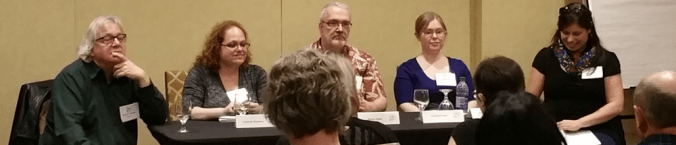
Panellists: Hayden Trenholm, Gabrielle Harbowy, Robert Runte, Elizabeth Hirst, Marie Bilodeau
Q: What do you want to see/hear in a pitch?
EH: Enthusiasm. If the author loves their book and believes in it, that’s a good sign. Make sure the book you pitch is finished.
HT: Don’t lie. If the book isn’t finished, be up front about it. If the finished book comes in nine months later, that ship has sailed, though.
GH: First impressions count. Don’t ignore the guidelines. One guy wiped his nose before he shook my hand. It didn’t matter what he did after that.
EH: Presentation is key.
HT: I have to know I can send you to a high-end book store. Publishers don’t buy books. We buy authors.
RR: Different editors look for different things. You want to get rejected as quickly as possible. If you’re not a fit for the editor, you have to feel good about that and move on. You’ll find the editor who’s as passionate about your work as you are. I polled my SF Canada colleagues and asked them, ‘what’s the longest you’ve waited for a response?’ Eight years was the longest. That’s a huge chunk of your life.
HT: Pitching is like a job interview. Treat it like that.
EH: I wish the authors well. If it’s not for me, I might suggest someone else.
GH: Don’t argue. All decisions are final.
HT: Some people try to tell me why I’m wrong. It’s like asking for a second date after a failed first one.
EH: You should ask as many questions as they ask you.
HT: You have to make sure it’s the right fit.
EH: I might recommend self-publishing to some pitchers.
GH: But I can’t take a book that’s already been published.
RR: You have to make sure you match your capabilities. Don’t promise anything you can’t deliver.
HT: We don’t know everything. We all do what we can. Self-published books are a tough sell. 55% of Americans won’t read an ebook. Think about what you want. Your expectations should be clear. A bestseller in Canada is about 5000 books. When you choose a small publisher, you have a personal relationship. Our goal is to make the best book we can. If that’s what you want, pitch to a small press.
GH: Bigger presses look at Dragon Moon’s catalogue. We’re happy to send authors on to bigger and better things.
RR: If you’re asked for a synopsis, it’s a blow by blow of everything that happens in the novel, including the end. I need to know the ending. You have to tell me what your book is about.
EH: The ending is not as important to me as the main conflict. What’s interesting about the book? What’s the intrigue? That’s the reason people read.
GH: Premise and plot are not the same thing, though.
HT: People think the book has to be perfect. No. The book has to be interesting. If the book is a shambles in terms of spelling and grammar, we can fix it.
RR: I have to love your book to put the four- to five hundred comments on it that I do on most books. I’ve been giving these talks forever, but I finished my first book and went to pitch it . . . and blew it.
HT: The last person who knows what the book is about is the author.
Q&A ensued.
And that’s the end of day 1. Between Nina’s workshop and this panel, the opening ceremonies took place and after this panel, I went to the Bundoran Press book launch and SF Canada party, where I got to hear GoH Ed Willett read from his latest novel and network with my writerly peeps.
So that was all I did on Friday.
Next week: Asteroids.
Note: I’m not sure if I’ll be able to post on Saturday or if it will have to be pushed to Sunday. Family shenanigans. You know the holiday drill 🙂

 Always Looking Up