Tipsday: Writerly Goodness found on the interwebz, Aug 21-27, 2016

Sorry to have missed a week of curation, but life happens. I’m back now, though, and here with your informal writerly learnings for the week 🙂

Jane Friedman explores discourse communities as a means of distinguishing yourself among agents and editors. Writer Unboxed

Heather Webb writes about revision and how to make it through. Writer Unboxed

We need to give ourselves permission to begin, courage to continue, and forgiveness to try again. I so needed this, Dan Blank. Bless you. Writer Unboxed

Angela Ackerman offers some advice on creating mood in a scene using light and shadow. Writers helping writers

Later in the week, Angela announces the expansion of One Stop for Writers.

Roz Morris shares three surprising to measure your progress when you’re writing a slow burn book. Nail your novel

Susan Brooks guest posts on Janice Hardy’s Fiction University on the importance of being genre-specific. Part one of a new series. Later in the week, Janice guests on Jody Hedlund’s blog, sharing five reasons your plot stalled. Then, Marcy Kennedy stopped by to explore indie choices: writing in multiple genres or specializing.

Jenny Hansen guest posts on Jami Gold’s blog (while she recovers) and offers some strategies for overcoming fear, the writer’s enemy number one.

Leanne Sowul writes about the importance of quality sleep. DIYMFA

Gabriela Pereira interviews MJ Rose for the DIYMFA Radio podcast: build buzz around your book.

Jamie Raintree guests on Writers in the Storm: the career mindset comes before the writing career.

Love this woman’s big squishy brain 🙂 Kameron Hurley shares her thoughts on why being a writer is an exercise in cognitive dissonance.

K. Eason shares six tips for writing a science fiction series. Writer’s Digest

Steven Pressfield studies stuff that works: True Grit and Paper Moon, which are essentially the same movie . . .

DBC Pierre lists ten books all writers should read. With the exception of a couple, they’re not what you’d think. The Guardian

John Bradley evokes Marshall McLuhan’s statement, “the medium is the message” to examine how we read and how it affects us. The Wild Detectives

Brandon Taylor states that there is no secret to writing about people who do not look like you. Literary hub

Sarah Gailey encourages SFF writers to “do better” when it comes to writing sexual violence. Tor.com

Laurie Garrison’s #women_writers manifesto aims to build the community of female authors. Lara Williams for The Guardian.

It was the 101st anniversary of James Tiptree Jr. (Alice B. Sheldon)’s birth. Tachyon Publications offers this tribute to her work and influence. Leah Schnelbach writes this article on Tiptree and the power of the SF community for Tor.com.

Fiona Macdonald reports on the secret libraries of history for the BBC.

Alexandra Alter interviews Hugo award winner, N.K. Jemisin, for The New York Times.

J.M. Frey explores how fantasy tropes can bring out the power of being a fan girl. The MarySue

And here’s the cover reveal for her new novel 🙂

Cheryl Eddy presents all the new science fiction and fantasy books you must read this fall. i09

Charlie Jane Anders previews Dominik Parisien’s new fairy tale anthology, The Starlit Wood for i09.

Katharine Trendacosta shares photos of some of the set pieces for the Ready Player One movie for i09. I have to say that this was one of my favourite novels I read last year. So looking forward. Here are some more from Collider.

And that was Tipsday.

See you Thursday!

Tipsday

Tipsday: Writerly Goodness found on the interwebz, Aug 7-13, 2016

Bumper week here at Writerly Goodness 🙂

The week previous, K.M. Weiland shared the reasons she believes writing is important, last week, she collected her readers’ thoughts on the issue. Helping writers become authors

On a related note: what do we write when the world feels insane? Sarah Selecky’s Story is a state of mind.

K.M. Weiland returns with more writing lessons from the Marvel Cinematic Universe (MCU) with the single best way to write powerful themes.

Roz Morris offers ten eye-opening tips to add impact to your storytelling. Nail your novel

Chuck Wendig lists 25 reasons he stops reading books. Terribleminds

Then Chuck shares ten things he learned about storytelling from Stranger Things.

Related: Janice Hardy shares lessons learned about handling flashbacks from Stranger Things. Fiction University. Nick Wisseman then guests posts on Janice’s blog, explaining how to plot your pants (wait . . . that sounds bad).

Janice then hopes over to Writers in the Storm to post: using internal conflict to create plot.

Finally, Janice guest posts on Jami Gold’s blog: if you’re stuck on plot, start at the end.

Lisa Cron writes about getting out of your process comfort zone: there is no safe place. Not plotter or pantser, but seeker. Writer Unboxed

Allie Larkin shows us how to organize a second draft with note cards and Tom Petty. Writer Unboxed

Christine Frazier shows us how to write a fight scene in which the hero fends off an attack to save a friend. The better novel project

Chris Winkle shares what she knows about creating realistic cultures. Mythcreants

Sarah Callender writes about enduring the long road to publication for Writer Unboxed.

The author as busy, busy bee and other bee-filled nightmares. Kameron Hurley.

Phil Stamper-Halpin shares what the editors of Penguin Random House look for in the first page of a novel.

Jennifer Johnson Blalock offers six ways to make comp titles work for you on Carly Watters’ blog.

Susan Spann helps you understand ebook rights. Writers in the Storm.

Robin Lovett shares what she learned from a negative experience: when your book doesn’t sell. DIYMFA

Gabriela Pereira interviews Andrew Piper (not the Canadian author) on her DIYMFA Radio podcast. Will an MFA influence your chances of success as an author?

Timothy Beck Werth looks at Djuna Barnes’ 1936 novel Nightwood and what may be the first trans woman in western literature. The Awl

Lorraine Berry: the horror of female adolescence and how to write about it. The Guardian

Michael Newton leads a celebration of Alan Garner. The Guardian

Ursula K. Le Guin writes about the golden age for The New Yorker. “I . . . think it ungrateful in a writer to write science fiction and deny that it’s science fiction.”

BrainPickings looks at Le Guin’s thoughts on aging and the meaning of beauty.

“What the market wants” is code for white stories in science fiction where black writers face universal racism. Amy McNeill for The National Post.

Michael Swanick lists five fantasy novels you won’t find in the fantasy section. Tor.com

Sarah Gailey writes in defence of villainesses for Tor.com.

Writing begins with forgiveness: why one of the most common pieces of writing advice is wrong. Daniel José Older on Seven Scribes.

Every writer’s worst nightmare: Helen Gladwell died before learning that her first book had been accepted for publication. Worse, her body remained undiscovered for months. The Telegraph

I saw this article in many forms over the last week. This one, by Jenn Savedge for Mother Nature Network, was the first. Reading a minimum of 30 minutes a day can extend your lifespan.

Jacob Mikanowski examines the Oneirocritica, an ancient encyclopaedia of dreams and dream interpretation. The Awl

Anthony Jones lists 25 words for other words. Mental Floss

Abraham Riesman interviews Margaret Atwood at San Diego ComiCon. The Vulture

Katharine Trendacosta reports that The Silver Chair, the next film adaptation of C.S. Lewis’s Narnia series, is in production. Whee! i09

Germaine Lussier presents a first look at the Arrival trailer. i09

Phil and I are looking forward to September 30 for this reason: Luke Cage. i09

Laura Prudom breaks George R.R. Martin news for Variety: Wild Cards series in development.

Rogue One: A Star Wars Story trailer.


Thems was some juicy informal writerly learnings, eh?

I’m off to WorldCon tomorrow. Poor Phil’s holding down the fort. Not to worry, my mom’s going to feed him 😀 Thursday’s curation has already been scheduled, but the blog will be silent from the 19th to the 26th. For the sake of sanity, I’m not going to catch up on the curation.

Be well. Be kind.

Tipsday

The next chapter: July 2016 update

So, here we are again at a monthly update. August. Where has the year gone?

One of the great things about tracking your production (and this applies to all things, not just writing) is that you can look back and see the evidence of your work. It’s very comforting.

In addition to wrapping up my work in July this time, I’m going to review the year to date.

July

JulyProgress

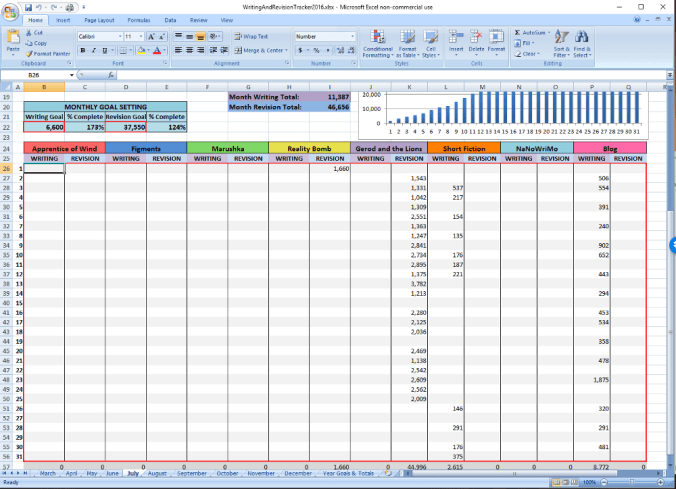
This month, I finished my first review of Gerod and the Lions. As with the last couple of novels, I wasn’t twitching as I reread, reacquainted myself with the story, and worked on some of the flow issues I saw. One reason for the flow issues was that GatL was written in chunks, separated by work done on other projects.

Sometimes the gaps were months long, and it shows. I had to get my head back into Gerod’s world and each time I returned to it, it took a few days to recapture the feeling.

The draft comes in at 44,996 words, which is decent for a middle grade book and 124% of my revision goal for the month.

I also continued work on the short story, which I’ll be submitting for consideration soon. 2,615 words written on that.

And, of course, there was the blog, and since I continued to participate in the weekly challenges presented by Gabriela Pereira to her DIYMFA Street Team, I far outblogged my goal.

Between the short story and the blog, I wrote 173% of my goal for July.

I also had the pleasure of guest blogging a couple of times in July, once on Mel’s Madness, and later, on DIYMFA (holy cow!). I have another guest blog due out this month on Kristene Perron’s Warp World blog.

I continued querying.

Year-to-date

Please keep in mind that revision is a very different animal than writing. I’m not writing all these words from scratch. I’m rearranging words, rewriting sentences or paragraphs for flow, inserting or removing punctuation, and making notes for future revisions.

Writing equates to original words.

Month Revision Writing Projects
January 69,774 words 186% of goal 9,274 words 141% of goal Apprentice of Wind, blog
February 40,708 words 108% of goal 5,027 words 90% of goal Apprentice of Wind, blog
March 66,637 words 177% of goal 8,436 words 141% of goal AoW, Figments, Marushka, blog
April 37,478 words 100% of goal 10,498 words 187% of goal Marushka, blog
May 50,882 words 136% of goal 10,474 words 181% of goal Marushka, Reality Bomb, blog
June 48,009 words 128% of goal 12,013 words 207% of goal Reality Bomb, blog
July 46,656 words 124% of goal 11,387 words 173% of goal RB, Gerod and the Lions, short fiction, blog

 Now and the rest of the year

With GatL, I’ve finished reviewing all of my drafted novels. Many of them are still grossly underwritten, but at least I have a better idea now of where I’m going with each.

For August, I just finished up my short story, which I will now revise, and otherwise, the only writing I’m doing is on the blog.

I’ve taken some time off to consider the remainder of the year and what I want to do.

Under consideration are:

  • Assembling a poetry collection (going to submit to a local small press) – August
  • Organizing a collection of my non-SFF short fiction (again, targeted at the small publisher) – August
  • Outlining the third book in my epic fantasy series. I’ve already taken a shot at it, but I know I have to rework it. I’ll do this anyway, because it’s this year’s NaNoWriMo project, but it’s on the list. – concurrent with other projects through to the end of October
  • Returning to Initiate of Stone and AoW, to recapture the voice of the series and bring everything into line in light of the outlining and NaNo for the third book. I want to get to November steeped in the world and its characters. – September and October

Because the third in series is of the epic nature, I expect to be continuing the drafting well into December.

I’m also taking a bit of time to think out how I want to structure my writing year from here on out. Previous to 2016, my focus was on getting the words down. Great, but then I had six novels drafted, only one of which was ready for querying.

This year, I’m focusing on the revision of all those drafts. They won’t be completely ready to go, but I’ll be in a place where I can alternate writing and revision in the coming years.

I want to draft new work twice a year, and then work on revision in between. I don’t know exactly what form that’s going to take (except for NaNo), but I think it’s something I can do.

Other stuff

I’m heading out to WorldCon/MidAmeriCon II on the 17th. It will be my first big con, so I’m super excited. This will be my last convention or conference for the year, though. I’ve blown my budget.

As a result, though, I’m going on a blogging vacay. I’ll schedule my Thoughty Thursday curation for the 18th before I leave, but you won’t hear from me again until I’m back and recovered and ready to resume bloggage on the 27th. Sacrifices have to be made.

I’ve done the crazy and applied for Brenda Drake’s #PitchWars. I’ll find out how that goes on the 25th. Not saying more about it for now.

I’m investigating partnerships with an editor. I want something long term, a professional editor who can help me get my drafts into publishable states.

I signed up for a first five pages workshop with NLA. Again, I’ll leave the deets for later.

And that’s this writer’s life.

Next weekend, I’ll be continuing with my CWS 2016 reportage with my notes from the Writing Hard Truths panel.

The Next Chapter

Tipsday: Writerly Goodness found on the interwebz, July 24-30, 2016

Yummy, soul-feeding stuff this week.

The first post of the week for K.M. Weiland was intensely personal. It was also inspirational. It was exactly what I needed to read as the world around me seems to be falling to pieces (though that’s more apparent in my Thoughty Thursday curation posts, of late). Read it, my writerly friends, and take heart. This is why we write: five reasons why writing is important to the world. Later in the week she cautions us: don’t make this mistake with story structure.

Bonnie Randall guest posts on Janice Hardy’s Fiction University. Once more with feeling: writing emotionally strong characters.

Chris Winkle offers five ways to restore tension in your novel. Mythcreants.

Two of my favourite writerly women: Joanna Penn interviews Roz Morris for the Creative Penn podcast. Finding your author voice.

Katharine Britton guest posts on Writer Unboxed. On the road to a first draft: when you don’t know where you’re going, any road will do.

Marcy Kennedy is back with part four of her reading as a writer series.

Kelly Harms: writing a book takes how long, now? Writers in the Storm.

Jami Gold shares more lessons learned from her recent RWA conference. Do you belong, or are you a fraud?

Shawn Coyne wonders if good enough is good enough . . . This post was a bit controversial for a friend. Yes, we need mentors; we need editors. I personally don’t think there’s anything wrong with learning through experimentation, practice, and study, however. The idea that writers aren’t good enough, that they can’t be good enough without the intervention of others can result in sensitive creatives believing that they are inherently worthless. Or, it can result in the following problems, which can be just as bad . . . Just sayin’.

Karen Woodward encourages us to let go of perfectionism.

Kristen Lamb explores stress and burnout . . . and how to get your writerly mojo back.

Heather Webb has some advice on what to do when you feel like you’re treading water. Writer Unboxed.

Kameron Hurley: the wisdom of the grind.

Jane Friedman offers a definition of author platform.

Constance Renfrow writes about the do’s and don’ts of query letters. DIYMFA. AND . . . I had the opportunity to guest post on DIYMFA thanks to my participation in Gabriela’s Street Team! Five things I’ve learned from being on the DIYMFA Street Team.

Camille DeAngelis says that having her book go out of print was a pretty great thing, after all. Publishers Weekly.

Lynn Neary: can serialized fiction turn binge watchers into binge readers? NPR.

Sudburian Matthew Heiti wins the Carter v. Cooper competition! The Northern Life.

Working girls: the Bröntes. Elizabeth Hardwick for The New York Review of Books.

Alex Kulaev for BookBaby: The Jungle Book is a beautiful film with flawed storytelling.

Orange is the New Black’s Samira Wiley joins the cast of Hulu’s adaptation of Margaret Atwood’s The Handmaid’s Tale. Amy McNeill for The National Post.

Katherine Trendacosta thinks Christophe Gans’ La Belle et La Bête (Beauty and the Beast) is the most beautiful thing she’s seen in ages. i09

We are not things: shining examples of women’s autonomy in science fiction. Delia Harrington for The MarySue.

Babylon 5’s Jerry Doyle dies at the age of 60. Sadness 😦 James Whitbrook for i09.

And that was your informal writerly learnings for the week.

See you Thursday!

Tipsday

Tipsday: Writerly Goodness found on the interwebz, July 10-16, 2016

Got some goodies for you this week 🙂

Roz Morris shares three steps to a smoother writing style. Nail your novel.

If you just keep writing, will you get better? Barbara Baig guest posts on Jane Friedman’s blog. Later in the week, Elizabeth Sims guests with this post: internal dialogue is the greatest tool for gaining reader confidence.

K.M. Weiland offers seven reasons you need story theory. Helping writers become authors. She returns with more lessons from Marvel: how to write subtext in dialogue.

MJ Bush brings her usual awesome in her advanced techniques (and insights) for jaw-dropping dialogue. Writingeekery.

Sophie Masson shares a few tips on writing fiction for middle grade audiences. Writer Unboxed.

David Corbett builds on Heather Bouwman’s WU post of the week previous with Sisyphus, happiness, and the Abyss.

Lisa Cron explains why it’s crucial to write ugly. Writer Unboxed.

Marcy Kennedy returns with part three of her reading as a writer series (with links to part 1 and part 2).

Elizabeth Kauffman rounds up some of the DIYMFA launch team’s posts from the last weeks (with a lovely nod to one by yours truly). Gabriela Pereira interviews Emma Straub for DIYMFA Radio. And then Andree Neal writes a guest post for DIYMFA (you might notice her in the round up, as well).

S.L. Huang guest posts on Chuck Wendig’s Terribleminds on the subject of manpain (!)

David D. Levine: a passion for Mars. Tor.com

Posche Burke: on white writers, ‘daring’ topics, and the unappreciated legacy of Octavia Butler. The National Post.

Ayodeji Awosika shares the undisputed secret to becoming a great writer.  Creativity is a muscle. Be yourself.

How to be a writer: the map is the territory. Ramona Ausubel shares her winding path to publication. Literary Hub.

Award news!

Airship Ambassador interviews Holly Schofield.

Connie Verzak recaps the Outlander season 2 finale for Scotland Now. Oh, the feelz.

Rogue One: A Star Wars Story. Celebration reel.


See you Thursday for some weighty thoughty.

Tipsday

My favourite story archetype

QOTW 15: What’s Your Favorite Type of Story?

Now I want to know: what’s your favorite story archetype? If you need a refresher on these archetypes, look back at Chapter 11 to the section on conflict and power struggles. More importantly, I’d love to know why you chose that story type and whether you’re using it in your current work-in-progress (WIP).

content_QOTW-15

In presenting her QotW, Gabriela mentioned how much she enjoys underdog, or comeback stories.

I have to confess a fondness for the same. I tend to appreciate these stories in the context of the bildungsroman, or the classic story of a character who moves from innocence to experience, in short, the coming of age story.

In terms of the classics, a lot of Dickens’ works are of this type (Oliver Twist, Great Expectations).

I read (and write) a lot of fantasy, though. So I’ll give you a couple of examples from the genre.

I recently read (and enjoyed—a lot) Brent Weeks’s The Way of Shadows. In this novel, Azoth, a young guild rat, begins the story as a homeless orphan whose only aspiration is to stop being afraid all the time. In the attempt to attain his goal, he apprentices to a magical assassin, plays the part of a young noble in the course of his education, and eventually becomes the Night Angel, not by doing what’s expected of him, or what his master tells him to, but by doing what’s right.

Very Oliver Twist-ish, non?

An old favourite of mine is Mary Brown’s The Unlikely Ones. In this lovely fable, the protagonist, known only as Thing, is servant (slave) to a witch. She’s forced to wear a mask all the time because her mistress tells her how ugly she is.

Thing’s lie is very literal. She behaves like the Thing she’s always been told she was. Magic begins to happen when she starts to challenge the lie, however. What I like most about this novel is that Thing manages her transformation through acts of kindness.

My own novels, though I’d very much agree that my protagonists are all protectors, follow similar development and themes. Though they may all have special talents that eventually help them become ‘bigger than life’ characters, my protagonists begin their stories disadvantaged in some way. They have to learn through struggle and loss what they might become.

If you want to find out more about story archetypes, or any of the other writerly goodness that is DIYMFA visit the DIYMFA page!

Tomorrow: I’ll be sharing my notes on the final Ad Astra session I attended.

Next week: I’ll be starting on the panels and presentations I attended at the Canadian Writers’ Summit.

Tipsday: Writerly Goodness found on the interwebz, July 3-9, 2016

Some very interesting posts and articles this week 🙂

K.M. Weiland continues her most common writing mistakes series with part 52: stagnant story conflict. Helping writers become authors. Becca Puglisi guest posts later in the week with four ways to choose the right story setting. Kate returns with more lessons from Marvel: how to transform your story with a moment of truth.

Must you have conflict in every scene, disaster in every act? Roz Morris says, yes, and no. Nail your novel.

Kathryn Craft shares ten ways to add a spark of fire to your fiction. Writer Unboxed.

Donald Maass explores how to stay ahead of yourself . . . and your reader. Writer Unboxed.

Heather Bouwman writes (in the) happy middles. Writer Unboxed.

Annie Neugebauer begins a new series for Writer Unboxed. The query letter, part one: the pitch.

Sara Letourneau looks at the protagonist-antagonist relationship in DIYMFA’s developing themes in your stories series.

Data mining reveals the six basic emotional arcs of storytelling. MIT Technology Review.

“The six basic emotional arcs are these:

A steady, ongoing rise in emotional valence, as in a rags-to-riches story such as Alice’s Adventures Underground by Lewis Carroll. A steady ongoing fall in emotional valence, as in a tragedy such as Romeo and Juliet. A fall then a rise, such as the man-in-a-hole story, discussed by Vonnegut. A rise then a fall, such as the Greek myth of Icarus. Rise-fall-rise, such as Cinderella. Fall-rise-fall, such as Oedipus.

Susan Spann busts some popular copyright myths. Writers in the storm.

Hugh Howey writes about an idea, broken. The Wayfarer.

Shakespeare and music.


Underwritten female character: the movie. (Bwahahahaha!)


What Mallory Ortberg learned about heterosexual female desire from decades of reading. The Toast.

Ted Ed: What makes something Kafkaesque?


Airship Ambassador interviews Colleen Anderson in four parts: part one, part two, part three, and part four.

Jen Doll explains how A Wrinkle in Time changed science fiction forever. One of my formative reads. Who’d a thunk it? Mental Floss.

Shawn Taylor wonders why Hollywood is ignoring Octavia Butler. Fusion.

The New York Times called this guy daring for “daring” to tackle slavery through science fiction. (Includes the author’s response.) J. Hotham for Slate.

Jonathan Barkan celebrates 30 years of Big Trouble in Little China. Bloody Disgusting.

Emily Asher-Perrin: Jupiter Ascending is a chilling look at our future, in more ways than one. Tor.com

Phil and I are looking forward to checking this one out. Netflix’s 1980’s science fiction throwback Stranger Things is must (binge) watch TV. i09

Until thoughty Thursday!

Tipsday

Trying new things with DIYMFA

Here is the QotW:

QOTW 14: Try a New Technique

Throughout the book, there are visual techniques, diagrams, and exercises to help your writing. These include story-mapping, the revision pyramid, the character compass, and so forth. This week, I want you to choose a technique that is new to you and try it out. Then report back and tell us how it went.

The technique I’ve chosen is TADA.

This is an acronym Gabriela created to assess character. The letters stand for Thoughts, Action, Dialogue, and Appearance.

The idea is that the writer wants to achieve a balance between all four aspects of character, and between characters, in each story. This could even be applied on a scene by scene basis.

So you can look at your characters individually, in scenes, in conjunction with one another, and overall in the story to ensure you’re keeping all of these character elements in the ratios you want.

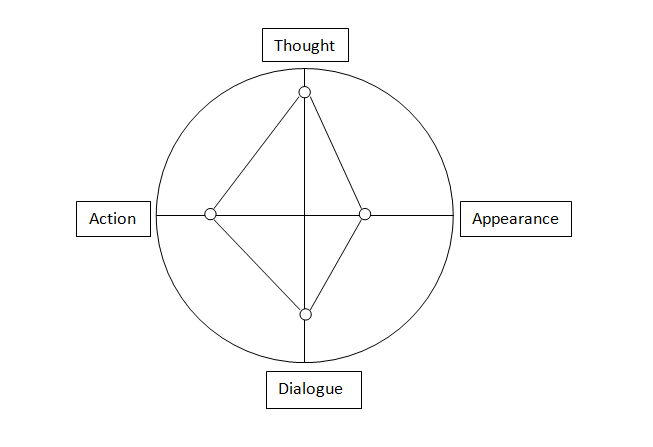
To visualize this, Gabriela provided a graph, which she calls the character compass. It’s a circle with the letters T, A, D, and A distributed over the cardinal directions. Lines divide the circle into four with Thought and Dialogue, and Action and Appearance, in opposition to each other.

CharacterCompass

I’ve done my best to create a facsimile with Word’s drawing tools, print screen, and The Gimp 🙂

In this particular compass, I’m looking at one character, Ferathainn, in general.

She’s my protagonist and her POV is first person, past tense. There’s a lot of thought and internal monologue with Fer.

She’s studying to become a mage, but at the beginning of the novel, it’s all been theoretical. Her studies have prevented her from maintaining friendships, and so she lives in her head a lot. Part of her studies include rhetoric. Intonation and presentation can affect certain types of magick.

Fer’s been allowed (yes, allowed, it’s a plot thing) to study with her father, who is a bard, and her betrothed, who is an eleph finiris, or songmaster, because magick can be sung. She’s extended this part of her training to include dance, because she’s realized she needs a physical outlet after all this theory and rote memorization.

One of her small rebellions is that she also trains with her best friend, the forester, who teaches her how to fight. Primarily unarmed combat and survival skills.

So Fer is a heavily thinky character, with a good side order of dialogue and action. She doesn’t often consider her appearance, however. There aren’t a lot of mirrors in her little village. It’s not something she’s ever placed a lot of value on.

So I have to be careful when I write a scene about Fer alone, because she’s lopsided.

When she interacts with other characters, it’s primarily through dialogue and action, but I have to pay attention to their reactions to her physically. It’s actually very good for the show versus tell thing.

For example, Fer’s mother has to reach up to hug her, because Fer is tall. She’s of a height with her father, though. Through little interactions like this, readers form a picture of Fer in their minds over time.

When I switch POV to the other characters, they get to describe Fer, but I try not to have them do the ‘classical’ romantic inventory.

In early romances, which were often more adventure tales than what we think of as romances, when the hero meets the love interest for the first time, he waxes poetic and describes her from head to toe. Bad thing to do in a modern novel, though.

When Eoghan first ‘meets’ Fer, she’s all but dead. Having tried and failed to save victims of the war in the wake of the army’s passing, Eoghan decides he’s going to make his stand. He’s going to save this raggedy girl if it’s the last thing he does. Her appearance, other than the severity of her wounds, is secondary to his efforts.

When Dairragh first sees Fer, it’s from a distance, and it’s what she’s doing—performing magick—that makes its biggest impression on him. Dairragh hates all magi with a passion for the sake of the mage who murdered his parents and destroyed his home, including the people and gryphons that were his charge to protect.

So, of course, he hates Fer on sight and his prejudice colours his every interaction with her. At least initially.

The way I see it, readers are going to form an image of Fer in their heads that’s probably nothing like the way I see her. And that’s okay. They get ownership of my characters and my story on a reader by reader basis.

That’s what I want.

Gabriela’s TADA acronym and character compass are going to be one tool I take from the DIYMFA book and incorporate into my writing process.

Since I’m a plantser (part plotter, part pantser) I tend to pants my way through the first draft, but in revision, I can see the character compass being a very useful tool to evaluate how balanced my characters are in any given scene.

I hope I’ve given you enough of a run down that you might be able to make use of this technique yourself. Of course, you could always go buy Gabriela’s DIYMFA book and get a more detailed explanation of TADA and the character compass. The official release date was yesterday.

Jus’ sayin’.

content_QOTW-14

Tipsday: Writerly Goodness found on the interwebz, June 26-July 2, 2016

Easing back on the overwhelm of writerly goodness this week. You’re welcome 🙂

K.M. Weiland shares five secrets of creating complex supporting characters. Helping writers become authors. Kate returns with more lessons from the Marvel movies: use minor characters to flesh out your protagonist.

Bonnie Randall guests on Janice Hardy’s Fiction University: the Pandora ’s Box of having ‘been there.’

Steven Pressfield: The Dude abides, but in what genre?

Jami Gold helps you strengthen your writing with rhetorical devices (and the angels sing—I lurve rhetorical devices).

Angela Ackerman guest posts on DIYMFA: the top five mistakes writers make when it comes to setting.

Oren Ashkenazi offers a counterpoint to his post of last week. Five bad ideas science fiction teaches us to love. Mythcreants

Kristiana Willsey says that hunger is the beginning of every folktale. The Toast

Tim Grahl: how to use fear to beat resistance.

Marcy Kennedy asks, is it important for writers to be readers? Spoiler: It’s an emphatic, duh, yes!

Jeff Goins tell us everything we need to know about Facebook Live on the Portfolio Life podcast.

Alice Adams considers the question, why does anyone write? Literary Hub

Lincoln Michel teaches you everything you wanted to know about book sales but were afraid to ask. Electric Lit

This is shameful. The journalist who risked her life going undercover in North Korea had her expose marketed as an Eat, Pray, Love-style memoir. Anna Merlan for Jezebel.

Alison Stine explores Labyrinth and the dark heart of childhood. The Atlantic.

I think these Game of Thrones/Legend of Korra mash ups are amazing. What about you? Movie Pilot

The Game of Thrones finale confirms game-changing fan theory. Entertainment Weekly.

Also, Game of Thrones showrunners confirm that there are only 13 to 15 episodes left. Wah! They really pulled last year’s plot poopers out of the fire this year. Oh well. i09

Germain Lussler wonders why more people aren’t talking about the Preacher series. Phil and I are enjoying it 🙂 i09 Later in the week, he reports that Preacher season two will return with 13 episodes. YAY!

AMC’s Preacher series is different from the comics, but you’ll probably really like it anyway. James Hibberd for Entertainment Weekly.

And that was your informal writerly earnings for the week.

See you Thursday!

Tipsday

The next chapter: June 2016 update

Welcome to July! Half of 2016 is already past 😦

Let’s get right down to business.

June was a good month. As far as revision goes, I focused on Reality Bomb. It was another pleasant surprise. I didn’t hate what I wrote. This was just the first pass, and I’ve identified a number of things I need to work on, but I wasn’t writhing as I read 🙂 I don’t know if this means I’m a better writer now, or if I’ve just become inured to my failings (!)

I approached RB as I did Marushka before it, reading, mapping, editing, and making notes as I went. RB was my 2015 NaNoWriMo project and my second “win.”

I finished the first pass on July 1st (yes, Canada Day—the fireworks were for me, too) and the draft comes in at 282 pages and 67,808 words. Not bad for what I still consider a rough draft.

I’ve moved on to Gerod and the Lions, since. Early days, but not hating this one, either 😀 I should be finished this first run through of GatL in early August, just in time for another break—for WorldCon!

Since I’ve been a part of Gabriella Pereira’s Launch Team for DIYMFA, I’ve had extra blogging to do each weekend. As a result, I more than doubled my blogging goals for the month. I’ve also had some guest posting opportunities come my way, which has been another, validating surprise.

I went to the Canadian Writers’ Summit from June 17th to 19th and took a wee vacay from revising, blogging, and, in fact, most social media. It was a nice break.

My query, synopsis, and opening for Initiate of Stone have been revised and querying continues.

I’m starting work on some short fiction. It kind of just happened. It’s a good thing, though.

This is how the month settled out:

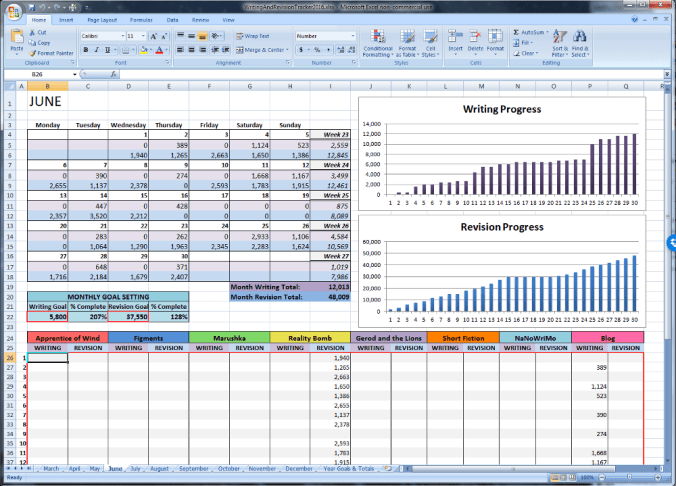
I achieved 128% on my revision goal with 48,009 words.

I achieved 207% of my blogging goal (yes, even with the vacay) with 12,013 words.

JuneProgress

The summer office is in operation, and I’ve been enjoying our lovely, lovely weather (so far). The garden is growing, though I haven’t been able to keep up with the weeding 😦 Still, we’ve been enjoying the fruits (literally) of what labour has been done and have had strawberries every day for the last three weeks. The raspberries are ripening. Phil’s been harvesting lettuces and herbs for the occasional meal.

It just makes you feel good to eat food out of your own garden.

In other news, I’m walking a little more, and getting some minor health issues sorted. I’ll be getting a new pair of glasses, not because my prescription has changed, but because my current pair is in disrepair. It’s time for a new perspective 🙂

Phil’s in good shape, now. He and his doctor have sorted his meds and he’s feeling well. All of his labs are showing results in the acceptable range, as well. I’m glad. Through the first few months of the year, it was not a good situation. Very stressful.

And that’s what June brought into this writer’s life.

Next weekend: I’ll be back to Ad Astra 2016 reportage.

Happy Independence Day to all of my American friends!

I’ll be back to work tomorrow.

The Next Chapter