Tipsday: Writerly Goodness found on the interwebz, June 17-23, 2018

It’s that time of the week when you get to reward yourself with some informal writerly learnings 🙂

K.M. Weiland explains how to intertwine plot, character, and theme in every scene. New insights from my favourite guru 🙂 Helping Writers Become Authors

This column was a-MA-zing. Read it. Love it. Live it! Asking myself why I write … again. Vaughn Roycroft on Writer Unboxed.

Jim Dempsey explains how to create drama with your character’s desire. Writer Unboxed

Roz Morris posts about what she wished she’d known in school: two instructions for making a creative life. Nail Your Novel

Jennie Nash stops by Writers Helping Writers to explain how the growth mindset for writers leads to the satisfaction of excellence.

Chuck Wendig explains how to be a writer in this fucked-ass age of rot and resistance. Terribleminds

Literary agent Barbara Poelle answers the question, what are the best times to query an agent? Funny you should ask. Writer’s Digest

Nathan Bransford confesses something about the fear of never finishing.

L.L. Barkat stops by Jane Friedman’s blog to share her introvert’s guide to launching a book.

Lisa Hall-Wilson encourages you to write beyond lust and attraction and use the body language of love. Writers in the Storm

Elisabeth Kauffman answers another writerly conundrum in her ask the editor column: travelling between worlds. DIY MFA

Bran L. Ayres wonders, should we include trigger warnings in our novels? Then, Bran L. Ayres returns to Jami Gold’s blog: how to develop and show a healthy romance.

Oren Ashkenazi provides six more bad arguments against social justice in speculative fiction. Then, Oren critiques six supposedly powerful abilities that don’t measure up. Really, it’s about overpowered characters. Mythcreants

Melody Wilding: how mental illness inspired Gabriela Pereira to launch a creative writing business. Forbes

Tajja Isen hopes writers of colour can expand the way they write about their identities. “Despite the position from which I write, and the need for it to inform my work, I also want that work to bloom around a richer core than the supposed pain of racial difference. If each writer chases a singular question, then I need a refrain that does more open-ended, unexpected work than just announcing the color of my skin as the intellectual bottom line — even if, or especially if, that tortured pose is the kind of work that editors expect.” Buzzfeed

Camille Perri says, we need more queer stories where nobody suffers. Electric Lit

MTV’s Decoded: code switching with Franchesca Ramsey.


And that was Tipsday. Tomorrow is hump-day and that’s one day closer to Friday!

Come back on Thursday for your weekly dose of thoughty.

Be well until then, my friends.

tipsday2016

Tipsday: Writerly Goodness found on the interwebz, June 10-16, 2018

You’ve made it through Monday and now it’s time to reward yourself with some informal writerly learnings 🙂

Roz Morris shares five tips for writing good prose. Nail Your Novel

K.M. Weiland walks you through the five steps to creating great character chemistry. Helping Writers Become Authors

Jeanne Kisacky explores non-verbal communication in writing. Writer Unboxed

Sarah Callender laments losing a beloved critique partner. Writer Unboxed

David Corbett follows up on Sharon Bially’s post (which I shared—last week, was it?) with whiff of death, meet moment of clarity. Writer Unboxed

Porter Anderson looks at solitude and solidarity and the advocacy of the Authors Guild. Writer Unboxed

Chuck Wendig presents the opposite of “kill your darlings.”  Then, he’s setting free the sacred cows of writing advice. He was going to slaughter them, but, ick. Terribleminds

Piper Bayard and Jay Holmes glean five writing lessons from “The Americans.” Writers in the Storm

Lisa Hall-Wilson says that emotional layers are the gateway to deep point of view. Writers in the Storm

Becca Puglisi helps you determine your character’s emotional range. Writers in the Storm

Jami Gold stops by Writers Helping Writers: watch out! Avoiding sneaky plot holes.

Christina Delay dives deep into POV on Writers Helping Writers.

Kristen Lamb talks boundaries: be nice … until it’s time to not be nice.

Brenda Joyce Patterson helps you solve the riddle of voice. DIY MFA

Valentine Ferrari shares five tips to keep your blog healthy and vital for many years. DIY MFA

Nathan Bransford advises you to watch out for empty gestures in your novel.

Rebecca Monterusso on Jane Friedman’s blog: what does it mean to write a scene that works?

Chris Winkle presents five underused character archetypes. Mythcreants

And that was Tipsday. Be sure to come back for some thought on Thursday!

Until then, be well.

tipsday2016

Tipsday: Writerly Goodness found on the interwebz, June 3-9, 2018

Another week, another batch of informal writerly learnings.

Jane Friedman excerpts from Tanya Hall’s Ideas, Influence, and Income: what to look for in a book publicist and tips for going it alone.

Donna Galanti offers eleven ways to find and connect with other authors in your genre. Writers in the Storm

Fae Rowan explains why you have to give your readers what they want. Writers in the Storm

Jenna Moreci shares her top ten hacks for your writing process.


Agent Barbara Poelle answers a question about word counts on Funny You Should Ask. Writer’s Digest

Nancy Johnson helps you find rhythm in your prose. Writer Unboxed

Donald Maass gives you the reason to build a box. Writer Unboxed

Kathryn Magendie explores rhythms in reading and writing. Writer Unboxed

James Scott Bell invites you to use the writer’s spice cabinet. Writers Helping Writers

Chrys Fey stopps by Writers Helping Writers to help you boost your creativity mindset naturally.

K.M. Weiland reviews Avengers: Infinity War and gives us four ways to write a better antagonist. Helping Writers Become Authors

Sara Letourneau provides a case study on revenge as a literary theme. DIY MFA

And here’s my latest column. Mythic structure: The Virgin’s Promise, part one. DIY MFA

Ashley Hilst shows you five ways to inject theme into your story (without being obvious). DIY MFA

Chris Winkle explains how to give your hero sympathetic problems. Mythcreants

Monday and Tuesday are under your workweek belt. Feel good about that.

Be well until Thursday!

tipsday2016

Join me over at DIY MFA for my latest column!

This time around, I’ve returned to mythic structure in an exploration of Kim Hudson’s The Virgin’s Promise, the feminine archetypical storytelling journey.

virginspromise

So hop on over and have a boo 🙂

Mythic Structure: The Vigrin’s Promise, Part One

See you back here on Thursday for a little thoughty.


The next chapter: May 2018 update

Hello, all you writerly people!

It’s time for my next chapter update for May 2018.

Looks like I’m finding my stride. Things were going so well with the drafting of Playing with Fire, that I actually decided to take a purposeful break to read the draft to date. The problem I was encountering is that it’s taken me so long, relatively speaking, to draft the darned thing that I started to forget what I’d written way back in November (or December, January, February, March, or April!).

It’s been niggling at me for a while, and sometimes, I’d just go back to the chapter I suspected contained the bit I was looking to be refreshed on, but that got cumbersome, particularly since, once there, I’d start tweaking …

K.M. Weiland has been mentioning how she does a periodic re-read of her WIP, and I decided to give it a try. It was a nice rest, and a great way to tighten some of my plot threads, especially since I didn’t have to time to do much of an outline for this novel before I started drafting.
MayProgress

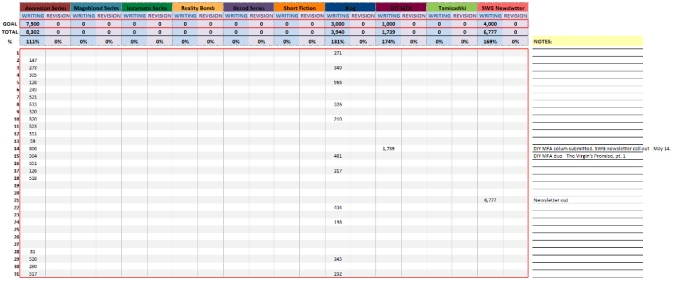
Even with the break, about nine days, I still managed to surpass my 7,500-word writing goal. I wrote 8,302 words, or 111%.

I’m enjoying the break from weekend blogging as well, and though I adjusted my blogging goal to 3,000 words, even with just the curation posts going up, I managed to write 3,940 words on the blog, or 131% of my goal.

I met my DIY MFA deadline with a long column of 1,739 words, or 174% of my goal, and aggregated my penultimate Sudbury Writers’ Guild newsletter at 6,777 words, or 169% of that goal.

So, it’s been a good month, writing-wise.

The burnout thing

I promised to tell you how the whole burnout thing was going.

Well, after a lot of soul-searching, pondering, and some all-out navel-gazing, I’ve finally figured out why I’ve suffered such a protracted burnout in the past year. And, let’s be clear, I’ve been struggling since at least the beginning of 2017. It might, in fact, be longer than that.

Part of it is historical. It’s my writing wound, the lie I believe about myself as a creative person and about my work. If you’re ever curious and you have the time, you can read the posts in the category, My History as a So-called Writer. That will give you the low-down.

The short version is that my creative life has been full of threshold guardians (in hero’s journey terms), who’ve blocked me, stunted my growth, and betrayed me in various fashions. When I finally found my way back to a consistent writing practice in 2007, I thought I’d conquered those demons. In that version of victory, all the naysayers were wrong, and I was just going to do what I wanted. Screw them.

That, it turns out, was only half the battle. It’s the bitter legacy those experiences left me with that make me innately distrustful of handing my work off to anyone else, whether a friend, beta reader, editor, or … anyone. I don’t believe that the advice I receive is in the story’s best interest. Or mine. I always see it in terms of a personal attack, though unconsciously. I’m aware of it now but, in the moment, I often slip back into old ways of thinking.

While I’ve had some writing success, that lie has never left me. It’s made finding a critique group difficult. It makes working with editors a bit fraught. It also leaves me thinking that I’m not, at heart, a good writer (passable good, not even great) and that people are just humouring me. It’s not merely imposter syndrome. It’s a deep distrust of anyone else’s opinion of my work.

There’s been a lot of self-sabotage involved, mostly unconscious.

This is what I’m working to overcome now. It’s a process. It’s going to take time.

The next piece of the puzzle is that, in January of 2016, after decades of what we thought was good health, Phil went to the clinic thinking he might have shingles, and came home (well, there was some bloodwork in there) with multiple diagnoses: type II diabetes, high blood pressure, high cholesterol, and possibly shingles.

He had no rash, though. Several months passed and the doctor said, fibromyalgia. Several more months passed, and they finally settled on widespread diabetic neuropathy. Until the doctor found the right combination of meds, there were some horrible times, but it all worked out. Eventually.

Two of the meds Phil was on were Lyrica (an antidepressant found to be effective for nerve pain) and Cymbalta (an anticonvulsant also found to be effective for nerve pain). Aside from managing his pain and elevating his mood (it has often been said of my husband that the inside of his skull is painted black), both medications increased the amount of melatonin in his system.

Phil, who had always been a night owl and considered sleep to be the enemy, was now getting the best sleep of his life. Things went well for a while.

Then, because he got a promotion that required occasional travel, Phil decided to stop both the Lyrica and Cymbalta. He couldn’t risk falling asleep at the wheel. Combine this with a progressively complex and worsening situation at his employer (ongoing) and things quickly went from bad to worse.

The health problems shook me, probably more than I’d care to admit. It was after Phil’s health situation resolved that I started to feel the real effects of the burnout.

But it was the work situation that broke the peace of our household. I was used to living with Mr. Grumpy Pants, but his problems at work followed him home and made everything more difficult. It was about that time that we brought Torvi home. The extra stress of bringing up puppy did not help.

Also in the mix was my great adventure of last year. Though Phil encouraged me to go, I felt horribly guilty about the expense. I’ll just be paying off the last of that debt this month.

Add to all that my own health problems. Though less life-threatening than Phil’s, they were affecting my quality of life. Now that most of them have been addressed, I’m in a much better place.

But every time I tried to dig myself out of the hole, emotionally speaking, in the last couple of years something popped up and dragged me back down. I’ve suffered several episodes of depression, panic attacks, and poor quality of sleep (resulting from the other two).

Most of these issues are resolving. I’ve had my ablation and other health issues are being investigated. I’ve lost about 25 pounds. I’ve gotten back to my regular writing practice and it’s feeling good. Torvi, at eight months and in her second obedience class, is becoming a good dog but, that too is a process.

Really, it’s just Phil’s work situation that’s the continuing problem but, though there’s still no end in sight, slow progress is being made. There’s hope that things might be largely sorted by the end of this year. We just have to hang in there.

I’m sure other world events have played their parts, but I’m actively seeking to minimize their effects on me.

I’ll keep you updated, for those who want to know.

My writerly event of the month

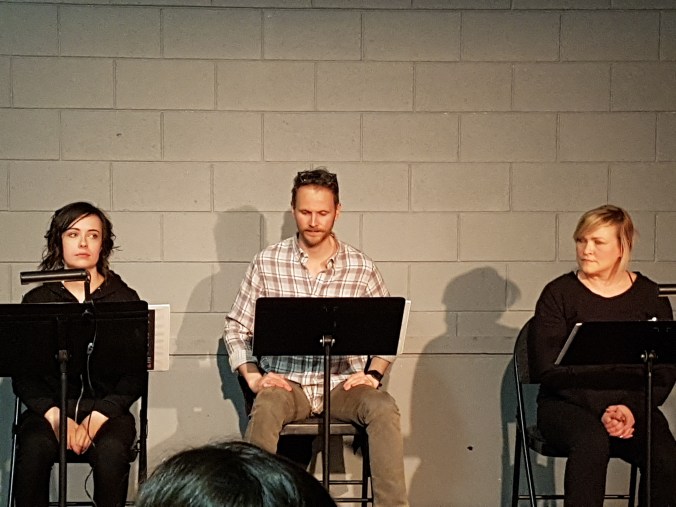
On May first (May Day, Beltaine—yes, I’m a paganish sort) I went to see the staged reading of the latest iteration of Kim Fahner’s play, Sparrows Over Slag. It was part of Play Smelter, which ran the rest of the week. It was fascinating to see the evolution of Kim’s play, of which I was privileged to read an early draft.
20180501_171021

She gave a lovely Q&A afterward that gave further insight into her process. Writing a play is a different beast than any other kind of writing, even screenplays.

Later that week, I had lunch with Kim, who was only in Sudbury for a couple of weeks around Play Smelter. She’s been in south western Ontario, working hard on her craft and trying to figure out her next steps, creatively.

Just chatting over lunch was a balm. We are soul sisters and that won’t change wherever she goes and whatever she chooses to do.

And that’s it for this month’s next chapter update.

Until the next time I blog, be well, be kind, and stay strong. The world needs your stories!
The Next Chapter

Tipsday: Writerly Goodness found on the interwebz, May 20-26, 2018

You survived Monday, and that’s a good thing! Have a wee treat. Another week, another batch of informal writerly learnings!

A.K. Perry explores another of James Scott Bell’s signpost scenes—the argument against transformation. DIY MFA

Gabriela Pereira interviews Kimmery Martin about revising your book and getting it right. DIY MFA

I shared Kate Weiland’s list last week. Great minds think alike 🙂 Lisa Cron busts five writing myths that may be holding you back. DIY MFA

Vaughn Roycroft examines his biases and tropes: warrior women, #MeToo, and one writer’s evolving sensibilities. Writer Unboxed

Liz Michalski advises you to blow it up (where it is a practice that no longer serves you). Writer Unboxed

Julie Carrick Dalton shares her thoughts on finding second life in cast-off words. I might have to try her fire brick idea some day. I’m not craft-inclined enough to try the other stuff 🙂 Writer Unboxed

Janice Hardy helps you edit your novel without feeling overwhelmed. Later in the week, she wonders, how much really needs to be in your novel’s opening line? Fiction University

K.M. Weiland offers five logical steps to grow as a writer. Helping Writers Become Authors

Joanna Penn helps you find your writing community. The Creative Penn

Kristen Lamb: truth is the door between your greatest fears and your greatest self. Later in the week, Kristen shares five reasons to invest in rest (and avoid burnout).

Nathan Bransford offers a guide to literary agent etiquette.

Shawn Coyne explains how an agent figures out her pitch to publishers. Steven Pressfield

Remember that book that no one had ever heard of that shot straight to the NYT bestseller list? Well, Chris Winkle took one for the team and has some lessons from the rambling writing of Handbook for Mortals. Mythcreants

Then, Oren Ashkenaski shares seven ways to motivate a reluctant protagonist. Mythcreants

Jeanna Kadlec offers this writerly horoscope. Electric Lit

And that was tipsday. Come back on Thursday for your weekly dose of thoughty.

Until then, be well, my friends.

tipsday2016

Tipsday: Writerly Goodness found on the interwebz, May 13-19, 2018

Another week has passed and, look, you’ve survived Monday. Good on ya 🙂 Have some informal writerly learnings as a reward. You know you deserve it.

K.M. Weiland lists five lies writers believe that actually hold them back. Helping Writers Become Authors

Jenny Hansen shows you how to use the twelve stages of physical intimacy to build tension in your fiction. Writers in the Storm

Margie Lawson encourages you to go deeper than the cold, hard stare. Writers in the Storm

Scrivener guru Gwen Hernandez explains how to save every word using Scrivener’s snapshot feature. Writers in the Storm

Annie Neugebauer helps you find the best readers for your novel at every stage. Writer Unboxed

Porter Anderson watches the Canadian problem with Access Copyright with interest and alarm. Authors I know whose work was copied for academic packages used to get paid. Universities rebelled and now they get nothing. Advocacy and authors. Writer Unboxed.

Nina Munteanu: science fiction asks, are we worth saving?

Jami Gold helps you figure out if your writing is any good. Later in the week, she wonders how much of yourself in in your writing?

Brenda Joyce Patterson explains why your writing should invite readers in. DIY MFA

Gabriela Pereira interviews Dharma Kelleher about transgendered characters in literature. DIY MFA

Sara Letourneau offers some advice on conducting informal interviews for story research. Writers Helping Writers

Janice Hardy helps you take away elements to fix a problem scene. Fiction University

Mira Singer reviews three movies with the wrong main character. Then, Oren Ashkenazi says that “historical accuracy” isn’t a reason to exclude diversity. Arguments I wish I’d had when I tried to present my secondary world fantasy to my MFA class for critique. #mistakesnaivewritersmake Mythcreants

Joanna Penn explains how to monetize a creative podcast in her interview on the Podcraft podcast. The Creative Penn

John Koenig’s The Dictionary of Obscure Sorrows (is back!): Silience.


And Pâro.


Anna Lovind discovered that in order to nurture her dream of writing, she had to give up something else: knowing when it’s time to let a dream die.

Anika Burgess reveals the artful imperfection of medieval manuscript repair. Atlas Obscura

Andres Liptak reports on the new documentary that will explore the life and legacy of Ursula K. Le Guin. I’m looking out for this one! The Verge

And that was Tipsday.

Be well until Thursday rolls around and then come back to get your weekly dose of thoughty 🙂

tipsday2016

Tipsday: Writerly Goodness found on the interwebz, May 6-12, 2018

Here, once again, are your informal writerly learnings:

Jo Eberhardt: writers write, right? Writer Unboxed

Keith Cronin writes a thought-provoking post for Writer Unboxed: when a bad person makes good art. I’ve struggled with this issue myself and there are no easy answers, at least none that satisfy both my need for social justice and my need for quality art to consume.

Related: Another popular and powerful artist proves he can’t even be a decent human being. MIT to investigate allegations of bullying and unwanted sexual contact against Junot Diaz. MassLive

Juliet Marillier examines the angsty writer. Writer Unboxed

Kathryn Craft helps you compose your protagonist’s “I want” song. Writer Unboxed

Grace Wynter offers some tips for creating your novel’s soundtrack. Writer Unboxed

Nina Munteanu wonders, how do you know your story’s finished?

K.M. Weiland returns to her most common writing mistakes series with part 64: POV problems. Helping Writers Become Authors

Jenna Moreci reviews the pros and cons of traditional publishing (and busts a few myths).


Then, Jenna lists the biggest mistakes writers make.


Susan DeFreitas: what it really takes to break through with your first book deal. Jane Friedman

Penny Sansevieri offers six reasons to relaunch your book (in the age of the reboot). Jane Friedman

September C. Fawkes explains how to convey an established relationship quickly. Writers Helping Writers

Becca Puglisi is choosing the right details. Writers Helping Writers

Nathan Bransford shares everything writers need to know about pitching their books.

Emily Wenstrom explains what authors should know about Facebook’s “meaningful interactions” update. DIY MFA

Robin Lovett lists seven reasons why being unpublished is hard. You’re preaching to the choir, here, Robin 🙂 DIY MFA

Julie Glover explains when action isn’t a good thing in your novel. Writers in the Storm

Shawn Coyne gives us an insider’s look into the acquisition process: how literary agents target acquisitions editors. Steven Pressfield

Joanna Penn helps you manage stress, anxiety, and burnout. The Creative Penn

Chris Winkle discusses five types of disastrous reveals. Mythcreants

Kristen Lamb looks at a trademark issue that hit publishing news this week. Cocky blocked: how to nuke your brand from orbit.

Jami Gold: why we all need a writing community.

And that was Tipsday.

Be well until thoughty Thursday. *waves*

tipsday2016

Tipsday: Writerly Goodness found on the interwebz, April 29-May 5, 2018

Another week has passed and here I am with another batch of informal writerly learnings 🙂

K.M. Weiland asks, what should your characters talk about? Helping Writers Become Authors

Julie Carrick Dalton says, it’s time cli-fi (climate fiction) became its own genre. I agree in part … The examples she cites are from a number of different genres, though. I don’t know if publishing in general or marketing in particular will be willing to get on board. Stranger things have happened. Writer Unboxed

Therese Walsh explains why you think your writing is brilliant one day and horrible the next. It’s a thing. Writer Unboxed

Donald Maass considers authenticity vs. outline. As with many other aspects of craft, it’s a matter of balance, not one over the other. Writer Unboxed

Julie Glover walks you through the five stages of editing grief. Writers in the Storm

Fae Rowan helps you world build using deep POV. Writers in the Storm

Christina Delay is living for the writing wins. Writers in the Storm

Gabriela Pereira helps you write by design using colour theory. Writers Helping Writers

Kristen Lamb: why every writing project needs a synopsis, even though you hate writing them.

Elisabeth Kauffman tells you how to raise the stakes. DIY MFA

Kharma Kelley explains all authors need to know about the new EU law.

Chris Winkle: storytelling’s terminology problem. Then, Oren Ashkenazi critiques six underdeveloped love interests. Mythcreants

Kim Fahner considers Canada’s 20th Bookmark to be a “love letter” to Sudbury. The Sudbury Star

And then watch the unveiling!


Emily Petsko lists 25 foreign words with hilarious literal meanings. Mental Floss

More fun with words: the Merriam-Webster time traveler. Check out what words entered the dictionary the year you were born … or any other year since 1828 🙂

And that was Tipsday for this week.

Be well until Thursday!

tipsday2016

The next chapter: April 2018 update

Hey, all you writerly people 🙂

Here we are in May, Cinco de Mayo, in fact, and it’s time for my next chapter update.

It’s been a weird few weeks since I made my decision to stop posting every weekend. I had one weekend that was fairly restful, caught a flu and was sick for a week, and have spent the last week frantically catching up at work and at home.

I still think it was a good decision, but I’ll likely have to give it more time before I see real results.

I have formally announced my intention to hand off responsibility for the Sudbury Writers’ Guild newsletter, but elections (newsletter-er isn’t an elected position, but volunteer positions are filled at the same time as elected ones are voted upon) aren’t until the May meeting at the end of the month. Also, whoever decides to take over for me won’t do so until the beginning of the new SWG year in September. We usually break for the summer, so the June newsletter would be my last.

I’m still on the program committee and one of its sub-committees for the Canadian Authors Association, but my obligations have not been too onerous there. For now. If that changes, I’ll have to bow out.

On another front that I haven’t discussed much, I’m sad to report that my critique group has imploded. Well I’m two parts sad to one part relieved. I’m sad because I had great hopes, and relieved because it’s one less commitment to fulfill.

Several members were in the process of moving (some internationally) in January and February and so we delayed the start of the critiquing year. One submission has been made and I’ve read and critiqued it, but I haven’t heard from anyone else in the group about an online conference to actually discuss the submission, or anything else moving forward. I’m going to read through the submission one more time, finalize my written comments, and return them to the author. And then I’m going to pull the plug.

I may check out the novel critique group that the SWG runs. I need something. Writing in a feedback void isn’t getting me anywhere. I can continue to write and revise, but unless I can get some other eyes on the work, my revisions will lack direction and I’ll take so much longer to get anything ready for an editor, or for submission to agents or small publishers.

I got my taxes wrangled and, for the first time in a number of years, I’ve has absolutely no income to report from my creative work. No workshops. No panelist honoraria. No prize money. No sales of short fiction or even contributor copies. It’s a bit distressing. I’ve never had much income to report, but I’ve generally had something. It just makes me feel like I’ve been falling back, that it’s not just been my burnout, but something more insidious going on with me.

AprilProgress

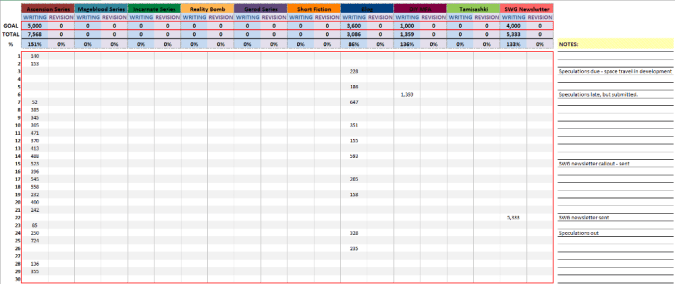
I have, however, made strides with regard to my writing practice. For April, I set (or reset) the modest goal of 5,000 words written on Playing with Fire. I managed to write more days than not, and wrote 7,568 words, or 151% of my goal.

I also adjusted my writing goal for the blog given that I’m not posting most weekends. Even though I adjusted my blogging goal to 3,600 words, I wrote only 3,086 words, or 86% of my goal.

My DIY MFA post came in at 1,359 words of my 1,000-word goal, or 136%, and the SWG newsletter was 5,333 words of my 4,000-word goal, or 133%. Admittedly, the newsletter is not all my writing. I have submissions from the membership and the contests and inspirational quotes are found online and copied. Still, I have to fill in gaps, edit, format, and cobble all the disparate parts of the newsletter together into a more or less cohesive whole.

Overall, I wrote 128% more in the month than I set out to, and that makes me happy.

Though it was May 1st, I was able to attend one literary event, the staged reading of the latest iteration of Kim Fahner’s play, “Sparrows Over Slag.”

20180501_171021

Here are the actors, Morgan St. Onge, Matthew Heiti, and Sarah Gartshore.

Kim also had an artist talk afterward during which she explained the impetus for the play and its development.

On the Torvi front, we’re one class away from graduating from the beginner obedience class at Skiplyn Kennels, only to jump right into the intermediate class. Torvi is still a challenge. The second biggest problem now is her propensity to get up on counters, tables, desks, grab whatever she can get her teeth on, and run. She also jumps on people. We’ve been persistent with telling her to get off, and pushing her off, but she still hasn’t gotten the message.

The biggest problem is that she’s started peeing in the house again. We thought we had this licked, but no. So now we’re pacing around the yard reciting “do your pee” until she complies. She’s still distracted by everything. Even if she asks to go out, she forgets what she’s there for once she sees a bird, or squirrel, or a truck or a motorcycle goes by.

She’s showing steady improvement in all other areas, but those are the two stubborn problems.

Here’s a comparison: Torvi at seven weeks and Torvi at seven months 🙂

20180505_164010

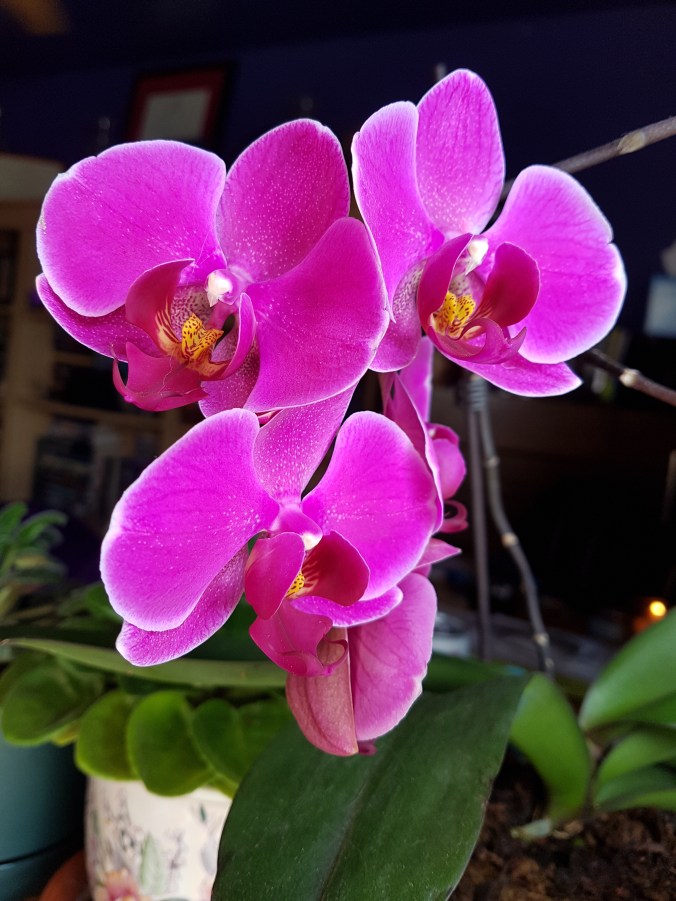
As for the orchids, it’s all the fuchsia phalaenopsis. The pink has dropped all its blooms now.

And that’s all I have to report for this month. It’s been mostly good and I’m looking forward to better yet to come.

Until Tipsday, be well, be kind, and stay strong. The world needs your stories!
The Next Chapter